
Lakshadweep Pashupalan Loan Yojana 2026 – 50% Subsidy & Apply Online
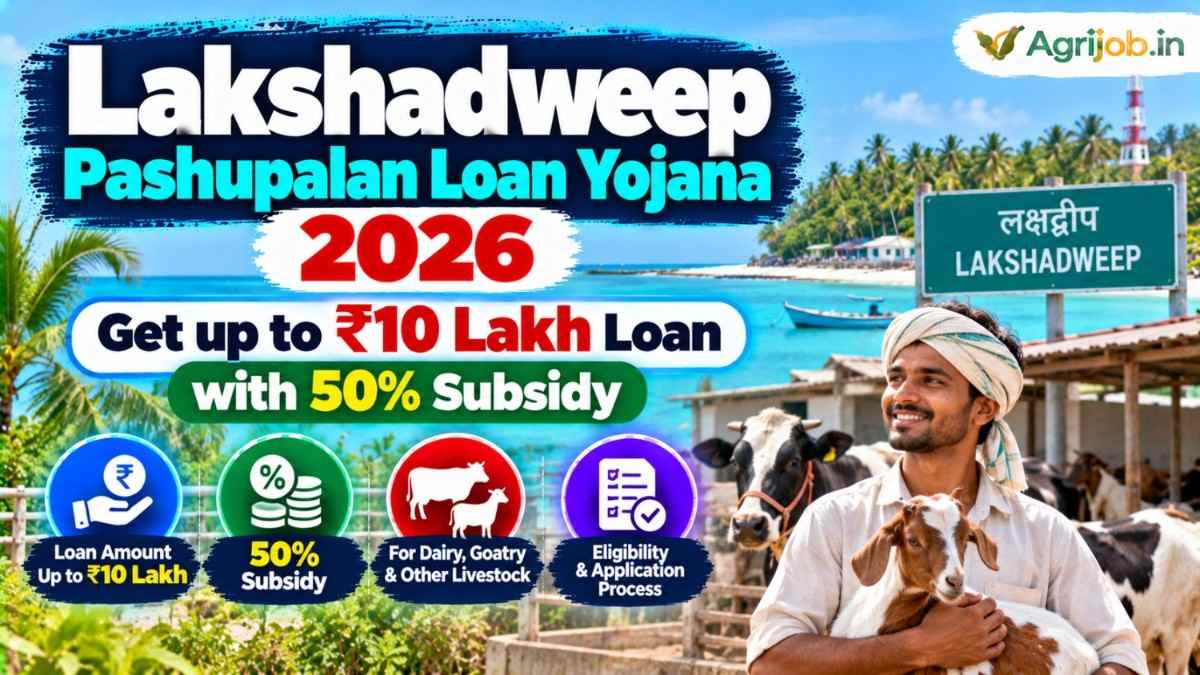
Lakshadweep Pashupalan Loan Yojana 2026 gives island livestock farmers access to up to Rs.10 lakh in subsidised loans, with 50% capital subsidy available under the National Livestock Mission — one of the highest subsidy rates in India’s animal husbandry financing ecosystem. This guide is for Lakshadweep residents, island farmers, rural youth aged 18–60, and cooperative members who want to start or expand goat rearing, poultry farming, or cattle development with government-backed financial support. Below you will find every scheme — UT-level, central government, bank, and cooperative — with exact loan amounts, subsidy percentages, eligibility rules, and the step-by-step online application process updated for 2026.

Under Lakshadweep Pashupalan Loan Yojana 2026, eligible islanders can access up to Rs.10 lakh in livestock loans backed by 50% capital subsidy through the National Livestock Mission (NLM) and collateral-free Pashu KCC credit up to Rs.2 lakh at 4% effective interest. Applications for NLM are submitted online at nlm.udyamimitra.in and processed through the Lakshadweep Animal Husbandry Department, Kavaratti.
- Nodal Department: Animal Husbandry Dept., Lakshadweep Administration, Kavaratti
- Maximum Loan (NLM): Rs.10 lakh per unit (goat/sheep/poultry)
- Maximum Subsidy (NLM): 50% capital subsidy — up to Rs.5 lakh back-ended
- Pashu KCC Loan Limit: Up to Rs.2 lakh collateral-free; effective interest 4% p.a.
- AHIDF Loan Range: Rs.1 lakh – Rs.100 crore; 3% interest subvention
- Livestock Covered: Goat, cattle, buffalo, sheep, poultry (layer/broiler), pig
- Age Eligibility: 18–60 years (individuals); SHGs, FPOs, cooperatives also eligible
- UT Livestock Census (2019): 2,493 cattle · 43,188 goat · 2,26,025 poultry
- NLM Online Portal: nlm.udyamimitra.in
- UT Budget (Agriculture & Allied, 2026-27): Rs.5.27 crore (shared head)
- What Is Lakshadweep Pashupalan Loan Yojana 2026?
- Who Should Apply for This Scheme?
- Subsidy, Loan Amount & Income Potential 2026
- Eligibility Criteria & Documents Required
- How to Apply — Step-by-Step Process 2026
- UT-Level Lakshadweep Animal Husbandry Schemes
- Central Government Schemes for Lakshadweep Pashupalan
- Bank Loan Schemes for Pashupalan in Lakshadweep 2026
- Cooperative Society Schemes for Animal Husbandry
- State vs Central vs Bank vs Cooperative — Full Comparison
- Advantages and Disadvantages of Pashupalan Loan Yojana
- Important Terms Related to Pashupalan Loan Yojana 2026
- Important Dates & Application Timeline
- Important Links
- Conclusion
- Key Takeaways
- Frequently Asked Questions
What Is Lakshadweep Pashupalan Loan Yojana 2026?
Lakshadweep Pashupalan Loan Yojana 2026 is not a single standalone scheme but a comprehensive framework of livestock financing programmes operating at four levels: the Lakshadweep UT Administration, the Government of India (central schemes), scheduled banks, and cooperative societies. Together these programmes cover goat rearing, poultry development, cattle improvement, and animal feed — making animal husbandry a viable income source for the 64,473 islanders spread across 10 inhabited islands in the Arabian Sea.
The Animal Husbandry Department of Lakshadweep, established in the late 1960s under the Agriculture Department, implements Centrally Sponsored Schemes including the National Livestock Mission (NLM), the National Animal Disease Control Programme, and the Integrated Sample Survey — all with 100% central assistance. The department also facilitates Kisan Credit Card (KCC) loans to animal husbandry farmers across all islands, directly through scheduled banks including SBI and its branches in Kavaratti and Agatti.

As per the 20th Livestock Census 2019, Lakshadweep has a livestock population of 2,493 cattle, 43,188 goats, and 2,26,025 poultry. With the UT administration actively outsourcing demonstration farms and hatcheries to private players since 2022, there is now a deliberate policy push to create commercial animal husbandry enterprises on the islands.
Who Should Apply for Lakshadweep Pashupalan Loan Yojana 2026?
- 🐐 Goat and sheep farmers on any of the 10 inhabited islands wanting to scale from backyard to commercial 50–500 animal units.
- 🐔 Poultry farmers looking to set up broiler or layer units of 500–1,000 birds with NLM subsidy support.
- 🐄 Cattle development beneficiaries eligible for UT-level demonstration farm support and Pashu KCC working capital.
- 👩 Women entrepreneurs and SHGs — eligible for NLM and NABARD schemes without collateral up to Rs.1.60 lakh under Pashu KCC.
- 🎓 Educated rural youth aged 18–35 wanting to start a livestock enterprise with a bank-backed project report.
- 🏛️ Cooperative society members of Lakshadweep’s 10 fishery cooperative societies who want to diversify into livestock lending.
- 🏢 MSMEs and private entrepreneurs planning dairy processing, animal feed plants, or meat processing infrastructure under AHIDF.
- 👨🌾 Existing pashupalan farmers who need working capital for feed, veterinary care, or insurance through the Pashu KCC revolving credit line.
Subsidy, Loan Amount & Income Potential 2026
The financial support available under Lakshadweep Pashupalan Loan Yojana 2026 varies significantly by scheme. Below is the complete money table covering every programme.
| Scheme / Programme | Loan Amount | Subsidy / Subvention | Effective Cost |
|---|---|---|---|
| NLM — Goat/Sheep Farm (500 animals) | Up to Rs.10 lakh | 50% capital subsidy (Rs.5 lakh back-ended) | Net loan Rs.5 lakh |
| NLM — Poultry (500 birds, broiler/layer) | Up to Rs.5 lakh | 50% capital subsidy (Rs.2.5 lakh back-ended) | Net loan Rs.2.5 lakh |
| Pashu KCC (Animal Husbandry) | Up to Rs.2 lakh (collateral-free) | 3% interest subvention from GoI | 4% p.a. effective rate |
| AHIDF — Dairy / Feed Infrastructure | Rs.1 lakh – Rs.100 crore | 3% interest subvention (8 years) | EBLR+200 bps minus 3% |
| SBI / Nationalised Bank Animal Husbandry Loan | Rs.50,000 – Rs.50 lakh | NLM subsidy if linked | MCLR + 0.5% + 2%–3% |
| NABARD DEDS Dairy Term Loan | Rs.7 lakh – Rs.18 lakh | 25%–33% DEDS subsidy | ~8%–10% p.a. |
| UT Livestock Development (backyard) | Grant / in-kind support | 100% for demonstration units | Nil to beneficiary |
Income potential: A 50-goat unit generates roughly Rs.18,000–Rs.25,000 per month from kid sales and milk. A 500-bird broiler batch earns Rs.10,000–Rs.18,000 per cycle (45 days). With 50% NLM subsidy cutting initial investment by half, payback periods fall to 18–30 months.
Eligibility Criteria & Documents Required
The eligibility for Lakshadweep Pashupalan Loan Yojana 2026 is deliberately wide so that landless islanders, women, and tribal community members are not excluded.
- Age: 18–60 years for individuals; no age bar for SHGs, FPOs, and cooperatives.
- Residence: Must be a resident of Lakshadweep UT (any of the 10 inhabited islands).
- Land/Space: Must have adequate space for animal shed — own, rented, or leased.
- Bank Account: Active savings or Jan Dhan account with any scheduled bank.
- Livestock Experience: Preferred for NLM; animal husbandry training certificates add weight.
- Not a Defaulter: No active NPA or loan default with any bank or cooperative at time of application.
- ST Category: Over 95% of Lakshadweep’s population is Scheduled Tribe — most residents are eligible for tribal relaxations under NLM and NABARD schemes.
| Category | Application Fee | Collateral (Pashu KCC) |
|---|---|---|
| All categories (NLM — online) | Nil (free online application) | N/A |
| Pashu KCC — up to Rs.1.60 lakh | Nil | Nil (collateral-free) |
| Pashu KCC — Rs.1.60 lakh to Rs.2 lakh | Nil | Hypothecation of animals |
| Bank Term Loan — above Rs.2 lakh | As per bank processing fee | Third-party guarantee / land mortgage |
| AHIDF — Rs.1 lakh to Rs.5 crore | As per bank norms | CGTMSE / NABSanrakshan guarantee |
Documents required for NLM application: Aadhaar card, PAN card, bank passbook (first page), proof of residence (Lakshadweep UT domicile), land/shed ownership or lease agreement, project report/DPR, caste/ST certificate (if claiming SC/ST benefits), passport-size photograph, and mobile number linked to Aadhaar.
How to Apply — Step-by-Step Process 2026
- Register on the NLM Portal: Visit nlm.udyamimitra.in and create a free applicant account using your Aadhaar-linked mobile number.
- Choose Your Livestock Activity: Select from goat/sheep rearing, rural poultry (broiler/layer), piggery, or breed development unit. Each has a specific sub-component under NLM’s Entrepreneurship Development Programme (EDP).
- Prepare a Project Report (DPR): Draft a Detailed Project Report specifying number of animals, shed construction cost, feed cost, veterinary budget, and expected income. The Animal Husbandry Department in Kavaratti can provide technical guidance.
- Submit Bank Application Simultaneously: Apply to the nearest scheduled bank branch (SBI, Canara Bank, or cooperative bank in Lakshadweep) with the same DPR for term loan sanction — NLM subsidy is disbursed only after bank approval.
- UT-Level Scrutiny: The Lakshadweep Animal Husbandry Department reviews and forwards shortlisted applications to DAHD (Department of Animal Husbandry and Dairying, Government of India) for final approval.
- Bank Disburses Loan: After DPR approval, the bank releases the full term loan. You begin construction or purchase of animals.
- Site Inspection: A government officer visits to verify physical infrastructure before the back-ended subsidy is released.
- Subsidy Credited: NLM’s 50% capital subsidy is credited directly to your loan account, effectively reducing the outstanding principal by half.
Lakshadweep islanders with ST status (over 95% of the population) should mention their tribal certificate at Step 2 — NLM does not offer a higher ST-specific subsidy rate (it is 50% for all), but NABARD’s DEDS Dairy scheme gives 33.33% subsidy to general category and up to 25% to others. For maximum benefit, combine NLM’s 50% capital subsidy with AHIDF’s 3% interest subvention on the remaining 50% loan amount — this dual-stack approach is explicitly permitted under DAHD guidelines.
UT-Level Lakshadweep Animal Husbandry Schemes 2026
The Animal Husbandry Department of Lakshadweep, established in the late 1960s and operating under the Agriculture Department, runs the following UT-level support programmes with 100% central assistance as per the official department website (lakshadweep.gov.in):
- Integrated Poultry Development Programme: Grants for setting up large-scale poultry units; awards for Best Poultry Farmer at UT and island level; hatchery support on all inhabited islands.
- Goat and Cattle Development Programme: Breed improvement through outsourced demonstration farms; award for Best Cattle Farmer at Lakshadweep and island level; technical guidance to backyard farmers.
- Disease Control Programme: Livestock Health and Disease Control Programme (LHDCP) and National Animal Disease Control Programme (NADCP) with 100% central funding — covers vaccination, veterinary treatment, and disease surveillance across all islands.
- Kisan Credit Card Facilitation: The department actively facilitates Pashu KCC loan applications for animal husbandry farmers in coordination with scheduled banks operating in Lakshadweep.
- Outsourced Demonstration Farms & Hatcheries: From 2022, all island-based demonstration farms and hatcheries have been handed to private players to create commercial livestock enterprises and reduce government operational overhead.
The combined UT budget for Agriculture, Animal Husbandry, Fisheries, and Cooperation in 2026-27 is Rs.5.27 crore (shared head under Demand No. 56/Lakshadweep, indiabudget.gov.in). Exact allocation to Animal Husbandry is not published separately, but district panchayats also support livestock activities through the Rs.7.97 crore Panchayati Raj head.
Central Government Schemes for Lakshadweep Pashupalan 2026
All major central livestock schemes operate in Lakshadweep UT. Because the islands are classified as a tribal area, 100% central assistance applies to most centrally sponsored schemes, giving island farmers access to the same subsidy rates as mainland beneficiaries.
1. National Livestock Mission (NLM) 2026 — 50% Capital Subsidy
The NLM is implemented by the Department of Animal Husbandry and Dairying (DAHD) under the Ministry of Fisheries, Animal Husbandry and Dairying. Its Entrepreneurship Development Programme (EDP) sub-mission provides 50% back-ended capital subsidy on goat/sheep farms (up to 500 females + 25 males), rural poultry units (up to 1,000 birds), piggery units, and fodder seed development. Applications are fully online at nlm.udyamimitra.in. The subsidy is disbursed directly to the beneficiary’s bank account via SIDBI.
2. Animal Husbandry Infrastructure Development Fund (AHIDF)
AHIDF was operational until 31 March 2026 with a total outlay of Rs.29,610.25 crore. It provides 3% interest subvention per annum (for up to 8 years including moratorium) on loans from Rs.1 lakh to Rs.100 crore for dairy processing plants, meat processing units, animal feed plants, breed improvement infrastructure, and animal waste management. Eligible entities include individual entrepreneurs, MSMEs, FPOs, dairy cooperatives, and private companies. Credit guarantee cover up to Rs.2 crore is provided through NABSanrakshan, and up to Rs.5 crore through CGTMSE for MSMEs. Applications at ahidf.udyamimitra.in.
3. Pashu Kisan Credit Card (Pashu KCC)
Extended to animal husbandry farmers in 2019, the Pashu KCC provides a revolving working capital credit line of up to Rs.2 lakh for feed, veterinary care, insurance, and labour. The base interest rate is 7% p.a.; with the Government of India’s 3% interest subvention under the Modified Interest Subvention Scheme (MISS), the effective rate is 4% p.a. for prompt repayers. No collateral is required up to Rs.1.60 lakh. The card is issued within 30 days of KYC verification by any scheduled bank. Per RBI guidelines, Pashu KCC loans for animal husbandry are subject to a Rs.2 lakh standalone working capital limit.
4. Rashtriya Gokul Mission (RGM)
RGM supports cattle and buffalo breed improvement through 50% capital subsidy on Gokul Grams (indigenous breed hubs) and support for artificial insemination. Lakshadweep, with its 2,493 cattle population, benefits from central funds for breed quality improvement at veterinary stations in Kavaratti, Agatti, and other islands.
5. National Animal Disease Control Programme (NADCP)
NADCP covers 100% vaccination cost for Foot and Mouth Disease (FMD) and Brucellosis across all livestock in Lakshadweep. The programme protects island farmers from epidemic losses, indirectly securing the value of any loan-funded livestock investment.
Bank Loan Schemes for Pashupalan in Lakshadweep 2026
| Bank Scheme | Loan Amount | Interest Rate (2026) | Repayment | Collateral |
|---|---|---|---|---|
| SBI Animal Husbandry Term Loan | As per NABARD unit cost | 1-yr MCLR + 0.5% + 2%–3% | 3–7 years | Nil up to Rs.2 lakh; land/guarantee above |
| SBI AHIDF Term Loan | Up to 90% of project cost | ~6–7% (post 3% subvention) | Up to 8 yrs + 2-yr moratorium | 30% margin for >Rs.2 lakh |
| NABARD DEDS Dairy Term Loan | Rs.7 lakh – Rs.18 lakh | 8.05%–10% p.a. | Up to 7 years | Hypothecation + land |
| Canara Bank / PNB Animal Husbandry Loan | Rs.50,000 – Rs.50 lakh | MCLR + 1%–3% | 3–7 years | Hypothecation + third-party guarantee |
| Pashu KCC (all scheduled banks) | Up to Rs.2 lakh | 4% effective (post subvention) | Revolving 12-month limit | Nil up to Rs.1.60 lakh |
Scheduled banks operating in Lakshadweep — primarily State Bank of India (Kavaratti and Agatti branches) and the Lakshadweep cooperative banking network — are the primary disbursement channels for all NLM-linked and standalone animal husbandry term loans. Farmers should contact their nearest branch to initiate the DPR and loan sanction process simultaneously with the online NLM application.
Cooperative Society Schemes for Animal Husbandry 2026
Lakshadweep has 10 active fishery cooperative societies registered under the National Cooperative Database (as of December 2024). Under updated PACS model byelaws notified by the Ministry of Cooperation, PACS can now undertake more than 25 business activities — including animal husbandry term lending. Key cooperative-route benefits include:
- PACS Animal Husbandry Term Loans: Short-term cooperative credit for goat and poultry purchase at interest rates typically 1%–2% lower than commercial banks; nil share requirement for loans up to Rs.5,000 and Rs.500 share for loans up to Rs.5 lakh.
- NABARD Refinance through StCB/DCCB: Cooperative banks receive NABARD refinance for agricultural term loans including animal husbandry, passing the benefit as lower interest rates to islanders.
- Computerisation of PACS (2022–26): PACS are being onboarded onto a common ERP system under the Ministry of Cooperation — improving loan processing speed and enabling digital loan applications for island-based pashupalan units.
- Multipurpose PACS Plan: The Government of India’s plan to establish 2 lakh multipurpose PACS includes Lakshadweep islands — new PACS being set up can offer integrated services: input supply, insurance, loan, and market linkage for livestock farmers.
UT Scheme vs Central vs Bank vs Cooperative — Full Comparison 2026
| Feature | UT Scheme (Animal Husbandry Dept.) | Central (NLM / AHIDF) | Bank Loan (KCC / Term) | Cooperative (PACS) |
|---|---|---|---|---|
| Maximum Loan | Grant / in-kind (no cap) | Rs.10 lakh (NLM) / Rs.100 cr (AHIDF) | Rs.2 lakh (KCC) / project-based (TL) | Rs.5 lakh typical |
| Subsidy % | Up to 100% (grants for demo units) | 50% capital (NLM) / 3% subvention (AHIDF) | 3% subvention (KCC) | None (lower interest rate) |
| Interest Rate | Nil (grants) | 4% (KCC) / ~6–7% (AHIDF) | 4% (KCC) / 8–11% (TL) | 7%–9% p.a. |
| Application Mode | Offline — Animal Husbandry Dept., Kavaratti | 100% Online — nlm.udyamimitra.in / ahidf.udyamimitra.in | Bank branch + online | PACS office |
| Best For | Backyard poultry and cattle starters | Commercial goat/sheep/poultry entrepreneurs | Working capital & mid-scale farms | Small-scale credit needs |
| Processing Time | Variable (contact dept.) | 4–8 weeks (online + bank sanction) | 2–4 weeks (KCC) / 4–8 weeks (TL) | 1–3 weeks |
| Tribal Benefit | Yes (100% of islanders) | Yes — eligible under tribal schemes | Priority sector lending | Yes — lower threshold |
For Lakshadweep islanders, the best combination is NLM (50% capital subsidy) stacked with AHIDF (3% interest subvention) on the remaining 50% loan amount. This effectively gives you a Rs.5 lakh free grant plus heavily subsidised borrowing on the balance. Start with the NLM online portal, get a bank loan sanction, and apply for the AHIDF interest benefit simultaneously for maximum financial relief. For working capital needs, the Pashu KCC at 4% effective interest is unmatched.
Advantages and Disadvantages of Lakshadweep Pashupalan Loan Yojana 2026
✅ Advantages
- 50% capital subsidy under NLM — among the highest in India’s agricultural financing, cutting startup investment by half.
- 100% central assistance for UT-level schemes — no state co-funding burden on islanders.
- Collateral-free Pashu KCC up to Rs.1.60 lakh — ideal for landless islanders and women farmers.
- Tribal ST status for over 95% of the population ensures priority access and relaxed norms across all schemes.
- Zero application fee for NLM online portal — no upfront cost to apply.
❌ Disadvantages
- Limited bank branch network — only SBI and cooperative society offices are accessible; no private sector banks on most islands, creating delays in DPR processing.
- Back-ended subsidy structure under NLM — you must fund 100% of the project first; subsidy arrives only after site inspection, creating cash-flow strain for small islanders.
- Transportation cost of livestock — importing breeding animals from mainland India via ship is expensive and time-consuming, adding to project cost not covered by NLM.
Important Terms Related to Lakshadweep Pashupalan Loan Yojana 2026
- NLM (National Livestock Mission): Central scheme by DAHD offering 50% back-ended capital subsidy for goat, sheep, poultry, and pig entrepreneurship units. Applied at nlm.udyamimitra.in.
- AHIDF (Animal Husbandry Infrastructure Development Fund): Rs.29,610 crore central fund offering 3% interest subvention on loans for dairy, meat processing, and animal feed infrastructure.
- Pashu KCC: Kisan Credit Card extended to animal husbandry farmers; provides revolving working capital at 4% effective interest up to Rs.2 lakh without collateral.
- Back-ended Subsidy: A subsidy credited to your loan account only after the project is physically verified — you bear the full loan burden initially, which is then reduced by the subsidy amount.
- DAHD: Department of Animal Husbandry and Dairying under the Ministry of Fisheries, Animal Husbandry and Dairying — the nodal central ministry for all livestock schemes.
- NABARD: National Bank for Agriculture and Rural Development — refinances cooperative and commercial banks for agricultural term loans including animal husbandry.
- MCLR: Marginal Cost of Funds-based Lending Rate — the base rate used by banks to price loans; animal husbandry loans are typically MCLR + 0.5% to 3% depending on collateral and scheme.
- PACS: Primary Agricultural Credit Societies — ground-level cooperative institutions in Lakshadweep that can offer short-term animal husbandry loans to islanders.
- MISS (Modified Interest Subvention Scheme): GoI scheme that pays 2% subvention to banks and 3% prompt repayment incentive to borrowers on short-term crop and animal husbandry loans up to Rs.2 lakh under KCC.
- DPR (Detailed Project Report): A formal document submitted with your loan application covering project cost, expected income, repayment plan, and technical specifications for the animal unit.
Important Dates & Application Timeline 2026
| Event | Timeline / Deadline |
|---|---|
| NLM online applications (rolling) | Open year-round at nlm.udyamimitra.in |
| AHIDF — last project approval deadline | 31 March 2026 (disbursements by 31 March 2027) |
| Pashu KCC — ongoing scheme (no deadline) | Apply at any scheduled bank branch |
| UT Annual Plan (pashupalan component) | Budget year 2026-27 (April 2026 – March 2027) |
| Livestock Census next cycle | 21st Livestock Census — 2024 data, official release pending |
| PACS ERP onboarding (Lakshadweep) | Ongoing under Ministry of Cooperation plan 2023-26 |
Important Links
| Link Name | URL |
|---|---|
| NLM Online Application Portal | nlm.udyamimitra.in |
| AHIDF Application Portal | ahidf.udyamimitra.in |
| Lakshadweep Animal Husbandry Dept. (Official) | lakshadweep.gov.in/departments/animal-husbandry/ |
| DAHD Scheme Details | dahd.gov.in |
| UT Budget 2026-27 (Demand No. 56) | indiabudget.gov.in — sbe56.pdf |
| Agrijob.in — NLM National Guide | National Livestock Mission 2026 Complete Guide |
| Agrijob.in — Pashu KCC Guide | Pashu KCC Dairy Farming 2026 Guide |
Conclusion — Lakshadweep Pashupalan Loan Yojana 2026
Lakshadweep Pashupalan Loan Yojana 2026 offers island livestock farmers an unmatched financial package — up to 50% capital subsidy under NLM, collateral-free KCC credit at just 4% interest, and Rs.100 crore AHIDF infrastructure loans — making animal husbandry one of the most financially supported livelihoods available in the UT today. With 95%+ of the population holding ST status and 100% central assistance on most schemes, Lakshadweep residents enjoy priority access that few other UTs can match. Apply today at nlm.udyamimitra.in or visit the Animal Husbandry Department in Kavaratti — and bookmark this page, as we update it every time official scheme data changes.
- NLM provides 50% back-ended capital subsidy — up to Rs.5 lakh free grant on a Rs.10 lakh goat or poultry unit.
- Pashu KCC delivers collateral-free working capital up to Rs.2 lakh at 4% effective interest for every registered animal husbandry farmer.
- Over 95% of Lakshadweep’s population qualifies as ST — tribal priority access and relaxed norms apply to all central schemes.
- The best strategy is to stack NLM (50% subsidy) with AHIDF (3% subvention) on the remaining loan — both can be used on the same project per DAHD guidelines.
- Apply online for NLM at nlm.udyamimitra.in — applications are open year-round with zero application fee.
Frequently Asked Questions About Lakshadweep Pashupalan Loan Yojana 2026
What is Lakshadweep Pashupalan Loan Yojana 2026?
Lakshadweep Pashupalan Loan Yojana 2026 is the collective term for all livestock loan and subsidy schemes available to islanders in Lakshadweep UT, including UT-level programmes (Animal Husbandry Department grants), central government schemes (NLM, AHIDF, Pashu KCC, NADCP), bank term loans (SBI, Canara Bank, cooperative banks), and PACS cooperative credit. Together these provide up to Rs.10 lakh in subsidised funding with 50% capital subsidy for goat, poultry, and cattle units.
How much subsidy is available under Lakshadweep Pashupalan Loan Yojana 2026?
Under the National Livestock Mission (NLM), all eligible applicants receive a 50% back-ended capital subsidy — up to Rs.5 lakh for goat/sheep units costing Rs.10 lakh. UT-level demonstration programmes offer 100% grants in-kind for backyard livestock setups. The Pashu KCC provides a 3% interest subvention bringing effective borrowing cost to 4% p.a.
How do I apply online for Lakshadweep Pashupalan Loan Yojana 2026?
Register and apply online at nlm.udyamimitra.in for NLM subsidy. Simultaneously submit a bank loan application at the nearest SBI or cooperative bank branch in Lakshadweep with your Detailed Project Report. NLM subsidy is released after bank sanction and physical site inspection by the Animal Husbandry Department, Kavaratti.
Is collateral required for Lakshadweep pashupalan loan 2026?
No collateral is required for the Pashu KCC up to Rs.1.60 lakh. For the Pashu KCC between Rs.1.60 lakh and Rs.2 lakh, hypothecation of the purchased animals suffices. For bank term loans above Rs.2 lakh, third-party guarantee or land mortgage is required as per standard banking norms.
Can women and SHGs apply for pashupalan loan in Lakshadweep?
Yes. Women, Self-Help Groups (SHGs), Joint Liability Groups (JLGs), Farmer Producer Organisations (FPOs), and cooperative societies are all explicitly eligible under NLM and AHIDF schemes. SHG members who jointly hold an animal shed (own, rented, or leased) can apply collectively under the same NLM unit application.
What is the interest rate on pashupalan loan in Lakshadweep 2026?
The Pashu KCC carries an effective interest rate of 4% per annum for animal husbandry working capital loans up to Rs.2 lakh after the Government of India’s interest subvention. Bank term loans for animal husbandry are typically MCLR + 2%–3% (approximately 9%–11%), with AHIDF interest subvention reducing the effective cost to approximately 6%–8% for infrastructure-linked loans.
Which livestock activities are covered under NLM in Lakshadweep?
NLM in Lakshadweep covers goat/sheep rearing units (up to 500 females + 25 males), rural poultry farming (broiler and layer units up to 1,000 birds), piggery development, and fodder and feed seed production. Cattle improvement is covered separately under Rashtriya Gokul Mission. Applicants can apply for more than one NLM component simultaneously, and more than one family member may apply independently if each meets the eligibility criteria.
What is the AHIDF scheme and is it applicable to Lakshadweep?
AHIDF (Animal Husbandry Infrastructure Development Fund) is a central scheme with a Rs.29,610.25 crore outlay providing 3% interest subvention on loans from Rs.1 lakh to Rs.100 crore for dairy processing, meat processing, animal feed plants, and related infrastructure. It is applicable to Lakshadweep UT residents, MSMEs, and cooperative societies. Note: AHIDF’s project approval deadline was 31 March 2026 and disbursement is allowed up to 31 March 2027. Apply at ahidf.udyamimitra.in.
Where is the Animal Husbandry Department office in Lakshadweep?
The Animal Husbandry Department of Lakshadweep operates under the Agriculture Department at the Secretariat in Kavaratti, the UT’s capital island. Island-level veterinary services and sub-offices are present on all 10 inhabited islands — Kavaratti, Agatti, Amini, Kadmat, Kiltan, Chetlat, Bitra, Andrott, Kalpeni, and Minicoy. Contact the Kavaratti Secretariat for scheme-specific guidance before submitting an NLM application.
Last Updated: October 2026 | This guide is reviewed and updated regularly. Bookmark this page for the latest Lakshadweep pashupalan scheme information. For official scheme details, always verify at lakshadweep.gov.in and nlm.udyamimitra.in before applying.
⚠️ Disclaimer: This article is for informational purposes only. Loan amounts, subsidy percentages, and scheme eligibility may change as per official government notifications. Readers are advised to verify all figures with the Animal Husbandry Department, Lakshadweep, their bank, or the official DAHD portals before making financial decisions. Agrijob.in is not responsible for any discrepancies arising from scheme updates post-publication.