

Cherry tomato farming in India 2026 is one of the highest-ROI horticulture businesses available to Indian farmers today. With retail prices of Rs.60–Rs.100 per kg (3–5× higher than regular tomatoes) and polyhouse yields of 15–20 tonnes per acre, progressive farmers are netting Rs.6–10 lakh per acre annually — from a crop that costs under Rs.125 per gram of seed to start. This guide is for farmers, agri-entrepreneurs, and horticulture graduates who want a complete, data-backed roadmap covering botany, cultivation techniques, cost-profit analysis, and step-by-step APEDA export procedures. We cover NSC seed variety advantages, polyhouse setup costs, government subsidies under NHM/MIDH, domestic market tie-ups, and cold-chain logistics for global export.

Cherry tomato farming in India 2026 delivers net profit of Rs.6–10 lakh per acre per year under polyhouse conditions, with market prices of Rs.60–100/kg and yields of 15–20 tonnes/acre. NSC-certified seeds at Rs.125/gm, plus 50% polyhouse subsidy under MIDH/NHM, make this one of India’s most accessible high-value horticulture businesses.
- Seed Cost (NSC): Rs.125 per gram (1 gm seeds sufficient for 400–500 plants)
- Polyhouse Setup Cost: Rs.8–12 lakh per 1,000 sqm (after 50% NHM subsidy: Rs.4–6 lakh)
- Average Yield (Polyhouse): 15–20 tonnes per acre per crop cycle
- Market Price: Rs.60–Rs.100/kg (domestic); Rs.80–Rs.150/kg (export/premium)
- Net Profit (1 Acre Polyhouse): Rs.6–10 lakh per year
- Government Subsidy: Up to 50% under MIDH/NHM; up to 65% in select states (Haryana)
- Ideal Temperature: 18°C–27°C
- Crop Duration: 90–120 days per cycle; 2–3 cycles per year possible in polyhouse
- Key Export Markets: UAE, Saudi Arabia, UK, Germany, Netherlands, Singapore
- Regulatory Body: APEDA (Agricultural & Processed Food Products Export Development Authority)
- What Is Cherry Tomato Farming and Why It Matters in 2026
- Botanical Profile & NSC Seed Advantages
- Who Should Start Cherry Tomato Farming?
- Cultivation Methods: Polyhouse, Open Bed & Pot Farming
- How Cherry Tomato Cultivation Works — Step-by-Step Process
- Cherry Tomato Farming Profit: Income & Cost Breakdown 2026
- Eligibility for NHM/MIDH Polyhouse Subsidy 2026
- Polyhouse vs Open Field Cherry Tomato Farming
- Pros and Cons of Cherry Tomato Farming in India
- Cherry Tomato Export Guide: APEDA, MRL & Global Markets
- Important Terms Related to Cherry Tomato Farming
- Important Links
- Conclusion
- Key Takeaways
- Frequently Asked Questions
What Is Cherry Tomato Farming and Why It Matters in 2026
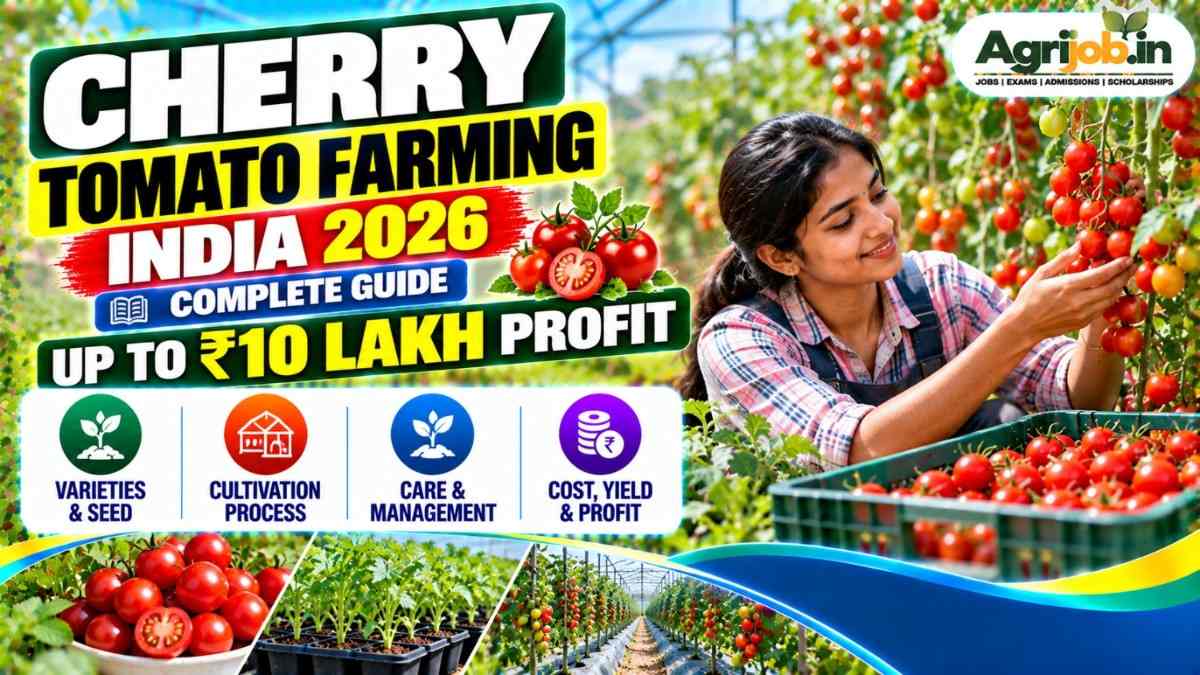
Cherry tomato farming is the commercial cultivation of small-fruited tomato varieties (Solanum lycopersicum var. cerasiforme) grown primarily for premium domestic retail and international export. Unlike regular tomatoes that sell at Rs.10–30/kg in open mandis, cherry tomatoes consistently command Rs.60–100/kg at supermarkets and Rs.80–150/kg in export channels — making them one of India’s most bankable horticulture cash crops in 2026.
India produced over 21 million tonnes of tomatoes in 2024–25, but cherry tomatoes remain a niche, high-value segment growing at 18–22% annually as urban consumption of salads, gourmet foods, and health-conscious diets rises. The National Seeds Corporation (NSC), a Schedule-B Miniratna CPSE under India’s Ministry of Agriculture and Farmers’ Welfare, has been a key driver of this expansion through its certified cherry tomato seed programme — branding their variety under the tagline “Small Tomato, Big Flavor!”

Botanical Profile & NSC Cherry Tomato Seed Advantages
The cherry tomato belongs to the Solanaceae family and is classified as Solanum lycopersicum var. cerasiforme. It grows as an indeterminate vine, meaning it continues to elongate and set fruit throughout its life cycle — a key commercial advantage over determinate (bush) varieties that produce a single flush of fruit. Understanding the botanical characteristics helps farmers select the right variety, plan their trellising system, and time their fertiliser applications correctly.
| Botanical Characteristic | Detail |
|---|---|
| Scientific Name | Solanum lycopersicum var. cerasiforme |
| Family | Solanaceae |
| Growth Habit | Indeterminate (continues growing; needs staking/trellising) |
| Fruit Shape | Round to oval; 15–30 gm per fruit |
| Fruit Colour | Bright red (at maturity); green to yellow before ripening |
| Lycopene Content | Higher than regular tomatoes; significant antioxidant value |
| Days to First Harvest | 55–70 days from transplant |
| Pollination | Self-pollinating; wind-assisted in polyhouse |
| Root System | Fibrous; requires well-drained, aerated soil |
NSC Cherry Tomato Seed Advantages: NSC’s government-certified cherry tomato seed (priced at Rs.125 per gram) offers several commercially significant traits that give it an edge over unbranded alternatives sold in local markets:
- High Germination Rate: Certified NSC seeds ensure 85–92% germination, reducing nursery waste and per-plant cost.
- Early Maturity: The variety reaches first harvest in 55–65 days post-transplant, enabling faster market entry.
- Disease Resistance: Built-in resistance to common tomato pathogens including Fusarium wilt and Tomato Leaf Curl Virus (ToLCV), reducing pesticide input cost.
- Uniform Fruit Size: Critical for export grading — buyers in the Middle East and EU demand consistent fruit diameter (20–28 mm) and colour.
- Rich Nutrient Profile: High lycopene, Vitamin C, and potassium content aligns with growing health-food demand in urban Indian and export markets.
- Wide Adaptability: Performs across polyhouse, open-field, and container cultivation — making it accessible to farmers of all scales.
Who Should Start Cherry Tomato Farming in India?
- 🌱 Small and Marginal Farmers (0.5–2 acres): Who want to move from commodity crops (wheat, rice) to high-value horticulture with government subsidy support under NHM/MIDH.
- 🏗️ Polyhouse Owners: Who currently grow regular tomatoes or capsicum and want to add a premium-priced crop to their rotation.
- 🎓 Agriculture Graduates & Agri-Entrepreneurs: Looking to start a viable agribusiness with low seed investment (Rs.125/gm) and proven export demand.
- 🏨 Contract Farmers Near Metro Cities: Supplying supermarkets (BigBasket, Reliance Fresh), 5-star hotels, and cloud kitchens where cherry tomatoes are in consistent, year-round demand.
- 🚢 Aspiring Agri-Exporters: Who want to enter the Middle East and European fresh vegetable export market through APEDA channels.
- 💼 FPOs & Cooperative Groups: Who can aggregate production from multiple farmers to meet the minimum lot-size requirements of export buyers.
- 🌾 Organic Farmers: Cherry tomatoes with zero-pesticide residue command a significant price premium in EU and Japanese markets.
- 🏙️ Urban & Peri-Urban Growers: Who want to start container or terrace-based cherry tomato cultivation for direct-to-consumer sales at 2–3× mandi price.
Cultivation Methods: Polyhouse, Open Bed & Container Farming
Cherry tomatoes are among the most versatile vegetable crops in India, adapted to three distinct cultivation systems — each with its own economics, yield potential, and target market. Selecting the right method depends on your land holding, capital, access to market linkages, and whether you intend to pursue export or domestic premium sales.
| Cultivation Method | Setup Cost (1 Acre) | Yield Potential | Target Market | Best For |
|---|---|---|---|---|
| Naturally Ventilated Polyhouse (NVPH) | Rs.8–12 lakh (pre-subsidy) | 15–20 tonnes/acre/cycle | Export, premium supermarkets, hotels | Commercial farmers, agri-entrepreneurs |
| Hi-Tech Fan-Pad Polyhouse | Rs.18–25 lakh (pre-subsidy) | 20–28 tonnes/acre/cycle | EU/US export, organic premium | Large commercial operations |
| Open Field / Raised Bed | Rs.30,000–70,000 | 8–12 tonnes/acre | Local mandi, urban retail | Small farmers, first-time growers |
| Container / Pot Farming | Rs.5,000–20,000 (50 pots) | 2–5 kg per plant/season | Direct consumer, local markets | Urban growers, terrace farmers |
Soil and Site Requirements: Cherry tomatoes thrive in well-drained sandy loam soil with a pH of 6.0–7.0, rich in organic matter (SOM >1.5%). Before planting, incorporate well-decomposed FYM at 15–20 tonnes/acre. Avoid waterlogged, compacted, or alkaline soils — root zone aeration is critical for high yields. In polyhouse, fertigation through drip irrigation replaces soil nutrition requirements partially, enabling higher plant densities (2,500–3,000 plants per 1,000 sqm).
How Cherry Tomato Cultivation Works — Step-by-Step Process 2026
- Seed Selection & Procurement: Purchase NSC-certified cherry tomato seeds from your nearest NSC Regional Office or authorised dealer (available across 107 NSC Marketing Centres in India). One gram of seed produces approximately 400–500 seedlings, sufficient to plant 500–1,000 sqm of polyhouse area.
- Nursery Preparation (Days 1–21): Sow seeds in pro-trays (98 cells) filled with cocopeat + perlite (3:1 mix). Maintain nursery temperature of 22–26°C. Seeds germinate in 5–7 days. Water gently with a rose can. Apply starter fertilizer (19:19:19 NPK at 2 g/litre) from Day 8 onwards. Seedlings are ready for transplanting when 4–5 true leaves appear (21–25 days after sowing).
- Land Preparation & Bed Formation (Days 15–25): Deep plough the polyhouse soil to 30 cm depth. Form raised beds 90 cm wide with 60 cm pathways. Apply basal dose of fertiliser: FYM (15 tonnes/acre), DAP (50 kg/acre), and Potash (40 kg/acre). Cover beds with black polyethene mulch (25 micron) — this controls weeds, conserves moisture, and prevents soil-splash disease.
- Transplanting (Day 25–28): Transplant seedlings at a spacing of 45 cm × 60 cm (row × plant). Plant in the evening or on a cloudy day to reduce transplant shock. Water immediately after transplanting. Target a plant population of 3,000–3,500 plants per 1,000 sqm in polyhouse.
- Staking & Trellising (Day 30 onwards): Install vertical strings or bamboo stakes (1.8–2.0 m height). Train the main stem upward, removing side shoots (suckers) below the 4th truss. In polyhouse, overhead wire systems with hanging strings (Dutch lowering system) give 15–20% yield improvement over bamboo staking.
- Fertigation Schedule (Weeks 4–16): Use drip fertigation for precision nutrition. Vegetative stage (Weeks 4–7): Nitrogen-dominant (N:P:K = 4:1:2). Flowering stage (Weeks 8–11): Balance N and K, increase P (N:P:K = 3:2:3). Fruiting stage (Weeks 12–16): Potassium-dominant for fruit size and colour (N:P:K = 2:1:4). Calcium and Boron foliar sprays every 15 days prevent Blossom End Rot.
- Integrated Pest & Disease Management: Monitor weekly for Whitefly (vector for ToLCV), Thrips, Spider Mites, and Leaf Miner. Use yellow sticky traps (10 per 1,000 sqm). Apply neem-based biopesticides as first line. For fungal diseases (Early Blight, Powdery Mildew), apply Mancozeb or Carbendazim as per state KVK recommendations. Maintain 25-day pre-harvest interval (PHI) for any chemical application — critical for MRL compliance in export markets.
- Harvest (Days 65–120 onwards): Harvest cherry tomatoes when fully red and firm. Pick every 2–3 days — cherry tomatoes are fast-ripening and field heat accelerates softening. Harvest in early morning. Place gently in shallow plastic crates (5–8 kg per crate) to avoid bruising. One plant produces 3–5 kg of fruit per season in polyhouse conditions.
- Post-Harvest Handling: Pre-cool harvested fruit to 10–12°C within 4 hours. Grade by size (18–22 mm for domestic; 22–28 mm for export). Pack in ventilated clamshell boxes (250 gm or 500 gm) for premium retail, or corrugated cartons (3–5 kg) for bulk buyers. Apply food-safe wax coating if needed for extended shelf life in export.
In a closed polyhouse, natural pollination by wind and insects is limited. Improve fruit set by 15–25% by using an electric vibrator (bee stick) on flowering clusters every morning between 8 AM and 11 AM — this mimics the buzz-pollination performed by native bees. Alternatively, introduce commercial bumblebee colonies (1 hive per 500 sqm). This single step often adds Rs.80,000–1,20,000 to annual yield value.
Cherry Tomato Farming Profit: Complete Income & Cost Breakdown 2026
Cherry tomatoes are one of India’s highest-margin horticulture crops. The combination of premium market price, multiple harvests per year, and yield consistency in polyhouse conditions makes the economics compelling even after accounting for higher setup costs.
| Cost Component | Open Field (1 Acre) | Polyhouse (1,000 sqm) |
|---|---|---|
| Land Preparation & Beds | Rs.15,000 | Rs.20,000 |
| Seeds (NSC Certified) | Rs.2,000 | Rs.2,500 |
| Nursery & Transplanting | Rs.5,000 | Rs.8,000 |
| Fertilisers (FYM + NPK) | Rs.18,000 | Rs.20,000 |
| Crop Protection (IPM) | Rs.10,000 | Rs.10,000 |
| Labour (4–5 months) | Rs.40,000 | Rs.40,000 |
| Irrigation / Electricity | Rs.8,000 | Rs.8,000 |
| Packaging & Transport | Rs.12,000 | Rs.15,000 |
| Total Input Cost (Per Cycle) | Rs.1,10,000 | Rs.1,23,500 |
| Yield | 8–12 tonnes | 15–20 tonnes |
| Market Price | Rs.40–60/kg | Rs.60–100/kg |
| Gross Revenue | Rs.3.2–7.2 lakh | Rs.9–20 lakh |
| Net Profit (Per Cycle) | Rs.2.1–6.1 lakh | Rs.7.8–18.8 lakh |
Annual Earnings Projection (Polyhouse — 2 cycles per year): A well-managed 1,000 sqm polyhouse running 2 cherry tomato cycles per year at a conservative average price of Rs.70/kg and yield of 16 tonnes/cycle generates gross revenue of Rs.22.4 lakh annually. After deducting total input costs of Rs.2.47 lakh (2 cycles), net profit reaches approximately Rs.19.9 lakh — though realistic operational costs including labour and overheads typically result in Rs.6–10 lakh net profit per year for most farmers.
Eligibility for NHM/MIDH Polyhouse Subsidy 2026
The Indian government’s Mission for Integrated Development of Horticulture (MIDH), through its National Horticulture Mission (NHM) and National Horticulture Board (NHB) sub-schemes, provides up to 50% capital subsidy on polyhouse construction — directly enabling cherry tomato farming at dramatically lower entry cost.
- Any Indian citizen who is a farmer, FPO member, agri-entrepreneur, or horticulture graduate is eligible to apply.
- Land ownership or long-term lease (minimum 7 years) is required — own land preferred.
- Minimum polyhouse area: 500 sqm (NHM); minimum 2,500 sqm for NHB commercial subsidy.
- Maximum subsidised area: 4,000 sqm per beneficiary under NHM (subsidy capped at ~Rs.18.7 lakh per 4,000 sqm NVPH).
- SC/ST and Women farmers receive additional 10–15% top-up subsidy in several states.
- Haryana offers up to 65% combined subsidy (50% central + 15% state); Himachal Pradesh offers up to 85% for general farmers.
- Application made through State Horticulture Mission (SHM) / District Horticulture Officer (DHO) or online through state NHM portal.
| Category | Subsidy Rate | Max Polyhouse Area | Administering Body |
|---|---|---|---|
| General Farmers (NHM) | 50% of unit cost | 4,000 sqm | State Horticulture Mission |
| Commercial Projects (NHB) | 50% (capped at Rs.56 lakh) | 2,500 sqm minimum | National Horticulture Board |
| SC/ST Farmers (many states) | 60–75% | 4,000 sqm | State SHM / DHO |
| Haryana (State Top-up) | 50% + 15% = 65% | 4,000 sqm | Haryana Horticulture Dept |
| Himachal Pradesh | Up to 85% | 4,000 sqm | HP State Horticulture Dept |
Polyhouse vs Open Field Cherry Tomato Farming
| Parameter | Polyhouse Cultivation | Open Field Cultivation |
|---|---|---|
| Yield per Acre per Cycle | 15–20 tonnes | 8–12 tonnes |
| Market Price Realised | Rs.60–100/kg (premium) | Rs.25–50/kg (mandi) |
| Annual Net Profit | Rs.6–10 lakh/acre | Rs.1–2.5 lakh/acre |
| Weather Risk | Very low (protected environment) | High (rain, hail, extreme heat) |
| Pest & Disease Risk | Moderate (controlled environment) | High (open to all vectors) |
| Cycles per Year | 2–3 (temperature-controlled) | 1–2 (season-dependent) |
| Water Use Efficiency | 60–70% saving vs flood irrigation | Standard irrigation |
| Export Eligibility | Yes (consistent quality & MRL) | Difficult (inconsistent MRL) |
| Initial Investment | Rs.8–12 lakh per 1,000 sqm (pre-subsidy) | Rs.30,000–70,000 per acre |
| Break-Even Period | 2.5–3 years (with subsidy) | 1 season |
For serious agri-entrepreneurs targeting export or premium urban markets, polyhouse cherry tomato farming is unambiguously the superior choice. The 50% NHM/MIDH subsidy cuts the capital barrier significantly, and the 4–6× higher yield plus premium price realisation make break-even achievable within 2.5–3 years. Open field cultivation remains viable for contract farmers near major cities who have guaranteed supermarket offtake agreements — but for export ambitions, polyhouse is non-negotiable.
Advantages and Disadvantages of Cherry Tomato Farming in India
A balanced assessment of cherry tomato farming is essential before committing capital. Here are the key advantages and disadvantages every prospective farmer should evaluate:
Advantages
- ✅ Premium Price Stability: Cherry tomatoes sell at Rs.60–100/kg year-round, unlike regular tomatoes that crash to Rs.2–5/kg during seasonal gluts.
- ✅ Multiple Harvest Cycles: Indeterminate growth habit enables continuous harvest for 4–6 months per crop, with 2–3 cycles per year in polyhouse — maximising land productivity.
- ✅ Government Subsidy Support: Up to 50–85% polyhouse subsidy under MIDH/NHM dramatically reduces initial investment risk.
- ✅ Export Demand: UAE, Saudi Arabia, UK, and Germany import fresh cherry tomatoes year-round — Indian off-season supply fills a significant gap.
- ✅ Low Seed Investment: Rs.125/gm NSC seed covers nursery needs for 400–500 plants — one of the lowest seed-cost-to-output ratios in premium horticulture.
- ✅ Health Food Trend Alignment: Rising urban demand for lycopene-rich, low-calorie cherry tomatoes supports consistent domestic price realisation.
Disadvantages
- ❌ Perishability: Cherry tomatoes have a shelf life of only 7–10 days at ambient temperature — cold chain logistics are mandatory for export, adding Rs.8–15/kg to post-harvest cost.
- ❌ Niche Market Volume: Unlike regular tomatoes, you cannot sell tonnes of cherry tomatoes in a local mandi — prior tie-ups with supermarkets, hotels, or export agents are essential before scaling up.
- ❌ High Polyhouse Capital Cost: Despite subsidies, initial investment of Rs.4–6 lakh post-subsidy per 1,000 sqm can be a barrier for landless or debt-stressed small farmers.
- ❌ Skilled Labour Requirement: Polyhouse operations — trellising, sucker pruning, fertigation management, and grading — require skilled farm labour that is not always available in rural areas.
Cherry Tomato Export Guide: APEDA, MRL Compliance & Global Markets 2026
Indian cherry tomatoes have significant competitive export potential, particularly to the Middle East, Southeast Asia, and European markets during their off-seasons. In 2024, India’s total fresh tomato exports reached approximately $23.2 million in value at 78 million kg — a figure set to grow as premium cherry tomato exports rise. Export success requires compliance with APEDA regulations, destination-country MRL standards, and cold-chain infrastructure.
Key Export Markets for Indian Cherry Tomatoes
| Country / Region | Key Demand Period | Export Price (FOB) | Critical Requirement |
|---|---|---|---|
| UAE (Dubai, Abu Dhabi) | Year-round (peak Nov–Apr) | Rs.90–130/kg | Phytosanitary Certificate, GCC MRL compliance |
| Saudi Arabia & Qatar | Oct–Mar (off-season supply) | Rs.85–120/kg | Halal-safe post-harvest chemicals |
| UK & Germany | Nov–Mar | Rs.110–160/kg | GlobalGAP certification, EU MRL strict compliance |
| Netherlands | Dec–Apr | Rs.110–150/kg | EU Organic certification (for premium tier) |
| Singapore & Malaysia | Year-round | Rs.80–110/kg | SFA import permit, MRL compliance |
| Bangladesh & Nepal | Year-round | Rs.50–70/kg | Phytosanitary Certificate, APEDA RCMC |
Step-by-Step APEDA Export Process for Cherry Tomatoes
- Obtain Import Export Code (IEC): Register on DGFT’s website (dgft.gov.in) and obtain your IEC — the foundational document for all export activities. Cost: Rs.500 application fee.
- APEDA RCMC Registration: Register with APEDA (apeda.gov.in) and obtain your RCMC (Registration-cum-Membership Certificate). APEDA registration is mandatory for all fresh vegetable exporters. Annual renewal required.
- Farm Registration & GAP Certification: Register your farm with APEDA’s traceability systems. Implement Good Agricultural Practices (GAP) — maintain pesticide application records, comply with 25-day PHI for all chemicals used.
- Pre-Harvest MRL Testing: At least 15 days before shipment, send fruit samples to an NABL-accredited laboratory for pesticide residue testing against the destination country’s MRL standards (not FSSAI domestic limits — these are different and usually stricter for EU/UK).
- Grading & Packing: Grade cherry tomatoes to buyer specifications (uniform size 22–28 mm, vibrant red colour, no blemishes). Pack in ventilated clamshell boxes (250/500 gm) or corrugated cartons. Each box must carry producer name, lot number, APEDA RCMC, origin, and weight.
- Phytosanitary Certificate: Obtain a Phytosanitary Certificate from PPQS (Plant Protection, Quarantine and Storage) — an inspection of your consignment by a licensed Plant Quarantine officer. Certificate issued within 24–48 hours at major ports.
- Cold Chain Logistics: Pre-cool fruit to 10–12°C before loading. Use reefer containers (12°C setting) for sea freight to Gulf markets (3–5 day transit). Use air cargo (24–36 hours) for UK/EU markets where speed is critical for shelf life. Break in cold chain above 15°C causes rapid softening and colour loss — a leading cause of rejection at destination ports.
- Documentation & Customs Clearance: Prepare: Commercial Invoice, Packing List, Bill of Lading/Airway Bill, Phytosanitary Certificate, Certificate of Origin (APEDA-endorsed), and MRL Test Report. File Shipping Bill through ICEGATE (icegate.gov.in). For Gulf markets, bank-to-bank Letter of Credit (LC) or advance payment is standard.
Important Terms Related to Cherry Tomato Farming
- Indeterminate Variety: A tomato plant that continues growing and fruiting indefinitely until frost or disease kills it — requires continuous staking; gives multiple harvest flushes. Cherry tomatoes are predominantly indeterminate.
- MRL (Maximum Residue Limit): The highest legally permitted level of pesticide residue in food products. EU MRL standards are among the strictest globally; non-compliance causes consignment rejection at destination ports.
- APEDA RCMC: Registration-cum-Membership Certificate issued by the Agricultural & Processed Food Products Export Development Authority — mandatory for all Indian agri-exporters.
- GlobalGAP Certification: A private sector food safety standard for pre-farm-gate production, widely required by EU and UK supermarket chains. Adds Rs.50,000–1.5 lakh per year in certification cost but opens high-value European markets.
- MIDH (Mission for Integrated Development of Horticulture): India’s flagship centrally sponsored scheme that funds 50–85% of polyhouse construction costs and is the primary route for accessing NHM/NHB subsidies.
- Fertigation: The application of fertilisers dissolved in irrigation water through a drip system — enables precision nutrition and saves 30–40% in fertiliser compared to broadcast application.
- PHI (Pre-Harvest Interval): The mandatory waiting period between the last pesticide application and harvest — critical for MRL compliance. NSC’s disease-resistant varieties help extend PHI compliance windows.
- Lycopene: The red carotenoid pigment in tomatoes with proven antioxidant and anti-cancer properties. Cherry tomatoes contain significantly higher lycopene density per 100 gm than standard tomatoes — a key marketing differentiator in health-food markets.
- Cold Chain Logistics: The temperature-controlled supply chain (10–12°C for cherry tomatoes) from farm to foreign market, comprising pre-cooling, refrigerated transport, cold storage, and reefer containers.
- Blossom End Rot (BER): A physiological disorder caused by calcium deficiency and irregular irrigation, manifesting as dark, sunken patches at the fruit base — a leading cause of export rejection. Prevented by consistent drip irrigation and foliar calcium sprays.
Important Links for Cherry Tomato Farmers & Exporters
| Resource | Link |
|---|---|
| NSC Official Website (Seed Purchase) | indiaseeds.com |
| APEDA Official Portal (Export Registration) | apeda.gov.in |
| National Horticulture Mission (NHM Subsidy) | nhm.nic.in |
| MIDH Official Portal (Ministry of Agriculture) | midh.gov.in |
| DGFT (Import Export Code Registration) | dgft.gov.in |
| ICAR-IIHR (Horticulture Research India) | iihr.res.in |
| National Horticulture Board (NHB Subsidy) | nhb.gov.in |
| Agrijob.in — NHM 2026 Subsidy Guide | NHM 2026 Complete Subsidy Guide |
| Agrijob.in — APEDA MRL Compliance Guide | APEDA MRL Compliance India 2026 |
| Agrijob.in — Organic Farming Export India | Organic Farming Export from India 2026 |
Conclusion: Cherry Tomato Farming Is India’s Best Horticulture Bet in 2026
Cherry tomato farming in India 2026 presents a rare combination of low seed investment (Rs.125/gm NSC-certified seed), government-subsidised infrastructure (50–85% polyhouse subsidy under MIDH/NHM), and premium price realisation (Rs.60–100/kg domestic; Rs.80–150/kg export) that makes it one of the most bankable horticulture businesses available to Indian farmers today. The step-by-step process from nursery to APEDA-cleared export shipment is structured, learnable, and well-supported by government schemes. Apply for NHM/MIDH polyhouse subsidy through your District Horticulture Officer (DHO) or visit midh.gov.in — and bookmark this page, as we update it each time official subsidy rates or APEDA export procedures change.
- Cherry tomato farming India 2026 delivers Rs.6–10 lakh net profit per acre per year under polyhouse conditions — 4–5× higher than open-field regular tomato farming.
- NSC-certified cherry tomato seeds cost Rs.125/gm and cover planting for 400–500 plants, with disease resistance built in — cutting pesticide costs and improving MRL compliance.
- The MIDH/NHM scheme provides up to 50–85% polyhouse construction subsidy, reducing farmer investment from Rs.8–12 lakh to Rs.2–6 lakh per 1,000 sqm.
- Polyhouse cultivation yields 15–20 tonnes per acre per crop cycle at Rs.60–100/kg market price versus open field yield of 8–12 tonnes at Rs.25–50/kg.
- APEDA export to UAE, UK, Germany, and Singapore requires IEC, APEDA RCMC, NABL-lab MRL test, Phytosanitary Certificate, and cold chain logistics at 10–12°C.
- Apply for NHM/MIDH subsidy at your District Horticulture Officer (DHO) office or online at midh.gov.in — and start with a 500–1,000 sqm trial polyhouse before scaling to 4,000 sqm.
Frequently Asked Questions About Cherry Tomato Farming India 2026
What is the market price of cherry tomatoes in India in 2026?
Cherry tomatoes in India 2026 command retail prices of Rs.60–100 per kg at supermarkets and modern retail chains, and Rs.80–150 per kg in export markets (UAE, UK, Europe). This is 3–5× higher than regular tomatoes, which sell at Rs.15–30/kg. Premium organic cherry tomatoes can fetch Rs.120–180/kg in select specialty stores. Price stability is a key advantage over regular tomatoes, which see dramatic seasonal crashes.
How much profit can I make from 1 acre of cherry tomato farming?
From 1 acre of polyhouse cherry tomato farming, you can realistically net Rs.6–10 lakh per year (from 2 crop cycles). This assumes a yield of 15–18 tonnes per cycle at Rs.70/kg average realisation, minus total input costs of Rs.1–1.5 lakh per cycle. Open field cherry tomato farming on 1 acre yields lower — approximately Rs.1.5–4 lakh net profit per year — due to lower yield and lower market price realisation.
How much does NSC cherry tomato seed cost and where do I buy it?
NSC (National Seeds Corporation) cherry tomato seed is priced at approximately Rs.125 per gram and is available at NSC’s 107 Marketing Centres across India, through ONDC platforms, and at authorised NSC dealers. One gram of seed typically yields 400–500 seedlings — sufficient for a 500–800 sqm polyhouse plot. NSC seeds come with government certification of germination rate (85%+) and varietal purity.
What government subsidy is available for cherry tomato polyhouse farming?
Under the Mission for Integrated Development of Horticulture (MIDH), cherry tomato polyhouse farmers are eligible for 50% capital subsidy on polyhouse construction cost through the National Horticulture Mission (NHM) or National Horticulture Board (NHB). States like Haryana offer up to 65% combined subsidy, and Himachal Pradesh offers up to 85%. Apply through your District Horticulture Officer (DHO) or at midh.gov.in and nhm.nic.in.
How do I export cherry tomatoes from India?
To export cherry tomatoes from India, you need: (1) Import Export Code (IEC) from DGFT, (2) APEDA RCMC registration at apeda.gov.in, (3) GAP-certified farm with pesticide records, (4) NABL-lab MRL test against destination-country standards, (5) Phytosanitary Certificate from PPQS, and (6) cold chain logistics at 10–12°C. The primary export destinations in 2026 are UAE, Saudi Arabia, Qatar, UK, Germany, and Singapore.
What is the ideal temperature for cherry tomato cultivation?
Cherry tomatoes grow best at daytime temperatures of 21–27°C and night temperatures of 15–18°C. Below 10°C, fruit set is severely reduced; above 35°C, flower drop occurs, cutting yields by 30–50%. Polyhouse cultivation allows temperature regulation via ventilation and shade nets, extending the growing season into summer months when open field production is impossible in most Indian states.
What is the yield of cherry tomatoes per acre in a polyhouse?
A well-managed polyhouse cherry tomato crop yields 15–20 tonnes per acre per 90–100 day crop cycle. With 2 cycles per year, annual total yield reaches 30–40 tonnes per acre. By comparison, open field cultivation yields only 8–12 tonnes per acre per cycle. The yield advantage of polyhouse production is due to higher plant density, controlled environment, continuous fertigation, and protection from weather losses.
Can I grow cherry tomatoes without a polyhouse?
Yes, cherry tomatoes can be grown in open fields, raised beds, and containers without a polyhouse. Open field cultivation requires lower initial investment (Rs.30,000–70,000 per acre) and is viable for farmers with direct supermarket or hotel offtake agreements near their farm. However, yield, price realisation, weather protection, and export eligibility are all significantly lower compared to polyhouse cultivation. For export or premium market supply, a polyhouse or shade net house is strongly recommended.
What are the best cherry tomato varieties for farming in India?
The best cherry tomato varieties for commercial farming in India in 2026 include NSC’s certified variety (Rs.125/gm), Sarpan 12 (indeterminate, suited for export), Sakura (widely grown in Gujarat and Maharashtra for supermarket supply), Red Snapper, and Punjab Red Cherry. For polyhouse and export, indeterminate varieties with uniform fruit size (22–28 mm) and strong disease resistance to Fusarium wilt and ToLCV are preferred. Contact your nearest ICAR-IIHR or KVK centre for region-specific variety recommendations.
Last Updated: October 2026 | This guide is reviewed and updated regularly for accuracy. Bookmark this page for the latest cherry tomato farming data, subsidy notifications, and export procedure updates.
Disclaimer: Profit figures, market prices, and subsidy rates mentioned in this article are based on current available data (October 2026) from official government sources, APEDA, and verified agri-market data. Actual returns depend on local market conditions, farm management practices, and seasonal variations. Consult your District Horticulture Officer or KVK before making investment decisions. This article does not constitute financial advice.