
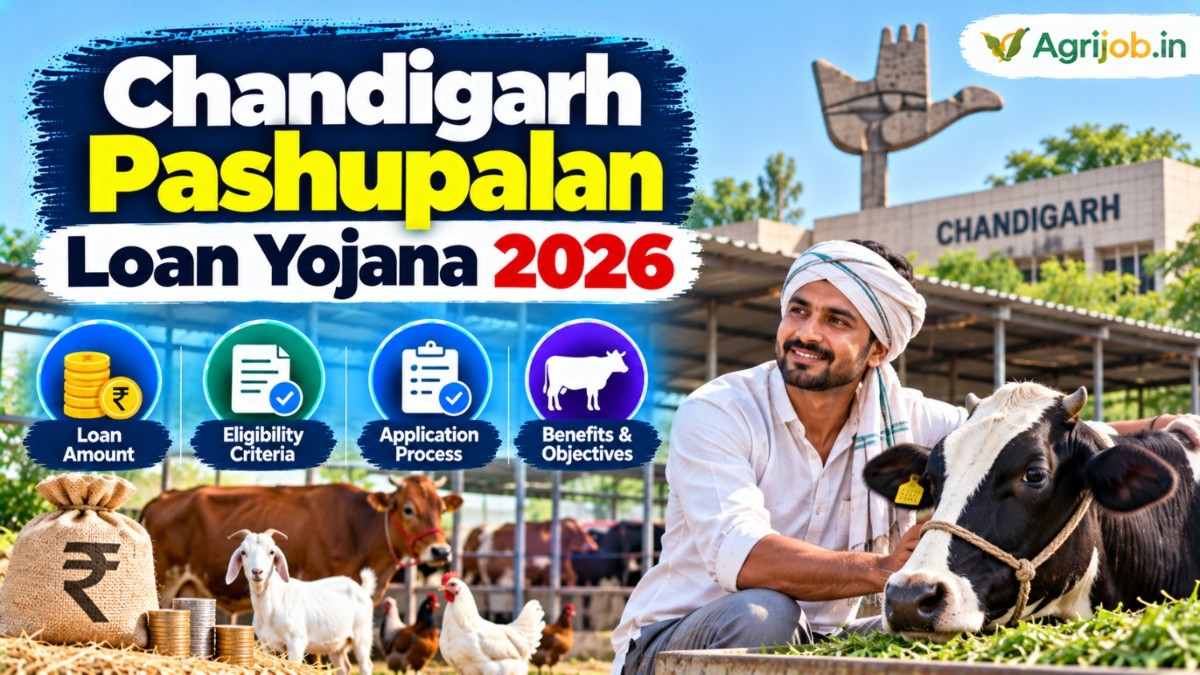
Chandigarh Pashupalan Loan Yojana 2026 covers loans from Rs.1 lakh to Rs.1 crore for dairy, poultry, goat, and pig farming through central schemes (NLM, RGM, AHIDF), bank products (KCC, term loans), and cooperative society loans — with subsidies ranging from 25% to 50% of project cost for general-category applicants and up to 33%–50% for SC/ST and women beneficiaries in UT Chandigarh.
Chandigarh Pashupalan Loan Yojana 2026 is not a single standalone scheme — it is the complete ecosystem of central government, UT administration, bank, and cooperative society programmes available to livestock farmers and entrepreneurs in Union Territory Chandigarh. Whether you want to start a 2-buffalo dairy unit in Burail village or establish a 100-cow commercial dairy farm, structured loan and subsidy support is available right now. This guide is for residents of UT Chandigarh aged 18 and above — farmers, rural youth, women, SHG members, and dairy entrepreneurs — who want to access animal husbandry finance in 2026. It covers every active scheme in detail: who qualifies, how much you can borrow, what subsidy you get, and exactly how to apply.

- Applicable Area: Union Territory Chandigarh (rural villages only for cooperative bank loans)
- Loan Range: Rs.1 lakh (KCC / cooperative dairy unit) to Rs.1 crore+ (AHIDF infrastructure)
- Best Subsidy Rate: 50% capital subsidy — National Livestock Mission (NLM-EDP)
- SC/ST Subsidy: 33%–50% depending on scheme (NLM, DEDS heritage, AHIDF)
- Interest Rate (KCC): 7% per annum (with GoI interest subvention for up to Rs.2 lakh)
- AHIDF Interest Subvention: 3% per annum on term loans up to Rs.100 crore
- Cooperative Bank Dairy Loan: Rs.1 lakh per buffalo at 12% p.a. (Chandigarh State Cooperative Bank)
- NLM Apply Portal: nlm.udyamimitra.in (100% online)
- Central Nodal Ministry: DAHD, Ministry of Fisheries, Animal Husbandry & Dairying (dahd.gov.in)
- Implementing Department: Directorate of Animal Husbandry & Fisheries, UT Chandigarh (chdanimalhusbandry.gov.in)
- What Is Chandigarh Pashupalan Loan Yojana 2026?
- Who Should Apply for Pashupalan Loan in Chandigarh?
- National Livestock Mission (NLM) — 50% Capital Subsidy
- Rashtriya Gokul Mission (RGM) — Breed Improvement Subsidy
- AHIDF — Animal Husbandry Infrastructure Development Fund
- KCC Animal Husbandry Loan — 7% Interest Rate
- Chandigarh Cooperative Society Dairy Loan
- Earnings & Income Potential from Pashupalan in Chandigarh
- Eligibility & Documents Required
- How to Apply Step by Step
- Scheme Comparison Table — Which Is Best for You?
- Pros and Cons of Pashupalan Loan in Chandigarh
- Important Terms Related to Pashupalan Loan Yojana
- Important Links
- Conclusion
- Key Takeaways
- Frequently Asked Questions
What Is Chandigarh Pashupalan Loan Yojana 2026?
Chandigarh Pashupalan Loan Yojana 2026 refers to the collective set of animal husbandry loan and subsidy programmes available to residents of Union Territory Chandigarh — covering dairy cattle, buffalo, goat, poultry, and piggery farming. These programmes flow through four distinct channels: central government schemes administered by the Department of Animal Husbandry and Dairying (DAHD), the UT Chandigarh Administration’s own Animal Husbandry and Fisheries Department, nationalised and scheduled commercial banks, and the Chandigarh State Cooperative Bank Limited. There is no single “Chandigarh Pashupalan Yojana” notification — instead, every active channel listed in this guide is currently operational and accepting applications in 2026.
The Department of Animal Husbandry and Fisheries, UT Chandigarh — operational since April 1, 1978 — provides veterinary health cover, artificial insemination, and implements all centrally sponsored livestock schemes within the UT. As per the 21st Quinquennial Livestock Census 2024 conducted by this department, Chandigarh’s livestock population is actively tracked for benefit targeting. The UT’s proximity to Punjab’s MILKFED (Verka dairy cooperative network) and Haryana’s cooperative dairy structure means Chandigarh-based dairy farmers can additionally access the Chandigarh Milk Plant network for milk procurement and cooperative society benefits.

Who Should Apply for Pashupalan Loan in Chandigarh?
This guide and these schemes are specifically relevant to the following groups of applicants in UT Chandigarh:
- 🐄 Dairy farmers in Chandigarh’s rural villages (Burail, Behalana, Badhari, and other PACS-registered villages) who want to expand their 2–10 animal units using subsidised finance.
- 👩🌾 Women and SHG members eligible for enhanced 33%+ subsidy under NLM and cooperative dairy schemes — women-specific provisions are embedded in every scheme.
- 🧑🎓 Unemployed graduates aged 18–35 seeking self-employment in dairy, goat, poultry, or piggery farming through NLM’s Entrepreneurship Development Programme.
- 🏭 MSMEs and private dairy entrepreneurs planning dairy processing units, animal feed plants, or breed multiplication farms eligible for AHIDF’s 3% interest subvention on loans up to Rs.100 crore.
- 🌾 Farmers already holding a Kisan Credit Card who want to add an animal husbandry working capital component at the concessional 7% rate within the overall Rs.3 lakh KCC limit.
- 🏘️ Cooperative dairy society members registered with BURAIL RAJPUTTAN COOPERATIVE DAIRY SOCIETY or other Chandigarh dairy cooperatives seeking short-term and term loans from the Chandigarh State Cooperative Bank.
- 🐐 SC/ST applicants eligible for enhanced subsidy (33%–50%) across NLM, AHIDF, and the former DEDS heritage rates — getting up to Rs.46,600 subsidy even for a 2-animal dairy starter unit.
- 🏥 Veterinary entrepreneurs planning to establish veterinary vaccine production, animal feed manufacturing, or IVF centres eligible for AHIDF and RGM breed multiplication farm components.
National Livestock Mission (NLM) — 50% Capital Subsidy for Chandigarh 2026
The National Livestock Mission (NLM) is the most generous livestock subsidy scheme currently active in India, providing a 50% capital subsidy up to Rs.50 lakh per eligible project under the Entrepreneurship Development Programme (NLM-EDP). It is a central sector scheme implemented by the Department of Animal Husbandry and Dairying (DAHD) under the Ministry of Fisheries, Animal Husbandry and Dairying, applicable in all states and UTs including Chandigarh. Applications are processed entirely online at nlm.udyamimitra.in.
Under NLM-EDP, a total of 3,295 projects have been sanctioned nationally with a project cost of Rs.2,381.12 crore and a subsidy of Rs.1,098.63 crore as of the latest DAHD data. In Haryana (the adjacent state sharing administration with Chandigarh UT), 13 NLM-EDP projects were approved with a sanctioned subsidy of Rs.4.06 crore, giving Chandigarh-based applicants a clear pathway through the same administrative structure.
| NLM-EDP Component | Eligible Activity | 50% Subsidy Ceiling |
|---|---|---|
| Poultry Farming | Layer/Broiler unit setup | Rs.25 lakh per unit |
| Sheep & Goat Farming | Small ruminant rearing unit | Rs.25 lakh per unit |
| Piggery | Pig breeding & rearing | Rs.25 lakh per unit |
| Feed & Fodder | Feed processing, chaff cutter, TMR | Rs.50 lakh per unit |
| Breed Improvement | Breed multiplication farm (indigenous) | 50% of capital cost, max Rs.2 crore |
| IVF Pregnancy (RGM overlap) | Rs.5,000 subsidy per assured IVF pregnancy | Per pregnancy basis |
Eligibility for NLM in Chandigarh: Any resident of UT Chandigarh aged 18+ — including individual farmers, FPOs, FCOs, SHGs, JLGs, and Section 8 companies — can apply. More than one adult family member can each apply independently provided they set up separate units at different locations. The subsidy is back-ended: the bank sanctions the loan first, the unit is set up, verified by a DAHD-appointed field officer, and then the subsidy is released into the loan account reducing outstanding principal.
Rashtriya Gokul Mission (RGM) — Breed Improvement & Indigenous Cattle Subsidy 2026
The Rashtriya Gokul Mission (RGM) is a central sector scheme focused specifically on development, conservation, and productivity enhancement of indigenous bovine breeds. In April 2026, the Government of India granted administrative approval for the Revised Rashtriya Gokul Mission with a budget allocation of Rs.800 crore for implementation up to September 30, 2026, implemented via State Livestock Development Boards and the National Dairy Development Board (NDDB). Chandigarh UT applicants are covered under this national approval.
| RGM Component | Benefit / Subsidy | Eligible Beneficiary |
|---|---|---|
| IVF Pregnancy (Accelerated Breed Improvement) | Rs.5,000 per assured IVF pregnancy | All dairy farmers irrespective of caste |
| Sex-Sorted Semen | Rs.750 or 50% of cost per dose | All dairy farmers |
| Breed Multiplication Farm | 50% capital subsidy, max Rs.2 crore | Entrepreneurs, FPOs, Section 8 companies |
| AI Technician Equipment | AI kits provided free to certified MPATs | Trained AI workers at farmers’ doorstep |
| Gokul Gram (Indigenous Cattle Centre) | 100% grant-in-aid from GoI | State/UT implementing agencies |
For Chandigarh dairy farmers who rear indigenous breeds such as Sahiwal cows or Murrah buffaloes, the RGM’s IVF pregnancy component provides an immediate Rs.5,000 subsidy per verified assured pregnancy. The breed multiplication farm component — offering 50% capital subsidy up to Rs.2 crore — is particularly suitable for agri-entrepreneurs in Chandigarh’s peri-urban villages looking to establish scientifically managed breeding farms. Applications are channelled through the DAHD portal at dahd.gov.in/schemes-programmes and through NDDB (eoi.nddb.coop) for breed multiplication farm EOIs.
AHIDF — Animal Husbandry Infrastructure Development Fund 2026
The Animal Husbandry Infrastructure Development Fund (AHIDF) is a central sector scheme with a corpus of Rs.15,000 crore, providing 3% per annum interest subvention on term loans from Rs.1 lakh to Rs.100 crore for livestock infrastructure projects. Sanctioned and disbursed loans continue to be valid under AHIDF through March 31, 2027, for projects approved up to March 31, 2026. For Chandigarh-based dairy processors and entrepreneurs, AHIDF is the most powerful tool for large-scale infrastructure financing.
| AHIDF Parameter | Details |
|---|---|
| Fund Corpus | Rs.15,000 crore (central sector scheme) |
| Eligible Loan Amount | Rs.1 lakh minimum to Rs.100 crore maximum |
| Loan Coverage | Up to 90% of eligible project cost |
| Borrower Margin | 10% (MSME/small) | 15% (medium) | 25% (others) |
| Interest Subvention | 3% per annum — paid by GoI directly to lending bank |
| Subvention Period | Up to 8 years including 2-year moratorium |
| Repayment Period | Maximum 120 months (10 years) including moratorium |
| Credit Guarantee (MSME) | 25% via CGTMSE on loans up to Rs.5 crore |
| Implementing Banks | SBI, PNB, Indian Bank, Indian Overseas Bank, Federal Bank, others |
Eligible activities under AHIDF in Chandigarh include dairy processing units, value-added dairy product manufacturing, meat processing infrastructure, animal feed manufacturing plants, breed improvement and breed multiplication farms (IVF centres, sex-sorted semen stations), and animal waste to wealth management units. The Credit Guarantee Fund of Rs.750 crore managed by NABARD provides security cover, reducing the collateral burden for MSME borrowers. SBI’s IND PASHUDHAN Mitra product and Indian Bank’s AHIDF scheme products are the most easily accessible in Chandigarh’s banking network.
If your project involves both infrastructure (dairy processing unit) and livestock rearing (cattle/goat purchase), structure it so that the infrastructure component is financed under AHIDF (3% interest subvention for 8 years) and the livestock purchase component goes under NLM-EDP (50% capital subsidy up to Rs.50 lakh). This dual-scheme approach is legally permitted and can reduce your effective cost of setting up a dairy business by 40%–60% compared to a plain commercial loan.
KCC Animal Husbandry Loan — 7% Interest Rate for Chandigarh Farmers
The Kisan Credit Card (KCC) scheme — extended to animal husbandry and fisheries sectors — provides short-term working capital at a concessional 7% per annum for all dairy, poultry, small ruminant (goat, sheep), and pig farmers in UT Chandigarh. The KCC for animal husbandry is available at every nationalised bank and Regional Rural Bank operating in Chandigarh, including SBI, PNB, Punjab & Sind Bank, Indian Bank, and Bank of Baroda. The Government of India provides an interest subvention of 2% per annum on KCC-Animal Husbandry loans up to Rs.2 lakh (within the overall KCC ceiling of Rs.3 lakh), bringing the effective farmer rate to 5% for prompt repayers.
| KCC-Animal Husbandry Parameter | Details |
|---|---|
| Purpose | Working capital for dairy, poultry, goat, pig farming — feed, medicine, insurance, labour |
| Interest Rate | 7% p.a. (with GoI subvention on up to Rs.2 lakh component) |
| Prompt Repayment Incentive | Additional 3% rebate — effective rate 4% for timely repayors |
| Maximum Animal Husbandry Component | Rs.2 lakh within overall KCC limit of Rs.3 lakh |
| Loan Type | Revolving cash credit (can draw and repay multiple times) |
| Repayment | 5-year tenure — revolving annual credit limit |
| Collateral | Nil for limits up to Rs.1.60 lakh; hypothecation of animals above that |
| Who Is Eligible | All dairy farmers, poultry farmers, SHGs, JLGs, tenant farmers with rented/owned sheds |
For a Chandigarh farmer maintaining 4 milch buffaloes, a KCC-Animal Husbandry limit of Rs.80,000–Rs.1,20,000 can cover an entire year’s recurring expenses — feed, veterinary care, artificial insemination, animal insurance — without needing fresh documentation every cycle. The scale of finance is determined by the District Level Technical Committee (DLTC), which sets the per-animal working capital norm for Chandigarh UT. Apply directly at your nearest SBI or PNB branch by submitting the KCC application form along with Aadhaar, proof of animal ownership, and a photograph.
Chandigarh Cooperative Society Dairy Loan — Bank & Cooperative Route
The Chandigarh State Cooperative Bank Limited (CSCB) offers the most targeted dairy loan product for residents of Chandigarh’s rural villages. Under its Dairy Loan Unit, each buffalo can be financed up to Rs.1 lakh at 12% per annum, repayable in five years in monthly instalments. The loan requires the borrower to be a nominal member of the cooperative bank, a resident of UT Chandigarh, and to sign a tripartite agreement between borrower, cooperative milk producer society, and the bank — ensuring milk supply linkage for the financed animals.
| Cooperative / Bank Loan Scheme | Loan Amount | Interest Rate | Key Condition |
|---|---|---|---|
| CSCB Dairy Loan (Buffalo) | Up to Rs.1 lakh per buffalo | 12% p.a. | Milk supply to cooperative; tripartite agreement required |
| CSCB Poultry Loan (Village Only) | Rs.1.25 lakh (500 layers) / Rs.2.43 lakh (1,000 layers) | 12% p.a. | Project in UT Chandigarh village; immovable property as security |
| PACS — Primary Agricultural Credit Societies | As per DLTC-approved scale of finance | As per NABARD re-finance rate | Must be PACS member; Chandigarh has PACS at Burail, Behalana, Badhari, Burail Patti etc. |
| Chandigarh State Rural Dev. Bank | Project-based term loan for medium/large dairy | As per NABARD long-term refinance | For larger investment credit — cattle shed, equipment |
Chandigarh has registered dairy cooperatives including BURAIL RAJPUTTAN COOPERATIVE DAIRY SOCIETY LIMITED and several PACS covering Burail, Behalana Jadid, Badhari, and adjacent villages. These cooperatives can access NABARD refinance through the Chandigarh State Cooperative Bank, and members of these societies get preferential loan processing and milk price support. Chandigarh UT cooperative members can also participate in inter-state dairy cooperative visits and capacity building — as evidenced by the March 2025 visit to Verka MILKFED (Punjab) conducted by the UT Department of Cooperation to transfer best practices to Chandigarh dairy cooperatives.
Earnings & Income Potential from Pashupalan in Chandigarh 2026
Pashupalan (animal husbandry) in Chandigarh offers multiple income streams — milk sales, manure, breeding calves, and value-added products. Given Chandigarh’s premium urban consumer market and proximity to the Verka Milk Plant (Chandigarh Milk Plant, established 1961–62), dairy farmers can access assured milk procurement at remunerative prices.
| Farming Type | Unit Size | Monthly Income (Approx.) | Annual Income (Approx.) |
|---|---|---|---|
| Buffalo Dairy (Murrah) | 2 buffaloes | Rs.12,000–Rs.18,000 | Rs.1.44 lakh–Rs.2.16 lakh |
| Cow Dairy (HF/Jersey crossbreed) | 5 cows | Rs.20,000–Rs.30,000 | Rs.2.40 lakh–Rs.3.60 lakh |
| Commercial Dairy | 20 animals | Rs.80,000–Rs.1.20 lakh | Rs.9.60 lakh–Rs.14.40 lakh |
| Goat Farming (Beetal/Sirohi) | 20 goats + 2 bucks | Rs.8,000–Rs.15,000 | Rs.96,000–Rs.1.80 lakh |
| Layer Poultry | 500 layers | Rs.15,000–Rs.22,000 | Rs.1.80 lakh–Rs.2.64 lakh |
| Pig Farming | 10 sows | Rs.20,000–Rs.35,000 | Rs.2.40 lakh–Rs.4.20 lakh |
A 5-cow dairy unit in Chandigarh, financed through NLM (50% subsidy on Rs.5 lakh project = Rs.2.5 lakh subsidy, Rs.2.5 lakh bank loan at 7% KCC rate), can generate net income of Rs.20,000–Rs.28,000 per month after deducting feed, medicine, and loan EMI costs. The milk price offered by cooperative procurement in the Chandigarh–Punjab–Haryana region is consistently above Rs.35–Rs.40 per litre for cow milk and Rs.50–Rs.60 per litre for buffalo milk, making Chandigarh’s peri-urban dairy farming one of the most financially viable agricultural enterprises in North India.
Eligibility & Documents Required for Chandigarh Pashupalan Loan 2026
Eligibility criteria vary by scheme. The common baseline requirements across all programmes are:
- Age: Minimum 18 years (no upper age cap for most schemes)
- Residence: Resident of Union Territory Chandigarh (domicile / Aadhaar address)
- Bank Account: Active savings/current account with a scheduled bank or cooperative bank
- No Existing Default: Must not be a loan defaulter with any bank or cooperative
- SC/ST certificate (for enhanced subsidy — issued by SDM/Tehsildar UT Chandigarh)
- Women applicants: Enhanced subsidy available; no additional income bar
| Document | Purpose |
|---|---|
| Aadhaar Card | Identity + residence proof (mandatory for all schemes) |
| PAN Card | KYC for bank loan sanction |
| Proof of Residence in Chandigarh | Aadhaar / Voter ID / Ration Card showing UT address |
| Animal Ownership / Tenancy Proof | For KCC; or proposed animal purchase agreement for subsidy schemes |
| Detailed Project Report (DPR) | Mandatory for NLM-EDP and AHIDF — must be prepared with unit size, cost, and revenue projections |
| Bank Sanction Letter | Required for NLM and RGM subsidy — subsidy is back-ended after bank loan is drawn |
| Land / Shed Documents | Proof of ownership/lease for the proposed livestock unit location |
| SC/ST Certificate | From SDM Chandigarh — for enhanced 33%–50% subsidy |
| PACS Membership Certificate | For cooperative bank loans through Chandigarh PACS |
| Insurance Policy | Full insurance of animals in favour of bank — mandatory for cooperative bank dairy loans |
How to Apply for Chandigarh Pashupalan Loan Yojana 2026 — Step by Step
- Identify the Right Scheme: Use the comparison table (Section 11) to match your project type, size, and budget to the best-fit scheme — NLM for livestock rearing subsidy, AHIDF for infrastructure, KCC for working capital, or CSCB for cooperative dairy loans in rural Chandigarh villages.
- Visit the Animal Husbandry Department: Contact the Directorate of Animal Husbandry and Fisheries, UT Chandigarh (chdanimalhusbandry.gov.in) for scheme guidance, eligibility verification, and to get a list of empanelled banks and PACS in your area. Call on the department’s phone number listed on the official portal before visiting.
- Prepare the Detailed Project Report (DPR): For NLM and AHIDF, a DPR is mandatory. Include unit size, land details, animal purchase cost, shed construction cost, working capital, revenue projections, and repayment schedule. Veterinary officers at the department can guide DPR preparation at no cost.
- Register on NLM Portal (for NLM-EDP): Go to nlm.udyamimitra.in, create an applicant account, fill in the project details as per your DPR, attach all required documents, and submit. DAHD officials verify the application and forward it to your district’s designated bank.
- Apply at Your Bank: For KCC, AHIDF, or bank-linked NLM loans, submit the application at your nearest SBI, PNB, or Indian Bank branch in Chandigarh. The bank assesses DPR viability, sanctions the loan, and disburses the first instalment. For CSCB cooperative dairy loans, visit The Chandigarh State Cooperative Bank Limited directly.
- Set Up the Unit: Construct the cattle shed, purchase animals or equipment as per the approved DPR. Do not deviate from the approved project scope — subsidy verification is based on the sanctioned project.
- Field Verification: A DAHD field officer or bank-appointed verifier inspects the unit to confirm that the project is operational as per the DPR before any back-ended subsidy is released.
- Subsidy Release: After successful field verification, the NLM / RGM subsidy is credited directly to your loan account, reducing the outstanding principal. AHIDF interest subvention is credited to the bank on your behalf annually.
Chandigarh Pashupalan Scheme Comparison Table 2026 — Which Is Best for You?
| Feature | NLM-EDP (Central) | AHIDF (Central) | RGM (Central) | KCC-AH (Bank) | CSCB Dairy Loan (Cooperative) |
|---|---|---|---|---|---|
| Scheme Type | Central Sector | Central Sector | Central Sector | Bank Product (GoI backed) | Cooperative Bank Product |
| Best For | Livestock rearing (goat, poultry, pig, feed) | Dairy/meat processing infrastructure, feed plants | Indigenous breed improvement | Working capital — day-to-day dairy expenses | Small buffalo dairy unit in Chandigarh village |
| Maximum Benefit | 50% subsidy, max Rs.50 lakh | 3% interest subvention for 8 years | Rs.5,000/IVF pregnancy; 50% subsidy on breed farm | Effective 4%–7% interest rate on Rs.2 lakh limit | Rs.1 lakh per buffalo at 12% p.a. |
| SC/ST Benefit | 50% subsidy (standard rate) | Standard subvention (no SC/ST differential) | All categories equally eligible | Enhanced subvention as per GoI | Standard rate; SC loan schemes via separate Haryana Coop schemes for comparison |
| Apply Portal / Channel | nlm.udyamimitra.in | dahd.gov.in / udyamimitra.in | dahd.gov.in / nddb.coop | Any scheduled bank branch / online | CSCB Chandigarh branch directly |
| Processing Time | 3–6 months (online + field verification) | 3–6 months (bank assessment + DAHD approval) | 2–4 months (vet verification + subsidy credit) | 7–30 days (simple KCC renewal/fresh) | 1–2 months (cooperative membership + loan sanction) |
| DPR Required? | Yes — mandatory | Yes — detailed bankable DPR | Yes (for breed farm); no for IVF subsidy | No (scale of finance from DLTC) | No (standard cooperative loan form) |
- Small farmer (2–5 animals): Start with KCC-Animal Husbandry for working capital, then apply for NLM-EDP for animal purchase subsidy. Combined, your effective net cost of entry is under Rs.1 lakh.
- First-time entrepreneur (5–20 animals): NLM-EDP is your best entry point — 50% subsidy significantly de-risks the investment. Ensure the DPR is well-prepared to clear DAHD field verification.
- Commercial dairy / processing unit: AHIDF with 3% interest subvention over 8 years delivers the most value at scale. Combine with SBI or Indian Bank for seamless processing.
- Indigenous breed / conservation focus: Apply under Rashtriya Gokul Mission — the IVF and sex-sorted semen subsidy directly boosts your herd’s genetic quality and milk productivity at minimal cost.
Pros and Cons of Pashupalan Loan Yojana in Chandigarh 2026
Advantages of taking pashupalan loans in Chandigarh:
- ✅ Up to 50% subsidy under NLM reduces total project cost by half — a Rs.10 lakh dairy farm requires only Rs.5 lakh in own investment plus loan repayment.
- ✅ Interest rates as low as 4% effective under KCC prompt repayment incentive — far cheaper than personal loans (14%+) or unsecured business loans (18%+).
- ✅ Premium market access — Chandigarh’s urban consumer base and cooperative milk procurement network (Verka Chandigarh Milk Plant) offer reliable offtake at above-MSP prices.
- ✅ Government veterinary support free of charge — UT Chandigarh’s 4 veterinary hospitals and 8 sub-centres provide free/subsidised health cover for all financed livestock.
- ✅ Multiple schemes can be stacked — NLM for livestock + AHIDF for shed construction + KCC for working capital can be used simultaneously without conflict.
Disadvantages and challenges:
- ⚠️ Limited land availability in UT Chandigarh — only rural villages (Burail, Behalana, Badhari, etc.) are eligible for cooperative bank dairy and poultry loans; urban sectors are excluded for CSCB loans.
- ⚠️ DPR preparation can be complex — NLM and AHIDF require bankable DPRs; first-time applicants need support from veterinary officers or agriculture consultants.
- ⚠️ Back-ended subsidy means upfront cash needed — NLM subsidy is released after unit setup and verification, so you must arrange or borrow the full project cost first.
- ⚠️ CSCB dairy loan is village-restricted — borrowers must be in rural Chandigarh and projects must be located within UT; residents of urban sectors cannot access CSCB dairy loans.
Important Terms Related to Chandigarh Pashupalan Loan Yojana 2026
Understanding these terms helps you navigate scheme applications, compare benefits, and ensure you meet lender requirements:
- Back-Ended Capital Subsidy: A subsidy released into the loan account only after the unit is physically set up and verified by a government officer — not upfront cash. Most NLM and AHIDF subsidies are back-ended.
- KCC (Kisan Credit Card): A revolving credit facility at concessional 7% interest for agricultural and allied activities including animal husbandry — one of India’s most widely used farm finance tools.
- NABARD (National Bank for Agriculture and Rural Development): India’s apex rural development bank that provides refinance to cooperative banks and RRBs funding pashupalan in Chandigarh.
- DAHD (Department of Animal Husbandry and Dairying): The central ministry body at dahd.gov.in that administers NLM, RGM, AHIDF, and all central livestock schemes including those applicable in Chandigarh UT.
- NLM-EDP (National Livestock Mission — Entrepreneurship Development Programme): The 50% capital subsidy component of NLM for setting up new livestock enterprises — the flagship scheme for Chandigarh pashupalan entrepreneurs in 2026.
- AHIDF (Animal Husbandry Infrastructure Development Fund): Rs.15,000 crore central fund providing 3% interest subvention for dairy and meat processing infrastructure, feed plants, and breed improvement facilities.
- RGM (Rashtriya Gokul Mission): Focused scheme for conservation and productivity enhancement of indigenous bovine breeds — Rs.800 crore allocation approved for 2026.
- Interest Subvention: Government pays a portion of the interest on your behalf to the bank — reducing effective borrowing cost. AHIDF gives 3%, KCC animal husbandry gives 2%, reducing your rate to 7% and further to 4% for prompt repayors.
- CSCB (Chandigarh State Cooperative Bank Limited): The apex cooperative bank in UT Chandigarh offering dairy loans at Rs.1 lakh per buffalo at 12% p.a. — exclusively for village residents within UT.
- PACS (Primary Agricultural Credit Societies): Village-level cooperative credit societies in Chandigarh (Burail, Behalana, Badhari, Burail Patti) that provide ground-level credit to dairy farmer members through NABARD-refinanced funds.
Important Links — Chandigarh Pashupalan Loan Yojana 2026
| Link / Resource | URL |
|---|---|
| UT Chandigarh Animal Husbandry Department (Official) | chdanimalhusbandry.gov.in |
| NLM Apply Online Portal | nlm.udyamimitra.in |
| DAHD Schemes & Programmes (Central) | dahd.gov.in/schemes-programmes |
| NABARD Official Website | nabard.org |
| Chandigarh State Cooperative Bank (CSCB) | cscbapex.bank.in |
| NDDB — Breed Multiplication Farm EOI | eoi.nddb.coop |
| SBI AHIDF Scheme Product Page | sbi.co.in — AHIDF |
| RGM Administrative Approval April 2026 (Official PDF) | dahd.gov.in — RGM 2026 PDF |
Conclusion — Chandigarh Pashupalan Loan Yojana 2026
Chandigarh Pashupalan Loan Yojana 2026 is one of the most comprehensively supported animal husbandry financing ecosystems available in any Union Territory of India — combining the 50% capital subsidy of NLM-EDP, the Rs.800 crore Rashtriya Gokul Mission breed improvement support, the Rs.15,000 crore AHIDF infrastructure fund with 3% interest subvention, concessional 7% KCC animal husbandry credit, and the Chandigarh State Cooperative Bank’s ground-level dairy loans. Whether you are a first-time goat farmer in Burail village or a dairy entrepreneur planning a 50-cow commercial unit, there is a scheme in 2026 that fits your profile and significantly reduces your financial risk. Apply on nlm.udyamimitra.in for NLM-EDP, visit your nearest scheduled bank for KCC and AHIDF, and contact chdanimalhusbandry.gov.in for UT-specific guidance. Bookmark this page — it is updated every time official scheme data changes.
- NLM-EDP offers the best subsidy deal: 50% capital subsidy up to Rs.50 lakh — apply at nlm.udyamimitra.in.
- AHIDF provides 3% interest subvention for up to 8 years on loans from Rs.1 lakh to Rs.100 crore for dairy infrastructure.
- KCC Animal Husbandry gives working capital at effective 4% for prompt repayers on up to Rs.2 lakh — available at any nationalised bank in Chandigarh.
- SC/ST farmers can get up to 33%–50% subsidy across multiple schemes — enhanced benefit is embedded in NLM and legacy DEDS provisions.
- Chandigarh State Cooperative Bank offers Rs.1 lakh per buffalo at 12% p.a. — exclusively for residents of UT Chandigarh rural villages.
- Always contact the Directorate of Animal Husbandry and Fisheries, UT Chandigarh (chdanimalhusbandry.gov.in) first — they coordinate all central scheme benefits for UT applicants.
Frequently Asked Questions About Chandigarh Pashupalan Loan Yojana 2026
What is Chandigarh Pashupalan Loan Yojana 2026?
Chandigarh Pashupalan Loan Yojana 2026 is the collective umbrella of central government schemes, bank loan products, and cooperative society finance available to animal husbandry practitioners in Union Territory Chandigarh. It includes NLM-EDP (50% subsidy), AHIDF (3% interest subvention), Rashtriya Gokul Mission (breed improvement), KCC-Animal Husbandry (7% working capital), and Chandigarh State Cooperative Bank dairy loans (Rs.1 lakh per buffalo at 12% p.a.).
How much subsidy is available for pashupalan loan in Chandigarh?
The maximum subsidy available is 50% of capital cost up to Rs.50 lakh under the National Livestock Mission (NLM-EDP) — the highest in any current central livestock scheme. For SC/ST applicants and women, enhanced rates of 33%–50% are available across NLM and related programmes. The AHIDF scheme provides 3% per annum interest subvention for up to 8 years instead of an upfront capital subsidy, which is more suitable for large-scale infrastructure projects.
Who can apply for pashupalan loan in UT Chandigarh?
Any resident of UT Chandigarh aged 18 years or above can apply — including individual farmers, women, SHG members, JLG groups, FPOs, MSMEs, private companies, and Section 8 companies. For cooperative bank dairy loans (CSCB), the borrower must reside in a rural village of UT Chandigarh and the livestock unit must be located within UT. There is no income ceiling for NLM, AHIDF, or KCC applications.
How do I apply for NLM subsidy in Chandigarh?
Register on the official NLM portal at nlm.udyamimitra.in, prepare a Detailed Project Report (DPR) for your proposed unit, attach required documents (Aadhaar, PAN, land proof, project details), and submit online. DAHD officials review the application and forward it to a designated bank for loan sanction. After the unit is set up and field-verified, the 50% back-ended capital subsidy is credited to your loan account.
Can I get a pashupalan loan in Chandigarh without collateral?
Yes — for KCC Animal Husbandry loans up to Rs.1.60 lakh, no collateral is required; only hypothecation of the financed animals is needed. For NLM-EDP projects, NABARD’s Credit Guarantee Fund covers a portion of the risk for MSME borrowers. AHIDF provides CGTMSE credit guarantee for MSME borrowers on loans up to Rs.5 crore. Above these thresholds, standard bank security requirements (collateral of 30%+ of loan amount) apply.
What is the interest rate for pashupalan loan in Chandigarh 2026?
Under KCC-Animal Husbandry, the rate is 7% per annum with GoI interest subvention, effective 4%–5% for prompt repayers. AHIDF infrastructure loans attract the bank’s standard rate (EBLR + 200 bps for MSME) reduced by 3% GoI subvention — bringing effective cost to around 6%–8% depending on bank and credit rating. Chandigarh State Cooperative Bank charges 12% p.a. on its dairy unit loan, which is higher but accessible without a formal DPR.
Is there a pashupalan loan scheme for women in Chandigarh?
Yes — women in Chandigarh are eligible for enhanced subsidy rates under NLM-EDP and are a priority category for cooperative society dairy loans. Women SHGs and JLGs can apply jointly for NLM livestock enterprise support. All schemes are open to women applicants without any additional restrictions. The Rashtriya Gokul Mission also recognises best dairy farmer awards that include women dairy farmers as a special category.
What is the Rashtriya Gokul Mission 2026 update for Chandigarh?
In April 2026, the Government of India issued administrative approval for the Revised Rashtriya Gokul Mission with Rs.800 crore allocation, valid up to September 30, 2026. The mission provides Rs.5,000 per IVF-assured pregnancy, Rs.750 or 50% of cost per sex-sorted semen dose, and 50% capital subsidy up to Rs.2 crore for breed multiplication farms. Chandigarh UT applicants can access these benefits through the DAHD portal and NDDB’s eoi.nddb.coop for breed multiplication farm EOIs.
How does the Chandigarh State Cooperative Bank dairy loan work?
The Chandigarh State Cooperative Bank (CSCB) offers dairy loans of up to Rs.1 lakh per buffalo and poultry loans for village residents of UT Chandigarh. The borrower must become a nominal member of the cooperative bank, provide immovable property as security (for amounts above the collateral threshold), sign a tripartite agreement with the cooperative milk producer society and the bank, and insure the financed animals in the bank’s favour. Repayment is in monthly instalments over five years. The loan is exclusively for projects located within UT Chandigarh’s rural villages.
Can I combine multiple schemes for my pashupalan project in Chandigarh?
Yes — multiple schemes can be stacked legally for different components of the same project. A typical optimal combination for a Chandigarh dairy farm would be: NLM-EDP for livestock purchase (50% subsidy), AHIDF for shed construction and dairy processing equipment (3% interest subvention), and KCC-Animal Husbandry for day-to-day working capital (7% effective interest). Each scheme covers distinct components and there is no restriction on simultaneous utilisation, provided the same project cost component is not claimed under two different subsidy schemes simultaneously.
Last Updated: October 2026 | Source: DAHD (dahd.gov.in), chdanimalhusbandry.gov.in, NABARD (nabard.org), cscbapex.bank.in | This guide is reviewed and updated regularly for accuracy. Bookmark this page for the latest scheme information.
Disclaimer: This article is for informational purposes only. Subsidy amounts, interest rates, and scheme guidelines are subject to change by the Government of India and UT Chandigarh Administration. Always verify current details on official portals — dahd.gov.in, nlm.udyamimitra.in, and chdanimalhusbandry.gov.in — before applying. This is not financial or legal advice.