
Delhi Pashupalan Loan Yojana 2026 is the collective term for all state government, central government, bank, and cooperative society livestock loan and subsidy schemes available to Delhi residents for dairy farming, goat rearing, poultry, and other animal husbandry activities. Delhi farmers and urban livestock entrepreneurs in 2026 can access loans from as low as Rs.1.60 lakh (collateral-free Pashu KCC) up to Rs.10 crore (AHIDF large infrastructure) with capital subsidies of 25%–50% of project cost. This guide covers every active scheme available to Delhi residents — state-level, central government, bank, and cooperative — with eligibility, subsidy rates, income potential, and how to apply online.

Delhi Pashupalan Loan Yojana 2026 provides livestock entrepreneurs access to government-backed loans ranging from Rs.1.60 lakh (collateral-free Pashu KCC at 4% effective interest) to Rs.10 crore (AHIDF) with capital subsidies of 25%–50% under central schemes like NLM and NABARD DEDS — any Delhi resident aged 18+ with an animal husbandry project is eligible to apply.
- Scheme Type: Umbrella of Central + State + Bank + Cooperative schemes
- Implementing Bodies: DAHD (dahd.gov.in), NABARD (nabard.org), Delhi Animal Husbandry Dept, Delhi Milk Scheme (DMS)
- Maximum Loan Available: Rs.10 crore (AHIDF large dairy infrastructure)
- Minimum Loan: Rs.1.60 lakh collateral-free (Pashu Kisan Credit Card)
- Best Subsidy Rate: 50% capital subsidy — National Livestock Mission (NLM)
- NABARD DEDS Subsidy: 25% (General) / 33.33% (SC/ST/Women)
- Effective Interest Rate: 4% p.a. under Pashu KCC (base 7% – 3% subvention)
- Cooperative Dairy Support: Rs.46.08 crore interest subvention allocated 2026–27 (DAHD official — dahd.gov.in)
- NLM Apply Portal: nlm.udyamimitra.in (100% online)
- AHIDF Apply Portal: dahd.gov.in / udyamimitra.in
- Pashu KCC Apply: jansamarth.in / nearest bank branch
- Minimum Age: 18 years
- What Is Delhi Pashupalan Loan Yojana 2026?
- Who Should Apply for Delhi Pashupalan Loan?
- Delhi State Government Pashupalan Schemes 2026
- Central Government Schemes for Delhi Pashupalan 2026
- Bank Loan Options for Pashupalan in Delhi 2026
- Cooperative Society Schemes for Pashupalan in Delhi
- Subsidy Rates and Income Potential — Scheme-Wise Breakdown
- Eligibility Criteria for Delhi Pashupalan Loan 2026
- How to Apply for Delhi Pashupalan Loan Yojana 2026
- Delhi Pashupalan Loan vs Regular Bank Dairy Loan
- Pros and Cons of Delhi Pashupalan Loan Schemes
- Important Terms Related to Delhi Pashupalan Loan
- Important Links — Delhi Pashupalan Loan Yojana 2026
- Conclusion
- Key Takeaways
- Frequently Asked Questions
What Is Delhi Pashupalan Loan Yojana 2026?
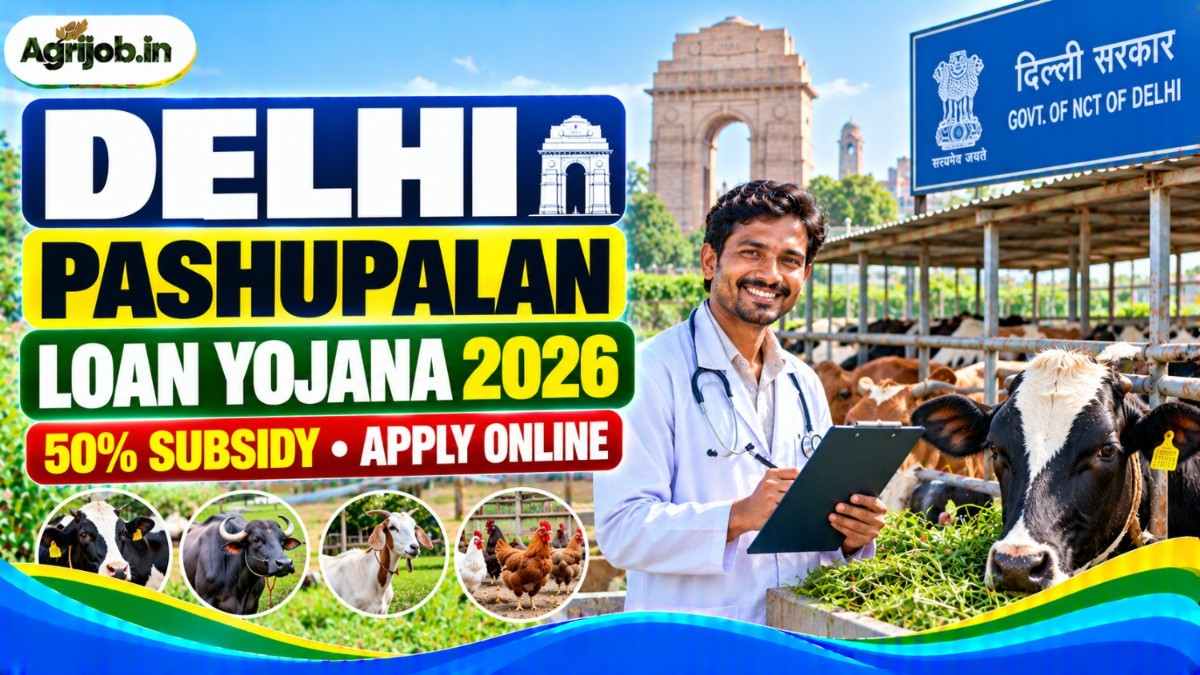
Delhi Pashupalan Loan Yojana 2026 is not a single scheme — it is an ecosystem of livestock financing programmes available to Delhi residents, combining Delhi state government initiatives, central government schemes from the Department of Animal Husbandry and Dairying (DAHD), NABARD refinance-backed dairy loans, commercial and cooperative bank products, and dairy cooperative society credit. Delhi, as the National Capital Territory, benefits from both Union Territory-level administrative support and the full range of central government livestock subsidy schemes.
Delhi’s animal husbandry sector is managed at two levels: the Delhi Animal Husbandry Department handles state-level administration, veterinary services, and dairy colony management, while the Delhi Milk Scheme (DMS) — a subordinate office of DAHD (Ministry of Fisheries, Animal Husbandry and Dairying, Government of India) — manages milk procurement and distribution. In 2026, Delhi Chief Minister Rekha Gupta chaired a high-level meeting with Animal Husbandry Department officials and announced a comprehensive dairy infrastructure transformation plan, including a model gaushala with Rs.40 crore budget allocation, signalling renewed state support for livestock entrepreneurs.

For financing, Delhi residents can stack multiple schemes: a central NLM subsidy of 50% + a NABARD DEDS back-ended subsidy + a Pashu KCC working capital line — all for the same qualifying project, subject to stacking rules. The combined effect can reduce your net capital outlay to as low as 25%–50% of total project cost.
Who Should Apply for Delhi Pashupalan Loan Yojana 2026?
- 🧑🌾 Delhi dairy farmers currently managing cows or buffaloes in authorized dairy colonies (e.g., Ghazipur Dairy Colony, Ghitorni) who want to expand their herd and modernize their unit
- 👩💼 Women entrepreneurs in Delhi who qualify for the enhanced 33.33% SC/ST/Women subsidy under NABARD DEDS and want to start a 2–10 animal dairy unit
- 🎓 Agriculture graduates and rural youth (18–35 years) from Delhi or NCR who want to set up a goat farm, poultry unit, or small dairy as a self-employment business
- 🏭 FPOs and dairy cooperatives in Delhi eligible for the Rs.46.08 crore interest subvention on working capital loans under the SDC/FPO scheme (DAHD 2026–27)
- 🐄 Gaushala operators and cow shelter managers in Delhi who want to access the new model gaushala development fund or central government scheme support
- 🏦 SC/ST families in Delhi who qualify for the 33.33% enhanced DEDS subsidy or the 50% NLM capital subsidy for goat/sheep/poultry units
- 🌾 Peri-urban farmers in Delhi NCR border areas (Najafgarh, Narela, Bawana) with land who want to set up a commercial dairy of 10–20 animals under NABARD DEDS
- 🏗️ Large dairy infrastructure investors (MSMEs, companies, FPOs) planning milk chilling, processing or feed plant projects above Rs.1 crore who can access AHIDF with 3% interest subvention
Delhi State Government Pashupalan Schemes 2026
Delhi operates as a Union Territory with limited state-exclusive animal husbandry schemes compared to full states, but it provides critical administrative and infrastructure support for livestock entrepreneurs.
A. Delhi Animal Husbandry Department — Veterinary & Infrastructure Support
The Delhi Animal Husbandry Department provides free or subsidized veterinary services, artificial insemination, and animal health camps across all 11 Delhi districts. While it does not operate a standalone capital subsidy loan scheme like some states, it acts as the nodal agency for channelling central government schemes (NLM, DEDS) to Delhi beneficiaries and verifying project eligibility.
| Service | Details | Cost to Beneficiary |
|---|---|---|
| Veterinary Consultation | At authorized dairy colonies, animal hospitals | Free / Nominal |
| Artificial Insemination (AI) | Breed improvement for high-yield crossbred cattle | Free at government centres |
| Animal Health Camps | Vaccination, deworming, disease prevention drives | Free |
| Dairy Colony Infrastructure | Upgraded facilities at Ghazipur, Ghitorni, Bakkarwala | Rs.40 crore model gaushala project (2026) |
| Project Verification (DPR) | Required for NLM and DEDS subsidy application | Free (Department process) |
B. Delhi Milk Scheme (DMS) — Procurement and Cooperative Integration
The Delhi Milk Scheme (DMS), a central government body under DAHD, operates a milk procurement and distribution network in Delhi. Dairy farmers who supply milk to DMS gain access to reliable procurement at fixed prices, and DMS-affiliated units may access the central SDC/FPO interest subvention scheme (Rs.46.08 crore allocated for 2026–27). DMS currently has a capacity of 5 lakh litres per day and is expanding procurement to newer colonies under the 2026 transformation plan.
Central Government Schemes for Delhi Pashupalan 2026
Central government schemes form the backbone of pashupalan financing in Delhi. These four programmes together cover every scale of livestock enterprise — from a 2-animal dairy to a Rs.10 crore processing plant.
1. National Livestock Mission (NLM) — 50% Capital Subsidy
The National Livestock Mission (NLM) is a centrally sponsored scheme implemented by the Department of Animal Husbandry and Dairying (DAHD) under the Ministry of Fisheries, Animal Husbandry and Dairying. Under its Entrepreneurship Development Programme (NLM-EDP), it provides a 50% one-time capital subsidy on eligible livestock enterprises including goat/sheep breeding farms (minimum 100 female units), backyard and commercial poultry, and piggery units. For a 100-female goat unit with a project cost of Rs.10 lakh, NLM delivers Rs.5 lakh back-ended subsidy directly to the beneficiary’s account through SIDBI in two equal instalments. Applications are 100% online at nlm.udyamimitra.in.
| NLM Component | Minimum Unit Size | Subsidy (50%) | Max Subsidy Ceiling |
|---|---|---|---|
| Goat/Sheep Breeding Farm | 100 female + 5 male | 50% of project cost | Rs.25 lakh per unit |
| Backyard Poultry (Rural) | As per DPR | 50% of project cost | Rs.25 lakh per unit |
| Commercial Poultry (Layer/Broiler) | As per DPR | 50% of project cost | Rs.25 lakh per unit |
| Piggery Unit | As per DPR | 50% of project cost | Rs.25 lakh per unit |
| Breed Improvement (Indigenous) | As per DAHD norms | 50% of project cost | Subject to DAHD ceiling |
2. Animal Husbandry Infrastructure Development Fund (AHIDF) — 3% Interest Subvention
The AHIDF is a central sector scheme under PM Atmanirbhar Bharat Abhiyan with a total fund allocation of Rs.29,110.25 crore (till March 2026). It provides up to 90% of project cost as a bank loan with a 3% annual interest subvention for 8 years (including 2-year moratorium) for dairy/meat/feed processing plants, milk chilling infrastructure, and animal feed units. The minimum loan under AHIDF is Rs.10 lakh and maximum is Rs.10 crore per project. MSMEs, private companies, and FPOs in Delhi are fully eligible. Applications go through scheduled commercial banks on the udyamimitra.in or dahd.gov.in portal.
3. NABARD Dairy Entrepreneurship Development Scheme (DEDS) — 25%–33.33% Back-Ended Subsidy
The DEDS (Dairy Entrepreneurship Development Scheme), implemented through NABARD as the nodal agency, provides a back-ended capital subsidy of 25% for General category and 33.33% for SC/ST and women beneficiaries on bankable dairy projects through scheduled commercial banks, cooperative banks, and RRBs. Small dairy units of 2–10 high-yielding milch animals, heifer calf rearing (up to 20 calves), milking machine purchase, and dairy processing equipment are covered. The subsidy is released by NABARD and credited to the borrower’s loan account — reducing effective loan liability. Delhi borrowers apply through their bank branch, which forwards the claim to NABARD.
4. Pashu Kisan Credit Card (PM Pashu KCC) — Collateral-Free Working Capital at 4% Effective Rate
The PM Pashu KCC (Animal Husbandry Kisan Credit Card) is a revolving working capital credit facility for all livestock farmers including dairy, goat, sheep, poultry, and piggery. As of 2026, the collateral-free limit has been raised to Rs.2 lakh per borrower (raised from Rs.1.60 lakh effective January 1, 2025). Under the Modified Interest Subvention Scheme (MISS), the base bank rate is 7% p.a., with a 3% subvention for prompt repayment — making the effective rate just 4% p.a. Per-animal loan benchmarks: Rs.60,249 per buffalo and Rs.40,783 per cow. Apply online at jansamarth.in or at any bank branch.
5. SDC/FPO Interest Subvention Scheme 2026–27 (Dairy Cooperatives)
DAHD has allocated Rs.46.08 crore for 2026–27 (till 30th September 2026) for providing interest subvention on working capital loans to dairy Cooperative Societies and Farmer Producer Organizations (FPOs) engaged in dairy activities, implemented through the National Dairy Development Board (NDDB). DMS-linked cooperatives and Delhi dairy FPOs may be eligible through their respective state dairy federation. Contact NDDB or your dairy cooperative society secretary for application details.
Bank Loan Options for Pashupalan in Delhi 2026
Beyond government subsidy schemes, commercial banks offer dedicated dairy and animal husbandry loan products that Delhi residents can access independently or in combination with the above subsidies.
| Bank / Product | Loan Range | Interest Rate | Tenure | Collateral |
|---|---|---|---|---|
| SBI Dairy Plus / Kisan Credit Card AH | Rs.50,000 – Rs.5 lakh | 7% p.a. (effective 4% with MISS) | Up to 72 months | Nil up to Rs.2 lakh |
| Indian Bank Dairy Loan | As per NABARD unit cost | As per RBI/NABARD norms | Max 72 months (12 months holiday for shed) | 15%–25% margin above Rs.2 lakh |
| MUDRA Loan (Kishore/Tarun/Tarun Plus) | Up to Rs.20 lakh | Competitive — varies by bank | Up to 5 years | Nil up to Rs.10 lakh (Tarun) |
| NABARD Refinance-backed Dairy Loan | Rs.7 lakh – Rs.50 lakh | 8–10% p.a. (varies) | Up to 7 years | Hypothecation of animals + land |
| PMEGP Livestock Loan (KVIC) | Up to Rs.25 lakh (manufacturing) / Rs.10 lakh (service) | Bank rate; 25%–35% subsidy | 3–7 years | As per bank norms |
Stack your financing for maximum benefit: apply for a NABARD DEDS-backed dairy loan at SBI/Indian Bank (25%–33.33% subsidy) AND simultaneously apply for a Pashu KCC for working capital (effective 4% interest, collateral-free up to Rs.2 lakh). The two schemes are complementary — DEDS reduces your capital loan liability, while Pashu KCC handles your monthly feed, veterinary and labour costs. Always confirm stacking eligibility with your bank manager before applying.
Cooperative Society Schemes for Pashupalan in Delhi
Dairy cooperative societies play a critical role in livestock financing in India. Delhi does not have a dedicated state dairy cooperative bank like NDDB-affiliated federations in Gujarat or Maharashtra, but Delhi dairy farmers can access cooperative credit through two routes.
- Delhi Cooperative Bank / DCCB: District Central Cooperative Banks in Delhi offer animal husbandry and dairy loans at competitive rates (typically 8.75%–10% p.a. as per NABARD guidelines) for livestock purchase, shed construction, and equipment. Application at the nearest DCCB branch with a project report and KYC documents.
- Delhi Milk Scheme (DMS) Cooperative Integration: Dairy farmers supplying to DMS or registered DMS-affiliated milk societies may access the DAHD SDC/FPO interest subvention for their working capital loans. This benefit passes through the cooperative to the member farmer, reducing effective borrowing costs on working capital by 2%–3% per annum.
- NDDB / NCDC Credit Lines: The National Cooperative Development Corporation (NCDC) and National Dairy Development Board (NDDB) provide bulk credit to dairy cooperatives and FPOs operating in Delhi, which is then on-lent to member farmers for animal purchase and dairy expansion at cooperative lending rates.
Subsidy Rates and Income Potential — Scheme-Wise Breakdown 2026
| Scheme / Programme | Loan Amount | Subsidy Rate | Activity Covered | Monthly Income Potential |
|---|---|---|---|---|
| NLM – Goat/Sheep Farm (100 females) | Rs.10 lakh (50% subsidy = Rs.5 lakh back-ended) | 50% | Goat/sheep breeding, meat | Rs.20,000 – Rs.40,000 |
| NLM – Poultry (commercial layer/broiler) | Rs.5 lakh – Rs.25 lakh | 50% | Layer/broiler poultry production | Rs.15,000 – Rs.60,000 |
| AHIDF (Dairy/Processing Plant) | Rs.10 lakh – Rs.10 crore | 3% interest subvention | Dairy, meat, feed plant | Rs.50,000 – Rs.5 lakh+ |
| NABARD DEDS (Small Dairy) | Rs.2 lakh – Rs.50 lakh | 25%–33.33% (back-ended) | Dairy farm 2–20 animals | Rs.18,000 – Rs.70,000 |
| Pashu KCC (Working Capital) | Up to Rs.2 lakh (collateral-free) / Rs.3 lakh | Effective 4% interest rate | Feed, vet, labour working capital | Supports existing unit cashflow |
| PMEGP (Livestock MSME) | Up to Rs.25 lakh | 25%–35% capital subsidy | Any livestock enterprise MSME | Rs.20,000 – Rs.80,000 |
| MUDRA Loan (Tarun Plus) | Up to Rs.20 lakh | No capital subsidy; low rate | Any non-farm livestock enterprise | Rs.15,000 – Rs.50,000 |
Eligibility Criteria for Delhi Pashupalan Loan Yojana 2026
Eligibility varies by scheme, but the following core criteria apply across most pashupalan loan programmes available to Delhi residents in 2026.
- Age: Minimum 18 years; maximum 60–65 years at loan maturity (varies by bank)
- Residency: Delhi/NCT resident; Aadhaar-linked Delhi address preferred for state-level schemes
- Activity: Must be engaged in or intending to start a qualifying livestock activity (dairy, goat, poultry, piggery, etc.)
- Land / Space: Proof of space or land for livestock rearing (own/leased shed or authorized dairy colony allotment); area norms apply — minimum 500m distance between two funded farms under NLM
- Bank Account: Active savings account with Aadhaar linkage (DBT requirement)
- CIBIL / Credit History: Clean credit record; no loan defaults; CIBIL score 650+ preferred by commercial banks
- Project Report (DPR): Detailed Project Report required for NLM, DEDS, AHIDF; not required for Pashu KCC or MUDRA Shishu
- Category-Specific: SC/ST/Women applicants get enhanced 33.33% DEDS subsidy; general category gets 25%; NLM gives 50% to all eligible categories
Application Fee Table — Delhi Pashupalan Loan Schemes 2026
| Scheme | Application Fee | Processing Charge |
|---|---|---|
| National Livestock Mission (NLM) | Nil (online portal) | Nil |
| NABARD DEDS (via bank) | Nil | As per bank norms on loan amount |
| AHIDF (via scheduled bank) | Nil (DAHD portal) | Bank processing fee (varies) |
| Pashu Kisan Credit Card | Nil | Nil (most banks waive for AH KCC) |
| MUDRA Loan | Nil (Shishu/Kishore); up to 0.5% for Tarun | Varies by bank |
| PMEGP | Nil | Bank processing charge applies |
How to Apply for Delhi Pashupalan Loan Yojana 2026 — Step-by-Step
- Identify your scheme: Based on your project size, category, and activity, choose your primary scheme. Small goat/poultry unit → NLM (50% subsidy, online). Small dairy 2–10 animals → NABARD DEDS (25%–33% subsidy, via bank). Large processing plant → AHIDF (3% interest subvention, via scheduled bank). Working capital only → Pashu KCC (4% effective, jansamarth.in).
- Contact Delhi Animal Husbandry Department: Visit your district’s Animal Husbandry office for DPR guidance, scheme eligibility confirmation, and the mandatory departmental verification letter required for NLM and DEDS applications.
- Prepare your Detailed Project Report (DPR): The DPR must include project cost estimation (animal purchase, shed construction, equipment), repayment plan, land/space details, and projected income. For NLM, DAHD provides DPR templates at nlm.udyamimitra.in.
- Register on the scheme portal: For NLM — register at nlm.udyamimitra.in using Aadhaar and PAN. For AHIDF — apply at dahd.gov.in or udyamimitra.in. For Pashu KCC — log in at jansamarth.in or visit your nearest SBI/PNB/Bank of Baroda branch with the KCC AH application form.
- Submit your application with documents: Upload Aadhaar, PAN, bank passbook, land/lease proof, DPR, caste certificate (if SC/ST), and the departmental verification letter. For bank-processed schemes (DEDS, MUDRA), submit the complete application kit at your bank branch.
- Bank/departmental appraisal: Your bank appraises the DPR and assesses creditworthiness. For NLM, DAHD’s State Level Disbursement Committee (SLDB) evaluates the application. Typical processing time: 30–60 days.
- Loan sanction and first disbursement: Bank sanctions the loan and releases the first instalment. For DEDS, the bank releases the loan first, then applies to NABARD for the back-ended subsidy — the subsidy is credited to your loan account after physical verification of the unit.
- Physical verification and subsidy release: For NLM — subsidy is released directly to your bank account in two equal instalments through SIDBI after inspection. For DEDS — NABARD releases subsidy to your bank after confirmation that the dairy unit is functional.
Delhi Pashupalan Loan vs Regular Bank Dairy Loan — Comparison 2026
| Parameter | Delhi Pashupalan Scheme (Subsidized) | Regular Commercial Bank Dairy Loan |
|---|---|---|
| Capital Subsidy | 25%–50% of project cost (DEDS / NLM) | No direct capital subsidy |
| Effective Interest Rate | 4% p.a. under Pashu KCC; 7%–9% under DEDS term loan | 10%–14% p.a. typical |
| Collateral Requirement | Nil up to Rs.2 lakh (Pashu KCC); nil up to Rs.10 lakh (NLM) | Collateral typically required above Rs.1 lakh |
| Maximum Loan Amount | Rs.10 crore (AHIDF) | Varies; typically up to Rs.2–5 crore for dairy |
| Subsidy Disbursement | Back-ended (credited to loan account after verification) | Not applicable |
| Application Mode | Online (NLM, AHIDF) / Bank branch (DEDS, KCC) | Bank branch / bank app |
| Processing Time | 30–90 days depending on scheme and DPR complexity | 7–21 days (pre-approved products faster) |
| Income Support | Pashu KCC + DEDS covers both capital and working capital | Only term loan for capital purchase |
| Best For | First-time pashupalan entrepreneurs, SC/ST, women, FPOs | Established businesses needing quick bridge capital |
For most Delhi livestock entrepreneurs in 2026, the optimal strategy is to combine NLM (50% subsidy for goat/poultry) or NABARD DEDS (25%–33% subsidy for dairy) with a Pashu KCC working capital line. This combination minimizes upfront capital outlay, reduces ongoing interest burden to just 4% effective, and covers both the capital investment and monthly operational costs. Large dairy processors should additionally explore AHIDF for infrastructure with 3% interest subvention. Regular commercial bank loans should only be used when speed of disbursement is critical and government scheme timelines don’t work for your project.
Pros and Cons of Delhi Pashupalan Loan Schemes 2026
Advantages
- ✅ High subsidy rate: NLM offers 50% capital subsidy — you fund only half the project cost yourself
- ✅ Collateral-free credit: Pashu KCC allows up to Rs.2 lakh with zero mortgage requirement
- ✅ Low effective interest: 4% p.a. under Pashu KCC is among the lowest interest rates for any business loan in India
- ✅ Multiple schemes stackable: DEDS subsidy + Pashu KCC can both apply to the same dairy unit
- ✅ Delhi’s urban proximity advantage: Delhi dairy farmers benefit from the Rs.80–Rs.120/litre urban milk retail market — one of the highest-paying markets in India
- ✅ Free veterinary support: Delhi Animal Husbandry Department provides free AI, vaccination, and animal health camps
Disadvantages
- ⚠️ No state-exclusive capital subsidy: Unlike states like Haryana (90% SC scheme) or MP (90% Dudharu scheme), Delhi has no dedicated high-subsidy state scheme; it relies entirely on central schemes
- ⚠️ Space constraints: Delhi’s high land cost and limited authorized dairy colony space restricts large-scale pashupalan; NLM’s 500m farm-distance rule is difficult to satisfy in dense urban areas
- ⚠️ DEDS back-ended subsidy risk: Subsidy is released only after the unit is operational and inspected — you must arrange upfront financing before subsidy credit arrives
- ⚠️ Long processing timelines: NLM and AHIDF applications can take 60–120 days for final approval; not suitable for urgent capital needs
Important Terms Related to Delhi Pashupalan Loan 2026
- NLM (National Livestock Mission): Central government scheme under DAHD offering a 50% back-ended capital subsidy for eligible livestock entrepreneurship units — the highest subsidy available in the pashupalan sector. Apply at nlm.udyamimitra.in.
- DEDS (Dairy Entrepreneurship Development Scheme): NABARD-implemented scheme providing 25% (General) / 33.33% (SC/ST/Women) back-ended capital subsidy for small dairy units of 2–20 animals. Apply via bank branch.
- AHIDF (Animal Husbandry Infrastructure Development Fund): Central scheme with Rs.29,110 crore corpus offering 3% annual interest subvention for 8 years on loans up to Rs.10 crore for dairy/feed/meat infrastructure. Apply at dahd.gov.in.
- Pashu KCC (Pashu Kisan Credit Card): Revolving working capital credit facility for livestock farmers — collateral-free up to Rs.2 lakh (2026 enhanced limit) at 4% effective interest. Apply at jansamarth.in.
- Back-Ended Subsidy: Subsidy disbursed after the project is set up and verified — not upfront; this means the borrower funds the full project initially and receives subsidy credit to their loan account later.
- NABARD (National Bank for Agriculture and Rural Development): The nodal agency for DEDS and other agricultural refinance schemes; provides technical norms for unit costs and subsidy ceilings.
- DPR (Detailed Project Report): Mandatory project documentation required for NLM, DEDS, and AHIDF applications — covers project cost, income projection, repayment plan, and technical specifications.
- MISS (Modified Interest Subvention Scheme): Central government scheme providing 1.5% bank interest subvention + 3% Prompt Repayment Incentive on KCC loans up to Rs.3 lakh — reduces effective rate from 7% to 4% p.a.
- SDC/FPO Scheme: DAHD scheme providing soft working capital loans and interest subvention to Dairy Cooperative Societies and Farmer Producer Organizations; Rs.46.08 crore allocated for 2026–27.
- DMS (Delhi Milk Scheme): Central government-owned dairy operating under DAHD with 5 lakh litre/day capacity; acts as procurement channel for Delhi dairy farmers and links units to cooperative financing routes.
Important Links — Delhi Pashupalan Loan Yojana 2026
| Resource | Link |
|---|---|
| DAHD — Central Animal Husbandry Schemes (Official) | dahd.gov.in |
| NLM Online Application Portal | nlm.udyamimitra.in |
| Pashu KCC / Jan Samarth Portal | jansamarth.in |
| AHIDF Application — DAHD / Udyami Mitra | udyamimitra.in |
| NABARD Official Website | nabard.org |
| Delhi Milk Scheme (DMS) — India.gov.in | india.gov.in – DMS Information |
| Agrijob — DEDS Scheme 2026 Complete Guide | agrijob.in – DEDS Scheme Guide |
| Agrijob — National Livestock Mission 2026 Guide | agrijob.in – NLM 2026 Guide |
| Agrijob — Pashu KCC Dairy Farming Loan 2026 | agrijob.in – Pashu KCC Guide |
| Agrijob — PM Dairy Loan Yojana 2026 (All Central Schemes) | agrijob.in – PM Dairy Loan Guide |
Conclusion
Delhi Pashupalan Loan Yojana 2026 gives livestock entrepreneurs in the National Capital Territory access to one of India’s most comprehensive government-backed livestock financing ecosystems — combining central government subsidies (NLM at 50%, NABARD DEDS at 25%–33.33%), AHIDF infrastructure support, and collateral-free Pashu KCC working capital at just 4% effective interest. While Delhi lacks a standalone high-subsidy state scheme like MP or Haryana, the combined central scheme package covers every scale of operation from a 2-animal dairy to a Rs.10 crore processing plant. If you are a Delhi resident planning to start or expand a dairy, goat, or poultry unit, start by visiting your district Animal Husbandry Department office for DPR assistance, then apply on nlm.udyamimitra.in or visit your nearest bank branch for DEDS or Pashu KCC. Bookmark this page — it is updated regularly as official scheme guidelines change.
- NLM gives the highest capital subsidy at 50% (up to Rs.25 lakh per unit) for goat, sheep, and poultry enterprises — apply online at nlm.udyamimitra.in
- NABARD DEDS provides 25%–33.33% back-ended subsidy for small dairy units of 2–20 milch animals through scheduled banks across Delhi
- Pashu KCC (collateral-free up to Rs.2 lakh) is available at 4% effective interest — the lowest-cost working capital option for any Delhi livestock farmer
- AHIDF supports large dairy infrastructure projects up to Rs.10 crore with a 3% annual interest subvention for 8 years for MSMEs and FPOs
- DAHD has allocated Rs.46.08 crore in 2026–27 for dairy cooperative and FPO working capital interest subvention — DMS-linked cooperatives in Delhi are eligible
- Delhi state is investing Rs.40 crore in a model gaushala and dairy infrastructure transformation in 2026 — watch for new state-level disbursement opportunities
Frequently Asked Questions About Delhi Pashupalan Loan Yojana 2026
What is Delhi Pashupalan Loan Yojana 2026?
Delhi Pashupalan Loan Yojana 2026 is the collective term for all livestock loan and subsidy programmes available to Delhi residents, including central government schemes (NLM, DEDS, AHIDF, Pashu KCC), bank dairy loans, cooperative society credit, and Delhi state government support through the Animal Husbandry Department and Delhi Milk Scheme. Any Delhi resident aged 18+ engaged in dairy, goat, poultry, or piggery can access these programmes.
What is the maximum subsidy available under Delhi Pashupalan Loan 2026?
The highest subsidy available is 50% capital subsidy under the National Livestock Mission (NLM), with a maximum ceiling of Rs.25 lakh per eligible unit for goat/sheep/poultry enterprises. NABARD DEDS offers 25% (General) or 33.33% (SC/ST/Women) for dairy units. Both are back-ended subsidies released after the unit becomes operational and passes departmental inspection.
How much loan can a Delhi dairy farmer get without collateral in 2026?
Under the Pashu Kisan Credit Card (Pashu KCC), Delhi dairy farmers can get a collateral-free working capital loan of up to Rs.2 lakh (enhanced from Rs.1.60 lakh with effect from January 1, 2025). This requires only hypothecation of the animals and no land mortgage. The effective interest rate is just 4% p.a. for timely repayment under the Modified Interest Subvention Scheme (MISS).
Does Delhi have its own state pashupalan scheme separate from central schemes?
Delhi does not have a standalone high-capital-subsidy state scheme like Madhya Pradesh’s Mukhyamantri Dudharu Pashu Praday Yojana (90% subsidy) or Haryana’s SC Livestock Scheme (90% goat/sheep). Delhi’s state support is primarily through the Animal Husbandry Department’s free veterinary services, AI, and the 2026 dairy infrastructure transformation plan (Rs.40 crore model gaushala). For capital subsidies, Delhi residents rely on central schemes (NLM, DEDS, AHIDF).
How to apply for NLM subsidy in Delhi 2026?
To apply for the National Livestock Mission subsidy in Delhi: (1) Register at nlm.udyamimitra.in using Aadhaar and PAN; (2) Submit a Pre-Application Expression of Interest (EoI) with your project details; (3) Prepare a Detailed Project Report (DPR) with cost estimates; (4) Get your application evaluated by DAHD’s State Level Disbursement Body; (5) Arrange bank loan for 50% project cost; (6) Subsidy is released in two equal instalments through SIDBI after inspection. The entire process is online — no physical submission is required.
Can women entrepreneurs in Delhi get extra pashupalan loan benefits in 2026?
Yes. Women applicants qualify for an enhanced DEDS subsidy of 33.33% (same as SC/ST category) under the NABARD Dairy Entrepreneurship Development Scheme, compared to 25% for general category applicants. Additionally, PMEGP gives rural women entrepreneurs a 35% capital subsidy (vs 25% for general urban applicants). Women-led SHGs and FPOs are also eligible for the DAHD SDC/FPO interest subvention on working capital loans through dairy cooperatives.
What is the AHIDF scheme and how can Delhi dairy entrepreneurs use it?
The Animal Husbandry Infrastructure Development Fund (AHIDF) is a central government scheme with a Rs.29,110 crore national corpus providing up to 90% of project cost as a bank loan with a 3% annual interest subvention for 8 years (2-year moratorium included). Delhi-based MSMEs, private companies, and FPOs can use AHIDF for milk chilling, processing plants, feed plants, or any dairy infrastructure project between Rs.10 lakh and Rs.10 crore. Apply through scheduled commercial banks or at dahd.gov.in / udyamimitra.in.
What documents are needed for Delhi Pashupalan Loan application?
Core documents required for most pashupalan loan applications in Delhi: Aadhaar card, PAN card, bank passbook (6-month statement), passport-size photographs, proof of land/shed/dairy colony allotment, Detailed Project Report (DPR) for loans above Rs.2 lakh, caste certificate (for SC/ST applicants), income certificate (if applicable), and a departmental verification letter from the Delhi Animal Husbandry Department. For Pashu KCC, only Aadhaar, PAN, and bank account details are needed — no DPR required.
How long does it take to get subsidy disbursement under NLM or DEDS in Delhi?
Under NLM, the typical timeline from application to final subsidy disbursement is 3–6 months: application screening (30 days), bank loan sanction (30–45 days), unit setup (30–90 days), physical inspection, and then subsidy release in two instalments through SIDBI. Under DEDS, timeline is similar: bank sanctions loan and releases disbursement, then applies to NABARD for subsidy claim; NABARD releases subsidy to the loan account after inspection — typically 90–150 days from initial application.
What is the income potential from a 10-animal dairy unit in Delhi 2026?
A 10-animal dairy unit (mixed HF/Murrah buffalo herd) in Delhi can generate Rs.40,000–Rs.70,000 per month in gross milk revenue at Delhi’s retail-linked procurement prices of Rs.35–Rs.50 per litre. After deducting feed costs (approximately Rs.15,000–Rs.20,000/month for 10 animals), net monthly income ranges from Rs.20,000–Rs.50,000 per month. Urban proximity to Delhi’s premium milk market — one of India’s highest per-capita milk consumption zones — provides above-average price realization compared to rural dairy farmers.
Last Updated: October 2026 | This guide is reviewed and updated regularly for accuracy. Bookmark this page for the latest information on Delhi Pashupalan Loan Yojana schemes and subsidy updates.
Disclaimer: This article is for informational purposes only. Subsidy amounts, eligibility criteria, and scheme guidelines are subject to change by DAHD, NABARD, and the Delhi Animal Husbandry Department. Always verify current scheme status at official portals (dahd.gov.in, nabard.org, nlm.udyamimitra.in) before applying. Agrijob.in is not responsible for any loss arising from reliance on this information.