
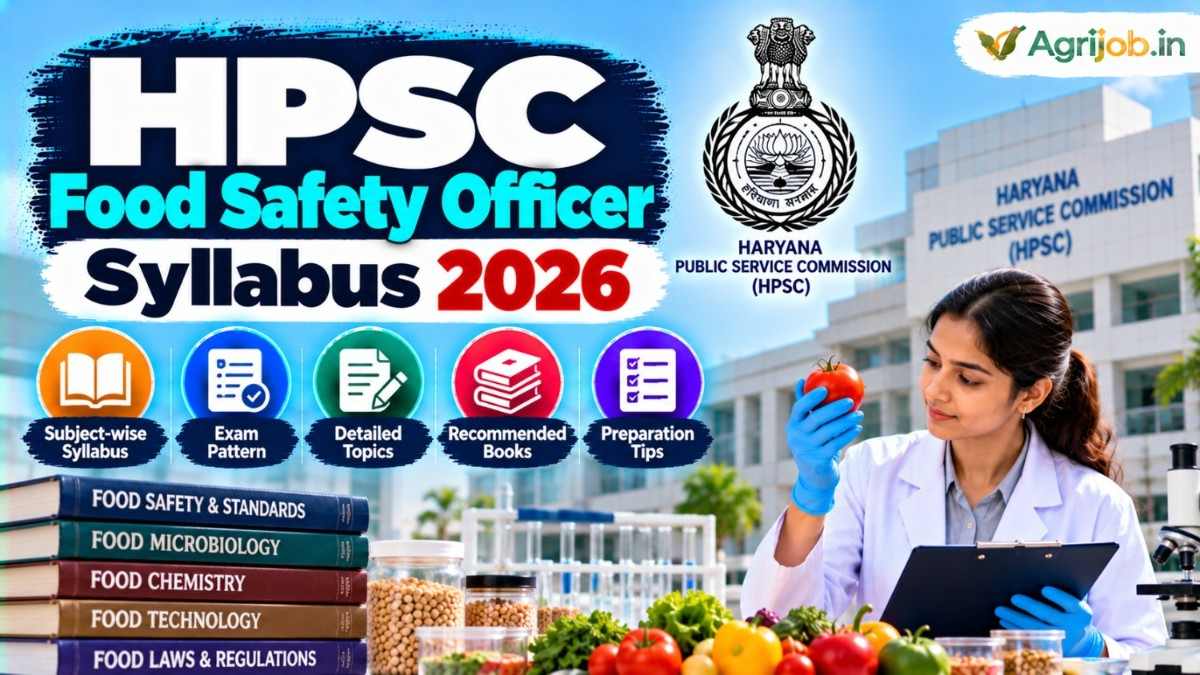
HPSC Food Safety Officer Syllabus 2026 has been officially released by the Haryana Public Service Commission for 45 Group-B FSO posts under Advertisement No. 25/2026. The Screening Test is scheduled for 6 December 2026, followed by the Subject Knowledge Test on 31 January 2027. This complete guide covers the full syllabus (all 12 units), the three-stage exam pattern, expected category-wise cut-off trends, and a proven 90-day strategy to crack both stages.

This guide is for food technology, agriculture, microbiology, biochemistry, and medical graduates aged 18–42 who are targeting a gazetted Group-B government job in Haryana’s Food and Drugs Administration Department. You will find the exact unit-wise breakdown, marking scheme, scoring pattern, and a week-by-week preparation roadmap — everything in one place.
The HPSC FSO 2026 selection has 3 stages: a 100-mark Screening Test (qualifying only, held 6 Dec 2026), a 150-mark descriptive Subject Knowledge Test covering 12 food-science units (87.5% weightage, held 31 Jan 2027), and an Interview (12.5% weightage). Candidates must score at least 25 marks in the Screening Test and 35% (52.5 out of 150) in the Subject Knowledge Test to qualify.
- Conducting Body: Haryana Public Service Commission (HPSC)
- Post: Food Safety Officer (Group-B) — Food & Drugs Administration, Haryana
- Advertisement No.: 25/2026 (published 19 September 2026)
- Total Vacancies: 45 posts (UR: 22 | DSC: 05 | OSC: 05 | BC-A: 05 | BC-B: 03 | EWS: 05)
- Pay Scale: FPL-6, Cell-1 — Rs.35,400/month (approx. Rs.56,000/month CTC with allowances)
- Screening Test Date: 6 December 2026
- Subject Knowledge Test Date: 31 January 2027
- Screening Test Marks: 100 marks | 100 MCQs | 2 hours | English medium
- Subject Knowledge Test: 150 marks | Subjective | 3 hours | 87.5% final weightage
- Interview Weightage: 12.5% of final merit score
- Minimum Qualifying: 25 marks in Screening; 35% (52.5/150) in Subject Knowledge Test
- Official Website: hpsc.gov.in
- What Is HPSC Food Safety Officer Exam 2026?
- Who Should Apply for HPSC FSO 2026?
- HPSC FSO Exam Pattern 2026 — All 3 Stages
- HPSC FSO Screening Test Syllabus 2026
- HPSC FSO Subject Knowledge Test — All 12 Units
- HPSC FSO Salary, Pay Scale and Job Profile
- Vacancy Breakup, Eligibility and Application Fee
- HPSC FSO Previous Cut-Off Trends — Category-Wise
- HPSC FSO vs FSSAI FSO — Comparison Table
- Pros and Cons of HPSC FSO 2026
- How to Crack HPSC FSO 2026 — 90-Day Strategy
- Important Terms Related to Food Safety Officer Exam
- Important Links
- Conclusion
- Key Takeaways
- Frequently Asked Questions
What Is HPSC Food Safety Officer Exam 2026?
The HPSC Food Safety Officer Exam 2026 is a state-level competitive examination conducted by the Haryana Public Service Commission to recruit candidates for 45 Group-B gazetted posts in the Food and Drugs Administration Department, Haryana. A Food Safety Officer (FSO) under the Food Safety and Standards Act, 2006 (FSSA) is a statutory authority empowered to lift food samples, inspect premises, seize non-conforming products, and prosecute violators. The post comes with a pay scale of Rs.35,400/month (FPL-6) and job security equivalent to a Class-II government officer in Haryana.

The selection happens across three stages: first a Screening Test to shortlist candidates (qualifying only — marks not counted in final merit), then a descriptive Subject Knowledge Test of 150 marks that carries 87.5% weightage, and finally an interview worth 12.5%. With only 45 vacancies and thousands of eligible applicants from food technology, agriculture, medical science and allied disciplines, the competition is intense — but the exam is achievable with focused subject preparation.
Who Should Apply for HPSC FSO 2026?
This guide and the FSO exam itself is ideal for the following candidate profiles:
- 🎓 Food Technology / Food Engineering graduates — core discipline; highest advantage in the Subject Knowledge Test
- 🌾 Agriculture Science / Horticulture degree holders — primary production and food supply units are a strength area
- 🔬 Microbiology / Biochemistry / Chemistry graduates — strong base for food microbiology and analytical chemistry units
- ⚕️ MBBS, BDS, BAMS, and other medical degree holders — eligible under the notification; nutrition and food safety law units suit them
- 🧪 Biotechnology / Oil Technology degree holders — food biotechnology Unit XII is a direct match
- 🥛 Dairy Technology graduates — food commodities and product technology (Unit V) is a natural strength
- 📋 Candidates who appeared in FSSAI FSO exams — significant syllabus overlap; HPSC FSO is a strong parallel opportunity
- 🏡 Haryana-domicile candidates in reserved categories (DSC, OSC, BC-A, BC-B, EWS) — strong competition advantage due to lower cut-off and higher proportional vacancy share
HPSC FSO Exam Pattern 2026 — All 3 Stages
The HPSC FSO 2026 selection process follows a three-stage design. The Screening Test (Stage 1) is held only if the number of applicants is very large; if the Commission decides to skip it, shortlisting is done on academic percentage directly. The Subject Knowledge Test (Stage 2) is the core exam and the most important stage. The Interview (Stage 3) rounds off the final merit. The table below shows the complete exam pattern with all key parameters:
| Parameter | Stage 1: Screening Test | Stage 2: Subject Knowledge Test | Stage 3: Interview |
|---|---|---|---|
| Exam Date | 6 December 2026 | 31 January 2027 | To be notified |
| Type of Questions | MCQ (5 options per question) | Subjective / Descriptive | Viva-Voce |
| Total Marks | 100 marks | 150 marks | Not specified separately |
| Duration | 2 hours | 3 hours | — |
| Medium | English | English | English / Hindi |
| Negative Marking | 1/4 mark per wrong answer; also 1/4 deducted if 5th option not marked | No negative marking | — |
| Minimum Qualifying Score | 25 marks out of 100 | 35% (52.5 out of 150) | — |
| Weightage in Final Merit | Qualifying only — NOT counted in final merit | 87.5% | 12.5% |
Key insight: Since the Screening Test carries zero weightage in the final merit list, candidates must treat Stage 2 as the main battle. Scoring 100+ out of 150 in the Subject Knowledge Test is the real target for a safe rank in the general (UR) category. The interview shortlist typically calls 3 candidates per vacancy, so roughly 135 candidates will be interviewed for the 45 posts.
HPSC FSO Screening Test Syllabus 2026
The Screening Test covers general aptitude subjects — not food science. This is a qualifying round, so the strategy is to score above 25 marks comfortably (aim for 50–60 marks) without over-investing study time. The major topics are:
- General Studies & Current Affairs: National and international events, government schemes, science and technology, economic survey, Union Budget 2026, India’s ranking in global indices
- Reasoning & Analytical Ability: Puzzles, coding-decoding, blood relations, direction sense, syllogism, logical reasoning, data sufficiency
- Basic Numeracy & Data Interpretation: Percentages, ratios, profit/loss, simple and compound interest, pie charts, bar graphs, data tables
- Haryana General Knowledge: Haryana history, geography, major rivers, crops, government schemes (e.g., Mhara Gaon Jagmag Gaon), awards, cultural heritage, Haryana government policies, food safety and nutrition programs in Haryana
- English Language: Reading comprehension, grammar, sentence correction, vocabulary, fill in the blanks
In the HPSC FSO 2026 Screening Test, the 5th option rule is critical: if you are unsure about an answer and skip the question, you must mark the 5th option (No Answer) to avoid losing 0.25 marks. Do NOT leave any question blank — always mark option 5 for questions you wish to skip. This is different from most government exams and can significantly affect your score if ignored.
HPSC FSO Subject Knowledge Test — All 12 Units
The Subject Knowledge Test is the heart of the HPSC FSO 2026 selection. It is a descriptive exam of 150 marks covering 12 units. Candidates must score at least 35% (52.5 marks) to be shortlisted for the interview. This test carries 87.5% of the final merit score, making it the single most decisive stage of the entire recruitment process. Here is the complete unit-wise breakdown:
Unit I: Food Chemistry and Constituents
- Composition and properties of macronutrients: carbohydrates, proteins, lipids, water
- Micronutrients: vitamins (fat-soluble and water-soluble), minerals and trace elements
- Food enzymes and their industrial functions (amylase, protease, lipase, oxidoreductases)
- Chemical reactions affecting food quality and shelf life: Maillard reaction, lipid oxidation, enzymatic browning, hydrolysis
- Macronutrient and micronutrient deficiencies, malnutrition, and food fortification strategies
- Nutraceuticals, phytochemicals, bioactive compounds, antioxidants in foods
Unit II: Human Nutrition and Dietary Requirements
- Recommended Dietary Allowances (RDA) for Indian population — ICMR guidelines 2020
- Nutritional requirements across life stages: infants, children, adolescents, pregnant/lactating women, elderly
- Protein-energy malnutrition (PEM), micronutrient deficiency diseases (anemia, rickets, pellagra, xerophthalmia)
- Diet planning, balanced diet concepts, therapeutic diets
- Food fortification programs: FSSAI fortification standards (rice, wheat, oil, salt, milk)
- National nutrition programs: PM POSHAN (Mid-Day Meal), ICDS, Eat Right India
Unit III: Food Microbiology
- Microbial contamination of food: bacteria, fungi, viruses, parasites, prions
- Food spoilage organisms and mechanisms (psychrophiles, mesophiles, thermophiles)
- Beneficial microorganisms: fermentation (yogurt, cheese, idli, wine, beer, vinegar)
- Foodborne pathogens: Salmonella, E. coli O157:H7, Listeria monocytogenes, Staphylococcus aureus, Clostridium botulinum — symptoms, incubation periods, food vehicles
- Food safety indicators: coliform count, E. coli, APC (Aerobic Plate Count)
- Microbial limits as per FSSAI Food Safety and Standards (Contaminants, Toxins and Residues) Regulations
- Rapid detection methods for foodborne pathogens: ELISA, PCR, lateral flow assay
Unit IV: Primary Production and Food Supply
- Traditional and modern farming systems in India and Haryana
- Good Agricultural Practices (GAP), Good Animal Husbandry Practices (GAHP)
- Pesticide residue management, Maximum Residue Limits (MRL) under FSSAI
- Pre-harvest and post-harvest practices, cold chain management
- Hurdle technology, enzymes as processing aids, food additives (INS numbers), nutraceuticals, and functional foods
- Food supply chain integrity, food traceability, recall systems
Unit V: Food Commodities and Product Technology
- Technology of major food commodities: cereals, pulses, oilseeds, fruits, vegetables, meat, poultry, fish, eggs, dairy, sugar and confectionery
- Processing of traditional and regional Indian food products
- Emerging processing technologies: microwave, ohmic, infrared, induction heating, high-pressure processing (HPP), pulsed electric field (PEF)
- Packaging materials and food-contact safety: migration limits, food-grade standards under FSSAI
- Modified atmosphere packaging (MAP), active and intelligent packaging
Unit VI: Food Processing and Preservation
- Principles of food preservation: heat treatment (pasteurization, sterilization, UHT), cold storage, drying, freeze-drying, fermentation, canning, irradiation
- Water activity (aw) and its role in food preservation
- Food additives: preservatives, antioxidants, emulsifiers, stabilizers, colors, flavors — permitted under FSSAI regulations with INS numbers
- HACCP (Hazard Analysis and Critical Control Points): principles, CCP identification, monitoring, corrective actions
- GMP (Good Manufacturing Practices) and GHP (Good Hygiene Practices) for food factories
Unit VII: Food Hazards, Hygiene and Safety Management
- Food Safety and Standards Act, 2006 (FSSA): history, definitions, organizational structure, powers of authorities, offences and penalties, licensing and registration
- Food Safety and Standards Rules, 2011 and all related Regulations (Labelling, Packaging, Contaminants, Products Standards, etc.)
- Roles and powers of Food Safety Officer, Designated Officer, Food Analyst, Commissioner of Food Safety, FSSAI Central Advisory Committee
- Food contaminants, adulterants, food fraud, food safety risk analysis (risk assessment, risk management, risk communication)
- Rapid Analytical Food Testing (RAFT) kits, food surveillance, market sampling
- Eat Right India campaign, Clean Street Food Hubs, RUCO (Repurpose Used Cooking Oil) program
- ISO 22000:2018 food safety management system: monitoring, corrective action, verification, validation, traceability, documentation
- Standard setting process, enforcement procedures, imports, food testing laboratory network, third-party food safety audits
Unit VIII: Food Sampling, Analysis and Laboratory Quality
- Official sampling procedures under FSSAI: designated food safety officers, sealed sample protocol, referee samples, public analyst reports
- Proximate analysis: moisture, ash, crude protein (Kjeldahl), crude fat (Soxhlet), crude fiber, carbohydrates (by difference)
- Analytical techniques: spectrophotometry (UV-Vis), HPLC, GC-MS, atomic absorption spectroscopy (AAS), titration methods
- Rapid testing methods and field test kits for adulterants (RAFT kits, milk adulteration testing)
- Laboratory quality assurance: ISO/IEC 17025, accreditation, standard operating procedures (SOPs), uncertainty of measurement
- Common food adulterants and their detection methods in India
Unit IX: Indian Food Law and Regulatory Compliance
- FSSAI licensing and registration categories (turnover-based thresholds), conditions of license
- Food labelling requirements: mandatory declarations, nutritional information per 100g/ml, allergen labeling, traffic light labeling
- Import and export of food articles under FSSAI — Import Regulations, PCP (Prior Certificate of Permission)
- Legal metrology requirements for packaged commodities
- Adjudication process, penalty structure (Sections 51–67 of FSSAI), food recall procedures
- Identifying binding regulatory requirements vs. advisories and draft standards
- Other food-related Acts: Prevention of Food Adulteration Act (PFA) — historical context; Weights and Measures Act; Environment Protection Act provisions for food packaging
Unit X: FSSAI Systems and Programs
- FSSAI’s Food Safety Ecosystem: FoSCoS (Food Safety Compliance System), Petatrack, Sugam portal
- Eat Right Index, State Food Safety Index (SFSI) — Haryana’s ranking
- Product approval process for novel foods, proprietary foods, and organic products
- Food Fortification Resource Centre (FFRC) and FSSAI’s fortification mandate
- FSSAI’s Clean Plant Program, Blissful Hygienic Offering to God (BHOG), Hygienic Street Food programs
- Food testing laboratory network: FSSAI-notified labs, referral labs, NABL accreditation
Unit XI: International Food Control and Standards
- Codex Alimentarius Commission: structure, functions, significance for India, Codex standards, guidelines, and codes of practice
- WHO and FAO’s role in global food safety
- WTO Sanitary and Phytosanitary (SPS) Agreement and Technical Barriers to Trade (TBT) Agreement
- International standards for pesticide residues: JMPR (Joint Meeting on Pesticide Residues)
- Comparison of FSSAI standards with Codex and EU food regulations
- IPPC (International Plant Protection Convention) for plant-based food safety
Unit XII: Food Biotechnology and Emerging Developments
- Genetically modified (GM) organisms in food: development, safety assessment, FSSAI regulations on GM foods
- Enzyme technology in food: immobilized enzymes, industrial applications
- Functional foods, nutraceuticals, probiotics, prebiotics, synbiotics — definitions and FSSAI standards
- Nanotechnology in food: nanopackaging, nanoencapsulation, regulatory status
- Food fraud and emerging adulterants: new trends in detection and prevention
- Artificial intelligence, blockchain, and digital traceability in food supply chains
- Alternative proteins: plant-based meat, insect protein, cultured meat — global and Indian regulatory outlook
HPSC FSO Salary, Pay Scale and Job Profile
An HPSC Food Safety Officer is a Class-II gazetted officer in Haryana’s Food and Drugs Administration Department. The pay scale and in-hand salary structure is as follows:
| Component | Amount (2026) |
|---|---|
| Basic Pay (FPL-6, Cell-1) | Rs.35,400/month |
| Dearness Allowance (DA) — approx. 53% of Basic | Rs.18,762/month |
| House Rent Allowance (HRA) — approx. 16% of Basic (city-dependent) | Rs.5,664/month |
| Travel Allowance / Medical Allowance | Rs.1,000–2,000/month |
| Estimated In-Hand Salary (post tax) | Rs.52,000–Rs.58,000/month |
| Annual Increment (3% of Basic as per 7th Pay) | Rs.1,062/year |
| Retirement Age | 58 years |
| Pension | Old Pension Scheme (OPS) or NPS — per Haryana Govt notification |
Job responsibilities of an HPSC FSO include: collecting food samples from the market, inspecting food businesses (restaurants, factories, retail stores), seizing adulterated or non-conforming food articles, filing prosecution under FSSAI, coordinating with the public analyst, and educating food business operators (FBOs) on compliance with FSSAI regulations.
Vacancy Breakup, Eligibility and Application Fee
| Category | Vacancies | Application Fee | Age Relaxation |
|---|---|---|---|
| Unreserved (UR / General) | 22 | Rs.1,000 | 18–42 years |
| Deprived Scheduled Castes (DSC) | 05 | Rs.250 | 5-year relaxation |
| Other Scheduled Castes (OSC) | 05 | Rs.250 | 5-year relaxation |
| Backward Classes-A (BC-A, NCL) | 05 | Rs.250 | 5-year relaxation |
| Backward Classes-B (BC-B, NCL) | 03 | Rs.250 | 5-year relaxation |
| Economically Weaker Section (EWS) | 05 | Rs.250 | Per Haryana Govt rules |
| Haryana Women (any category) | Horizontal | Rs.250 | Per Haryana Govt rules |
| Ex-Servicemen (General) — Horizontal | 02 | Rs.1,000 (UR) / Rs.250 (reserved) | 3x service + 3 yrs |
| PwBD (min. 40% disability, Haryana) | 02 | Nil | 5 years (+5 if also SC/BC/EWS); max 52 years |
| Total | 45 | — | — |
Educational Qualification: Degree in Food Technology, Food Engineering, Dairy Technology, Oil Technology, Biotechnology, Agriculture Science, Veterinary Science, Biochemistry, Microbiology, Chemistry, or a recognized medical degree (MBBS, BDS, BAMS, etc.), plus Hindi/Sanskrit passed at Matric level.
HPSC FSO Previous Cut-Off Trends — Category-Wise
HPSC has not officially published category-wise cut-off marks for the FSO exam historically, as the final cut-off is determined post-examination based on paper difficulty and candidate performance. However, based on trends from HPSC Group-B exams and comparable state-level FSO recruitments (FSSAI CFSO, UPPSC FSO), the expected cut-off ranges for the HPSC FSO Subject Knowledge Test (out of 150 marks) are as follows:
| Category | Vacancies (2026) | Expected Cut-Off Range (SKT, out of 150) | FSSAI CFSO 2023 CBT-1 Benchmark (out of 300) |
|---|---|---|---|
| Unreserved (UR) | 22 | 90–110 marks | UR: 300 (max) |
| EWS | 05 | 80–100 marks | EWS: 267 |
| DSC / SC | 05 (DSC) + 05 (OSC) | 70–90 marks | SC: 267 |
| BC-A | 05 | 80–100 marks | OBC: 279 |
| BC-B | 03 | 75–95 marks | OBC: 279 |
| PwBD | 02 (horizontal) | 52–70 marks (minimum qualifying: 52.5) | PwBD (HH): 109 |
Important note on cut-offs: HPSC has confirmed that official qualifying cut-offs for the 2026 examination are “Not Released / To Be Updated” and will be determined post-examination. The above ranges are indicative estimates based on HPSC Group-B patterns (ADO, PGT, Safety Officer) and should be used as a planning benchmark, not as official data. Candidates targeting a safe rank in the UR category should aim for 100+ out of 150 in the Subject Knowledge Test.
Factors affecting cut-off in 2026: 45 vacancies (more than 2025’s 41 posts) means slightly more relaxed cut-offs. The descriptive nature of the Subject Knowledge Test favors well-prepared candidates who can write structured answers over those who rely on rote MCQ preparation. The interview shortlist (3 per vacancy = 135 candidates) means 135 candidates compete for 45 posts — a 1:3 ratio — where interview performance matters considerably.
HPSC FSO vs FSSAI Central FSO — Comparison Table
| Parameter | HPSC Food Safety Officer 2026 | FSSAI Central Food Safety Officer |
|---|---|---|
| Conducting Body | Haryana Public Service Commission (HPSC) | FSSAI via NTA/SSC |
| Vacancies (recent cycle) | 45 (2026 cycle) | Varies; last major cycle ~275 posts (2023) |
| Pay Scale | Rs.35,400/month (FPL-6) | Rs.44,900–Rs.1,42,400 (Pay Level 7, approx. Rs.65,000 in-hand) |
| Exam Type | MCQ Screening + Descriptive SKT + Interview | CBT Stage 1 (MCQ) + CBT Stage 2 (MCQ) + Document Verification |
| Exam Level | State (Haryana only) | Central (all India) |
| Eligibility (domicile) | Haryana domicile for reservations; all India can apply for UR | All India; no domicile restriction |
| Interview | Yes — 12.5% weightage | No interview in recent cycles |
| Syllabus Overlap | 12-unit SKT with heavy FSSAI law focus | Heavy FSSAI Act, food science, microbiology focus |
| Job Location | Haryana only | Pan-India; transferable |
| Best For | Haryana-domicile candidates wanting state-level government job | All-India candidates seeking higher pay and central government benefits |
For Haryana-domicile candidates, HPSC FSO 2026 is the stronger option right now — lower competition in reserved categories, descriptive exam rewards deep understanding, and state government perks (potential OPS benefits). For candidates from other states or those targeting higher pay, FSSAI Central FSO remains the gold standard. Both exams share nearly 70% of their syllabus, so preparing for HPSC FSO automatically builds a strong foundation for FSSAI exams.
Pros and Cons of HPSC FSO 2026
Advantages of HPSC FSO 2026
- ✅ Gazetted Group-B post — higher social standing and administrative powers than Group-C government jobs
- ✅ 45 vacancies — more seats than the 2025 cycle (41 posts), reducing competition marginally
- ✅ Statutory powers under FSSAI — FSOs have legal authority to inspect, sample, and prosecute; a respected law-enforcement role
- ✅ Multiple eligibility streams — food tech, agriculture, medical, microbiology, chemistry graduates all eligible
- ✅ Lower fee for reserved categories — Rs.250 vs Rs.1,000 for UR; substantial saving
- ✅ Descriptive SKT rewards subject expertise — food science specialists can outperform MCQ test-takers
Disadvantages of HPSC FSO 2026
- ❌ Pay scale lower than FSSAI Central FSO — Rs.35,400 vs Rs.44,900 basic pay at central level
- ❌ No official historical cut-off data — makes target-setting uncertain for UR category aspirants
- ❌ Subjective SKT format is less predictable — unlike MCQ exams, examiner subjectivity can affect scores
- ❌ Haryana posting only — unlike central government positions, no pan-India transfer option
How to Crack HPSC FSO 2026 — 90-Day Strategy
With the Screening Test on 6 December 2026 and the Subject Knowledge Test on 31 January 2027, candidates have approximately 90–120 days of preparation time. Here is a structured, phase-wise preparation strategy:
Phase 1 (Days 1–30): Foundation Building
- Download and print the official HPSC FSO Syllabus 2026 PDF from hpsc.gov.in. Read every unit carefully — mark topics you are strong in (Score: 3), average at (Score: 2), and weak in (Score: 1).
- Master FSSAI Act 2006 and Rules 2011 completely. Unit VII and Unit IX together make up approximately 25–30% of SKT marks. Read the actual text of the Act, not just summaries. Know all penalties, powers of FSO, DO, and Commissioner.
- Complete food chemistry and food microbiology basics (Units I and III). These are the most scoring technical units. Study from NDRI or CFTRI study material, or from standard textbooks on food science.
- Build a Haryana GK + Current Affairs note for the Screening Test. Focus on Haryana government schemes (2024–26), food safety programs, and HPSC-relevant topics.
Phase 2 (Days 31–60): Subject Depth and Practice
- Cover Units II, IV, V, VI, VIII — nutrition, primary production, food commodities, processing, and food analysis. Prepare chapter-wise notes in point form for quick revision.
- Solve 3–4 previous FSO papers (FSSAI CFSO, UPPSC FSO, RPSC FSO) to understand question patterns, frequently tested topics, and typical descriptive answer length.
- Practice writing descriptive answers under timed conditions. The SKT is a 3-hour paper for 150 marks — practice writing 150–200 word structured answers for each topic sub-unit.
- Cover Codex Alimentarius and international food standards (Unit XI) — these are often asked in descriptive FSO exams and differentiate high scorers from average candidates.
Phase 3 (Days 61–90): Revision, Mock Tests and Final Push
- Take 5–7 full-length mock tests for the Screening Test under timed conditions (2 hours, 100 MCQs). Target 55–65 marks in mocks to ensure comfortable qualification.
- Revise all 12 units of the SKT using your condensed notes. Spend extra time on FSSAI Act provisions, Codex standards, and food microbiology pathogens — these recur most frequently.
- Prepare 2-minute verbal answers on key topics (food adulteration detection, HACCP principles, ISO 22000, FSSAI licensing categories) for interview preparation in parallel.
- Bookmark hpsc.gov.in and check regularly for admit card release (expected 2–3 weeks before exam), exam schedule changes, and official answer key after the Screening Test.
FSSAI’s Food Safety and Standards Act, 2006 (Unit VII) and Indian Food Law (Unit IX) together make up the most high-value units in the SKT. Every FSO examiner expects thorough knowledge of the Act — sections, definitions, penalty amounts (up to Rs.10 lakh for certain offences), appeal mechanisms, and FSO powers (Section 38). Memorize these sections verbatim and you will outscore most competitors. Recommended resource: FSSAI’s official Act PDF + PAN FSO guide (available at fssai.gov.in).
Important Terms Related to HPSC FSO Exam 2026
- FSSAI (Food Safety and Standards Authority of India): Autonomous body under Ministry of Health & Family Welfare, India. Regulates manufacture, storage, distribution, sale and import of food through FSSA 2006. Headquarters: New Delhi.
- Food Safety Officer (FSO): Designated officer under Section 36 of FSSA 2006 with powers to lift food samples, inspect food premises, seize sub-standard or unsafe food, and initiate prosecution.
- HACCP: Hazard Analysis and Critical Control Points — a food safety management system that identifies, evaluates and controls food safety hazards. Internationally recognized under Codex Alimentarius.
- ISO 22000:2018: International standard for food safety management systems integrating HACCP principles and PRPs (Prerequisite Programs). Required for large food businesses in India.
- Codex Alimentarius: A collection of internationally adopted food standards, guidelines and codes of practice by the FAO/WHO Codex Alimentarius Commission. India is a member and aligns FSSAI standards with Codex.
- MRL (Maximum Residue Limit): Maximum level of pesticide residue legally permissible in food. Set by FSSAI under the Contaminants, Toxins and Residues Regulations 2011.
- Water Activity (aw): The availability of water in food for microbial growth and chemical reactions. Foods with aw above 0.85 support bacterial growth; foods below 0.60 are shelf-stable without refrigeration.
- Maillard Reaction: Non-enzymatic browning reaction between amino acids and reducing sugars at high temperatures. Responsible for the color and flavor of bread crust, roasted coffee, and grilled meat — a key topic in food chemistry.
- State Food Safety Index (SFSI): Annual ranking by FSSAI of state performance in food safety — covers human resources, compliance, food testing, training, and consumer empowerment. Haryana’s SFSI score influences state-level FSO priorities.
- RAFT Kits (Rapid Analytical Food Testing): Portable field-testing kits for food safety officers to detect common adulterants (milk adulteration, oil rancidity, starch in milk) on-site within minutes without a lab.
Important Links — HPSC FSO 2026
| Link / Resource | URL |
|---|---|
| HPSC Official Website | hpsc.gov.in |
| FSSAI Official Website | fssai.gov.in |
| FSSAI Food Safety and Standards Act 2006 PDF | FSSAI Act 2006 (Official PDF) |
| Codex Alimentarius Commission | fao.org/codex |
| HPSC FSO Recruitment 2026 — Agrijob.in | HPSC FSO 2026 Full Details |
| HPSC FSO Previous Year Papers | Download PYQs (Adda247) |
Conclusion
The HPSC Food Safety Officer Syllabus 2026 is comprehensive but well-structured — 12 units for the Subject Knowledge Test, a straightforward qualifying Screening Test, and a 12.5% weightage interview. Candidates who go deep on FSSAI Act 2006, food microbiology, and food chemistry will have a decisive edge in the descriptive SKT. With 45 vacancies — the largest HPSC FSO cycle in recent years — and a Rs.35,400/month starting pay, this is one of the best Group-B government job opportunities for food and agriculture science graduates in Haryana in 2026.
Start your preparation today with the FSSAI Act and the 12-unit syllabus. Bookmark this page and the official HPSC website (hpsc.gov.in) for admit card updates, exam schedule changes, and post-exam cut-off notifications. Check our related guide on HPSC FSO Recruitment 2026 for complete eligibility, salary, and application details.
- HPSC FSO 2026 has 45 vacancies across 6 categories; Screening Test on 6 Dec 2026, SKT on 31 Jan 2027
- The Subject Knowledge Test (150 marks, 12 units) carries 87.5% of final merit — this is the exam that determines your rank
- Minimum qualifying marks: 25/100 in Screening Test; 52.5/150 (35%) in Subject Knowledge Test
- Expected cut-off for UR category in SKT: 90–110 marks out of 150; reserved categories: 70–100 marks
- FSSAI Act 2006 + food microbiology + food chemistry together cover approximately 40–45% of SKT marks — prioritize these 3 areas
- Visit hpsc.gov.in regularly and bookmark this guide — we update it as official cut-offs and results are released
Frequently Asked Questions About HPSC Food Safety Officer Syllabus 2026
What is the HPSC FSO 2026 Screening Test date?
The HPSC Food Safety Officer Screening Test 2026 is scheduled for 6 December 2026. It is a 100-mark MCQ exam of 2 hours duration, conducted in English medium. Candidates must score at least 25 marks to be shortlisted for the Subject Knowledge Test. Note that the Commission may skip the Screening Test and shortlist candidates based on academic percentage if the applicant numbers do not warrant it.
How many units are in the HPSC FSO Subject Knowledge Test?
The HPSC FSO Subject Knowledge Test 2026 contains 12 units covering all areas of food science, food law, and related disciplines. These are: Food Chemistry and Constituents, Human Nutrition, Food Microbiology, Primary Production and Food Supply, Food Commodities and Product Technology, Food Processing and Preservation, Food Hazards and Safety Management (FSSAI Act), Food Sampling and Analysis, Indian Food Law and Regulatory Compliance, FSSAI Systems and Programs, International Food Control and Standards, and Food Biotechnology and Emerging Developments.
What is the weightage of the HPSC FSO interview?
The interview (Viva-Voce) carries 12.5% weightage in the final merit list for HPSC FSO 2026. The Subject Knowledge Test carries 87.5% weightage. The Screening Test is qualifying only and does not count in the final merit. Candidates who score 35% or more in the Subject Knowledge Test are shortlisted for interview, with approximately 3 candidates called per vacancy (around 135 total for 45 posts).
What is the expected cut-off for HPSC FSO 2026?
HPSC has not released official historical cut-off data for FSO exams. Based on comparable HPSC Group-B exams and FSSAI FSO trends, the expected Subject Knowledge Test cut-off (out of 150 marks) is approximately 90–110 marks for UR, 80–100 marks for EWS and BC-A, 70–90 marks for DSC and OSC categories. These are indicative estimates. The official cut-off will be published on hpsc.gov.in after the SKT result.
Is negative marking applicable in HPSC FSO 2026?
Yes, the Screening Test has 1/4 mark (0.25) negative marking per incorrect answer. Uniquely, 1/4 mark is also deducted if the fifth option (No Answer) is not marked for a question you skip — so you must always mark option 5 for unattempted questions. There is no negative marking in the Subject Knowledge Test, which is a descriptive (subjective) exam.
Which units should I prioritize in the HPSC FSO SKT?
Prioritize Unit VII (Food Hazards and FSSAI Act) and Unit IX (Indian Food Law) first — these carry the highest marks and are most asked in FSO descriptive exams. Follow with Unit III (Food Microbiology) and Unit I (Food Chemistry). These four units together constitute approximately 45–50% of a typical FSO written paper. Units XI (International Standards — Codex) and Unit XII (Food Biotechnology) are differentiation areas that separate 90+ scorers from average candidates.
Can candidates from outside Haryana apply for HPSC FSO 2026?
Yes, candidates from all states of India can apply for HPSC FSO 2026 — however, they can only compete under the Unreserved (UR) category and pay the UR application fee of Rs.1,000. Age relaxation, fee concession, and reservation benefits (DSC, OSC, BC-A, BC-B, EWS, ESM) are available only to bonafide residents/domiciles of Haryana. Non-Haryana candidates competing in UR against 22 posts face the highest cut-off threshold.
What is the minimum age for HPSC FSO 2026?
The minimum age for HPSC FSO 2026 is 18 years and the maximum age is 42 years as on the closing date (19 October 2026) for the general/UR category. Reserved categories (DSC, OSC, BC-A, BC-B, EWS) get a 5-year upper age relaxation (maximum 47 years). PwBD candidates get an additional 5-year relaxation (maximum 52 years). Ex-Servicemen receive relaxation equal to 3 times their service period plus 3 years, subject to the 52-year cap.
What books should I use to prepare for HPSC FSO 2026?
The most recommended resources for HPSC FSO 2026 preparation are: (1) FSSAI Act 2006 official text (free from fssai.gov.in) — mandatory reading; (2) Food Safety Officer Previous Year Solved Papers (any FSSAI/state FSO edition — check for 2024 or 2025 edition); (3) Food Technology: Principles and Practices by Norman Potter for food chemistry and processing; (4) Microbiology of Food by Frazier and Westhoff for food microbiology; (5) Toppersexam.com HPSC FSO MCQ question bank for Screening Test practice. Always supplement with standard NCERT-level chemistry and biology for basics.
Last Updated: October 2026 | Source: HPSC Official Notification 25/2026 (hpsc.gov.in) | This guide is reviewed and updated regularly as HPSC releases official answer keys, results, and cut-off data. Bookmark this page for the latest information.
Disclaimer: This post is for informational and educational purposes only. Salary figures, cut-off estimates, and exam dates are based on officially published HPSC notifications and comparable government recruitment data as of October 2026. Always verify the latest information directly from hpsc.gov.in before making any exam-related decisions.