
Pradhan Mantri Dairy Loan Yojana 2026 – Schemes, Subsidy & Apply
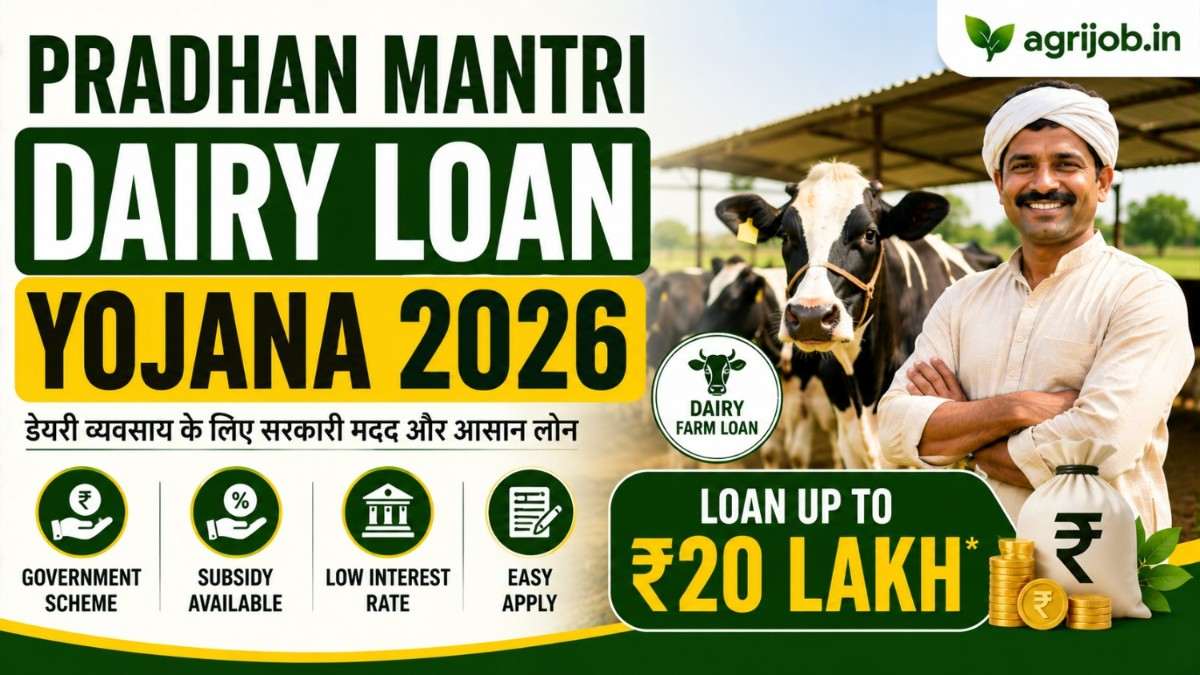
The Pradhan Mantri Dairy Loan Yojana 2026 is the common search term used by millions of Indian farmers looking for central government dairy financing — but here is the important truth: there is no single scheme by this exact name. What exists is a powerful umbrella of 6 central government dairy schemes, together worth over Rs.50,000 crore in combined budgets, that jointly form what people call the “PM dairy yojana.” These include the Animal Husbandry Infrastructure Development Fund (AHIDF) with Rs.29,110 crore corpus, DEDS-pattern NABARD dairy loans with 25–33% subsidy, the Pradhan Mantri Pashu Kisan Credit Card (PM-KCC) offering dairy working capital at just 4% effective interest, the National Livestock Mission (NLM) with 50% capital subsidy for dairy entrepreneurship, the Rashtriya Gokul Mission (RGM) for indigenous breed development, and the National Programme for Dairy Development (NPDD) for cooperative infrastructure. This 2026 complete guide covers all 6 schemes side-by-side — eligibility, loan amount, subsidy percentage, official portal links, and step-by-step application process — so you can identify and apply for the scheme that is right for your dairy farm.

- What Is PM Dairy Loan Yojana 2026? The 6-Scheme Umbrella Explained
- Comparison of All 6 Central Government Dairy Schemes 2026
- AHIDF – Rs.29,110 Crore Dairy Infrastructure Loan 2026
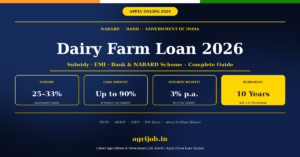
- NABARD DEDS-Pattern Dairy Loan – 25% to 33% Subsidy
- PM Pashu Kisan Credit Card – Dairy Working Capital at 4%
- National Livestock Mission – 50% Subsidy for Dairy Entrepreneurship
- Rashtriya Gokul Mission – Indigenous Breed & Dairy Development
- PM Dairy Loan Yojana Eligibility 2026 – All Categories
- How to Apply for PM Dairy Loan Yojana Online 2026
- Who Should Apply for PM Dairy Loan Yojana 2026?
- Central PM Dairy Schemes vs State Dairy Schemes: Key Differences
- High-Value Dairy Finance Terms You Must Know in 2026
- Frequently Asked Questions (FAQ)
| Number of Central Schemes | 6 (AHIDF, DEDS/NABARD, PM-KCC, NLM, RGM, NPDD) |
| Implementing Ministry | Dept. of Animal Husbandry & Dairying (DAHD), Govt. of India |
| Total Combined Budget | Over Rs.50,000 crore (all 6 schemes combined) |
| Max Loan Amount | Up to Rs.10 crore per project (AHIDF) |
| Max Subsidy | 50% capital subsidy (NLM / RGM) up to Rs.2 crore |
| Min Interest Rate | 4% effective (PM-KCC with Prompt Repayment Incentive) |
| Eligible Borrowers | Farmers, SHGs, FPOs, Private companies, MSMEs, Cooperatives |
| SC/ST Benefit | Higher 33.33% subsidy under DEDS-pattern; priority under NLM |
| Application Mode | Online (udyamimitra.in, jansamarth.in, eoi.nddb.coop, bank apps) |
| Official Portal | dahd.gov.in |
What Is PM Dairy Loan Yojana 2026? The 6-Scheme Umbrella Explained
When farmers search for Pradhan Mantri dairy loan yojana 2026, they are actually searching for a cluster of central government dairy financing programmes operated by the Department of Animal Husbandry and Dairying (DAHD) under the Ministry of Fisheries, Animal Husbandry and Dairying. India is the world’s largest milk producer — contributing over 5% to the national GDP and directly supporting 80 million+ rural households. To sustain and grow this sector, the Government of India under PM Narendra Modi’s Atmanirbhar Bharat initiative has built a comprehensive dairy finance architecture across 6 distinct schemes.
Each of the 6 central dairy schemes targets a different beneficiary type, loan size, and development objective. Together they cover the entire dairy value chain — from a 2-animal small farmer unit (DEDS/NABARD) to a Rs.10 crore dairy processing plant (AHIDF). The PM Pashu Kisan Credit Card covers day-to-day working capital for dairy cattle care; the National Livestock Mission (NLM) funds dairy entrepreneurship with a 50% capital subsidy; the Rashtriya Gokul Mission (RGM) promotes indigenous cow breeds like Sahiwal, Gir, and Rathi; and the NPDD modernises milk testing and chilling infrastructure for cooperatives. Understanding which scheme applies to your specific situation is the most important first step before starting the application process for PM dairy loan yojana 2026.

Comparison of All 6 Central Government Dairy Schemes 2026
Here is the complete side-by-side comparison of all 6 central government dairy loan schemes in India 2026, so you can immediately identify the right scheme for your dairy project:
| Scheme | Budget / Corpus | Target Beneficiary | Max Loan | Subsidy / Benefit | Apply Portal |
|---|---|---|---|---|---|
| AHIDF (Animal Husbandry Infrastructure Development Fund) | Rs.29,110.25 crore (till March 2026) | FPOs, Private companies, MSMEs, Individual entrepreneurs | Rs.10 crore/project | 3% interest subvention + 25% credit guarantee | udyamimitra.in / Scheduled Banks |
| DEDS-Pattern NABARD Loan | NABARD refinance (ongoing) | Individual farmers, SHGs, NGOs, cooperatives | Rs.5 lakh (10-animal unit) | 25% (general) / 33.33% (SC/ST) back-ended subsidy | SBI YONO Krishi / Bank branch |
| PM Pashu KCC (Animal Husbandry KCC) | Central scheme — ongoing | All dairy farmers with milch animals | Rs.5 lakh (KCC limit raised 2025–26) | Interest at 7% (effective 4% with PRI) | jansamarth.in / Bank branch |
| NLM (National Livestock Mission) | Centrally Sponsored Scheme (ongoing) | Individuals, FPOs, SHGs, cooperatives | Rs.50 lakh (breed improvement unit) | 50% capital subsidy (up to Rs.2 crore for certain components) | nlm.udyamimitra.in |
| RGM (Rashtriya Gokul Mission) | Rs.2,400 crore (2021–26) | Dairy farmers with indigenous breeds | Project-based | 50% subsidy (up to Rs.2 crore) for breed multiplication farms | eoi.nddb.coop |
| NPDD (National Programme for Dairy Development) | Rs.1,568.28 crore (incl. JICA aid) | State Cooperative Dairy Federations, milk unions, SHGs | As per project | Loan + govt. grant for chilling/testing infrastructure | dahd.gov.in / NDDB |
AHIDF – Rs.29,110 Crore Dairy Infrastructure Loan 2026
The Animal Husbandry Infrastructure Development Fund (AHIDF) is the flagship central scheme under the PM dairy loan umbrella and the largest by corpus. Launched under Atmanirbhar Bharat, its revised budget of Rs.29,110.25 crore has been extended until FY 2025-26 (31 March 2026). AHIDF provides subsidised loans to private dairy entrepreneurs, FPOs, individual businesspersons, MSMEs, and Section 8 companies for building dairy processing infrastructure, animal feed plants, breed improvement farms, veterinary vaccine production units, and animal waste management facilities. AHIDF has already increased India’s milk processing capacity by 141.04 lakh litres per day (LLPD) since inception.
Under AHIDF, the central government provides a 3% interest subvention directly to the borrower on bank loans, and a 25% credit guarantee on the total borrowing — significantly reducing both the cost and risk of the loan. The maximum loan is Rs.10 crore per project, repayable over a maximum of 10 years including a holiday period of up to 2 years. AHIDF does NOT fund land acquisition. Security includes hypothecation of assets, equitable mortgage of land and building, and personal guarantee of directors or partners. For MSME-defined ceiling loans, the 25% credit guarantee is available. Applications are submitted at udyamimitra.in or through empanelled scheduled banks.
NABARD DEDS-Pattern Dairy Loan – 25% to 33% Back-Ended Subsidy
The Dairy Entrepreneurship Development Scheme (DEDS) was the original central government dairy subsidy scheme. While formally discontinued as a standalone scheme from 2020-21, banks and NABARD continue to provide dairy loans using the same subsidy structure and NABARD refinance framework. This DEDS-pattern NABARD dairy loan is the most accessible PM dairy yojana option for individual farmers starting or expanding small dairy units of 2 to 10 milch animals.
Under this scheme, general category borrowers receive a 25% back-ended capital subsidy (maximum Rs.1.25 lakh for a 10-animal unit at Rs.5 lakh project cost) and SC/ST farmers receive 33.33% subsidy (maximum Rs.1.67 lakh). The subsidy is not paid upfront — it is held by the lending bank in a Subsidy Reserve Fund Account and adjusted against the borrower’s final few EMI payments after 12 months of satisfactory dairy unit operations. Eligible animals include crossbred cows, indigenous breeds like Sahiwal and Gir, and graded buffaloes like Murrah. Eligible applicants include individual farmers, SHGs, NGOs, JLGs, milk cooperatives, and farmer producer organisations with no prior loan default. Applications are made through SBI, Bank of Baroda, PNB, Canara Bank, Central Bank of India, and Regional Rural Banks.
PM Pashu Kisan Credit Card – Dairy Working Capital at 4% Interest
The Pradhan Mantri Pashu Kisan Credit Card (PM Pashu KCC) is the central government’s most widely accessible dairy finance tool, designed for day-to-day working capital needs of dairy farmers. Extended to the animal husbandry sector in 2019, the KCC provides a revolving credit facility to all dairy farmers owning milch cows, buffaloes, goats, or other livestock. As of 2026, 44.40 lakh KCCs have been issued for animal husbandry activities across India, with a special drive by DAHD to issue KCCs to all dairy farmers in milk cooperative societies and milk producer companies.
The KCC interest rate is 7% per annum, which reduces to an effective 4% with the 3% Prompt Repayment Incentive for farmers who repay on time. In Budget 2025-26, the short-term loan limit under the Modified Interest Subvention Scheme was raised from Rs.3 lakh to Rs.5 lakh, allowing dairy farmers to borrow more at the concessional 7% rate. As of 2026, the scheme has gone fully digital with the d-KCC (digital Kisan Credit Card) rollout offering Aadhaar-based e-KYC and faster approvals via the JanSamarth portal at jansamarth.in. KCC holders also receive accidental death and disability insurance of Rs.50,000 and other risk coverage of Rs.25,000 as part of the credit card facility. No collateral is required for loans up to Rs.1.6 lakh under PM Pashu KCC.
National Livestock Mission – 50% Subsidy for Dairy Entrepreneurship
The National Livestock Mission (NLM) is a Centrally Sponsored Scheme focused on employment generation, entrepreneurship development, and per-animal productivity improvement in the livestock sector including dairy. The re-aligned NLM (launched 2021-22) provides a 50% capital subsidy — up to Rs.2 crore in certain components — to individuals, FPOs, SHGs, JLGs, and Section 8 companies setting up breed improvement projects, dairy cow or dairy buffalo farming entrepreneurship units, fodder production units, and animal feed enterprises. For dairy farmers in North-Eastern and Hilly States, the NLM provides 50% subsidy up to Rs.50 lakh.
Under NLM-Entrepreneurship Development Programme (NLM-EDP), applications are submitted at nlm.udyamimitra.in. Financial assistance under NLM can be availed from all scheduled banks and financial institutions across India. The scheme directly supports Modi dairy yojana 2026 goals of doubling farmers’ income and generating rural self-employment, with the livestock sector having achieved a CAGR of 7.93% between 2014-15 and 2020-21.
Rashtriya Gokul Mission – Indigenous Breed & Dairy Development 2026
The Rashtriya Gokul Mission (RGM), running since December 2014 under the umbrella scheme Rashtriya Pashudhan Vikas Yojana with a Rs.2,400 crore budget for 2021-26, specifically targets the development and conservation of indigenous bovine breeds like Sahiwal, Gir, Rathi, Tharparkar, and Murrah buffalo. Over 70% of livestock farming is done by women in India; RGM directly supports rural women’s empowerment through breed improvement and dairy productivity enhancement.
Under RGM’s Breed Multiplication Farm (BMF) component, eligible dairy farmers receive a 50% capital subsidy (up to Rs.2 crore) for construction of cattle sheds, equipment, and procurement of elite bull mothers. Farmers apply through the NDDB portal at eoi.nddb.coop. The subsidy is released directly to the beneficiary’s loan account through NDDB in tranches — 75% upfront and remaining 25% after 10% of calves are born at the farm. RGM has so far established 16 Gokul Grams (integrated cattle development centres) across India and implemented nationwide Artificial Insemination with sex-sorted semen at 50% subsidy.
- 🐄 Small farmer (2–10 cows): Apply for DEDS-pattern NABARD loan via your nearest SBI or Bank of Baroda branch. Get 25–33% back-ended subsidy + PM Pashu KCC for working capital at 4%.
- 🏭 Dairy entrepreneur (processing plant, feed unit): Apply for AHIDF at udyamimitra.in. Get loan up to Rs.10 crore with 3% interest subvention + 25% credit guarantee.
- 🌿 Indigenous breed farmer (Gir, Sahiwal): Apply for RGM Breed Multiplication Farm at eoi.nddb.coop. Get 50% subsidy up to Rs.2 crore.
- 🚀 Dairy startup or FPO: Apply for NLM-EDP at nlm.udyamimitra.in. Get 50% capital subsidy for dairy entrepreneurship up to Rs.50 lakh.
PM Dairy Loan Yojana Eligibility 2026 – All Categories
Eligibility for the Pradhan Mantri dairy loan yojana 2026 varies by scheme but the common thread across all 6 central dairy schemes is as follows. Understanding category-wise eligibility is critical before applying to avoid rejection:
| Eligibility Parameter | Requirement |
|---|---|
| Nationality | Indian citizen |
| Age | 18 to 65 years (for individual applicants) |
| Loan default status | No prior default with any bank or financial institution (CIBIL must be clean for AHIDF; not mandatory for some state cooperative banks) |
| Land / Shed | Own or leased land for dairy shed (mandatory for DEDS/NABARD); not required for KCC working capital |
| Animal ownership | Minimum 2 milch animals for DEDS loans; at least 10 cows producing 200 litres/day for DIDF |
| Education | No minimum qualification for individual farmers; training from KVK or approved centre recommended |
| Entity type (AHIDF) | Private company, MSME, FPO, SHG, Section 8 company, individual entrepreneur |
| SC/ST Category | Higher 33.33% subsidy under DEDS-pattern NABARD loans; priority processing under NLM and RGM |
| Women applicants | Priority under RGM (70%+ of livestock work done by women), NLM, and many state-level dairy schemes |
| Application fee | Nil — no application fee under any central dairy scheme |
How to Apply for PM Dairy Loan Yojana Online 2026
The application process for Pradhan Mantri dairy loan yojana 2026 depends on which of the 6 schemes you are applying for. Here is the step-by-step process for each major pathway:
- 🎯 Step 1 – Identify your scheme: Based on your project size, entity type, and dairy goal, choose your primary scheme from the 6 central dairy schemes. Small farmer → DEDS/NABARD + PM Pashu KCC. Large processing unit → AHIDF. Indigenous breed farmer → RGM. Dairy entrepreneur → NLM. Cooperative → NPDD.
- 📊 Step 2 – Prepare your Detailed Project Report (DPR): For AHIDF, NLM, and RGM, a formal bankable project report is mandatory. It must include capital expenditure plan, income-expenditure projections for 5–7 years, animal breed details, shed construction plan, and loan repayment schedule. For PM Pashu KCC and small DEDS/NABARD loans, a simpler bank application form suffices.
- 🌐 Step 3 – Apply online at the correct portal:
- AHIDF: udyamimitra.in or directly at your nearest scheduled bank
- NLM Entrepreneurship: nlm.udyamimitra.in
- RGM Breed Multiplication Farm: eoi.nddb.coop
- PM Pashu KCC: jansamarth.in or SBI YONO app / Bank of Baroda BOB World Kisan
- DEDS/NABARD Dairy Loan: Visit nearest SBI, Bank of Baroda, PNB, Canara Bank, or RRB branch; SBI YONO Krishi for online application
- NPDD: Submit DPR through NDDB or State Cooperative Dairy Federation to DAHD at dahd.gov.in
- 📁 Step 4 – Upload documents: Standard KYC documents (Aadhaar, PAN, address proof), land documents or lease agreement, bank account statement (6 months), DPR, caste certificate for SC/ST subsidy, passport photos, and animal insurance intent letter. AHIDF additionally requires company registration proof, GST number, and projected cash flow statement.
- ✅ Step 5 – Bank evaluation and loan sanction: The empanelled bank reviews the DPR for technical feasibility and financial viability. Approval takes 15–30 working days for DEDS/NABARD loans and up to 60 days for AHIDF projects. On sanction, the bank sets loan terms — interest rate, repayment tenure, moratorium period, and collateral requirements.
- 💰 Step 6 – Loan disbursement and project implementation: Funds are disbursed in 2–3 tranches linked to project milestones — animal purchase, shed construction, equipment installation. You contribute your margin money (10–25% of project cost) alongside the bank loan.
- 🏛️ Step 7 – Bank claims subsidy / interest subvention from DAHD / NABARD: The bank applies to NABARD (for DEDS-pattern) or DAHD (for AHIDF interest subvention) on your behalf. You do not approach NABARD or DAHD directly for the subsidy. The subsidy or interest benefit is credited to your loan account after satisfactory operations.
- 🎉 Step 8 – Subsidy adjustment and loan closure: Back-ended subsidies (DEDS/NABARD) are adjusted against your final EMIs after 12 months. AHIDF’s 3% interest subvention is applied annually, reducing your effective interest burden each year. NLM and RGM subsidies are released directly to your loan account through NDDB or scheduled banks in tranches.
Who Should Apply for PM Dairy Loan Yojana 2026?
The Pradhan Mantri dairy loan yojana 2026 is designed for a wide cross-section of India’s dairy sector. Here are the 8 profiles who should apply immediately in 2026:
- 🧑🌾 Small and marginal farmers with 2–10 milch animals who want a subsidised DEDS-pattern NABARD loan of up to Rs.5 lakh with 25–33.33% back-ended capital subsidy for expanding their dairy herd.
- 👩 Rural women and women SHG members — over 70% of livestock farming work in India is done by women. RGM, NLM, and most state-level dairy schemes give priority processing to women dairy entrepreneurs seeking PM dairy yojana benefits.
- 🏭 Private dairy entrepreneurs planning milk processing units, animal feed plants, or veterinary vaccine production facilities who can access up to Rs.10 crore at 3% lower interest under AHIDF.
- 🐄 Indigenous breed cattle farmers rearing Gir, Sahiwal, Rathi, or Murrah buffaloes who want to set up breed multiplication farms with 50% capital subsidy up to Rs.2 crore under the Rashtriya Gokul Mission.
- 🤝 Farmer Producer Organisations (FPOs) and cooperative societies looking for AHIDF loans for large-scale dairy infrastructure or NPDD grants for chilling and milk testing equipment modernisation.
- 🎓 Agriculture graduates and rural youth wanting to start a dairy entrepreneurship business using NLM’s 50% subsidy and structured bank financing — dairy farming can generate Rs.1–2 lakh/month from a 15-cow commercial unit.
- 💳 Existing dairy farmers without working capital access who need funds for feed, medicines, and cattle care at just 4% effective interest through the PM Pashu Kisan Credit Card (PM Pashu KCC).
- 🌿 Dairy cooperatives and milk federations (such as district milk unions in Bihar, UP, Rajasthan, Gujarat) that want NPDD grants for bulk milk coolers, automatic milk collection units, and quality testing laboratories to improve organised milk procurement and marketing.
Central PM Dairy Schemes vs State Dairy Schemes: Key Differences
Many dairy farmers wonder whether to apply for central PM dairy schemes or their state government’s dairy schemes. Here is a comprehensive comparison to help you decide:
| Parameter | Central PM Dairy Schemes (AHIDF / NLM / RGM) | State-Level Dairy Schemes |
|---|---|---|
| Coverage | All 28 states + 8 UTs | State-specific (e.g., UP Nand Baba Mission, Haryana Pashu KCC) |
| Loan Amount | Up to Rs.10 crore (AHIDF) | Usually Rs.1–20 lakh |
| Subsidy | 25%–50% (varies by scheme) | 25%–80% in some states (UP gives 40% for indigenous breeds) |
| Interest Rate | 4%–8.05% (with subvention) | 0%–6% in some states (state subvention stacked with centre) |
| Eligibility | Pan-India; broad including private companies, FPOs | State residents only; often priority to BPL/SC/ST |
| Application Portal | udyamimitra.in, jansamarth.in, eoi.nddb.coop | State animal husbandry department portal or district office |
| Processing Time | 30–60 days (AHIDF); 15–30 days (DEDS/NABARD) | 7–45 days depending on state |
| Stacking | Can be combined with state schemes in many cases | Central + state subsidy both claimable by some borrowers |
| Best For | Large-scale dairy infrastructure, entrepreneurship, breed farms | Small and marginal farmers wanting quick local processing |
High-Value Dairy Finance Terms You Must Know in 2026
Understanding these 10 high-value terms will help you navigate all 6 central PM dairy loan yojana 2026 schemes with confidence when speaking with bank officers, NABARD district managers, or DAHD officials:
- 💰 Interest Subvention: A direct reduction in interest rate provided by the central government to the borrower. Under AHIDF, 3% interest subvention makes an 11% bank loan effectively 8%. Under PM Pashu KCC, 2% upfront subvention + 3% Prompt Repayment Incentive reduces a 7% loan to an effective 4% per annum — among the lowest rates in Indian agriculture credit.
- 🏦 Credit Guarantee: Under AHIDF, the government provides 25% credit guarantee on total borrowing. This means if you default, the government covers 25% of the bank’s loss — incentivising banks to lend to dairy entrepreneurs they might otherwise reject as too risky for large dairy infrastructure projects.
- 📊 Back-Ended Capital Subsidy: The subsidy amount (25–33% under DEDS/NABARD) is not received as cash upfront. It is held in a Subsidy Reserve Fund Account at the bank and adjusted against the borrower’s final EMI instalments after 12 months of verified dairy unit operations. This design prevents misuse and ensures subsidy reaches genuine dairy farmers.
- 🐄 Milch Animal: A dairy animal kept for milk production. Eligible milch animals under PM dairy loan yojana 2026 include crossbred cows (Holstein-Friesian crosses), indigenous descript milch breeds (Sahiwal, Gir, Rathi, Tharparkar, Red Sindhi, Hariana), and graded buffaloes (Murrah, Mehsana, Surti). Annual milk income from a 10-cow unit ranges from Rs.6–18 lakh depending on breed and management.
- 🌐 DAHD (Department of Animal Husbandry and Dairying): The apex central government body under the Ministry of Fisheries, Animal Husbandry and Dairying that administers AHIDF, RGM, NLM, and NPDD. The official portal is dahd.gov.in. All scheme guidelines, operational documents, and progress reports are published here.
- 📋 DPR (Detailed Project Report): A comprehensive business plan required for AHIDF, NLM, and RGM applications. It includes project cost estimate, breed details, infrastructure plan, working capital requirements, milk production projections, income-expenditure for 5–7 years, and loan repayment schedule. Banks use NABARD-approved state unit costs to evaluate DPRs — inflated project costs are rejected.
- 🤝 JLG (Joint Liability Group): A group of 4–10 individuals who apply for a dairy loan jointly and act as co-guarantors for each other. Particularly useful for landless dairy farmers who cannot provide individual collateral. JLGs qualify for DEDS/NABARD dairy loans, AHIDF, and NLM schemes under the central dairy finance framework.
- 🌿 d-KCC (Digital Kisan Credit Card): The fully digital version of PM Pashu KCC launched in 2026, allowing Aadhaar-based e-KYC and faster approvals without a bank branch visit. Available through the Kisan Rin Portal (fasalrin.gov.in) and SBI YONO, BOB World Kisan, and PNB ONE apps. Currently extending to 44.40 lakh animal husbandry KCC holders.
- 🏷️ Moratorium Period: The initial loan holiday period (typically 6–24 months under AHIDF) during which no EMI repayments are required. This gives your dairy unit time to become fully operational and start generating stable income before debt servicing begins — a critical feature for new dairy entrepreneurs under PM dairy loan yojana 2026.
- 📈 CAGR of 7.93%: The compound annual growth rate of India’s livestock sector from 2014-15 to 2020-21. Dairy contributes over 5% to India’s national GDP and supports 80 million+ rural households. This consistent growth rate makes dairy farming one of the most reliable income sources for rural India, backed by all 6 central PM dairy schemes.
Frequently Asked Questions – Pradhan Mantri Dairy Loan Yojana 2026
What is Pradhan Mantri Dairy Loan Yojana 2026?
Pradhan Mantri dairy loan yojana 2026 is the popular term for the umbrella of 6 central government dairy financing schemes managed by DAHD: AHIDF (Rs.29,110 crore corpus), DEDS-pattern NABARD dairy loans (25–33% subsidy), PM Pashu Kisan Credit Card (4% effective interest), National Livestock Mission (50% capital subsidy), Rashtriya Gokul Mission (50% subsidy for indigenous breeds), and NPDD (cooperative dairy infrastructure). Together these schemes support dairy farmers, SHGs, FPOs, cooperatives, and private entrepreneurs across all 36 states and UTs of India.
What is the subsidy under PM dairy yojana 2026?
PM dairy yojana subsidy in 2026 ranges from 25% to 50% depending on the scheme and category. DEDS-pattern NABARD loans offer 25% (general) or 33.33% (SC/ST) back-ended capital subsidy; AHIDF provides 3% interest subvention plus 25% credit guarantee; NLM gives 50% capital subsidy up to Rs.2 crore for entrepreneurship; and RGM offers 50% subsidy (up to Rs.2 crore) for indigenous breed multiplication farms. The PM Pashu KCC reduces dairy working capital interest to just 4% effective rate with timely repayment.
Who is eligible for PM dairy loan yojana 2026?
Eligibility for Pradhan Mantri dairy loan yojana 2026 is broad: individual farmers (aged 18–65), dairy entrepreneurs, private companies, MSMEs, NGOs, SHGs, JLGs, FPOs, milk cooperatives, and Section 8 companies. For AHIDF, private companies, FPOs, and individual entrepreneurs are the primary targets. For DEDS/NABARD loans, any farmer or SHG member with no prior default and land for a dairy shed qualifies. SC/ST farmers receive a higher 33.33% subsidy under NABARD loans and priority under NLM and RGM.
What is the PM dairy loan amount limit in 2026?
PM dairy loan amount in 2026 ranges from Rs.1.6 lakh (collateral-free PM Pashu KCC) up to Rs.10 crore per project under AHIDF. DEDS-pattern NABARD small dairy units get up to Rs.5 lakh for 10 animals. NLM entrepreneurship projects go up to Rs.50 lakh with 50% subsidy. The KCC short-term crop and allied activity loan limit has been raised to Rs.5 lakh in Budget 2025-26. AHIDF’s total national corpus is Rs.29,110.25 crore, extended until March 2026, making it the largest dairy infrastructure financing programme in India’s history.
How to apply for PM dairy yojana online 2026?
To apply for Pradhan Mantri dairy loan yojana 2026 online: for AHIDF and NLM, visit udyamimitra.in or nlm.udyamimitra.in; for RGM breed farms, apply at eoi.nddb.coop; for PM Pashu KCC, apply at jansamarth.in or through your bank’s mobile app (SBI YONO, BOB World Kisan, PNB ONE); for DEDS/NABARD loans, visit your nearest bank branch or use SBI YONO Krishi. You do not apply to NAHBD or DAHD directly — all applications go through empanelled scheduled commercial banks, RRBs, or cooperative banks.
What is Pashu Kisan Credit Card and how does it help dairy farmers?
Pashu Kisan Credit Card (PM Pashu KCC) is the central government’s credit card scheme for all dairy and livestock farmers, extended to animal husbandry in 2019. It provides revolving working capital credit at 7% interest (effective 4% with 3% Prompt Repayment Incentive). By 2026, 44.40 lakh KCCs have been issued for animal husbandry activities. It covers purchase of cattle feed, medicines, veterinary care, and dairy operational expenses. No collateral is required up to Rs.1.6 lakh. The 2026 d-KCC (digital KCC) allows Aadhaar-based paperless approval within days.
What is AHIDF dairy loan and how much can I borrow?
AHIDF (Animal Husbandry Infrastructure Development Fund) is the flagship central dairy scheme with Rs.29,110.25 crore corpus under PM dairy loan yojana 2026, extended until FY 2025-26. Eligible borrowers — FPOs, private companies, individual entrepreneurs, and MSMEs — can get loans up to Rs.10 crore per project from scheduled banks. The central government provides 3% interest subvention annually and 25% credit guarantee on total borrowing. AHIDF funds dairy processing plants, animal feed units, vaccine production, and breed improvement farms. Maximum repayment period is 10 years with 2-year moratorium.
Can I combine central PM dairy schemes with state government dairy schemes?
Yes, dairy farmers can often combine central PM dairy loan yojana 2026 benefits with state government dairy schemes. For example, a farmer can avail a DEDS-pattern NABARD loan (25% central subsidy) for animal purchase, a PM Pashu KCC (4% interest) for working capital, and simultaneously receive UP’s Nand Baba Milk Mission subsidy (40%) for indigenous cows — each scheme covering a different cost component. However, the general rule is that two subsidies cannot cover the exact same component or cost. Always verify at your state animal husbandry department to check stacking eligibility before applying.
For complete scheme guidelines, operational documents, and the latest 2026 notifications, visit the Department of Animal Husbandry and Dairying official schemes portal at dahd.gov.in. For NABARD dairy refinance and subsidy queries, visit www.nabard.org. For NLM applications, go to nlm.udyamimitra.in. This guide is regularly reviewed and updated for accuracy — bookmark this page for the latest PM dairy loan yojana 2026 updates.
Last Updated: June 2026 | Source: DAHD, NABARD, Ministry of Fisheries Animal Husbandry and Dairying, Govt. of India, PIB