
Ladakh Pashupalan Loan Yojana 2026 is not a single scheme — it is a complete ecosystem of state (UT), central government, bank, and cooperative society schemes designed for livestock farmers, Changpa herders, dairy entrepreneurs, and pashmina producers across Leh and Kargil districts. Whether you rear pashmina goats, dairy cattle, sheep, yak, or poultry, multiple overlapping schemes offer subsidies from 50% to 90% and loans from Rs.1.60 lakh to Rs.2 crore. This guide is for farmers, herders, SHGs, FPOs, and rural entrepreneurs in the Union Territory of Ladakh who want to start or expand a livestock business in 2026. We cover every active scheme — UT-level state schemes, central government missions, bank loan products, and cooperative society routes — with eligibility, subsidy rates, documents, and step-by-step application process.

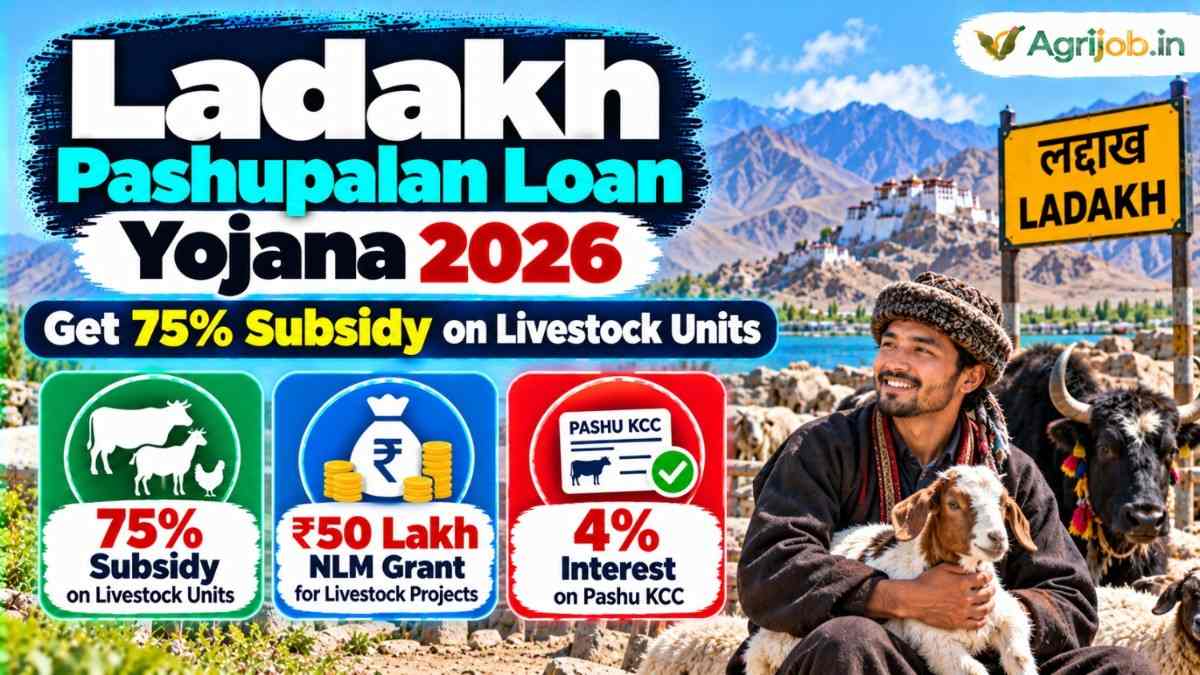
Ladakh Pashupalan Loan Yojana 2026 offers up to 75% subsidy on livestock units under UT Sheep Husbandry Department schemes, 50% capital subsidy up to Rs.50 lakh under the National Livestock Mission (NLM), 90% cow subsidy under the “One Household, One Cow” scheme, and collateral-free working capital at 4% effective interest via Pashu Kisan Credit Card — all available to eligible Ladakh residents as of 2026.
- UT Sheep Husbandry Subsidy: 75% on pashmina goat/sheep/Merino units (25% beneficiary share)
- One Household One Cow Scheme: 90% subsidy on cross-bred Jersey cows (ongoing, Animal Husbandry Dept, Leh)
- NLM (National Livestock Mission): 50% capital subsidy; max Rs.50 lakh for goat/sheep; Rs.25 lakh for poultry
- AHIDF (Animal Husbandry Infrastructure Development Fund): 90% bank financing + 3% interest subvention for 8 years
- Pashu KCC (Pashu Kisan Credit Card): Rs.1.60 lakh collateral-free; effective 4% interest (2% subvention + 2% prompt repayment)
- Rashtriya Gokul Mission: 50% subsidy for indigenous breed dairy development; 3% interest subvention on IVF heifer loans
- UT Budget for Animal/Sheep Husbandry + Fisheries (2026–27): Rs.108.4 crore allocated
- Pashmina Board Revolving Fund (July 2026): Rs.8 crore sanctioned for Changthang Pashmina Growers Cooperative
- Lead Banks in Ladakh: J&K Bank (37 branches), SBI (27 branches), PNB, and J&K Grameen Bank
- Official Portal for NLM: nlm.udyamimitra.in | AHIDF: ahidf.udyamimitra.in
📋 Table of Contents
- What Is Ladakh Pashupalan Loan Yojana 2026?
- Who Should Apply for Ladakh Pashupalan Loan?
- UT Ladakh State Government Pashupalan Schemes 2026
- Central Government Livestock Schemes for Ladakh 2026
- Bank Loan Schemes for Pashupalan in Ladakh 2026
- Cooperative Society Schemes for Ladakh Livestock 2026
- Subsidy & Loan Comparison Table — All Schemes 2026
- Eligibility Criteria for Ladakh Pashupalan Loan 2026
- How to Apply for Ladakh Pashupalan Loan — Step-by-Step
- Pros and Cons of Ladakh Pashupalan Loan Yojana
- Important Terms Related to Ladakh Pashupalan Loan 2026
- Important Dates & Timeline
- Important Links
- Conclusion
- Key Takeaways
- Frequently Asked Questions
What Is Ladakh Pashupalan Loan Yojana 2026?
Ladakh Pashupalan Loan Yojana 2026 is the collective name for all livestock loan, subsidy, and financial assistance programmes available to farmers and herders in the Union Territory of Ladakh — covering schemes implemented by the UT administration (Sheep Husbandry Department and Animal Husbandry & Fisheries Department), central government missions (NLM, AHIDF, Rashtriya Gokul Mission), scheduled banks (J&K Bank, SBI, PNB), and cooperative societies (NCDC-backed dairy cooperatives, Changthang Pashmina Cooperative). These schemes operate across both Leh and Kargil districts and are coordinated through the Autonomous Hill Development Councils (LAHDC Leh and LAHDC Kargil) as well as the UT-level Secretariat.
Ladakh’s livestock sector is unique in India. At altitudes of 3,500–5,000 metres, the region is home to the rare Changthangi pashmina goat, indigenous yak, and high-altitude sheep breeds like Merino, which produce premium wool sought globally. The Animal Husbandry Department and Sheep Husbandry Department together serve over 2 lakh livestock-dependent households across the UT’s 7 districts. The State Development Plan (SDP) Subsidy Schemes for FY 2026–27, reviewed in August 2026, specifically include proposals for pashmina goat feed subsidies and dairy farming subsidy support as the two flagship pillars of the UT’s livestock assistance.

The latest major initiative — approved in July 2026 — is the Ladakh Pashmina Development Board’s Livestock Development Incentive Programme, which gives a 25% top-up incentive on the raw Pashmina procurement value, paid directly via Direct Benefit Transfer (DBT) into Changpa herders’ bank accounts. Combined with the Rs.8 crore revolving fund sanctioned for the All Changthang Pashmina Growers Co-operative Marketing Society, this represents the most significant new infusion into Ladakh’s livestock economy in 2026.
Who Should Apply for Ladakh Pashupalan Loan Yojana 2026?
This guide is for any resident of UT Ladakh who earns a livelihood from or wants to start a livestock business. Here are the 8 specific profiles who will benefit most:
- 🐐 Changpa herders (Tangyud/Broqpa communities): Pashmina goat rearers in Changthang, Rupshu, and Nubra who want the 25% Pashmina DBT incentive and subsidised feed under LAHDC Leh schemes
- 🐄 Dairy farmers in Leh and Kargil districts: Those applying for the “One Household, One Cow” scheme (90% subsidy on Jersey cross-bred heifers) or NLM dairy entrepreneurship grants
- 🐑 Sheep rearers and wool producers: Farmers wanting 75% subsidised sheep/Merino units, wool-shearing machines at 75% subsidy, or spinning units under the Sheep Husbandry Department
- 🏗️ Livestock shed and infrastructure builders: Anyone wanting a 75%-subsidised livestock shed or chain-link fencing to prevent wild dog and snow leopard attacks on their animals
- 🏦 Working capital seekers: Farmers needing money for animal feed, medicines, and veterinary care — best suited for Pashu KCC at 4% effective interest
- 🏭 Dairy processing entrepreneurs: Those setting up milk chilling units, cheese facilities, or value-added dairy infrastructure — AHIDF offers 90% bank loan + 3% interest subvention
- 🤝 Self-Help Groups and cooperatives: Women SHGs and producer groups wanting NCDC-backed cooperative dairy support or NLM group applications
- 🌱 First-generation livestock entrepreneurs: Young Ladakhis with no prior livestock business wanting to start small with NLM’s 50% capital subsidy or Pashu KCC working capital
UT Ladakh State Government Pashupalan Schemes 2026
The Union Territory of Ladakh operates its own livestock subsidy schemes through two departments — the Sheep Husbandry Department (focused on wool-producing animals and pashmina) and the Animal Husbandry & Fisheries Department (focused on dairy, poultry, and general livestock). Both are funded under the State Development Plan (SDP) and receive additional allocations from LAHDC Leh and LAHDC Kargil budgets.
A) Sheep Husbandry Department — Ladakh UT Schemes 2026
The Sheep Husbandry Department, UT Ladakh — headquartered in Leh with district offices at Leh (Dr. Tsewang Morup, 01982-252037) and Kargil (Niyaz ul Hussain, 01985-232238) — administers the following active schemes:
| Scheme Name | Subsidy Rate | Coverage | Beneficiary Share |
|---|---|---|---|
| Pashmina/Dairy Goat/Merino units (9F+1M or 5F+1M) | 75% | Purchase cost of animals, Leh district | 25% |
| Livestock Shed / Chain-link Fencing | 75% | Shed construction to prevent depredation, Leh district | 25% |
| Wool Shearing Machine | 75% | Progressive sheep rearers, Leh district | 25% |
| Spinning Unit | 75% | Wool processing unit, progressive sheep rearers, Leh district | 25% |
| Bio-Fertilizer / Compost Unit | Subsidised (DBT) | Manure-to-fertilizer conversion units for sheep/goat rearers | Varies |
| Subsidised Pelleted Feed (LAHDC Leh) | 75% | High-altitude herder blocks: Nyoma, Chumur, Korzok, Sumdo, Angkung | 25% |
| Pashmina DBT Incentive (Ladakh Pashmina Board — July 2026) | 25% top-up on procurement value | Changpa herders selling raw pashmina via official channel | Nil |
Key update for 2026: On 14 January 2026, the Sheep Husbandry Department, Nyoma, distributed 2,074 quintals of pelleted feed at 75% subsidised rate to herders of Tagazong, Chumur, Korzok, Sumdo, and Angkung blocks — with milk replacers and feeding bottles also distributed. The Ladakh Pashmina Development Board, in its maiden meeting in July 2026, set a target to double the pashmina goat population to 4 lakh over the next three years.
B) Animal Husbandry & Fisheries Department — Ladakh UT Schemes 2026
The Animal Husbandry Department, headquartered at DD Upshi Complex, Leh (Director: Iftikhar Hussain), runs the following flagship schemes:
| Scheme Name | Subsidy / Benefit | Target Beneficiary |
|---|---|---|
| “One Household, One Cow” — Empowering Sustainable Rural Livelihood | 90% subsidy on cross-bred Jersey cows/heifers | Rural households across Leh district (150 cows Phase 1) |
| Dairy Farming Promotion Scheme (SDP 2026–27) | Subsidy support for dairy units (rates under finalisation per Aug 2026 review) | Small dairy farmers, women SHGs, rural entrepreneurs |
| Livestock Health & Disease Control Programme (LH&DCP) | Free vaccination (FMD, Brucellosis); mobile veterinary units | All livestock owners, Leh and Kargil |
| Kisan Credit Card (KCC) for Animal Husbandry | Concessional credit (interest subvention via banks) | All AH/Fisheries farmers in Leh and Kargil |
| NLM (National Livestock Mission) — State co-implementation | 50% capital subsidy via DAHD/SIDBI | Entrepreneurs, FPOs, SHGs; implemented via Directorate, Leh |
The “One Household, One Cow” scheme distributes cross-bred Jersey cows at 90% government subsidy — meaning you pay only 10% of the animal cost. Applications for Phase 2 are expected to open via the District Animal Husbandry Office, Leh (contact: Chief Animal Husbandry Officer, Stanzin Rabgyas). Women homemakers and rural households are given priority. Apply early — Phase 1 had only 150 animals for the entire Leh district.
Central Government Livestock Schemes for Ladakh 2026
Four major central government schemes are actively implemented in Ladakh, each targeting a different segment of the livestock sector. The total budget for Animal Husbandry and Fisheries in UT Ladakh for 2026–27 is Rs.108.4 crore, combining central and UT allocations. All central schemes operate through the Directorate of Animal, Sheep and Fisheries Department, Leh as the State Implementing Agency (SIA).
A) National Livestock Mission (NLM) — 50% Capital Subsidy
The National Livestock Mission (NLM), implemented by the Department of Animal Husbandry & Dairying (DAHD), Government of India, offers a 50% capital subsidy for livestock entrepreneurship projects across all species. The scheme is fully online through nlm.udyamimitra.in. In Ladakh, NLM covers high-altitude projects including Pashmina/Changthangi goat breeding units and yak wool processing, with field coordination by the Sheep Husbandry Department at Nyoma.
| Livestock Project Type | Maximum Project Cost | Maximum Subsidy (50%) |
|---|---|---|
| Goat / Sheep Farming (incl. Pashmina goat) | Rs.1 crore | Up to Rs.50 lakh |
| Poultry Farming (high-altitude varieties) | Rs.50 lakh | Up to Rs.25 lakh |
| Pig Farming | Rs.60 lakh | Up to Rs.30 lakh |
| Fodder Production & Processing | Rs.1 crore | Up to Rs.50 lakh |
| Yak Wool Processing (Ladakh-specific) | As per DPR | 25% (SC/ST: 50%) — verify with Sheep Husbandry Dept, Nyoma |
B) Animal Husbandry Infrastructure Development Fund (AHIDF) — 90% Bank Loan + 3% Subvention
AHIDF is the largest livestock infrastructure loan programme in India with a Rs.29,110.25 crore corpus. It provides 90% bank financing of the total project cost plus a 3% interest subvention per annum for 8 years. AHIDF is suited for larger livestock entrepreneurs setting up dairy processing plants, meat processing units, feed mills, or veterinary medicine manufacturing in Ladakh. Apply at ahidf.udyamimitra.in.
C) Rashtriya Gokul Mission (RGM) — Indigenous Breed Development
The Rashtriya Gokul Mission, revised for 2026–27 with an administrative approval dated 7 May 2026, provides 50% capital subsidy for indigenous breed development farms and a 3% interest subvention on bank loans for purchasing high-genetic-merit (HGM) IVF-born heifers. For Ladakh, RGM is particularly relevant for promoting indigenous yak and Changthangi goat genetic improvement programmes. Total RGM outlay for 2021–2026 cycle: Rs.3,400 crore.
D) Livestock Health & Disease Control Programme (LH&DCP)
The LH&DCP provides free vaccination against Foot-and-Mouth Disease (FMD) and Brucellosis across Ladakh, along with mobile veterinary units (MVUs) for remote high-altitude blocks including Changthang, Nubra, and Zanskar valleys. The programme also includes the Pashu Aushadhi component, which supplies affordable generic veterinary medicines at subsidised rates. This reduces out-of-pocket veterinary costs for Ladakh’s livestock farmers significantly.
Bank Loan Schemes for Pashupalan in Ladakh 2026
In Ladakh, J&K Bank (37 branches) is the dominant lender for agricultural and livestock KCC loans, financing 83% of all agriculture KCC loans in the UT. SBI (27 branches) is the leading public sector bank, with active livestock finance awareness programmes running at Drass, Kargil, and Leh. PNB, Axis Bank, and J&K Grameen Bank also operate in the region.
| Bank / Scheme | Loan Amount | Interest Rate | Repayment | Collateral |
|---|---|---|---|---|
| Pashu KCC (J&K Bank / SBI / PNB) | Up to Rs.3 lakh (working capital) | 4% effective p.a. (2% subvention + 2% prompt repayment) | Revolving annual | Nil up to Rs.1.60 lakh |
| J&K Bank Agriculture KCC | As per crop/livestock plan | 7% p.a. (with 2% subvention = 5% effective) | Up to 5 years | As per bank norms |
| SBI Dairy Plus / Kisan Credit Card AH | Rs.50,000 – Rs.5 lakh | 7% p.a. (effective lower with subvention) | 3–7 years | Hypothecation of animals |
| AHIDF Term Loan (J&K Bank / SBI / Union Bank) | Up to 90% of project cost | 3% effective p.a. (after 3% GoI subvention) | Up to 8 years | Project assets; bank norms |
| Mudra Loan (Shishu / Kishore / Tarun) | Rs.50,000 – Rs.10 lakh | 8%–12% p.a. | 3–5 years | Collateral-free |
| SBI RSETI / J&K Bank Skill Loan | Training + Rs.25,000–Rs.1.5 lakh | Subsidised | As per sanction | Nil |
Per-animal credit limits under Pashu KCC (as per DAHD norms): Buffalo — Rs.60,249; Cow — Rs.40,783; Sheep / Goat — Rs.4,063 per animal; Poultry (layer) — Rs.720 per bird. These limits are cumulative per household up to Rs.3 lakh total.
Cooperative Society Schemes for Ladakh Livestock 2026
Cooperative routes give Ladakh’s pastoral communities access to finance with minimal own contribution. The most important cooperative instruments in Ladakh in 2026 are:
- All Changthang Pashmina Growers Co-operative Marketing Society: The LG-approved Rs.8 crore revolving fund (July 2026) ensures timely raw pashmina procurement at guaranteed prices, eliminating exploitative middlemen. Changpa herders receive payment directly via DBT. This is the most impactful cooperative development for Ladakh’s pastoral sector in 2026.
- NCDC (National Cooperative Development Corporation) — Dairy Sahakar: NCDC’s Dairy Sahakar programme provides 50% loan + 20% share capital + 25% subsidy, requiring only a 5% own contribution from cooperative members. Registered dairy cooperatives in Ladakh can apply through the Ministry of Cooperation. Contact: ncdc.in
- DIDF / NABARD Dairy Cooperative Route: Although DIDF (Dairy Processing and Infrastructure Development Fund) was formally subsumed into AHIDF on 1 February 2024, milk cooperatives, milk unions, and SHGs registered under the cooperative/companies act can still access the NABARD/NDDB concessional lending channel at 2.5% interest subvention for dairy processing infrastructure.
- Primary Agricultural Credit Societies (PACS) / District Cooperative Societies (DCS): Local PACS and cooperative banks in Leh and Kargil provide short-term livestock working capital at subsidised rates. Contact the Deputy Registrar Cooperatives, Leh, for the nearest registered PACS.
Subsidy & Loan Comparison — All Ladakh Pashupalan Schemes 2026
| Scheme | Type | Max Loan / Benefit | Subsidy / Subvention | Who Qualifies | Implementing Agency |
|---|---|---|---|---|---|
| UT Sheep Husbandry — Pashmina/Merino Units | State — Capital Subsidy | 75% of unit cost | 75% subsidy | Sheep/goat rearers, Leh district residents | Sheep Husbandry Dept, UT Ladakh |
| One Household One Cow | State — Capital Subsidy | 90% of cow cost | 90% subsidy | Rural households, Leh district | Animal Husbandry Dept, Leh |
| NLM (National Livestock Mission) | Central — Capital Subsidy | Rs.25–50 lakh max subsidy | 50% of project cost | Individuals, FPOs, SHGs, cooperatives; livestock training required | DAHD via SIDBI; SIA: Directorate, Leh |
| AHIDF | Central — Interest Subvention + Loan | 90% of project cost; no upper cap per unit | 3% interest subvention for 8 years | Entrepreneurs, MSMEs, FPOs, cooperatives (dairy/meat/feed infra) | DAHD via scheduled banks |
| Rashtriya Gokul Mission | Central — Capital Subsidy + Interest Subvention | 50% subsidy for breed farms; Rs.3,400 crore national pool | 50% capital + 3% interest (IVF heifer loans) | Indigenous breed farmers, cooperatives, Gokul Grams | DAHD / State AH Dept, Leh |
| Pashu KCC (J&K Bank / SBI) | Bank — Revolving Credit | Up to Rs.3 lakh (Rs.1.60 lakh collateral-free) | 4% effective interest (2% subvention + 2% prompt repayment) | All livestock farmers in Ladakh | J&K Bank, SBI, PNB — apply at branch |
| NCDC Dairy Sahakar (Cooperative) | Cooperative — Loan + Subsidy | 50% loan + 25% subsidy (5% own share) | 25% capital subsidy + 20% share capital | Registered dairy cooperatives and milk unions | NCDC / Ministry of Cooperation |
| Pashmina DBT Incentive (Ladakh Pashmina Board) | State — Direct Benefit Transfer | 25% of procurement value per kg | 25% top-up incentive | Changpa herders registered with All Changthang Pashmina Cooperative | Ladakh Pashmina Development Board / UT Ladakh |
- Pashmina herders / small sheep rearers: Start with UT Sheep Husbandry Department’s 75% subsidy on Pashmina/Merino units — least documentation, fastest approval.
- Dairy households (1–5 cows): Apply for “One Household, One Cow” (90% subsidy) first; supplement with Pashu KCC for feed and veterinary working capital.
- Medium enterprises (goat farm, poultry, pig): NLM gives you 50% capital subsidy up to Rs.50 lakh — best for entrepreneurs with a bank-appraised DPR.
- Large infrastructure (dairy plant, feed mill): AHIDF is your route — 90% bank financing + 3% subvention, no project cost ceiling per unit.
- Cooperatives: NCDC Dairy Sahakar requires only 5% own contribution — ideal for women’s SHGs and village-level cooperative societies.
Eligibility Criteria for Ladakh Pashupalan Loan Yojana 2026
Eligibility varies by scheme. Below are the consolidated requirements across all four categories. Always verify current norms with the respective implementing agency before applying.
Common Eligibility Criteria (All Schemes)
- ✅ Permanent resident / domicile of UT Ladakh (Leh or Kargil district)
- ✅ Minimum age: 18 years; maximum: 65 years (bank-specific)
- ✅ Not a bank defaulter or wilful defaulter as per CIBIL records
- ✅ Aadhaar-linked bank account (mandatory for DBT-based schemes)
- ✅ Must be engaged in or planning to start a livestock-related activity
Scheme-Specific Eligibility
| Scheme | Specific Eligibility Requirement | Priority Categories |
|---|---|---|
| UT Sheep Husbandry (75% Subsidy) | Sheep/goat rearer, Leh district resident; land/grazing access confirmed by village Nambardar | Traditional herders, BPL households |
| One Household One Cow (90%) | Rural household, Leh district; no existing dairy subsidy from same scheme | Women homemakers, marginal farmers |
| NLM (50% Subsidy) | Training/experience in livestock OR trained technical team; no subsidy for land purchase; minimum 10% own contribution of project cost | SC/ST (50% subsidy), women entrepreneurs, FPOs |
| AHIDF (90% Loan + 3% Subvention) | Viable DPR; minimum 10% own margin; bank appraised project; MSME/FPO/cooperative/individual entrepreneur | MSMEs, dairy cooperatives, FPOs |
| Pashu KCC | Any livestock owner (dairy, sheep, goat, poultry, yak); no CIBIL default; active bank account | All categories; women farmers given priority for faster processing |
| NCDC Dairy Sahakar | Registered dairy cooperative under state cooperative/companies act; minimum 5% own share capital contribution | Milk unions, milk producer companies, SHGs |
Application Fee Table — All Ladakh Pashupalan Schemes 2026
| Scheme | Application Fee | Processing Fee |
|---|---|---|
| UT Sheep Husbandry (75% subsidy) | Nil | Nil |
| One Household One Cow | Nil | Nil |
| NLM (via nlm.udyamimitra.in) | Nil | Bank loan processing fee as per bank norms |
| AHIDF (via ahidf.udyamimitra.in) | Nil | Bank loan processing fee (varies by bank) |
| Pashu KCC (J&K Bank / SBI / PNB) | Nil | Nil to minimal (most banks waive for KCC) |
| NCDC Dairy Sahakar | Nil | As per NCDC norms; cooperative registration fee applies |
How to Apply for Ladakh Pashupalan Loan — Step-by-Step
The application route depends on the scheme. Follow the correct pathway for your chosen scheme:
- Identify the right scheme: Use the Comparison Table above to match your livestock type, project size, and budget to the best scheme. Pashmina rearers → UT Sheep Husbandry 75% subsidy first; dairy households → One Household One Cow; medium enterprises → NLM; large infrastructure → AHIDF.
- Contact the implementing office: For UT schemes — visit your District Sheep Husbandry Office (Leh: 01982-252037 / Kargil: 01985-232238) or the District Animal Husbandry Office. They will provide the application form and beneficiary selection criteria for the current cycle.
- Prepare your documents: Collect the mandatory documents listed below. Having complete paperwork is the single biggest factor in fast approval. Incomplete applications cause delays of 3–6 months.
- Apply online for NLM/AHIDF: Register at nlm.udyamimitra.in (NLM) or ahidf.udyamimitra.in (AHIDF). Upload your Detailed Project Report (DPR), land documents, bank loan sanction, and training certificate. The SIA (Directorate, Leh) reviews and routes to DAHD/PAC.
- Apply at your bank for Pashu KCC: Visit any J&K Bank, SBI, or PNB branch in Leh or Kargil. Carry Aadhaar, land/grazing rights document, livestock ownership proof, and bank account details. J&K Bank finances 83% of all agriculture KCC in Ladakh — start there for fastest processing.
- SLEC / PAC approval (NLM/AHIDF): The State Level Executive Committee (SLEC) reviews NLM applications and forwards to DAHD. PAC approval by DAHD releases subsidy through SIDBI to your lending bank — this typically takes 45–90 days after complete documentation.
- Receive subsidy in subsidy account: NLM and RGM subsidies are credited to a separate subsidy account held with the lending bank — not directly to you. The bank adjusts loan EMIs accordingly. AHIDF subvention is credited against your outstanding loan interest quarterly.
Documents Required (Common Across All Schemes)
- Aadhaar Card (mandatory identity and address proof)
- Permanent Residency / Domicile Certificate of UT Ladakh
- Voter ID / Passport / Driving Licence (additional identity)
- Bank passbook / cancelled cheque (Aadhaar-linked account)
- Land or grazing rights document / lease agreement
- Livestock ownership proof (ear-tag certificate / village Nambardar letter)
- Detailed Project Report / DPR (for NLM, AHIDF, RGM)
- Training or experience certificate in relevant livestock activity (NLM mandatory)
- Caste certificate (SC/ST for enhanced 50% NLM subsidy)
- BPL certificate (where applicable for priority processing)
- Bank loan sanction letter (for NLM, AHIDF — subsidy follows bank sanction)
Pros and Cons of Ladakh Pashupalan Loan Yojana 2026
✅ Advantages
- Among the highest subsidy rates in India: 75%–90% state subsidies for livestock units are far higher than most other states/UTs
- Multiple stackable schemes: A pashmina herder can simultaneously access UT 75% subsidy, NLM subsidy, Pashu KCC working capital, and Pashmina DBT incentive
- Zero application fee across all central and most UT-level schemes
- DBT-linked payments eliminate middlemen and ensure direct fund transfer
- Ladakh-specific components in NLM: Yak wool processing and Changthangi goat breeding are recognised NLM components — not just generic livestock
- Strong J&K Bank network: 37 branches with proven track record of agriculture KCC disbursement make credit accessible even in remote blocks
⚠️ Disadvantages & Challenges
- Geographic remoteness: Many high-altitude herder communities (Chumur, Korzok, Sumdo) are 6–12 hours from district offices — in-person application processes remain difficult
- Limited NLM utilisation in Ladakh: As of March 2025, Ladakh showed “No demand” for NLM Insurance and zero project approvals in the EDP (Entrepreneurship Development Programme) — awareness and DPR capacity remain barriers
- Seasonal access constraints: Mountain passes close from November to May, making bank visits and document submission difficult for remote communities
- DPR preparation burden: NLM and AHIDF require a professionally prepared Detailed Project Report — a cost many small farmers cannot independently bear
Important Terms Related to Ladakh Pashupalan Loan 2026
- NLM (National Livestock Mission): Central sector scheme by DAHD providing 50% capital subsidy for livestock entrepreneurship; managed through SIDBI and State Implementing Agencies; apply at nlm.udyamimitra.in
- AHIDF (Animal Husbandry Infrastructure Development Fund): Rs.29,110 crore central corpus offering 90% bank financing + 3% interest subvention for 8 years on dairy/meat processing and feed infrastructure
- Pashu KCC (Pashu Kisan Credit Card): Revolving working capital credit facility at 4% effective annual interest (2% subvention + 2% prompt repayment incentive); collateral-free up to Rs.1.60 lakh; 44.40+ lakh cards issued nationally by 2026
- Rashtriya Gokul Mission (RGM): Central scheme for indigenous bovine breed conservation and genetic improvement; 50% capital subsidy for breed farms; revised with Rs.3,400 crore outlay for 2021–2026
- DAHD: Department of Animal Husbandry and Dairying — the nodal central ministry implementing NLM, AHIDF, RGM, and LH&DCP
- Changthangi / Pashmina Goat: The indigenous cashmere-producing goat of Ladakh’s Changthang plateau; recognised as the world’s finest natural fibre producer; the backbone of Changpa pastoral livelihoods
- LAHDC: Ladakh Autonomous Hill Development Council — Leh and Kargil hill councils that allocate SDP budget for livestock schemes and manage local implementation
- SIA (State Implementing Agency): The Directorate of Animal, Sheep and Fisheries Department, UT Ladakh — routes NLM and AHIDF applications from Ladakh to DAHD/SIDBI
- DBT (Direct Benefit Transfer): The government payment mechanism that transfers subsidies directly to the beneficiary’s Aadhaar-linked bank account, eliminating middlemen
- NCDC (National Cooperative Development Corporation): Central agency that funds dairy cooperatives through Dairy Sahakar — 25% subsidy + 50% loan + 20% share capital; only 5% own contribution from cooperative members
Important Dates & Timeline — Ladakh Pashupalan 2026
| Event / Scheme | Status / Date |
|---|---|
| UT Sheep Husbandry 75% Subsidy — Current Cycle | Active; applications accepted at District Sheep Husbandry Office, Leh / Kargil |
| One Household One Cow Scheme — Phase 1 | Launched June 2025 (40 cows Phase 1); Phase 2 expected — contact AH Office Leh |
| SDP Subsidy Scheme Review (Sheep Husbandry + AH Dept) | Reviewed August 7, 2026; SDP 2026–27 schemes being finalised — apply early |
| NLM Annual Action Plan (Ladakh 2026–27) | Fodder Development proposals (Leh+Kargil): Rs.134.50 lakh central share submitted |
| Pashmina DBT Incentive (Ladakh Pashmina Board) | Approved July 2026; implementation via All Changthang Pashmina Growers Cooperative |
| NLM (Online Applications) | Year-round at nlm.udyamimitra.in |
| AHIDF (Online Applications) | Year-round at ahidf.udyamimitra.in |
| Pashu KCC (Bank Applications) | Year-round at J&K Bank, SBI, PNB branches in Leh and Kargil |
| NLM Pelleted Feed Distribution (Nyoma / Chumur / Korzok) | January 2026 (2,074 quintals at 75% subsidy); next cycle expected Jan 2027 |
| Rashtriya Gokul Mission 2026–27 Administrative Approval | Issued by DAHD on 7 May 2026 (Order No. 3-1/2016-AHT) |
Important Links — Ladakh Pashupalan Loan Yojana 2026
| Resource | Link |
|---|---|
| Animal & Sheep Husbandry Department, UT Ladakh (Official) | ladakh.gov.in/animal-sheep-husbandry |
| Sheep Husbandry Department Schemes — UT Ladakh | ladakh.gov.in/sheep-husbandry |
| NLM Official Portal (Apply Online) | nlm.udyamimitra.in |
| AHIDF Official Portal (Apply Online) | ahidf.udyamimitra.in |
| DAHD — All Livestock Schemes | dahd.gov.in/schemes-programmes |
| Pashu KCC Apply (Jansamarth Portal) | jansamarth.in |
| J&K Bank — Agriculture / KCC Loans | jkbank.com |
| NCDC — Dairy Sahakar Scheme | ncdc.in |
| Rashtriya Gokul Mission (DAHD) | dahd.gov.in — Rashtriya Gokul Mission |
| Agrijob.in — Dairy Farm Loan Complete Guide 2026 | agrijob.in/dairy-farm-loan-2026 |
Conclusion — Ladakh Pashupalan Loan Yojana 2026
Ladakh Pashupalan Loan Yojana 2026 offers the most comprehensive financial support ecosystem ever assembled for UT Ladakh’s livestock sector — from the Sheep Husbandry Department’s 75% subsidy on Pashmina goat units to the NLM’s Rs.50 lakh grant for sheep and goat entrepreneurs, the 90% “One Household One Cow” subsidy for dairy households, and the Rs.8 crore Pashmina Board revolving fund for Changpa herder cooperatives. Whether you are a traditional high-altitude herder in Chumur, a young entrepreneur in Leh starting a dairy farm, or a cooperative in Kargil wanting to process wool — there is a specific scheme for you. Visit your District Sheep Husbandry or Animal Husbandry Office in Leh (01982-252037) or Kargil (01985-232238), or apply online at nlm.udyamimitra.in for NLM and ahidf.udyamimitra.in for AHIDF. Bookmark this page — we update it every time official data changes for Ladakh schemes.
- UT Sheep Husbandry Dept offers 75% subsidy on pashmina goat, Merino sheep, wool-shearing machines, livestock sheds, and spinning units in Leh district
- The “One Household, One Cow” scheme gives a 90% subsidy on cross-bred Jersey cows — one of the highest dairy subsidies in India for individual households
- NLM (National Livestock Mission) provides 50% capital subsidy up to Rs.50 lakh for goat/sheep farming — apply online at nlm.udyamimitra.in, year-round
- Pashu KCC gives collateral-free credit up to Rs.1.60 lakh at 4% effective interest — the fastest and easiest scheme for working capital needs
- The Ladakh Pashmina Board’s July 2026 approval of a 25% DBT incentive and Rs.8 crore revolving fund is the most significant new pastoral development in 2026
- Apply first at your District AH/Sheep Husbandry Office for state subsidies; use nlm.udyamimitra.in for NLM; visit J&K Bank or SBI for Pashu KCC
Frequently Asked Questions About Ladakh Pashupalan Loan Yojana 2026
What is Ladakh Pashupalan Loan Yojana 2026?
Ladakh Pashupalan Loan Yojana 2026 is the collective name for all livestock loan and subsidy schemes available in UT Ladakh, including UT-level state schemes (75% subsidy on sheep/goat units, 90% subsidy on dairy cows), central government schemes (NLM, AHIDF, Rashtriya Gokul Mission), bank products (Pashu KCC at 4% effective interest), and cooperative routes (NCDC Dairy Sahakar). Together, they cover every livestock category from pashmina goats and yak to dairy cattle, poultry, and sheep.
What is the maximum subsidy available for pashupalan in Ladakh?
The maximum capital subsidy available in Ladakh is 90%, under the “One Household, One Cow” scheme for dairy cattle (Animal Husbandry Department, Leh). For sheep/goat/pashmina units and livestock sheds, the Sheep Husbandry Department provides 75% subsidy. Under the National Livestock Mission, the maximum capital subsidy is 50% — up to Rs.50 lakh for goat and sheep farming projects.
How do I apply for the NLM scheme in Ladakh?
Apply online at nlm.udyamimitra.in. You will need a Detailed Project Report (DPR), land/grazing rights document, bank loan sanction letter, training certificate in livestock, and Aadhaar. The Directorate of Animal, Sheep and Fisheries Department in Leh is the State Implementing Agency (SIA) that reviews and forwards your application to DAHD, New Delhi for PAC approval.
Can Changpa herders access any government scheme in 2026?
Yes. In 2026, Changpa herders have access to three dedicated programmes: (1) the UT Sheep Husbandry 75% subsidy on Pashmina goat units and subsidised pelleted feed at 75% cost; (2) the Ladakh Pashmina Development Board’s 25% DBT incentive on raw pashmina procurement value (approved July 2026); and (3) the Rs.8 crore revolving fund for the All Changthang Pashmina Growers Co-operative Marketing Society. Contact the Sheep Husbandry Department, Nyoma, for field-level registration.
What is the Pashu KCC limit for sheep and goat farmers in Ladakh?
Under the Pashu Kisan Credit Card (Pashu KCC), the per-animal credit limit for sheep and goat is Rs.4,063 per animal (as per DAHD norms). A farmer with 40 sheep/goats can access up to approximately Rs.1.60 lakh collateral-free at an effective interest rate of 4% per annum (2% government subvention + 2% prompt repayment incentive). Apply at any J&K Bank, SBI, or PNB branch in Leh or Kargil.
Which bank is best for pashupalan loan in Ladakh?
J&K Bank is the recommended first choice for livestock loans in Ladakh — it has 37 branches across the UT and finances 83% of all agriculture KCC loans in Ladakh. For NLM and AHIDF, SBI and Union Bank are also approved lenders with national-level scheme expertise. For remote areas of Kargil, J&K Grameen Bank and cooperative banks serve as additional channels.
Is there any scheme for women in Ladakh pashupalan 2026?
Yes. Women farmers receive priority processing in the “One Household, One Cow” scheme, which specifically targets women homemakers for dairy empowerment. NLM gives SC/ST and women entrepreneurs a 50% capital subsidy (vs. 33% for general category in some components). Women SHGs can access the NCDC Dairy Sahakar scheme with just 5% own contribution. The Ladakh Pashmina Board’s DBT incentive also reaches women Changpa herders directly through their bank accounts.
Does AHIDF apply to Ladakh? What is the interest rate?
Yes, AHIDF is available to eligible entrepreneurs and cooperatives across all states and UTs including Ladakh. Under AHIDF, you receive 90% bank financing of your project cost plus 3% interest subvention per annum for 8 years — making the effective bank interest approximately 3%–5% p.a. depending on your lending bank’s base rate. Apply at ahidf.udyamimitra.in. AHIDF is best suited for dairy processing plants, meat processing units, and animal feed manufacturing with a project cost above Rs.10 lakh.
What documents are needed to apply for Ladakh pashupalan subsidy?
The core documents required across all Ladakh pashupalan schemes are: Aadhaar Card, Domicile/Permanent Residency Certificate of UT Ladakh, bank account proof (Aadhaar-linked passbook), land or grazing rights document, livestock ownership proof (ear-tag or Nambardar letter), Detailed Project Report (for NLM/AHIDF), training/experience certificate in the relevant livestock activity, caste certificate (for SC/ST enhanced subsidy), and bank loan sanction letter (NLM/AHIDF — subsidy follows the bank sanction).
⚠️ Disclaimer: This article is for informational purposes only. Subsidy rates, eligibility criteria, and application windows may be revised by the UT Ladakh administration, DAHD, or lending banks. Always verify current norms with the District Animal Husbandry Officer (Leh: 01982-252037), District Sheep Husbandry Officer (Kargil: 01985-232238), or the official portals before applying.