

The Bihar NCL certificate 2026 rules are now clear: the General Administration Department (GAD) has told every District Magistrate to issue Non-Creamy Layer certificates directly, without forcing students to make separate caste, residence and income certificates first. Letter No. 15866, dated 1 September 2026, ends months of confusion.

This guide is for BC and EBC students, job aspirants and parents in Bihar who keep hearing that an NCL certificate “expires” or “must be remade every time”. It explains the letter point by point, the older circulars behind it, the validity rules for related certificates, and the exact steps to apply on the state portal.
Under the Bihar NCL certificate 2026 rules, GAD Letter No. 15866 (1 September 2026) says an NCL certificate can be issued directly, is accepted as proof of caste and residence, and need not be re-issued repeatedly if the applicant submits a Form-XVIIIB self-declaration. Parental salary and agricultural income are not added when calculating the Rs 8 lakh limit.
- Issuing department: General Administration Department, Government of Bihar
- Latest letter: No. 15866 dated 01.09.2026 (signed 31.08.2026)
- Signed by: Diwakar Mani, Under Secretary to Government
- Addressed to: All District Magistrates of Bihar
- Base circular: No. 11490 dated 16.08.2012 (paragraphs 5, 6, 7)
- Self-declaration form: Form-XVIIIB (Circular 15440 dated 05.12.2017)
- Central income limit: Rs 8 lakh per year (since 2017)
- Apply at: serviceonline.bihar.gov.in (RTPS)
- What Is the Bihar NCL Certificate and What Did the 2026 Letter Say?
- Who Should Read This Bihar NCL Certificate 2026 Guide?
- Six Rules From GAD Letter 15866 Explained
- How Long Is Each Bihar Certificate Valid?
- NCL Income Limit and What Counts as Income
- How to Apply for a Bihar NCL Certificate Step by Step
- NCL Certificate vs Caste Certificate vs Income Certificate
- Pros and Cons of the New NCL Rules
- Important Terms Related to Bihar NCL Certificate
- Timeline of Circulars Behind the Letter
- Important Links
- Final Thoughts on the Bihar NCL Certificate 2026
- Frequently Asked Questions About Bihar NCL Certificate 2026
What Is the Bihar NCL Certificate and What Did the 2026 Letter Say?
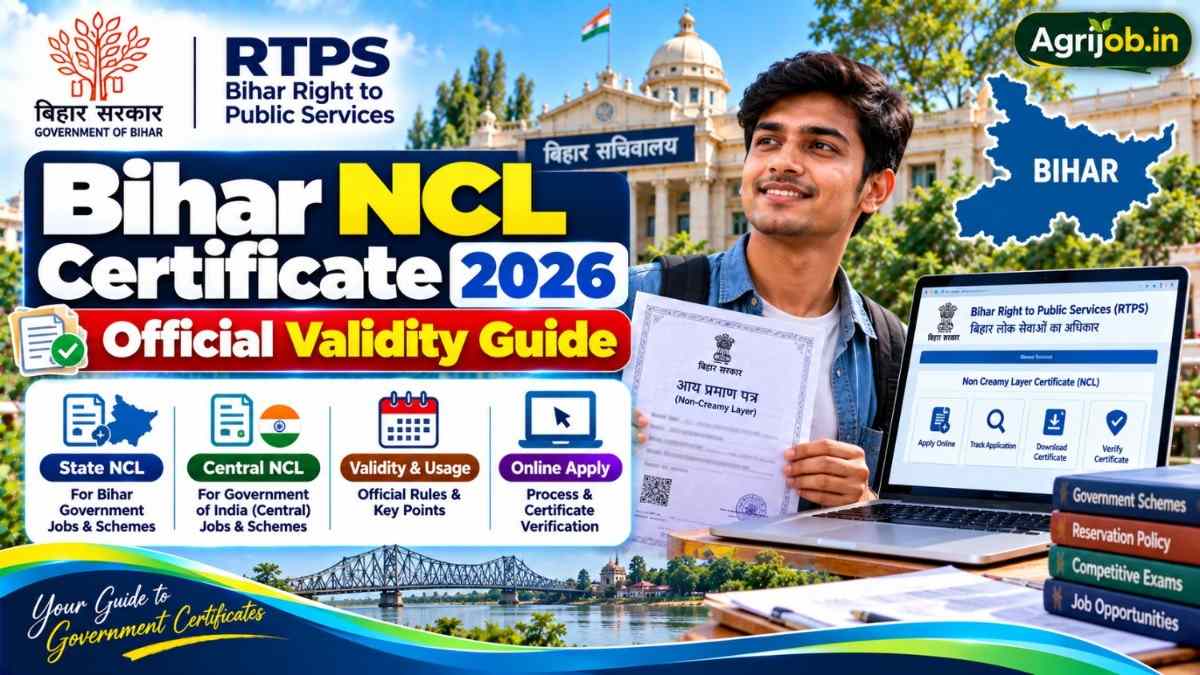
Non-Creamy Layer (NCL) certificate: an official document proving that a Backward Class (BC) or Extremely Backward Class (EBC) candidate does not belong to the creamy layer, and therefore qualifies for OBC reservation in jobs and admissions. In Bihar, the GAD sets the issuing procedure, and Revenue Officers, Sub-Divisional Officers and District Magistrates issue it.

On 1 September 2026, the GAD wrote to all District Magistrates under the subject “Issuing Non-Creamy Layer (NCL) Certificates”. The letter is signed by Diwakar Mani, Under Secretary. It does not create a new rule. It orders strict compliance with rules already in force since 2011, 2012, 2017 and 2021.
The reason is stated plainly. The department received information from several sources that its instructions on NCL certificates were not being followed fully. District offices were asking students for extra documents and repeat certificates. The letter tells District Magistrates to instruct every subordinate office so that ordinary citizens face no difficulty in getting an NCL certificate. A news report on the GAD letter confirms the department’s direction.
Who Should Read This Bihar NCL Certificate 2026 Guide?
If any profile below sounds like you, the rules in this guide directly affect your paperwork.
- 🎓 Class 12 students applying to central institutions under the OBC quota
- 📝 Competitive exam aspirants for SSC, Railways, UPSC and banking jobs
- 🏛️ BPSC and other Bihar state service candidates from BC or EBC groups
- 👩 Married women who are unsure whose caste applies on the certificate
- 🌾 Farmer families worried that land income will make them “creamy layer”
- 👨👩👧 Parents in government service who fear their salary disqualifies the child
- 🧾 Applicants told by a local office to “bring caste, residence and income first”
- 🔁 Students who already hold an NCL certificate and were asked to remake it
Six Rules From GAD Letter 15866 Explained
The letter reaffirms six practical rules. Each one answers a common student misunderstanding.
Rule 1: NCL Can Be Issued Directly
Paragraph 5 of Circular 11490 (16 August 2012) states that NCL certificates rest on caste, residence and income, but issuing them does not require first making a caste, residence and income certificate. Offices must issue the NCL certificate directly. Any office demanding three separate certificates first is going against this circular.
Rule 2: NCL Doubles as Caste and Residence Proof
Paragraph 6 explains that an NCL certificate already records the applicant’s residence and caste. So, as the case may be, the NCL certificate can also be accepted as a caste certificate and a residence certificate. One document does the work of three.
Rule 3: Parents’ Salary and Farm Income Are Not Clubbed
Paragraph 7 directs strict compliance with the Central Government’s guidelines: annual income must not be worked out by adding the parents’ salary income and agricultural income. This follows the 1993 DoPT Office Memorandum No. 36012/12/93-Estt (SCT), dated 8 September 1993, which Bihar circulated in Hindi through Circular 246 (9 June 2004).
Rule 4: No Repeat Certificates With Form-XVIIIB
Circular 15440 (5 December 2017) introduced a self-declaration affidavit, Form-XVIIIB. The circular says NCL certificates will not be issued again and again. When a candidate already holds an earlier NCL certificate, the applicant submits the Form-XVIIIB declaration that they still do not fall in the creamy layer, and the earlier certificate is treated as valid.
Rule 5: Same Rule for BC and EBC Applicants
Circular 14011 (25 November 2021) repeated paragraphs 5 and 7 of Circular 11490 for Backward Class and Extremely Backward Class candidates. It also ordered firm compliance with the 2004 circular. The 2026 letter simply reminds districts that these orders still stand.
Rule 6: Districts Must Comply 100 Percent
The final paragraph asks District Magistrates to direct all subordinate offices and officers so the instructions are followed “cent percent”. This is the line students should quote politely if a counter refuses to accept the rules above.
Carry a printed copy of GAD Letter 15866 and a filled Form-XVIIIB when you visit the Circle or Sub-Division office. If a clerk asks for a fresh caste, residence or income certificate first, politely cite paragraph 5 of Circular 11490 (16.08.2012) and note the request in your application acknowledgement.
How Long Is Each Bihar Certificate Valid?
Most confusion comes from mixing validity periods. A separate GAD public notice on reservation facts (PR No. 10239, G.A.D., 2017-18) lists the following rules, which remain the reference points for students.
| Certificate | Validity Rule (as per GAD) |
|---|---|
| Caste certificate | Always valid; validity never lapses |
| Permanent residence certificate | Always valid |
| Temporary residence certificate | One year from date of issue |
| Income certificate | One year from date of issue |
| NCL certificate (Bihar state services) | Old certificate stays usable with Form-XVIIIB self-declaration (Circular 15440) |
| Original certificates after verification | Returned to the candidate |
| Caste of a person | Decided by father’s caste, not husband’s |
The same notice adds that reservation in state services goes to original residents of Bihar, and lists horizontal reservations: 4 percent for persons with disabilities, 2 percent for grandchildren of freedom fighters and 35 percent for women. A further 3 percent vertical share for women of SC, ST, EBC and BC groups is also mentioned in the notice. Always cross-check current figures against the latest recruitment advertisement, since reservation rules can be amended.
Note on central jobs: the letter does not set a fixed number of years for an NCL certificate. Some private websites quote three years for state use and one year for central use, but those figures are not in the GAD letter. Central recruiters usually specify the financial year in their own notification, so read that advertisement carefully.
NCL Income Limit and What Counts as Income
The creamy layer income ceiling is Rs 8 lakh per year. The Union Cabinet was informed of the raise from Rs 6 lakh to Rs 8 lakh in 2017. As of the latest reports in 2026, the central threshold has not been officially changed, although some states such as Karnataka have said they are reviewing their own limits.
| Year | Creamy Layer Income Limit |
|---|---|
| 1993 | ₹1 lakh |
| 2004 | ₹2.5 lakh |
| 2008 | ₹4.5 lakh |
| 2013 | ₹6 lakh |
| 2017 to 2026 | ₹8 lakh |
What counts: income from business, profession, rent and other non-salary, non-farm sources. What does not count: the parents’ salary and agricultural income, exactly as paragraph 7 of the Bihar circular instructs. Status-based exclusions, such as children of certain senior government officers, are examined separately under the 1993 rules.
How to Apply for a Bihar NCL Certificate Step by Step
You apply online through the Bihar Right to Public Services (RTPS) portal. The process below follows the official service pages.
- Open serviceonline.bihar.gov.in and register or log in.
- Select the General Administration Department under Public Services.
- Choose “Non Creamy Layer Certificate” for either the Government of Bihar or the Government of India purpose.
- Pick the level: Revenue Officer (Circle), Sub-Divisional Officer or District Magistrate.
- Fill in your name, father’s name, mother’s name, father’s caste and your address.
- Attach the Form-XVIIIB self-declaration, Aadhaar, photograph and residence proof.
- Add your caste details and land details (irrigated land percentage, verified by the Circle Officer) where asked.
- Submit, save the acknowledgement, and track the status until the certificate is issued.
- Download the certificate from the “Download Certificate” option on the portal.
For District Magistrate level, reports say you first need the Revenue Officer or SDO level certificate. Service timelines are typically stated on the acknowledgement slip. The portal listing is also available on the National Government Services Portal.
NCL Certificate vs Caste Certificate vs Income Certificate
The three documents overlap, but they prove different things. The table shows where each is used.
| Point | NCL Certificate | Caste Certificate | Income Certificate |
|---|---|---|---|
| What it proves | Not in creamy layer | Caste or community | Annual family income |
| Also shows caste and residence | Yes | Caste only | No |
| Validity | Old one stays usable with Form-XVIIIB | Permanent | One year |
| Needed before NCL? | — | No | No |
| Salary and farm income | Not clubbed | Not relevant | Reports actual income |
| Issuing authority | RO / SDO / DM | Competent authority | Circle Officer |
| Best for | OBC quota in jobs and admissions | SC, ST, BC, EBC identification | Scholarships, EWS and fee waivers |
Apply for the NCL certificate first if you need OBC reservation benefits. It can serve as caste and residence proof too, so a student with a valid NCL and Form-XVIIIB usually does not need a separate certificate just for reservation. Keep a caste certificate anyway, because it never expires and is widely accepted.
Pros and Cons of the New NCL Rules
Advantages
- Saves time: no need to first make three separate certificates.
- Saves money and travel to Circle and Block offices.
- Stops repeated re-issuing when Form-XVIIIB is submitted.
- Protects salaried parents and farming families from wrongful exclusion.
- Gives students a written order to cite against counter-level refusals.
Disadvantages
- Some offices may still ignore the circulars until district heads enforce them.
- Central recruiters can set their own validity rules, which may differ.
- A false Form-XVIIIB declaration can lead to cancellation and legal action.
Important Terms Related to Bihar NCL Certificate
- Creamy layer: the socially and economically advanced part of OBCs, excluded from reservation since the Indra Sawhney case in 1992.
- OBC / BC / EBC: Other Backward Classes, Backward Classes and Extremely Backward Classes as listed by the state and Centre.
- Form-XVIIIB: the self-declaration affidavit stating the applicant is outside the creamy layer.
- RTPS Bihar: Right to Public Services, the state’s online service delivery portal.
- DoPT: the Department of Personnel and Training, Government of India, which sets creamy layer criteria.
- Revenue Officer (RO): the Circle-level officer who can issue NCL certificates.
- Sub-Divisional Officer (SDO): the sub-division officer who issues NCL certificates at the next level.
- Permanent residence certificate: proof of being an original resident of Bihar, valid without expiry.
- Horizontal reservation: reservation cutting across categories, such as for women or persons with disabilities.
- Annual family income: gross yearly income counted for the creamy layer test, excluding salary and farm income.
Timeline of Circulars Behind the Letter
| Date | Order |
|---|---|
| 08.09.1993 | DoPT OM 36012/12/93-Estt (SCT) on creamy layer criteria |
| 06.02.1994 | DoPT letter circulating the 1993 guidelines |
| 09.06.2004 | Bihar GAD Circular 246 with Hindi version of the guidelines |
| 08.03.2011 | Circular 673 on caste, income, residence and NCL certificates |
| 16.08.2012 | Circular 11490 (paragraphs 5, 6, 7 on direct issue and income) |
| 05.12.2017 | Circular 15440 introducing Form-XVIIIB and no repeat NCL |
| 25.11.2021 | Circular 14011 reaffirming paragraphs 5 and 7 for BC and EBC |
| 01.09.2026 | Letter 15866 asking districts for full compliance |
Important Links
| Link Name | URL |
|---|---|
| Bihar RTPS official portal | serviceonline.bihar.gov.in |
| NCL service on National Government Services Portal | Apply for NCL at RO level, Bihar |
| News report on GAD letter | Bihar NCL certificate rules report |
| Creamy layer Rs 8 lakh decision | The Tribune report |
| Government of India portal | india.gov.in |
| Agrijob home | Agrijob.in – latest government job updates |
Final Thoughts on the Bihar NCL Certificate 2026
The Bihar NCL certificate 2026 debate has a simple official answer. An NCL certificate is issued directly, works as caste and residence proof, ignores parental salary and farm income, and does not need to be remade when a Form-XVIIIB declaration is filed. The GAD letter of 1 September 2026 only restates what circulars since 2012 already say.
Your next step: download the acknowledgement copy, keep Form-XVIIIB ready, and bookmark this page. We update it whenever the department issues a new order.
- GAD Letter 15866 (1 September 2026) orders full compliance with existing NCL rules.
- NCL certificates can be issued directly, without first making caste, residence or income certificates.
- Parents’ salary and agricultural income are not added when working out the Rs 8 lakh limit.
- Form-XVIIIB self-declaration keeps an earlier NCL certificate valid, so repeats are not needed.
- Caste certificates never expire, while income certificates last one year.
- Apply on serviceonline.bihar.gov.in and bookmark this guide for updates.
Frequently Asked Questions About Bihar NCL Certificate 2026
Is an NCL certificate valid in Bihar without a caste certificate?
Yes. Circular 11490 says the NCL certificate can be issued directly, and because it records caste and residence, it can be treated as a caste and residence certificate too. The Bihar NCL certificate 2026 letter repeats this instruction to all districts.
Do I need to remake my NCL certificate every year in Bihar?
Not under Bihar’s own circulars. Circular 15440 says NCL certificates will not be issued repeatedly. If you already hold one, you submit a Form-XVIIIB self-declaration that you remain outside the creamy layer, and the earlier certificate is treated as valid.
What is Form-XVIIIB for the Bihar NCL certificate?
Form-XVIIIB is the applicant’s self-declaration affidavit, introduced through Circular 15440 dated 5 December 2017. It states that the applicant does not fall under the creamy layer. It is also listed among documents on the RTPS application.
Are parents’ salary and farm income counted for the NCL limit?
No. Paragraph 7 of Circular 11490 directs officers not to add the parents’ salary income and agricultural income when deciding annual income for a Bihar NCL certificate. The Rs 8 lakh limit applies to other income sources.
What is the income limit for the Bihar NCL certificate 2026?
The creamy layer income limit is Rs 8 lakh per year, in place since 2017. Reports through 2026 say the central figure has not been officially revised, so applicants should use Rs 8 lakh unless a new notification is issued.
Whose caste is written on the certificate for a married woman?
A person’s caste is decided by the father’s caste, not the husband’s. The GAD reservation notice states this directly, so a married woman’s Bihar NCL certificate carries her father’s caste.
How long is a caste certificate or income certificate valid in Bihar?
A caste certificate is always valid. A permanent residence certificate is also always valid, while a temporary one lasts a year. An income certificate is valid for one year from the date of issue, according to the GAD notice.
Where can I apply for a Bihar NCL certificate online?
Apply on the RTPS portal, serviceonline.bihar.gov.in, under General Administration Department services. Choose the Government of Bihar or Government of India purpose, then the Revenue Officer, SDO or DM level, and upload Form-XVIIIB with residence proof.
What should I do if the office refuses the rules in the 2026 letter?
Show a printed copy of Letter 15866 and cite paragraph 5 of Circular 11490. If refusal continues, submit a written complaint to the Sub-Divisional Officer or District Magistrate, since the letter makes District Magistrates responsible for compliance.
Last Updated: September 2026. This guide is reviewed and updated regularly for accuracy. Bookmark this page for the latest information. Written by Nitish Singh, Agrijob.in.
Disclaimer: This article explains public government letters for general awareness and is not legal advice. Rules, validity periods and income limits can change. Always confirm with the official RTPS portal, your Circle or Sub-Division office, and the recruitment notification before applying.