
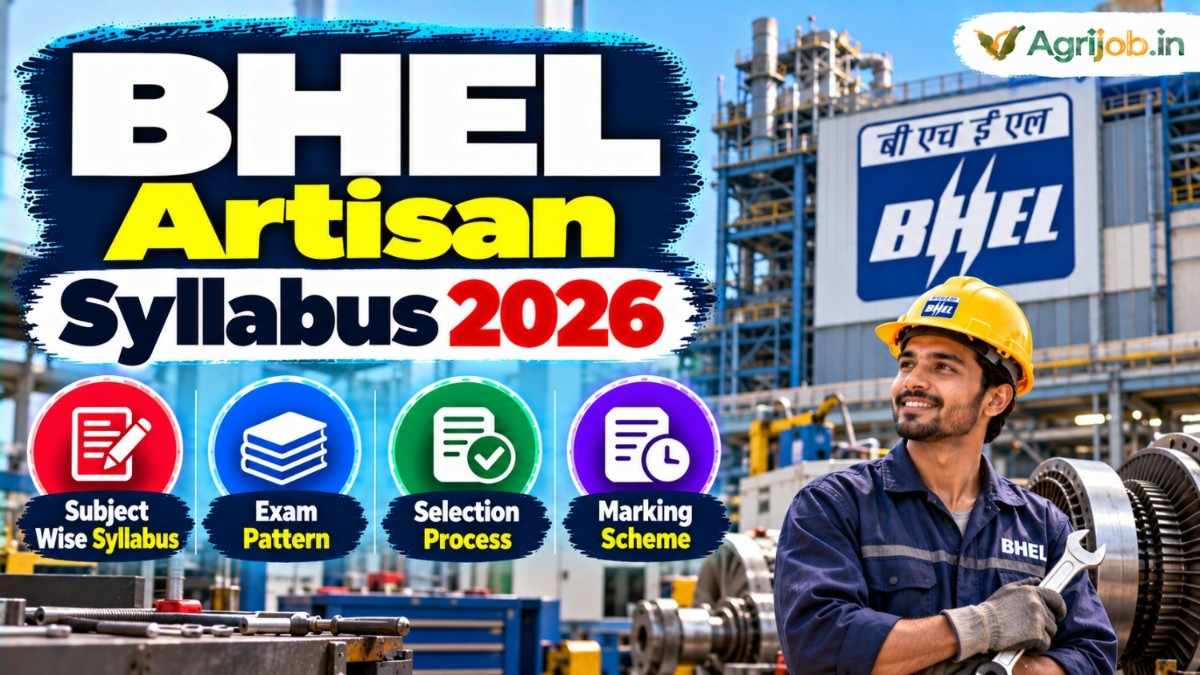
BHEL Artisan Syllabus 2026 has been officially released by Bharat Heavy Electricals Limited (BHEL) along with Advertisement No. 01/2026 for 660 Artisan Grade IV vacancies. If you are an ITI-qualified candidate targeting a Maharatna PSU job with a salary of Rs. 29,500–Rs. 65,000 per month, this guide covers everything — the complete trade-wise syllabus, the exact exam pattern, actual cut-off marks from the previous recruitment cycle, and a proven strategy to crack the CBT scheduled tentatively for December 2026.

The BHEL Artisan 2026 CBT is a 120-question, 90-minute online exam divided into Trade Theory (70 marks), Engineering Drawing & Workshop Calculations (30 marks), and Reasoning Ability (20 marks). Negative marking of 0.25 marks applies per wrong answer. Based on 2025-26 data, category-wise cut-off ranged from approximately 36 to 98 out of 120, varying by trade and unit.
- Organisation: Bharat Heavy Electricals Limited (BHEL) — Maharatna PSU
- Post: Artisan Grade IV
- Advertisement No.: 01/2026
- Total Vacancies: 660
- Trades: Fitter, Welder, Turner, Machinist, Electrician, Electronics Mechanic, Foundryman
- Apply Online: 21 October 2026 to 18 November 2026
- CBT Date (Tentative): 11 December 2026
- Total Questions: 120 | Total Marks: 120 | Duration: 90 Minutes
- Negative Marking: 0.25 per wrong answer
- Salary: Rs. 29,500 – Rs. 65,000 + allowances after regularisation
- Official Website: careers.bhel.in
📋 Table of Contents
- What is BHEL Artisan Grade IV?
- Who Should Apply for BHEL Artisan 2026?
- BHEL Artisan Salary & Pay Scale 2026
- Eligibility Criteria & Application Fee
- BHEL Artisan Exam Pattern 2026 — Detailed
- BHEL Artisan Syllabus 2026 — All 7 Trades
- BHEL Artisan Cut Off 2025-26 — Unit & Category Wise
- CBT vs Skill Test — What Matters More?
- Pros and Cons of BHEL Artisan Job
- Important Terms Related to BHEL Artisan Exam
- Important Dates — Timeline 2026
- Expert Strategy to Crack BHEL Artisan 2026
- Important Links
- Conclusion
- Frequently Asked Questions
What is BHEL Artisan Grade IV — Complete Overview 2026
The BHEL Artisan Grade IV is a permanent government job in one of India’s most reputed Maharatna public sector undertakings. Bharat Heavy Electricals Limited (BHEL) manufactures heavy electrical equipment for power plants, railways, aerospace, defence, and renewable energy sectors across the country. The Artisan Grade IV position places selected candidates directly in core manufacturing and maintenance operations at BHEL’s 9 major production units spread across Tamil Nadu, Andhra Pradesh, Uttar Pradesh, Uttarakhand, Karnataka, Telangana, and Madhya Pradesh.
Selection for BHEL Artisan Grade IV involves a Computer Based Test (CBT) followed by a Skill Test and Document Verification. The CBT is the primary elimination round that shortlists candidates for the practical skill assessment. Understanding the syllabus in full detail is, therefore, the single most important step before starting your preparation.

Who Should Apply for BHEL Artisan 2026?
This recruitment is specifically targeted at technically qualified ITI candidates who want a stable, well-paying central government job in engineering manufacturing. Here is exactly who fits the profile:
- 🔧 ITI pass-outs (NTC + NAC) in Fitter, Electrician, Welder, Turner, Machinist, Electronics Mechanic, or Foundryman trade who scored 60%+ (General/OBC) or 55%+ (SC/ST)
- 👩🔧 Class 10 pass candidates with valid NTC and NAC certificates in any of the 7 notified trades
- 📅 Candidates aged up to 27 years (General/EWS) or 30 years (OBC) or 32 years (SC/ST) as on 1 October 2026
- 🏭 Apprenticeship-trained candidates seeking to convert their training into a permanent BHEL post
- 💼 BHEL Ex-Apprentices who completed apprenticeship at any BHEL unit and want priority consideration
- 🌍 Candidates from across India willing to relocate to BHEL units in Tamil Nadu, Andhra Pradesh, Karnataka, UP, Uttarakhand, MP, or Telangana
- 🎯 Fitter and Electrician aspirants targeting the highest vacancy count — Fitter (278) and Electrician (90) together represent 55% of all 660 posts
- 🧠 Re-applicants from the 2025 cycle who narrowly missed the cut-off and want to use the official cut-off data to calibrate their 2026 preparation
BHEL Artisan Salary and Pay Scale 2026
One of the most attractive features of the BHEL Artisan job is its competitive salary combined with central government benefits. Selected candidates are initially appointed as Temporary Employees for one year on a consolidated wage package, after which they are regularised at the pay scale of Rs. 29,500 to Rs. 65,000 per month.
| Salary Component | Details |
|---|---|
| Basic Pay Scale | Rs. 29,500 – Rs. 65,000 / month |
| Initial Appointment | Temporary for 1 year (consolidated wages) |
| Grade | Artisan Grade IV |
| Provident Fund | Yes (EPFO/BHEL PF) |
| Medical Benefits | Yes (BHEL Medical Scheme) |
| Housing Allowance (HRA) | Applicable as per BHEL policy |
| Performance Incentive | Variable, performance-linked |
| Gratuity & Pension | As per central government norms |
| Leave Benefits | Earned Leave, Medical Leave, CL |
| Approximate Annual CTC | Rs. 5 lakh – Rs. 8 lakh (post regularisation) |
Beyond the base salary, BHEL Artisan employees receive subsidised housing in BHEL townships, children’s education support, canteen facilities, and group insurance cover. These non-monetary benefits add significant value over and above the take-home salary.
Eligibility Criteria and Application Fee for BHEL Artisan 2026
Before studying the syllabus, confirm that you meet every eligibility condition set by BHEL. The requirements are strict and non-negotiable.
- Education: Class 10 (High School) passed from a recognised board
- Technical Qualification: National Trade Certificate (NTC / ITI) AND National Apprenticeship Certificate (NAC) in the relevant trade
- Minimum Marks in NTC and NAC: Not less than 60% for General & OBC; not less than 55% for SC & ST
- Age Limit: Upper age counted as on 1 October 2026
| Category | Upper Age Limit |
|---|---|
| General / EWS | 27 years |
| OBC (Non-Creamy Layer) | 30 years |
| SC / ST | 32 years |
| PwD / Ex-Servicemen | As per Government of India rules |
| Candidates with relevant work experience | Up to 7 years additional relaxation |
| Category | Exam Fee | Processing Fee | Total Payable |
|---|---|---|---|
| UR / EWS / OBC | Rs. 600 | Rs. 400 + GST | Rs. 1,072 |
| SC / ST / PwD / Ex-Servicemen | NIL | Rs. 400 + GST | Rs. 472 |
BHEL Artisan Exam Pattern 2026 — Complete Breakdown
The BHEL Artisan Exam Pattern 2026 follows the Computer Based Test (CBT) format with a total of 120 objective-type multiple-choice questions to be answered in 90 minutes. Every question carries 1 mark and there is a negative marking of 0.25 marks for each wrong answer. The exam is conducted in English, Hindi, and one regional language (candidate’s choice).
| Section | Questions | Marks | Duration |
|---|---|---|---|
| Trade Related Theory | 70 | 70 | 90 Minutes (Combined) |
| Engineering Drawing & Workshop Calculations | 30 | 30 | |
| Reasoning Ability | 20 | 20 | |
| Total | 120 | 120 | 90 Minutes |
Key exam pattern points every candidate must know:
- The exam is fully online (Computer Based Test — CBT) with no pen-and-paper mode
- Each question has 4 options; only 1 is correct
- 0.25 marks are deducted per wrong answer — unattempted questions carry zero penalty
- Trade Theory (70 marks) is the highest-weightage section and the primary differentiator
- Engineering Drawing & Workshop Calculations (30 marks) covers practical technical knowledge
- Reasoning (20 marks) is the easiest to score for most ITI candidates and must not be ignored
- The exam is trade-specific — each candidate gets a paper tailored to their registered trade
- Shortlisted candidates from CBT are then called for Skill Test (practical test at respective BHEL unit)
With -0.25 marking, attempt a question only when you are at least 50% confident in your answer. Leaving 10 questions unattempted is better than attempting all 10 and getting 6 wrong — that combination costs you 1.5 marks net. Target 85+ questions with high accuracy rather than 120 with guesswork.
BHEL Artisan Syllabus 2026 — Complete Trade-Wise Topics
The BHEL Artisan Syllabus 2026 is divided into 3 parts: Trade Theory (70 marks), Engineering Drawing & Workshop Calculations (30 marks), and Reasoning Ability (20 marks). The Trade Theory section is entirely trade-specific. Below is the comprehensive syllabus for all 7 trades along with the common sections.
Electrician Trade Syllabus (70 Marks — Theory)
- Basic Electrical Engineering: Ohm’s Law, Kirchhoff’s Laws, Series and Parallel Circuits, AC/DC fundamentals
- Electrical Machines: DC Motors, AC Motors (Single Phase and Three Phase), Transformers, Generators
- Wiring and Installation: House wiring, industrial wiring, conduit wiring, earthing methods
- Electrical Tools and Safety: Insulation testing, megger, safety procedures, PPE in electrical work
- Measuring Instruments: Multimeter, Ammeter, Voltmeter, Wattmeter, Energy Meter, CRO basics
- Earthing Systems: TN-S, TN-C, TT earthing, earth resistance measurement
- Electronics Basics: Diodes, Transistors, Rectifiers, Power supplies
- Batteries and UPS: Lead-acid batteries, Ni-Cd batteries, charging circuits, inverter UPS basics
- Industrial Electrical Equipment: Control panels, starters (DOL, Star-Delta), PLC basics
- Electrical Machines manufactured by BHEL: Specific products relevant to BHEL’s product line
Fitter Trade Syllabus (70 Marks — Theory)
- Workshop Tools: Files, Hacksaw, Chisels, Hammers, Punches, Scrapers, Spanners
- Measuring Instruments: Vernier Caliper, Micrometer, Dial Gauge, Height Gauge, Surface Plate
- Welding and Gas Cutting: Arc welding basics, Oxy-Acetylene welding, electrode selection
- Drilling and Reaming: Drill bits, drilling machines, reamer types, speed and feed
- Threading: Thread terminology, taps and dies, thread gauges, metric vs inch threads
- Grinding: Types of grinding wheels, surface grinding, cylindrical grinding, wheel dressing
- Heat Treatment: Annealing, Normalising, Hardening, Tempering, Case Hardening
- Maintenance: Planned Maintenance, Breakdown Maintenance, Predictive Maintenance basics
- Metal Joining Processes: Riveting, soldering, brazing
- Estimation and Costing: Simple material estimation, trade-specific costing problems
- Safety: Housekeeping, fire safety, first aid, PPE for fitter trade
Welder Trade Syllabus (70 Marks — Theory)
- Arc Welding: Shielded Metal Arc Welding (SMAW), electrode types, polarity, welding current settings
- Gas Welding: Oxy-Acetylene equipment, flame types (Neutral, Carburising, Oxidising)
- Types of Joints: Butt, Lap, T-Joint, Corner Joint, Edge Joint
- Welding Positions: Flat (1G), Horizontal (2G), Vertical (3G), Overhead (4G)
- GMAW (MIG Welding): Wire feed, shielding gases, voltage and wire speed settings
- GTAW (TIG Welding): Non-consumable tungsten electrode, filler rod selection, inert gas types
- Gas Cutting: Oxy-Fuel cutting, plasma cutting basics, cutting parameters
- Brazing and Soldering: Filler metals, flux, temperature control
- Welding Defects and Remedies: Porosity, undercut, cracks, spatters, distortion
- Inspection Methods: Visual inspection, Dye Penetrant Test (DPT), Magnetic Particle Testing
- Weld Safety: UV radiation protection, fume extraction, PPE, fire prevention in welding area
Machinist Trade Syllabus (70 Marks — Theory)
- Drilling Operations: Drill geometries, speeds and feeds, countersinking, counter boring
- Turning Operations: Lathe machine parts, turning, facing, taper turning, knurling
- Milling Operations: Types of milling cutters, up-milling vs down-milling, indexing
- Grinding: Surface grinder, cylindrical grinder, tool and cutter grinder, wheel specification
- Heat Treatment: Hardening, Tempering, Annealing — effect on material properties
- CNC Basics: G-codes, M-codes, coordinate systems, part programming introduction
- Tolerances and Fits: Limits, Fits (clearance, interference, transition), IS standards
- Cutting Tools: HSS tools, Carbide tools, tool geometry, tool wear, cutting fluids
- Gear Basics: Gear terminology, types of gears (spur, helical, bevel)
- Cam Basics: Types of cams, follower motion, cam terminology
Turner Trade Syllabus (70 Marks — Theory)
- Lathe Machine: Parts and functions, types of lathes, spindle speeds, feed mechanisms
- Cutting Tools: Geometry (rake angle, clearance angle), HSS vs carbide, tool holders
- Measuring Instruments: Vernier Caliper, Micrometer, Bore Gauge, Thread Gauge
- Turning Operations: Plain turning, step turning, taper turning, grooving, parting, threading
- Thread Cutting: Metric and BSW threads, change gear calculations, lead screw
- CNC Introduction: CNC lathe basics, coordinate systems, G-code and M-code basics
- Coolants and Lubricants: Types, applications, coolant maintenance
- Safety: Chuck guard, safety during machining, lathe-specific hazards
- Mandrels and Chucks: Types of chucks (3-jaw, 4-jaw), mandrel types, collet chucks
Electronics Mechanic Trade Syllabus (70 Marks — Theory)
- Hand Tools: Soldering iron, PCB tools, wire strippers, crimping tools
- AC/DC Basics: Waveforms, RMS values, frequency, capacitance, inductance
- Batteries and Power Supplies: SMPS, linear power supply, battery management
- Diodes and Transistors: PN junction, BJT, FET, MOSFET, applications
- Amplifiers and Oscillators: Op-amps, RC oscillators, LC oscillators
- Digital and Analog Circuits: Logic gates, flip-flops, counters, ADC/DAC basics
- Soldering and Desoldering: PCB soldering, SMD soldering, solder defects
- Power Electronics: SCR, TRIAC, DIAC, inverters and converters basics
- Microcontrollers: Architecture basics (8051/ARM), I/O operations, interrupts
- IoT Basics: Sensors, actuators, communication protocols (UART, I2C, SPI)
- Communication Systems: AM, FM, mobile communication basics, optical fiber introduction
Foundryman Trade Syllabus (70 Marks — Theory)
- Principles of Foundry: Types of foundry, advantages of castings, quality assurance basics
- Gating System: Sprue, runner, gate, riser — types and functions
- Sand Testing: Green strength, permeability, clay content, AFS grain fineness number
- Casting Defects: Porosity, cold shut, misrun, hot tear, shrinkage — causes and remedies
- Moulding Processes: Green sand, dry sand, shell moulding, investment casting basics
- Foundry Tools: Rammer, strike-off bar, draw spike, swab, vent wire
- Furnaces: Cupola furnace, induction furnace, electric arc furnace — types and operations
- Melting Charge: Pig iron, scrap metal, ferro-alloys, charge calculation basics
- Heat Treatment for Castings: Stress relief, annealing for castings
- Safety in Foundry: Molten metal hazards, burns, fume extraction, PPE
Engineering Drawing and Workshop Calculations Syllabus (30 Marks)
- Engineering Drawing Symbols: Standard symbols, projection methods (first angle and third angle)
- Circuit and Layout Diagrams: Electrical schematic reading, piping layout, mechanical assembly drawings
- Mensuration: Area and volume calculations for standard shapes (cylinder, cone, sphere)
- Algebra: Linear equations, quadratic equations, simple simultaneous equations
- Trigonometry: Sin, Cos, Tan ratios, applications in trade calculations (angles, tapers)
- Heat and Temperature: Thermal expansion, specific heat, conduction, convection, radiation basics
- Material Science: Properties of metals (tensile strength, hardness, ductility), alloying effects
- Estimation and Costing: Trade-specific estimation problems, simple material cost calculation
Reasoning Ability Syllabus (20 Marks)
- Analogies: Semantic Analogy, Symbolic/Number Analogy, Figural Analogy
- Venn Diagrams: 2-set and 3-set Venn diagrams, finding members of sets
- Logical Reasoning: Statement-Conclusion, Syllogistic Reasoning
- Data Interpretation: Simple tables and bar charts, reading and inference
- Arithmetic Number Series: Finding missing terms, next/previous term in a sequence
- Coding-Decoding: Letter coding, number coding, substitution coding
- Classification: Odd one out (Semantic, Figural, Symbolic)
- Space Visualisation: Mirror image, paper folding, dice problems
- Observation and Decision Making: Discrimination, relationship concepts, judgment
- Basic Aptitude: Percentages, ratios, prime numbers, simple arithmetic
BHEL Artisan Cut Off 2025-26 — Unit and Category Wise (Official Data)
BHEL released the official cut-off marks for Artisan Recruitment 2025-26 in March 2026. These are the actual minimum marks required out of 120 to qualify for the Skill Test, across different units and trades. Use this data to set your preparation target.
BAP Ranipet (Tamil Nadu) — Cut Off Marks (Out of 120)
| Trade | UR | EWS | OBC | SC | ST |
|---|---|---|---|---|---|
| Fitter | 62.75 | — | 60.25 | 56.75 | 36.25 |
| Welder | 64.75 | 48.75 | 55.50 | 57.75 | NA |
| Turner | 54.00 | — | 49.00 | 45.00 | NA |
| Machinist | 49.00 | — | 37.50 | 38.00 | NA |
HPVV Vizag (Andhra Pradesh) — Cut Off Marks (Out of 120)
| Trade | UR | EWS | OBC | SC | ST |
|---|---|---|---|---|---|
| Fitter | 77.00 | 56.75 | 79.25 | 65.75 | 73.75 |
| Welder | 68.00 | — | 66.75 | 62.00 | 68.75 |
| Machinist | 48.75 | — | 46.00 | 38.75 | NA |
HERP Varanasi (Uttar Pradesh) — Cut Off Marks (Out of 120)
| Trade | UR | EWS | OBC | SC | ST |
|---|---|---|---|---|---|
| Fitter | 83.75 | 49.25 | 66.25 | 63.75 | NA |
| Turner | 77.75 | 65.00 | 69.50 | 67.00 | 59.00 |
| Machinist | 67.50 | 0.00 | 47.50 | 45.00 | 45.50 |
EDN Bangalore (Karnataka) — Cut Off Marks (Out of 120)
| Trade | UR | EWS | OBC | SC | ST |
|---|---|---|---|---|---|
| Electrician | 80.25 | 61.75 | 89.00 | 68.00 | 52.50 |
| Electronics Mechanic | 57.75 | 51.25 | 55.75 | 51.00 | 45.25 |
| Fitter | 69.25 | NA | 68.25 | NA | NA |
HEP Bhopal (Madhya Pradesh) — Cut Off Marks (Out of 120)
| Trade | UR | EWS | OBC | SC | ST |
|---|---|---|---|---|---|
| Fitter | 83.50 | 77.25 | 90.50 | 78.00 | 68.00 |
| Welder | 72.50 | NA | 73.75 | NA | 70.25 |
| Turner | 69.00 | NA | NA | 60.25 | NA |
| Machinist | 79.00 | 58.00 | 78.75 | 71.75 | 65.25 |
| Electrician | 97.75 | 82.00 | 98.00 | 86.75 | 77.75 |
TP Jhansi (Uttar Pradesh) — Cut Off Marks (Out of 120)
| Trade | UR | EWS | OBC | SC | ST |
|---|---|---|---|---|---|
| Fitter | 75.50 | 49.00 | 71.50 | 64.50 | NA |
| Welder | 71.25 | 48.25 | 64.25 | 67.25 | NA |
| Machinist | 61.75 | NA | 45.50 | 52.25 | NA |
| Electrician | 86.25 | 57.25 | 79.25 | 71.00 | NA |
HPBP Trichy (Tamil Nadu) — Cut Off Marks (Out of 120)
| Trade | UR | EWS | OBC | SC | ST |
|---|---|---|---|---|---|
| Fitter | 75.75 | 55.75 | 73.25 | 68.75 | NA |
| Welder | 60.75 | 55.75 | 66.50 | 63.50 | NA |
| Machinist | 59.25 | — | 57.00 | 45.00 | NA |
- HEP Bhopal had the highest UR cut-off for Electrician at 97.75/120 — among the toughest in India
- EDN Bangalore Electrician OBC cut-off was 89.00/120 — competition is fierce in Karnataka
- BAP Ranipet Machinist UR cut-off was just 49/120 — relatively low competition for this trade
- PwD candidates get relaxation of up to 25% less than the category cut-off
- These are official cut-offs from BHEL’s PDF published at careers.bhel.in in March 2026
BHEL Artisan CBT vs Skill Test — What Matters More?
| Factor | CBT (Written Test) | Skill Test (Practical) |
|---|---|---|
| Purpose | Screening / Shortlisting | Final selection confirmation |
| Marks | 120 marks (120 questions) | Qualifying in nature |
| Negative Marking | -0.25 per wrong answer | No negative marking |
| Trade-specific | Yes — 70 marks trade theory | Yes — hands-on practical task |
| Syllabus | ITI theory + Engineering Math + Reasoning | NCVT standard trade practical |
| Time Limit | 90 minutes | Varies by task assigned |
| Mode | Online (CBT) | At BHEL unit workshop |
| Final Merit Based On | CBT score is primary merit factor | Pass/Fail (qualifying) |
| Difficulty Level | Moderate to High | ITI standard practical |
| Best for Ranks | Your entire rank depends on CBT | You only need to pass Skill Test |
The CBT is where your selection is won or lost. The Skill Test is qualifying — meaning you simply need to pass it, not score high. Your entire rank and unit allocation depends entirely on your CBT marks. Allocate 85% of your preparation time to CBT subjects and keep 15% for brushing up trade practicals before the Skill Test.
Pros and Cons of BHEL Artisan Grade IV Job
✅ Advantages of BHEL Artisan Job:
- Permanent central PSU job with Rs. 29,500–Rs. 65,000/month salary and regular increments
- Comprehensive benefits: PF, gratuity, group insurance, medical coverage for self and family
- Subsidised BHEL township housing, canteen, and schooling for children in most units
- Direct recruitment at Grade IV — no probation exam, regularised after 1 year temporary period
- Work across India’s most strategic infrastructure sectors — power, defence, railways, renewable energy
- Clear promotion path: Artisan Grade IV → Grade III → Grade II → Grade I → Supervisor (with departmental exams)
❌ Disadvantages of BHEL Artisan Job:
- Initial 1 year as Temporary Employee on consolidated wages — not full pay scale during this period
- Competition is extremely high — Electrician at HEP Bhopal saw a UR cut-off of 97.75/120
- Unit preference is not guaranteed — you may be posted to a different state than your home
- Physical factory environment with shift duties in some manufacturing units
Important Terms Related to BHEL Artisan Exam and Recruitment
- NTC (National Trade Certificate): Certificate awarded after passing the ITI trade exam conducted by NCVT or SCVT. Minimum 60% required (55% for SC/ST) for BHEL Artisan eligibility.
- NAC (National Apprenticeship Certificate): Certificate awarded after completing the Apprenticeship Training under the Apprentices Act 1961. Both NTC and NAC are mandatory for BHEL Artisan 2026.
- CBT (Computer Based Test): Online objective-type exam conducted at designated test centres; 120 questions in 90 minutes.
- NCVT (National Council for Vocational Training): Apex body under Ministry of Skill Development that certifies ITI trades across India. BHEL accepts both NCVT and SCVT certificates.
- Artisan Grade IV: Entry-level shop floor technical position in BHEL; responsible for trade-specific manufacturing and maintenance tasks in the assigned unit.
- Negative Marking (0.25): For every incorrect answer in the BHEL Artisan CBT, 0.25 marks are deducted from your total score. Unattempted questions carry no penalty.
- Skill Test: Practical examination conducted at the respective BHEL manufacturing unit; qualifying in nature — pass/fail only; does not affect merit rank.
- DV (Document Verification): Final stage where shortlisted candidates submit original certificates for verification. Any mismatch results in rejection.
- Cut-Off (CBT): Minimum marks required in the CBT to qualify for the Skill Test. It varies by unit, trade, and category. Official cut-off is published by BHEL on careers.bhel.in after results.
- EWS (Economically Weaker Section): Candidates from general category with family income below Rs. 8 lakh/year qualify for EWS reservation — 10% horizontal reservation.
Important Dates — BHEL Artisan 2026 Timeline
| Event | Date (2026) |
|---|---|
| Official Notification Released | 17 October 2026 |
| Online Application Starts | 21 October 2026 |
| Last Date to Apply Online | 18 November 2026 |
| CBT (Computer Based Test) | 11 December 2026 (Tentative) |
| Admit Card Release | Expected December 2026 (before exam) |
| Result and Cut Off Publication | Expected February–March 2027 |
| Skill Test / Document Verification | Expected April–May 2027 |
Expert Strategy to Crack BHEL Artisan 2026 — 8-Week Plan
Based on the actual cut-off data and exam pattern, here is a proven week-by-week strategy to score 80+ out of 120 in BHEL Artisan CBT 2026:
- Week 1–2: Master Trade Theory Foundation (70 marks section) — Begin with your specific trade’s core theory. For Fitter, focus on measuring instruments and fitting processes. For Electrician, prioritise AC/DC fundamentals, motors, and transformers. Target 100% coverage of NCVT ITI first-year and second-year theory books. Use NIMI question banks available on nimionlinetest.nic.in free of cost.
- Week 3–4: Engineering Drawing and Workshop Calculations (30 marks section) — Study projections (first angle vs third angle) and reading engineering drawings. Practice mensuration problems daily — area and volume of cylinders, cones, and spheres. Solve 10 trigonometry problems per day — sin/cos/tan for taper angle calculations are common in exams. Material science basics (hardness, tensile strength, alloying) take 2–3 days, not weeks.
- Week 5: Reasoning Ability (20 marks section — highest ROI) — Reasoning is the quickest 20 marks you can secure if you practice daily for 1 hour. Focus on: number series, coding-decoding, Venn diagrams, and analogies. Complete all 20 marks with 95%+ accuracy in 15–18 minutes. Use the saved time to review trade theory questions in CBT.
- Week 6: Previous Year Questions and Mock Tests — Attempt BHEL Artisan previous year papers from 2025 (October 2025 exam) and the January 2026 re-exam. Analyse your weak topics after each mock. Score below 50 in any section → immediately revise that section’s theory before the next mock.
- Week 7: Cut-Off-Based Target Setting — Check your target unit’s cut-off from the 2025-26 table above. Add 10–15 marks as buffer. If targeting Electrician at HEP Bhopal UR, your target should be 97+. If targeting Machinist at BAP Ranipet UR, a score of 60+ is sufficient. This unit-specific targeting prevents over-studying or under-preparation.
- Week 8: Revision + Negative Marking Discipline — In the final week, solve only full-length mock tests (120 questions in 90 minutes). Practice the “skip-review-attempt” strategy: skip questions you are unsure about in Round 1; come back to them only after completing all confident questions. Never guess randomly — each wrong answer costs 0.25 marks. Aim for 85–90 high-accuracy attempts rather than 120 random attempts.
- Throughout All 8 Weeks — Trade Practical Revision — Spend 30 minutes daily reviewing practical skills (welding positions for Welder, lathe operations for Turner, panel wiring for Electrician). The Skill Test is only Pass/Fail but a lapse in basics will cost your selection at the final stage after clearing the CBT.
- Resources to Use — NIMI question banks (free at nimionlinetest.nic.in), Arihant BHEL Artisan trade-specific books, RK Jain’s Engineering Drawing for drawing section, RS Aggarwal’s Reasoning for the reasoning section. Avoid coaching if exam date is within 8 weeks — direct practice from these books is more effective than classroom sessions at this stage.
Important Links — BHEL Artisan 2026
| Resource | Link |
|---|---|
| BHEL Official Careers Portal | careers.bhel.in |
| BHEL Artisan 2026 Official Notification PDF | Download from careers.bhel.in |
| BHEL Artisan 2025-26 Cut Off PDF (Official) | Unit-wise Cut Off PDF — careers.bhel.in |
| NIMI Free ITI Question Banks (Official) | nimionlinetest.nic.in |
| Ministry of Heavy Industries (BHEL Governing Body) | heavy.gov.in |
Conclusion — BHEL Artisan Syllabus 2026
The BHEL Artisan Syllabus 2026 is clearly defined with 70 marks for Trade Theory, 30 marks for Engineering Drawing and Workshop Calculations, and 20 marks for Reasoning. The previous cycle’s official cut-off data shows that scores between 49 and 98 out of 120 were needed depending on trade, unit, and category. Your target score must be your unit’s cut-off plus a 10-mark buffer. Apply before 18 November 2026 at careers.bhel.in and start your preparation immediately with the 8-week strategy outlined above. Bookmark this page — it is updated every time BHEL releases official data changes.
- BHEL Artisan 2026 has 660 vacancies across 7 trades — applications close on 18 November 2026
- The CBT has 120 questions for 120 marks in 90 minutes, with -0.25 negative marking per wrong answer
- Trade Theory (70 marks) is the single most important section — study your ITI trade syllabus thoroughly
- HEP Bhopal Electrician UR cut-off was 97.75/120 in 2025-26 — competition is intense at popular units
- BAP Ranipet Machinist UR cut-off was only 49/120 — trade and unit choice significantly affects your chances
- Skill Test is qualifying (Pass/Fail) only — your entire rank is determined by CBT score alone
Frequently Asked Questions About BHEL Artisan Syllabus 2026
What is the BHEL Artisan Syllabus 2026?
The BHEL Artisan Syllabus 2026 covers three main sections: Trade Theory (70 marks — trade-specific topics for your registered trade), Engineering Drawing and Workshop Calculations (30 marks — drawing symbols, mensuration, algebra, trigonometry, material science), and Reasoning Ability (20 marks — analogies, number series, Venn diagrams, logical reasoning). The entire exam is 120 questions for 120 marks in 90 minutes.
What is the exam pattern for BHEL Artisan 2026?
The BHEL Artisan Exam Pattern 2026 is a 120-question Computer Based Test (CBT) totalling 120 marks, completed in 90 minutes. It consists of 70 questions from Trade Theory, 30 from Engineering Drawing and Workshop Calculations, and 20 from Reasoning Ability. There is a negative marking of 0.25 marks per wrong answer. The exam is available in English, Hindi, and one regional language.
What was the BHEL Artisan cut off for 2025-26?
The official BHEL Artisan cut-off 2025-26 (released March 2026) varied widely by trade and unit. The highest cut-off was for Electrician at HEP Bhopal — UR: 97.75, EWS: 82.00, OBC: 98.00, SC: 86.75, ST: 77.75. The lowest cut-off was for Machinist at BAP Ranipet — UR: 49.00, OBC: 37.50, SC: 38.00. Always check the official PDF at careers.bhel.in for your specific unit and trade.
Is there negative marking in BHEL Artisan CBT?
Yes, the BHEL Artisan CBT has negative marking of 0.25 marks for every wrong answer. A correct answer earns +1 mark. Questions left unattempted carry zero penalty. This means you should attempt only questions where you are reasonably confident — random guessing will reduce your total score rather than increase it.
How many vacancies are there in BHEL Artisan 2026?
BHEL has announced 660 vacancies under Advertisement No. 01/2026 for Artisan Grade IV posts across 7 trades: Fitter (278), Welder (104), Machinist (101), Electrician (90), Turner (52), Electronics Mechanic (23), and Foundryman (12). These positions are spread across 9 manufacturing units in Tamil Nadu, Andhra Pradesh, Karnataka, Uttar Pradesh, Uttarakhand, Madhya Pradesh, and Telangana.
What is the salary for BHEL Artisan Grade IV?
The BHEL Artisan Grade IV salary is Rs. 29,500 to Rs. 65,000 per month after regularisation following the initial 1-year temporary period. Additionally, selected candidates receive Provident Fund, medical benefits for self and family, group insurance, housing in BHEL townships (at some units), performance-linked incentives, and other central government employee benefits making the total annual CTC approximately Rs. 5–8 lakh.
Is NTC and NAC both required for BHEL Artisan 2026?
Yes, both NTC (National Trade Certificate, i.e., ITI certificate from NCVT/SCVT) and NAC (National Apprenticeship Certificate from the apprenticeship training under Apprentices Act 1961) are mandatory for BHEL Artisan 2026 eligibility. Candidates holding only NTC without NAC, or only NAC without NTC, are NOT eligible. Minimum marks in both must be 60% for General/OBC and 55% for SC/ST candidates.
Which trade has the highest cut-off in BHEL Artisan?
Based on 2025-26 official data, the Electrician trade at HEP Bhopal had the highest cut-off at 97.75 out of 120 for UR candidates and 98.00 for OBC candidates — making it the most competitive combination. Electrician trade in general had high cut-offs at multiple units including TP Jhansi (UR: 86.25) and EDN Bangalore (OBC: 89.00). Machinist and Turner trades at smaller units had significantly lower cut-offs.
What is the last date to apply for BHEL Artisan 2026?
The last date to apply for BHEL Artisan 2026 is 18 November 2026. Online applications open on 21 October 2026 at careers.bhel.in. The application fee is Rs. 1,072 for UR/EWS/OBC candidates and Rs. 472 for SC/ST/PwD/Ex-Servicemen. Do not wait for the last day — server congestion at the deadline can cause issues with form submission.
How should I prepare for BHEL Artisan 2026 in 2 months?
For a 2-month BHEL Artisan 2026 preparation plan: spend the first 3 weeks mastering trade theory using your NCVT ITI textbooks and NIMI question banks (free on nimionlinetest.nic.in). Spend week 4 on Engineering Drawing and Workshop Calculations (mensuration, projections, trigonometry). Spend week 5 on Reasoning Ability (target full 20 marks here). From week 6 onwards, take daily mock tests, analyse errors, and revise weak topics. In the final week, practice 90-minute full-length mocks with strict negative marking discipline — aim for 85–90 accurate attempts, not 120 attempts with guesswork.
Last Updated: October 2026 | Source: BHEL Official Notification Advt. 01/2026 and official Unit-wise Cut Off PDF published at careers.bhel.in. All figures are as per the latest official data. Bookmark this page for updates when BHEL releases the detailed notification and admit card.
Disclaimer: This article is for informational purposes only. Cut-off marks from previous recruitment cycles are provided as reference data. Actual cut-offs for the 2026-27 cycle will depend on exam difficulty, vacancy count, and applicant performance. Always verify all details from the official BHEL portal at careers.bhel.in before making any application decisions.