

Edible marigold farming in India is one of the most profitable niche floriculture opportunities available to Indian farmers in 2026. While ornamental marigolds earn Rs.20–Rs.80/kg at mandis, edible varieties command Rs.200–Rs.999/kg from gourmet restaurants, luxury hotels, and export buyers — on the same amount of land, in the same 60-day crop cycle. This guide is for Indian farmers, agri-entrepreneurs, and horticulture enthusiasts who want to enter the high-value edible flower market with minimal investment. Inside, you will find the complete botany, step-by-step cultivation method, domestic market strategy, profit calculation, and a full export roadmap.

Edible marigold farming in India (primarily Tagetes tenuifolia and Tagetes lucida) is a highly profitable niche crop yielding Rs.2.5–3 lakh net profit per acre per cycle. NSC-certified edible marigold seeds are available for as low as Rs.50–Rs.120 per pack, and fresh edible flowers sell at Rs.200–Rs.999/kg to gourmet buyers — up to 10× the mandi rate for ornamental varieties.
- Botanical Names: Tagetes tenuifolia (Signet), Tagetes lucida (Mexican Tarragon)
- Seed Cost (NSC): Rs.50–Rs.120 per pack (5–10 gm)
- Cultivation Cost per Acre: Rs.55,000–Rs.70,000
- Average Yield per Acre: 8–14 tonnes (loose flowers/season)
- Gourmet Market Price (Fresh): Rs.200–Rs.999/kg
- Dried Petal Price (B2B): Rs.450–Rs.1,480/kg
- Net Profit per Acre per Cycle: Rs.2.5–Rs.3 lakh
- Crop Duration: 60–90 days (60-day fast cycle possible)
- India Floriculture Export FY 2025-26: USD 92.55 million (APEDA)
- Global Marigold Extract Market 2026: USD 412.5 million (CAGR 6.8%)
📋 Table of Contents
- What Is Edible Marigold and Why It Is Different
- Who Should Grow Edible Marigolds
- Botany and Varieties of Edible Marigolds
- Step-by-Step Cultivation Guide
- Profit and Income Calculation per Acre
- Gourmet and Domestic Market Opportunity
- Edible Marigold vs. Ornamental Marigold
- Pros and Cons of Edible Marigold Farming
- Complete Export Guide for Global Markets
- Important Terms Related to Edible Floriculture
- Important Links and Resources
- Conclusion
- Key Takeaways
- Frequently Asked Questions
What Is Edible Marigold and Why It Is Different from Ornamental Varieties
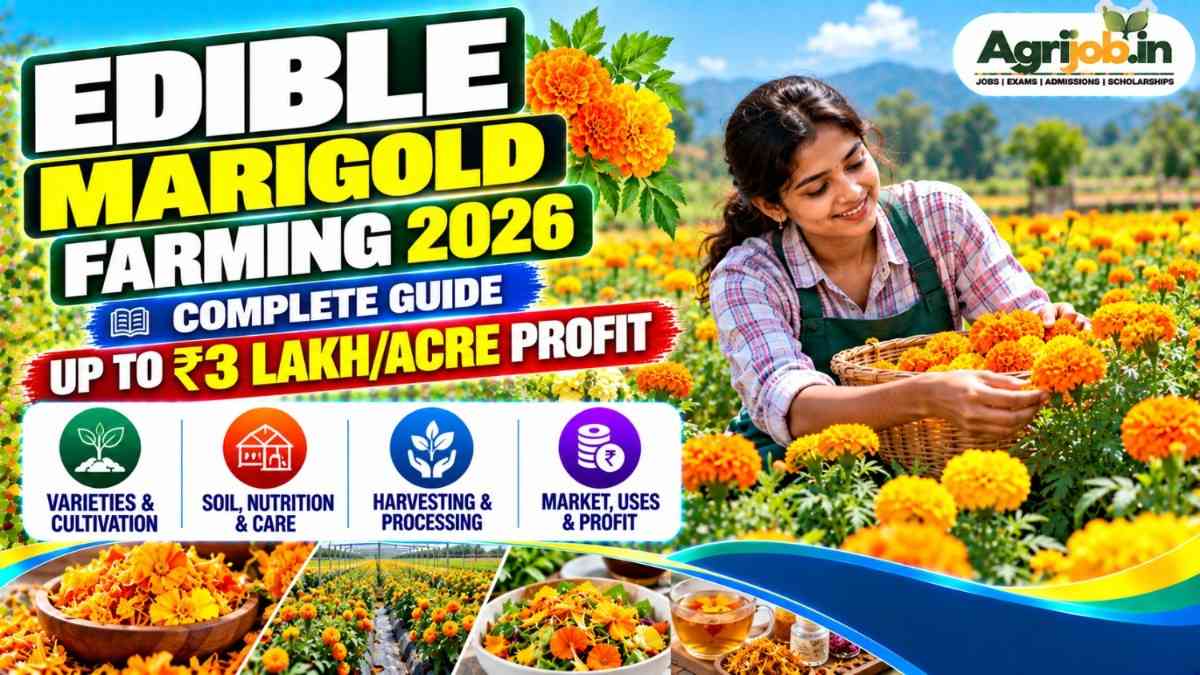
Edible marigold refers specifically to culinary-grade varieties of the genus Tagetes — most notably Tagetes tenuifolia (Signet Marigold) and Tagetes lucida (Mexican Tarragon) — that are grown, harvested, and processed under food-safe, chemical-free conditions for human consumption. These are fundamentally different from the common ornamental African Marigold (Tagetes erecta) or French Marigold (Tagetes patula) that dominate Indian mandi trade. While ornamental marigolds are grown with synthetic pesticides and chemical fertilizers for visual impact, edible varieties must meet strict food-safety standards — making them a premium, high-value niche within Indian floriculture.
The flowers produce small, star-shaped, delicate blooms with a distinctive flavor profile that food scientists describe as a blend of citrus, tarragon, and mild mint. Their leaves and petals are both consumable, making them a dual-use crop for gourmet restaurants, herbal tea manufacturers, luxury bakeries, and pharmaceutical companies. The National Seeds Corporation (NSC) — a Miniratna Category-I Central PSU under India’s Ministry of Agriculture — officially promotes edible marigold cultivation through its seed distribution network, branding the crop under its “Nature’s Freshness for Healthy Meals” initiative.

Who Should Grow Edible Marigolds in India?
Edible marigold cultivation suits a wide range of growers and agri-entrepreneurs who want to diversify income without large capital investment. This guide is especially relevant for:
- 🌸 Small and marginal farmers with 0.5–2 acres who want a premium crop that earns 5–10× more per kg than traditional vegetables
- 🏡 Kitchen and terrace garden growers in urban and peri-urban areas supplying directly to local restaurants and hotels
- 👨🌾 Existing marigold farmers (West Bengal, Karnataka, Andhra Pradesh, Tamil Nadu) who want to upgrade from mandi-price ornamentals to gourmet-price edibles
- 🌿 Organic farmers already certified or seeking NPOP certification who can command a 40–100% premium in both domestic and export markets
- 📦 Agri-exporters and trading companies seeking high-CPC, low-weight, high-value horticultural products for European, Middle Eastern, and US buyers
- 🍵 Value-addition entrepreneurs interested in herbal teas, edible flower infusions, marigold oleoresin, and dried petal products
- 🎓 Agriculture graduates and farm management professionals looking for innovative business ideas with low entry barriers
- 🏨 Hospitality-linked farm suppliers who can establish direct B2B contracts with 5-star hotels and boutique restaurants
Botany and Varieties of Edible Marigolds: A Scientific Overview
Understanding the botany of edible marigolds is essential for selecting the right variety, predicting yield, and meeting buyer specifications. The genus Tagetes, part of the Asteraceae family, contains approximately 50 species, but only a few are suitable for culinary and food-grade use.
| Feature | Tagetes tenuifolia (Signet) | Tagetes lucida (Mexican Tarragon) | Tagetes minuta |
|---|---|---|---|
| Common Name | Signet / Lemon Marigold | Mexican Marigold / Winter Tarragon | Muster John Henry |
| Flavor Profile | Citrus, lemony, tangy | Tarragon-anise, sweet | Strong herbal, peppery |
| Plant Height | 25–50 cm | 60–90 cm | 50–100 cm |
| Flower Size | Small, 1–2 cm (star-shaped) | Small, 1–2 cm (yellow) | Very small, clusters |
| Edible Parts | Flowers + leaves | Leaves + flowers | Leaves (primarily) |
| Best Use | Salads, garnishes, teas | Herbal tea, cooking substitute | Essential oil, herbal extract |
| Antioxidant Content | High (flavonoids, carotenoids) | Very High (quercetin-rich) | High (thiophene compounds) |
| NSC Availability | Yes (Edible Marigold 10gm pack) | Limited / specialty | Available via agri-nurseries |
Key bioactive compounds found in edible marigolds include lutein, zeaxanthin, beta-carotene, flavonoids, quercetin, and natural thiophene — all of which drive pharmaceutical and nutraceutical demand globally. The global marigold flower extract market was valued at USD 412.5 million in 2026 and is projected to reach USD 745.7 million by 2035 at a CAGR of 6.8%, with India recording the fastest country-level growth at 10.1% CAGR through 2036 — the highest among all producing nations. This data makes India’s edible marigold sector one of the most strategically important niches in commercial floriculture today.
Step-by-Step Edible Marigold Cultivation Guide for Indian Farmers 2026
Edible marigold farming requires no specialized equipment and fits easily into an existing horticulture operation. The most critical difference from ornamental cultivation is the strict zero-chemical-pesticide requirement — edible varieties must be grown using only natural, food-safe inputs throughout the crop cycle.
- Variety and Seed Selection: Source NSC-certified Tagetes tenuifolia (Signet) edible marigold seeds from the nearest NSC Area Office, MyStore (digihaat.in), or authorized NSC distributors. The Edible Marigold 10gm Truthfully Labelled seed pouch from NSC-Bhopal is widely available at Rs.50–Rs.120 per pack. Verify seed lot number and germination percentage (minimum 80%) on the label before purchase.
- Land Preparation: Select well-drained loamy soil with a pH between 7.0 and 7.5. Saline and waterlogged soils are unsuitable. Perform deep plowing (2–3 passes), then apply 10–15 tonnes of fully composted organic matter (FYM) per hectare. Do NOT apply synthetic NPK fertilizers — substitute with vermicompost, neem cake, bone meal, and bio-stimulants to maintain food-grade status.
- Nursery and Transplanting: Sow seeds in pro-trays or raised nursery beds 3–4 weeks before transplanting. Germination occurs in 5–7 days. Maintain nursery beds at 14.5°C–28.6°C. Transplant seedlings at a spacing of 30 cm × 30 cm (French-style) or 45 cm × 45 cm for better air circulation, which is critical for organic production to prevent fungal disease.
- Irrigation Management: Install drip irrigation for precise water delivery. Edible marigolds require moderate, consistent moisture — neither drought stress nor waterlogging. Water every 2–3 days during seedling establishment, then every 4–5 days at maturity. Overhead sprinklers are avoided post-flowering to prevent petal damage and mold, which disqualifies flowers from gourmet and export grades.
- Organic Pest and Disease Management: Because synthetic pesticides are prohibited, use neem oil spray (3–5 ml/litre) every 10–14 days as a preventive measure against aphids, thrips, and spider mites. Deploy yellow sticky traps at 25 per acre for whitefly monitoring. For fungal issues (powdery mildew), apply diluted wood ash or copper-based biocontrol. This is the single most important management practice for maintaining food-grade certification.
- Pinching for Higher Yield: Pinch the growing tip of seedlings 2–3 weeks after transplanting. This encourages branching and dramatically increases the number of flower-bearing stems per plant — typically adding 30–40% more flower yield without any additional input cost. This practice is unique to edible flower production and separates high-yielding farms from average ones.
- Harvesting — Timing Is Everything: Harvest flowers in the early morning (5:00 AM–8:00 AM) when essential oil content and flower turgidity are at their peak. Use clean, food-grade scissors or hand-pick only fully open blooms. Harvest every 2–3 days to prevent over-maturation, which reduces flavor quality and shelf life. Handle flowers gently to avoid bruising — bruised flowers are downgraded or rejected by premium buyers.
- Post-Harvest Handling: Immediately after harvest, cool flowers in a 2°C–4°C cold room or pre-cooler. Pack in rigid, food-grade clamshell containers or shallow ventilated trays lined with damp food-safe tissue. Fresh edible flowers have a shelf life of 5–7 days under cold-chain; dried petals have a shelf life of 12–18 months in airtight packaging.
Most new edible marigold farmers skip pinching because it feels counterintuitive to cut a healthy plant. Don’t. A single pinch at the 4-leaf stage converts one main stem into 4–6 flowering branches. On a 1-acre plot with 8,000 plants, this one 2-hour operation adds the equivalent of Rs.30,000–Rs.50,000 in additional flower yield per crop cycle — with zero additional input cost. Always use sterilized scissors and pinch in the morning to allow wounds to dry before evening dew.
Edible Marigold Profit and Income Calculation per Acre — 2026 Data
The economics of edible marigold farming are significantly more attractive than conventional floriculture when you target premium market channels. Here is a realistic per-acre income and cost model based on 2025–2026 market data.
| Cost Item | Amount (Rs./Acre) |
|---|---|
| Land preparation and plowing | Rs.4,000–Rs.6,000 |
| NSC edible marigold seeds | Rs.800–Rs.2,000 |
| Organic manure and vermicompost | Rs.8,000–Rs.12,000 |
| Drip irrigation (first-year capital) | Rs.18,000–Rs.25,000 |
| Labour (transplanting, pinching, harvest) | Rs.12,000–Rs.18,000 |
| Neem oil, biocontrol inputs | Rs.2,500–Rs.4,000 |
| Post-harvest packaging and cold storage | Rs.5,000–Rs.8,000 |
| Total Cost per Acre (First Year) | Rs.55,000–Rs.70,000 |
| Total Cost per Acre (Subsequent Years) | Rs.35,000–Rs.45,000 |
| Revenue Channel | Price per kg | Estimated Yield/Acre | Gross Revenue/Acre |
|---|---|---|---|
| Mandi / wholesale (fresh) | Rs.60–Rs.100/kg | 8–10 tonnes | Rs.48,000–Rs.1,00,000 |
| Direct to restaurants / hotels | Rs.200–Rs.500/kg | 6–8 tonnes | Rs.1.2L–Rs.4L |
| Premium gourmet / organic buyers | Rs.499–Rs.999/kg | 4–6 tonnes | Rs.2L–Rs.6L |
| Dried petals (herbal/pharma) | Rs.450–Rs.1,480/kg | 1.5–2 tonnes (dried) | Rs.67,500–Rs.2.96L |
| Export (FOB, dried extract) | Rs.892–Rs.1,480/kg | 1–2 tonnes | Rs.89,200–Rs.2.96L |
Realistic net profit scenario (direct-to-restaurant + partial export model): A 1-acre edible marigold farm producing 7 tonnes of fresh flowers at an average realized price of Rs.350/kg generates Rs.2,45,000 gross revenue. After Rs.60,000 in total costs, net profit is approximately Rs.1,85,000–Rs.2,50,000 per acre per cycle. With two cycles per year and a mixed fresh+dried sales model, annual net income from one acre can reach Rs.3.5–Rs.5 lakh per acre per year — compared to Rs.50,000–Rs.90,000 from the same land under ornamental marigold cultivation.
Gourmet and Domestic Market Strategy for Edible Marigolds
The domestic gourmet market for edible flowers in India is expanding at double-digit rates, driven by the growth of fine-dining culture, health-conscious urban consumers, and luxury hospitality. Edible marigolds occupy a unique position: they are simultaneously affordable to grow, visually striking, nutritionally validated, and culturally familiar as a recognizable flower form.
Primary buyer categories in India’s gourmet market:
- Five-star and boutique hotels: Use edible flowers extensively in fine-dining menus, cocktail garnishes, and dessert plating. Delhi, Mumbai, Bangalore, and Goa markets pay Rs.300–Rs.600/kg for consistent, food-grade fresh supplies.
- Luxury bakeries and patisseries: Cake decorators and pastry chefs command Rs.400–Rs.800/kg for edible flower petals used in wedding cakes, artisan desserts, and Instagram-worthy pastries.
- Herbal tea manufacturers: Companies producing premium tisanes and wellness teas buy dried edible marigold at Rs.450–Rs.900/kg (bulk) for blends marketed under “floral infusion” and “antioxidant tea” categories.
- Health food and D2C brands: Direct-to-consumer brands on platforms like Amazon, Flipkart, and specialty health stores sell dried edible marigold at Rs.280–Rs.1,480/kg retail — making wholesale procurement at Rs.200–Rs.450/kg extremely profitable.
- Pharmaceutical and nutraceutical companies: Lutein and zeaxanthin extraction from marigold petals is a growing industrial segment. Companies like Parry (India) Limited source bulk marigold for carotenoid extraction at contracted rates.
- Direct consumer marketing via social media: Urban farmers near metro cities successfully sell through Instagram, WhatsApp communities, and local farmer markets at Rs.500–Rs.1,000/kg, cutting out all middlemen.
Value-addition beyond fresh flowers dramatically increases per-acre revenue. Drying flowers at home using a food dehydrator (Rs.5,000–Rs.15,000 investment) converts 6 kg of fresh flowers into 1 kg of dried petals — multiplying realization from Rs.80/kg to Rs.480/kg. Infusing dried petals in extra-virgin olive oil or artisanal vinegar and selling as gourmet condiments adds another layer of value that restaurants and specialty stores pay Rs.300–Rs.800 per 100ml bottle for.
Edible Marigold vs. Ornamental Marigold — Which Is More Profitable?
| Parameter | Edible Marigold | Ornamental Marigold |
|---|---|---|
| Main Varieties | Tagetes tenuifolia, T. lucida | Tagetes erecta, T. patula |
| Cultivation Method | 100% organic / chemical-free (mandatory) | Conventional (synthetic inputs allowed) |
| Mandi Price (Fresh) | Rs.60–Rs.100/kg (if sold at mandi) | Rs.12–Rs.80/kg |
| Gourmet / Direct Price | Rs.200–Rs.999/kg | Not applicable |
| Export Value (Dried) | Rs.892–Rs.1,480/kg | Rs.200–Rs.500/kg (oleoresin) |
| Seed Cost | Rs.50–Rs.120/pack (NSC) | Rs.30–Rs.80/pack |
| Yield per Acre | 8–14 tonnes (loose flowers) | 10–14 tonnes (loose flowers) |
| Net Profit per Acre | Rs.1.85–Rs.3 lakh/cycle | Rs.88,000–Rs.1.27 lakh/cycle |
| Market Competition | Low (niche, premium) | High (commodity) |
| Export Potential | Very High (gourmet + nutraceutical) | Moderate (oleoresin, dye) |
| Best For | Premium income, diversification | Volume-based, festival markets |
Edible marigold farming is the clear winner for Indian farmers who can access premium market channels — hotels, restaurants, organic brands, or export buyers. The input cost is almost identical to ornamental marigold cultivation, but the revenue is 3–10× higher per kg. The critical requirement is direct market linkage: farmers who sell through mandis lose most of the premium. If you have a contact at one 5-star hotel, one organic tea brand, or one export agent — edible marigold will transform your farm’s income.
Advantages and Disadvantages of Edible Marigold Farming
✅ Advantages (Pros):
- High price realization: Rs.200–Rs.999/kg vs. Rs.20–Rs.80/kg for ornamentals — same land, same labour, dramatically higher income
- Low investment to start: NSC certified seeds at Rs.50–Rs.120 per pack; no exotic infrastructure required for basic cultivation
- 60-day crop cycle: Two full cycles per year possible, enabling Rs.3.5–Rs.5 lakh annual net income per acre
- Growing global market: India records 10.1% CAGR in upcycled floral ingredients demand — the fastest growing nation globally as of 2026
- Multiple revenue streams: Fresh flowers, dried petals, herbal teas, infused oils, pharmaceutical extraction — one crop, many buyers
- Companion cropping benefit: Edible marigolds planted as companion crops naturally repel nematodes and pests from adjacent vegetable beds, adding passive value
⚠️ Disadvantages (Cons):
- Market development required: Premium buyers do not walk up to your farm gate — you must actively build relationships with restaurants, exporters, and brands before planting
- Cold chain dependency: Fresh edible flowers have a 5–7 day shelf life and require 2°C–4°C cold-chain maintenance that may not be available in remote rural areas
- Zero tolerance for pesticide residues: A single pesticide application destroys the entire food-grade status of the crop — discipline and vigilance are non-negotiable
- Lower mandi fallback value: If premium channels fail and flowers go to mandi, edible varieties do not fetch significantly more than ornamentals — the business model depends entirely on premium channels
Complete Export Guide: Selling Edible Marigolds in Global Markets 2026
India’s floriculture export sector earned USD 92.55 million (Rs.818 crore) in FY 2025-26 according to APEDA data, with the United States, Netherlands, UAE, UK, and Canada as the top five destinations. Edible marigolds — primarily as dried petals, extracts, and food-grade fresh flowers — represent one of the highest-margin segments within this export basket. Indian farmers and exporters who meet phytosanitary and organic certification requirements can access lucrative markets in Europe, the Middle East, and North America.
- Register with APEDA (Agricultural and Processed Food Products Export Development Authority): APEDA is the statutory body under the Ministry of Commerce responsible for promotion and development of floriculture exports from India. Registration is mandatory for all exporters of horticulture products. Apply online at apeda.gov.in. The registration fee is a one-time Rs.5,000 payment. APEDA provides market intelligence, export certification, and trade fair participation support to registered members.
- Obtain an Import Export Code (IEC): Apply for IEC through DGFT (Directorate General of Foreign Trade) at dgft.gov.in. This is a 10-digit code mandatory for all import-export businesses in India. Application is online, fee is Rs.500, and processing time is 2–3 working days.
- Secure Food Safety Certification: Importing countries — particularly EU member states and the UK — have strict Maximum Residue Limits (MRLs) for pesticide residues. Because edible marigolds are consumed raw, EU regulations (EC 396/2005) set near-zero MRL tolerances. Organic certification under NPOP (National Programme for Organic Production) or equivalent USDA NOP (for US markets) is essential. FSSAI (Food Safety and Standards Authority of India) food business registration is mandatory for any domestic food-grade processing or packaging operations.
- Phytosanitary Certificate from NPPO: Every consignment of fresh or dried edible flowers exported from India must carry a Phytosanitary Certificate issued by the National Plant Protection Organisation (NPPO) / Department of Agriculture, Cooperation and Farmers Welfare. This certifies that the consignment is free from regulated pests and meets the phytosanitary requirements of the importing country.
- Logistics — Cold Chain for Fresh, Ambient for Dried: Fresh edible marigold flowers must be shipped by air freight only, packed in rigid food-grade clamshell containers at 2°C–4°C cold chain. Total transit time from harvest to buyer must not exceed 48–72 hours. Dried petals can be shipped by sea freight in food-grade vacuum-sealed bags inside fibre drums — dramatically reducing logistics cost and enabling larger order quantities. Fresh exports typically go to UAE, Singapore, Bahrain, and UK; dried exports go to US, EU, Canada, Japan, and Korea.
- Target Markets and Price Benchmarks (International): In the US market, fresh edible flower garnishes retail at USD 8–15 per 50-pack (equivalent to Rs.660–Rs.1,240 per 50 blooms), and Indian organic suppliers can price at USD 3–5 per 50-pack FOB. In European gourmet markets, dried edible marigold petals sell at EUR 20–40 per 100gm retail — Indian bulk suppliers price at EUR 6–12 per 100gm FOB, still offering 60–70% gross margin to distributors and incentivizing repeat orders.
Important Terms Related to Edible Marigold and Floriculture Business
Understanding these high-value industry terms will help you communicate professionally with buyers, certifiers, and regulators — and helps this article rank for high-CPC keywords across the floriculture and export category.
- Phytosanitary Certificate: A plant health document issued by a national plant protection authority certifying that exported plant material is free from pests and diseases. Mandatory for all live plant and flower exports from India. Issued by NPPO / State Departments of Agriculture.
- APEDA Registration: Agricultural and Processed Food Products Export Development Authority registration — the gateway to formal floriculture export from India. Provides access to market development assistance, trade fairs, and export promotion schemes worth Rs.50,000–Rs.5 lakh per year per registered exporter.
- NPOP Certification: National Programme for Organic Production — India’s official organic certification standard under APEDA. Organic certified edible marigolds command 40–100% price premiums over conventional produce in both domestic and international markets.
- Maximum Residue Limit (MRL): The maximum permissible concentration of pesticide residues in food products, set by regulatory bodies such as FSSAI (India), EFSA (EU), and EPA (US). For edible flowers consumed raw, EU MRL is near zero — making pesticide-free cultivation non-negotiable for European markets.
- Lutein and Zeaxanthin: Key carotenoid compounds found in high concentrations in edible marigold petals. These are used as natural color additives (E161b) in food products and as nutraceuticals for eye health. Global lutein market demand is a major driver of marigold extraction industry growth in India.
- IEC (Import Export Code): A 10-digit code issued by DGFT India, mandatory for all businesses engaged in international trade. Application fee Rs.500; processing in 2–3 days at dgft.gov.in.
- Cold Chain Logistics: A temperature-controlled supply chain maintaining 2°C–4°C from harvest to destination, essential for fresh edible flower exports. Absence of cold chain reduces shelf life from 7 days to under 2 days, making export impossible.
- Tagetes tenuifolia: The botanical name for Signet/Lemon Marigold — the most widely cultivated edible variety in India, promoted by NSC. Its small, citrus-flavored flowers are the most preferred by fine-dining restaurants and gourmet buyers worldwide.
- Oleoresin: A concentrated extract from marigold petals containing carotenoids (primarily lutein), widely used in food coloring, cosmetics, and pharmaceuticals. Indian marigold oleoresin exports are a major component of the Rs.818 crore floriculture export revenue.
- Floriculture Mission / NHM (National Horticulture Mission): A Government of India scheme under MIDH (Mission for Integrated Development of Horticulture) providing subsidies of 50–60% on protected cultivation infrastructure, cold storage, and post-harvest equipment to floriculture farmers. Edible marigold farmers are eligible to apply through their State Horticulture Department.
Important Links — Edible Marigold Farming and Export Resources
| Resource | Link |
|---|---|
| NSC Official Website (Edible Marigold Seeds) | nsc.gov.in |
| NSC DigiHaat Online Seed Store | digihaat.in |
| APEDA Floriculture Export Registration | apeda.gov.in/FloricultureAndSeeds |
| DGFT — Import Export Code (IEC) Application | dgft.gov.in |
| FSSAI — Food Safety Registration | foscos.fssai.gov.in |
| NHM Horticulture Subsidies (MIDH) | midh.gov.in |
| ICAR — Floriculture Research Resources | icar.org.in |
| AgriExchange — Live Export Price Data | agriexchange.apeda.gov.in |
Conclusion — Is Edible Marigold Farming Right for You in 2026?
Edible marigold farming in India represents one of the clearest income-upgrade opportunities available to farmers and agri-entrepreneurs in 2026. The crop is botanically forgiving, seed costs are as low as Rs.50 per pack from government-backed NSC, and the same 60-day cultivation cycle that earns Rs.20–Rs.80/kg at an ornamental marigold mandi can earn Rs.200–Rs.999/kg through the gourmet, organic, and export channels this guide maps out. The global marigold extract market is valued at USD 412.5 million in 2026 and growing at 6.8% annually, and India is the fastest-growing supplier nation at 10.1% CAGR — making this an ideal moment to enter the market.
Your next step: source NSC edible marigold seeds, prepare a small 0.25-acre trial plot using the organic cultivation protocol in Section 4, and simultaneously build your buyer network by approaching two or three local restaurants or hotels. Bookmark this page — it is updated regularly as APEDA export data, NSC seed prices, and market rates change.
- Edible marigold (Tagetes tenuifolia) sells at Rs.200–Rs.999/kg vs. Rs.20–Rs.80/kg for ornamental varieties — same land, dramatically higher income
- Net profit from 1 acre of edible marigold can reach Rs.1.85–Rs.3 lakh per 60-day crop cycle through direct-market and export channels
- NSC-certified edible marigold seeds are available from Rs.50–Rs.120 per pack via digihaat.in and NSC authorized centers across India
- India’s floriculture exports hit USD 92.55 million in FY 2025-26 (APEDA); edible flower segments are the fastest-growing premium niche
- Export requires APEDA registration, IEC code, NPOP organic certification, and strict cold-chain logistics — total setup cost is manageable for small exporters
- Start with a 0.25-acre trial plot, build one direct buyer relationship, and scale from confirmed repeat orders before committing full acreage
Frequently Asked Questions About Edible Marigold Farming India 2026
What is edible marigold and which varieties are safe to eat?
Edible marigold refers to culinary-grade varieties of the Tagetes genus grown specifically for human consumption. The two most widely recognized edible species in India are Tagetes tenuifolia (Signet Marigold) — known for its citrus-lemony flavor — and Tagetes lucida (Mexican Tarragon), which has an anise-tarragon flavor. The common ornamental African Marigold (Tagetes erecta) is generally not consumed in large quantities due to its bitter taste and is typically grown with synthetic pesticides that disqualify it from food use. Always source seeds labeled specifically as edible varieties from certified suppliers like NSC.
How much does edible marigold farming cost per acre in India?
The total cost of edible marigold cultivation per acre in India ranges from Rs.55,000–Rs.70,000 in the first year, which includes drip irrigation setup (Rs.18,000–Rs.25,000 one-time capital), organic inputs, seeds, labour, and post-harvest packaging. From the second cycle onwards, when drip irrigation is already in place, recurring costs drop to Rs.35,000–Rs.45,000 per acre per cycle. NSC edible marigold seeds cost just Rs.50–Rs.120 per pack, making seed cost a negligible fraction of total investment.
What is the profit per acre from edible marigold farming?
Net profit from edible marigold farming ranges from Rs.1.85 lakh to Rs.3 lakh per acre per 60-day crop cycle when selling through direct restaurant, hotel, or export channels at Rs.200–Rs.999 per kg. With two cycles per year and value-addition (dried petals, herbal teas, infused oils), annual net income can reach Rs.3.5–Rs.5 lakh per acre — compared to Rs.50,000–Rs.90,000 from ornamental marigold on the same land. The critical factor is building direct market relationships rather than depending on mandi prices.
Where can I buy NSC edible marigold seeds in India?
NSC (National Seeds Corporation) edible marigold seeds — marketed as “NSC Edible Marigold 10 Gram Truthfully Labelled Seed Pouch” — are available at NSC Area Offices across all states, NSC Marketing Centres (107 locations nationally), and through the NSC DigiHaat online store at digihaat.in. A 5–10 gm pack is priced at Rs.50–Rs.120. The NSC X/Twitter handle (@NSCLIMITED) also announces new product launches including the Edible Marigold + Rocket Leaf combo pack at Rs.120 for 50gm, making it one of the most cost-effective entries into edible flower cultivation.
Can edible marigolds be exported from India? What certifications are needed?
Yes, edible marigolds can be exported from India in fresh, dried, and extract forms. Key certifications required include: APEDA registration (Rs.5,000 one-time fee at apeda.gov.in), Import Export Code or IEC from DGFT (Rs.500 at dgft.gov.in), NPOP organic certification for EU and US markets, Phytosanitary Certificate from NPPO for each consignment, and FSSAI food business registration for processing operations. Fresh flowers must be air-freighted with cold-chain at 2°C–4°C; dried petals can be sea-freighted, dramatically reducing logistics cost for large orders.
Which states in India are best for edible marigold cultivation?
Edible marigold cultivation is viable across most Indian states but performs best in regions with moderate temperatures between 14.5°C–28.6°C and well-drained loamy soils. The top performing states for marigold cultivation broadly are Karnataka, Andhra Pradesh, Tamil Nadu, West Bengal, Maharashtra, and Gujarat — these states collectively account for 64.65% of India’s total marigold production area. For edible varieties specifically, proximity to metro gourmet markets (Bangalore, Hyderabad, Chennai, Kolkata, Mumbai, Pune) provides a logistics advantage for fresh flower supply chains.
Are there government subsidies for edible marigold farming in India?
Yes, edible marigold farmers are eligible for subsidies under the Mission for Integrated Development of Horticulture (MIDH) and the National Horticulture Mission (NHM) operated by the Ministry of Agriculture. These schemes provide 50–60% subsidy on protected cultivation structures (shade nets, poly-tunnels), drip irrigation systems, cold storage units, and post-harvest handling equipment. Additionally, APEDA provides Market Development Assistance (MDA) to registered exporters for participation in international trade fairs, buyer-seller meets, and product development. Apply through your State Horticulture Department or at midh.gov.in.
What is the shelf life of fresh edible marigold flowers and how should they be stored?
Fresh edible marigold flowers have a shelf life of 5–7 days when stored at 2°C–4°C in rigid, food-grade clamshell containers with proper ventilation. At ambient temperature (25°C–35°C), shelf life drops to just 12–24 hours — making cold-chain access essential for domestic supply chains beyond 50 km from the farm. Dried edible marigold petals, processed using a food-safe dehydrator at 40°C–50°C, have a shelf life of 12–18 months when stored in airtight, food-grade packaging away from light and moisture. Dried products are strongly preferred for export due to lower logistics complexity and much longer usable life.
What are the nutritional and health benefits of edible marigolds?
Edible marigolds are rich in lutein, zeaxanthin, and beta-carotene — carotenoid compounds clinically associated with eye health, reduction of macular degeneration risk, and antioxidant protection against oxidative stress. They also contain quercetin (anti-inflammatory flavonoid), thiophene compounds (natural antibacterial), and Vitamin C. The global nutraceutical demand for lutein derived from marigold is a key driver of the USD 412.5 million global marigold extract market in 2026. These scientifically validated health benefits support premium pricing for edible marigold products in health food, supplement, and functional beverage categories.
Last Updated: October 2026 | This guide is reviewed and updated regularly for accuracy. Bookmark this page for the latest data on edible marigold farming, market prices, and export regulations.
Disclaimer: All income and profit figures cited are indicative estimates based on current market data and should not be treated as guaranteed returns. Actual income depends on market access, crop health, weather conditions, and business execution. Consult your nearest Krishi Vigyan Kendra (KVK) or State Horticulture Department before making large-scale investment decisions. Export compliance requirements may vary — verify current regulations with APEDA and FSSAI before initiating shipments.