
Rashtriya Pashudhan Mission 2026 – Loan, Subsidy & Apply
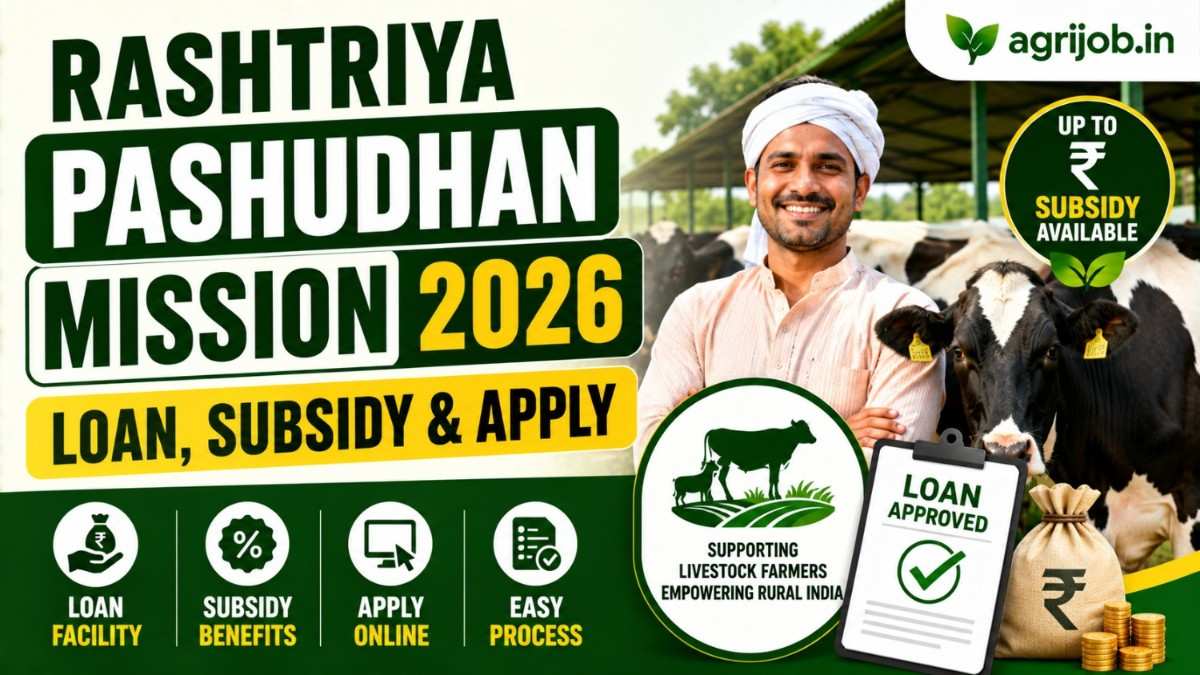
Rashtriya Pashudhan Mission 2026, officially the National Livestock Mission (NLM), is the central government’s flagship scheme for entrepreneurship and breed development in the livestock sector. Run by the Department of Animal Husbandry and Dairying (DAHD) with an outlay of Rs.2,300 crore, NLM offers a 50% capital subsidy (up to Rs.50 lakh) to individuals, FPOs, SHGs, and Section 8 companies setting up poultry, goat, sheep, piggery, or fodder enterprises. This guide covers the scheme’s three sub-missions, the exact subsidy ceiling for each component, eligibility, documents, and the complete online application process at nlm.udyamimitra.in — so you can apply for the right component without confusion.

Scheme Name: National Livestock Mission (Rashtriya Pashudhan Mission)
Implementing Body: Dept. of Animal Husbandry & Dairying (DAHD), GoI
Total Outlay: Rs.2,300 crore (revised from 2021-22)
Subsidy: 50% capital subsidy, up to Rs.25–50 lakh depending on component
Application Mode: Fully online at nlm.udyamimitra.in
Eligible Applicants: Individuals, FPOs, SHGs, FCOs, JLGs, Section 8 companies
📋 Table of Contents
- 1. What Is Rashtriya Pashudhan Mission (NLM) 2026?
- 2. NLM Restructuring: From 2021 to 2026
- 3. The Three Sub-Missions of NLM
- 4. Sub-Mission 1: Breed Development of Livestock & Poultry
- 5. Sub-Mission 2: Feed and Fodder Development
- 6. Sub-Mission 3: Research, Innovation & Livestock Insurance
- 7. NLM Subsidy & Loan Table: How Much Can You Get?
- 8. Eligibility & Documents Required
- 9. Step-by-Step: How to Apply on nlm.udyamimitra.in
- 10. Who Should Apply for NLM Entrepreneurship Scheme?
- 11. Grant vs Loan: How the NLM Funding Structure Works
- 12. Important NLM Terms You Must Know
- 13. NLM vs AHIDF: Which Scheme Should You Choose?
- 14. Frequently Asked Questions
What Is Rashtriya Pashudhan Mission (NLM) 2026?
The National Livestock Mission is a Centrally Sponsored Scheme implemented by DAHD since 2014-15, with an outlay of Rs.2,300 crore following its revision in 2021-22. The mission’s core purpose is to generate rural employment by promoting entrepreneurship in small ruminant (sheep and goat), poultry, piggery, and feed-fodder sectors, while improving per-animal productivity through better breeds and scientific management. It works alongside its sister scheme, the Rashtriya Gokul Mission, which focuses specifically on indigenous cattle and buffalo breed development under the same Rashtriya Pashudhan Vikas Yojana umbrella.
NLM Restructuring: From 2021 to 2026
NLM was significantly revised and realigned starting Financial Year 2021-22, shifting its focus more sharply toward entrepreneurship development rather than only infrastructure grants to state governments. Updated Operational Guidelines 2.0 were released in January 2025, refining unit-size requirements and subsidy mechanics for several components. Applicants should always download the latest guidelines PDF from the official DAHD website before applying, since minimum unit sizes and documentation requirements have been revised between guideline versions.
The Three Sub-Missions of NLM
NLM is implemented through three distinct sub-missions, each targeting a different layer of the livestock value chain:
- 🐓 Sub-Mission on Breed Development of Livestock & Poultry — entrepreneurship and genetic improvement in rural poultry, sheep/goat, and piggery
- 🌾 Sub-Mission on Feed and Fodder Development — strengthening the certified fodder seed chain and fodder processing units
- 🔬 Sub-Mission on Research & Development, Extension, Innovation and Livestock Insurance — funding for ICAR institutes, universities, extension activities, and animal insurance
Sub-Mission 1: Breed Development of Livestock & Poultry
This is the sub-mission most farmers and entrepreneurs apply under, since it carries the direct entrepreneurship subsidy component (NLM-EDP). It is structured into five core activities:
- 🐔 Activity I — Rural Poultry Entrepreneurship: Establishment of parent farm, hatchery, and brooder-cum-mother unit for production of hatching eggs and chicks
- 🐐 Activity II — Small Ruminant Entrepreneurship: Establishment of sheep and goat breeding farms
- 🧬 Activity III — Genetic Improvement of Sheep & Goat Breeds: Artificial insemination and selective breeding infrastructure for state departments
- 🐖 Activity IV — Piggery Entrepreneurship: Establishment of pig breeding farms with defined sow-to-boar ratios
- 🧪 Activity V — Genetic Improvement of Pig Breeds: Semen station and AI infrastructure strengthening
Each entrepreneurship activity provides a one-time 50% capital subsidy of total project cost, with the ceiling varying from Rs.25 lakh to Rs.30 lakh per unit depending on the activity, released in two equal installments.
Sub-Mission 2: Feed and Fodder Development
This sub-mission strengthens India’s certified fodder seed chain and incentivises entrepreneurs to set up fodder processing infrastructure:
- 🌱 Activity I — Quality Fodder Seed Production: Central assistance to eligible seed production agencies, generally requiring a minimum annual turnover and government/ICAR linkage
- 🧺 Activity II — Entrepreneurial Activities in Feed & Fodder: Capital subsidy for Hay/Silage/Total Mixed Ration (TMR)/Fodder Block manufacturing units and fodder storage units, with subsidy ceilings up to Rs.25 lakh
Sub-Mission 3: Research, Innovation & Livestock Insurance
This sub-mission does not provide direct entrepreneur subsidy but funds the broader ecosystem:
- 🔬 Activity I — Research & Development and Innovations: Funding for ICAR institutes, agricultural universities, and organisations researching sheep, goat, pig, and feed-fodder topics
- 📢 Activity II — Extension Activities: Farmer training, awareness campaigns, and IEC material
- 🛡️ Activity III — Livestock Insurance: Subsidised insurance premiums for livestock to protect farmers from death/loss-related financial shock; crores have already been released nationally to insure lakhs of animals under this component
NLM Subsidy & Loan Table: How Much Can You Get?
| Component | Subsidy % | Maximum Subsidy Ceiling | Installments |
|---|---|---|---|
| Rural Poultry (parent farm/hatchery) | 50% of project cost | Up to Rs.25 lakh | 2 equal installments |
| Sheep & Goat Breeding Farm | 50% of project cost | Up to Rs.25–50 lakh (unit-size dependent) | 2 equal installments |
| Piggery Breeding Farm | 50% of project cost | Up to Rs.30 lakh | 2 equal installments |
| Fodder Value Addition Unit | 50% of project cost | Up to Rs.25 lakh | 2 equal installments |
| Equine/Camel/Donkey Breeding Farm | 50% of project cost | Up to Rs.50 lakh | 2 equal installments |
Eligibility & Documents Required
- ✅ Eligible entities: Individuals, Farmers Producer Organisations (FPOs), Self Help Groups (SHGs), Farmer Cooperative Organisations (FCOs), Joint Liability Groups (JLGs), Section 8 companies
- ✅ Training/experience clause: Applicant must have obtained relevant training, employ trained experts, or have sufficient practical experience in the chosen livestock activity
- ✅ Minimum unit size: Each activity (poultry, sheep/goat, piggery) has a defined minimum scale requirement — check current guidelines for exact figures
- 📄 Documents commonly required: Identity proof (Aadhaar), bank account details, land ownership/lease documents, detailed project report (DPR), training/experience certificate, and KYC documents for the lending bank
- 🚫 Not covered by subsidy: Purchase of land, land lease/rent cost, working capital, and personal vehicles
Step-by-Step: How to Apply on nlm.udyamimitra.in
- 🌐 Visit the official NLM Entrepreneurship Scheme portal at nlm.udyamimitra.in
- 📱 Register using your mobile number — an OTP will be sent to your registered mobile number (RMN) for verification
- 📝 Fill in the online application form, selecting your chosen activity (poultry, sheep/goat, piggery, or fodder unit)
- 📤 Upload all required documents digitally — there is no physical document submission required
- 🏦 Choose your preferred lending bank from the dropdown list provided in the portal for loan sanction
- 🔍 Your application is screened and routed through the State Implementing Agency (SIA)
- 💰 Once the bank sanctions the loan, the first 50% subsidy installment is released to the lending bank account
- 🏗️ After the beneficiary completes the required project expenditure (commonly verified at 25% infrastructure completion), the remaining subsidy installment is released
- 📊 Track your application status anytime using the “Track Status” tab on the portal’s dashboard
Who Should Apply for NLM Entrepreneurship Scheme?
- 🧑🌾 Individual farmers wanting to scale into commercial poultry, goat, or piggery farming
- 👩👩👧 Self-Help Groups (SHGs) looking for a group-based livestock entrepreneurship project
- 🏭 FPOs and FCOs aiming to set up shared breeding or fodder processing infrastructure
- 🎓 Trained rural youth with animal husbandry training or veterinary background wanting to start a breeding farm
- 🌾 Fodder entrepreneurs wanting to set up silage, hay, or Total Mixed Ration (TMR) production units
- 🐎 Equine/camel/donkey breeders in regions where these species support local livelihoods
- 🏢 Section 8 companies working in the livestock development or rural livelihood space
- 🔬 Research institutions and universities seeking funding for livestock-related R&D, extension, or innovation projects under Sub-Mission 3
Grant vs Loan: How the NLM Funding Structure Works
NLM is not a pure grant scheme — it works on a hybrid loan-plus-subsidy model. The government provides a 50% capital subsidy as a grant-in-aid component, but this subsidy is routed through a lending bank and is contingent on the applicant first securing a bank loan or arranging the remaining cost through self-finance. The bank sanctions the loan covering the project cost, the first installment of subsidy is released into that loan account, and the second installment follows after verified project progress. This means applicants need bankable project reports and, in most cases, some margin money or loan-servicing capacity — NLM significantly reduces the cost burden but does not eliminate the need for a financing relationship with a bank or institution like NCDC.
Important NLM Terms You Must Know
- 📌 NLM-EDP: National Livestock Mission – Entrepreneurship Development Programme, the specific component offering direct capital subsidy to individuals and groups
- 📌 DPR (Detailed Project Report): The bankable project document required to apply for both the loan and the subsidy
- 📌 SIA (State Implementing Agency): The state-level body, often the Livestock Development Board, that screens and routes NLM applications
- 📌 SLEC: State Level Empowered Committee that approves projects before subsidy release in several scheme variants
- 📌 Capital subsidy: A one-time subsidy on infrastructure/asset cost, as opposed to a recurring or interest subsidy
- 📌 AHIDF: Animal Husbandry Infrastructure Development Fund, a complementary Central Sector Scheme offering loans up to 90% of project cost with interest subvention, often combined with NLM for larger projects
- 📌 Margin money: The applicant’s own minimum contribution toward the project cost, typically around 10–25% depending on the lending institution
- 📌 RMN (Registered Mobile Number): The mobile number used for OTP-based registration and verification on the NLM portal
NLM vs AHIDF: Which Scheme Should You Choose?
| Factor | NLM (National Livestock Mission) | AHIDF |
|---|---|---|
| Support type | 50% capital subsidy (max Rs.25–50 lakh) | Loan up to 90% of project cost + 3% interest subvention |
| Best project scale | Small to mid-size entrepreneurship units | Larger infrastructure projects (dairy/meat processing, large breeding farms) |
| Eligible entities | Individuals, FPOs, SHGs, FCOs, JLGs, Section 8 companies | Private companies, individual entrepreneurs, FPOs, MSMEs, NGOs (government entities/cooperatives largely excluded) |
| Funding mechanism | Subsidy + applicant loan/self-finance | Interest-subsidised bank loan |
| Can both be combined? | Yes, in some cases — NLM subsidy can reduce upfront cost before AHIDF loan is taken on the remainder | Yes — see “leveraging NLM” examples in official DAHD guidance |
For a typical 500-animal goat or sheep farm costing around Rs.1 crore, official DAHD guidance shows entrepreneurs can use NLM’s capital subsidy to bring the effective project cost down before taking an AHIDF-backed loan on the balance — reducing both the principal borrowed and the interest burden over the loan tenure.
Frequently Asked Questions
What is Rashtriya Pashudhan Mission 2026?
Rashtriya Pashudhan Mission, officially called the National Livestock Mission (NLM), is a Centrally Sponsored Scheme run by the Department of Animal Husbandry and Dairying (DAHD), Government of India, with an outlay of Rs.2,300 crore. First launched in 2014-15 and revised in 2021-22, it supports entrepreneurship and breed development in poultry, sheep, goat, pig, and feed-fodder sectors through capital subsidy.
How much subsidy does NLM provide?
Under the NLM Entrepreneurship Development Programme (NLM-EDP), eligible applicants get a one-time 50% capital subsidy of total project cost, released in two equal installments. The maximum ceiling differs by component: up to Rs.25 lakh for rural poultry and fodder units, up to Rs.30 lakh for piggery, and up to Rs.50 lakh for larger sheep/goat, equine, or camel breeding farms, depending on unit size and category.
Who can apply for the NLM Entrepreneurship Scheme?
Any individual, Farmers Producer Organisation (FPO), Self Help Group (SHG), Farmer Cooperative Organisation (FCO), Joint Liability Group (JLG), or Section 8 company can apply, provided they meet the minimum unit-size and training/experience requirements for their chosen activity.
What are the three sub-missions under NLM?
NLM is implemented through three sub-missions: the Sub-Mission on Breed Development of Livestock and Poultry, the Sub-Mission on Feed and Fodder Development, and the Sub-Mission on Research & Development, Extension, Innovation and Livestock Insurance.
How do I apply for NLM online in 2026?
Applicants can apply entirely online through the official NLM portal at nlm.udyamimitra.in. Registration requires a mobile number and OTP verification; no physical document submission is needed since all documents are uploaded directly, and applications are routed through the State Implementing Agency (SIA), the lending bank, and DAHD for approval.
Is land purchase covered under NLM subsidy?
No. NLM subsidy explicitly excludes land purchase, land lease/rent, working capital, and personal vehicles. The subsidy covers only capital costs such as construction, breeding stock, equipment, and machinery for the approved project.
What is the minimum unit size required for NLM poultry, goat, or pig projects?
Minimum unit sizes vary by activity and have been revised between guideline versions. Rural poultry parent farms generally require a minimum of around 1,000 parent layers, while sheep/goat and pig breeding farms have their own minimum female-to-male or sow-to-boar ratios. Always check the latest NLM Guidelines PDF on dahd.gov.in for the exact current figures before applying.
Can I get a bank loan along with NLM subsidy?
Yes. The remaining project cost after the 50% capital subsidy must be arranged through a bank loan, a loan from a financial institution such as NCDC, or self-financing. The loan is sanctioned first, and the first installment of subsidy is then released into the lending bank account.
How is the NLM subsidy released?
The subsidy is released in two equal installments. The first installment of 50% of the subsidy amount goes to the lending bank after project approval and loan sanction. The remaining installment follows once the beneficiary completes a defined share of project expenditure, verified by the implementing agency.
📚 Official Sources: For the latest guidelines and to apply, always use the original government sources — Department of Animal Husbandry & Dairying – NLM page (dahd.gov.in), NLM Application Portal (nlm.udyamimitra.in), and National Apprenticeship Portal for related skilling support.
This guide is regularly reviewed and updated for accuracy. Bookmark this page for the latest NLM notifications. Subsidy ceilings, minimum unit sizes, and operational guidelines are periodically revised by DAHD — always confirm the current version on the official NLM portal before preparing your project report.
Last Updated: June 2026