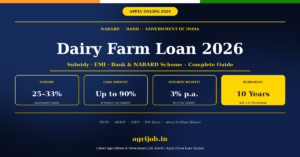

DEDS Scheme 2026 – 25% Subsidy, Loan & Apply Online
| Scheme Name | Dairy Entrepreneurship Development Scheme (DEDS) |
| Launched By | Dept. of Animal Husbandry, Dairying & Fisheries + NABARD |
| Launch Year | September 2010 (modified from Venture Capital Scheme) |
| Subsidy – General Category | 25% of project cost (back-ended capital subsidy) |
| Subsidy – SC/ST/Women | 33.33% of project cost (back-ended capital subsidy) |
| Max Project Cost (5 Milch Animals) | Approx. ₹8.15 lakh (combined project) |
| Repayment Tenure | 3–7 years (3–6 months grace period for dairy farms) |
| Nodal Agency | NABARD (National Bank for Agriculture & Rural Development) |
| Who Can Apply | Farmers, SHGs, Cooperatives, NGOs, Entrepreneurs |
| Application Mode | Offline – through NABARD-approved banks |
DEDS scheme 2026 — officially known as the Dairy Entrepreneurship Development Scheme (डेयरी उद्यमिता विकास योजना) — is one of the most impactful government subsidy programmes for dairy farmers in India, offering a back-ended capital subsidy of 25% for General category and 33.33% for SC/ST and women beneficiaries on bankable dairy projects through NABARD. Whether you want to start a 5-cow dairy farm, install modern milking machines, or set up a milk chilling unit, the DEDS scheme helps reduce your loan burden significantly. This complete 2026 guide covers the DEDS scheme subsidy breakdown, eligibility criteria, required documents, participating bank list, step-by-step application process, and a clear comparison with the AHIDF scheme.


- What is DEDS Scheme 2026?
- DEDS Scheme Subsidy – Component-wise Breakdown
- DEDS Scheme Eligibility 2026
- Documents Required for DEDS Scheme
- Banks Participating in DEDS Scheme 2026
- How to Apply for DEDS Scheme 2026 – Step by Step
- Who Should Apply for DEDS Scheme?
- DEDS Scheme vs AHIDF – Complete Comparison
- High-Value Dairy Scheme Terms You Must Know
- DEDS Scheme 2026 – Frequently Asked Questions
What is DEDS Scheme 2026? (Dairy Entrepreneurship Development Scheme)
The Dairy Entrepreneurship Development Scheme (DEDS) was launched in September 2010 by the Department of Animal Husbandry, Dairying and Fisheries (DAHD&F), Government of India. It was a modernised upgrade of the earlier Venture Capital Scheme for Dairy and Poultry (2004), redesigned after incorporating feedback from state governments, banks, and over 15,000 dairy farmer beneficiaries. NABARD (National Bank for Agriculture and Rural Development) serves as the nodal implementing agency for DEDS across all states and Union Territories in India.
The core concept behind DEDS scheme is straightforward: dairy farming in India is largely unorganised, underfunded, and technologically backward — especially at the village level. The scheme bridges this gap by providing back-ended capital subsidies to farmers and rural entrepreneurs for setting up modern, hygienic dairy farms and milk processing units. India contributes over 24% of global milk production, and schemes like DEDS have played a critical role in building that capacity — the scheme has helped over 1.86 lakh entrepreneurs set up mini dairy units, creating employment for approximately 2 people per unit.

5 Key Objectives of DEDS Scheme
- 🐄 Establish modern dairy farms for hygienic, large-scale milk production across rural and semi-urban India, replacing traditional low-yielding setups.
- 🌱 Encourage heifer calf rearing to develop and conserve high-yielding indigenous and crossbred breeding stock (Sahiwal, Gir, Rathi, Murrah).
- 🏭 Bring initial milk processing to the village level by supporting chilling, pasteurisation, and packaging infrastructure at the grassroots.
- 💼 Generate self-employment for rural youth, women, and marginalised SC/ST communities in the dairy sector.
- 🔬 Upgrade traditional dairy technology so milk is handled commercially with modern milking machines, bulk milk coolers, and cold storage units.
DEDS Scheme Subsidy 2026 – Component-wise Breakdown Table
The DEDS scheme subsidy is a back-ended capital subsidy — it is not given upfront. NABARD releases it to the financing bank after the project is verified and the first loan instalment is disbursed. The bank then credits it to your loan account, reducing your outstanding principal immediately. Below is the complete component-wise DEDS subsidy table for 2026:
| Component | Project Investment | Subsidy (General – 25%) | Subsidy (SC/ST/Women – 33.33%) | Annual Saving |
|---|---|---|---|---|
| Small dairy unit – 10 milch animals | Rs.5.00 lakh | Rs.1.25 lakh | Rs.1.67 lakh | Rs.10,000–15,000/yr on interest |
| 5 milch animals (combined project) | ~Rs.8.15 lakh | Rs.2.04 lakh | Rs.2.72 lakh | Rs.15,000–20,000/yr on interest |
| Heifer calf rearing – 20 calves | Rs.20.00 lakh | Rs.1.20 lakh (max) | Rs.1.60 lakh (max) | Rs.9,000–12,000/yr |
| Vermicompost unit (with milch animals) | Rs.20,000 | Rs.5,000 | Rs.6,700 | Minimal; add-on benefit |
| Milking machines / bulk milk cooler (up to 2,000 L) | Rs.18.00 lakh | Rs.4.50 lakh | Rs.6.00 lakh | Rs.35,000–48,000/yr |
| Milk processing / product manufacturing | Rs.20.00 lakh | Rs.5.00 lakh | Rs.6.67 lakh | Rs.40,000–53,000/yr |
| Cold storage for milk and milk products | Rs.30.00 lakh | Rs.7.50 lakh | Rs.10.00 lakh | Rs.60,000–80,000/yr |
| Private veterinary clinic (mobile) | Rs.2.40 lakh | Rs.60,000 | Rs.80,000 | Rs.5,000–6,500/yr |
| Private veterinary clinic (stationary) | Rs.1.80 lakh | Rs.45,000 | Rs.60,000 | Rs.3,600–4,800/yr |
| Dairy parlour / milk marketing outlet | Rs.56,000 | Rs.14,000 | Rs.18,600 | Rs.1,100–1,500/yr |
Key Note: The entrepreneur must contribute a minimum of 10% of the project cost as margin money for loans exceeding Rs.1 lakh. Banks verify component costs based on NABARD’s current unit cost norms. The subsidy amount is rounded to the nearest Rs.100. For a 2-animal unit (minimum), the General category subsidy cap is Rs.25,000; for SC/ST it is Rs.33,300.
DEDS Scheme Eligibility 2026 – Who Can Apply?
The DEDS scheme eligibility is broad and inclusive, designed to cover both organised and unorganised dairy sector participants across India. There is no upper age limit for applicants. Here is the complete eligibility breakdown:
Eligible Beneficiaries Under DEDS 2026
- 👨🌾 Individual farmers — aiming to start or expand dairy units with crossbred cows, indigenous milch cattle (Sahiwal, Gir, Rathi, Red Sindhi), or graded buffaloes (Murrah, Surti, Mehsana).
- 🏢 Individual entrepreneurs — including young agri-entrepreneurs and rural youth seeking self-employment in the dairy sector.
- 👩 Women entrepreneurs and women SHG members — receive the higher 33.33% subsidy and are given priority for dairy parlours, processing units, and calf-rearing components.
- 🤝 Self-Help Groups (SHGs) — rural SHGs, especially women’s groups, are eligible and preferred for cluster-mode DEDS projects.
- 🏭 Dairy cooperative societies, milk unions, and milk federations (including state milk federations associated with NDDB).
- 🏛️ NGOs and registered companies working in the dairy or animal husbandry sector.
- 🏘️ Panchayat Raj Institutions (PRIs) — for community-level dairy infrastructure at the gram panchayat level.
Key Eligibility Conditions for DEDS Scheme
- ✅ Each entity can avail DEDS scheme benefit only once per component (e.g., once for dairy unit, once for cold storage).
- ✅ More than one family member can avail DEDS subsidy provided they establish separate units with independent infrastructure at least 500 metres apart.
- ✅ Projects implemented under cluster mode (groups, cooperatives, FPOs, women SHGs) are given processing priority by NABARD.
- ✅ Applicant must not be a defaulter at any financial institution — a signed affidavit is mandatory.
- ✅ Loan margin: minimum 10% of total project cost to be contributed by the borrower for loans above Rs.1 lakh.
- ✅ Preference is given to weaker sections — SC/ST, OBC, BPL families, women, and small/marginal farmers.
- ✅ Milch animals must be purchased within the state or district (as specified by the state); a veterinary health and valuation certificate is mandatory.
Documents Required for DEDS Scheme Application 2026
Before visiting your nearest NABARD-approved bank to apply for a DEDS scheme dairy loan, ensure all the following documents are compiled and ready. Incomplete documentation is the most common cause of application delays — often adding 2–4 weeks to the processing time.
- 🪪 Identity proof — Aadhaar card, PAN card, or Voter ID (any one valid document).
- 🏠 Address proof — Electricity bill, ration card, or Aadhaar (if not used as identity proof).
- 🌾 Land documents — Ownership deed or registered lease agreement (minimum 7-year lease for leased land). Mandatory if the loan amount exceeds Rs.1 lakh.
- 🏦 Bank account statement — Last 6 months passbook or account statement showing savings/transaction history.
- 📊 Detailed Project Report (DPR) — Business plan covering: number and breed of cattle to purchase, shed dimensions and construction cost, equipment list, expected daily milk output, monthly income projection, and loan repayment schedule. Your bank’s Agriculture Officer or the nearest NABARD Regional Office can help prepare this.
- 📜 Caste certificate — SC/ST/OBC certificate issued by the competent authority (Tehsildar/SDM), required to avail the 33.33% subsidy rate.
- 📝 Non-defaulter affidavit — Sworn statement on Rs.10 stamp paper declaring you are not a defaulter at any financial institution and have not previously received subsidy for the same component.
- 📷 Passport-size photographs — 2–3 recent photographs of the applicant.
- 🐄 Cattle valuation certificate — Veterinary health and valuation certificate for the animals to be purchased (issued by a government veterinary surgeon).
Banks Participating in DEDS Scheme 2026 – Complete Bank List
DEDS scheme dairy loans are not applied through NABARD directly. You must approach a NABARD-approved financial institution that is eligible for NABARD refinancing. Here are all eligible bank categories and major participating banks:
| Bank Type | Major Banks | Special DEDS Feature |
|---|---|---|
| Public Sector Commercial Banks | SBI, PNB, Canara Bank, Bank of Baroda, Central Bank of India, Bank of India, Union Bank | SBI YONO Krishi – Safal Dairy Loan (digital apply); BOB Mini Dairy Unit Scheme |
| Private Sector Banks | ICICI Bank, HDFC Bank, Axis Bank, IDBI Bank | Faster processing; select branches have dedicated agri-loan desks |
| Regional Rural Banks (RRBs) | State-wise RRBs (e.g., Baroda UP Gramin Bank, Karnataka Gramin Bank, Prathama UP Gramin Bank) | Best for rural and semi-urban applicants; field officers visit the farm site |
| State Cooperative Banks (SCBs) | State-level cooperative banks (Gujarat, Maharashtra, UP, Punjab) | Strong in dairy belt states; lower processing fees in many cases |
| State Cooperative Agriculture & Rural Development Banks (SCARDBs) | State-wise long-term cooperative banks | Suitable for long-tenure dairy infrastructure loans (cold storage, processing) |
💡 Pro Tip: Visit 2–3 banks before finalising your DEDS scheme loan. Compare their dairy loan interest rates, processing charges, and typical disbursement timelines. For the quickest digital experience, SBI’s YONO Krishi portal allows farmers in many states to initiate dairy loan applications from their smartphones without visiting the branch.
How to Apply for DEDS Scheme 2026 – Step-by-Step Guide
Applying for the DEDS scheme dairy loan is a structured offline process managed through NABARD-approved banks. There is currently no single national online portal for DEDS applications. Follow these 7 steps carefully to ensure smooth and timely approval:
- Choose your DEDS component — Decide which activity you want to finance: small dairy unit (2–10 animals), heifer calf rearing, milking equipment, cold storage, or dairy parlour. Verify it matches DEDS eligibility criteria.
- Visit the nearest NABARD-approved bank — Walk into SBI, PNB, Bank of Baroda, your regional RRB, or state cooperative bank. Request the Agriculture Loan Officer specifically and ask for DEDS scheme / NABARD back-ended dairy subsidy loan.
- Prepare a Detailed Project Report (DPR) — Prepare a project outline covering: cattle breed and number, shed size and construction estimate, equipment cost, expected daily milk yield, projected monthly revenue, margin money available, and repayment plan. Your nearest NABARD Regional Office, District Animal Husbandry Officer, or Block Veterinary Officer will assist free of cost.
- Submit the loan application form — Fill the bank’s standard agriculture loan application form. Attach all documents: Aadhaar, PAN, land records, DPR, affidavit, caste certificate, bank statements, and cattle valuation certificate.
- Bank technical appraisal and NABARD review — The bank’s Agriculture Officer will inspect your project site and verify documents. The application is then sent to NABARD’s concerned Regional Office for approval and subsidy linkage. Loan approval typically takes 15–30 working days.
- Loan disbursement (stage-wise) — Upon sanction, the loan amount is disbursed in stages aligned with project progress — first instalment on project commencement, subsequent instalments after physical verification. Funds for cattle purchase or equipment may be paid directly to the seller/vendor by the bank.
- Subsidy credit from NABARD — After project completion and first instalment disbursement, the bank applies to NABARD’s Regional Office for subsidy release. NABARD credits the back-ended subsidy to the bank, which adjusts it against your loan account. From this date, interest is charged only on the outstanding loan minus the subsidy amount — reducing your effective monthly EMI significantly.
- Start with a smaller unit (2–5 animals) for faster bank approval — you can scale up in the next phase.
- Maintain a clean credit history: no pending EMI defaults at any bank before applying for the DEDS loan.
- If you are part of an SHG or dairy cooperative, apply under cluster mode — these applications receive processing priority from NABARD.
- Insure your cattle under the government livestock insurance scheme — banks offer better loan terms for insured cattle.
- Visit the nearest Chief Animal Husbandry Officer or Block Veterinary Officer first; they provide free guidance and can help prepare your DPR.
Who Should Apply for DEDS Scheme in 2026?
The DEDS dairy entrepreneurship scheme is designed for a wide range of applicants in the agriculture and rural sector. Here are 8 profiles who should strongly consider applying in 2026:
- 🐄 Small and marginal farmers with basic land resources wanting to start a 2–10 cow or buffalo unit to supplement their crop income with a stable daily milk revenue.
- 👩🌾 Rural women and women SHG members — eligible for the higher 33.33% subsidy rate and given preference for dairy parlours, processing units, and calf-rearing components. DEDS is one of the best government schemes for rural women’s income generation.
- 🎓 Agriculture graduates and B.Sc. Ag / B.V.Sc. passouts looking to start agri-enterprises rather than waiting for government exam results — DEDS provides the seed capital.
- 📉 SC/ST beneficiaries — entitled to 33.33% subsidy (vs 25% for General), making DEDS one of the most financially rewarding government schemes for marginalised farming communities.
- 🏘️ Rural youth aged 18–40 seeking self-employment in animal husbandry in villages or peri-urban areas where milk demand is rising.
- 🤝 Dairy cooperative members and FPO shareholders wanting to scale up individual milk production to supply consistently to their cooperative or dairy company.
- 🏥 Veterinary doctors and para-vets planning to set up mobile or stationary private veterinary clinics in dairy clusters — the DEDS vet clinic component offers up to Rs.80,000 subsidy for SC/ST applicants.
- 🥛 Entrepreneurs targeting milk chilling, cold storage, or dairy parlour businesses in towns and semi-urban markets where clean, packaged milk demand is growing rapidly.
DEDS Scheme vs AHIDF – Which Dairy Scheme is Better in 2026?
Two major government dairy schemes are often compared: the DEDS scheme and AHIDF (Animal Husbandry Infrastructure Development Fund). Here is a clear 8-point comparison to help you choose the right scheme for your dairy project size and goals:
| Parameter | DEDS Scheme | AHIDF Scheme |
|---|---|---|
| Launched By | DAHD&F + NABARD (September 2010) | Govt. of India (Atma Nirbhar Bharat, 2020) |
| Target Beneficiaries | Farmers, SHGs, NGOs, cooperatives, individuals | MSMEs, private companies, FPOs, Section 8 companies |
| Type of Financial Support | 25–33.33% back-ended capital subsidy on project cost | 3% interest subvention per year for up to 8 years |
| Focus Area | Farm-level: dairy units, heifers, vermicompost, equipment, vet clinics | Processing-level: dairy plants, meat units, animal feed factories |
| Max Project Size | Small to medium (up to Rs.30 lakh per component) | Large infrastructure (fund size: ₹29,110 crore; no strict per-project ceiling) |
| Eligible Cattle Purchase? | Yes – milch animals and heifer calves directly covered | No – focused on processing/manufacturing infrastructure only |
| Application Process | Offline – through nearest NABARD-approved bank | Online – via AHIDF portal (ahidf.udyamimitra.in); bank appraisal required |
| Best For | Individual farmers, rural youth, women, SC/ST, SHGs | Startups, agri-businesses, dairy cooperatives with large-scale processing plans |
If you are a farmer, rural youth, or SHG member starting a small to medium dairy unit with 2–10 milch animals or installing milking/chilling equipment, DEDS scheme is your best option — the back-ended capital subsidy directly and permanently reduces your loan principal. If you are an MSME or agri-entrepreneur setting up a large dairy processing plant, cold chain, or animal feed factory, AHIDF’s 3% interest subvention over 8 years is the superior tool for large capital expenditure. Many serious dairy entrepreneurs stack both — DEDS for the farm unit, AHIDF for the downstream processing plant.
High-Value Dairy Scheme Terms You Must Know in 2026
Understanding these 10 key terms will help you navigate the DEDS scheme, dairy loan applications, and government subsidy processes with confidence:
- 💰 Back-ended capital subsidy — A subsidy released after loan disbursement and project verification, not upfront. Under DEDS, NABARD credits it directly to your bank loan account, permanently reducing the outstanding principal and your future EMIs.
- 📋 Detailed Project Report (DPR) — The mandatory business document required for DEDS loan applications. It details project cost, cattle breeds, infrastructure plan, income projections, and repayment schedule. A well-prepared DPR is the single biggest factor in loan approval speed.
- 🐄 Milch animals — Milk-producing female cattle. DEDS scheme covers crossbred cows, indigenous descript milch breeds (Sahiwal, Gir, Rathi, Red Sindhi), and graded buffaloes (Murrah, Surti, Jaffarabadi).
- 🌱 Heifer calf rearing — Rearing of female calves (heifers) to develop them into productive milch animals. DEDS provides subsidy for rearing up to 20 calves per unit — ideal for breed improvement projects.
- 🏦 NABARD refinance — Banks lending under DEDS receive their funds refinanced (reimbursed) by NABARD at concessional rates, enabling them to offer competitive interest rates on dairy farm loans.
- 🧑🤝🧑 Cluster mode projects — Projects collectively owned or managed by cooperatives, FPOs, women SHGs, or producer companies where multiple beneficiaries collaborate. These get priority processing from NABARD under DEDS.
- 🥛 Bulk Milk Cooling Unit (BMC) — Refrigerated stainless steel tanks (up to 2,000 litres capacity) that chill milk at the village level immediately after collection, before transport to dairy plants. DEDS covers BMC purchase under the milking equipment component.
- 🌾 Vermicompost unit — A cow-dung composting setup producing organic manure (vermicompost) as a by-product of dairy farming. DEDS covers this as a Rs.20,000 add-on component when set up alongside a milch animal unit — generating additional income from manure sales.
- 🏥 AHIDF (Animal Husbandry Infrastructure Development Fund) — A Rs.29,110 crore central scheme offering 3% interest subvention for 8 years for large-scale dairy and meat processing infrastructure. Operates as a complement to DEDS for bigger dairy businesses.
- 📜 NDDB (National Dairy Development Board) — The apex body driving dairy development in India, responsible for Amul’s cooperative model. NDDB cooperatives and affiliated dairy federations are eligible DEDS beneficiaries for equipment and infrastructure components.
DEDS Scheme 2026 – Frequently Asked Questions
What is DEDS scheme in full form?
DEDS full form is Dairy Entrepreneurship Development Scheme (Hindi: डेयरी उद्यमिता विकास योजना). The DEDS scheme was launched in September 2010 by the Government of India’s Department of Animal Husbandry, Dairying and Fisheries, with NABARD as the nodal implementing agency. It was evolved from the earlier Venture Capital Scheme for Dairy and Poultry (2004) after widespread stakeholder consultations.
What is the subsidy under DEDS scheme for SC/ST farmers?
SC/ST and women beneficiaries receive a 33.33% back-ended capital subsidy under DEDS scheme — higher than the 25% given to General category. For a 10-animal dairy unit costing Rs.5 lakh, SC/ST farmers receive up to Rs.1.67 lakh subsidy versus Rs.1.25 lakh for General. For a 5-milch animal combined project (~Rs.8.15 lakh), the SC/ST subsidy amounts to approximately Rs.2.72 lakh, permanently reducing the principal that accrues interest.
Is DEDS scheme still active in 2026?
The original DEDS scheme was temporarily discontinued for FY 2020-21 due to insufficient fund allocation. However, its subsidy framework and operational guidelines remain in place, and many NABARD-approved banks continue to process DEDS-linked dairy loans. Its core objectives are also continued through allied schemes like AHIDF and various state-level dairy subsidy programmes. Applicants should confirm the current status directly with their nearest NABARD Regional Office or NABARD’s official DEDS page before applying.
How is DEDS subsidy released and credited to the borrower?
The DEDS subsidy is back-ended — not disbursed upfront. After the bank releases the first loan instalment and physically verifies the project site, it applies to NABARD’s Regional Office for subsidy release. NABARD directly transfers the subsidy amount to the bank, which credits it to the borrower’s loan account. From that date, interest is charged only on the outstanding loan balance minus the subsidy — often reducing the monthly EMI by Rs.1,000–Rs.3,000 depending on the project size.
What is the loan repayment period under DEDS scheme?
DEDS scheme loan repayment tenure ranges from 3 to 7 years, depending on the nature of the dairy activity and the projected cash flows in your DPR. There is also a grace period: 3 to 6 months for general dairy farm loans (time needed to set up operations and start generating milk income) and up to 3 years for calf-rearing unit owners (who need more time before heifers become productive milch animals). The final grace period and tenure are decided by your bank based on your specific project.
Can two family members both apply for DEDS scheme?
Yes. Two or more family members can each receive separate DEDS scheme subsidies, but only if they establish completely independent units with their own infrastructure located at least 500 metres apart. They cannot share the same shed, cattle, equipment, or land parcel. Each applicant must submit independent land records, separate DPRs, and individual documentation to the bank. This rule is strictly enforced to prevent misuse of the subsidy by a single household claiming multiple subsidies for the same dairy unit.
Which component has the highest DEDS subsidy cap?
Among all DEDS components, cold storage facilities for milk and milk products carry the highest subsidy cap: up to Rs.7.50 lakh for General category and Rs.10.00 lakh for SC/ST/women on a Rs.30 lakh project investment. The milk processing and product manufacturing component ranks second, with subsidies up to Rs.5.00 lakh (General) or Rs.6.67 lakh (SC/ST) on a Rs.20 lakh project. These larger components are ideal for dairy entrepreneurs building value-added dairy product businesses.
What is the minimum own contribution required under DEDS?
Under the DEDS scheme, the applicant must contribute a minimum of 10% of the total project cost as margin money for loans exceeding Rs.1 lakh. On a combined project of Rs.8.15 lakh (5 milch animals), you need to arrange at least Rs.81,500 from your own resources. The bank funds the remaining 90%, with the NABARD-released back-ended subsidy further reducing the outstanding principal after project verification. Maintaining a savings account statement showing this capacity helps speed up the loan approval.
🔗 Official Sources: NABARD DEDS Official Page | DAHD Schemes & Programmes Portal | AHIDF Official Guidelines on DAHD
📌 This DEDS scheme guide is regularly reviewed and updated for accuracy. Bookmark this page for the latest DEDS scheme 2026 notifications, subsidy revisions, and dairy loan scheme updates from NABARD and DAHD. Last Updated: June 2026.