
Milking machine price in India 2026 ranges from as low as Rs.6,000 for a basic hand-operated unit to over Rs.30 lakh for a fully robotic Automatic Milking System (AMS) — the right choice depends entirely on your herd size, power availability, and budget. India is the world’s largest milk producer, contributing over 23% of global milk output, yet more than 70% of dairy farmers still milk by hand, losing time, milk yield, and animal health quality every single day.
This guide is for dairy farmers, agri-entrepreneurs, and livestock investors across India who want to upgrade their dairy operation to full or partial mechanization. Whether you manage 2 cows or 200, this complete 2026 guide covers all three milking machine types, their exact prices, top brands, a head-to-head comparison, government subsidy schemes, NABARD dairy loans, and a step-by-step process to apply for financial support.
Milking machine price in India 2026 starts at Rs.6,000 for manual units, Rs.18,000–Rs.65,000 for automatic single/double bucket machines, and Rs.15 lakh–Rs.30 lakh+ for robotic AMS systems. Under the NABARD DEDS and AHIDF schemes, eligible farmers can claim 25%–33.33% back-ended capital subsidy on milking equipment costing up to Rs.20 lakh.
- Manual Milking Machine Price: Rs.6,000 – Rs.22,000
- Automatic Milking Machine Price: Rs.18,000 – Rs.65,000
- Trolley / Double-Bucket Machine Price: Rs.45,000 – Rs.75,000
- Robotic AMS Machine Price (India): Rs.15 lakh – Rs.30 lakh+
- NABARD DEDS Subsidy on Milking Equipment: 25% (General) / 33.33% (SC/ST)
- AHIDF Interest Subvention: 3% on eligible dairy infrastructure loans
- AHIDF Max Loan Coverage: Up to 90% of project cost
- DEDS Max Project Cost for Milking Machines: Rs.20 lakh
- Max Subsidy Amount (General) on Milking Equipment: Rs.5 lakh
- Max Subsidy Amount (SC/ST) on Milking Equipment: Rs.6.67 lakh
📋 Table of Contents
- What Is a Milking Machine and How Does It Work?
- 3 Types of Milking Machines Available in India 2026
- Milking Machine Price in India 2026 – Complete Breakdown
- Who Should Buy a Milking Machine in India?
- Manual vs Automatic vs Robotic Milking Machine – Comparison Table
- Top Brands Selling Milking Machines in India 2026
- Pros and Cons of Milking Machine Mechanization
- Government Schemes & Subsidies for Dairy Mechanization 2026
- How to Apply for NABARD Dairy Loan & Milking Machine Subsidy
- Important Terms Related to Dairy Mechanization
- Important Links
- Conclusion
- Key Takeaways
- Frequently Asked Questions
What Is a Milking Machine and How Does It Work in 2026?
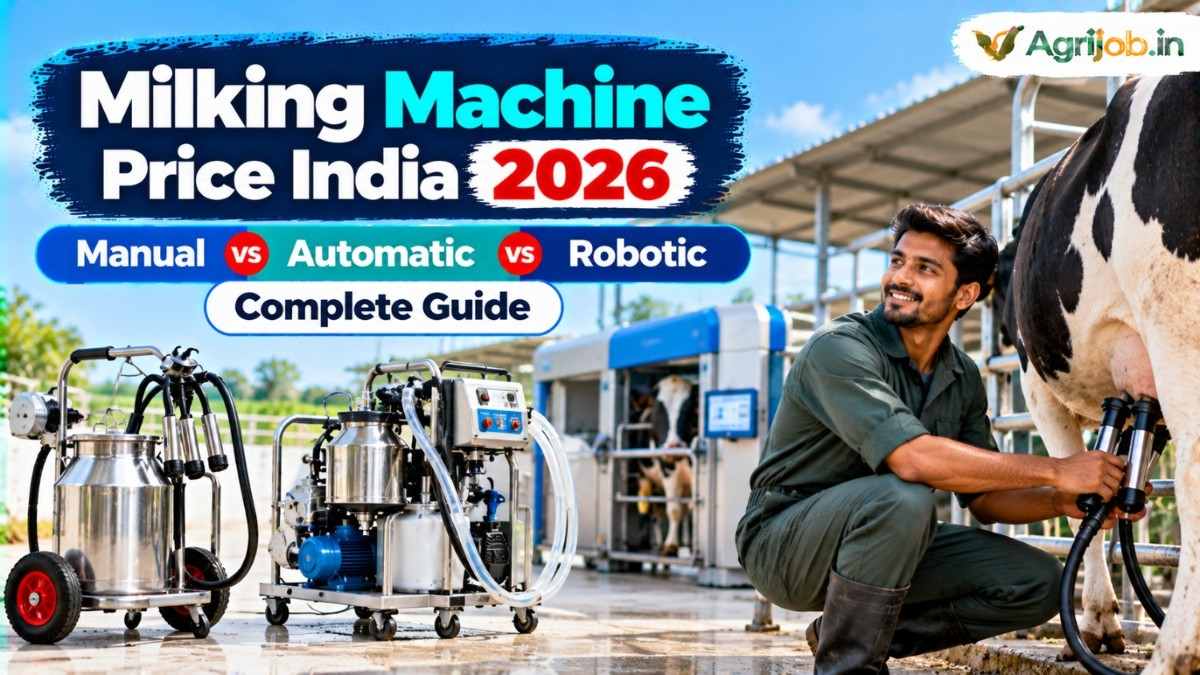
A milking machine is a mechanical device that mimics the natural suckling action of a calf to extract milk from a cow or buffalo hygienically, quickly, and consistently. The machine creates a pulsating vacuum (typically 300–400 mmHg) that alternately compresses and releases the teat liner, drawing milk from the udder into a collection bucket or pipeline system.
All milking machines share three core components: a vacuum pump (creates suction), a pulsator (controls the milking rhythm at 50–70 pulsations per minute), and teat cups with liners (the interface with the animal). What differs between manual, automatic, and robotic systems is how these components are powered, monitored, and scaled.
A trained dairy worker milks 3–4 cows per hour by hand. A single-bucket electric milking machine handles the same animal in 5–6 minutes. A robotic AMS system milks a cow on demand, 24 hours a day, with zero human intervention — monitoring individual milk yield, somatic cell count, and mastitis risk with each milking.
3 Types of Milking Machines Available in India 2026
India’s milking machine market in 2026 offers three broad categories, each suited to a different farm size and investment capacity. Understanding these types is critical before comparing prices or applying for a government subsidy.
Type 1 — Manual / Hand-Operated Milking Machine
These machines use a hand-pump piston mechanism to create vacuum without any electricity. The operator pumps a handle to generate suction, which is then applied to the teat cups. They are ideal for remote farms without reliable power supply and for herds of 1–3 cows or buffaloes. Bucket capacity typically ranges from 10–15 litres. Price range: Rs.6,000 – Rs.22,000.
Type 2 — Automatic / Electric Milking Machine (Bucket/Trolley Type)
These are motor-powered machines (0.75 HP to 1.5 HP) that run on 220V AC power. They include single-bucket models (1 cow at a time), double-bucket models (2 cows simultaneously), and trolley-mounted versions for easy movement across a shed. Milking time is 5–8 minutes per cow. These are the most popular category among medium Indian dairy farmers managing 5–30 animals. Price range: Rs.18,000 – Rs.75,000.
Type 3 — Robotic / AMS (Automatic Milking System)
Robotic milking systems use AI-guided laser teat detection, automated teat cup attachment, and real-time milk quality sensors. Cows voluntarily enter the milking stall when ready; the robot identifies the cow via RFID ear tag, attaches the cups automatically, milks, and releases — all without human intervention. Each robot serves 55–70 cows. Brands like Lely Astronaut A5 and DeLaval VMS V310 dominate this segment globally. India’s domestic robotic machine market is nascent but growing rapidly for commercial dairies. Price range: Rs.15 lakh – Rs.30 lakh+ for Indian-compatible models; imported systems Rs.1.4 crore–Rs.1.8 crore per unit.
Milking Machine Price in India 2026 – Complete Breakdown
The table below consolidates verified October 2026 market prices from IndiaMART, Moglix, TradeIndia, KrishiTool, and manufacturer catalogues. All prices include GST where listed.
| Machine Type | Model / Specification | Price Range (Rs.) | Best For |
|---|---|---|---|
| Manual Hand-Operated (12L) | Aplus C12, Sameer SM-12, BRAVIX SS | Rs.5,800 – Rs.8,500 | 1–2 cows, no power |
| Manual Hand-Operated (15L) | Sameer SM-15, Aplus B15, Swadesi SS | Rs.6,000 – Rs.9,000 | 1–3 cows, off-grid |
| Nano / Portable Piston | VSAN Nano, Rapid 100 Single | Rs.17,500 – Rs.24,000 | 2–4 animals |
| Semi-Auto Single Bucket (0.75 HP) | Simply EML01, Open Door | Rs.19,950 – Rs.28,000 | 3–6 cows |
| Automatic Single Bucket (1 HP) | Marathon Motor, Tool Tech, SAM 400 | Rs.32,000 – Rs.42,000 | 5–10 cows |
| Auto Double Bucket (1–1.5 HP) | SAM 400S Double, VSAN 2-Bucket | Rs.50,000 – Rs.58,000 | 10–20 cows |
| Trolley Type (Engine + Motor) | Agrimate AM-MM-TTM, Fixed Pipeline | Rs.39,000 – Rs.70,000 | 10–25 cows |
| Battery-Operated Portable (12V) | KrishiTool 12V Single | Rs.45,000 – Rs.50,000 | Field use, power backup |
| Semi-Robotic / Indian AMS | Domestic-grade pipeline systems | Rs.3 lakh – Rs.10 lakh | 30–60 cows |
| Imported Robotic AMS (DeLaval/Lely) | DeLaval VMS V310, Lely A5 | Rs.1.4 crore – Rs.1.8 crore | 55–70 cows per robot |
Pro tip: For a dairy herd of 10–20 animals, an automatic double-bucket trolley machine (Rs.50,000–Rs.60,000) gives the best return on investment — typically recovering its cost in under 12 months through labour savings and improved milk hygiene.
Who Should Buy a Milking Machine in India?
- 🐄 Small dairy farmers with 2–5 cows or buffaloes — a manual or semi-auto machine cuts milking time by 60%, reducing physical strain and preventing milk loss from delayed milking.
- 👨🌾 Medium dairy entrepreneurs with 10–30 animals — an automatic single or double-bucket machine is the sweet spot for productivity, hygiene, and ROI under 18 months.
- 🏭 Commercial dairy owners running 30–100+ cattle — trolley-type or pipeline milking systems with multiple clusters dramatically reduce labour dependency and suit FSSAI hygiene standards.
- 🏦 Agri-entrepreneurs applying for NABARD/AHIDF financing — milking machines are a covered component under DEDS with up to Rs.5 lakh subsidy for general category applicants.
- 👩👧 Women SHG/FPO dairy collectives — SC/ST and women entrepreneurs qualify for the higher 33.33% subsidy under DEDS, making group purchases of Rs.20 lakh in equipment eligible for Rs.6.67 lakh back-ended subsidy.
- 🌾 Farmers in states running White Revolution 2.0 initiatives — states like UP (Nandi Baba Milk Mission), Gujarat, Punjab, and Maharashtra offer additional state-level subsidies stackable with central schemes.
- 🔬 Modern dairy units seeking FSSAI or export certification — machine milking is mandatory for Grade A milk procurement by major dairy co-operatives (Amul, Mother Dairy, Sudha).
- 📱 Tech-forward farmers exploring AMS robotics — large commercial operations of 100+ cows can leverage AHIDF loans at 3% interest subvention to fund robotic system imports.
Manual vs Automatic vs Robotic Milking Machine – Comparison 2026
| Parameter | Manual (Hand-Operated) | Automatic (Electric) | Robotic (AMS) |
|---|---|---|---|
| Price Range | Rs.6,000 – Rs.22,000 | Rs.18,000 – Rs.75,000 | Rs.15 lakh – Rs.1.8 crore |
| Power Required | None (hand-pump) | 220V AC / 0.75–1.5 HP motor | 3-phase / 220V + internet |
| Milking Time per Cow | 8–12 minutes | 5–8 minutes | 4–7 minutes (voluntary) |
| Cows Handled per Hour | 5–7 (1 operator) | 8–15 (1 operator) | Unlimited (autonomous, 24/7) |
| Labour Savings | Moderate (30%) | High (50–60%) | Very High (70–80%) |
| Hygiene / Somatic Cells | Good | Very Good | Excellent (per-quarter sensing) |
| Mastitis Risk Reduction | Moderate | High | Very High (early detection AI) |
| Maintenance Cost/Year | Rs.500 – Rs.2,000 | Rs.3,000 – Rs.8,000 | Rs.75,000 – Rs.1.5 lakh |
| Best Herd Size | 1–5 animals | 5–30 animals | 55–200+ animals |
| ROI Payback Period | 3–6 months | 6–18 months | 5–8 years |
For the vast majority of Indian dairy farmers managing 5–30 cows or buffaloes in 2026, the automatic electric single or double-bucket milking machine (Rs.28,000–Rs.58,000) delivers the best value — significant labour savings, fast ROI, eligibility for NABARD subsidy, and low maintenance. Manual machines are best only for truly off-grid farms. Robotic AMS is commercially viable only for large integrated dairies with 80+ animals and access to AHIDF financing.
Top Milking Machine Brands in India 2026
| Brand | Origin | Best Category | Price Range | Notable Model |
|---|---|---|---|---|
| Sameer | India | Manual bucket | Rs.5,800 – Rs.6,200 | SM-12, SM-15 |
| Aplus | India | Manual/semi-auto | Rs.5,800 – Rs.9,000 | B12, C15 |
| VSAN Agro | India (Chennai) | Full range | Rs.8,500 – Rs.54,500 | Rapid 100, 2-Bucket |
| Agrimate | India | Trolley automatic | Rs.63,000 – Rs.75,000 | AM-MM-TTM-1C |
| SAM (Way2Agri) | India | Double bucket auto | Rs.50,000 – Rs.58,000 | SAM 400S Double |
| DeLaval | Sweden (India ops) | Parlour + AMS | Rs.2 lakh – Rs.1.8 crore | MM15 Portable, VMS V310 |
| Lely | Netherlands | Robotic AMS | Rs.1.5 crore – Rs.1.8 crore | Astronaut A5 |
Pros and Cons of Dairy Farm Mechanization in India
Advantages of Using a Milking Machine:
- ✅ Reduces milking time by 50–70% — a 20-cow herd that takes 5 hours by hand takes under 2 hours with an automatic double-bucket machine.
- ✅ Improves milk hygiene — closed collection system prevents contamination, lowering somatic cell count (SCC) and meeting co-operative procurement standards.
- ✅ Reduces mastitis risk — consistent vacuum pressure and milking rhythm is gentler than irregular hand milking, protecting udder health.
- ✅ Increases milk yield — studies show machine-milked cows yield 5–10% more milk per lactation due to complete udder evacuation and reduced stress.
- ✅ Saves recurring labour cost — one skilled milker on a 20-cow farm saves Rs.8,000–Rs.12,000/month in contract milking charges.
Disadvantages / Challenges:
- ❌ Power dependency — automatic and robotic systems are useless during extended power cuts without backup generators or batteries.
- ❌ Initial capital cost — even an entry-level automatic machine (Rs.32,000–Rs.42,000) is a significant investment for marginal dairy farmers.
- ❌ Maintenance and spare parts — teat cup liners, pulsators, and vacuum tubing need periodic replacement; rural service infrastructure is limited for premium brands.
Government Schemes & Subsidies for Dairy Mechanization 2026
India’s Ministry of Fisheries, Animal Husbandry and Dairying (MFAHD) operates multiple central government schemes that directly support the purchase of milking machines and dairy equipment in 2026. Here are the 4 most relevant schemes with verified subsidy rates and eligibility criteria:
Scheme 1 — NABARD DEDS (Dairy Entrepreneurship Development Scheme)
The DEDS, implemented by NABARD, provides back-ended capital subsidy on milking machines, milk testers, and bulk milk cooling units (up to 5,000 litre capacity). Under DEDS, the maximum project cost eligible for milking equipment is Rs.20 lakh, with subsidy of 25% for general category (Rs.5 lakh max) and 33.33% for SC/ST category (Rs.6.67 lakh max). The subsidy is released to the farmer’s loan account by NABARD after disbursement of the first loan instalment.
| Component | Max Project Cost | General Subsidy | SC/ST Subsidy | Max Subsidy (General) | Max Subsidy (SC/ST) |
|---|---|---|---|---|---|
| Milking Machines / Milk Testers / BMC (up to 5,000 L) | Rs.20 lakh | 25% | 33.33% | Rs.5 lakh | Rs.6.67 lakh |
| Small Dairy Unit (2–10 animals) | Rs.5 lakh | 25% | 33.33% | Rs.1.25 lakh | Rs.1.67 lakh |
| Dairy Processing Equipment | Rs.13.2 lakh | 25% | 33.33% | Rs.3.3 lakh | Rs.4.4 lakh |
| Cold Chain / Transportation | Rs.26.5 lakh | 25% | 33.33% | Rs.6.25 lakh | Rs.8.83 lakh |
Important Note: NABARD discontinued standalone DEDS from FY 2020-21. However, milking machine subsidy components continue to be available under AHIDF and state-level dairy schemes. Check with your nearest NABARD district office or scheduled bank for the currently active window. (Verify latest status at the official portal before applying.)
Scheme 2 — AHIDF (Animal Husbandry Infrastructure Development Fund)
The AHIDF, launched under Atmanirbhar Bharat with a fund allocation of Rs.15,000 crore, is currently the most active central scheme for dairy mechanization. It provides a 3% interest subvention on term loans for dairy processing, value-addition infrastructure, and equipment. Loans cover up to 90% of eligible project cost. Eligible entities include individual entrepreneurs, MSMEs, FPOs, and dairy cooperatives.
| Feature | Details |
|---|---|
| Fund Size | Rs.15,000 crore |
| Interest Subvention | 3% per annum on eligible loan |
| Loan Coverage | Up to 90% of project cost |
| Eligible Items | Dairy processing units, milking infrastructure, cold chain |
| Repayment Tenure | Up to 8 years with 2-year moratorium |
| Implementing Ministry | MFAHD / DAHD, Government of India |
| Application Portal | udyamimitra.in / through scheduled banks |
Scheme 3 — Rashtriya Gokul Mission (RGM)
Under the RGM, running from 2021–22 to 2025–26 under the umbrella of Rashtriya Pashudhan Vikas Yojana with a budget of Rs.2,400 crore, 50% capital subsidy is available to eligible entrepreneurs — individuals, SHGs, FPOs, FCOs, JLGs, and Section 8 companies — for establishment of Breed Multiplication Farms. Dairy mechanization including milking infrastructure at RGM-supported Gokul Grams benefits from 100% grant-in-aid from the Government of India for institutional components. Farmers should contact their State Livestock Development Board (SLDB) for eligibility verification.
Scheme 4 — State-Level Dairy Mechanization Schemes 2026
Multiple state governments offer supplementary subsidies on milking equipment that can be combined with central schemes for different components. Notable 2026 examples include the UP Nandi Baba Milk Mission (Uttar Pradesh), which provides dairy infrastructure funding combinable with NABARD DEDS for different components, and state-level schemes in Gujarat, Punjab, Haryana, and Maharashtra through their respective State Animal Husbandry Departments. Always verify the current operative window with your State Animal Husbandry Department before budgeting.
A dairy farmer in a state with an active state dairy scheme can claim NABARD/AHIDF subsidy on milking equipment and a state subsidy on cattle purchase simultaneously, as they cover different project components. This stacking strategy can reduce the net cost of a complete mechanized dairy setup by 30–40%. Always prepare a Detailed Project Report (DPR) before approaching your bank — it is mandatory for AHIDF and DEDS applications.
How to Apply for NABARD Dairy Loan & Milking Machine Subsidy – Step-by-Step
- Prepare a Detailed Project Report (DPR): Include the type and number of milking machines, proposed herd size, shed plan, estimated project cost, and expected milk output per day. This document is mandatory for all NABARD/AHIDF applications.
- Identify the correct scheme: For a project cost under Rs.20 lakh focused on milking equipment, target DEDS (if operative in your state) or AHIDF. For larger dairy processing infrastructure, apply under AHIDF directly.
- Approach a NABARD-empanelled bank: Submit your DPR along with KYC documents, land ownership/lease papers, cattle ownership proof, and bank account details to any scheduled commercial bank, Regional Rural Bank (RRB), or cooperative bank participating in the scheme.
- Bank verifies and sanctions the loan: The bank appraises your DPR, conducts a field visit, and sanctions the loan (up to 90% of project cost under AHIDF). The remaining 10% is your promoter contribution.
- Loan disbursement and equipment purchase: After the first instalment is disbursed, purchase the milking machine from an approved/registered supplier and retain all invoices. The bank reports to NABARD after disbursement.
- NABARD releases subsidy to bank: NABARD directly credits the subsidy amount (25% or 33.33% of eligible project cost) to your loan account, reducing your outstanding principal. This is the “back-ended” mechanism — you receive no cash upfront.
- Compliance and utilization certificate: Submit utilization certificates and operational proof (photographs, invoices, milk sale records) to the bank as required for subsidy release verification.
Important Terms Related to Dairy Mechanization in India
Understanding these 8 terms will help you navigate government applications and equipment procurement with confidence:
- AMS (Automatic Milking System): The technical term for robotic milking. An AMS unit serves 55–70 cows, operates 24/7, and requires zero milking labour. Imported systems cost Rs.1.4 crore–Rs.1.8 crore per unit in India (2026).
- Bulk Milk Cooler (BMC): A refrigeration unit that chills raw milk to 4°C within 2 hours to prevent bacterial growth. Eligible for NABARD subsidy alongside milking machines.
- Somatic Cell Count (SCC): A measure of milk hygiene. Machine milking reduces SCC significantly, making milk eligible for premium procurement by Amul, Mother Dairy, and export-grade dairies.
- Back-Ended Capital Subsidy: Government subsidy credited to your loan account after loan disbursement — not paid upfront. This is the model under NABARD DEDS and AHIDF.
- DEDS (Dairy Entrepreneurship Development Scheme): NABARD’s flagship milking equipment and small dairy unit subsidy scheme offering 25–33.33% back-ended capital subsidy on projects up to Rs.20 lakh.
- AHIDF (Animal Husbandry Infrastructure Development Fund): A Rs.15,000 crore Government of India fund offering 3% interest subvention and up to 90% loan coverage for dairy and meat processing infrastructure.
- Pulsation Rate: The number of vacuum cycles per minute in a milking machine (standard: 50–70 pulsations/minute). Incorrect pulsation causes teat injury and reduced milk yield.
- DPR (Detailed Project Report): A mandatory business plan document required for all government-backed dairy loan applications under AHIDF and DEDS. Must include projected milking capacity, ROI, and equipment specifications.
Important Links for Milking Machine Purchase and Dairy Schemes
| Resource | Link |
|---|---|
| Department of Animal Husbandry & Dairying (DAHD) – Official | dahd.gov.in |
| NABARD – Dairy Schemes & Refinance | nabard.org |
| AHIDF Application Portal (Udyami Mitra) | udyamimitra.in |
| India.gov.in – Dairy & Animal Husbandry Schemes | india.gov.in |
| NDDB – National Dairy Development Board | nddb.coop |
| Agrijob.in – NABARD Dairy Farm Loan Guide 2026 | NABARD Dairy Farm Loan 2026 |
| Agrijob.in – UP Nandi Baba Milk Mission 2026 | UP Nandi Baba Milk Mission Guide |
Conclusion
Milking machine price in India 2026 offers an option for every farm size and budget — from a Rs.6,000 hand-operated unit for a 2-cow household dairy to a Rs.30 lakh+ robotic AMS for fully mechanized commercial operations. The Indian government actively supports dairy mechanization through NABARD DEDS, AHIDF’s Rs.15,000 crore fund, Rashtriya Gokul Mission, and state-level schemes, making the net cost of upgrading far more affordable than most farmers realize. Your single most important next step is to prepare a Detailed Project Report (DPR) and visit your nearest NABARD-empanelled bank or district NABARD office to confirm the currently active subsidy window for your state and project scale.
Bookmark this page — we update it every time official NABARD and DAHD scheme data changes. For the latest dairy job opportunities and agri-scheme updates, explore our related guides below.
- Milking machine prices in India 2026 range from Rs.6,000 (manual) to Rs.1.8 crore (imported robotic AMS) — the automatic electric bucket machine at Rs.28,000–Rs.58,000 suits most Indian dairy farmers.
- NABARD DEDS offers 25% back-ended capital subsidy (33.33% for SC/ST) on milking equipment up to Rs.20 lakh, with a maximum subsidy of Rs.5 lakh for general category applicants.
- AHIDF provides 3% interest subvention and up to 90% loan coverage for dairy infrastructure, with a Rs.15,000 crore national fund still actively operational in 2026.
- An automatic double-bucket milking machine on a 20-cow dairy saves 3+ hours of milking labour per day and typically recovers its investment within 12–18 months through labour savings alone.
- Prepare a Detailed Project Report (DPR) before approaching any bank — it is mandatory for all government-backed dairy loan and subsidy applications.
- State-level schemes (UP Nandi Baba, Gujarat, Punjab, Maharashtra) can be stacked with central AHIDF/DEDS subsidies on different project components to maximize total government support.
Frequently Asked Questions About Milking Machine Price India 2026
What is the price of a milking machine in India in 2026?
Milking machine price in India 2026 starts at Rs.5,800–Rs.9,000 for basic hand-operated units (12–15 litre), Rs.18,000–Rs.42,000 for automatic single-bucket electric machines, Rs.50,000–Rs.75,000 for automatic double-bucket or trolley-type models, and Rs.15 lakh–Rs.30 lakh for domestic semi-robotic pipeline systems. Imported robotic AMS units from DeLaval or Lely cost Rs.1.4 crore–Rs.1.8 crore per unit in India.
Which milking machine is best for a small dairy farm of 5–10 cows in India?
For a farm of 5–10 cows or buffaloes, the best option is an automatic single-bucket electric milking machine (Rs.32,000–Rs.42,000) with a 1 HP motor. Brands like VSAN Agro, SAM (Way2Agri), and Tool Tech offer reliable models with all-India service support. The investment is recoverable in 8–15 months through saved labour costs and improved milk quality. Double-bucket models are preferred if you manage 10+ animals.
Can I get a government subsidy on a milking machine in India?
Yes. Under the NABARD Dairy Entrepreneurship Development Scheme (DEDS), milking machines, milk testers, and bulk milk cooling units (up to 5,000 litre capacity) are eligible for a 25% back-ended capital subsidy (33.33% for SC/ST) on project costs up to Rs.20 lakh. The maximum subsidy is Rs.5 lakh (general) or Rs.6.67 lakh (SC/ST). Additionally, the AHIDF scheme provides 3% interest subvention on loans up to 90% of project cost. Verify the currently active scheme window with your nearest NABARD district office before applying.
What is the difference between manual, automatic, and robotic milking machines?
A manual milking machine uses a hand pump to create vacuum — no electricity needed, priced Rs.6,000–Rs.22,000, ideal for 1–5 cows. An automatic electric milking machine uses a motor to generate consistent vacuum, priced Rs.18,000–Rs.75,000, suited for 5–30 animals with significant labour savings. A robotic AMS uses AI-guided laser teat detection and operates 24/7 without human intervention, handling 55–70 cows per unit at a cost of Rs.1.4 crore–Rs.1.8 crore — designed for large commercial dairy operations.
Which government scheme is best for buying a milking machine in India 2026?
For individual farmers and small enterprises buying milking equipment worth Rs.5 lakh–Rs.20 lakh, the NABARD DEDS (25–33.33% back-ended subsidy) is most suitable. For larger dairy processing and infrastructure projects above Rs.20 lakh, the AHIDF scheme (3% interest subvention, 90% loan coverage) from the Ministry of Fisheries, Animal Husbandry and Dairying is more appropriate. State-level dairy schemes in UP, Gujarat, Punjab, and Maharashtra can supplement either central scheme for different project components.
How much does a DeLaval or Lely robotic milking machine cost in India?
Imported robotic milking systems from DeLaval (VMS V310) and Lely (Astronaut A5) cost approximately Rs.1.4 crore to Rs.1.8 crore per unit in India (2026), based on global installed costs of USD 170,000–220,000 plus Indian import duties, freight, and installation. Each unit serves 55–70 cows autonomously. For domestic semi-robotic pipeline systems suited to Indian commercial farms of 30–80 cows, prices range from Rs.3 lakh–Rs.10 lakh.
Is milking machine milking better than hand milking for cows and buffaloes?
Yes, machine milking is superior in most measurable parameters. It reduces milking time by 50–70%, improves milk hygiene by preventing contamination (lower somatic cell count), reduces mastitis incidence through consistent vacuum and pulsation rhythm, and typically increases milk yield by 5–10% per lactation through complete udder evacuation. For dairy units supplying to Amul, Mother Dairy, Sudha, or other organized co-operatives, machine milking is increasingly a procurement requirement for Grade A milk acceptance.
What documents are needed to apply for a milking machine loan under AHIDF or NABARD DEDS?
The standard documentation required for AHIDF/DEDS milking machine loan applications includes: (1) Detailed Project Report (DPR) with project cost and machinery specifications; (2) KYC documents — Aadhaar, PAN, and photograph; (3) land ownership/lease agreement; (4) cattle ownership records or procurement plan; (5) bank account details and passbook; (6) caste/category certificate for SC/ST applicants; (7) existing loan statements (if any). Some banks also require a quotation from the milking machine supplier and a projected cash flow statement.
Disclaimer: Subsidy rates, scheme operational status, and eligibility criteria are subject to change by the Government of India and NABARD. Always verify current scheme details at the official DAHD portal (dahd.gov.in), NABARD website (nabard.org), or with your nearest scheduled bank/NABARD district office before making financial decisions. This article is for informational purposes only and does not constitute financial or legal advice.
Last Updated: October 2026. This guide is reviewed and updated regularly for accuracy. Bookmark this page for the latest milking machine price and dairy scheme information.