
NABARD Dairy Farm Loan 2026 – Subsidy, Interest Rate & Apply
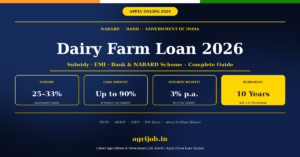
The NABARD dairy farm loan 2026 is one of India’s most powerful government-backed schemes for farmers, rural entrepreneurs, and Self Help Groups who want to start or expand a dairy business. Through this scheme — operating via the Dairy Entrepreneurship Development Scheme (DEDS) model and the Animal Husbandry Infrastructure Development Fund (AHIDF) — eligible applicants can access loans from leading banks at competitive interest rates starting from 8.05% per annum, along with a back-ended subsidy of 25% (general category) or 33.33% (SC/ST farmers) on the approved project cost. Whether you are a small farmer planning a 2-cow unit or an entrepreneur eyeing a large dairy processing plant, this 2026 updated guide covers everything: eligibility, subsidy details, interest rates, loan amount limits, documents required, step-by-step application process, and the best banks for NABARD dairy loans.

- What Is NABARD Dairy Farm Loan 2026?
- NABARD Dairy Loan Subsidy Percentage & Amount
- NABARD Dairy Loan Interest Rate 2026
- NABARD Dairy Loan Eligibility & Age Limit
- Documents Required for NABARD Dairy Loan
- How to Apply for NABARD Dairy Farm Loan Online
- Who Should Apply for NABARD Dairy Farm Loan 2026?
- NABARD Dairy Loan vs Mudra Loan: Key Differences
- High-Value Animal Husbandry Finance Terms You Must Know
- Frequently Asked Questions (FAQ)
| Scheme Name | NABARD Dairy Farm Loan (DEDS / AHIDF / DIDF) |
| Implementing Body | NABARD (refinancer) + Commercial Banks / RRBs / Cooperative Banks |
| Subsidy (General) | 25% back-ended capital subsidy |
| Subsidy (SC/ST) | 33.33% back-ended capital subsidy |
| Interest Rate | From 8.05% p.a. (DIDF cooperatives: 6.5%) |
| Loan Amount (Small Unit) | Up to Rs.5 lakh (2–10 animal unit) |
| Loan Amount (AHIDF) | Up to Rs.10 crore per project |
| Repayment Period | 5–7 years (with 6–12 month moratorium) |
| Eligible Borrowers | Farmers, NGOs, SHGs, FPOs, Cooperatives, Entrepreneurs |
| Application Mode | Online (via SBI YONO Krishi, Bank portals) + Offline (bank branch) |
| Official Website | www.nabard.org |
What Is NABARD Dairy Farm Loan 2026?
The NABARD dairy farm loan 2026 refers to the comprehensive financing framework provided by the National Bank for Agriculture and Rural Development (NABARD) to support dairy farming in India. Established in 1982, NABARD is India’s apex development bank for agriculture and rural development. It does not lend directly to individual dairy farmers but operates as a refinancing institution — it provides low-cost funds to commercial banks, Regional Rural Banks (RRBs), cooperative banks, and NBFCs, which in turn disburse loans to borrowers at farmer-friendly terms.
The dairy loan ecosystem under NABARD in 2026 operates through 3 main schemes: the Dairy Entrepreneurship Development Scheme (DEDS) for small units of 2–10 milch animals, the Animal Husbandry Infrastructure Development Fund (AHIDF) for larger processing and infrastructure projects up to Rs.10 crore, and the Dairy Processing and Infrastructure Development Fund (DIDF) for milk cooperatives and federations. Together, these schemes support dairy farmers across all 28 states and 8 Union Territories of India, helping them purchase crossbred cows, indigenous milch breeds such as Sahiwal, Gir, and Rathi, or graded buffaloes like Murrah.

The key objective of the NABARD dairy loan 2026 notification is to promote modern, hygienic dairy farming, generate rural self-employment, conserve good breeding stock, and bring India’s unorganised dairy sector under a structured financial framework. As per the Ministry of Animal Husbandry, Dairying and Fisheries, this scheme supports Govt. of India’s goal of Doubling Farmers’ Income and the Atmanirbhar Bharat mission by making dairy farming commercially viable for rural households.
NABARD Dairy Loan 2026 Subsidy Percentage & Amount
The most searched question about NABARD dairy farm loan is: how much subsidy will I get? The subsidy structure varies by scheme and applicant category. Here is the complete 2026 subsidy breakdown:
| Component / Unit Type | Project Cost | Subsidy (General) | Subsidy (SC/ST) | Max Subsidy Amount |
|---|---|---|---|---|
| Small dairy unit – 2 animals | Rs.1 lakh | 25% | 33.33% | Rs.25,000 / Rs.33,300 (SC/ST) |
| Small dairy unit – 10 animals | Rs.5 lakh | 25% | 33.33% | Rs.1.25 lakh / Rs.1.67 lakh (SC/ST) |
| Heifer calf rearing – up to 20 calves | As per NABARD unit cost | 25% | 33.33% | Pro-rata basis |
| Vermicompost unit (linked dairy) | Rs.20,000 per unit | 25% | 33.33% | Rs.5,000 / Rs.6,660 (SC/ST) |
| AHIDF – Large dairy infrastructure | Up to Rs.10 crore | 3% interest subvention (back-ended) | Same as general | Interest subvention via DAHD |
| DIDF – Milk cooperative processing | Corpus Rs.8,004 crore (national) | Loan @ 6.5% interest | 2.5% interest subvention | As per project |
Important note: The NABARD dairy farm loan subsidy is back-ended, meaning it is NOT paid upfront in cash. Instead, the subsidy is held in a Subsidy Reserve Fund Account at the lending bank and adjusted against the last few EMIs of your loan. This reduces your outstanding principal and lowers your remaining monthly instalments. After 12 months of satisfactory dairy unit operations, NABARD credits the subsidy to your loan account. You continue repaying EMIs as normal; the bank simply waives the final few instalments equivalent to the subsidy amount.
NABARD Dairy Farm Loan Interest Rate 2026
The NABARD dairy loan interest rate is not fixed by NABARD — the lending bank sets the actual rate based on their MCLR (Marginal Cost of Funds Based Lending Rate), the borrower’s credit profile, and the nature of the project. However, since these loans fall under agricultural lending norms and benefit from NABARD refinance, interest rates are significantly lower than standard commercial loans. Here is the 2026 interest rate comparison across major banks:
| Bank / Institution | Scheme Name | Interest Rate (2026) | Loan Amount | Annual Earning Potential |
|---|---|---|---|---|
| SBI | Safal Dairy Loan / YONO Krishi | From 8.05% p.a. | Up to Rs.10 lakh | Rs.1.2–2 lakh/month (10 cows) |
| Bank of Baroda | Mini Dairy Unit Scheme | At MCLR + spread | 2–10 animals (per NABARD unit cost) | Rs.50,000–1.5 lakh/month |
| Central Bank of India | Cent Dairy Scheme | Competitive (agri rate) | Up to Rs.10 lakh | Rs.60,000–1.8 lakh/month |
| RRBs / Cooperative Banks | NABARD Refinance-linked | 8.3–10% p.a. | As per project DPR | Varies by unit size |
| NABARD DIDF (Cooperatives) | Dairy Processing Fund | 6.5% p.a. (subsidised) | Up to Rs.8,004 crore (national corpus) | Institutional-scale |
Under the Modified Interest Subvention Scheme (MISS), NABARD continues to provide 2% interest subvention on short-term agricultural loans up to Rs.3 lakh in 2026, with an additional 3% incentive for prompt repayment — bringing the effective rate as low as 4% for KCC-linked borrowers. States like Bihar provide an additional 1% subvention under special MoUs, further reducing the cost of dairy finance for rural borrowers.
NABARD Dairy Farm Loan Eligibility & Age Limit 2026
The eligibility for NABARD dairy farm loan 2026 is broader than most applicants expect. Both individuals and organised groups can apply. Here is the complete eligibility breakdown:
- 🧑🌾 Individual farmers — owner-cultivators, tenant farmers, oral lessees, and sharecroppers with access to land or lease agreement for dairy shed construction.
- 👩🦱 Women entrepreneurs — women farmers and dairy entrepreneurs receive priority processing and can access SC/ST equivalent attention under state schemes in many states.
- 🤝 Self Help Groups (SHGs) — organised groups of 10–20 rural women or men with a group savings record and bank linkage qualify for NABARD dairy loan via SHG-Bank Linkage Programme.
- 🏢 NGOs and Farmer Producer Organisations (FPOs) — registered entities with at least 6 months of operations since formation are eligible under AHIDF framework.
- 🏭 Dairy cooperatives and milk unions — registered dairy cooperative societies, milk unions, and milk federations can access DIDF funds at subsidised rates of 6.5%.
- 🧑💼 Entrepreneurs and private companies — first-time dairy entrepreneurs, proprietorships, partnerships, and limited liability companies can apply for AHIDF under NABARD dairy loan 2026.
- 🐄 Existing dairy farmers — those already in the business and looking to expand from 2–5 animals to 10+ animals or add processing infrastructure are fully eligible.
| Eligibility Criterion | Requirement |
|---|---|
| Nationality | Indian citizen |
| Age | 18 to 65 years |
| Loan default status | No default with any financial institution (clean CIBIL) |
| Land / Shed | Own land or lease agreement for shed construction |
| Education | No minimum qualification (training from approved centre recommended) |
| Income limit (DEDS-pattern) | Family income below Rs.1,00,000/year for some state schemes |
| Minimum animals (DIDF) | 10+ cows, min 200 litres/day milk capacity |
| Application fee | Nil (no NABARD application fee) |
Documents Required for NABARD Dairy Loan 2026
To apply for the NABARD dairy farm loan through any participating bank in 2026, you need the following documents ready before visiting the branch or applying online. Missing even one document can delay your loan approval by weeks, so prepare all paperwork in advance.
- 🪪 Aadhaar Card — primary identity and address proof (mandatory for KYC).
- 📄 PAN Card — required for loan amounts above Rs.50,000 as per RBI norms.
- 🏠 Address Proof — electricity bill, ration card, or bank passbook with current address.
- 🌾 Land Documents — sale deed, lease agreement, or khata/patta paper showing land availability for dairy shed.
- 🏦 Bank Statement — last 6 months’ account statement showing regular financial activity.
- 📊 Detailed Project Report (DPR) — must include animal purchase plan, shed construction estimate, equipment cost, feed cost, expected milk production and income projections. Banks accept DPRs prepared by NABARD-approved consultants or agricultural universities.
- 📸 Passport-size photographs — 2 to 4 recent colour photographs.
- 📋 Caste Certificate — mandatory for SC/ST applicants to claim the higher 33.33% subsidy.
- 🐄 Animal insurance details — some banks require proof of intention to insure animals (or existing insurance policy for expansion loans).
- 📝 Income Certificate — required by some state-level schemes to verify family income below Rs.1,00,000/year.
Before visiting the bank, confirm with that branch that they are actively participating in the AHIDF or NABARD refinance scheme. Not every branch of every bank has active allocations. If the branch is not empanelled, you will have to restart the process elsewhere. SBI’s YONO Krishi app and Bank of Baroda’s online portal let you check branch eligibility and submit documents digitally, saving time. Always prepare your DPR professionally — banks reject DPRs with inflated cost estimates, as NABARD applies standard unit costs approved by regional offices.
How to Apply for NABARD Dairy Farm Loan Online 2026
Applying for NABARD dairy farm loan 2026 is a structured 8-step process. NABARD itself does not accept direct applications from farmers — the process runs entirely through partner banks. Here is the complete step-by-step guide:
- 🐄 Step 1 – Choose your dairy activity: Decide on the type and scale of your dairy unit — a small 2–10 animal unit, heifer calf rearing, milk cooling and chilling unit, or a full dairy processing plant. This decision determines which sub-scheme (DEDS/AHIDF/DIDF) applies to you and what subsidy you qualify for under NABARD dairy loan 2026.
- 🏢 Step 2 – Register your business (if applicable): Individuals can apply directly. For NGOs, SHGs, cooperatives, or companies, ensure your entity is registered and has a valid registration certificate, bank account, and at least 6 months of operational history.
- 📊 Step 3 – Prepare a Detailed Project Report (DPR): The DPR is the most critical document. It must include animal purchase plan with breed details, shed construction estimate, milking equipment cost, feed and fodder plan, water source, projected milk production (litres/day), income-expenditure projections for 5 years, and loan repayment schedule. You can take help from NABARD district offices, Krishi Vigyan Kendras (KVKs), or approved consultants for preparing a bankable project report for the dairy farm.
- 🏦 Step 4 – Select a participating bank and apply: Approach SBI, Bank of Baroda, PNB, Canara Bank, Central Bank of India, or your local RRB or cooperative bank. Confirm the branch participates in NABARD refinance or AHIDF scheme. For SBI, use the YONO Krishi – Safal Dairy Loan feature on the SBI YONO app to apply online. Submit your application form along with all required KYC and DPR documents.
- ✅ Step 5 – Bank review and loan sanction: The bank’s technical officer reviews the DPR for technical feasibility and economic viability. This process takes 15–30 working days. Upon approval, the loan is sanctioned with defined terms — interest rate, tenure, moratorium period, and collateral requirement (if any). For loans below Rs.1.6 lakh, no collateral is required at Bank of Baroda. For higher amounts, equitable mortgage of land or third-party guarantee may apply.
- 💰 Step 6 – Loan disbursement in stages: The loan is disbursed in 2 to 3 tranches against the creation of specific assets — animal purchase, shed construction, and equipment installation. You implement the project using both your own contribution (minimum 10–25% margin money) and the bank loan. Do NOT wait for the subsidy before starting — it arrives later.
- 📩 Step 7 – Bank claims NABARD subsidy: Once the first instalment of the loan is disbursed, the bank applies to NABARD for sanction of the dairy farm subsidy. NABARD verifies the claim and releases the subsidy to the bank, which holds it in a Subsidy Reserve Fund Account with no interest. This subsidy is not paid out to you directly.
- 🎉 Step 8 – Subsidy adjustment against EMIs: After 12 months of satisfactory dairy unit operation and regular loan repayment, the subsidy amount is adjusted against your last few EMI instalments. Your loan effectively closes earlier than the original schedule — saving you lakhs in interest payments on the NABARD dairy loan.
You can also visit NABARD’s official website at nabard.org to download scheme guidelines, find your nearest NABARD district development manager (DDM), and check state-wise unit costs. For AHIDF applications, visit the Department of Animal Husbandry and Dairying (DAHD) official portal at dahd.gov.in. For apprenticeship-linked self-employment in rural dairy, also visit apprenticeshipindia.gov.in for skill-linked dairy training programmes.
Who Should Apply for NABARD Dairy Farm Loan 2026?
The NABARD dairy farm loan 2026 is designed for a wide range of applicants. If you fall into any of these 8 categories, you should strongly consider applying this year:
- 🧑🌾 Small and marginal farmers who already own 2–5 cattle and want to scale up to 10 animals with a structured 25% subsidy and low-interest bank loan.
- 👩 Rural women and women SHG members — state schemes in Bihar, UP, Rajasthan, and Haryana give priority processing to women dairy entrepreneurs under the pashupalan yojana 2026 framework.
- 🎓 Young agricultural graduates and diploma holders who want to start a modern dairy farm as a business rather than entering government service — dairy farming can generate Rs.1–2 lakh/month from a 10-cow unit.
- 🏷️ SC/ST farmers — who receive the higher 33.33% back-ended subsidy instead of 25%, making the NABARD dairy farm loan especially attractive for this category with a maximum Rs.1.67 lakh subsidy on a 10-animal unit.
- 🤝 Joint Liability Group (JLG) and SHG members — individuals without formal land documents can access NABARD dairy loan via group lending norms, with the group acting as a guarantee mechanism.
- 🏭 Existing dairy cooperatives and milk unions — entities that want to upgrade chilling plants, add processing capacity, or install electronic milk quality testing equipment under the DIDF at the concessional 6.5% interest rate.
- 🚀 Dairy entrepreneurs and agri-startups — registered FPOs or private limited companies planning large-scale integrated dairy projects of Rs.1–10 crore can access AHIDF under NABARD refinance scheme dairy 2026.
- 🌿 Organic and niche dairy producers — those planning A2 milk, goat milk, or value-added dairy product units (paneer, ghee, butter) who need structured financing with NABARD’s refinance support and DAHD’s interest subvention.
NABARD Dairy Loan vs Mudra Loan: Key Differences
Many dairy farmers are confused about whether to apply for a NABARD dairy loan or a PM Mudra Yojana loan. Here is a complete comparison to help you decide:
| Parameter | NABARD Dairy Farm Loan 2026 | PM Mudra Loan (Kishore/Tarun) |
|---|---|---|
| Loan Amount | Up to Rs.5 lakh (small unit) / Rs.10 crore (AHIDF) | Up to Rs.10 lakh (Tarun category) |
| Subsidy | 25%–33.33% back-ended capital subsidy | No subsidy (only collateral-free loan) |
| Interest Rate | From 8.05% (with NABARD refinance benefit) | 8–12% (market rate, no subvention) |
| Purpose | Specifically for dairy farming, cattle, sheds, equipment | Any income-generating micro/small business |
| Eligible Borrowers | Farmers, SHGs, FPOs, cooperatives, entrepreneurs | Individuals, proprietorships, partnerships |
| Processing Time | 15–30 working days (DPR review required) | 7–14 working days (simpler process) |
| Collateral | Not required up to Rs.1.6 lakh; mortgage for higher amounts | No collateral required (collateral-free) |
| Best For | Dedicated dairy farmers wanting maximum subsidy benefit | Small dairy entrepreneurs wanting quick, simple financing |
| Repayment Period | 5–7 years | 3–5 years |
High-Value Animal Husbandry Finance Terms You Must Know
Understanding these key terms will help you navigate the NABARD dairy loan application confidently and communicate effectively with bank officers and NABARD district managers:
- 💰 Back-ended Capital Subsidy: The subsidy is not given upfront. It sits in a bank account and is adjusted against your last few loan EMIs after 12 months of satisfactory unit operations — saving you principal repayment at the end of your loan term.
- 📊 Detailed Project Report (DPR): A bankable business plan for your dairy farm including capital costs, operating costs, projected milk income, and loan repayment schedule. This document is mandatory for NABARD dairy loan 2026 approval. Estimated cost: Rs.2,000–Rs.10,000 if prepared by a professional consultant.
- 🏦 NABARD Refinance: When a commercial bank sanctions your dairy loan using NABARD refinance support, NABARD replenishes the bank’s funds at a low cost, enabling the bank to offer you lower interest rates than standard commercial loans.
- 🐄 AHIDF (Animal Husbandry Infrastructure Development Fund): A Rs.15,000 crore fund by Govt. of India, managed through NABARD, providing credit to private entities, FPOs, and MSME dairy entrepreneurs for large-scale infrastructure — loan limit up to Rs.10 crore per project.
- 🥛 DIDF (Dairy Processing and Infrastructure Development Fund): A Rs.8,004 crore corpus at NABARD providing subsidised loans at 6.5% to milk cooperatives and federations for modernising processing plants and chilling infrastructure.
- 🌾 Pashupalan Loan (पशुपालन लोन): The common Hindi term for livestock and dairy farm loans under government schemes. Pashupalan yojana 2026 covers goat farming, dairy, poultry, and other animal husbandry activities under NABARD and state government frameworks.
- 💳 Kisan Credit Card (KCC): NABARD-designed revolving credit facility for farmers. Dairy farmers can use KCC for working capital — buying feed, fodder, and medicines — at interest rates as low as 4% after interest subvention, alongside their NABARD dairy farm loan.
- 🏷️ Subsidy Reserve Fund Account: The special bank account where NABARD releases the dairy loan subsidy amount. The bank holds this amount with no interest and adjusts it against your final EMIs, effectively closing your loan early.
- 📍 NABARD District Development Manager (DDM): NABARD’s field officer at the district level who helps coordinate dairy loan applications, guides farmers on DPR preparation, and liaisons between the bank and NABARD’s regional office for subsidy release.
- 🔄 Moratorium Period: The initial period (typically 6–12 months) after loan disbursement during which you are not required to repay EMIs. This gives your dairy unit time to become operational and start generating income before repayments begin.
Frequently Asked Questions – NABARD Dairy Farm Loan 2026
What is NABARD dairy farm loan 2026?
The NABARD dairy farm loan 2026 is a government-backed financing scheme where farmers, SHGs, cooperatives, and entrepreneurs apply through participating commercial banks, RRBs, or cooperative banks for loans to set up or expand dairy units. NABARD does not lend directly but provides refinance support and a back-ended capital subsidy of 25% (general category) or 33.33% (SC/ST farmers). This 2026 updated guide covers the complete process from DPR preparation to subsidy adjustment.
What is the subsidy percentage for NABARD dairy farm loan?
The NABARD dairy farm loan subsidy is 25% of the approved project cost for general category applicants, and 33.33% for SC/ST farmers. For a standard 10-animal dairy unit costing Rs.5 lakh, the maximum back-ended subsidy is Rs.1.25 lakh for general applicants and Rs.1.67 lakh for SC/ST. The subsidy is provided on a pro-rata basis depending on unit size — even a 2-animal starter unit qualifies for up to Rs.25,000 in subsidy under the NABARD pashupalan yojana 2026.
What is the NABARD dairy loan interest rate in 2026?
NABARD dairy loan interest rates in 2026 start from approximately 8.05% per annum at SBI. Under the DIDF scheme for milk cooperatives, the rate is 6.5%. The interest rate varies by lender, loan amount, and credit profile. Under interest subvention schemes, prompt-repaying borrowers can access effective rates as low as 4% on KCC-linked working capital for dairy. Always confirm the current rate at your branch before signing the loan agreement.
Who is eligible for NABARD dairy farm loan 2026?
Eligibility for NABARD dairy farm loan 2026 covers individual farmers (aged 18–65), dairy entrepreneurs, NGOs, Self Help Groups (SHGs), Joint Liability Groups (JLGs), milk cooperatives, Farmer Producer Organisations (FPOs), milk unions, and private companies. Applicants must be Indian citizens with no prior loan default, and must have or arrange land or shed space for the dairy unit. SC/ST farmers receive priority and a higher 33.33% subsidy under the pashupalan loan NABARD 2026 framework.
What documents are required for NABARD dairy loan?
Documents required for NABARD dairy farm loan 2026 include Aadhaar card, PAN card, address proof (electricity bill/ration card), land documents or lease agreement for dairy shed, 6-month bank statement, Detailed Project Report (DPR) for the dairy unit, 2–4 passport-size photos, and caste certificate for SC/ST subsidy. Some banks may also ask for income certificate and a letter of intent to insure the animals under the national livestock insurance scheme.
How to apply for NABARD dairy farm loan online in 2026?
To apply for NABARD dairy farm loan online in 2026, prepare a Detailed Project Report and visit a participating bank branch such as SBI, Bank of Baroda, PNB, or a Regional Rural Bank. SBI’s YONO Krishi – Safal Dairy Loan allows online application directly from a smartphone. Submit your KYC documents, DPR, and land papers. The bank sanctions the loan, disburses it in stages, and then claims the NABARD dairy subsidy on your behalf — you never apply to NABARD directly.
What is the maximum loan amount under NABARD dairy loan 2026?
For small dairy units (2–10 milch animals) under DEDS-pattern financing, the standard investment is up to Rs.5 lakh for a 10-animal unit based on NABARD-approved state unit costs. Under the Animal Husbandry Infrastructure Development Fund (AHIDF) for larger processing or infrastructure projects, the NABARD dairy loan amount goes up to Rs.10 crore per eligible borrower. Loan amounts are assessed by the bank based on your approved DPR cost — inflated estimates are rejected during bank review.
What is the repayment period for NABARD dairy farm loan?
The repayment period for NABARD dairy farm loan is generally 5 to 7 years, with a moratorium period of 6 to 12 months. Monthly or quarterly EMI repayments begin after the moratorium. Commercial-scale dairy projects may qualify for up to 7 years under AHIDF. With the back-ended subsidy adjusted against the last few EMIs, your effective repayment period is shorter, reducing the total interest burden on your NABARD dairy loan in 2026.
Can SC/ST farmers get more subsidy under NABARD dairy loan?
Yes, SC/ST farmers receive a higher back-ended subsidy of 33.33% under the NABARD dairy farm loan scheme, compared to 25% for general category. For a 10-animal dairy unit costing Rs.5 lakh, SC/ST borrowers receive up to Rs.1.67 lakh in subsidy versus Rs.1.25 lakh for general applicants. Additionally, many state governments provide further benefits to SC/ST dairy farmers — such as priority loan sanctioning, reduced margin money requirements, and dedicated state subsidy stacked on top of the NABARD dairy subsidy.
For the latest NABARD dairy loan notifications, scheme guidelines, and state-wise unit costs, always refer to the official NABARD website at www.nabard.org and the Department of Animal Husbandry and Dairying portal at dahd.gov.in. This guide is regularly reviewed and updated for accuracy — bookmark this page for the latest 2026 notifications on pashupalan loan, NABARD dairy refinance scheme, and AHIDF updates.
Last Updated: June 2026 | Source: NABARD Official Guidelines, DAHD, Ministry of Animal Husbandry Dairying and Fisheries, Govt. of India