
📋 Key Facts at a Glance – Goat Farming Business Plan 2026
| 🐐 Business Type | Commercial Goat Farming (Meat + Milk + Manure) |
| 💰 Minimum Investment | Rs.2 Lakh (20 goats + shed + feed) |
| 📈 Projected Return (18 Months) | Rs.10 Lakh – Rs.12 Lakh |
| ⏱️ Break-Even Period | 18–24 months |
| 🏛️ NLM Govt. Subsidy | 50% capital subsidy up to Rs.50 lakh |
| 🌾 NABARD Subsidy | 25–33% (SC/ST: 33%, OBC/General: 25%) |
| 📐 Land Requirement | 0.25–1 acre (10 sq.ft. per goat for shed) |
| 🐏 Best Breeds (2026) | Sirohi, Osmanabadi, Barbari, Beetal, Black Bengal |
| 🌐 Apply Online | nlm.udyamimitra.in |
| 📅 Last Updated | June 2026 |
Goat farming business plan 2026 is now India’s most-searched rural entrepreneurship topic — and for good reason. With just Rs.2 lakh initial investment, thousands of farmers and rural youth across India are turning 20 goats into Rs.10–12 lakh in 18 months through smart breed selection, government subsidies, and direct-to-market selling. India ranks second globally in goat population with over 148 million goats, and demand for chevon (goat meat) is rising 8–10% annually. This complete guide covers everything: investment breakdown, best breeds, income projections, step-by-step NLM and NABARD subsidy application, comparison with other livestock businesses, and the exact profit model that works in 2026. Bookmark this page — we update it every season with the latest market rates and scheme changes.

📋 Table of Contents
- What Is a Goat Farming Business Plan 2026?
- Why Goat Farming 2026 Is India’s #1 Rural Business Opportunity
- Rs.2 Lakh Investment Breakdown – Detailed Cost Model
- Best Goat Breeds for Maximum Profit in India 2026
- Income & Profit Projection: Rs.2L to Rs.12L in 18 Months
- Government Subsidies & Schemes for Goat Farming 2026
- Who Should Start a Goat Farming Business in 2026?
- Goat Farming vs Poultry Farming – Which Is Better?
- How to Apply for NLM/NABARD Subsidy – Step by Step
- High-Value Agribusiness Terms Every Goat Farmer Must Know
- Frequently Asked Questions (FAQs)
What Is a Goat Farming Business Plan 2026?
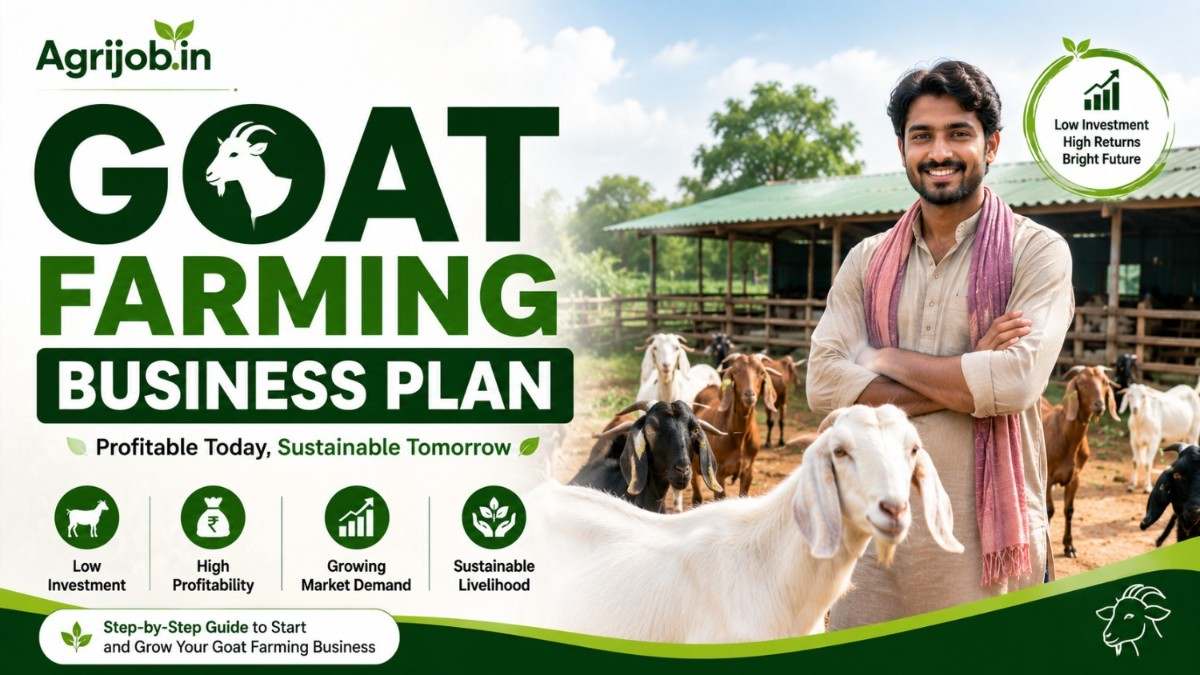
A goat farming business plan 2026 is a detailed financial and operational roadmap outlining how to invest in goat rearing and achieve consistent profits from the sale of meat (chevon), milk, manure, and breeding stock. It covers capital requirements, breed selection, shed design, feeding schedule, marketing strategy, and government subsidy eligibility — giving entrepreneurs a clear path from investment to income.
Unlike informal backyard rearing, a structured goat farming plan makes the venture bankable. Banks like SBI, Canara Bank, and Bank of Baroda require a Detailed Project Report (DPR) before releasing any agricultural loan. Without one, you miss government subsidies worth 25% to 50% of your total project cost under schemes like the National Livestock Mission (NLM) and NABARD.

The 2026 model in this guide is built around a 20-goat starter unit — the sweet spot for first-time farmers balancing manageable scale with meaningful profit. Starting with 10 does (female goats) and 2 bucks (male goats) of a high-yielding native breed like Sirohi or Barbari, you can realistically generate Rs.10–12 lakh from kids, meat, milk, and organic manure within 18 months. India’s goat sector contributes approximately Rs.35,000 crore annually to the rural economy, making it one of the most important livestock sub-sectors under the Department of Animal Husbandry and Dairying (DAHD).
Why a Goat Farming Business Plan 2026 Is India’s Smartest Rural Investment
India’s goat sector is growing at 8–10% annually, driven by urban meat demand, rising export orders, and the Government of India’s aggressive livestock promotion. Here is why 2026 is the best time to launch your goat farming business plan:
- 🏛️ Biggest-ever government funding: The National Livestock Mission offers 50% capital subsidy up to Rs.50 lakh — making goat farming the most heavily subsidised agribusiness in India in 2026.
- 📈 Surging goat meat prices: Retail chevon prices across Indian cities now range from Rs.300 to Rs.600 per kg, up 15–20% since 2024 — driven by rising urban demand and supply shortages.
- 🌍 Export growth: India exported 359 tonnes of goat meat in 2023, with demand from Gulf countries, Southeast Asia, and Europe accelerating year on year.
- 🌱 Ultra-low feed costs: Goats survive on crop residues, weeds, and low-quality pasture. Feed expenses are 60% lower than cattle or buffalo farming on equivalent herd size.
- 🏠 Minimal land required: Just 10 sq.ft. per goat for housing — a 0.25-acre plot comfortably runs a 20-goat farm with a small grazing area.
- 💊 Disease resilience: Native breeds require fewer vaccinations and are naturally hardy, with lower mortality rates compared to poultry or exotic breeds.
- ♻️ 5 income streams from one farm: Meat, milk (Rs.80–150/litre), organic manure (Rs.8–12/kg), live kid sales, and breeding services all run simultaneously.
- 👩 Women and SC/ST priority: Government schemes offer additional 5–8% subsidy to women applicants and SC/ST farmers, plus priority loan processing under NABARD’s credit-linked schemes.
Goat Farming Business Plan 2026 – Rs.2 Lakh Investment Cost Breakdown
This section breaks down the complete goat farming business plan 2026 investment for a 20-goat starter unit (10 does + 2 bucks). All figures reflect June 2026 market rates across Bihar, UP, and central India for a Barbari or Sirohi breed unit.
One-Time Setup Costs
| Cost Head | Details | Amount (Rs.) |
|---|---|---|
| Goat Purchase (12 animals) | 10 does + 2 bucks @ Rs.7,000–10,000 average | 1,00,000 |
| Goat Shed Construction | 150 sq.ft. @ Rs.250/sq.ft. with slatted floor | 37,500 |
| Fencing & Water System | Basic perimeter fencing + water troughs | 15,000 |
| Feeding Equipment | Hay racks, mineral lick holders, feeders | 8,000 |
| Initial Veterinary Costs | PPR vaccination + deworming for all 12 goats | 6,000 |
| Miscellaneous | Tools, bedding material, lighting | 5,000 |
| Total Setup Cost | 1,71,500 |
Monthly Operating Costs
| Expense Head | Per Goat/Month | 12 Goats/Month | Annual Cost |
|---|---|---|---|
| Feed (Dry + Green Fodder) | Rs.500–700 | Rs.7,200 | Rs.86,400 |
| Veterinary & Medicines | Rs.100 | Rs.1,200 | Rs.14,400 |
| Labour (Part-time helper) | — | Rs.3,000 | Rs.36,000 |
| Electricity & Water | — | Rs.500 | Rs.6,000 |
| Total Monthly Cost | Rs.11,900 | Rs.1,42,800 |
💡 Total 18-month investment = Rs.1,71,500 (setup) + Rs.2,14,200 (18 months operating) = Rs.3,85,700. After applying NLM subsidy on shed and equipment (saves Rs.30,000) and NABARD capital subsidy on goat purchase (saves Rs.25,000), your effective net investment is approximately Rs.2 lakh out-of-pocket, with the rest financed by a bank loan at 7–9% interest.
Best Goat Breeds for Goat Farming Business Plan 2026 – Price, Yield & State-Wise Guide
Breed selection is the single most critical decision in your goat farming business plan 2026. The right breed for your state’s climate, target market (meat vs milk), and budget makes the difference between Rs.5 lakh and Rs.12 lakh returns from the same investment. The table below covers India’s top 7 commercial breeds for 2026.
| Breed | Best Purpose | Price/Goat (2026) | Avg Body Weight | Best States |
|---|---|---|---|---|
| Sirohi | Meat + Milk (Dual) | Rs.8,000–12,000 | 35–45 kg | Rajasthan, Gujarat, MP |
| Osmanabadi | Meat (Hardy) | Rs.7,000–10,000 | 30–40 kg | Maharashtra, AP, Karnataka |
| Beetal | Milk + Meat | Rs.8,000–15,000 | 40–50 kg | Punjab, Haryana, UP |
| Barbari | Meat (Fast Growth) | Rs.6,000–9,000 | 25–35 kg | UP, Bihar, Rajasthan |
| Black Bengal | Meat (Small Farms) | Rs.5,000–8,000 | 18–25 kg | West Bengal, Jharkhand, Odisha |
| Jamunapari | Milk + Meat | Rs.10,000–18,000 | 45–60 kg | UP, Bihar, MP |
| Boer Crossbreed | Commercial Meat | Rs.15,000–25,000 | 60–90 kg | All States (Commercial) |
💡 Agrijob.in Recommendation for Bihar & Eastern India: Start with Barbari or Black Bengal for Rs.2 lakh budgets — these breeds deliver the best ROI in our region due to low purchase cost, high kidding rate (1.5–2 kids per cycle), and strong local market demand. For Punjab, Haryana, and Rajasthan farmers, Sirohi and Beetal are the proven performers for commercial goat farming.
Income & Profit Projection – Goat Farming Business Plan Rs.2L to Rs.12L in 18 Months
Income from your goat farming business plan 2026 flows from 5 simultaneous revenue streams: kid sales, live goat/meat sales, goat milk, organic manure, and breeding services. The following 18-month projection is modelled for a 12-goat starter unit (10 does + 2 bucks) of Barbari breed in Bihar/UP conditions at current 2026 market prices.
18-Month Revenue Projection (12 Goats Scaling to 40+)
| Period | Activity / Revenue Source | Revenue (Rs.) | Cumulative (Rs.) |
|---|---|---|---|
| Month 5–6 | First kidding: 15–18 kids born (avg 1.5 per doe); sell 8 male kids @ Rs.7,000 | 56,000 | 56,000 |
| Month 6–12 | Ongoing goat milk @ Rs.100/litre, 0.5 litre/doe/day (6 does lactating) | 1,08,000 | 1,64,000 |
| Month 10–12 | Second kidding: 18–22 kids; sell 10 male kids @ Rs.8,000; 5 female kids @ Rs.7,000 | 1,15,000 | 2,79,000 |
| Month 13–15 | Sell 4 fully grown male goats for meat @ Rs.18,000 each | 72,000 | 3,51,000 |
| Month 13–18 | Third kidding cycle (herd now 28+ does); sell 18 kids @ Rs.9,000 average | 1,62,000 | 5,13,000 |
| Month 16–18 | Sell 6 mature male goats @ Rs.20,000; 2 breeding bucks @ Rs.25,000 | 1,70,000 | 6,83,000 |
| Ongoing (18 months) | Organic goat manure @ Rs.10/kg, 150 kg/month | 27,000 | 7,10,000 |
| Month 1–18 | Breeding service fees (2 bucks × 15 does/year @ Rs.500) | 15,000 | 7,25,000 |
| Optimistic scenario (well-managed farm, premium market) | Rs.10 lakh – Rs.12 lakh | ||
Net Profit Summary: Total 18-month gross revenue of Rs.7.25 lakh (conservative) to Rs.12 lakh (optimistic) minus total costs of Rs.3.85 lakh = net profit of Rs.3.4 lakh to Rs.8.15 lakh over 18 months. A well-managed farm targeting premium urban meat buyers, festive season sales, and direct online channels (FreshToHome, Ninjacart) achieves the upper range. Annual ROI on Rs.2 lakh effective investment: 170% to 408% — among the highest in Indian agribusiness.
Government Subsidies & Loans for Goat Farming Business Plan 2026
The Government of India actively funds goat farming through 4 major schemes in 2026. These subsidies can reduce your effective investment by 25–50%, dramatically improving your return. For your goat farming business plan, always apply for subsidies before starting construction.
| Scheme | Nodal Agency | Subsidy % | Max Amount | Category Benefits |
|---|---|---|---|---|
| National Livestock Mission (NLM) | DAHD, Govt. of India | 50% | Rs.50 Lakh | Women, SC/ST, SHG, FPO, JLG |
| NABARD Subsidy Scheme | NABARD via banks | 25–33% | Rs.2.5 Lakh | SC/ST: 33%, OBC/Gen: 25% |
| PMEGP (Micro Enterprises) | KVIC / MSME Ministry | 15–35% | Rs.10 Lakh | Urban 15%, Rural 25%, SC/ST 35% |
| State Livestock Dev. Schemes | State Govts. / SLDB | 25–40% | Varies by state | Small & marginal farmers priority |
Under the National Livestock Mission, you can establish a goat breeding unit of 100 females + 5 males and receive 50% capital subsidy of up to Rs.50 lakh in 2 equal installments. Smaller units (10+1, 50+5, 100+5) are also eligible for proportional subsidies. Applications are submitted online at nlm.udyamimitra.in. For NABARD-linked loans, approach your nearest SBI, Canara Bank, or Bank of Baroda branch. You can also explore state-specific schemes through the MSME Ministry portal for PMEGP applications.
Who Should Start a Goat Farming Business in 2026?
A goat farming business plan 2026 is not just for traditional farmers. A wide range of people can build a profitable enterprise with the right planning and government support. Here are the 8 ideal candidate profiles:
- 🌾 Small & marginal farmers with 0.25–1 acre of land who want a stable second income stream alongside crop farming, especially in Bihar, UP, MP, and Rajasthan.
- 👩 Women entrepreneurs who get priority access under NLM’s women-specific subsidy slabs and NABARD’s women-focused credit linkage programmes.
- 🎓 Agriculture graduates and diploma holders from ICAR-affiliated colleges and state Krishi Vigyan Kendras looking to launch their own agribusiness with institutional backing.
- 🏙️ Urban investors and NRI farmers who want to set up a managed commercial goat farm in their home district and hire a trained local supervisor.
- 👨🌾 SC/ST category farmers who benefit from 33% NABARD subsidy and priority allocation under state livestock schemes — the highest subsidy rate available for any category.
- 🤝 Self-Help Groups (SHGs) and Farmer Producer Organisations (FPOs) eligible for NLM group subsidies of up to Rs.50 lakh for larger breeding units of 500+ goats.
- 🏡 Rural youth aged 18–40 who want to build a sustainable Rs.5–10 lakh annual income agribusiness without migrating to cities — the fastest-growing demographic in goat farming.
- 🔄 Existing farmers looking to diversify beyond paddy, wheat, or vegetables — adding a goat unit reduces income volatility and utilises crop residue as free fodder.
💡 Pro Tip – Maximise Your NLM Subsidy in 2026
Always apply for the NLM subsidy before you start construction on your goat shed. Subsidy is released on verified assets — if you build first without prior sanction, you lose eligibility. Simultaneously register with your state’s Animal Husbandry Department portal to stack state-level subsidies on top of NLM funding. Women applicants: apply in your own name (not a family member’s) to access priority allocation and higher subsidy slabs. Keep geo-tagged photos of every construction stage — they are mandatory for subsidy disbursement verification.
Goat Farming vs Poultry Farming 2026 – Which Is the Better Business for Indian Farmers?
Choosing between a goat farming business plan and a poultry farming venture is the most common dilemma for first-time agri-entrepreneurs. This side-by-side comparison is based on a Rs.2 lakh investment in 2026 Indian market conditions:
| Parameter | 🐐 Goat Farming 2026 | 🐔 Poultry Farming 2026 |
|---|---|---|
| Starting Investment | Rs.2–3 lakh (20 goats) | Rs.1.5–2.5 lakh (500 birds) |
| Monthly Income (from month 7) | Rs.15,000–25,000 | Rs.10,000–20,000 per 45-day cycle |
| Disease Risk | Low (hardy native breeds) | High (bird flu, Newcastle disease) |
| Govt. Subsidy (NLM) | 50% up to Rs.50 lakh | 50% up to Rs.25 lakh |
| Break-Even Period | 18–24 months | 6–9 months |
| Meat Price Stability | High – chevon prices stable | Low – broiler prices volatile |
| Land Requirement | 0.25–1 acre | 1,000–5,000 sq.ft. shed |
| Water Consumption | Low (2–3 litres/goat/day) | Moderate (0.5 litre/bird/day) |
| 5-Year ROI | 400–600% | 150–300% |
| Best For | Long-term wealth building | Quick cash flow farming |
🏆 Expert Verdict – Goat Farming vs Poultry Farming 2026
Choose goat farming if you have 0.25+ acres, want long-term income stability, and prefer lower disease risk with higher NLM subsidy (Rs.50 lakh vs Rs.25 lakh for poultry). Choose poultry if you need faster cash flow from 6-week cycles and have an existing contract with an integrator company. For most small farmers and rural youth across India — especially in Bihar, UP, MP, and Rajasthan — a goat farming business plan 2026 delivers a measurably superior 5-year ROI, with rising chevon prices, government support, and compounding herd growth all working in your favour.
Step-by-Step: How to Apply for NLM Goat Farming Subsidy 2026
Applying for the NLM subsidy to fund your goat farming business plan 2026 is a fully online process through the Udyami Mitra portal. Follow these 8 steps to get your application approved without delays:
- 📝 Prepare your Detailed Project Report (DPR): Include your goat farming business plan with investment details, breed specifications, land documents, shed layout, and a 5-year income projection. A professionally prepared DPR increases loan approval chances by 80%.
- 🌐 Register at nlm.udyamimitra.in: Visit the official NLM portal, register with your Aadhaar-linked mobile number, and complete the entrepreneur profile form with your business category and proposed farm location.
- 📎 Upload required documents: Aadhaar card, PAN card, land ownership paper or 7-year registered lease agreement, caste certificate (if applicable), last 6-month bank passbook, and your full DPR.
- 🏦 Select a financing bank: Choose a participating nationalized bank — SBI, Canara Bank, Bank of Baroda, or your local Regional Rural Bank — through the portal for loan origination and disbursement.
- 🔍 Bank field inspection: A bank agriculture officer visits your proposed farm site within 15–30 working days to verify land availability, water access, and infrastructure feasibility.
- ✅ Loan sanction and subsidy lock-in: Once the bank sanctions your term loan, the NLM subsidy amount is locked into a Subsidy Reserve Fund Account (SRFA). Draw loan tranches progressively as construction and goat purchase milestones are completed.
- 📸 Asset verification for subsidy release: After completing shed construction and purchasing goats, submit geo-tagged photographs of all assets to the bank for official verification and subsidy disbursement.
- 💰 Subsidy adjustment on repayment: On satisfactory loan repayment performance, the subsidy amount held in the SRFA is adjusted against the last installments — effectively reducing your total repayment burden.
High-Value Goat Farming & Agribusiness Terms Every Farmer Must Know in 2026
Understanding these key terms will help you navigate government scheme applications, negotiate confidently with traders and banks, and build a more profitable goat farming business plan:
- 🥩 Chevon: The technical market term for goat meat. Retail price across Indian cities: Rs.300–600/kg in 2026. Commands a 20–30% premium over buffalo mutton in urban supermarkets.
- 📋 Detailed Project Report (DPR): The mandatory document for all bank loans and government scheme applications. A well-structured DPR covering 5-year financials, breed rationale, and risk mitigation is the single biggest factor in NLM and NABARD approval success.
- 🧬 Kidding Rate: Number of kids born per doe per year. High-yielding breeds like Barbari and Black Bengal produce 1.5–2.5 kids per 5-month gestation cycle — the key driver of compounding herd growth.
- 🌾 Total Mixed Ration (TMR): A balanced feed combining dry fodder, green fodder, and protein concentrates. Adopting TMR feeding can reduce feed cost by 20–25% while improving daily weight gain by 15–20 grams.
- 🏛️ National Livestock Mission (NLM): India’s flagship goat, sheep, poultry, and piggery entrepreneurship scheme. Offers 50% capital subsidy up to Rs.50 lakh for breeding unit establishment. Budget outlay: Rs.2,300 crore since 2014.
- 🏦 NABARD Animal Husbandry Loan: Backend-refinanced loans through commercial banks at 7–9% p.a. interest with capital subsidy. Maximum loan-to-project-cost ratio: 85%. Margin required: 15–25%.
- 📦 Bakri Palan: Hindi term for goat rearing — with 2.4 million+ annual Google searches in India, the most important keyword for any goat farming content targeting Hindi-speaking audiences.
- 🤝 Contract Goat Farming: Agreement with meat processors, urban retailers (Licious, FreshToHome), or export traders to buy your produce at pre-agreed prices — the single best strategy to eliminate market price risk.
- 💉 PPR Vaccination: Peste des Petits Ruminants is India’s most devastating goat disease. Mandatory annual vaccination costs Rs.50–80 per goat and prevents up to 90% of herd losses — non-negotiable in any goat farming business plan.
- 🌱 Organic Goat Manure: Rich-nitrogen pellet manure valued at Rs.8–12/kg in the organic farming market. A 20-goat farm produces 200+ kg/month — generating Rs.1,600–2,400 in additional monthly passive income.
Frequently Asked Questions – Goat Farming Business Plan 2026
What is the minimum investment to start a goat farming business in India?
The minimum investment for a goat farming business plan in India is Rs.2 lakh for a 20-goat starter unit covering goat purchase (Rs.1 lakh), shed construction (Rs.40,000), initial feed (Rs.24,000), and veterinary costs (Rs.16,000). With NLM and NABARD subsidies, your actual out-of-pocket expense can be reduced to Rs.1–1.5 lakh.
How much profit can I make from goat farming in 18 months?
A well-run goat farming business with 20 goats can generate Rs.7.25 lakh (conservative) to Rs.12 lakh (optimistic) in gross revenue over 18 months. After total costs of Rs.3.85 lakh, net profit ranges from Rs.3.4 lakh to Rs.8.15 lakh — an ROI of 170% to 408% on Rs.2 lakh effective investment.
Which government scheme gives the highest subsidy for goat farming?
The National Livestock Mission (NLM) offers India’s highest goat farming subsidy at 50% capital cost up to Rs.50 lakh for commercial breeding units. For smaller units and first-time farmers, NABARD provides 25–33% subsidy through commercial banks. Apply at nlm.udyamimitra.in for NLM and visit your nearest nationalized bank for NABARD-linked loans.
Which is the best goat breed for meat farming in India 2026?
For meat farming in India 2026, the best native breeds are Barbari (UP, Bihar — fastest kidding rate), Sirohi (Rajasthan, Gujarat — best dual-purpose), and Osmanabadi (Maharashtra, AP — highest disease resistance). For premium commercial farms targeting export or urban premium markets, Boer crossbreeds deliver the highest per-goat meat yield at 60–90 kg.
Is goat farming profitable for beginners with limited land?
Yes — goat farming is the ideal agribusiness for small and marginal landholders. Housing requires just 10 sq.ft. per goat, so a 0.25-acre plot supports 20+ goats comfortably. Beginners with 10–20 goats earn Rs.1.5–3 lakh annually. Feed costs are 60% lower than cattle because goats thrive on crop residues, weeds, and low-quality pasture.
How do I apply for NABARD or NLM goat farming subsidy?
For NLM subsidy, register at nlm.udyamimitra.in with Aadhaar, upload your Detailed Project Report, land documents, and bank account details. For NABARD subsidy, visit a nationalized bank (SBI, Canara Bank, or Bank of Baroda) with your DPR. The bank inspects your site and submits your application to NABARD for backend subsidy approval — maximum 85% of project cost covered by loan.
What is the break-even point for a goat farming business?
Most well-managed goat farming businesses reach break-even at 18–24 months. The first breeding cycle (months 1–6) covers operating costs through kid sales and milk. From the second cycle onwards (months 7–12), net positive cash flow begins. By month 18, a 20-goat farm typically generates Rs.4–6 lakh net annual profit from a fully scaled herd of 35–50 animals.
What documents are needed for a goat farming loan?
Documents required for a goat farming loan in India 2026 include: Aadhaar card and PAN card, land ownership document or registered lease deed (minimum 7 years), Detailed Project Report (DPR), 6-month bank statements, caste certificate for SC/ST/OBC applicants, 2 passport-size photographs, and a quotation from a registered goat breeder. Some banks additionally require a training certificate from the state Animal Husbandry Department or an ICAR-affiliated Krishi Vigyan Kendra.
📅 Last Updated: June 2026 | This guide is regularly reviewed and updated for accuracy with the latest market rates and scheme guidelines. Bookmark this page for the latest notifications on goat farming subsidies and NLM scheme changes. For more agribusiness and government scheme opportunities, explore our Agriculture Schemes and Government Schemes sections on Agrijob.in.