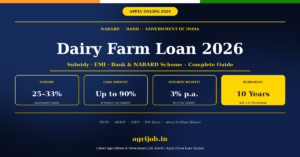

Murrah buffalo price in India 2026 ranges from Rs.90,000 to Rs.2.5 lakh depending on milk yield, age, and pedigree — making it the most commercially valued dairy buffalo breed in the country. If you are a farmer, dairy entrepreneur, or first-time investor looking to start a profitable milk business, this guide covers everything: current price data, milk yield benchmarks, NABARD loan eligibility, and how to apply for a 25% subsidy under DEDS.

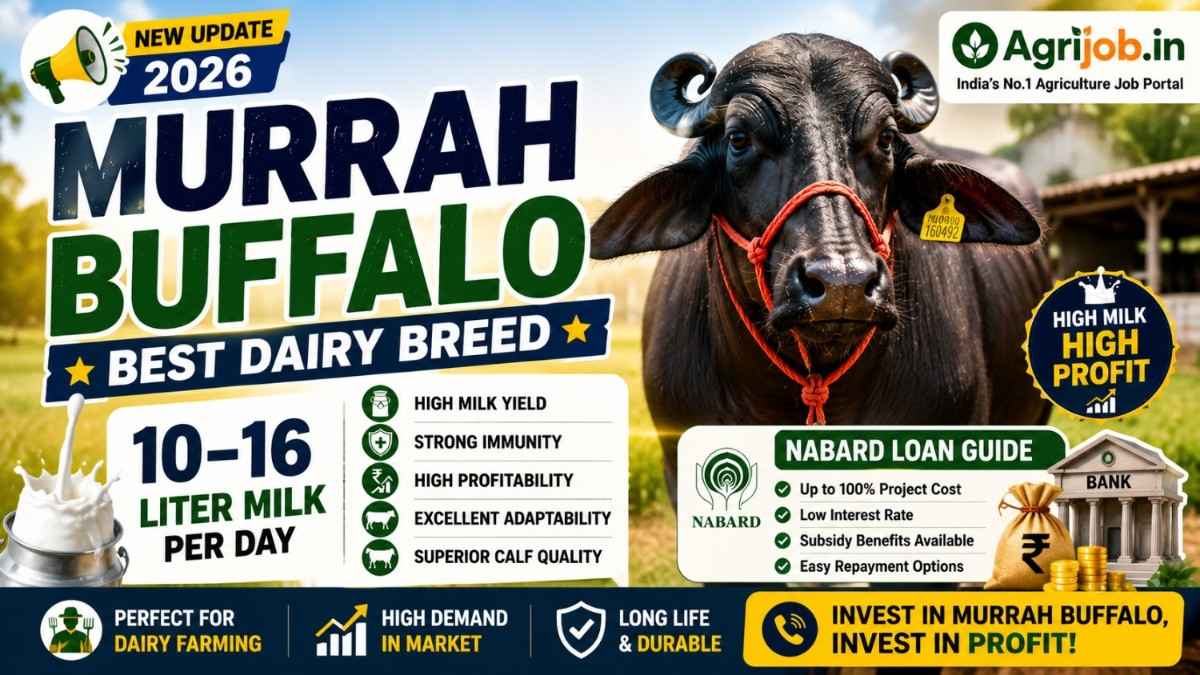
The Murrah buffalo is India’s best dairy buffalo breed, originating from Haryana and Punjab, with a daily milk yield of 10–16 litres and butterfat content of 6.9–8.3%. In 2026, a lactating Murrah buffalo costs Rs.90,000–Rs.2.5 lakh. NABARD DEDS offers a 25% back-ended capital subsidy (33.33% for SC/ST farmers) on dairy units of up to 10 animals.
- Origin: Rohtak, Hisar, Jind, Bhiwani (Haryana) and Patiala, Nabha (Punjab)
- Daily Milk Yield: 10–16 litres/day (peak up to 20+ litres for elite animals)
- Lactation Period: 270–305 days per cycle
- Milk Fat Content: 6.9%–8.3% (vs 3–4% in cow milk)
- Average Lactation Yield: 1,800–2,500 kg per lactation
- Price Range (2026): Rs.60,000–Rs.2.5 lakh (based on yield and age)
- NABARD DEDS Subsidy: 25% (General) / 33.33% (SC/ST/Women)
- AHIDF Interest Subvention: 3% per annum (up to 8 years)
- Body Weight: Female 450–650 kg; Male 550–800 kg
- Productive Lifespan: 12–15 years with peak yield at 4th lactation
- What Is Murrah Buffalo and Why Is It India’s Best Dairy Breed?
- Who Should Invest in Murrah Buffalo Farming?
- Murrah Buffalo Price in India 2026 – Category-Wise Breakdown
- Murrah Buffalo Milk Yield and Daily Income Potential
- NABARD Loan and Subsidy for Murrah Buffalo Dairy Farm 2026
- How to Apply for NABARD DEDS Dairy Farm Loan – Step-by-Step
- Murrah Buffalo vs Jersey Cow – Which Is More Profitable?
- Pros and Cons of Murrah Buffalo Farming
- Important Terms Related to Murrah Buffalo and Dairy Loans
- Important Dates and Official Links
- Conclusion
- Frequently Asked Questions About Murrah Buffalo Price 2026
What Is Murrah Buffalo and Why Is It India’s Best Dairy Breed?
The Murrah buffalo (Bubalus bubalis) is India’s premier milch buffalo breed, recognized globally as the most productive dairy water buffalo. It originates from the districts of Rohtak, Hisar, Jind, and Bhiwani in Haryana, and Patiala and Nabha in Punjab, where decades of selective breeding have produced an animal of exceptional genetic quality.
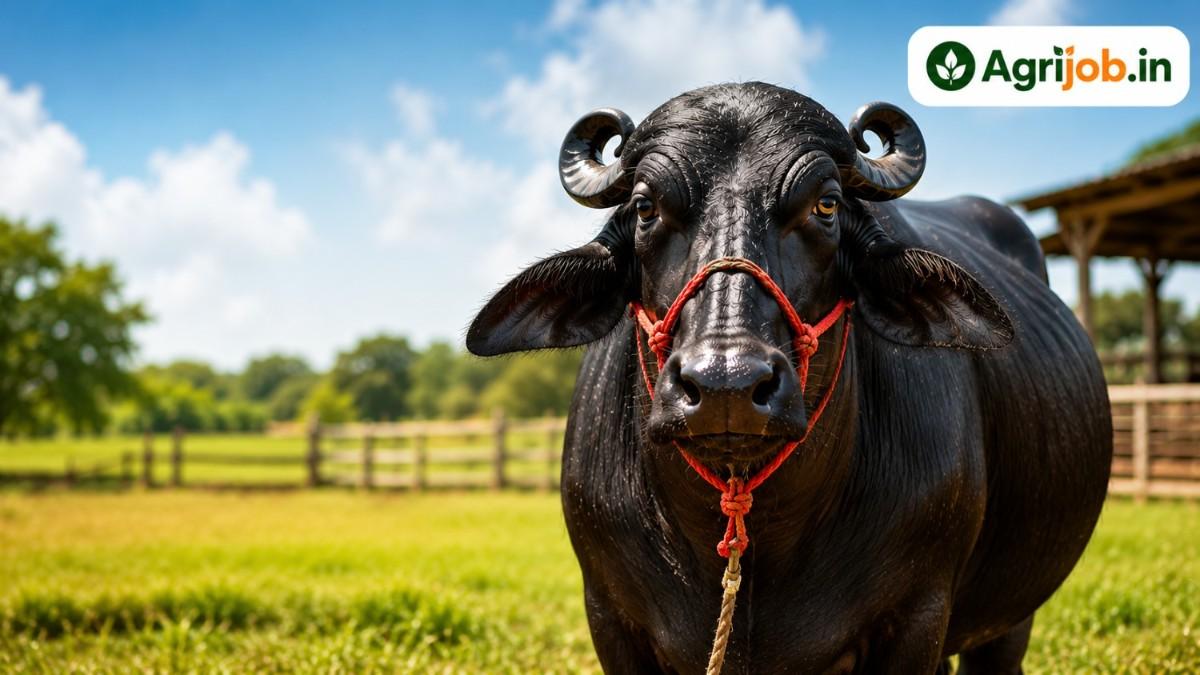
The breed is distinguished by its jet-black coat, tightly coiled spiral horns (curling inward), a well-developed drooping udder with equally spaced teats, and a compact but powerful frame. ICAR-National Dairy Research Institute (NDRI), Karnal research confirms a 305-day lactation yield ranging from 1,365 kg to 2,086 kg, with milk fat averaging 6.84%–8.17% — significantly richer than crossbred cow milk at 3–4% fat.

Murrah buffaloes have been exported to Italy (for mozzarella production), Bulgaria, Egypt, Brazil, and the Philippines precisely because of their unmatched genetic superiority. India contributes approximately 56% of the world’s buffalo milk supply, with the Murrah breed at its core.
| Characteristic | Murrah Buffalo Data |
|---|---|
| Scientific Name | Bubalus bubalis |
| Breeding Tract | Haryana (Rohtak, Hisar, Jind) & Punjab (Patiala) |
| Body Color | Jet black; white markings on tail switch allowed |
| Horn Type | Short, tight, spirally coiling inward (curled) |
| Female Body Weight | 450–650 kg |
| Male Body Weight | 550–800 kg |
| Avg 305-Day Milk Yield | 1,800–2,500 kg |
| Peak Daily Yield | 10–16 litres (record: 31.5 kg in one day) |
| Milk Fat % | 6.84%–8.3% (avg ~7%) |
| Lactation Period | 270–305 days |
| Age at First Calving | 45–50 months |
| Inter-Calving Period | 450–500 days |
| Productive Lifespan | 12–15 years |
Who Should Invest in Murrah Buffalo Farming in 2026?
Murrah buffalo farming suits a wide range of investors and farmers, but returns are best for those who can provide good fodder access and basic veterinary care. Here are the ideal profiles:
- 🌾 Small and marginal farmers with 1–2 acres of land who want a stable monthly milk income alongside crop income
- 🏗️ Landless rural entrepreneurs planning to set up a 5–10 animal dairy unit under NABARD DEDS subsidy
- 🎓 Agriculture graduates and unemployed youth seeking self-employment through the National Livestock Mission (NLM-EDEG) scheme
- 👩🌾 Women farmers and SHG members who qualify for the higher 33.33% NABARD subsidy reserved for SC/ST and women beneficiaries
- 🏦 Dairy cooperative members in Haryana, UP, Bihar, and Punjab looking to upgrade their herd quality
- 💼 Commercial dairy entrepreneurs planning units of 10–50 animals seeking AHIDF funding with 3% interest subvention
- 🧑🌾 Existing cow dairy farmers wanting to shift to buffalo milk for its 30–40% higher market price over cow milk
- 📈 Investors in agri-business evaluating value-added processing of ghee, paneer, and curd from high-fat Murrah milk
Murrah Buffalo Price in India 2026 – Category-Wise Breakdown
Murrah buffalo price in 2026 varies based on milk yield per day, age, pedigree quality, stage of lactation, and the region of purchase. Animals from Haryana’s Rohtak and Hisar districts — the original breeding tracts — generally command a premium over those sourced from other states.
| Category / Animal Type | Price Range (Rs.) | Daily Milk Yield |
|---|---|---|
| Young female, non-lactating (heifer) | Rs.60,000 – Rs.90,000 | Not yet milking |
| First-calf lactating buffalo (8–10 L/day) | Rs.90,000 – Rs.1,10,000 | 8–10 litres/day |
| Standard lactating Murrah (10–12 L/day) | Rs.1,00,000 – Rs.1,30,000 | 10–12 litres/day |
| High-yielding Murrah (12–15 L/day) | Rs.1,30,000 – Rs.1,80,000 | 12–15 litres/day |
| Elite/Champion Murrah (15–20+ L/day) | Rs.1,80,000 – Rs.2,50,000 | 15–20+ litres/day |
| Pregnant Murrah heifer (verified lineage) | Rs.80,000 – Rs.1,20,000 | Milking after calving |
| Murrah bull (breeding quality) | Rs.50,000 – Rs.1,50,000 | N/A |
Price influencing factors: Animals with verified pedigree certificates from ICAR-NDRI Karnal or state animal husbandry departments attract a 15–25% premium. Always cross-check milk records for at least 15 days before purchasing. For NABARD-financed units, the District Level Technical Committee (DLTC) fixes the Scale of Finance (SoF) per animal — this official rate governs how much loan you receive per buffalo.
Always buy from verified Murrah breeders in Haryana’s Rohtak or Hisar districts, or from NDDB-empanelled livestock markets. Ask for the last 3 milk records (morning + evening yield), vaccination certificates for FMD and HS, and a veterinary fitness certificate. A buffalo showing 10 litres consistently in morning milking will comfortably produce 14–16 litres daily — this single check saves you from buying an overpriced animal.
Murrah Buffalo Milk Yield and Daily Income Potential 2026
Murrah buffalo milk yield of 10–16 litres per day is the key driver of profitability. At a conservative market rate of Rs.60 per litre for buffalo milk, a single 15-litre/day Murrah buffalo generates approximately Rs.27,000 per month — enough to service a loan EMI and still return a net profit. A 10-animal dairy unit at 12 litres/animal/day produces Rs.2,16,000 per month in raw milk revenue alone.
| Farm Size | Animals | Daily Milk (Litres) | Monthly Revenue (Rs.60/L) | Annual Revenue |
|---|---|---|---|---|
| Small unit | 2 Murrah | 24 litres | Rs.43,200 | Rs.5.18 lakh |
| Mini unit | 5 Murrah | 60 litres | Rs.1,08,000 | Rs.12.96 lakh |
| Standard unit | 10 Murrah | 120 litres | Rs.2,16,000 | Rs.25.92 lakh |
| Medium unit | 20 Murrah | 240 litres | Rs.4,32,000 | Rs.51.84 lakh |
Value-added product profitability: Murrah milk’s 7% fat makes it ideal for ghee production. From 1 litre of Murrah milk, you recover approximately 45–50 ml of pure ghee (vs 30 ml from cow milk). At Rs.600–Rs.800 per kg of desi ghee, this translates to 2–3x higher value per litre of milk compared to selling raw milk. Paneer yield is similarly superior: 1 litre of Murrah milk yields 180–220 grams of paneer vs 120–150 grams from cow milk.
NABARD Loan and Subsidy for Murrah Buffalo Dairy Farm 2026
NABARD operates two major financing windows for Murrah buffalo dairy farms in 2026. The Dairy Entrepreneurship Development Scheme (DEDS) provides a back-ended capital subsidy, while the Animal Husbandry Infrastructure Development Fund (AHIDF) offers a 3% interest subvention for larger dairy and processing units. Both are channelled through commercial banks, cooperative banks, and Regional Rural Banks (RRBs).
| Scheme Parameter | NABARD DEDS | AHIDF (via DAHD/NABARD) |
|---|---|---|
| Implementing Agency | NABARD (via scheduled banks) | DAHD, Ministry of AH&F (via NABARD) |
| Loan Eligibility | Up to Rs.5 lakh (10-animal unit) | Up to 90% of project cost |
| Capital Subsidy | 25% (General) / 33.33% (SC/ST/Women) | No capital subsidy (interest subvention only) |
| Max Subsidy Ceiling | Rs.1.25 lakh (General) / Rs.1.67 lakh (SC/ST) | N/A |
| Interest Subvention | 2% (under DIDF-linked schemes) | 3% per annum for 8 years |
| Repayment Period | 3–7 years | Up to 10 years (2-year moratorium) |
| Entrepreneur Margin | Minimum 10% of project cost | 10% (Micro/Small), higher for larger units |
| Who Can Apply | Individuals, SHGs, cooperatives, NGOs | MSMEs, FPOs, cooperatives, private companies |
| Best For | 2–10 animal small dairy unit | Dairy processing, feed plant, 10+ animal units |
Important note: The original DEDS scheme was formally discontinued for FY 2020-21 as per NABARD’s official notification. However, its objectives continue through allied dairy-focused initiatives and state-level convergence schemes. Verify the current status with your nearest NABARD District Development Manager (DDM) or scheduled bank agriculture officer before applying — as per NABARD’s official portal at www.nabard.org.
How to Apply for NABARD Dairy Farm Loan for Murrah Buffalo – Step-by-Step
Applying for a NABARD-backed dairy farm loan requires a structured Detailed Project Report (DPR) and coordination between the applicant, their commercial bank, and the state animal husbandry department. Follow these 9 steps to maximize your subsidy eligibility and approval speed.
- Identify the right scheme: Visit your nearest NABARD District Development Manager (DDM) office to confirm which dairy financing scheme is currently active in your state — DEDS successors, NLM-EDEG, or AHIDF.
- Prepare a Detailed Project Report (DPR): Include number of animals (e.g., 10 Murrah buffaloes), unit cost per animal (as per DLTC norms), shed construction cost, equipment, and feed cost for 6 months. State animal husbandry departments assist with DPR preparation at no charge.
- Collect required documents: Aadhaar card, PAN card, 6-month bank statement, land ownership or lease deed, address proof, caste certificate (for SC/ST subsidy), and DPR.
- Approach a scheduled bank, cooperative bank, or RRB: Submit your DPR and application form at the agriculture lending desk. Banks empanelled with NABARD process these applications with priority.
- Bank appraises the project: The bank’s agriculture officer visits your proposed farm site, verifies land, and assesses project viability. This typically takes 15–30 working days post document submission.
- Bank sanction and disbursement: Upon sanction, the loan is disbursed directly to animal suppliers or vendors. For Murrah buffalo purchase, payment goes to the breeder/seller.
- Farm becomes operational: Purchase your Murrah buffaloes from verified breeders, set up shed, install waterers and milking equipment. Maintain milk yield records from Day 1 — these records support subsidy release.
- Bank forwards subsidy claim to NABARD: After satisfactory loan servicing for a defined period, the bank submits a subsidy claim to NABARD. NABARD releases the subsidy into a “Subsidy Reserve Fund Account” held by the bank.
- Subsidy adjusted against loan principal: On satisfactory repayment, the subsidy amount is adjusted against the outstanding principal — effectively reducing your total loan cost by 25% (General) or 33.33% (SC/ST/Women).
For KCC (Kisan Credit Card) limits up to Rs.3 lakh, there is zero processing fee and no separate collateral requirement. SBI’s Pashupalan Loan Yojana covers milch buffalo rearing and offers a 2% interest subvention under allied activities. Begin your application at your nearest SBI Agri branch or via the SBI YONO app. For AHIDF applications, use the Udyami Mitra Portal of SIDBI for DPR technical assistance.
Murrah Buffalo vs Jersey Cow – Which Is More Profitable for Dairy Farm 2026?
The Murrah buffalo vs Jersey cow debate is central to every dairy investment decision in India. Both breeds are high-yielders, but their profitability differs sharply based on milk fat, market price, feed cost, and disease resistance. Here is a direct 9-point comparison.
| Comparison Factor | Murrah Buffalo | Jersey Cow |
|---|---|---|
| Daily Milk Yield | 10–16 litres/day (avg) | 10–15 litres/day (avg) |
| Milk Fat Content | 6.9%–8.3% (avg ~7%) | 4.5%–5.5% |
| Milk Market Price (India) | Rs.55–Rs.75/litre | Rs.40–Rs.55/litre |
| Purchase Price (2026) | Rs.90,000–Rs.2.5 lakh | Rs.40,000–Rs.80,000 |
| Ghee Yield per Litre | 45–50 ml | 25–30 ml |
| Paneer Yield per Litre | 180–220 grams | 120–140 grams |
| Disease Resistance | High (adapted to Indian tropics) | Moderate (susceptible to heat stress) |
| Feed Efficiency | Excellent on coarse roughage | Requires quality feed for high yield |
| Best For | Ghee, paneer, raw milk (premium market) | Raw milk supply to cooperatives |
For dairy farmers targeting the value-added product market (ghee, paneer, premium raw milk), Murrah buffalo delivers 30–40% higher revenue per litre than a Jersey cow despite the higher initial purchase cost. The ROI break-even for a high-yielding Murrah (12+ L/day) at Rs.60/litre is achieved within 18–24 months of purchase. For cooperative milk supply at standard fat rates, Murrah’s superior fat percentage means a higher Fat Corrected Milk (FCM) payment — giving it the edge over Jersey even in commodity markets.
Want the HF cow added to this comparison too? See our full Jersey vs HF vs Murrah 2026 profit comparison guide for daily milk income, feed cost and a 10-row breed comparison table across all three animals.
Pros and Cons of Murrah Buffalo Farming in 2026
Before investing in Murrah buffaloes, weigh the genuine advantages against the operational challenges. Both sides are important for a realistic business plan.
| ✅ Advantages (Pros) | ⚠️ Challenges (Cons) |
|---|---|
| Highest milk fat content (7%) among Indian dairy breeds — premium price guaranteed | Higher initial purchase cost: Rs.90,000–Rs.2.5 lakh per animal |
| Yields 10–16 litres/day — strong revenue from even 2–3 animals | Requires regular green fodder, concentrate feed — daily feed cost Rs.200–Rs.350/animal |
| Thrives in India’s hot, humid tropical climate — minimal cooling costs | Age at first calving is 45–50 months — longer wait for a heifer to start producing |
| Strong disease resistance — fewer veterinary emergencies than exotic breeds | Inter-calving period of 450–500 days — less frequent calving than crossbred cows |
| 25–33% NABARD subsidy available — reduces effective capital outlay significantly | Wallowing (water bathing) requirement — needs water trough or pond access daily |
| High resale value — purebred Murrah retains value even after 3–4 lactations | Regional price variation — animals from outside Haryana breeding tracts may have lower genetic quality |
Important Terms Related to Murrah Buffalo Price and Dairy Loans
Understanding these key terms will help you navigate the NABARD subsidy system, read milk yield data correctly, and negotiate buffalo purchase prices with confidence.
Fat Corrected Milk (FCM): A standardized measure of milk value adjusted for fat content. Cooperatives pay more per litre when fat% is higher — Murrah’s 7% fat gives significantly higher FCM payment than cow milk at 4% fat.
Lactation Yield: Total milk produced during one lactation period (270–305 days for Murrah). A 2,000 kg lactation yield at Rs.60/litre generates Rs.1.2 lakh in one cycle per animal.
Scale of Finance (SoF): The cost per animal or unit component fixed by the District Level Technical Committee (DLTC). This is the official figure banks use to calculate your loan eligibility — not the market purchase price.
Back-Ended Subsidy: The NABARD DEDS subsidy is not given upfront. You pay interest on the full loan amount first; after satisfactory repayment, the subsidy is adjusted against principal — this is called “back-ended.”
Dry Period: The phase between two lactations when the buffalo is not milking (typically 120–250 days for Murrah). Planning cash flow for the dry period is critical in buffalo dairy business planning.
AHIDF (Animal Husbandry Infrastructure Development Fund): A Rs.29,110 crore central scheme under Atma Nirbhar Bharat providing 3% interest subvention on loans up to 90% of project cost for dairy processing, animal feed, and breed improvement units.
DEDS (Dairy Entrepreneurship Development Scheme): NABARD scheme offering 25% capital subsidy (33.33% for SC/ST) for establishing small dairy units of up to 10 milch animals — Murrah buffaloes qualify under “graded buffalo” category.
KCC (Kisan Credit Card) for Animal Husbandry: Short-term credit facility extended to livestock farmers with zero processing fee for limits up to Rs.3 lakh and a 2% interest subvention for timely repayment.
DPR (Detailed Project Report): The mandatory business plan document required for NABARD or AHIDF loan applications. It covers animal cost, infrastructure, feed plan, and projected revenue — prepared with help from the State Animal Husbandry Department at no charge.
NLM-EDEG (National Livestock Mission – Entrepreneurship Development & Employment Generation): A 50% capital subsidy scheme for SC/ST and women entrepreneurs starting small dairy, goat, or poultry units — an important alternate route when DEDS is not active.
Important Dates, Official Links, and Resources
| Resource | Link / Details |
|---|---|
| NABARD Official Portal | www.nabard.org |
| DAHD AHIDF Scheme Details | dahd.gov.in/schemes/programmes/ahidf |
| ICAR-NDRI Murrah Research | www.ndri.res.in (Karnal, Haryana) |
| Dairy Knowledge Portal (ICAR) | www.dairyknowledge.in |
| Udyami Mitra Portal (SIDBI) for DPR Help | www.udyamimitra.in |
| AHIDF Application Portal (DAHD) | dahd.gov.in |
| Agrijob.in – SBI Dairy Farm Loan Guide | SBI Dairy Farm Loan 2026 |
| Agrijob.in – Jersey vs HF vs Murrah Profit Comparison | Read comparison guide |
Conclusion – Is Murrah Buffalo the Right Investment for Your Dairy Farm in 2026?
Murrah buffalo price in 2026 reflects genuine investment value: at Rs.90,000–Rs.2.5 lakh per animal, you are acquiring India’s most productive dairy breed with a 10–16 litre daily milk yield, 7% butterfat content, and a 12–15 year productive lifespan. When financed through NABARD DEDS or AHIDF with a 25–33% subsidy and 3% interest subvention, the effective capital requirement drops significantly — making this one of the most subsidy-supported livestock investments available to Indian farmers today.
Your next step: Visit your nearest NABARD DDM office or scheduled bank agriculture desk, request the current DEDS/AHIDF status in your state, and begin DPR preparation with the State Animal Husbandry Department. Bookmark this page — we update it every time official scheme notifications change.
- Murrah buffalo price 2026 ranges from Rs.90,000 (standard lactating) to Rs.2.5 lakh (elite 15–20 L/day animals)
- Daily milk yield of 10–16 litres with 7% fat makes Murrah the most profitable dairy buffalo breed in India
- NABARD DEDS offers 25% capital subsidy (33.33% for SC/ST/Women) on dairy units of up to 10 animals
- AHIDF provides 3% interest subvention per annum for up to 8 years on dairy processing and infrastructure loans
- A 10-Murrah dairy unit at Rs.60/litre milk generates Rs.2.16 lakh/month — ROI break-even within 18–24 months
- Apply via your nearest scheduled bank with a DPR — NABARD DDM and State AH Dept provide free guidance
Frequently Asked Questions About Murrah Buffalo Price 2026
What is the price of a Murrah buffalo in India in 2026?
Murrah buffalo price in India in 2026 ranges from Rs.60,000 for a non-lactating young heifer to Rs.2.5 lakh for an elite animal producing 15–20 litres of milk per day. A standard lactating Murrah buffalo giving 10–12 litres per day costs between Rs.1 lakh and Rs.1.3 lakh. Prices are highest for animals sourced from Haryana’s Rohtak and Hisar districts — the original Murrah breeding tracts.
How many litres of milk does a Murrah buffalo give per day?
A Murrah buffalo typically gives 10–16 litres of milk per day under standard farm conditions. Elite animals produce 18–20 litres, and the recorded peak for a champion Murrah at the All India Milk Yield Competition was 31.5 kg in a single day. Average lactation yield over a 270–305 day cycle is 1,800–2,500 kg. Milk production peaks at the 4th lactation and gradually declines after that.
What is the fat content of Murrah buffalo milk?
Murrah buffalo milk fat content ranges from 6.84% to 8.3%, with an average of approximately 7%. This is nearly double the fat content of crossbred cow milk (3–4%) and significantly higher than Jersey cow milk (4.5–5.5%). The high fat content makes Murrah milk ideal for producing ghee, paneer, mozzarella cheese, and traditional dairy sweets — all of which command premium market prices.
How much NABARD subsidy is available for Murrah buffalo dairy farming?
Under NABARD’s Dairy Entrepreneurship Development Scheme (DEDS), the capital subsidy is 25% of project cost for General category farmers and 33.33% for SC/ST farmers and women, with a maximum ceiling of Rs.1.25 lakh for a 10-animal unit (Rs.1.67 lakh for SC/ST). Separately, the AHIDF scheme provides a 3% interest subvention per annum for up to 8 years on dairy processing and infrastructure loans. Verify current scheme status at nabard.org before applying.
Which bank gives dairy farm loan for Murrah buffalo in India?
All major scheduled banks in India — including SBI, Punjab National Bank, Bank of Baroda, Canara Bank — as well as Regional Rural Banks (RRBs) and cooperative banks provide NABARD-backed dairy farm loans for Murrah buffalo units. SBI’s Pashupalan Loan Yojana covers milch buffalo rearing with 2% interest subvention for timely repayment. KCC (Kisan Credit Card) covers limits up to Rs.3 lakh with zero processing fee and no separate collateral.
How do I start a Murrah buffalo dairy farm with NABARD loan?
To start a Murrah buffalo dairy farm with NABARD loan, first prepare a Detailed Project Report (DPR) with help from your State Animal Husbandry Department. Submit the DPR to a scheduled bank or RRB. The bank appraises the project and sanctions the loan within 15–30 working days of complete document submission. The subsidy under DEDS is back-ended — it is released by NABARD after the bank confirms satisfactory loan servicing, and is then adjusted against your outstanding principal.
Is Murrah buffalo farming profitable in India in 2026?
Yes, Murrah buffalo farming is profitable in India in 2026. A single Murrah buffalo giving 12 litres/day at Rs.60/litre earns Rs.21,600/month in raw milk revenue. After deducting feed cost of Rs.250/day (Rs.7,500/month) and veterinary costs, the net monthly income per animal is approximately Rs.13,000–Rs.15,000. A 10-animal unit generates Rs.1.3–Rs.1.5 lakh net per month — sufficient to repay a NABARD loan EMI and still earn a healthy surplus.
What is the difference between Murrah buffalo and Jaffarabadi buffalo?
Murrah buffalo originating from Haryana and Punjab is prized for the highest daily milk yield (10–16 L/day) and is best for milk and ghee production across India’s tropical climate. Jaffarabadi buffalo from Gujarat’s Gir region is a heavier breed (bulls up to 1,200 kg) known for higher single-lactation volume (1,800–2,700 kg) but slightly lower daily yield. Murrah is more widely available across India and better supported by government breeding programs and NABARD schemes.
Where can I buy a genuine Murrah buffalo in India?
Genuine Murrah buffaloes with verified pedigrees can be purchased from: livestock markets in Rohtak, Hisar, and Karnal (Haryana); ICAR-National Dairy Research Institute (NDRI) Karnal dispersal sales; state government livestock fairs in Punjab and Haryana; and NDDB-empanelled registered breeders. Always insist on a veterinary fitness certificate, vaccination record (FMD, HS), and at least 15 days of milk yield records before purchase to ensure you are buying genuine high-yielding stock.
What documents are required for NABARD dairy farm loan application?
Documents required for a NABARD dairy farm loan include: Aadhaar card and PAN card, address proof (electricity bill or ration card), 6-month bank account statement, land ownership or lease deed for the farm site, Detailed Project Report (DPR) prepared with help from the State Animal Husbandry Department, caste certificate (for SC/ST to claim 33.33% subsidy), and passport-size photographs. The bank’s agriculture officer may request additional documents based on loan size and local norms.