

FPO formation 2026 is one of the most powerful steps a group of small farmers in India can take to transform their agricultural livelihood. Under the Government of India’s Central Sector Scheme, just 10 farmers can legally form a Farmer Producer Organisation (FPO) and collectively access up to Rs.18 lakh management grant, Rs.15 lakh equity grant, and Rs.2 crore credit guarantee — without repaying the grants. This complete guide covers everything: what an FPO is, eligibility criteria, step-by-step registration process, grant amounts, comparison with cooperatives, who should apply, and how to unlock funding through SFAC and NABARD in 2026.

- What is FPO Formation 2026?
- FPO Grant Money – Rs.18 Lakh + Rs.15 Lakh + Rs.2 Crore
- FPO Formation Eligibility 2026
- How to Register an FPO Step by Step
- Documents Required for FPO Registration
- Who Should Form an FPO in 2026?
- FPO vs Cooperative Society – Full Comparison
- Implementing Agencies – SFAC, NABARD, NCDC
- High-Value Agriculture Business Terms You Must Know
- Frequently Asked Questions on FPO Formation 2026
What is FPO Formation 2026? A Complete Overview
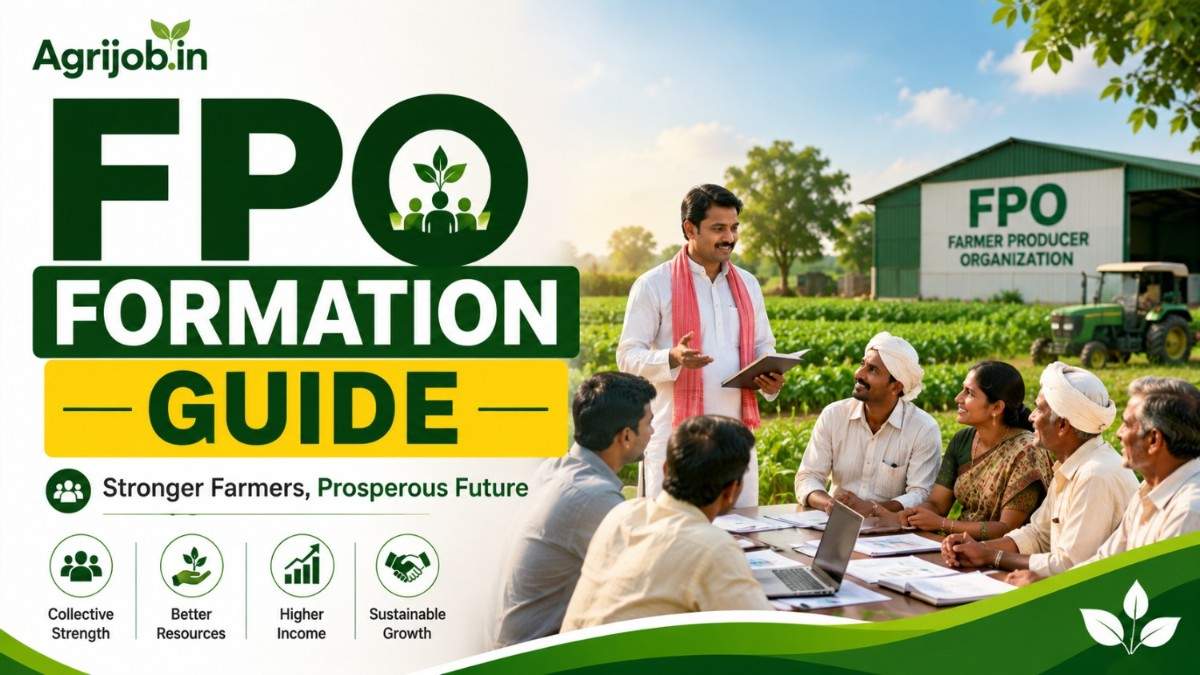
An FPO (Farmer Producer Organisation) is a legally registered collective of farmers that operates like a company — but for farmers, by farmers. In India, FPOs are registered under the Companies Act 2013 (as Producer Companies) or under respective state Cooperative Societies Acts. The concept merges the cooperative principle of mutual benefit with the corporate structure of a private limited company, giving farmers formal bargaining power, legal identity, and access to institutional finance.
India’s agriculture is dominated by small and marginal farmers — nearly 87% own less than 2 hectares. These farmers individually lack the volume to negotiate better input prices or secure direct market access. An FPO solves this by pooling land, produce, and purchasing power — enabling bulk buying of seeds, fertilisers, and equipment at wholesale rates while collectively selling produce directly to large buyers, eliminating costly middlemen.

The Government of India launched the Central Sector Scheme for Formation and Promotion of 10,000 FPOs in 2020 with a budget of Rs.6,865 crore, implemented by SFAC, NABARD, NCDC, NAFED, and 5 other agencies. As of early 2026, India has successfully formed its 10,000th FPO — but the scheme’s financial incentives continue for newly forming groups seeking to register under implementing agencies.
FPO Grant Money 2026 – Rs.18 Lakh + Rs.15 Lakh Equity + Rs.2 Crore Credit
The financial package available to a newly formed FPO in 2026 is arguably the most generous collective farming incentive in Indian policy history. Here is a complete breakdown of every rupee your FPO can access:
| Scheme Name | Formation & Promotion of 10,000 FPOs |
| Ministry | Ministry of Agriculture & Farmers Welfare, Govt. of India |
| Management Grant | Up to Rs.18 lakh per FPO (released over 3 years) |
| Equity Grant | Up to Rs.15 lakh per FPO (Rs.2,000 per member matching) |
| Credit Guarantee | Up to Rs.2 crore per FPO (collateral-free loan) |
| Minimum Members (Plain Area) | 300 farmers (10 minimum for Producer Company) |
| Minimum Members (NE/Hilly) | 100 farmers |
| Handholding Support | 5 years by CBBO (Cluster Based Business Organisation) |
| Legal Structure | Producer Company (Companies Act 2013) or Cooperative |
| Registration Portal | mca.gov.in / sfacindia.com |
Here is a detailed table of all 3 financial benefits available to your FPO:
| Grant/Facility | Amount | Repayable? | Disbursement Period | Equivalent Annual Support |
|---|---|---|---|---|
| Management Cost Grant | Rs.18,00,000 | No (Free Grant) | 3 Years | Rs.6,00,000/year |
| Equity Matching Grant | Up to Rs.15,00,000 | No (Free Grant) | One-time | Rs.2,000 per member max |
| Credit Guarantee Facility | Up to Rs.2,00,00,000 | Yes (Loan) | Up to 5 years tenure | Collateral-free access |
| Total Non-Repayable Support | Up to Rs.33,00,000 | No | 3–5 Years | Rs.6–11 lakh/year |
The equity grant works as a matching grant — if your 500-member FPO collects Rs.1,000 each as share capital (total Rs.5 lakh), the government matches it with another Rs.5 lakh, effectively doubling your FPO’s equity base without any repayment. The credit guarantee covers up to 85% of any sanctioned loan, enabling FPOs to access working capital from scheduled banks, RRBs, and NABARD-affiliated institutions even without land or asset collateral.
FPO Formation Eligibility 2026 – Who Qualifies?
Understanding the eligibility conditions for FPO formation 2026 is critical before beginning registration. The criteria are defined at two levels — for FPO registration as a legal entity and for accessing the government grant package.
| Eligibility Parameter | Requirement |
|---|---|
| Minimum Members (Producer Company) | 10 farmers (directors/shareholders) |
| Minimum Members (Cooperative) | 500 farmers |
| Recommended Members for Full Grant | 300 (plain areas), 100 (NE & hilly regions) |
| Farmer Category (for Equity Grant) | Minimum 50% small, marginal, or landless tenant farmers |
| Women Farmer Preference | Yes — women farmer shareholders given preference |
| Max Member Shareholding | Not more than 10% of total equity per member |
| Legal Status | Registered under Companies Act 2013 or State Co-op Act |
| Sector | Agriculture, horticulture, dairy, fisheries, allied activities |
| CBBO Linkage | Must be supported by an empanelled CBBO under IAs |
| SC/ST/OBC Relaxation | Priority allocation of blocks for SC/ST-dominated areas |
There is no application fee for FPO registration under the Companies Act 2013 — standard MCA portal fees apply (varies by authorised share capital, typically Rs.500–Rs.2,000 for small producer companies). FPOs in the North East, hilly areas, and tribal regions receive additional relaxations in membership requirements and are prioritised for block allocation by implementing agencies.
How to Register an FPO in 2026 – Step-by-Step Process
The FPO registration process in India is a structured multi-step procedure involving coordination between farmers, a CBBO, an implementing agency, and the Ministry of Corporate Affairs (MCA). Follow these steps carefully for successful FPO formation 2026:
- 🌾 Form a Farmer Group: Identify at least 10 farmers (ideally 300+) from the same district or produce cluster. Ensure the group is engaged in similar agricultural activities — e.g., wheat, rice, vegetables, dairy, or horticulture. Elect an interim management committee.
- 📋 Contact a CBBO or Implementing Agency: Approach an empanelled Cluster Based Business Organisation (CBBO) in your district. CBBOs are engaged by SFAC, NABARD, or NCDC and provide free end-to-end handholding for FPO formation. Visit sfacindia.com to find the agency active in your district.
- 📝 Draft Memorandum & Articles of Association (MoA & AoA): Prepare the founding documents defining the FPO’s name, objects, governance structure, share capital, and profit-sharing rules. The company name must end with the words “Producer Company”. Verify uniqueness on the MCA portal.
- 🖊️ Obtain Digital Signature Certificates (DSC) & Director Identification Numbers (DIN): All proposed directors (minimum 5, maximum 15 for Producer Companies) must obtain DSC and DIN. Apply on the MCA21 portal.
- 💻 File SPICe+ Form on MCA Portal: Submit the Company Incorporation form (SPICe+) at mca.gov.in along with MoA, AoA, KYC documents, and share capital details. The Registrar of Companies (ROC) processes the application and issues the Certificate of Incorporation.
- 🏦 Open FPO Bank Account: After receiving the Certificate of Incorporation, open a dedicated FPO current account with a scheduled commercial bank, RRB, or cooperative bank. This is required for grant disbursement.
- 🌐 Register on SFAC/PM-KISAN FPO Portal: Visit pmkisan.gov.in/FPOApplication, select “New Registration”, and submit all FPO details. This step links your FPO to the implementing agency’s monitoring system and triggers the grant process.
- 📊 Apply for Management Grant through IA: Submit an application to your implementing agency (SFAC/NABARD/NCDC) through the assigned CBBO with Certificate of Incorporation, bank account details, member list, and business plan. Grant disbursement begins after verification.
- 💰 Apply for Equity Grant: Once members have contributed share capital, apply for the matching equity grant through the IA. The grant is processed after verification of member-wise equity contribution and ROC filings.
- 📈 Start Operations & Access Credit: Use the management grant to hire a CEO/manager, procure inputs, and establish market linkages. Apply for working capital loans using the credit guarantee facility through eligible lending institutions.
Documents Required for FPO Formation 2026
Keeping the correct documents ready before starting FPO registration will speed up the process significantly. Here is the complete checklist:
- 📄 Identity Proof: Aadhaar card, PAN card of all founding farmer members and proposed directors
- 🏡 Address Proof: Voter ID, electricity bill, or ration card of all directors
- 🌾 Farming Proof: Land ownership records (Khasra/Khatauni), tenancy agreement, or Kisan Credit Card copies
- 🖊️ Director Documents: DSC (Digital Signature Certificate) and DIN (Director Identification Number) of minimum 5 directors
- 📋 MoA and AoA: Drafted Memorandum and Articles of Association in prescribed format
- 📸 Passport-size Photographs: Recent photographs of all directors/founding members
- 🏦 Registered Office Proof: NOC or rental agreement for the FPO’s registered office address
- 💳 Bank Account Details: Cancelled cheque or bank passbook copy (after incorporation)
- 📊 Business Plan: Brief 2–3 page agribusiness plan showing target produce, market linkage plan, and projected turnover (required for grant application)
Who Should Form an FPO in 2026?
FPO formation 2026 is ideal for a wide range of farmer profiles across India. If you fall into any of the categories below, forming or joining an FPO can dramatically improve your income and market access:
- 🌾 Small & Marginal Farmers (less than 2 hectares): FPO formation gives you collective bargaining power and bulk-purchase access to seeds, fertilisers, and pesticides at 15–20% lower cost than retail rates.
- 👩🌾 Women Farmers & Self-Help Group Members: The government gives preference to FPOs with women as shareholders. Women-led FPOs can access additional support under NABARD’s women empowerment programmes.
- 🏔️ Farmers in NE States & Hilly Regions: Relaxed membership requirement of just 100 farmers (versus 300 in plains) and priority block allocation make FPO formation especially attractive in Assam, Himachal Pradesh, Uttarakhand, and North East states.
- 🥦 Horticulture & Vegetable Growers: Perishable crops need fast market access. An FPO can negotiate direct contracts with aggregators, food processing units, and export companies — eliminating APMC mandi dependence.
- 🐄 Dairy, Fishery & Allied Sector Farmers: FPOs are not limited to crop farming. Dairy farmers, fishermen, poultry farmers, and beekeepers can form FPOs to collectively access cold storage, processing units, and export certifications.
- 🎓 Agricultural Graduates & Young Agri-Entrepreneurs: Educated youth in rural areas can serve as FPO CEOs or managers — a growing professional opportunity in the agri-business sector with salaries funded by the Rs.18 lakh management grant.
- 🏘️ Farmers in RKVY-RAFTAAR & AIF Beneficiary Districts: Districts under the Agriculture Infrastructure Fund (AIF) and RKVY-RAFTAAR have synergistic benefits — FPO members can access additional Rs.10 crore AIF loans for agri-infrastructure projects.
- 👨💼 NGOs & Farmer Organisations Seeking Formalisation: Existing informal farmer groups, FIGs (Farmer Interest Groups), or NGO-supported collectives can convert to FPO status to access formal institutional credit and government grants.
FPO vs Cooperative Society 2026 – Which is Better?
Both FPOs and cooperative societies are farmer collectives, but they differ significantly in governance, financial flexibility, and access to government grants. Here is a detailed comparison:
| Parameter | FPO (Producer Company) | Cooperative Society |
|---|---|---|
| Governing Law | Companies Act 2013 (Part IXA) | State Cooperative Societies Act |
| Minimum Members | 10 farmers | 500 farmers (typical) |
| Profit Sharing | Dividends allowed (flexible) | Fixed formula, restricted |
| Government Grant | Rs.18 lakh + Rs.15 lakh equity | Limited, state-specific |
| Credit Guarantee | Rs.2 crore (SFAC facility) | State bank-dependent |
| Political Interference | Minimal (corporate governance) | High (state oversight) |
| Tax Status | Taxed like Pvt Ltd (agri income exempt) | Partial tax exemptions |
| Management | Professional CEO possible | Usually member-managed |
| Best For | Commercial agribusiness, export, processing | Credit & input supply |
FPO Implementing Agencies – SFAC, NABARD, NCDC in 2026
The Government of India has empanelled 9 Implementing Agencies (IAs) to facilitate FPO formation across India. Each agency operates through district-level CBBOs that provide end-to-end registration and management support. Knowing which agency operates in your state helps you reach the right contact faster:
| Implementing Agency | Focus Area / States | Website |
|---|---|---|
| SFAC (Small Farmers Agribusiness Consortium) | Pan-India nodal agency | sfacindia.com |
| NABARD | Rural & tribal districts, NE India | nabard.org |
| NCDC (National Cooperative Development Corp.) | Cooperative-sector FPOs, PACS blocks | ncdc.in |
| NAFED | Oilseeds, pulses, spices clusters | nafed.in |
| NERAMAC | North East India exclusively | neramac.in |
| TN-SFAC | Tamil Nadu | tnsfac.gov.in |
| SFACH (Haryana) | Haryana | State Agriculture Dept. |
| WDD Karnataka | Karnataka watershed districts | State Agriculture Dept. |
| FDRVC (MoRD) | Rural value chain districts | Ministry of Rural Dev. |
For grant-related queries and to locate your district CBBO, farmers can contact the SFAC FPO Scheme official portal, the NABARD official website, or the Ministry of Agriculture & Farmers Welfare website. Registration on the PM-KISAN FPO Application portal at pmkisan.gov.in/FPOApplication is mandatory after incorporation.
High-Value Agriculture Business Terms Every FPO Member Must Know
Understanding these key agribusiness and government scheme terms will help your FPO navigate funding, compliance, and market opportunities more effectively in 2026:
- 🌾 FPO (Farmer Producer Organisation): A legally registered collective of farmers operating as a business entity under the Companies Act 2013 or Cooperative Societies Act, eligible for Rs.18 lakh government grant.
- 🏢 Producer Company: The recommended legal structure for FPO formation under Part IXA of the Companies Act 2013, offering corporate governance, dividends, and grant eligibility to as few as 10 farmer members.
- 🤝 CBBO (Cluster Based Business Organisation): Professional agencies empanelled by implementing agencies to provide 5-year end-to-end support to new FPOs — covering registration, business planning, market linkage, and grant applications.
- 💰 SFAC Equity Grant: A non-repayable matching grant of up to Rs.2,000 per farmer member (max Rs.15 lakh) provided by SFAC to double the equity base of newly formed FPOs.
- 🏦 NABARD PRODUCE Fund: NABARD’s dedicated fund for promoting new FPOs — Producers’ Organisation Development and Upliftment Corpus — providing initial working capital and training support worth Rs.25,000 per FPO per year.
- 📊 e-NAM (Electronic National Agriculture Market): The government’s online agriculture marketplace where FPOs can directly list produce for sale to buyers across India, improving price discovery. Annual FPO-linked sales on e-NAM cross Rs.5,000 crore.
- 🏗️ AIF (Agriculture Infrastructure Fund): A Rs.1 lakh crore central scheme providing 3% interest subvention on loans up to Rs.2 crore per project for agri-infrastructure including cold storage, processing units, and warehouses — accessible to FPOs.
- 🌱 RKVY-RAFTAAR: Rashtriya Krishi Vikas Yojana with a focus on agri-entrepreneurship, offering grants up to Rs.25 lakh to agri-startups and FPOs for innovative agriculture projects through state agriculture departments.
- 📜 ROC (Registrar of Companies) Compliance: Annual filings mandatory for FPOs registered as Producer Companies — Form AOC-4 (financial statements) and MGT-7A (annual return) — non-compliance leads to grant suspension.
- 🔖 One District One Product (ODOP): Government programme clustering FPOs around district-specific crops or products (e.g., Makhana in Darbhanga, Litchi in Muzaffarpur, Mango in Malda) to improve collective brand identity and export potential.
Frequently Asked Questions on FPO Formation 2026
What is FPO formation and why is it important in 2026?
FPO formation 2026 refers to the process of registering a Farmer Producer Organisation as a legal company under the Companies Act 2013 or Cooperative Societies Act. It is particularly important in 2026 because the Government of India provides up to Rs.18 lakh management grant, Rs.15 lakh equity grant, and Rs.2 crore credit guarantee to every newly formed FPO — making it one of the most financially powerful collective farming schemes available to small and marginal farmers across India.
How many farmers are needed to form an FPO?
A minimum of 10 farmers are legally required to register a Producer Company under the Companies Act 2013. However, under the Government’s 10,000 FPO scheme, a minimum of 300 members in plain areas and 100 members in hilly/NE regions is recommended to qualify for the full Rs.18 lakh grant package. For cooperative-type FPOs, 500 members may be required.
What is the Rs.18 lakh FPO grant and how is it disbursed?
The Rs.18 lakh management grant is provided by the Government of India to cover the operational management cost of a newly formed FPO for its first 3 years. It is disbursed in tranches through the implementing agency (SFAC, NABARD, or NCDC) to the FPO’s registered bank account. This grant is non-repayable and can be used to hire a professional CEO, lease office space, and cover initial administrative expenses.
Who is eligible for the equity grant under the FPO scheme?
To receive the equity matching grant of up to Rs.15 lakh, an FPO must be legally registered, have at least 50% small, marginal, or landless tenant farmers as shareholders, have raised share capital from members as per its Articles of Association, and ensure no single member holds more than 10% of total equity. Women farmer shareholders are given preference and may improve grant eligibility scoring by implementing agencies.
What is the credit guarantee facility available for FPOs?
Under the FPO scheme, registered FPOs can access a credit guarantee of up to Rs.2 crore per FPO from eligible lending institutions. SFAC’s credit guarantee fund covers 75–85% of the sanctioned loan amount, enabling FPOs to secure collateral-free working capital loans from scheduled banks, Regional Rural Banks (RRBs), and cooperative banks for procurement, storage, processing, and market operations.
How do I register an FPO online in India in 2026?
To register an FPO online in India, first connect with a CBBO in your district through the SFAC portal, draft your MoA/AoA, obtain DSC and DIN for all directors, and file the SPICe+ form on the MCA portal at mca.gov.in. After receiving the Certificate of Incorporation, register your FPO on pmkisan.gov.in/FPOApplication and apply for grants through your implementing agency. The entire process typically takes 30–60 days with CBBO support.
Can an FPO get income tax exemption in India?
Agricultural income earned by FPO members is exempt from income tax under the Income Tax Act. However, Producer Companies as corporate entities are taxed similarly to private limited companies on non-agricultural income. The 2018 Union Budget introduced a 5-year income tax exemption for FPOs with annual turnover below Rs.100 crore, providing significant relief during the FPO’s formative years. NABARD and SFAC-supported FPOs may also benefit from interest subvention on scheme-linked loans.
What is the difference between FPO and cooperative society?
An FPO registered as a Producer Company under the Companies Act 2013 offers corporate governance, flexible profit sharing, professional management, and access to the central government’s Rs.18 lakh grant package — benefits unavailable to most cooperative societies. Cooperatives are governed by state acts and subject to greater political interference. For commercially oriented agribusiness, export linkage, and processing operations, FPOs are significantly better suited than traditional cooperative societies in India’s current policy environment.
For more information about agriculture business opportunities in India, also read our guides on NABARD Recruitment 2026 and Agriculture Startup Funding in India.
This guide is regularly reviewed and updated for accuracy. Bookmark this page for the latest FPO formation notifications, grant updates, and policy changes in 2026.
Last Updated: June 2026