
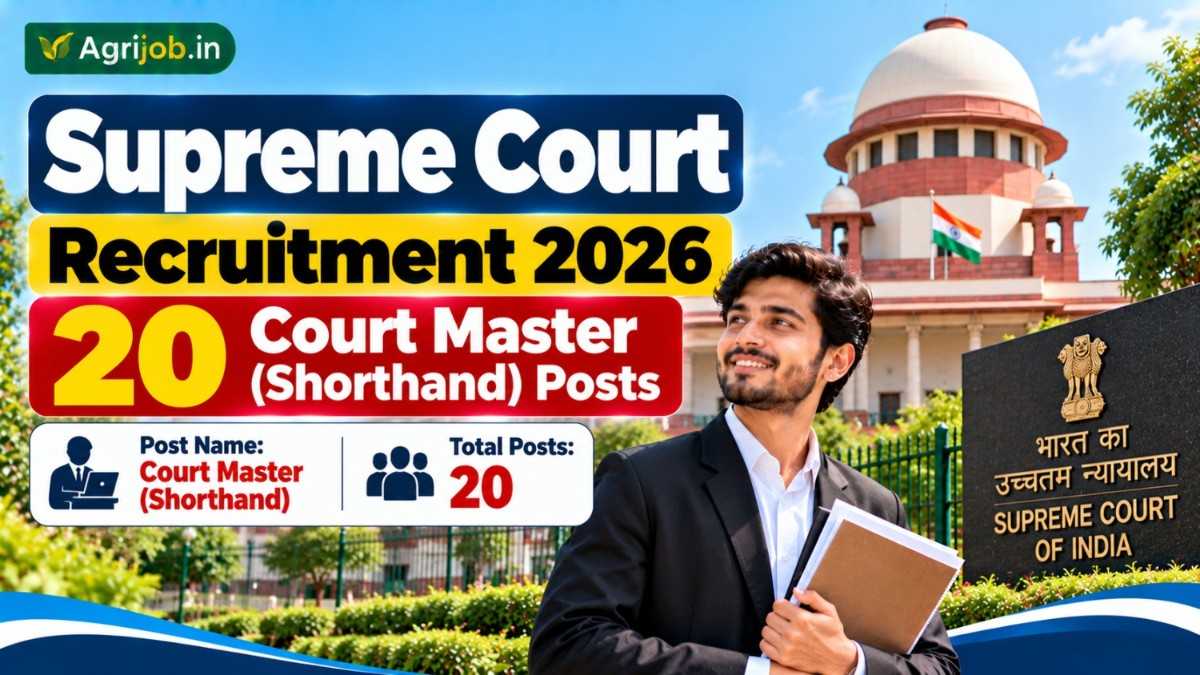
Supreme Court recruitment 2026 has opened a golden opportunity for experienced stenography professionals across India. The Registry of the Supreme Court of India has officially invited online applications for 20 tentative vacancies of Court Master (Shorthand) — a prestigious Group-A Gazetted post in Level 11 of the Pay Matrix, carrying an initial basic pay of Rs.67,700 per month (up to Rs.2,08,700). This guide is for government employees aged 30–45 years working as Private Secretary, Senior PA, PA, or Senior Stenographer who want to move into the apex court of India. This article covers eligibility, salary breakdown, selection process, exam pattern, important dates, and how to apply step by step.

The Supreme Court of India is recruiting 20 Court Master (Shorthand) posts in 2026 via direct recruitment. The salary ranges from Rs.67,700 to Rs.2,08,700 per month (Pay Level 11). Applications are accepted online at sci.gov.in from 25 October to 15 November 2026.
- Recruiting Body: Supreme Court of India, Registry
- Post Name: Court Master (Shorthand) — Group-A Gazetted
- Total Vacancies: 20 (tentative)
- Pay Scale: Rs.67,700 – Rs.2,08,700/month (Pay Level 11)
- Application Mode: Online only — sci.gov.in
- Application Start: 25 October 2026
- Application Deadline: 15 November 2026 (11:55 PM)
- Exam Date (Objective Test): 7 December 2026 (tentative)
- Age Limit: 30–45 years (as on 1 October 2026)
- Experience Required: Minimum 5 years as PS / Senior PA / PA / Senior Stenographer
- Application Fee: Rs.1,500 (General) | Rs.750 (SC/ST/OBC/Ex-SM)
- Notification No.: F.6/11/CM(S)/2026-SC(RC) dated 15 October 2026
📋 Table of Contents
- What is Court Master (Shorthand) in Supreme Court?
- Who Should Apply for Supreme Court Court Master 2026?
- Salary, Pay Scale & Allowances
- Eligibility Criteria & Qualifications
- Selection Process & Exam Pattern
- How to Apply Online – Step-by-Step
- Supreme Court vs High Court Jobs – Comparison
- Pros and Cons of Court Master Post
- Important Terms Related to This Recruitment
- Important Dates & Timeline
- Important Links
- Conclusion
- Key Takeaways
- Frequently Asked Questions
What is Court Master (Shorthand) in the Supreme Court of India?
Court Master (Shorthand) is a Group-A Gazetted post in the Registry of the Supreme Court of India, placed in Level 11 of the 7th Pay Commission Pay Matrix. A Court Master assists the Hon’ble Judges of the Supreme Court by recording proceedings at high speed using shorthand, transcribing dictations, preparing court orders, and managing classified judicial correspondence. This is one of the most respected and secure government positions in India’s judicial hierarchy, directly attached to the highest court of the Republic.
The post carries gazetted status, meaning the incumbent holds an official position recognized by the Government of India — equivalent to senior officers in central ministries. Court Masters work directly in the chambers and courtrooms of Supreme Court judges, making this role both highly responsible and professionally rewarding. The 2026 recruitment cycle opens 20 tentative vacancies through direct recruitment for eligible Indian citizens.

| Parameter | Details |
|---|---|
| Post Type | Group-A Gazetted |
| Pay Level | Level 11 (7th CPC Pay Matrix) |
| Initial Basic Pay | Rs.67,700/month |
| Maximum Pay | Rs.2,08,700/month |
| Job Location | Supreme Court of India, New Delhi |
| Nature of Work | Shorthand transcription, court proceedings, judicial correspondence |
| Working Hours | Odd hours and holidays (as required by court) |
Who Should Apply for Supreme Court Court Master Recruitment 2026?
This recruitment is specifically designed for experienced stenography and secretarial professionals already serving in government. Here are the exact profiles that should apply:
- 🏛️ Central Government Private Secretaries with 5+ years of regular service who have cleared departmental shorthand tests
- 📝 Senior Personal Assistants (PA/Senior PA) serving in ministries, departments, or public sector undertakings with shorthand speed of 120 wpm
- ⚖️ Senior Stenographers in High Courts or Tribunals seeking a prestigious move to the apex court
- 💼 PSU Employees in secretarial cadre — those in statutory bodies, SEBI, NABARD, RBI, etc. who meet the experience and skill criteria
- 🎓 Law graduates with shorthand expertise — LL.B. holders working as PA/Steno who want a judicial career with gazetted status
- 🏅 Ex-Servicemen with shorthand background and relevant administrative experience who avail of age relaxation benefits
- 👨💼 Departmental candidates of the Supreme Court Registry — they have NO upper age limit under this notification
- 📅 SC/ST/OBC professionals in eligible government service who want to avail reservation and fee concession benefits
Supreme Court Court Master Salary 2026 – Pay Scale & Allowances
The Court Master (Shorthand) post is placed in Level 11 of the 7th CPC Pay Matrix, with an initial basic pay of Rs.67,700 per month. Along with Dearness Allowance (DA), House Rent Allowance (HRA) for Delhi, Transport Allowance, and other admissible perks, the estimated gross in-hand salary is significantly higher than the basic pay alone.
| Pay Component | Amount (Approximate) |
|---|---|
| Basic Pay (initial) | Rs.67,700/month |
| Dearness Allowance (DA @55%) | Rs.37,235/month |
| House Rent Allowance (HRA Delhi @27%) | Rs.18,279/month |
| Transport Allowance (Level 11) | Rs.7,200 + DA/month |
| Estimated Gross Monthly CTC | Rs.1,30,000+ /month |
| Maximum Pay in Scale | Rs.2,08,700/month |
| Annual CTC (approx.) | Rs.15,60,000 – Rs.25,00,000+ |
Court Masters also receive benefits such as Leave Travel Concession (LTC), medical facilities under CGHS, government accommodation (subject to availability), and pension under NPS. The gazetted status entitles them to additional privileges including attestation rights and protocol benefits in government dealings.
Eligibility Criteria for Supreme Court Court Master 2026
Before applying, ensure you meet all of the following mandatory eligibility conditions as on 1st October 2026:
Educational Qualification
- Bachelor’s degree from a recognized University in India (any discipline)
- Proficiency in Shorthand at a speed of 120 words per minute (wpm) in English
- Computer typing speed of 40 words per minute (wpm) on computer
Experience Requirement
- Minimum 5 years of regular service in the cadre of: Private Secretary / Senior PA / PA / Senior Stenographer
- Service must be in Government / Public Sector Undertakings / Statutory Bodies
Age Limit (as on 1 October 2026)
| Category | Minimum Age | Maximum Age |
|---|---|---|
| General / UR | 30 years | 45 years |
| SC / ST | 30 years | 50 years (+5 yrs) |
| OBC (Non-Creamy Layer) | 30 years | 48 years (+3 yrs) |
| Ex-Servicemen | 30 years | As per GoI rules |
| Dependants of Freedom Fighters | 30 years | 50 years (max +5 yrs) |
| Departmental Candidates (SCI Registry) | 30 years | No upper age limit |
Application Fee
| Category | Application Fee |
|---|---|
| General / Unreserved | Rs.1,500 + Bank Charges |
| SC / ST / OBC (NCL) / Ex-Servicemen | Rs.750 + Bank Charges |
| Payment Mode | Online only via UCO Bank payment gateway |
Supreme Court Court Master 2026 – Selection Process & Exam Pattern
The selection for Court Master (Shorthand) 2026 involves a 4-stage examination process. All stages are mandatory. Candidates must clear each stage to advance to the next.
| Stage | Test | Duration | Max Marks | Qualifying Marks |
|---|---|---|---|---|
| Stage 1 | Objective Type Test (100 MCQs) | 1.5 hours | 100 | 50 |
| Stage 2 | Shorthand (English) Test at 120 wpm | 7 min dictation + 45 min transcription | 100 | 50 |
| Stage 3 | Typing Speed Test on Computer (40 wpm) | 10 minutes | 20 | 10 |
| Stage 4 | Interview / Viva Voce | As scheduled | 30 | 15 |
Objective Type Test Syllabus (Stage 1)
- General English: 25 questions
- General Knowledge: 25 questions
- Judiciary provisions in Constitution of India: 25 questions
- Supreme Court Rules, 2013: 15 questions
- Computer Operation Knowledge: 10 questions
- No negative marking in Objective Type Test
Shorthand Test Grading System (Stage 2)
| Mistake Level | Score Awarded |
|---|---|
| Without mistake (0%) | 100% of marks |
| Up to 1% mistakes | 90% of marks |
| Up to 2% mistakes | 80% of marks |
| Up to 3% mistakes | 70% of marks |
| Up to 4% mistakes | 60% of marks |
| Up to 5% mistakes (max allowed) | 50% of marks |
How to Apply Online for Supreme Court Court Master Recruitment 2026
Applications are accepted online only through the official Supreme Court website. Follow these steps carefully:
- Visit the official website: Go to www.sci.gov.in and click on the Recruitment section link for Court Master (Shorthand) 2026.
- Register yourself: Create a new account using your valid personal email ID and active mobile number — both must remain active throughout the recruitment process.
- Fill the Application Form: Enter your personal details, educational qualifications, experience details, and category (General / SC / ST / OBC / Ex-SM) accurately. Once submitted, no changes can be made.
- Upload documents: Scan and upload your recent photograph, signature, Class X certificate, Class XII certificate, graduation certificate, experience certificate, and caste/community certificate (for reserved category candidates).
- Pay the application fee: Complete online payment of Rs.1,500 (General) or Rs.750 (SC/ST/OBC/Ex-SM) via UCO Bank payment gateway. Fee is non-refundable under all circumstances.
- Submit the application: Review all details carefully and give the required Undertaking confirming accuracy of information. Submit the final form.
- Download printout: Take a printout of the filled application form for your records. Do NOT send the printout to the Registry by post.
- Retain Application Number: Save your application number carefully — it is required to download the Admit Card for tests from the SCI website.
If you are currently employed in a Central/State Government Department, Nationalized Bank, PSU, or Statutory Body — you must submit a No Objection Certificate (NOC) from your employer at the time of document verification. Failure to produce NOC will lead to cancellation of candidature. If you get employed after submitting the application, immediately inform the Registry at recruitment.cell@sci.nic.in.
Supreme Court Job vs High Court Job – Which is Better?
Many eligible candidates working in High Courts often wonder whether to pursue a Supreme Court posting or continue in their state judicial service. Here is a detailed comparison:
| Comparison Factor | Supreme Court of India | High Court (State) |
|---|---|---|
| Status | Group-A Gazetted (Central) | Varies by state (mostly Group B/C) |
| Pay Level | Level 11 (Rs.67,700 initial) | Level 6–8 typically |
| Location | New Delhi only | State capitals / benches |
| Prestige | Apex court of India | State apex court |
| Career Growth | Limited but prestigious | Moderate with lateral moves |
| Working Hours | Including odd hours/holidays | Standard government hours |
| Shorthand Speed Required | 120 wpm (strict) | 80–100 wpm (varies) |
| Competition Level | National — very high | State-level — moderate |
| Allowances | Full Central Govt (Delhi HRA) | State allowances (lower HRA) |
| Best For | Senior professionals seeking prestige | Local/regional career stability |
If you have 5+ years of experience and possess a shorthand speed of 120 wpm, applying for the Supreme Court Court Master post is strongly recommended. The pay package (Rs.1.3 lakh+ per month all-inclusive), gazetted status, and the prestige of working in India’s apex judicial institution far outweigh High Court equivalents. The competition is stiff, but for prepared candidates, this is a once-in-a-career opportunity.
Pros and Cons of Supreme Court Court Master Post
Advantages
- ✅ Group-A Gazetted status — one of the most prestigious designations in central government service
- ✅ Salary of Rs.67,700–Rs.2,08,700 with full 7th CPC allowances including Delhi HRA (27%) and DA (55%+)
- ✅ Job security — permanent government post with pension under NPS and CGHS medical benefits
- ✅ Direct access to apex judiciary — unique professional exposure working alongside Supreme Court judges
- ✅ Career in New Delhi — India’s capital with best infrastructure, facilities, and social opportunities
Disadvantages
- ❌ Odd hours and holiday duty mandatory — candidates must submit an undertaking to work even on holidays and at odd hours
- ❌ Highly competitive selection — national-level exam with thousands of applicants for just 20 posts; shorthand speed of 120 wpm is a strict barrier
- ❌ No relocation option — post is fixed at New Delhi; candidates from other states must relocate
Important Terms Related to Supreme Court Court Master Recruitment 2026
Understanding these key terms will help you navigate the application, exam, and selection process effectively:
- Gazetted Post: A government post recognized by the Government of India Gazette, allowing the officer to attest documents officially. Court Master (Shorthand) is a Group-A Gazetted post — one of the highest levels in central government.
- Pay Level 11 (7th CPC): Corresponds to the pre-revised PB-3 grade in the 6th CPC. The pay range is Rs.67,700–Rs.2,08,700 per month. Most equivalent to Deputy Secretary level in ministries.
- Shorthand Speed (120 wpm): The minimum dictation speed a candidate must accurately transcribe. At 120 wpm, a 7-minute passage = 840 words. Maximum 5% errors (42 words) are allowed.
- OBC Non-Creamy Layer: OBC candidates whose family income is below Rs.8 lakh per year as per the latest GoI guidelines are eligible for reservation and fee concession.
- NOC (No Objection Certificate): A certificate from your current employer stating they have no objection to your applying/joining a new post. Mandatory for government employees at document verification stage.
- Direct Recruitment: This 2026 notification is for direct recruitment — not deputation or internal promotion. Eligible citizens apply directly through sci.gov.in.
- Empanelment: Selected candidates are placed on a panel in order of merit. Being on the panel does not guarantee appointment — actual vacancy must exist when the panel is utilized.
- UCO Bank Payment Gateway: The official online payment channel for the application fee. No other mode of fee payment (demand draft, cash, etc.) is accepted.
Supreme Court Court Master Recruitment 2026 – Important Dates & Timeline
| Event | Date |
|---|---|
| Official Notification Released | 15 October 2026 |
| Online Application Starts | 25 October 2026 |
| Last Date to Apply Online | 15 November 2026 (11:55 PM) |
| Objective Type Test (tentative) | 7 December 2026 |
| Answer Key Upload (tentative) | 8 December 2026 |
| Objection Window (tentative) | 8–9 December 2026 (till 11:55 PM) |
| Shorthand & Typing Test Date | To be notified on sci.gov.in |
| Interview Date | To be notified on sci.gov.in |
Important Links – Supreme Court Court Master Recruitment 2026
| Link Name | URL |
|---|---|
| Official Supreme Court Website | www.sci.gov.in |
| Apply Online (from 25 Oct 2026) | sci.gov.in – Recruitment Section |
| 📥 Download Official Notification (Telegram) | t.me/agrijob_in/1128 |
| Agrijob Telegram Channel | t.me/agrijob_in |
| Official SCI Recruitment Email | recruitment.cell@sci.nic.in |
Conclusion
Supreme Court recruitment 2026 for 20 Court Master (Shorthand) posts is a rare, high-value opportunity for experienced stenography professionals in government service. With a starting salary of Rs.67,700 per month (gross in-hand exceeding Rs.1.3 lakh), a prestigious Group-A Gazetted designation, and the unmatched prestige of working in India’s apex court, this vacancy stands apart from any other judicial recruitment in the country. Eligible candidates — aged 30–45 with 5+ years of PS/PA/Steno experience — must apply online at sci.gov.in between 25 October and 15 November 2026. Bookmark this page for the latest updates, and join our Telegram channel for instant notifications on admit cards, results, and exam schedules.
- Supreme Court of India is recruiting 20 Court Master (Shorthand) posts via direct recruitment in 2026 — a Group-A Gazetted position.
- Salary ranges from Rs.67,700 to Rs.2,08,700/month (Pay Level 11); gross in-hand exceeds Rs.1.3 lakh per month with all allowances.
- Candidates must have 5+ years of experience as PS/Senior PA/PA/Senior Stenographer in Government/PSU/Statutory Body.
- 4-stage selection: Objective Test (100 MCQs) → Shorthand Test (120 wpm) → Typing Test (40 wpm) → Interview — all mandatory.
- Application fee is Rs.1,500 for General and Rs.750 for SC/ST/OBC/Ex-SM; apply online at sci.gov.in from 25 Oct–15 Nov 2026.
- Download the official notification from our Telegram channel and apply before the deadline.
Frequently Asked Questions About Supreme Court Recruitment 2026 Court Master
What is the last date to apply for Supreme Court Court Master 2026?
The last date to submit the online application for Supreme Court Court Master (Shorthand) 2026 is 15 November 2026 at 11:55 PM. The application window opens on 25 October 2026. Applications must be submitted at sci.gov.in — no offline or postal applications are accepted. Unsigned or incomplete applications will be summarily rejected.
What is the salary of Court Master (Shorthand) in Supreme Court?
The Court Master (Shorthand) post carries a pay of Rs.67,700 to Rs.2,08,700 per month in Pay Level 11 of the 7th CPC Pay Matrix. With Dearness Allowance (DA), House Rent Allowance (HRA for Delhi), and Transport Allowance added, the approximate gross monthly salary is Rs.1,30,000 or more. This is one of the highest-paying gazetted posts in the judicial services of India.
What is the age limit for Supreme Court Court Master recruitment 2026?
As on 1 October 2026, candidates must be between 30 and 45 years of age for the General category. SC/ST candidates get a relaxation of 5 years (up to 50 years) and OBC (NCL) candidates get 3 years of relaxation (up to 48 years). Departmental candidates of the Supreme Court Registry have no upper age limit. Dependants of freedom fighters get a maximum additional relaxation of 5 years.
What is the exam pattern for Supreme Court Court Master 2026?
The selection consists of 4 stages: Stage 1 is an Objective Type Test of 100 MCQs (covering General English, GK, Constitution/Judiciary, Supreme Court Rules 2013, Computer Knowledge) with a 90-minute duration and a minimum qualifying score of 50. Stage 2 is a Shorthand (English) Test at 120 wpm (7-minute dictation, 45-minute transcription). Stage 3 is a Typing Speed Test at 40 wpm for 10 minutes. Stage 4 is an Interview carrying 30 marks with a qualifying threshold of 15 marks. There is no negative marking in the Objective Type Test.
How many vacancies are there in Supreme Court Court Master recruitment 2026?
The Supreme Court of India has notified 20 tentative vacancies for the post of Court Master (Shorthand) under Notification No. F.6/11/CM(S)/2026-SC(RC) dated 15 October 2026. The word “tentative” means the actual number of vacancies may increase or decrease based on administrative requirements. The Registry reserves the right to change, restrict, cancel, or modify the selection process at any time.
What documents are required to apply for Supreme Court Court Master 2026?
Candidates must upload scanned copies of the following documents during online application: (1) recent passport-size photograph, (2) signature, (3) Class X certificate (for name and date of birth verification), (4) Class XII certificate, (5) graduation/degree certificate, (6) experience certificate proving 5+ years of regular service, and (7) valid caste/community certificate and non-creamy layer certificate (for reserved category applicants). At the document verification stage, government employees must additionally produce a No Objection Certificate (NOC) from their employer.
What is the application fee for Supreme Court Court Master 2026?
The application fee is Rs.1,500 for General/Unreserved category candidates and Rs.750 for SC/ST/OBC (Non-Creamy Layer)/Ex-Servicemen candidates, plus applicable bank charges. Payment must be made online through the UCO Bank payment gateway provided on the application portal. Fee paid under any other mode will not be accepted. The fee is non-refundable under all circumstances, including withdrawal of application or non-selection.
Where will the Supreme Court Court Master exam be conducted?
The Objective Type Test will be held across 69 cities in India including major centres in Bihar (Patna, Muzaffarpur), UP (Lucknow, Varanasi, Kanpur), Maharashtra (Mumbai, Pune, Nagpur), and others as listed in Annexure-A of the notification. Candidates can select cities in order of preference. However, the Shorthand Test, Typing Test, and Interview will be conducted exclusively in Delhi/NCR. No TA/DA is payable for appearing in any test or interview.
Is there reservation in Supreme Court Court Master recruitment 2026?
Yes. Reservation is available for Scheduled Castes (SC), Scheduled Tribes (ST), and Other Backward Classes (OBC — Non-Creamy Layer) in accordance with Rule 4A of the Supreme Court Officers and Servants (Conditions of Service and Conduct) Rules, 1961, and Government of India orders in force. Reserved category candidates qualifying on the basis of relaxed standards will be considered only against reserved vacancies — not unreserved vacancies. Valid caste and NCL certificates are mandatory.
Last Updated: October 2026 | Source: Supreme Court of India Official Notification F.6/11/CM(S)/2026-SC(RC) | This article is reviewed regularly for accuracy. Bookmark this page for the latest updates on admit card, exam date, results, and final merit list.
Disclaimer: This article is for informational purposes only. All details are sourced from the official Supreme Court of India notification dated 15 October 2026. Candidates are advised to verify all information directly from the official website sci.gov.in before submitting their application. Agrijob.in is not responsible for any discrepancies arising from changes made by the recruiting authority after the publication of this article.