

Best Bank for Dairy Farm Loan 2026
Looking for the best bank for dairy farm loan in 2026? Here’s something most comparison articles won’t tell you upfront: banks don’t publish a single fixed interest rate or processing fee for dairy loans — these depend on your credit profile, loan amount, and branch, and they move with RBI’s policy rate. What we can compare honestly is each bank’s actual scheme name, eligibility rules, loan structure, and collateral norms — which is what actually determines whether you’ll get approved smoothly. This guide compares SBI, Bank of Baroda, Punjab National Bank (PNB), Union Bank, Canara Bank, and Central Bank of India’s dairy financing schemes, plus regional rural and cooperative banks, so you can pick the right one for your situation.

Banks Covered: SBI, Bank of Baroda, PNB, Union Bank, Canara Bank, Central Bank of India
Common Collateral-Free Limit: Up to Rs.1.6 lakh (varies slightly by bank)
Typical Repayment Period: 3-7 years (up to 84 months at some banks)
Interest Rates: Linked to MCLR/repo-linked rate + spread — NOT a fixed published number
Subsidy Linkage: Most schemes can be combined with NABARD/NPDD/state subsidy where eligible
📋 Table of Contents
- 1. Why We’re Not Giving You a Fixed Interest Rate Table
- 2. SBI Dairy Loan Schemes
- 3. Bank of Baroda Dairy Loan Scheme
- 4. PNB Dairy/Pashupalan Loan Scheme
- 5. Union Bank Dairy Sector Financing
- 6. Canara Bank Dairy Loans
- 7. Central Bank of India Cent Dairy Scheme
- 8. Regional Rural Banks & Cooperative Banks
- 9. Scheme Comparison Table: Structure, Not Rates
- 10. How to Choose the Right Bank Based on Your State
- 11. Common Documents Required
- 12. Who Should Apply for a Dairy Farm Loan?
- 13. Important Loan Terms You Must Know
- 14. Frequently Asked Questions
Why We’re Not Giving You a Fixed Interest Rate Table
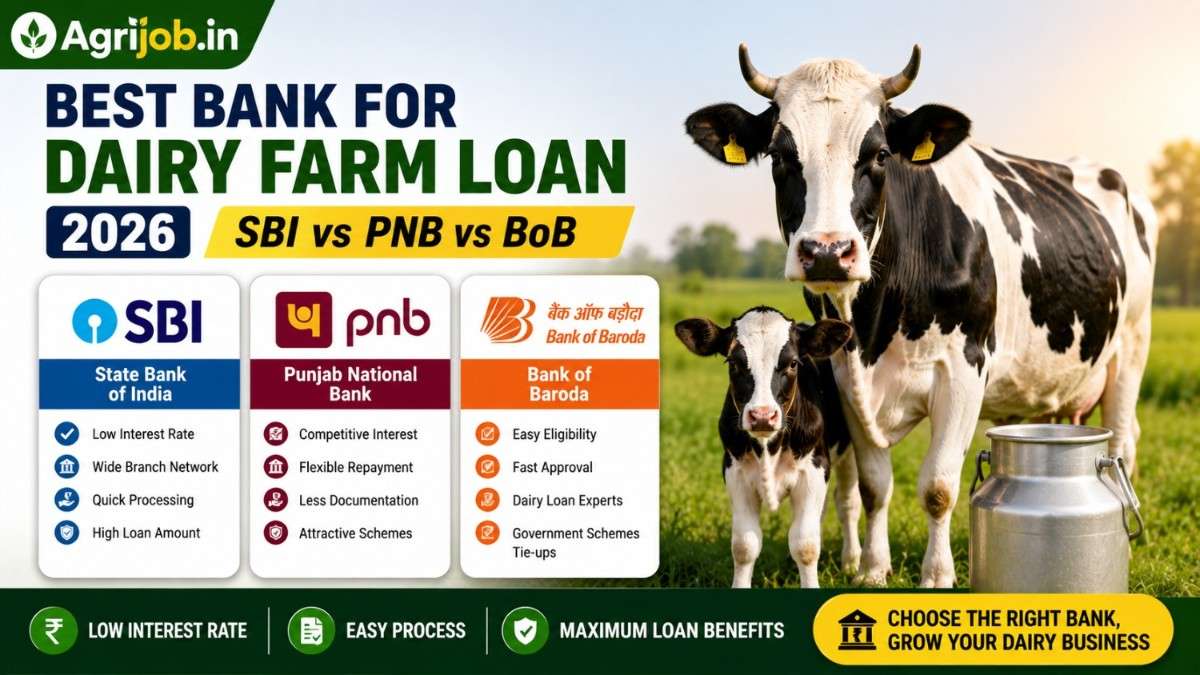
Most articles comparing dairy farm loans show a neat table with exact interest rates and processing fees for each bank. We checked each bank’s official scheme pages directly, and the honest answer is: none of these banks publish a fixed dairy-loan interest rate. Rates are quoted as the bank’s benchmark lending rate (MCLR or repo-linked rate) plus a spread that depends on your loan amount, tenure, credit history, and collateral. A rate that was accurate last quarter may already be outdated today because these benchmark rates move with RBI’s monetary policy.

What we’ve done instead is compare what’s actually verifiable and stable: scheme names, eligible animal/unit sizes, collateral thresholds, repayment tenure, and eligibility criteria. For your exact rate and processing fee, always ask your specific branch — this is the only way to get an accurate, current quote.
SBI Dairy Loan Schemes
SBI runs two distinct dairy-related schemes under its Agri & Rural banking vertical:
- 🥛 SBI Scheme for Dairy Societies: Finances infrastructure for registered “A” Grade Milk Societies — milk house/society office construction, automatic milk collection systems, transport vehicles, and bulk chilling units. Requires the society to supply at least 1,000 litres/day to the milk union and have a clean 2-year audit record.
- 🐄 SBI Dairy Plus Agriculture Loan Scheme: For individual milk-producing members of AMUL Pattern Societies, covering dairy shed construction, purchase of quality milking animals, milking machines, and chaff cutters, with a maximum term loan limit of Rs.5 lakh.
- 📄 Margin requirement: No margin for loans up to Rs.50,000; 10% margin for loans between Rs.50,000 and Rs.5 lakh
Bank of Baroda Dairy Loan Scheme
Bank of Baroda’s primary dairy product is the Scheme for Financing Mini Dairy Units:
- 🐃 Unit size: 2 to 10 milch animals (cows/buffaloes)
- 💰 Cost basis: Per-animal cost as provided by the respective regional office of NABARD for the concerned state
- 👥 Eligible applicants: Individuals, farmers, members of NGOs/SHGs/JLGs
- 🔒 Collateral: Not required for loans below Rs.1.6 lakh; equitable/registered mortgage or third-party guarantee required above that
- 💳 Related option: Baroda Animal Husbandry and Fisheries KCC for working capital needs (Rs.3,000 to Rs.10 lakh range)
PNB Dairy/Pashupalan Loan Scheme
Punjab National Bank’s relevant product is its Scheme for Financing Dairy Development Programmes, covering a range of dairy development activities under its broader agriculture credit umbrella. PNB also extends its Kisan Credit Card for working capital needs related to dairy animals, alongside its Krishi Bhu Swami Yojana for land-backed agricultural credit. PNB does not publish a single named “Pashupalan Yojana” loan product separate from its dairy development financing scheme — applicants should confirm the exact current scheme name with their branch, as naming can vary regionally.
Union Bank Dairy Sector Financing
Union Bank of India offers the Finance to Dairy Sector scheme, covering mini dairy units and commercial dairy units:
- 🔒 Collateral up to Rs.2 lakh: Hypothecation of assets created from bank finance only
- 🏦 Collateral above Rs.2 lakh: Hypothecation plus mortgage of land (value at least equal to loan amount) and/or third-party guarantee
- 📅 Repayment period: Flexible terms up to 84 months (7 years)
- 💳 Prepayment: Allowed, though a prepayment penalty may apply depending on the loan agreement
Canara Bank Dairy Loans
Canara Bank’s Dairy Loans scheme has some of the more detailed operational eligibility criteria among the banks compared here, reflecting a focus on dairy-readiness rather than just creditworthiness:
- 🏠 Shed requirement: Farmer must have adequate cattle shed/arrangement for existing and proposed animals
- 🌱 Fodder requirement: Must be cultivating green fodder or have a definite supply arrangement
- 💧 Water and veterinary access: Drinking water and veterinary/artificial insemination facilities must be readily available in the area
- 🐄 Animal quality: Heifer must be of good breed and good health
- 📈 Marketing: Assured marketing facilities for milk produced must be in place
- 👥 Eligible applicants: Farmers, individual entrepreneurs, NGOs, companies, SHGs, dairy cooperative societies, milk unions, milk federations
Central Bank of India Cent Dairy Scheme
Central Bank of India offers the Cent Dairy Scheme for establishing dairy units, open to farmers, individuals, groups of farmers, companies, societies, firms, and NGOs. As with other banks, exact margin requirements and loan-amount-based interest slabs should be confirmed directly with the branch, since published consumer finance sites referencing this scheme often carry outdated rate information from previous years.
Regional Rural Banks & Cooperative Banks
Don’t overlook Regional Rural Banks (RRBs) and State Cooperative Banks — both are explicitly listed as eligible refinancing institutions under NABARD-linked dairy schemes. Banks like J&K Grameen Bank and various state-level Grameena Vikas Banks run their own dairy loan products tailored to local landholding patterns and milk production track records. For small and marginal farmers, an RRB or cooperative bank branch in your own block or tehsil often has:
- 🏘️ Closer familiarity with local land records, reducing verification back-and-forth
- 👥 Existing relationships with the local dairy cooperative or milk union, which can speed up project report approval
- 📍 Easier physical verification logistics since the branch is geographically closer to your farm
Scheme Comparison Table: Structure, Not Rates
| Bank | Scheme Name | Unit Size / Focus | Collateral-Free Limit |
|---|---|---|---|
| SBI | Dairy Plus / Dairy Societies Scheme | Individual milch animals + society infrastructure | Up to Rs.50,000 (no margin) |
| Bank of Baroda | Scheme for Financing Mini Dairy Units | 2-10 milch animals | Up to Rs.1.6 lakh |
| PNB | Scheme for Financing Dairy Development Programmes | General dairy development activities | Confirm with branch |
| Union Bank | Finance to Dairy Sector | Mini & commercial dairy units | Up to Rs.2 lakh (asset hypothecation only) |
| Canara Bank | Dairy Loans | Milch cattle purchase, sheds, equipment | Confirm with branch |
| Central Bank of India | Cent Dairy Scheme | General dairy unit establishment | Confirm with branch |
How to Choose the Right Bank Based on Your State
- 🗺️ Check your state’s lead bank: Most districts in India have a designated “lead bank” responsible for priority sector lending coordination — this bank often has the most dairy-lending experience in your area
- 🥛 Check your milk union/cooperative’s existing tie-ups: If you’re part of a milk union or cooperative society, ask which bank they already work with — this dramatically speeds up project verification
- 🏘️ For small units (2-10 animals): Bank of Baroda’s Mini Dairy scheme or Union Bank’s Finance to Dairy Sector are well-suited given their clearer collateral-free thresholds
- 🏭 For commercial-scale or society-linked units: SBI’s Dairy Societies scheme or AHIDF-linked financing through any bank may be more appropriate
- 📍 For remote or rural locations: A Regional Rural Bank or cooperative bank branch may offer faster turnaround due to local familiarity, even if a larger public bank has a marginally different rate structure
Common Documents Required
- 🪪 Identity proof: Aadhaar, PAN, Voter ID, or Driving License
- 🏠 Address proof: Utility bill, ration card, or Aadhaar
- 📜 Land documents: Ownership or lease papers for the shed location
- 📋 Project report: Covering animal count, shed cost, equipment, and total project cost
- 🏦 Bank account details: For loan disbursal and any linked subsidy
- 📄 Caste certificate (where applicable): If applying under a subsidy-linked category benefit
Who Should Apply for a Dairy Farm Loan?
- 🧑🌾 Individual farmers wanting to set up a 2-10 animal dairy unit
- 🥛 Members of registered milk societies eligible for SBI’s society-linked scheme
- 👥 Self-Help Groups and Joint Liability Groups pooling resources for a shared dairy unit
- 🏭 Larger entrepreneurs considering AHIDF-linked financing through any participating bank
- 🏘️ Farmers in remote districts better served by a local RRB or cooperative bank branch
Important Loan Terms You Must Know
- 📌 MCLR (Marginal Cost of Funds based Lending Rate): The benchmark rate banks use as a base before adding their spread for agricultural loans
- 📌 EBLR (External Benchmark Lending Rate): A repo-rate-linked benchmark increasingly used instead of or alongside MCLR
- 📌 Margin money: The borrower’s own contribution toward the project cost, on top of the loan amount
- 📌 Hypothecation: A security arrangement where assets purchased with the loan (animals, equipment) are pledged without physical transfer of possession
- 📌 Lead bank: The bank designated to coordinate priority sector lending in a given district
- 📌 Priority sector lending: RBI-mandated lending categories, including agriculture and allied activities like dairy, that banks must meet minimum lending targets for
- 📌 Moratorium period: A grace period before EMI repayment begins, common in dairy and livestock loans to allow the unit to become productive first
Frequently Asked Questions
Which bank is best for a dairy farm loan in 2026?
There is no single “best” bank for every farmer, since interest rates are not fixed and depend on your credit profile, loan amount, and branch. SBI, Bank of Baroda, PNB, Union Bank, Canara Bank, and Central Bank of India all run dedicated dairy financing schemes. The better question is which bank has a strong rural branch network and dairy-lending track record in your specific district, since processing speed depends heavily on local branch familiarity with dairy projects.
What is Bank of Baroda’s dairy loan scheme called?
Bank of Baroda’s main dairy lending product is the Scheme for Financing Mini Dairy Units, for 2 to 10 milch animals, with per-animal cost based on NABARD’s regional rates for the concerned state. Bank of Baroda also offers a separate KCC for Animal Husbandry and Fisheries for working capital needs.
What is Central Bank of India’s dairy loan scheme called?
Central Bank of India offers the Cent Dairy Scheme, available to farmers, individuals, groups, companies, societies, firms, and NGOs for establishing dairy units.
Does PNB have a dedicated pashupalan or dairy loan scheme?
Yes. PNB runs a Scheme for Financing Dairy Development Programmes, alongside its broader Kisan Credit Card facility, which also covers working capital needs for dairy animals.
What documents are needed for a dairy farm loan from any bank?
Most banks require identity proof, address proof, land ownership or lease documents, a project report, and KYC documents. Collateral requirements typically apply above a threshold commonly around Rs.1.6 lakh, below which many banks offer collateral-free financing.
Do regional rural banks and cooperative banks also give dairy loans?
Yes. RRBs and State Cooperative Banks are eligible refinancing institutions for NABARD-linked dairy schemes and often have stronger last-mile reach in rural areas. For small farmers in remote areas, a local gramin/cooperative bank branch may process applications faster due to closer familiarity with local land records.
How long does dairy loan approval usually take?
Processing time isn’t publicly standardised and depends on document completeness, physical verification scheduling, and whether a government subsidy component is linked. Approval involving subsidy verification or NABARD/state department routing tends to take longer than a pure bank loan without subsidy linkage.
📚 Official Sources: Always verify current rates and terms directly — Bank of Baroda Mini Dairy Scheme, Union Bank Finance to Dairy Sector, and Canara Bank Dairy Loans.
This guide is regularly reviewed and updated for accuracy. Bookmark this page for the latest bank scheme updates. Interest rates, processing fees, and collateral norms change periodically — always confirm current terms with your branch before applying.
Last Updated: June 2026