
UPSSSC AGTA 2026 is one of the most sought-after government agriculture jobs in Uttar Pradesh, offering 2759 vacancies for Agriculture Technical Assistant (Group-C) posts with a monthly salary of Rs.25,000–Rs.35,000 in the 7th Pay Commission pay scale. If you hold a B.Sc. Agriculture degree and are targeting a secure state government job in UP, this is your complete guide — covering the official syllabus, exam pattern, topic-wise PYQ analysis, difficulty level breakdown, 2026 weightage predictions, and a proven 60-day preparation strategy to help you crack the exam.


| Organisation | UPSSSC (Uttar Pradesh Subordinate Services Selection Commission) |
| Post Name | Agriculture Technical Assistant (AGTA) Group-C |
| Total Vacancies | 2759 |
| Salary (Pay Scale) | Rs.25,000 – Rs.35,000/month (7th Pay Commission, Level 5) |
| Qualification | B.Sc. Agriculture from a UGC-recognised university |
| Age Limit | 21 – 40 years (with UP Govt. relaxation for SC/ST/OBC/PwBD) |
| Exam Type | Single offline paper, 100 MCQs, 120 minutes |
| Negative Marking | 0.25 marks per wrong answer |
| Application Last Date | 11 June 2026 |
| Official Website | upsssc.gov.in |
📋 Table of Contents
- What is UPSSSC AGTA 2026?
- UPSSSC AGTA 2026 Exam Pattern
- Complete Syllabus – All 3 Parts
- Topic-wise PYQ Analysis & Weightage
- Difficulty Level & Question Type Analysis
- High-Priority Topics for 2026
- Who Should Apply for UPSSSC AGTA 2026?
- UPSSSC AGTA vs Other Agriculture Government Jobs
- 60-Day Preparation Strategy
- Key Agriculture Career Terms You Must Know
- How to Apply for UPSSSC AGTA 2026
- Frequently Asked Questions
What is UPSSSC AGTA 2026? Complete Overview
The UPSSSC AGTA 2026 (Agriculture Technical Assistant) is a Group-C state government recruitment conducted by the Uttar Pradesh Subordinate Services Selection Commission. The post falls under the state’s agricultural development department and involves field-level technical support, crop management advisory, and scheme implementation work at the block and district level across UP’s 75 districts.
The examination underwent a major structural transformation — shifting from a broad aptitude-based paper to a specialized, subject-centric technical evaluation. The 2025 paper held on 13 July 2025 set the benchmark for the 2026 examination. With 2759 total vacancies on offer, this is one of the largest agriculture government job drives in UP in recent years, making it an unmissable opportunity for B.Sc. Agriculture graduates across the state.

UPSSSC AGTA 2026 Exam Pattern – 3-Part Structure
The UPSSSC AGTA 2026 written examination is a single offline paper consisting of 100 objective-type MCQs with a total time limit of 120 minutes (2 hours). There are no sectional cut-offs, meaning candidates can strategically allocate time across all parts. A penalty of 0.25 marks is deducted for each incorrect answer, so accuracy is as important as speed.
| Part | Subject Area | Questions | Marks | Duration |
|---|---|---|---|---|
| Part 1 | Agricultural Sciences (6 Sections) | 65 | 65 | 120 minutes (Combined) |
| Part 2 | Computer and Information Technology | 15 | 15 | |
| Part 3 | General Information of Uttar Pradesh | 20 | 20 | |
| Total | 100 | 100 | ||
Part 1 carries the highest weight at 65 marks and is divided into 6 sections: Crop Science (25 marks), Soil and Water Management (15 marks), Biotechnology and Plant Breeding (10 marks), Agriculture Extension (5 marks), Agriculture Economics (5 marks), and Dairy and Animal Husbandry (5 marks).
UPSSSC AGTA 2026 Complete Syllabus – All 3 Parts
Understanding the complete UPSSSC AGTA 2026 syllabus is essential for building a targeted preparation plan. Below is the official subject-wise breakdown with all key sub-topics:
Part 1: Agricultural Sciences (65 Marks)
| Section | Topic | Marks | Key Sub-topics |
|---|---|---|---|
| Section I | Crop Science | 25 | Crop classification; cereal, pulse, oilseed, millet, fiber, and cash crop cultivation; post-harvest management; cropping patterns; seed technology; IPM; crop rotation |
| Section II | Biotechnology, Plant Breeding & Crop Physiology | 10 | Genetics laws; breeding methodologies; plant anatomy; photosynthesis; respiration; transpiration; biotechnology applications in agriculture |
| Section III | Soil and Water Management | 15 | Soil physical/chemical/biological properties; erosion and conservation; plant nutrients and deficiency symptoms; fertilizers; INM; biofertilizers; irrigation systems; drainage; watershed management |
| Section IV | Agriculture Extension | 5 | Extension education principles; audio-visual aid classifications; training methodologies; state and central rural development schemes |
| Section V | Agriculture Economics & Schemes | 5 | UP’s Rs.1 Trillion economy goal; MSP mechanisms; e-NAM; agricultural marketing; import-export planning; agricultural statistics |
| Section VI | Dairy and Animal Husbandry | 5 | Indigenous livestock breeds; animal breeding; milk production and processing; poultry, aquaculture, apiculture, sericulture; major animal diseases |
Part 2: Computer and Information Technology (15 Marks)
- 🖥️ Computer History and Generations — generations 1 through 5, hardware-software architecture, input/output devices
- 🌐 Networking and Internet Protocols — IP address structures, network topologies, internet and intranet basics
- 📊 MS Word and MS Excel — formatting, file operations, formulas, cell functions, keyboard shortcuts
- 🔒 Cybersecurity — malware types, prevention systems, e-Governance digital tools, digital financial platforms
- 🤖 Emerging Technologies — Artificial Intelligence, Machine Learning, Deep Learning, Big Data, Internet of Things (IoT)
Part 3: General Information of Uttar Pradesh (20 Marks)
- 🗺️ Geography and Climate — state borders, district mappings, river networks, soil profiles, forest cover, wildlife sanctuaries
- 🏛️ History and Culture — ancient dynasties, 1857 revolt, folk dances, festivals, regional languages, heritage sites
- 💰 Economy and Administration — UP’s Rs.1 Trillion economy goal, ODOP scheme, industrial development, Panchayati Raj, state budget
- 📰 Current Affairs (UP-specific) — recent state achievements, GI Tags, Ramsar wetland sites, appointments, infrastructure
UPSSSC AGTA Topic-wise PYQ Weightage Analysis
The analysis of the July 13, 2025 UPSSSC AGTA paper and all available previous year question papers reveals a clear, consistent pattern in how marks are distributed. Use this data to prioritize your preparation for AGTA 2026:
| Subject | Avg. Questions (PYQ) | Expected 2026 | Weightage % | Difficulty |
|---|---|---|---|---|
| Agronomy (Crop Science) | 17 | 18 | 17–18% | Moderate–Difficult |
| Soil Science | 10 | 10 | 10% | Moderate |
| Plant Breeding & Biotech | 10 | 10 | 10% | Moderate–Difficult |
| Horticulture | 5 | 5 | 5% | Easy–Moderate |
| Plant Pathology | 5 | 5 | 5% | Moderate |
| Entomology | 3 | 3 | 3% | Moderate |
| Extension Education | 5 | 5 | 5% | Easy–Moderate |
| Agricultural Economics | 5 | 5 | 5% | Moderate |
| Animal Husbandry | 5 | 5 | 5% | Easy–Moderate |
| Computer & IT | 15 | 15 | 15% | Moderate |
| UP General Knowledge | 20 | 20 | 20% | Moderate–Difficult |
| Total | 100 | 100 | 100% | Moderate–Difficult |
Within the 65-mark agricultural sciences section, Agronomy, Soil Science, and Biotechnology/Plant Breeding alone contribute nearly 70% of the core agricultural questions — making them your top preparation priority. The 35 combined marks from Computer & IT and UP GK are equally critical and often determine the final merit list rank.
UPSSSC AGTA Difficulty Level & Question Type Breakdown
The empirical analysis of the 13 July 2025 UPSSSC AGTA paper reveals the following cognitive distribution, which is expected to remain consistent in 2026:
- 🟢 Easy Questions (45%) — Direct, fact-based recall questions testing botanical names of major pulses, standard crop seasons, simple computer shortcuts, and basic UP geography. These are scoring opportunities and should be attempted first.
- 🟡 Moderate Questions (35%) — Questions requiring deeper understanding, such as identifying specific micronutrient deficiency symptoms in cauliflower, calculating safe grain storage moisture levels, applying MS Excel functions, or matching livestock breeds to states.
- 🔴 Difficult Questions (20%) — Complex, multi-layered questions including matching-type breed matrices, FCO regulatory standards for biofertilizers, policy-related current affairs (PMFBY premium structures, MSP procurement agencies), and multi-step soil taxonomy questions.
Question type distribution is: Factual (65%) | Conceptual (30%) | Numerical/Calculation-based (5%). This means most marks come from direct recall of verified facts — botanical names, nutrient deficiency symptoms, scheme premium rates, and government agency roles — making structured note-making the single most impactful preparation technique.
High-Priority Topics for UPSSSC AGTA 2026
Based on PYQ trend analysis, the following topics are repeatedly tested in UPSSSC AGTA and carry the highest marks-per-study-hour ratio. Candidates targeting 75+ marks must master all of these before the exam:
Top 20 Most Repeated Concepts in AGTA PYQs
- Crown Root Initiation (CRI) stage — critical first irrigation timing in wheat, 20–25 days after sowing
- Cauliflower Whiptail disorder — caused by Molybdenum (Mo) deficiency under acidic soil
- Cauliflower Browning — caused by Boron (B) deficiency; hollow stems and brown curds
- Cauliflower Buttoning — caused by Nitrogen (N) deficiency; premature small curds
- Cauliflower Tip Burn — caused by Calcium (Ca) deficiency; brown leaf margins
- Safe storage moisture limits — Paddy: 14%, Wheat: 12%, Pulses: 10–11%, Oilseeds: 8–9%
- PMFBY premium rates — Kharif: 2.0%, Rabi: 1.5%, Commercial/Horticultural: 5.0%
- MSP procurement agencies — FCI (cereals), NAFED (pulses/oilseeds), CCI (cotton), JCI (jute)
- FCO 1985 biofertilizer standard — liquid Rhizobium formulations require minimum 1×10⁸ CFU/ml
- Wheat rust pathogens (Puccinia) — Black rust: P. graminis; Yellow rust: P. striiformis; Brown rust: P. triticina
- Bhadavari buffalo breed — exceptionally high milk fat percentage; known as “Black Gold of India”
- Seed certification hierarchy — Nucleus Seed → Breeder Seed → Foundation Seed → Certified Seed
- Pulse crop scientific names — Moong: Vigna radiata; Urad: Vigna mungo; Arhar: Cajanus cajan; Chana: Cicer arietinum
- Phosphorus deficiency symptom — anthocyanin accumulation causes purple/reddish leaf coloration
- e-Kisan Upaj Nidhi gateway — post-harvest loans using electronic Negotiable Warehouse Receipts (e-NWRs)
- Banana mattocking — cutting of pseudostem post-harvest to encourage healthy sucker development
- Splash erosion definition — detachment and movement of soil particles caused by raindrop impact
- Economic Threshold Level (ETL) — pest density level at which control measures become economically justified
- Norin-10 dwarf genes — Rht1 and Rht2 alleles responsible for semi-dwarf stature in Green Revolution wheat
- PMKSY Watershed component — implemented by the Department of Land Resources, Ministry of Rural Development
Who Should Apply for UPSSSC AGTA 2026?
UPSSSC AGTA 2026 is a versatile opportunity suited to a wide range of agriculture candidates across Uttar Pradesh. Here is a profile-wise assessment of who stands to benefit most:
- 🎓 B.Sc. Agriculture Freshers (2024–2026 Passouts) — With 2759 vacancies and a competitive but achievable exam, this is the ideal first government job opportunity for agriculture graduates from any UP university.
- 👩🌾 Rural Women Agriculture Graduates — The role involves field-level outreach and scheme implementation, providing an ideal working environment for women candidates from agricultural backgrounds with UP government age relaxation benefits.
- 🏘️ SC/ST/OBC Candidates from UP — Significant age relaxation (up to 5 years for OBC and 10 years for SC/ST) and reservation benefits under UP government norms make this recruitment particularly accessible for reserved category candidates.
- 💼 Agriculture Diploma Holders Seeking Upgradation — Candidates who hold B.Sc. Agriculture and are currently in private agri-sector roles seeking better job security and a permanent government position.
- 📚 UPSSSC PET Qualified Candidates — Candidates who already have a valid UPSSSC PET score and are looking to convert it into a Group-C appointment in the agricultural department.
- 🌾 Candidates from Farming Families — Those with practical agricultural knowledge and a B.Sc. background can leverage real-world experience in the exam’s applied and scheme-based questions.
- 🖥️ Computer-Proficient Agriculture Graduates — The 15-mark Computer and IT section rewards candidates who are comfortable with MS Office, basic networking, and e-governance tools — making tech-savvy agriculture graduates particularly competitive.
- 🗺️ UP-Origin Candidates with Strong State GK — The 20-mark UP General Knowledge section strongly favours candidates from UP who have deep familiarity with state geography, economy, ODOP schemes, and current agricultural affairs.
UPSSSC AGTA vs Other Agriculture Government Jobs – Comparison
| Parameter | UPSSSC AGTA 2026 | IBPS Agriculture Field Officer | NABARD Grade A | State KVK Programme Assistant |
|---|---|---|---|---|
| Monthly Salary | Rs.25,000–35,000 | Rs.36,000–63,000 | Rs.44,500–89,000 | Rs.18,000–28,000 |
| Vacancies (2026) | 2759 | ~600–900 | ~150–200 | 50–100 (variable) |
| Minimum Qualification | B.Sc. Agriculture | B.Sc. Agriculture / 4-yr degree | B.Sc. Agriculture + 60% | B.Sc. Agriculture |
| Competition Level | Moderate–High | Very High | Extremely High | Moderate |
| Exam Difficulty | Moderate–Difficult | Difficult | Very Difficult | Easy–Moderate |
| Job Security | State Govt. Permanent | Nationalized Bank Permanent | Central Govt. Permanent | Contract-based |
| Career Growth | State Dept. Promotions | Bank Scale II/III promotions | NABARD Grade B/C | Limited |
| Best For | UP freshers, rural candidates | Pan-India aspirants | Research-oriented candidates | Short-term employment |
60-Day UPSSSC AGTA 2026 Preparation Strategy
The following structured strategy is based on topic-wise weightage analysis and is designed to help candidates achieve a target score of 75+ marks in the UPSSSC AGTA 2026 exam. It uses a double-slot technique: Morning: Computer and UP GK | Evening: Core Agriculture | Night: MCQ Practice and Revision.
Phase 1: Core Foundation (Days 1–20)
Focus on building a strong foundation in Crop Science and Soil Science, which together account for 32–33 marks in the exam. Mornings should be dedicated to UP Geography (state borders, rivers, soil profiles, wildlife sanctuaries) and Computer hardware fundamentals. Evenings should cover systematic crop-by-crop cultivation practices — starting with major cereals (wheat, paddy, maize), then pulses (Moong, Urad, Gram), oilseeds (Mustard, Groundnut), and progressing into soil properties, nutrient deficiency symptoms, and erosion phases. Attempt 30 MCQs nightly to reinforce retention.
Phase 2: Core Sub-disciplines and Applied Agriculture (Days 21–40)
Shift focus to intermediate topics: Biotechnology, Genetics, Horticulture, and Computer applications. Cover Mendel’s laws of inheritance, seed certification classes (Nucleus → Breeder → Foundation → Certified), plant physiology (photosynthesis light and dark reactions, respiration pathways), and horticulture post-harvest management (FSSAI standards, zero-energy cool chambers). Simultaneously, study MS Word formatting controls, MS Excel cell functions, internet protocols, and UP Economy topics (One Trillion Dollar goal, ODOP listings, state budget allocations). Practice 30 subject-specific MCQs nightly.
Phase 3: Specialized Sectors and Policy Frameworks (Days 41–50)
Cover Animal Husbandry (indigenous breeds, mastitis disease, FCO feed safety standards), Agricultural Extension (MANAGE principles, audio-visual aid classifications, training models), and Agricultural Economics (MSP procurement agencies, e-NAM, e-Kisan Upaj Nidhi, PMFBY premium rates). Also cover UP scheme-specific GK: ODOP agricultural products, GI Tags, Ramsar wetland sites, and state census demographics. These topics account for a combined 15+ marks and are frequently decisive in merit ranking.
Phase 4: Mock Tests and Performance Optimization (Days 51–60)
Dedicate this phase entirely to full-length mock tests and weak-area consolidation. Attempt 3 full-length mock tests under strict 120-minute timed conditions on Days 51–52, 55–56, and 59–60. Spend at least 2 hours analyzing each test — categorizing errors into factual gaps, conceptual misunderstanding, and careless mistakes. Maintain a dedicated error log. The final 2 days should involve light revision of UP geography maps, key crop production tables, and computer shortcuts. Rest, prepare exam documents, and avoid studying new topics in the last 48 hours.
Key Agriculture Career Terms for UPSSSC AGTA 2026
These are high-yield technical terms, scheme names, and government program abbreviations that are directly tested in the UPSSSC AGTA 2026 exam. Mastering these definitions will help you score quickly on factual questions:
- 🌱 PMFBY (Pradhan Mantri Fasal Bima Yojana) — India’s flagship crop insurance scheme. Premium rates: 2% for Kharif, 1.5% for Rabi, 5% for commercial and horticultural crops. This is one of the most frequently tested government schemes in the AGTA exam.
- 💧 PMKSY (Pradhan Mantri Krishi Sinchayee Yojana) — National irrigation and water management scheme. Its Watershed Development Component is implemented by the Department of Land Resources under the Ministry of Rural Development.
- 📦 e-NAM (Electronic National Agriculture Market) — Unified online trading platform for agricultural commodities, allowing farmers to sell produce digitally across state mandis with transparent price discovery.
- 🏦 e-Kisan Upaj Nidhi — Digital post-harvest credit gateway allowing farmers to secure warehouse-backed loans using electronic Negotiable Warehouse Receipts (e-NWRs) without selling their produce during distress periods.
- 🌾 MSP (Minimum Support Price) — Government-declared floor price for agricultural commodities. Key procuring agencies: FCI (cereals), NAFED (pulses/oilseeds), CCI (cotton), JCI (jute).
- 🧬 SRR (Seed Replacement Rate) — The percentage of total cropped area sown with certified quality seeds rather than farm-saved seeds. A key indicator of agricultural modernization.
- 🐛 ETL (Economic Threshold Level) — The pest population density at which the economic damage justifies the cost of applying pesticide control measures. Central to IPM strategy questions in the exam.
- 🏷️ ODOP (One District One Product) — UP government initiative linking each district to a signature agricultural or handicraft product for export promotion and farmer income enhancement. Frequently tested in UP GK section.
- 🧪 INM (Integrated Nutrient Management) — Balanced application of organic manures, biofertilizers, and chemical fertilizers to maintain soil health while optimizing crop nutrition. A key Soil Science concept.
- 📋 NAC (National Apprenticeship Certificate) — Certification awarded to successful apprenticeship completers; also referenced in AGTA context as agricultural training certification under central skill programs.
How to Apply for UPSSSC AGTA 2026 – Step-by-Step Process
- Visit the Official UPSSSC Portal — Go to upsssc.gov.in, the official website of the Uttar Pradesh Subordinate Services Selection Commission.
- Register / Log In — New candidates must complete One-Time Registration (OTR) with a valid email address, mobile number, and UP domicile details. Existing registered candidates can log in directly.
- Verify PET Score — Confirm your valid UPSSSC Preliminary Eligibility Test (PET) score is linked to your profile. PET qualification is mandatory for Group-C recruitment eligibility.
- Fill the AGTA Application Form — Enter personal details, educational qualifications (B.Sc. Agriculture degree details), category, and district preference. Upload passport-size photograph and signature in the specified format.
- Pay the Application Fee — General and OBC candidates pay Rs.25 via online payment gateway. SC/ST and PwBD candidates may be fee-exempt as per UP government norms. Verify the current fee on the official notification.
- Submit and Download Confirmation — Review all details before final submission. Download and save the application confirmation number and PDF receipt for future reference, admit card download, and document verification.
For official notifications and admit card updates, refer to the UPSSSC official portal. For Agriculture Technical Assistant syllabus PDFs and exam pattern guidelines, visit the UP Agriculture Department official website. For national agricultural scheme information referenced in the exam, the Ministry of Agriculture and Farmers Welfare website is the authoritative source.
Frequently Asked Questions – UPSSSC AGTA 2026
What is UPSSSC AGTA 2026?
UPSSSC AGTA 2026 is the Agriculture Technical Assistant Group-C recruitment conducted by the Uttar Pradesh Subordinate Services Selection Commission. The 2026 cycle offers 2759 vacancies for candidates holding a B.Sc. Agriculture degree. The written exam consists of 100 MCQs across three parts: Agricultural Sciences (65 marks), Computer and IT (15 marks), and UP General Knowledge (20 marks), with a 2-hour time limit and 0.25 negative marking.
How many vacancies are there in UPSSSC AGTA 2026?
UPSSSC AGTA 2026 has a total of 2759 vacancies for the Agriculture Technical Assistant post across Uttar Pradesh. The application window closed on 11 June 2026. Candidates can track admit card release dates and exam schedule updates through the official UPSSSC portal at upsssc.gov.in.
What is the exam pattern for UPSSSC AGTA 2026?
The exam is a single offline paper of 100 MCQs in 120 minutes. Part 1 covers Agricultural Sciences (65 marks), Part 2 covers Computer and IT (15 marks), and Part 3 covers UP General Knowledge (20 marks). There is a negative marking of 0.25 marks per wrong answer. There are no sectional cut-offs, allowing flexible time distribution across all parts.
Which subjects carry the most marks in UPSSSC AGTA?
Agronomy (Crop Science) contributes 17–18 questions, making it the highest-weightage single subject. Soil and Water Management adds 15 questions, Biotechnology and Plant Breeding contributes 10 questions, and UP General Knowledge accounts for the full 20 marks of Part 3. Together, Agronomy, Soil Science, and Biotechnology represent nearly 70% of the core agricultural section marks.
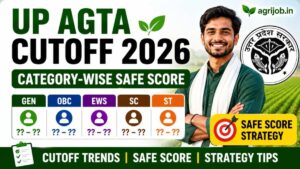
What is the safe score target in UPSSSC AGTA 2026?
Based on the 2025 paper analysis and historical cut-off trends, a net score of 70+ marks (after deducting negative marking) is considered a safe selection target. However, given the high number of applicants attracted by 2759 vacancies, a target score of 75+ marks is strongly recommended to comfortably secure selection across all categories.
What are the most repeated topics in UPSSSC AGTA PYQs?
The most frequently repeated UPSSSC AGTA topics include: the Crown Root Initiation (CRI) stage for first wheat irrigation, cauliflower micronutrient deficiency disorders (Whiptail by Mo deficiency, Browning by B deficiency), PMFBY premium rates, safe grain storage moisture limits, wheat rust Puccinia pathogens, Bhadavari buffalo characteristics, FCO 1985 biofertilizer cell count standard (1×10⁸ CFU/ml), and MSP procurement agencies (FCI, NAFED, CCI, JCI).
What is the eligibility for UPSSSC AGTA 2026?
Candidates must hold a B.Sc. Agriculture from a UGC-recognised university. The age limit is 21 to 40 years, with relaxation of 3–5 years for OBC and 5–10 years for SC/ST candidates under UP government norms. A valid UPSSSC PET (Preliminary Eligibility Test) score is also mandatory. Domicile of Uttar Pradesh is required for state-category reservation benefits.
How should I prepare for UPSSSC AGTA 2026 in 60 days?
Use the four-phase strategy: Days 1–20 for Crop Science and Soil Science foundations; Days 21–40 for Biotechnology, Horticulture, and Computer fundamentals; Days 41–50 for Animal Husbandry, Extension, and Agricultural Economics; Days 51–60 for full-length mock tests and weak-area revision. Attempt at least 3 complete timed mock tests. Prioritize morning sessions for Computer and UP GK every day — these 35 marks are decisive for final selection.
This guide is regularly reviewed and updated for accuracy. Bookmark this page for the latest UPSSSC AGTA 2026 notifications, admit card alerts, and result updates.
Last Updated: June 2026