
Study Agriculture in India 2026 – Universities, Fees & Visa Guide
Planning to study agriculture in India in 2026 is one of the smartest academic decisions a foreign student can make. India is the world’s #1 agricultural producer nation by number of farms, home to 73 ICAR-recognised agricultural universities and 680+ approved colleges, and offers degree programmes at a fraction of the cost of Western universities — with total annual expenses of just $3,000 to $8,000 per year (tuition + living). This complete, updated guide covers everything a foreign student needs to know: the top NIRF 2025-ranked universities, actual tuition fees, course options at BSc/MSc/PhD level, ICCR scholarship eligibility and how to apply, the step-by-step India student visa process, FRRO registration, monthly living costs, and career outcomes after graduating from an Indian agricultural university.


| No. of ICAR-Recognised Agri Universities | 73 universities + 680+ approved colleges |
| Top Ranked University (NIRF 2025) | IARI New Delhi (Score: 89.23, Rank #1) |
| Govt. University Annual Fees | Rs. 10,000–Rs. 50,000/year |
| Private University Annual Fees | Rs. 1,00,000–Rs. 3,00,000/year |
| Total Annual Cost (Foreign Students) | $3,000–$8,000/year (Rs. 2.5–7 lakh) |
| ICCR Scholarship | Fully/partially funded; covers tuition + stipend |
| Student Visa Duration | Up to 5 years or course duration (whichever less) |
| Admission Portals | studyinindia.gov.in | a2ascholarships.iccr.gov.in |
- Why Study Agriculture in India in 2026? 8 Compelling Reasons
- Top 10 Agriculture Universities in India 2026 – NIRF Rankings & Fees
- Agriculture Courses Available for Foreign Students in India
- Tuition Fees & Annual Education Cost Breakdown 2026
- How to Apply: 3 Official Admission Routes for Foreign Students
- ICCR Scholarship 2026 – Eligibility, Benefits & How to Apply
- India Student Visa 2026 – Step-by-Step Process & Documents
- FRRO Registration – What It Is & Why It Is Mandatory
- Living Costs in India for Foreign Agriculture Students 2026
- Who Should Study Agriculture in India?
- India vs Other Countries: Agriculture Study Destination Comparison
- High-Value Terms Every International Agri Student Must Know
- Frequently Asked Questions
Why Study Agriculture in India in 2026? 8 Compelling Reasons
India’s credentials as a global agricultural powerhouse make it a uniquely relevant destination to study agriculture in 2026. The country contributes 17.8% to national GDP through agriculture, employs 46% of its workforce in farming, and its agricultural sector is growing at a 9.68% CAGR through 2034. Here are 8 reasons why foreign students should seriously consider India:
- 💰 Lowest Cost Among Major Agri Study Destinations — Total annual cost of $3,000–$8,000 compared to $25,000–$50,000/year in USA, $20,000–$45,000 in UK, or $18,000–$35,000 in Australia. India offers a world-class agricultural education at 10–15% of Western costs.
- 🏆 54 QS-Ranked Universities in India (2026) — India houses 54 universities in the QS World Rankings 2026, with IARI featured among the top 50 agricultural research institutes globally. All leading agricultural universities are UGC, NAAC, and ICAR approved.
- 🌾 Hands-On Learning in World’s Largest Agricultural Economy — Studying in India means fieldwork, internships, and research in the world’s most diverse agricultural system — 20+ agro-climatic zones producing rice, wheat, spices, pulses, horticulture, and fisheries.
- 🎓 73 Specialised Agricultural Universities — One of the World’s Largest Networks — India has more dedicated agricultural universities than any other country, all following the standardised ICAR 5th Dean Committee curriculum aligned with international standards.
- 🌐 English-Medium Programmes Available — BSc, MSc, and PhD programmes at top universities including IARI, GBPUAT, TNAU, BHU, and private universities like Amity are taught in English, removing the language barrier for international students.
- 🤝 ICCR Fully Funded Scholarships for 160+ Countries — The Govt. of India’s ICCR scholarship programme covers agriculture specifically, funding international students’ tuition, monthly stipend, and accommodation at premier institutions.
- 📈 Booming Agritech & Career Ecosystem — Graduates from Indian agricultural universities are placed in ICAR, NABARD, FSSAI, agritech startups, and government departments. The agritech market is growing at 10.59% CAGR, creating Rs. 6–20 lakh/year starting salaries.
- 🌍 India’s Growing Global Agricultural Influence — With agri-exports crossing $50 billion in FY2025-26 and India being the world’s #1 organic producer nation, a degree from an Indian agricultural university carries increasing international recognition, especially across Asia, Africa, and the Middle East.
Top 10 Agriculture Universities in India 2026 – NIRF Rankings & Fees
The NIRF (National Institutional Ranking Framework), released annually by India’s Ministry of Education, is the official benchmark for ranking Indian universities. The NIRF 2025 Agriculture & Allied Sectors ranking is the most reliable guide for foreign students choosing where to study agriculture in India in 2026. Here are the top 10 universities with fees and programme details:

| NIRF 2025 Rank | University | Location | Annual Fees (Domestic) | Best Programme | Admission Route |
|---|---|---|---|---|---|
| #1 | ICAR-IARI (Indian Agricultural Research Institute) | New Delhi | Rs. 15,000–40,000 | MSc, PhD Agriculture | ICAR AIEEA |
| #2 | NDRI (National Dairy Research Institute) | Karnal, Haryana | Rs. 15,000–35,000 | MSc Dairy Technology, PhD | ICAR AIEEA |
| #3 | PAU (Punjab Agricultural University) | Ludhiana, Punjab | Rs. 25,000–45,000 | BSc (Hons) Agriculture | PAU CET |
| #4 | Banaras Hindu University (BHU) | Varanasi, UP | Rs. 10,000–25,000 | BSc Ag, MSc Ag | CUET |
| #5 | IVRI (Indian Veterinary Research Institute) | Izatnagar, Bareilly | Rs. 15,000–30,000 | MSc, PhD Veterinary Science | ICAR AIEEA |
| #6 | TNAU (Tamil Nadu Agricultural University) | Coimbatore, TN | Rs. 20,000–45,000 | BSc Ag, MSc Ag, PhD | TNAU Entrance |
| #7 | UAS Bangalore (University of Agricultural Sciences) | Bengaluru, Karnataka | Rs. 20,000–40,000 | BSc (Hons) Agriculture | KRCET |
| #8 | GBPUAT (Govind Ballabh Pant University) | Pantnagar, Uttarakhand | Rs. 25,000–50,000 | BSc Ag, B.Tech Ag Engg. | GBPUAT Entrance |
| #9 | SKUAST-K (Sher-e-Kashmir Univ. of Ag. Sciences) | Srinagar, J&K | Rs. 20,000–40,000 | BSc Ag, MSc Ag, PhD | SKUAST Entrance |
| #10 | RPCAU (Rajendra Prasad Central Ag. University) | Samastipur, Bihar | Rs. 15,000–35,000 | BSc (Hons) Agriculture | ICAR AIEEA |
Note for Foreign Students: International student fees are typically 2–3x the domestic fee listed above. Contact each university’s International Students Cell directly for the precise international fee schedule. IARI (NIRF #1) and NDRI (NIRF #2) are primarily PG/PhD institutions — for BSc Agriculture, the best options are PAU, GBPUAT, TNAU, BHU, and private universities like Amity University Noida, which offers English-medium BSc (Hons) Agriculture specifically designed for international students, listed on the Study in India portal.
Agriculture Courses Available for Foreign Students in India 2026
Foreign students choosing to study agriculture in India in 2026 can enrol at undergraduate, postgraduate, and doctoral levels across a rich range of specialisations. All ICAR universities follow the standardised ICAR 5th Dean Committee syllabus — the same curriculum across all institutions, specifically designed to align with competitive exams (IBPS AFO, NABARD Grade A, FCI AGT) and international agricultural research standards.
| Level | Course Name | Duration | Key Specialisations | Eligibility |
|---|---|---|---|---|
| UG | BSc (Hons) Agriculture | 4 years | Agronomy, Horticulture, Soil Science, Plant Pathology | Class 12 Science (Biology/Math), 50–60% |
| UG | BSc Horticulture | 4 years | Fruit Science, Vegetable Science, Floriculture | Class 12 Science, 50% |
| UG | BSc Forestry | 4 years | Forest Management, Agroforestry, Wildlife | Class 12 Science, 50% |
| UG | B.Tech Agricultural Engineering | 4 years | Farm Machinery, Irrigation, Post-Harvest Tech | Class 12 Physics/Chemistry/Math, 50% |
| PG | MSc Agriculture | 2 years | Plant Breeding & Genetics, Agronomy, Ag. Economics, Food Science | BSc Agriculture or allied, 50–60% |
| PG | MSc Horticulture | 2 years | Pomology, Olericulture, Post-Harvest Management | BSc Horticulture or Ag, 50% |
| PG | MBA Agribusiness Management | 2 years | Agri Finance, Supply Chain, Export Marketing | BSc Agriculture or related; CAT/MAT score |
| PhD | PhD Agriculture / Allied Fields | 3–5 years | All major sub-disciplines; research-focused | MSc relevant subject; ICAR NET/JRF |
| PG Diploma | PG Diploma in Precision Farming | 1 year | Drone Technology, IoT, AI in Agriculture | BSc Agriculture or B.Tech |
Tuition Fees & Annual Education Cost to Study Agriculture in India 2026
India offers 3 tiers of tuition fee structure for students who want to study agriculture in 2026. Government universities (State Agricultural Universities and ICAR Deemed Universities) are the most affordable, while top private universities offer premium facilities at higher costs. Foreign students are charged at an international rate, typically 2–3x the domestic fee shown below.
| University Type | Annual Tuition (Domestic) | Annual Tuition (Foreign/International est.) | Annual Living Expenses | Total Annual Cost (Foreign) |
|---|---|---|---|---|
| ICAR Deemed Universities (IARI, NDRI, IVRI) | Rs. 15,000–40,000 | Rs. 40,000–1,20,000 (~$500–$1,500) | Rs. 1.2–2.5 lakh | Rs. 1.6–3.7 lakh (~$2,000–$4,500) |
| State Agricultural Universities (PAU, TNAU, GBPUAT, BHU) | Rs. 10,000–50,000 | Rs. 30,000–1,50,000 (~$400–$1,800) | Rs. 1.0–2.0 lakh | Rs. 1.3–3.5 lakh (~$1,600–$4,300) |
| Top Private Universities (Amity, Chandigarh Univ., LPU) | Rs. 1,00,000–3,00,000 | Rs. 1,50,000–4,00,000 (~$1,800–$4,800) | Rs. 1.5–3.0 lakh | Rs. 3.0–7.0 lakh (~$3,600–$8,500) |
As a benchmark: the total annual cost for foreign students studying agriculture in India ranges from $3,000 to $8,000 (Rs. 2.5 lakh to Rs. 7 lakh), including tuition, hostel, food, transport, and miscellaneous expenses. This compares favourably against any major competing study destination — Australia requires proof of AUD 29,710/year (~Rs. 16 lakh), Canada requires CAD 22,895/year (~Rs. 14 lakh), and the USA costs Rs. 30–50 lakh/year for agricultural programmes.
How to Apply: 3 Official Admission Routes for Foreign Students in India 2026
Foreign students wanting to study agriculture in India in 2026 can choose from 3 government-approved admission routes. Each suits a different student profile and budget:
Route 1 — Study in India (SII) Programme (Recommended for All)
- Visit studyinindia.gov.in and create an account with a valid email and mobile number
- Complete your profile — personal details, academic qualifications (Class 12 mark sheets), country of origin, and English proficiency
- Search for agriculture courses and apply to a minimum of 5 preferred institutions (to maximise admission chances)
- Note your SII Unique ID — this is mandatory for your student visa application and will be verified during embassy processing
- Once the admission offer letter is issued, apply for an Indian Student Visa at your nearest Indian Embassy/High Commission quoting the SII Unique ID
- Arrive in India, register with FRRO within 14 days, and begin your course
Route 2 — ICCR Scholarship Programme (For Funded Study)
Apply through the A2A ICCR Scholarship Portal via the Indian Embassy/High Commission in your home country. Agriculture is an explicitly supported field under ICCR’s capacity-building mandate. The scholarship covers tuition fees, a monthly stipend, and (for some programmes) accommodation. Passport must have minimum 2-year validity as on 1 July 2026. Multiple applications in the same academic year are strictly prohibited — apply once, carefully.
Route 3 — Direct Admission to ICAR Universities (ICAR AIEEA)
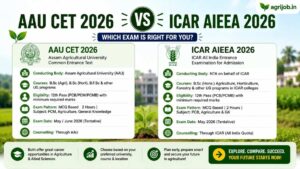
For ICAR Deemed Universities (IARI, NDRI, IVRI, CIFE), the ICAR AIEEA (All India Entrance Examination for Admission) is required. Foreign students may apply if they meet the academic eligibility. State Agricultural Universities (PAU, GBPUAT, TNAU) conduct their own state-level entrance tests. BHU uses CUET (Common University Entrance Test). Check each university’s international admissions cell for foreign student-specific application deadlines (typically March–June for July/August intake).
ICCR Scholarship 2026 – Eligibility, Benefits & How to Apply for Agriculture Students
The ICCR (Indian Council for Cultural Relations) Scholarship is one of the most valuable funding opportunities for foreign students who want to study agriculture in India. The Govt. of India’s ICCR has specifically highlighted agriculture, engineering, and management as priority capacity-building fields where it actively funds international students from developing countries. ICCR alumni have achieved leadership positions in government, academia, and business in their home countries — and each ICCR scholar is considered “India’s goodwill ambassador abroad.”
| Parameter | Details (2026-27) |
|---|---|
| Scholarship Name | Govt. of India ICCR Scholarship 2026-27 |
| Governing Document | ICCR Scholarship Manual 2026-27 |
| Eligible Levels | UG, PG (Student Visa), PhD (Research Visa) |
| Application Portal | a2ascholarships.iccr.gov.in |
| Application Route | Via Indian Mission/Embassy in home country |
| Passport Validity Required | Minimum 2 years as on 1 July 2026 |
| Fields Covered | Agriculture, Engineering, Management, Arts, Yoga, Ayurveda, Music |
| Coverage | Tuition fees + monthly stipend + (some cases) accommodation |
| Visa Required | Student Visa (S-Visa) for UG/PG; Research Visa for PhD |
| Multiple Applications | Strictly prohibited in the same academic year |
ICCR Scholarship Application Steps: Register on the A2A portal → Select your preferred Indian agricultural universities (minimum 5) → Submit the application to your Indian Embassy/Mission → The Embassy screens and nominates candidates → Admitted students get scholarship award letters → Register on the SII Portal for a Unique ID → Apply for Student Visa at your nearest Indian Embassy using the award letter and SII Unique ID.
India Student Visa 2026 – Step-by-Step Process & Documents for Agriculture Students
Getting the India Student Visa (S-Visa) is a structured, fully digital process in 2026. India’s immigration system is now described as faceless, cashless, and paperless — making it significantly faster than earlier years. All foreign students must mandatorily register on the Study in India portal first; the SII Unique ID is verified during visa authentication and cannot be skipped. Here is the complete step-by-step process to study agriculture in India on a Student Visa:
- Register on Study in India Portal — Visit studyinindia.gov.in, create an account, and complete your academic profile. Apply to at least 5 institutions. Note your SII Unique ID upon account creation.
- Secure an Admission Offer Letter — Once a university shortlists you, you will receive a formal admission offer letter or visa letter from the institution. This is required for your visa application.
- Apply for Student Visa (S-Visa) — Apply at your nearest Indian Embassy or High Commission. Submit: completed visa application form, valid passport (minimum 6 months validity beyond course end), SII Unique ID, admission offer letter, academic certificates (Class 10, Class 12 mark sheets), bank statement showing sufficient funds, 2 passport-size photographs, and visa fee payment receipt.
- Visa Interview (if required) — Some embassies may call for an interview. Be prepared to explain your chosen course, the university, and your career goals.
- Receive Student Visa — Indian Student Visas are granted for up to 5 years or the duration of the course, whichever is less. Processing time: 3–8 weeks from application date depending on your country and embassy workload.
- Arrive in India & Register with FRRO (within 14 days) — Immediately after arrival, register online at indianfrro.gov.in — the e-FRRO portal. See the FRRO section below for details. Failure to register within 14 days attracts penalties.
- Report to University & Begin Studies — Present your original documents, admission offer, and FRRO acknowledgement to the university’s international student office. Your Residential Permit (RP) will serve as your identity proof throughout your stay.
Documents Required for India Student Visa Application 2026
- 📄 Valid passport (minimum 6 months validity beyond expected course completion date)
- 📄 SII Unique ID from the Study in India portal
- 📄 Admission offer letter / visa letter from the Indian agricultural university
- 📄 Class 10 and Class 12 academic certificates with mark sheets
- 📄 English proficiency certificate (if university requires it — IELTS/TOEFL for some private universities)
- 📄 Bank statement showing sufficient funds (equivalent to Rs. 2.5–7 lakh/year)
- 📄 2 recent passport-size photographs (white background, both ears visible)
- 📄 Completed Indian visa application form
- 📄 Visa fee payment receipt (varies by nationality)
- 📄 ICCR scholarship award letter (if applying under ICCR route)
FRRO Registration – Mandatory for All Foreign Agriculture Students in India
FRRO — Foreigners Regional Registration Office — registration is mandatory for all foreign students whose Indian Student Visa is valid for more than 180 days. This applies to virtually all students studying agriculture in India on full-degree programmes (BSc = 4 years, MSc = 2 years, PhD = 3–5 years). Registration must be completed within 14 days of arrival in India — the clock starts on the date of arrival stamped in your passport.
- 🖥️ How to Register — Online at indianfrro.gov.in (e-FRRO portal); fully digital — no physical visit required unless specifically called by the FRRO officer
- 📋 Documents to Upload — Passport copy, visa copy, admission letter, address proof (hostel allotment letter / rental agreement), and passport-size photo
- ⏰ Deadline — Within 14 days of arrival. Late registration (from Day 15 onward) attracts financial penalties and may complicate your stay
- 🪪 Output — Residential Permit (RP); serves as proof of lawful stay in India for the entire course duration
- 🔄 Annual Renewal — RP must be renewed annually at the e-FRRO portal with updated university enrolment confirmation and valid visa
- 🚫 Consequences of Non-Compliance — Penalties, inconvenience at airport exit, and in serious cases, legal action under Indian prosecution laws. As of 2025-26, JNU has made FRRO registration mandatory for all international students including those from Nepal.
Living Costs for Foreign Students Studying Agriculture in India 2026
India is consistently ranked among the most affordable study destinations in Asia, and agricultural university towns like Ludhiana, Coimbatore, Pantnagar, and Samastipur offer significantly lower living costs than metro cities. Here is a realistic monthly and annual cost breakdown for a foreign student studying agriculture in India in 2026:
| Expense Category | University Town (Non-Metro) | Metro City (Delhi/Bengaluru) | Annual Estimate |
|---|---|---|---|
| University Hostel | Rs. 3,000–6,000/month | Rs. 8,000–15,000/month | Rs. 36,000–1,80,000/year |
| Food (mess/canteen) | Rs. 3,000–5,000/month | Rs. 5,000–10,000/month | Rs. 36,000–1,20,000/year |
| Local Transport | Rs. 500–1,500/month | Rs. 2,000–4,000/month | Rs. 6,000–48,000/year |
| Books & Stationery | Rs. 2,000–5,000/semester | Rs. 3,000–8,000/semester | Rs. 4,000–16,000/year |
| Internet & Mobile | Rs. 500–1,000/month | Rs. 800–1,500/month | Rs. 6,000–18,000/year |
| Personal & Miscellaneous | Rs. 2,000–4,000/month | Rs. 4,000–8,000/month | Rs. 24,000–96,000/year |
| Total Monthly Living Cost | Rs. 9,000–22,000/month | Rs. 20,000–38,000/month | Rs. 1.1–4.6 lakh/year |
Who Should Study Agriculture in India in 2026?
India as an agricultural study destination in 2026 suits a diverse range of international students. Here are 8 profiles for whom studying agriculture in India is an ideal choice:
- 🌍 Students from South Asia, Southeast Asia & Africa — Where Indian agricultural practices, crop varieties, and climate challenges are directly applicable. Over 49,000 international students already choose India, reflecting a vibrant, culturally diverse campus experience.
- 💡 Agritech & Innovation-Focused Students — India’s agritech market growing at 10.59% CAGR offers massive internship and startup incubation opportunities during study — especially at institutions near agritech hubs like Bengaluru, Delhi, and Coimbatore.
- 🔬 Research-Oriented PhD Candidates — IARI (NIRF #1, NAAC A+) is among the global top 50 agricultural research institutes, with state-of-the-art labs for seed technology, crop genetics, precision farming, and biotechnology. ICAR JRF/SRF fellowships support PhD scholars financially.
- 💰 Budget-Conscious Students Seeking Quality Education — Anyone who wants a world-recognised agriculture degree at 10–15% of Western university costs. Total 4-year BSc cost in India: Rs. 6–15 lakh vs Rs. 80–200 lakh in USA/Australia.
- 🤝 Students from Countries with ICCR Agreements — Citizens of 160+ countries where India has active ICCR scholarship arrangements can study agriculture in India at zero or near-zero personal cost under the ICCR programme.
- 🌱 Organic Farming & Sustainability Enthusiasts — India is #1 in total organic producers globally and has dedicated research programmes at IARI, TNAU, and GBPUAT in organic farming, natural farming, and climate-smart agriculture.
- 📊 Agribusiness & Export Management Students — Those seeking an MBA Agribusiness from institutions like MANAGE Hyderabad or IABM, positioned to work in India’s $50 billion+ agricultural export ecosystem or return to manage agri-trade in their home countries.
- 👩🎓 Female Students from Developing Nations — India’s agricultural universities have strong gender-inclusive policies, with dedicated women’s hostels, safety measures, and scholarship support for female international students across all degree levels.
India vs Other Countries: Study Agriculture Destination Comparison 2026
Choosing where to study agriculture is a major decision. Here is how India compares against 4 other major agricultural study destinations on 9 key parameters relevant to international students in 2026:
| Parameter | India | Australia | USA | Netherlands | China |
|---|---|---|---|---|---|
| Annual Tuition (Agri) | $500–$4,800 | $18,000–$35,000 | $20,000–$50,000 | €9,000–€18,000 | $3,000–$8,000 |
| Annual Living Cost | $1,500–$3,200 | $18,000–$25,000 | $15,000–$25,000 | €10,000–€14,000 | $3,000–$6,000 |
| Fully Funded Scholarships | ✅ ICCR (160+ countries) | ✅ Australia Awards | ✅ Fulbright (competitive) | ✅ Holland Scholarship | ✅ CSC Scholarship |
| English-Medium Courses | ✅ Available at top unis | ✅ All programmes | ✅ All programmes | ✅ Most programmes | Partial (growing) |
| Agri Diversity (Crops/Zones) | ⭐⭐⭐⭐⭐ (20+ zones) | ⭐⭐⭐ (4–5 zones) | ⭐⭐⭐⭐ (diverse) | ⭐⭐ (temperate) | ⭐⭐⭐⭐ (diverse) |
| Post-Study Work Rights | Limited (requires work visa) | 2–4 years post-study | OPT: 1–3 years | 1-year job search visa | Limited |
| Visa Complexity | Low–Medium (fully digital) | High (strict fund proof) | High (F-1 process) | Medium | Medium |
| Best For | Budget, research, tropical agri | Premium, post-study work | Agritech, research | Precision farming, tech | Budget, food security |
| NIRF/QS Global Agri Rank | IARI: Top 50 globally | Univ. of Melbourne: Top 20 | UC Davis: Top 5 | Wageningen: #1 globally | CAU: Top 20 |
High-Value Terms Every Foreign Agriculture Student in India Must Know (2026)
Navigating India’s academic and immigration system to study agriculture in India requires familiarity with these 10 essential terms, acronyms, and programmes:
- 💡 ICAR (Indian Council of Agricultural Research) — India’s apex body for agricultural education and research. Governs all 73 agricultural universities and 680+ approved colleges. Sets the standardised syllabus (ICAR 5th Dean Committee curriculum) used by all ICAR-affiliated institutions.
- 💡 NIRF (National Institutional Ranking Framework) — India’s official annual university ranking system, released by the Ministry of Education. NIRF 2025 Agriculture ranking, led by IARI (Score: 89.23), is the most reliable guide for choosing where to study agriculture in India.
- 💡 ICCR (Indian Council for Cultural Relations) — The Govt. of India body that administers scholarship programmes for foreign students. Covers agriculture as a priority field. Apply via a2ascholarships.iccr.gov.in through your home country’s Indian Embassy.
- 💡 SII (Study in India) Programme — The official Govt. of India online portal (studyinindia.gov.in) for international student admissions. Registration and SII Unique ID are mandatory for all foreign students applying for Indian Student Visa from 2025-26 onward.
- 💡 ICAR AIEEA (All India Entrance Examination for Admission) — The national entrance test for admission to PG and PhD programmes at ICAR Deemed Universities (IARI, NDRI, IVRI, CIFE). Foreign students may apply directly or through ICCR route.
- 💡 FRRO (Foreigners Regional Registration Office) — The Indian government body responsible for registering all foreign nationals staying in India for more than 180 days. Registration mandatory within 14 days of arrival at indianfrro.gov.in. Issues the Residential Permit (RP).
- 💡 SAU (State Agricultural University) — Refers to the 73 state-level agricultural universities under ICAR governance, such as PAU, GBPUAT, TNAU, and CCS HAU. These are India’s primary BSc Agriculture teaching institutions.
- 💡 NAAC A+ Grade — India’s highest institutional accreditation grade from the National Assessment and Accreditation Council. IARI holds NAAC A+ — the benchmark for academic quality assurance recognised by international students and employers.
- 💡 NABARD (National Bank for Agriculture and Rural Development) — One of the top employers of agriculture graduates in India, offering Grade A Officer positions starting at Rs. 44,500–89,000/month. A top career outcome for BSc/MSc Agriculture graduates from Indian universities.
- 💡 ICAR JRF/SRF (Junior/Senior Research Fellowship) — Funded research fellowships for PhD students at ICAR institutions. JRF: Rs. 31,000/month; SRF: Rs. 35,000/month — significantly reducing financial burden for foreign PhD students in agriculture.
Frequently Asked Questions – Study Agriculture in India 2026
Which is the best university to study agriculture in India in 2026?
The best university to study agriculture in India in 2026 is ICAR-IARI (Indian Agricultural Research Institute), New Delhi — ranked #1 in Agriculture & Allied Sectors by NIRF 2025 with a score of 89.23 and NAAC A+ accreditation. However, IARI is primarily a PG/PhD institution. For BSc Agriculture, the top choices are PAU Ludhiana (NIRF #3), GBPUAT Pantnagar (India’s first agricultural university), TNAU Coimbatore (South India’s best), and BHU Varanasi. For private, English-medium programmes welcoming international students, Amity University Noida is well-listed on the Study in India portal.
What are the tuition fees to study agriculture in India for foreign students?
Tuition fees for studying agriculture in India range from Rs. 10,000–Rs. 50,000/year at government State Agricultural Universities (domestic rate; international students pay 2–3x, approximately Rs. 30,000–1,50,000) to Rs. 1–3 lakh/year at top private universities. Total annual cost including living expenses is $3,000–$8,000/year (Rs. 2.5–7 lakh) — among the lowest for any quality agricultural education destination in the world. ICCR scholarship holders may have zero out-of-pocket costs.
How can foreign students apply for agriculture courses in India in 2026?
Foreign students can apply to study agriculture in India through 3 routes: (1) Study in India (SII) Programme at studyinindia.gov.in — register, get SII Unique ID, apply to 5+ institutions; (2) ICCR Scholarship via a2ascholarships.iccr.gov.in through your home country’s Indian Embassy — covers agriculture under its capacity-building mandate; (3) Direct admission — ICAR AIEEA for ICAR Deemed Universities, individual state entrance tests for SAUs (PAU, GBPUAT, TNAU). Admissions typically open March–May for the July/August intake.
What is the ICCR scholarship and how much does it cover for agriculture students?
The ICCR scholarship is a Govt. of India fully/partially funded scholarship for international students from 160+ countries, with agriculture as an explicitly supported priority field. It covers tuition fees, a monthly stipend, and (for some programmes) accommodation. The ICCR Scholarship Manual 2026-27 governs the latest terms. All applications are through the A2A portal (a2ascholarships.iccr.gov.in). The passport must have a minimum validity of 2 years as on 1 July 2026. Applications for the 2026-27 academic year typically close in April each year.
What is the student visa process for studying agriculture in India?
The India Student Visa (S-Visa) process for 2026 involves 5 stages: (1) Register on studyinindia.gov.in and get SII Unique ID; (2) Secure admission offer letter; (3) Apply for S-Visa at Indian Embassy with SII Unique ID, passport, offer letter, bank statement, and academic certificates; (4) Visa valid up to 5 years or course duration; processing time 3–8 weeks. (5) After arrival, register with FRRO at indianfrro.gov.in within 14 days to get Residential Permit (RP). India’s 2026 immigration system is fully digital — faceless, cashless, and paperless.
What is FRRO registration and why is it mandatory for foreign agriculture students?
FRRO (Foreigners Regional Registration Office) registration is mandatory for all foreign students whose Indian Student Visa exceeds 180 days — which includes all BSc (4 years), MSc (2 years), and PhD (3–5 years) agriculture students. Registration must be completed within 14 days of arrival via the e-FRRO portal at indianfrro.gov.in (fully online, no physical visit required). Upon registration, students receive a Residential Permit (RP) as proof of lawful stay. Late registration from Day 15 onward attracts financial penalties. From 2025-26, institutions including JNU have made FRRO registration mandatory for all international students.
What agriculture courses are available for foreign students in India?
Foreign students can enrol in BSc (Hons) Agriculture (4 years), BSc Horticulture, BSc Forestry, B.Tech Agricultural Engineering, MSc Agriculture (specialisations: agronomy, soil science, plant breeding & genetics, agricultural economics, food science), MBA Agribusiness Management, PhD Agriculture, and PG Diploma in Precision Farming. All ICAR-affiliated universities follow the standardised ICAR 5th Dean Committee syllabus. English-medium programmes are available at IARI, BHU, GBPUAT, TNAU, and private universities including Amity University Noida.
What are the monthly living costs for foreign students studying agriculture in India?
Monthly living costs for foreign students studying agriculture in India in 2026 range from Rs. 9,000–Rs. 22,000/month in university towns (Ludhiana, Coimbatore, Pantnagar, Samastipur) to Rs. 20,000–38,000/month in metro cities like Delhi (for IARI students). This includes university hostel (Rs. 3,000–15,000/month), food (Rs. 3,000–10,000/month), transport, internet, and personal expenses. Total annual living cost: Rs. 1.1–4.6 lakh — making India one of Asia’s most affordable student destinations compared to Australia (AUD 29,710/year proof required) or Canada (CAD 22,895/year).
This guide on how to study agriculture in India in 2026 is regularly reviewed and updated for accuracy. Bookmark this page for the latest admission deadlines, ICCR scholarship opening dates, and university fee revisions. For agriculture jobs and career opportunities after graduation from Indian agricultural universities, explore Agrijob.in — India’s #1 Agriculture Job & Career Portal.
Last Updated: May 2026 | Sources: NIRF 2025, ICAR, ICCR Scholarship Manual 2026-27, Study in India Programme, AgriDots, Edmaster India Student Visa Guide 2026, Kodem Law FRRO Guide, CollegeDekho, AgriDots Top Agricultural Universities India 2026