
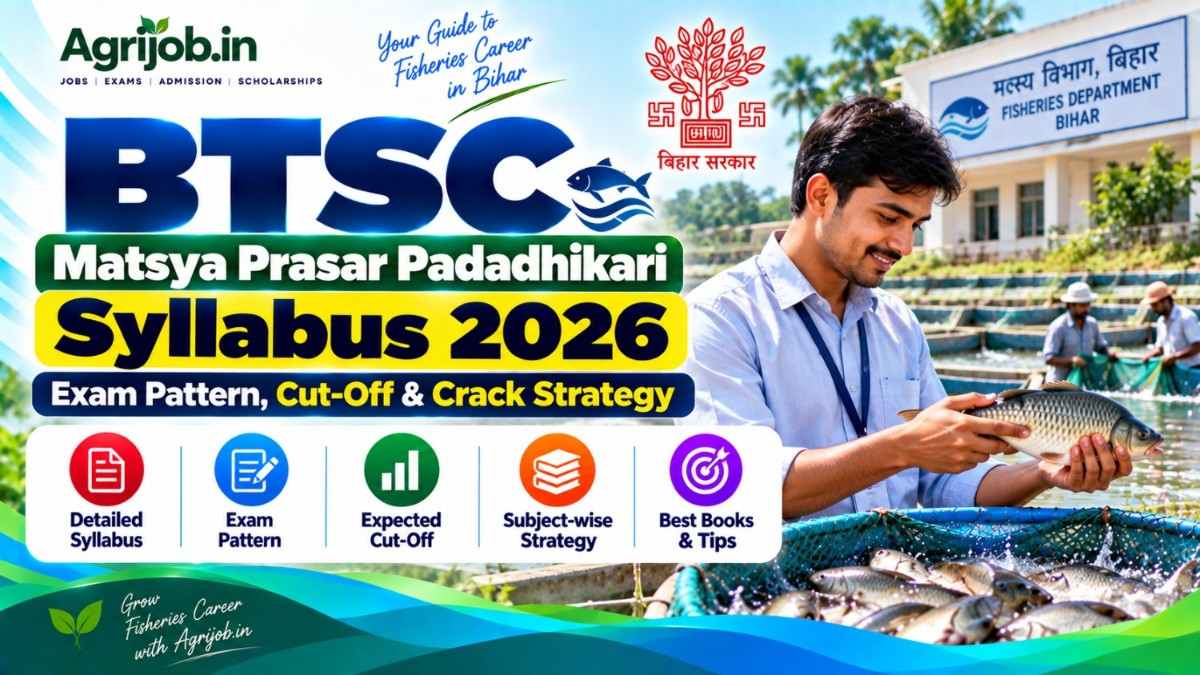
BTSC Matsya Prasar Padadhikari Syllabus 2026 is the #1 priority for every B.F.Sc. graduate targeting Bihar’s 231 regular government posts (Advertisement No. 28/2026). The Computer-Based Test carries 75 marks out of a total 100, and clearing it at a strong score is the only path to the merit list — experience marks apply only after you qualify. This guide covers the complete exam pattern, topic-wise syllabus derived from the B.F.Sc. curriculum, an honest cut-off analysis with category-wise projections, and a week-by-week preparation strategy to help you score 65+ marks in the CBT.

The BTSC Matsya Prasar Padadhikari CBT 2026 consists of 100 MCQs carrying 100 marks, conducted in 2 hours with -0.25 negative marking, based on B.F.Sc. fisheries science curriculum. The minimum qualifying mark is 30% (30 marks) for all categories. Your CBT score is then converted to 75 marks and added to up to 25 experience marks for the final merit.
- Advt. No.: 28/2026 | Bihar Technical Service Commission (BTSC)
- Post: Matsya Prasar Padadhikari (Fisheries Extension Officer)
- Total Vacancies: 231 (General Roster) + 77 PwD = 308 total posts
- Pay Level: Level-7 | Starting Basic: Rs.44,900/month | Gross: ~Rs.69,000–72,000/month
- CBT: 100 MCQs | 100 Marks | 2 Hours | -0.25 Negative Marking
- CBT Weightage in Final Merit: 75 Marks (CBT % × 0.75)
- Experience Weightage: Up to 25 Marks (5 marks/year of contractual service)
- Minimum Qualifying Marks (CBT): 30% for ALL categories
- Syllabus: B.F.Sc. curriculum (to be published on btsc.bihar.gov.in)
- Application Last Date: 23 October 2026
📋 Table of Contents
- What is BTSC Matsya Prasar Padadhikari 2026?
- Exam Pattern — CBT Structure and Marking Scheme
- Complete Topic-Wise Syllabus (B.F.Sc. Curriculum)
- Category-Wise Vacancy 2026
- Expected Cut-Off Analysis — Category and Post Wise
- Experience Weightage — How 25 Bonus Marks Work
- BTSC MPP vs Other Bihar Fisheries Jobs
- Pros and Cons of This Recruitment
- How to Crack BTSC Matsya Prasar Padadhikari 2026
- Important Fisheries Terms You Must Know
- Who Should Apply for BTSC Matsya Prasar Padadhikari 2026?
- Important Dates and Timeline
- Important Links
- Conclusion
- Frequently Asked Questions
What is BTSC Matsya Prasar Padadhikari 2026?
Matsya Prasar Padadhikari (मत्स्य प्रसार पदाधिकारी) — translated as Fisheries Extension Officer — is a Group-B gazetted technical post under Bihar’s Dairy, Fisheries and Animal Resources Department. The officer works under the Directorate of Fisheries and its district-level offices, responsible for extending scientific aquaculture knowledge to farmers, implementing government fisheries schemes like PM Matsya Sampada Yojana, and supervising fish production projects across Bihar’s 38 districts.
Bihar Technical Service Commission (BTSC) released Advertisement No. 28/2026 on 24 September 2026 for 231 regular vacancies. This is one of the largest technical fisheries recruitments in Bihar in recent years and a once-in-several-years opportunity for B.F.Sc. graduates to enter permanent government service at Pay Level-7 — with a starting basic pay of Rs.44,900/month and total gross emoluments of approximately Rs.69,000–72,000/month including DA and HRA.

BTSC Matsya Prasar Padadhikari Exam Pattern 2026 — CBT Structure
The selection process has two stages: a Computer-Based Test (CBT) and Document Verification. There is no interview. The CBT is the only competitive stage, and it decides 75 out of 100 final merit marks. Understanding the exact structure is the first step in your preparation strategy.
| Parameter | Details |
|---|---|
| Exam Mode | Computer-Based Test (CBT) — Online |
| Total Questions | 100 MCQs (Objective Multiple Choice) |
| Total Marks (Raw) | 100 Marks |
| Duration | 2 Hours (120 Minutes) |
| Medium of Exam | Hindi and English (Bilingual) |
| Correct Answer | +1 Mark |
| Wrong Answer | -0.25 Mark (Negative Marking) |
| Unattempted Questions | 0 Marks (No penalty) |
| Minimum Qualifying Marks | 30 Marks (30%) — All categories |
| Normalisation | Applicable if exam held in multiple shifts |
| CBT Final Weightage | CBT % × 0.75 = Score out of 75 |
| Syllabus | B.F.Sc. fisheries science curriculum (to be published on btsc.bihar.gov.in) |
Score conversion formula: If you score 80 marks in the CBT (raw), your weighted score becomes 80 × 0.75 = 60 marks out of 75. A candidate scoring 90/100 gets 67.5 marks. This conversion makes every additional mark in the CBT extremely valuable for your final merit rank.
BTSC Matsya Prasar Padadhikari Syllabus 2026 — Complete Topic-Wise Breakdown
BTSC has stated that the official syllabus will be published separately on btsc.bihar.gov.in, based on the curriculum defined by the Directorate of Fisheries. Since the post requires a 4-year B.F.Sc. degree, the exam will cover the complete undergraduate fisheries science curriculum. Based on the standard B.F.Sc. syllabus followed by ICAR-recognised universities (BAU, RPCAU, SKUAST, CIFE) and the nature of similar fisheries extension officer exams in other states, candidates should prepare the following 10 core subject areas:
1. Aquaculture and Fish Farming (20–25 Questions Expected)
- Principles of aquaculture — extensive, semi-intensive, intensive systems
- Pond preparation — liming, manuring, ploughing, water filling cycles
- Composite Fish Culture (CFC) — species combination, stocking density
- Integrated Fish Farming — fish with poultry, piggery, paddy, horticulture
- Freshwater prawn farming — Macrobrachium rosenbergii culture techniques
- Monoculture vs polyculture — advantages and economic comparison
- Biofloc technology, RAS (Recirculating Aquaculture Systems), cage culture
- Stocking and harvesting techniques — cast net, drag net, seine net operations
- Water quality management — dissolved oxygen, pH, alkalinity, hardness, ammonia
- Fish feed management — natural feed, supplementary feed, prepared feed, FCR
2. Fish Biology, Taxonomy, and Physiology (15–18 Questions Expected)
- Classification of Indian freshwater and marine fishes — major families and genera
- External and internal morphology of teleosts
- Digestive, respiratory, excretory, nervous, and reproductive systems of fish
- Fish taxonomy — identification of commercially important Indian species
- Major Indian carps: Catla, Rohu, Mrigal — biology and distinguishing features
- Exotic carps: Silver carp, Grass carp, Common carp — management differences
- Catfish species — Clarias, Pangasius, Mystus — commercial culture importance
- Migration, breeding behaviour, and spawning in carps
- Osmoregulation, thermoregulation in fish
3. Fish Reproduction and Induced Breeding (10–12 Questions Expected)
- Hypophysation — principle, method, dosage, and use of pituitary gland extract
- Synthetic hormones — WOVA-FH, Ovaprim, HCG — doses and application
- Hatchery management — circular hatcheries, jar hatcheries, HDPE hatcheries
- Spawning grounds — bundh breeding vs hatchery induced breeding
- Seed collection, transport, and nursery pond management
- Fry and fingerling rearing — fry pond, nursery pond, rearing pond differences
- Selective breeding and genetic improvement programs in carps
4. Fish Nutrition and Feed Technology (8–10 Questions Expected)
- Nutritional requirements of fish — proteins, carbohydrates, lipids, vitamins, minerals
- Natural food organisms — phytoplankton, zooplankton, benthos, detritus
- Supplementary vs formulated feeds — ingredients, proximate composition
- Feed conversion ratio (FCR) and its economic significance
- Fish meal, soybean meal, rice bran — alternative protein sources
- Feed preparation methods, pelleting, floating and sinking feeds
- Vitamin deficiency diseases in fish related to feed
5. Fish Diseases, Health Management, and Microbiology (10–12 Questions Expected)
- Bacterial diseases — Aeromonas, Pseudomonas, Columnaris, Edwardsiella infections
- Viral diseases — Koi Herpesvirus (KHV), Spring Viraemia, Epizootic Ulcerative Syndrome (EUS)
- Parasitic diseases — Argulus, Lernaea, Ichthyophthirius (white spot disease), Trichodina
- Fungal diseases — Saprolegnia, Branchiomyces
- Disease diagnosis — clinical signs, postmortem examination, lab tests
- Treatment and control — antibiotics, chemicals, salt treatment, lime application
- Biosecurity measures in aquaculture ponds
- Quarantine protocols for fish imports
6. Water Quality and Limnology (8–10 Questions Expected)
- Physical parameters — temperature, transparency (Secchi disc), turbidity, colour
- Chemical parameters — DO, CO2, pH, BOD, COD, alkalinity, hardness, ammonia, nitrite, nitrate, phosphate
- Biological oxygen demand (BOD) and its significance in pond management
- Eutrophication — causes, effects, management
- Aquatic ecology — food chains, energy flow, trophic levels in ponds
- Plankton ecology — phytoplankton, zooplankton diversity and productivity
- Water pollution — types, sources, impact on fisheries
- Soil quality — texture, pH, organic carbon, cation exchange capacity for pond soils
7. Fisheries Resource Management and Capture Fisheries (8–10 Questions Expected)
- Inland fisheries resources — rivers, reservoirs, floodplain lakes (chaurs), oxbow lakes of Bihar
- Bihar’s important water bodies — Ganga, Gandak, Kosi, Son rivers; Kanwar Lake
- Reservoir fisheries management — stocking norms, yield, mesh size regulations
- Fisheries Acts — Bihar Inland Fisheries Act, Indian Fisheries Act 1897, Wildlife Protection Act (aquatic species)
- Open-water fisheries — sustainable harvest, catch per unit effort (CPUE)
- Stock assessment methods — mark-recapture, virtual population analysis
- Overfishing — types (growth overfishing, recruitment overfishing), management measures
- Fishing gears — cast net, drag net, gill net, hook and line — selective use
8. Fish Processing and Post-Harvest Technology (6–8 Questions Expected)
- Post-harvest losses in fish — causes and prevention
- Traditional preservation methods — drying, salting, smoking, fermentation
- Modern methods — freezing, chilling, canning, vacuum packaging
- Cold chain management — ice usage, insulated boxes, refrigerated transport
- HACCP principles in fish processing
- Value-added fishery products — fish pickle, fish curry powder, fish sauce, fish meal
- Quality standards — FSSAI, BIS, export quality norms
9. Fisheries Extension, Rural Development, and Government Schemes (8–10 Questions Expected)
- Fisheries extension methods — contact approach, mass media, group approach, demonstration
- PM Matsya Sampada Yojana (PMMSY) — objectives, beneficiaries, subsidy pattern, implementation
- Pradhan Mantri Kisan Samman Nidhi and its relevance to fish farmers
- Bihar State Fisheries Policy — key targets and departmental programmes
- Matsya Sampada Yojana Bihar — state component, subsidy rates, eligible activities
- NFDB (National Fisheries Development Board) — role and schemes
- Blue Revolution / Neeli Kranti — integrated fisheries development concept
- Fish farmer self-help groups, cooperatives, and FPOs in fisheries
- Kisan Credit Card (KCC) for fish farmers — eligibility and process
- Bihar Rajya Matsyajivi Sahyog Samiti — role in inland fisheries
10. Fisheries Genetics, Biotechnology, and Ornamental Fish (4–6 Questions Expected)
- Basic genetics — Mendelian inheritance, sex determination in fish
- Selective breeding programs — Jayanti Rohu, Amur carp breeds
- Genetic improvement techniques — crossbreeding, hybridisation
- Ornamental fisheries — popular species, breeding, export potential
- DNA fingerprinting, PCR in fish disease diagnosis
- Transgenic fish — concept and ethical considerations
The official syllabus on btsc.bihar.gov.in will be the final authority. Monitor that page from mid-October onwards. Until then, prepare the full B.F.Sc. curriculum with emphasis on Aquaculture (25%), Fish Biology (18%), Government Schemes (10%), and Fish Diseases (12%) — these four areas alone account for an estimated 65% of questions in similar state-level fisheries exams.
Category-Wise Vacancy — BTSC Matsya Prasar Padadhikari 2026
| Category | Total Vacancies | Women (Bihar Domicile — 35% Horizontal) |
|---|---|---|
| Unreserved (UR) | 96 | 34 |
| Economically Weaker Section (EWS) | 23 | 08 |
| Scheduled Caste (SC) | 35 | 12 |
| Scheduled Tribe (ST) | 02 | 00 |
| Extremely Backward Class (EBC) | 41 | 14 |
| Backward Class (BC) | 27 | 09 |
| Backward Class Women (BCW) | 07 | — |
| Total | 231 | 77 |
| Horizontal Reservation Type | Posts |
|---|---|
| Visually Handicapped (VH) | 03 |
| Hearing Handicapped (HH) | 02 |
| Orthopedically Handicapped (OH) | 02 |
| Multiple/Intellectual Disability (MH) | 02 |
| Grandchildren of Freedom Fighters (Bihar domicile) | 04 |
Expected Cut-Off Analysis — Category-Wise and Post-Wise
No previous cut-off exists for this exact post because BTSC is conducting this recruitment after a gap. However, based on comparable BTSC technical cadre exams (2024–25), Bihar fisheries sector competition patterns, and the unique experience-weightage structure of this exam, the following cut-off projections are derived analytically.
Key factor that separates this exam from other Bihar recruitments: The 25-mark experience bonus for contractual Matsya Prasar Padadhikari employees creates a two-tier competition. Experienced contractual candidates (5 years = 25 bonus marks) effectively start with a 25-mark head start on the 100-mark merit list. This significantly compresses the effective cut-off for fresh candidates without experience.
| Category | Expected CBT Cut-Off (out of 100 raw) | Expected Final Merit Cut-Off (out of 100 total) | Remarks |
|---|---|---|---|
| UR (Male) | 62–70 | 70–78 | Highest competition pool — 96 seats |
| UR (Female) | 58–66 | 68–75 | 35% horizontal reservation benefit |
| EWS | 58–65 | 67–74 | 23 seats — moderate competition |
| EBC | 55–63 | 64–72 | 41 seats — largest reserved pool |
| BC | 55–62 | 63–71 | 27 seats |
| BCW | 50–58 | 60–68 | 7 dedicated seats for BC women |
| SC | 50–58 | 60–67 | 35 seats — B.F.Sc. pass-outs from Bihar |
| ST | 45–55 | 55–63 | Only 2 seats — very low pool |
| PwD (OH/HH) | 35–45 | 45–55 | Horizontal — distributed across categories |
Important cut-off analysis notes:
- These are projected ranges based on comparable exams — official cut-offs will be released with the result on btsc.bihar.gov.in
- The expected total applicant-to-vacancy ratio is approximately 25:1 to 40:1, based on comparable BTSC technical cadre recruitments in 2024–25
- Fresh candidates without experience must score 65+ in CBT to be competitive for UR category in the final merit, as experience candidates with 5+ years automatically add 25 marks
- Women candidates (Bihar domicile) compete in both the vertical category quota AND the 35% horizontal women’s quota — whichever gives more benefit applies
- Normalisation across multiple exam shifts may slightly adjust raw scores before conversion
How Experience Weightage Works — The 25-Mark Advantage Explained
The experience weightage is the most unique and decisive feature of this recruitment. Candidates who have worked as Matsya Prasar Padadhikari on contractual basis in Bihar Government or non-private Bihar state institutions earn 5 marks per completed year, up to a maximum of 25 marks. Experience is counted as of 24 September 2026.
| Contractual Service Duration | Experience Marks Awarded | Strategic Impact |
|---|---|---|
| Less than 1 year | Proportionate (e.g., 6 months = 2.5 marks) | Minor advantage |
| 1 year | 5 Marks | Moderate advantage |
| 2 years | 10 Marks | Significant edge |
| 3 years | 15 Marks | Strong advantage |
| 4 years | 20 Marks | Very strong advantage |
| 5 years or more | 25 Marks (Maximum) | Decisive — equivalent to +25 marks in CBT |
Certificate requirement: The experience certificate must be in Parishishth-I (Annexure-I) format, issued by the Director of Fisheries / Deputy Director of Fisheries / District Fisheries Officer-cum-Chief Executive Officer. Certificates from private employers or in non-prescribed formats are not accepted.
BTSC Matsya Prasar Padadhikari vs Other Bihar Fisheries Posts — Comparison
| Feature | BTSC Matsya Prasar Padadhikari 2026 | Contractual Matsya Prasar Padadhikari | BPSC Fisheries Officer |
|---|---|---|---|
| Post Type | Regular Government (Permanent) | Contractual (Fixed Term) | Regular (Through BPSC) |
| Pay Level | Level-7 (Rs.44,900–1,42,400) | Consolidated Rs.15,000–25,000 | Higher Level (Group A/B) |
| Gross Salary | Rs.69,000–72,000/month | Rs.15,000–25,000/month | Rs.80,000+ (estimated) |
| Pension | NPS (Government Contribution) | No pension | NPS |
| Job Security | Permanent — cannot be removed without cause | No security — annual renewal | Permanent |
| Promotion Scope | District Fisheries Officer → Deputy Director | None | Better promotion ladder |
| Qualification | 4-year B.F.Sc. (ICAR-accredited) | Same | Post-graduation often required |
| Selection Mode | CBT 75 + Experience 25 | District-level selection | BPSC screening |
| Application Fee | Rs.100 (All Categories) | Nil (Direct appointment) | Rs.200–600 (BPSC standard) |
| Best For | B.F.Sc. graduates seeking permanent state job | Freshers gaining experience | Post-graduates seeking higher grade |
For any B.F.Sc. graduate in Bihar, the BTSC Matsya Prasar Padadhikari 2026 recruitment is the single most valuable opportunity available this year. A permanent Level-7 post with Rs.44,900 basic, NPS pension, and clear promotion pathways is far superior to continuing on contract or waiting for unpredictable BPSC openings. If you are already working as a contractual Matsya Prasar Padadhikari, your 5–25 experience bonus marks make you the strongest candidates in this recruitment — apply immediately and aim for 60+ in CBT.
Advantages and Disadvantages of BTSC Matsya Prasar Padadhikari Recruitment 2026
Advantages (Pros):
- ✅ Permanent government job at Pay Level-7 — highest job security available
- ✅ Rs.44,900 starting basic with annual 3% increment reaching Rs.55,000+ in 4–5 years
- ✅ Experience bonus of up to 25 marks — contractual staff have a decisive built-in advantage
- ✅ Very low application fee — just Rs.100 for ALL categories (no category-wise fee differential)
- ✅ No interview stage — purely merit-based on CBT + experience, eliminating subjective bias
- ✅ Large vacancy count — 231 posts is unusually high for a technical fisheries cadre
- ✅ Bihar-specific role — direct field posting in Bihar’s fisheries-rich districts; no inter-state transfer
Disadvantages (Cons):
- ❌ Syllabus not yet published — waiting for official syllabus on btsc.bihar.gov.in creates preparation uncertainty
- ❌ No previous cut-off data — first BTSC regular recruitment for this post in several years, making target-setting harder
- ❌ Experience disadvantage for freshers — fresh B.F.Sc. graduates with no contractual service are at a 25-mark structural disadvantage against experienced candidates
- ❌ ST vacancies extremely limited — only 2 seats for Scheduled Tribe means near-zero competition but also near-zero openings
How to Crack BTSC Matsya Prasar Padadhikari 2026 — Complete Preparation Strategy
Cracking BTSC Matsya Prasar Padadhikari 2026 requires a structured, subject-weighted approach. The CBT is the only competitive stage, and aiming for 70+ marks (raw) gives you the best safety margin in the final merit list. Here is a 6-week preparation plan built around the most probable question distribution:
Step 1 — Wait for and Download the Official Syllabus
Check btsc.bihar.gov.in daily starting from mid-October 2026. Once the official syllabus is published, compare it with the topic list above and adjust your preparation plan. The official syllabus is the final authority — if any topic is listed that is not in this guide, add it immediately to your schedule.
Step 2 — Prioritise High-Weightage Topics First (Weeks 1–2)
Spend the first two weeks on Aquaculture (composite fish culture, pond management, induced breeding, seed production), Fish Diseases (EUS, white spot, Argulus, Lernaea treatment), and Government Schemes (PMMSY, Blue Revolution, Bihar Matsya Sampada Yojana). These three areas together likely account for 35–40 questions. Master them cold — use your B.F.Sc. notes, ICAR textbooks, and CIFE publications.
Step 3 — Cover Fish Biology, Water Quality, and Extension (Weeks 3–4)
Weeks 3 and 4 should focus on Fish Biology and Taxonomy (identification of 30–40 commercially important species by morphological features), Water Quality parameters (target all numerical values — e.g., ideal DO >5 ppm, ideal pH 7–8.5 for carps), and Fisheries Extension methods. These are high-accuracy areas — questions from these topics often have clear, single correct answers that high scorers never miss.
Step 4 — Revise Feed Technology, Fish Processing, and Genetics (Week 5)
Week 5 should cover Fish Nutrition and Feed Technology (FCR values, protein requirements of carps at different life stages), Post-Harvest Technology (freezing temperatures, HACCP principles, cold chain norms), and Fisheries Genetics (Jayanti Rohu improvement programme, basic Mendelian genetics applied to fish). These topics contribute 15–20 questions and are differentiators between average and above-average scorers.
Step 5 — Full Mock Tests and Negative Marking Discipline (Week 6)
In the final week, attempt 5–6 full-length mock tests of 100 questions each, strictly timed to 2 hours. The -0.25 negative marking rule is critical: avoid guessing unless you can eliminate at least 2 wrong options. A candidate who scores 70 right and 10 wrong gets 70 – 2.5 = 67.5 raw, which converts to 50.6 weighted marks. A candidate who scores 60 right and 0 wrong gets 60 × 0.75 = 45 marks. Accuracy beats volume.
Step 6 — Use Bihar Fisheries Department Resources
Study Bihar-specific fisheries statistics — production figures, important water bodies (Ganga, Gandak, Kosi, Son rivers; Kanwar Lake; floodplain chaurs), and the departmental scheme structure. Questions on Bihar’s fisheries context are high-value and often missed by candidates who prepare only from ICAR textbooks. The Bihar Department of Fisheries annual report (available on dahd.gov.in and bihar.gov.in) is an excellent supplement.
Important Fisheries Science Terms and Concepts for BTSC CBT
These high-value technical terms frequently appear in fisheries extension officer exams and are directly linked to high-CPC keyword clusters in fisheries education content:
- FCR (Feed Conversion Ratio): Ratio of feed given to weight gain of fish. Ideal FCR for Indian carps is 2:1 to 3:1. Lower FCR = more efficient feed use.
- Composite Fish Culture: Simultaneous culture of 5–6 species of carps in one pond utilising all food niches — surface (Silver carp), mid-water (Catla, Rohu), bottom (Mrigal, Common carp). Bihar follows a standard 6-species model.
- Hypophysation: Technique of injecting fish pituitary gland extract to induce spawning in carps. Developed by Dr. B.N. Chaudhuri — a landmark in Indian fisheries science.
- EUS (Epizootic Ulcerative Syndrome): A notifiable fish disease caused by Aphanomyces invadans fungus and viral triggers, affecting freshwater fish with ulcer-like lesions. Major threat in Bihar’s floodplain fisheries.
- PMMSY (PM Matsya Sampada Yojana): Central government scheme with Rs.20,050 crore investment over 5 years (2020–25) to double fish production and fishers’ income. Bihar is a major beneficiary state.
- Biofloc Technology: Zero-water-exchange aquaculture system where microbial flocs serve as supplementary feed, reducing feed costs by 20–25% and improving water quality.
- RAS (Recirculating Aquaculture System): Indoor fish farming technology using mechanical and biological filters to reuse 90–95% of water. High initial investment but maximum land efficiency.
- Secchi Disc: Device used to measure water transparency/turbidity in ponds. Ideal Secchi disc visibility for fish ponds: 25–30 cm (Bihar fisheries standard).
- Dissolved Oxygen (DO): Critical parameter for fish survival. Critical level below 3 ppm causes stress; below 1 ppm causes mortality in most Indian carps. Ideal range: 5–8 ppm.
- Jayanti Rohu: Genetically improved variety of Labeo rohita developed by CIFA, Bhubaneswar — shows 23% faster growth than wild Rohu in controlled trials.
Who Should Apply for BTSC Matsya Prasar Padadhikari 2026?
- 🎓 Fresh B.F.Sc. graduates (2022–2026): First major Bihar government job opportunity — apply and aim for 70+ CBT score to compensate for zero experience marks
- 🏛️ Contractual Matsya Prasar Padadhikari in Bihar government: This recruitment is tailor-made for you — 5+ years of service gives you 25 bonus marks, making you the strongest candidates in any category
- 🏢 B.F.Sc. graduates working in private aquaculture or NGO sectors: Private service does NOT earn experience marks, but you can still compete on CBT merit — prepare rigorously
- 👩🔬 M.F.Sc. (Master’s in Fisheries Science) holders: Over-qualification is NOT a barrier — the post requires only B.F.Sc., and M.F.Sc. candidates are fully eligible and bring stronger subject knowledge
- 🌾 Bihar-domicile women B.F.Sc. graduates: The 35% horizontal women’s reservation and lower effective cut-off make this a particularly strong opportunity
- ♿ PwD candidates with fisheries qualification: 10-year age relaxation plus 9 dedicated horizontal PwD posts available
- ⚔️ Ex-servicemen with B.F.Sc. degree: Age relaxation up to 3 years plus military service period applicable
- 🧑🎓 Final-year B.F.Sc. students (2026 batch): Eligible if degree is awarded by 23 October 2026 — provisional degree accepted for application; original must be produced at document verification
Important Dates and Timeline
| Event | Date |
|---|---|
| Notification Release | 24 September 2026 |
| Online Application Start | 24 September 2026 |
| Last Date to Apply Online | 23 October 2026 |
| Last Date for Certificate Issue | 23 October 2026 |
| Age / Experience Calculation Date | 01 August 2026 (age) / 24 September 2026 (experience) |
| Official Syllabus Publication | To be announced on btsc.bihar.gov.in |
| CBT Exam Date | To be announced |
| Admit Card | To be announced |
| Result and Merit List | To be announced |
| Document Verification | To be announced after result |
Important Links
| Resource | Link |
|---|---|
| Official BTSC Website | btsc.bihar.gov.in |
| BTSC Advt. 28/2026 Official Notification PDF | Download PDF |
| Bihar Directorate of Fisheries | fisheries.bihar.gov.in |
| PM Matsya Sampada Yojana (Official) | pmmsy.dof.gov.in |
| ICAR-CIFA (Fisheries Research Authority) | cifa.nic.in |
| Agrijob.in — Bihar Govt Jobs Updates | Bihar Jobs on Agrijob.in |
| Agrijob.in — BTSC Recruitment 2026 Main Post | BTSC MPP Recruitment 2026 |
Conclusion
BTSC Matsya Prasar Padadhikari Syllabus 2026 is built on the complete 4-year B.F.Sc. curriculum, with Aquaculture, Fish Biology, Government Schemes, Fish Diseases, and Water Quality forming the core of the 100-question CBT. The exam is a genuine merit-based opportunity — 231 permanent Level-7 posts at Rs.44,900 basic are rare in any technical cadre, and this cycle may not repeat for several years. Contractual Matsya Prasar Padadhikari employees in Bihar’s fisheries department have a decisive 25-mark experience advantage, but fresh B.F.Sc. graduates who score 70+ in the CBT can still secure a seat in many categories. Apply before 23 October 2026, monitor btsc.bihar.gov.in for the official syllabus, and begin your preparation now.
- BTSC CBT is 100 MCQs / 100 marks / 2 hours — minimum 30 marks to qualify; aim for 70+ to compete in UR category
- CBT score converts to 75 marks (% × 0.75); up to 25 experience marks added for contractual Bihar govt service
- Total final merit is out of 100 marks — a 5-year contractual candidate who scores 60 in CBT gets 45+25=70 total marks
- Official syllabus will be published on btsc.bihar.gov.in — monitor from mid-October; prepare B.F.Sc. curriculum until then
- Aquaculture, Fish Diseases, Government Schemes (PMMSY, Blue Revolution), and Fish Biology form the highest-weightage topics
- Last date to apply is 23 October 2026 — submit early to avoid portal congestion
Frequently Asked Questions About BTSC Matsya Prasar Padadhikari Syllabus 2026
Has the official BTSC Matsya Prasar Padadhikari Syllabus 2026 been released?
As per the official notification (Advt. 28/2026), the detailed syllabus will be published separately on btsc.bihar.gov.in. As of 26 September 2026, it has not yet been released. Candidates should check the official BTSC website regularly from mid-October onwards and prepare from the full B.F.Sc. curriculum in the meantime.
How many questions come from Aquaculture in the BTSC Matsya Prasar Padadhikari CBT?
The BTSC has not published a subject-wise question distribution. Based on comparable state fisheries extension officer exams and the B.F.Sc. curriculum structure, Aquaculture and Fish Farming is expected to account for 20–25 questions out of 100. This makes it the single highest-weightage topic area in the exam — prioritise it in your preparation.
What is the negative marking in BTSC Matsya Prasar Padadhikari CBT 2026?
Each correct answer earns +1 mark. Each wrong answer deducts -0.25 mark. Unattempted questions carry no penalty. With 100 questions in 120 minutes, candidates should attempt only questions they are reasonably confident about and skip or leave blank questions where they cannot eliminate at least 2 options. Accuracy is more important than attempting all 100 questions.
What is the expected BTSC Matsya Prasar Padadhikari cut-off for UR category?
The expected CBT raw score cut-off for the Unreserved (Male) category is projected at 62–70 out of 100, translating to a final merit score of approximately 70–78 out of 100 after the 0.75 conversion and experience marks. This is a projection based on comparable BTSC technical cadre exams — official cut-offs will be published with the result. Fresh B.F.Sc. graduates without experience should aim for 70+ in CBT to remain competitive for UR seats.
Can B.Sc. Zoology graduates apply for BTSC Matsya Prasar Padadhikari 2026?
No. The notification strictly requires a 4-year Bachelor’s degree in Fisheries Science (B.F.Sc.) from a Fisheries College under an ICAR-recognised Agricultural University. B.Sc. Zoology, B.Sc. Biology, B.Sc. Agriculture, and all other 3-year or non-fisheries degrees are ineligible. Even a B.Sc. with Zoology specialisation in fisheries is not accepted — the degree must be specifically a 4-year B.F.Sc. programme.
Do experience marks help even if I scored below 30% in the CBT?
No. Experience marks are counted only for candidates who qualify the CBT minimum threshold of 30% (30 marks out of 100). If you score below 30 in the CBT, you are disqualified regardless of how many years of contractual experience you have. Clearing the 30% qualifying mark is non-negotiable for all candidates — experience marks are added only to CBT qualifiers.
Which books are best for BTSC Matsya Prasar Padadhikari Syllabus 2026 preparation?
Until the official syllabus is released, candidates should use their university B.F.Sc. textbooks as the primary resource. For supplementary reading: Handbook of Fisheries and Aquaculture by ICAR, Fish Culture in Ponds by FAO, CIFE (Mumbai) training manuals on aquaculture, and the Bihar Department of Fisheries annual report for state-specific data. Previous year question papers of WBPSC Fisheries Officer and Andhra Pradesh Fisheries Extension Officer exams are useful for practice as they follow similar B.F.Sc.-based patterns.
Is there any reservation or age relaxation for candidates from outside Bihar?
Candidates from states other than Bihar can apply and will be considered in the Unreserved (UR) category only. They receive no caste-based reservation, no 35% women’s horizontal reservation (which is specific to Bihar domicile women), and no other Bihar-specific benefits. Age limits are the standard UR limits: 21–37 years for males, 21–40 years for females (as on 1 August 2026). Only Bihar-domicile candidates benefit from category-based relaxations.
When will the BTSC Matsya Prasar Padadhikari CBT exam date be announced?
The CBT exam date has not been announced in the recruitment notification. BTSC typically announces exam dates 4–6 weeks after the application window closes. Since the application deadline is 23 October 2026, the exam date is likely to be declared in November or December 2026, with the exam potentially held in January–February 2027. Monitor btsc.bihar.gov.in and the official Agrijob.in Bihar jobs page for the latest updates.
Last Updated: September 2026 | This article is reviewed and updated regularly. Bookmark this page for the latest BTSC Matsya Prasar Padadhikari Syllabus 2026 updates.
Disclaimer: This article is for informational purposes only. For official syllabus, exam dates, and eligibility details, always refer to the official BTSC notification available at btsc.bihar.gov.in. Agrijob.in is not affiliated with BTSC or the Bihar Government.