
Punjab Pashupalan Loan Yojana 2026 gives farmers, rural youth, and livestock entrepreneurs access to Rs.14 lakh in bank loans with a 33% capital subsidy for SC/ST applicants (25% for General category) — through a combination of the Punjab Dairy Development Board scheme, NABARD DEDS, National Livestock Mission, and commercial bank products. This guide is for Punjab residents aged 18–50 who want to start or expand a dairy, goat, poultry, or piggery unit using government-backed financing in 2026.
This complete guide covers all active state government, central government, cooperative society, and bank loan schemes available to Punjab pashupalan applicants — with exact subsidy amounts, eligibility rules, step-by-step process, and official portal links.
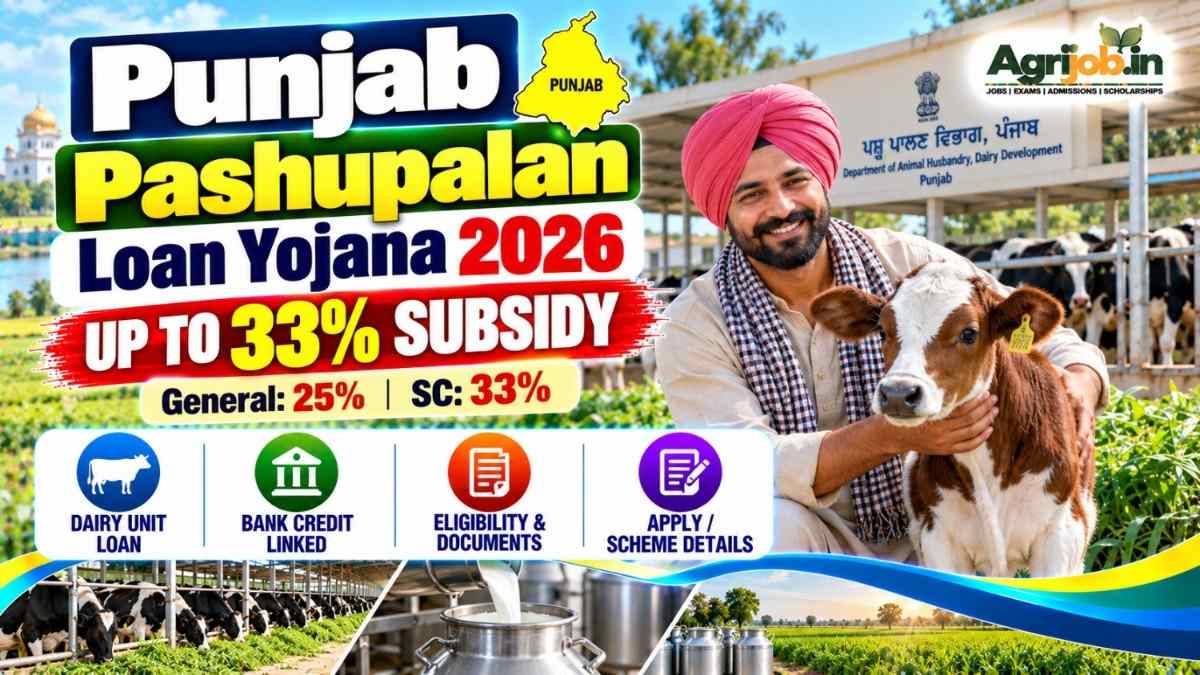
Punjab Pashupalan Loan Yojana 2026 provides up to Rs.14 lakh bank loan for a 20-animal dairy unit through the Punjab Dairy Development Board scheme, with a 25% subsidy for General/OBC category and 33% subsidy for SC/ST and women under NABARD DEDS. The Punjab Animal Husbandry Department and Dairy Development Department jointly implement these schemes; applicants must contact their District Dairy Office or nearest SBI/PNB/cooperative bank branch to begin the process.
- Scheme Name: Punjab Dairy Development Scheme (State) + NABARD DEDS (Central)
- Maximum Loan Amount: Rs.14 lakh for 20 milch animals (Punjab State scheme)
- Subsidy (General/OBC): 25% back-ended capital subsidy
- Subsidy (SC/ST & Women): 33% back-ended capital subsidy
- Eligible Animals: Cows, buffaloes, goats, pigs, poultry
- Minimum Age: 18 years | Maximum Age: 50 years
- Minimum Education: 5th Class pass (Punjab State Dairy Scheme)
- Training Required: 2-week Dairy Training Certificate from Punjab Dairy Development Board
- NLM Subsidy (Goat/Poultry/Pig): 50% capital subsidy up to Rs.50 lakh
- Interest Rate: From 8.05% p.a. (SBI); effective 4% under PM Pashu KCC
- Implementing Bodies: Dept. of Animal Husbandry Punjab + Dairy Development Dept. Punjab + NABARD
- Official Portals: animalhusbandry.punjab.gov.in | dairydevpunjab.in | nlm.udyamimitra.in
📋 Table of Contents
- What Is Punjab Pashupalan Loan Yojana 2026?
- Who Should Apply for Punjab Pashupalan Loan Yojana 2026?
- All Schemes & Subsidy Amounts — Punjab Pashupalan 2026
- Eligibility Criteria & Requirements
- How to Apply for Punjab Pashupalan Loan — Step-by-Step
- Punjab Pashupalan Loan vs Regular Bank Loan
- Pros and Cons of Punjab Pashupalan Loan Yojana 2026
- Important Terms Related to Punjab Pashupalan Loan
- Important Dates and Timelines 2026
- Income Potential — How Much Can You Earn?
- Important Links
- Conclusion
- Key Takeaways
- Frequently Asked Questions About Punjab Pashupalan Loan Yojana 2026
What Is Punjab Pashupalan Loan Yojana 2026?
Punjab Pashupalan Loan Yojana 2026 is the collective term for all animal husbandry loan and subsidy programmes available to Punjab farmers and rural entrepreneurs — covering state government dairy schemes, central government missions, NABARD-backed loans, cooperative society credit, and public sector bank products. Punjab’s Dairy Development Department (established in 1964) and Animal Husbandry Department jointly administer these schemes, helping approximately 200 new dairy units get established every year across Punjab’s 23 districts.

The state operates under a two-department model: the Department of Animal Husbandry (animalhusbandry.punjab.gov.in) manages goat, pig, sheep, and poultry schemes along with BPL/SC livestock support, while the Department of Dairy Development (dairydevpunjab.in) manages cattle and buffalo dairy farm loans through the Punjab Dairy Development Board (PDDB), headquartered at Livestock Complex, Sector-68, SAS Nagar. Both departments run parallel application processes and can be accessed through your District Dairy Office or District Animal Husbandry Office.
Punjab is India’s leading dairy state — home to the high-yielding Murrah buffalo, Sahiwal cow, and Nili-Ravi breeds. The state produces over 12 million tonnes of milk annually, making the pashupalan sector both commercially viable and strongly supported by government funding in 2026.
Who Should Apply for Punjab Pashupalan Loan Yojana 2026?
- 🐃 Small and marginal farmers in Punjab’s rural areas who already own 1–5 animals and want to expand to a 10–20 animal commercial dairy unit
- 🏚️ BPL and SC/ST families who qualify for the Central Assistance scheme providing free buffalo/cow calves — 100% GOI-funded, implemented by the Punjab Animal Husbandry Department
- 👩🌾 Women entrepreneurs in rural Punjab who get the higher 33% NABARD subsidy under DEDS and benefit from additional state-level women incentive programmes
- 👨🎓 Agriculture and veterinary graduates aged 18–35 who want to set up a commercial dairy farm as a primary livelihood using the Punjab Dairy Development Board loan route
- 🐐 Goat, piggery, and poultry farmers across all 23 Punjab districts who qualify for the 50% capital subsidy under National Livestock Mission (up to Rs.50 lakh for goat/sheep units)
- 🏦 Existing dairy cooperative members of Verka Milkfed who can access concessional working capital through cooperative society credit linked to milk procurement
- 🤝 Self Help Groups (SHGs) and Joint Liability Groups (JLGs) of women or marginal farmers wanting a collective dairy or livestock unit with shared subsidy benefits
- 🏭 Agri-entrepreneurs and MSMEs planning a dairy processing plant, animal feed plant, or milk chilling unit who qualify for AHIDF’s 90% loan coverage and 3% interest subvention
All Schemes & Subsidy Amounts — Punjab Pashupalan 2026
Punjab farmers in 2026 can stack multiple schemes for maximum benefit. Here are all active schemes, divided by source:
A. Punjab State Government Schemes
| Scheme Name | Implementing Body | Max Loan | Subsidy (Gen/OBC) | Subsidy (SC/ST/Women) | Target Animal |
|---|---|---|---|---|---|
| Punjab Dairy Development Scheme | Punjab Dairy Dev. Board (PDDB) / NABARD | Rs.14 lakh (20 animals) | 25% | 33% | Cow, Buffalo (milch animals) |
| Fodder Harvester Incentive | Dept. of Dairy Development, Punjab | Rs.50,000 (Gen) / Rs.63,000 (SC) | Rs.50,000 fixed | Rs.63,000 fixed | All dairy farmers |
| Special Central Assistance — SC BPL Calf Scheme | Dept. of Animal Husbandry Punjab (GOI 100%) | 1 free calf per family | N/A (BPL SC only) | 100% free | Buffalo / Cow calf |
| Goat Kid Rearing Scheme | Dept. of Animal Husbandry Punjab (GOI 100%) | 3 goat kids per unit (Rs.3,333/kid) | N/A (SC BPL only) | 100% free | Goats |
| Chaff Cutter Scheme | Dept. of Animal Husbandry Punjab (GOI 100%) | 1 chaff cutter per family (Rs.8,000) | N/A (SC BPL only) | 100% free | All milch animal owners |
| Rashtriya Gokul Mission (RGM) — Punjab | Punjab Livestock Dev. Board (PLDB) / DAHD | Breed improvement only | Incentive-based | Priority for SC/ST | Sahiwal cow, Murrah buffalo |
B. Central Government Schemes Available to Punjab Farmers
| Scheme | Max Loan / Subsidy | Subsidy Rate | Target Beneficiary | Apply At |
|---|---|---|---|---|
| NABARD DEDS (Dairy Entrepreneurship Development Scheme) | Rs.5 lakh (10 animals); Max subsidy Rs.1.67 lakh (SC/ST) | 25% (Gen) / 33.33% (SC/ST) | Individual farmers, SHGs, cooperatives | SBI / PNB / Cooperative Bank |
| National Livestock Mission (NLM) — EDP | Up to Rs.1 crore (goat/sheep 500 units); 50% subsidy max Rs.50 lakh | 50% of project cost | Individuals, FPOs, SHGs, Section 8 companies | nlm.udyamimitra.in |
| AHIDF (Animal Husbandry Infrastructure Dev. Fund) | Up to 90% of project cost; Rs.29,110 crore corpus | 3% interest subvention for 8 years | MSMEs, private companies, dairy cooperatives, FPOs | ahidf.udyamimitra.in |
| PM Pashu Kisan Credit Card (KCC) | Up to Rs.1.6 lakh (collateral-free working capital) | Effective 4% interest with timely repayment | All livestock-owning farmers | Nearest SBI / PNB / cooperative bank |
| National Programme for Dairy Development (NPDD) | Rs.1,568 crore corpus; cooperative dairy infrastructure | Interest subvention on working capital | Milk cooperatives, Milk Unions, Verka Milkfed members | DAHD via state dairy dept |
| Livestock Insurance Scheme | Premium subsidy on animal insurance | 50% (APL) / 70% (BPL/SC/ST) of premium | All Punjab livestock owners (max 2 animals per beneficiary) | District Animal Husbandry Office |
C. Bank Loan Products for Punjab Pashupalan 2026
| Bank / Institution | Scheme / Product | Interest Rate | Max Loan Amount | Repayment Period |
|---|---|---|---|---|
| State Bank of India (SBI) | Safal Dairy Loan / YONO Krishi | From 8.05% p.a. | Rs.10 lakh (individual); up to project cost (NABARD) | 5–7 years |
| Punjab National Bank (PNB) | PNB Dairy Farm Scheme | From 8.5% p.a. | Rs.10 lakh+ | 5–7 years with 6-month moratorium |
| Punjab & Sind Bank | Dairy / Livestock Loan | From 8.7% p.a. | Rs.10 lakh | 5 years |
| NABARD (via RRBs) | DEDS Refinance | From 8.05% (bank rate applies) | Up to Rs.5 lakh (2–10 animals) | 5–7 years |
| Punjab Cooperative Bank / PACS | Pashupalan Sahayata Rin (Cooperative Dairy Loan) | From 7% p.a. (cooperative rate) | Up to Rs.5 lakh | 3–5 years |
| Gramin Banks (RRBs) — Punjab Gramin Bank | Rural Dairy Loan | From 8.2% p.a. | Up to Rs.5 lakh | 5 years |
D. Cooperative Society Schemes
Punjab has a robust cooperative dairy ecosystem through Verka Milkfed (Punjab State Cooperative Milk Producers’ Federation), headquartered at SCO 153-55, Sector 34-A, Chandigarh. Verka-affiliated Primary Milk Cooperative Societies (PACS) provide working capital credit to member farmers for feed, medicine, and equipment purchase at cooperative lending rates (typically 7–8% p.a.). Membership in a Verka PACS also unlocks access to the NPDD working capital subvention scheme.
Punjab farmers can legally combine three schemes simultaneously: (1) the Punjab Dairy Development Board loan for the animal purchase, (2) NABARD DEDS subsidy (25–33%) credited back-ended after 6 months of EMI payment, and (3) PM Pashu KCC for working capital at 4% effective rate. This combination can cut your actual dairy unit setup cost by 25–33% and your working capital interest to just 4% — contact your District Dairy Office and NABARD desk at the nearest SBI branch to initiate all three simultaneously.
Eligibility Criteria & Requirements for Punjab Pashupalan Loan 2026
Basic Eligibility — Punjab Dairy Development Board Scheme
- ✅ Applicant must be a resident of Punjab (rural area mandatory)
- ✅ Age: Minimum 18 years, maximum 50 years
- ✅ Minimum education: 5th class pass
- ✅ Must hold a 2-week Dairy Training Certificate from the Punjab Dairy Development Board (training conducted at district level by the Dairy Development Dept.)
- ✅ Animal must be insured and medically examined before loan disbursement
- ✅ Applicant must belong to a rural area (as confirmed by Block Development Officer/village panchayat records)
- ✅ No prior loan default with any bank or financial institution
- ✅ Applicant must have land or a lease agreement for constructing the cattle shed
Eligibility for NABARD DEDS Subsidy
- ✅ Indian citizen, minimum 18 years old
- ✅ Viable dairy project of 2 to 10 milch animals (cow or buffalo)
- ✅ Satisfactory credit history — no defaults on existing loans (CIBIL check by lending bank)
- ✅ Individual farmer, dairy entrepreneur, woman entrepreneur, SHG, FPO, NGO, or dairy cooperative
- ✅ Loan must be sanctioned by a scheduled commercial bank, RRB, or cooperative bank
Application Fee Table — Punjab Pashupalan Schemes
| Scheme | Application Fee | Category | Age Relaxation |
|---|---|---|---|
| Punjab Dairy Development Board Scheme | Nil | Gen/OBC/SC/ST/Women | No specific relaxation |
| NABARD DEDS (via bank) | Nil | All categories | No age restriction above 18 |
| NLM (National Livestock Mission) | Nil | All categories | Minimum 18 years |
| PM Pashu KCC (via bank) | Nil (bank processing fee may apply) | All categories | No age restriction above 18 |
| SC BPL Calf/Goat Scheme (GOI 100%) | Nil | BPL SC families only | N/A |
How to Apply for Punjab Pashupalan Loan Yojana 2026 — Step-by-Step Process
- Complete the 2-Week Dairy Training: Contact your District Dairy Office (under the Dept. of Dairy Development, Punjab) to register for the mandatory 2-week dairy farming certificate training. Training covers milch animal care, breed selection, fodder management, milk hygiene, and record-keeping. Without this certificate, you cannot apply for the Punjab Dairy Development Board subsidy scheme.
- Select Your Livestock Unit Size: Decide your unit type — a 2-animal mini unit (Rs.1 lakh), 5-animal unit, 10-animal unit, or 20-animal commercial dairy (Rs.14 lakh loan). For goat/pig/poultry units, determine your project cost and download the DAHD/NLM project report template from dahd.gov.in.
- Prepare a Detailed Project Report (DPR): A DPR is mandatory for loans above Rs.1 lakh. It should include your land details, shed construction cost, animal purchase plan, feed management plan, projected milk production and income, and repayment schedule. Your District Dairy Officer will guide you or the lending bank’s agriculture officer can assist.
- Apply at Your District Dairy Office or Bank Branch: For the Punjab state dairy scheme, approach your District Dairy Office first — they coordinate with NABARD and the bank to set up the tripartite arrangement. For NABARD DEDS exclusively, approach the nearest SBI, PNB, Punjab Gramin Bank, or cooperative bank directly with your DPR and KYC documents. For NLM subsidy, apply online at nlm.udyamimitra.in.
- Submit Required Documents: Submit your application with the following documents — Aadhaar card, PAN card, proof of residence (Punjab domicile), land ownership or lease agreement, bank account details (Aadhaar-linked for DBT), dairy training certificate, passport-size photographs, and the completed project report. SC/ST applicants must attach a caste certificate for the higher 33% subsidy.
- Bank Appraisal and Loan Sanction: The bank’s agriculture or rural business officer appraises your project report, verifies land records, and physically inspects the proposed dairy site. Loan sanction typically takes 15–30 working days for amounts under Rs.5 lakh, and 30–60 days for larger amounts.
- Animal Purchase and Insurance: After loan sanction, purchase milch animals with the assistance of the Senior Veterinary Officer (SVO) or Veterinary Officer of the Animal Husbandry Department in your district. All animals must be medically examined and insured before the loan is disbursed. The Livestock Insurance Scheme covers 50% of the premium (APL) or 70% (BPL/SC/ST), limited to 2 animals per beneficiary for a one-time period up to 3 years.
- Subsidy Credit (Back-Ended): NABARD DEDS subsidy is back-ended — it is not given upfront. You pay EMIs for the first 6 months; then the bank applies the subsidy (25% or 33% of eligible project cost) to your outstanding principal. This effectively reduces your remaining loan balance. Subsidy is credited via DBT directly to your bank account linked with the scheme.
Punjab Pashupalan Loan vs Regular Bank Dairy Loan — Which Is Better?
| Comparison Factor | Punjab Pashupalan Loan (Govt Scheme) | Regular Bank Dairy Loan (No Scheme) |
|---|---|---|
| Capital Subsidy | 25% (Gen) / 33% (SC/ST/Women) back-ended | No subsidy |
| Interest Rate | From 8.05%; effective 4% with Pashu KCC | 8.5%–12% (market rate) |
| Collateral Requirement | Animals insured under livestock insurance; lower collateral burden | Full collateral may be required above Rs.1.6 lakh |
| Training Requirement | 2-week dairy training certificate mandatory (for state scheme) | No training requirement |
| Subsidy Disbursement | Back-ended after 6 EMI payments via DBT | Not applicable |
| Max Loan Amount | Rs.14 lakh (20-animal dairy unit) | As per bank credit policy (typically Rs.10–20 lakh) |
| Application Process | District Dairy Office + Bank (coordinated); NLM online at nlm.udyamimitra.in | Directly at bank branch only |
| Time to Sanction | 30–60 days (DPR review + scheme approval) | 15–30 days (bank appraisal only) |
| Stacking Permitted | Yes — combine PDDB loan + NABARD DEDS + Pashu KCC | Only one bank product at a time |
| Best For | New dairy farmers, SC/ST applicants, women, rural BPL households | Existing farmers who need faster credit with less paperwork |
For most Punjab pashupalan applicants in 2026, the government scheme route is clearly better — the 33% subsidy for SC/ST saves up to Rs.4.62 lakh on a Rs.14 lakh loan, and the PM Pashu KCC reduces working capital interest to just 4%. The 2-week training requirement is a minor inconvenience that actually improves farm productivity. The only scenario where a regular bank loan wins is when you need funds within 2 weeks and cannot wait for DPR processing — in that case, use the bank loan now and apply for NLM/DEDS subsidy immediately afterward as a refinance option.
Advantages and Disadvantages of Punjab Pashupalan Loan Yojana 2026
Advantages
- ✅ 33% capital subsidy for SC/ST — one of the highest state-level dairy subsidies in India, saving up to Rs.4.62 lakh on a Rs.14 lakh loan
- ✅ Multiple scheme stacking — Punjab farmers can combine state PDDB scheme + NABARD DEDS + PM Pashu KCC for a comprehensive financial package
- ✅ Livestock insurance support — 50–70% premium subsidy ensures your animals are protected against death/disease, reducing financial risk for new dairy farmers
- ✅ Verka Milkfed procurement network — Punjab dairy farmers have guaranteed milk procurement through the cooperative system, ensuring stable income from day one
- ✅ Free training and technical support — the District Dairy Officer and Animal Husbandry veterinary officers provide free guidance on animal selection, feeding, and disease management
Disadvantages
- ❌ Mandatory 2-week training — unlike most other states, Punjab requires a Dairy Development Board training certificate before you can apply, adding 2–3 weeks to the process
- ❌ Back-ended subsidy — NABARD DEDS subsidy is released only after 6 months of EMI payment, so you must service the full loan amount initially before the subsidy reduces your principal
- ❌ Rural residence required — the state dairy scheme is restricted to rural area applicants; urban and semi-urban applicants may only access central scheme routes (NLM, AHIDF) through commercial banks
- ❌ Animal insurance mandatory — while beneficial, insurance adds an upfront cost that some small farmers find challenging; however, the 50–70% premium subsidy mitigates this
Important Terms Related to Punjab Pashupalan Loan Yojana 2026
- NABARD DEDS: National Bank for Agriculture and Rural Development’s Dairy Entrepreneurship Development Scheme — the primary central scheme refinancing dairy loans through banks with 25–33.33% back-ended capital subsidy. Apply through your bank’s NABARD desk. (nabard.org)
- Punjab Dairy Development Board (PDDB): An autonomous body under the Dairy Development Department, Punjab, established under the Punjab Dairy Dev. Board Act 2000. It oversees dairy training, subsidy processing, and technical extension across all 23 Punjab districts. Office at Livestock Complex, 4th Floor, Sector-68, SAS Nagar. Contact: 0172-5027285
- NLM (National Livestock Mission): A centrally sponsored scheme with Rs.2,300 crore outlay, providing 50% capital subsidy (up to Rs.50 lakh) for goat, sheep, poultry, pig, and fodder entrepreneurship — applied online at nlm.udyamimitra.in. Dairy cattle are NOT covered under NLM’s EDP component.
- AHIDF (Animal Husbandry Infrastructure Development Fund): A Rs.29,110 crore central corpus for dairy processing plants, meat units, animal feed plants, and breed farms — loans cover 90% of project cost with 3% interest subvention for 8 years. Applied at ahidf.udyamimitra.in.
- PM Pashu KCC (Kisan Credit Card): A revolving working capital credit facility for dairy/livestock farmers at effectively 4% interest rate (with 2% GOI subvention + 2% prompt repayment incentive). Maximum Rs.1.6 lakh collateral-free. Apply at any bank or PACS.
- Back-Ended Subsidy: A government subsidy that is credited to your loan account after the project becomes operational — not given upfront. Under NABARD DEDS, the subsidy is applied to your outstanding loan principal after 6 months of EMI payment.
- Verka Milkfed: The Punjab State Cooperative Milk Producers’ Federation Ltd. (verka.coop), the state’s apex dairy cooperative handling Verka brand milk and products. Its affiliated Primary Cooperative Societies (PACS) provide cooperative credit and assured milk procurement to member farmers.
- PLDB (Punjab Livestock Development Board): Implements central breed improvement projects including National Dairy Plan Phase-I, Rashtriya Gokul Mission, and Semen Station Nabha — focused on high genetic merit Murrah, Nili Ravi, and Sahiwal animals.
- DPR (Detailed Project Report): A mandatory document for all loans above Rs.1 lakh, detailing the project scope, costs, income projections, and repayment plan. The District Dairy Officer or bank’s agriculture officer can assist in preparation.
- Murrah Buffalo: India’s premier dairy buffalo breed, widely reared in Punjab and producing 1,800–2,500 litres per lactation. The Punjab Livestock Development Board runs a dedicated Murrah bull progeny testing programme at Patiala, Sangrur, and Barnala districts — high-merit semen is provided free to farmers via Artificial Insemination.
Important Dates and Timelines — Punjab Pashupalan 2026
| Event / Milestone | Timeline |
|---|---|
| Punjab Dairy Development Board Scheme — applications accepted | Year-round; no specific deadline (contact District Dairy Office) |
| NABARD DEDS subsidy — active in 2026–27 | Year-round via participating banks (SBI, PNB, cooperative banks) |
| NLM (National Livestock Mission) — active in 2026–27 | Year-round; apply online at nlm.udyamimitra.in |
| AHIDF — valid up to 31.03.2026 (extension expected) | Check ahidf.udyamimitra.in for updated corpus and FY 2026–27 notification |
| PM Pashu KCC — applications open | Year-round at all scheduled banks and PACS |
| Dairy Training Certificate (PDDB) — training batches | Monthly batches at district level; duration 2 weeks; contact District Dairy Office |
| Goat/Pig Farmer Training (Dept. of Animal Husbandry Punjab) | Monthly schedule; check animalhusbandry.punjab.gov.in for current training calendar |
| Livestock Insurance — annual renewal | Insurance valid up to 3 years; renewal at District Animal Husbandry Office |
Income Potential — How Much Can You Earn from Punjab Dairy Farming in 2026?
Punjab’s milk procurement rate through Verka Milkfed is approximately Rs.35–45 per litre for buffalo milk and Rs.30–38 per litre for cow milk (as of 2026, varying by fat content). A Murrah buffalo produces 1,800–2,500 litres per lactation (8–10 litres per day at peak). Here is a realistic income table for common unit sizes under Punjab Pashupalan Loan Yojana 2026:
| Unit Size | Breed | Daily Milk (approx.) | Monthly Income (Gross) | Monthly Expenses (Feed+Vet) | Monthly Net Income | Annual Net Income |
|---|---|---|---|---|---|---|
| 2 Murrah Buffaloes | Murrah | 16–20 litres/day | Rs.17,000–27,000 | Rs.8,000–10,000 | Rs.9,000–17,000 | Rs.1.08–2.04 lakh |
| 5 Murrah Buffaloes | Murrah | 40–50 litres/day | Rs.42,000–67,500 | Rs.18,000–22,000 | Rs.24,000–45,500 | Rs.2.88–5.46 lakh |
| 10 HF/Jersey Cows | HF / Jersey Crossbred | 80–120 litres/day | Rs.72,000–1,36,800 | Rs.30,000–40,000 | Rs.32,000–96,800 | Rs.3.84–11.61 lakh |
| 20 Mixed (Cow+Buffalo) | Murrah + Sahiwal | 150–200 litres/day | Rs.1,35,000–2,70,000 | Rs.55,000–75,000 | Rs.60,000–1,95,000 | Rs.7.2–23.4 lakh |
These figures are illustrative estimates based on average Verka Milkfed procurement rates and standard feed costs in Punjab as of 2026. Actual income will vary based on breed quality, fodder management, and local market conditions. Verify current milk rates at verka.coop or your nearest milk chilling centre before finalising your project report.
Important Links — Punjab Pashupalan Loan Yojana 2026
| Link Name | URL |
|---|---|
| Punjab Animal Husbandry Dept. — Schemes & Plans | animalhusbandry.punjab.gov.in |
| Punjab Dairy Development Board — Subsidy Forms | dairydevpunjab.in |
| NLM — Apply Online (Goat/Sheep/Piggery/Poultry) | nlm.udyamimitra.in |
| AHIDF — Apply Online (Dairy Processing/Feed Plant) | ahidf.udyamimitra.in |
| NABARD Official Website — Dairy Loan Info | nabard.org |
| DAHD — Official Scheme List | dahd.gov.in |
| Verka Milkfed — Punjab Dairy Cooperative | verka.coop |
| Agrijob.in — NABARD Dairy Farm Loan 2026 Guide | Complete NABARD Dairy Loan Guide |
| Agrijob.in — Dairy Farm Loan 2026 Complete Guide | Dairy Farm Loan 2026 Guide |
| Agrijob.in — PM Dairy Loan Yojana 2026 (All 6 Central Schemes) | PM Dairy Loan Yojana Complete Guide |
Conclusion — Is Punjab Pashupalan Loan Yojana 2026 Worth Applying For?
Punjab Pashupalan Loan Yojana 2026 is one of the most well-supported livestock financing ecosystems in India — combining a strong state dairy department, NABARD’s back-ended subsidy, central NLM goat/piggery grants, and Punjab’s established Verka Milkfed cooperative network. For SC/ST applicants, the combination of a 33% capital subsidy plus the PM Pashu KCC working capital at 4% interest makes this a genuinely low-cost entry into dairy entrepreneurship.
Complete your 2-week PDDB training, prepare your Detailed Project Report, and visit your District Dairy Office or the nearest SBI branch to begin the application process. Bookmark this page — we update it every time the official scheme data or interest rates change.
- Punjab Pashupalan Loan Yojana 2026 provides up to Rs.14 lakh bank loan for a 20-animal dairy unit through the Punjab Dairy Development Board scheme
- 33% capital subsidy for SC/ST and women (25% for General/OBC) under NABARD DEDS, applied back-ended after 6 EMI payments
- 50% subsidy up to Rs.50 lakh is available for goat, sheep, piggery, and poultry units under the National Livestock Mission (NLM) at nlm.udyamimitra.in
- Punjab’s AHIDF dairy processing scheme offers 90% project financing with 3% interest subvention for 8 years for entrepreneurs building dairy plants or animal feed units
- A 2-week Dairy Training Certificate from the Punjab Dairy Development Board is mandatory before applying for the state dairy scheme — contact your District Dairy Office to register
Frequently Asked Questions About Punjab Pashupalan Loan Yojana 2026
What is Punjab Pashupalan Loan Yojana 2026?
Punjab Pashupalan Loan Yojana 2026 is the combined set of state and central government animal husbandry loan and subsidy programmes available to Punjab residents. The primary state scheme is the Punjab Dairy Development Board scheme offering up to Rs.14 lakh for 20 milch animals with 25–33% capital subsidy. Central schemes like NABARD DEDS, NLM, AHIDF, and PM Pashu KCC supplement this with additional subsidies and concessional interest rates.
How much subsidy is available under Punjab Pashupalan Loan Yojana 2026?
The NABARD DEDS subsidy available to Punjab farmers is 25% of the eligible project cost for General/OBC applicants and 33% for SC/ST applicants and women. On a Rs.14 lakh dairy unit, this translates to a subsidy of Rs.3.5 lakh (Gen) or Rs.4.62 lakh (SC/ST). NLM additionally provides a 50% capital subsidy up to Rs.50 lakh for goat, sheep, piggery, and poultry units.
What is the eligibility age for Punjab Pashupalan Loan Yojana 2026?
The Punjab Dairy Development Board scheme requires applicants to be between 18 and 50 years of age and must be residents of a rural area in Punjab. For central schemes like NABARD DEDS and NLM, the minimum age is 18 years with no upper age limit specified. The PM Pashu KCC requires the applicant to be a livestock owner with an active bank account.
Is dairy training mandatory to apply for Punjab Pashupalan loan?
Yes — the Punjab Dairy Development Board scheme specifically requires a 2-week Dairy Training Certificate obtained from the Dairy Development Department, Punjab. Training is conducted at district level and covers milch animal management, fodder, hygiene, and record-keeping. This training is free of cost. Without this certificate, you cannot access the state dairy subsidy; however, you can still apply for NABARD DEDS and NLM schemes through commercial banks without the state training certificate.
Can SC/ST farmers get free animals under Punjab Pashupalan Yojana?
Yes — BPL Scheduled Caste families in Punjab qualify for the Central Assistance Scheme for Female Buffalo/Cow Calf Rearing, which is 100% GOI-funded and implemented by the Punjab Animal Husbandry Department. Under this scheme, one young female buffalo or cow calf (up to 6 months of age) is provided free to eligible BPL SC landless families. A separate scheme provides 3 goat kids per unit free to BPL SC families. Contact the Deputy Director Animal Husbandry at the district level to apply.
Which banks provide pashupalan loans in Punjab?
Major banks providing pashupalan loans in Punjab under the NABARD DEDS framework include State Bank of India (from 8.05% p.a.), Punjab National Bank (from 8.5% p.a.), Punjab & Sind Bank, Punjab Gramin Bank (Regional Rural Bank), and Punjab Cooperative Bank / PACS (from 7% p.a. — cooperative rate). SBI’s Safal Dairy Loan and YONO Krishi platform are particularly accessible for Punjab farmers. The NABARD-linked dairy loan through cooperative banks is typically 0.5–1% cheaper than commercial banks.
Is Verka Milkfed membership required for Punjab dairy loan?
Verka Milkfed membership is not mandatory for applying for the Punjab Pashupalan Loan, but it is highly recommended. Membership in a Verka-affiliated Primary Milk Cooperative Society (PACS) gives you guaranteed milk procurement at fixed rates, access to cooperative credit at lower interest (7–8% p.a.), and eligibility for NPDD working capital subvention. Membership also strengthens your DPR’s income projections, making bank loan approval faster. Contact Verka Milkfed at verka.coop or customercare@verka.coop, helpline 18001023211.
Can I get a goat farming loan under Punjab Pashupalan Yojana 2026?
Yes — goat farming is covered under the National Livestock Mission (NLM) scheme available to Punjab residents, with a 50% capital subsidy up to Rs.50 lakh for goat/sheep entrepreneurship units. The Government Goat Breeding Farm at Kotkapura (under the Punjab Animal Husbandry Department) provides quality goat breeds and technical guidance. Apply online at nlm.udyamimitra.in. BPL SC families can also receive 3 free goat kids under the Goat Kid Rearing Scheme implemented by the Punjab Animal Husbandry Department (100% GOI-funded).
How much time does it take to get the Punjab Pashupalan loan sanctioned?
Loan sanction time depends on the scheme and amount. For small loans (Rs.1–3 lakh) through cooperative banks or PM Pashu KCC, sanction can happen in 7–15 working days. For the Punjab Dairy Development Board scheme with NABARD DEDS linkage, the typical time is 30–60 working days including DPR review, District Dairy Office coordination, site verification, and bank appraisal. NLM applications go through an online portal and typically take 30–45 days from application to sanction. Ensure all documents are complete before submission to avoid delays.
Disclaimer: This article is for informational purposes only. Scheme details, subsidy rates, interest rates, and eligibility criteria are subject to change by the Government of Punjab, Government of India, or NABARD. Always verify the latest terms at official portals: animalhusbandry.punjab.gov.in, dairydevpunjab.in, nabard.org, and dahd.gov.in before applying. This is not financial or legal advice.
Last Updated: October 2026 | This guide is reviewed and updated regularly for accuracy. Bookmark this page for the latest Punjab Pashupalan Loan Yojana information.