
Sikkim Pashupalan Loan Yojana 2026 connects livestock farmers in the state to loans from ₹50,000 to ₹2 crore under four funding channels: Sikkim state schemes, central government missions, nationalised bank products, and cooperative society credit. Farmers rearing cattle, buffaloes, goats, pigs, yaks, and poultry can access subsidies of 33%–50% — higher for SC/ST beneficiaries and women. This complete guide covers every active scheme, who qualifies, what documents are needed, and exactly how to apply — both online and at the district Animal Husbandry office.

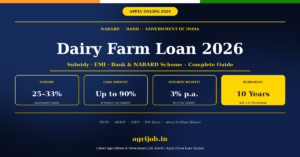
Sikkim Pashupalan Loan Yojana 2026 provides livestock loans from ₹50,000 to ₹2 crore with subsidies of 33%–50% under state, central, and cooperative schemes. General-category applicants receive 33% subsidy; SC/ST and women farmers get up to 50% under the National Livestock Mission. Apply at ahvs.sikkim.gov.in or your district Animal Husbandry & Veterinary Services (AHVS) office.
- Nodal Department: Animal Husbandry & Veterinary Services (AHVS), Govt. of Sikkim
- Minister Incharge: Puran Kumar Gurung (since June 2024)
- Official Website: ahvs.sikkim.gov.in | Krishi Bhawan, Tadong, Gangtok
- Loan Range: ₹50,000 (Pashu KCC) to ₹2 crore (AHIDF)
- Subsidy Available: 33%–50% capital subsidy (NLM); 3% interest subvention (AHIDF)
- Effective Interest Rate: 4%–7% p.a. after government subvention
- Repayment Period: 3–8 years depending on scheme
- Collateral-Free Limit: ₹1.60 lakh under Pashu KCC
- Sikkim Milk Incentive: ₹8/litre procurement support via Sikkim Milk Union (SCMPUL)
- Key Central Schemes: AHIDF · NLM · Pashu KCC · PMEGP · Rashtriya Gokul Mission
- What Is Sikkim Pashupalan Loan Yojana 2026?
- Who Should Apply for Pashupalan Loan in Sikkim?
- Sikkim State Government Pashupalan Schemes 2026
- Central Government Livestock Loan Schemes 2026
- Bank Loan Schemes for Pashupalan in Sikkim
- Cooperative Society Loan Schemes for Pashupalan
- Eligibility Criteria, Fees & Documents Required
- How to Apply for Pashupalan Loan 2026 — Step by Step
- Scheme Comparison: State vs Central vs Bank vs Cooperative
- Pros and Cons of Pashupalan Loan Schemes in Sikkim
- Important Terms Related to Pashupalan Loans
- Important Links
- Conclusion
- Frequently Asked Questions
What Is Sikkim Pashupalan Loan Yojana 2026?
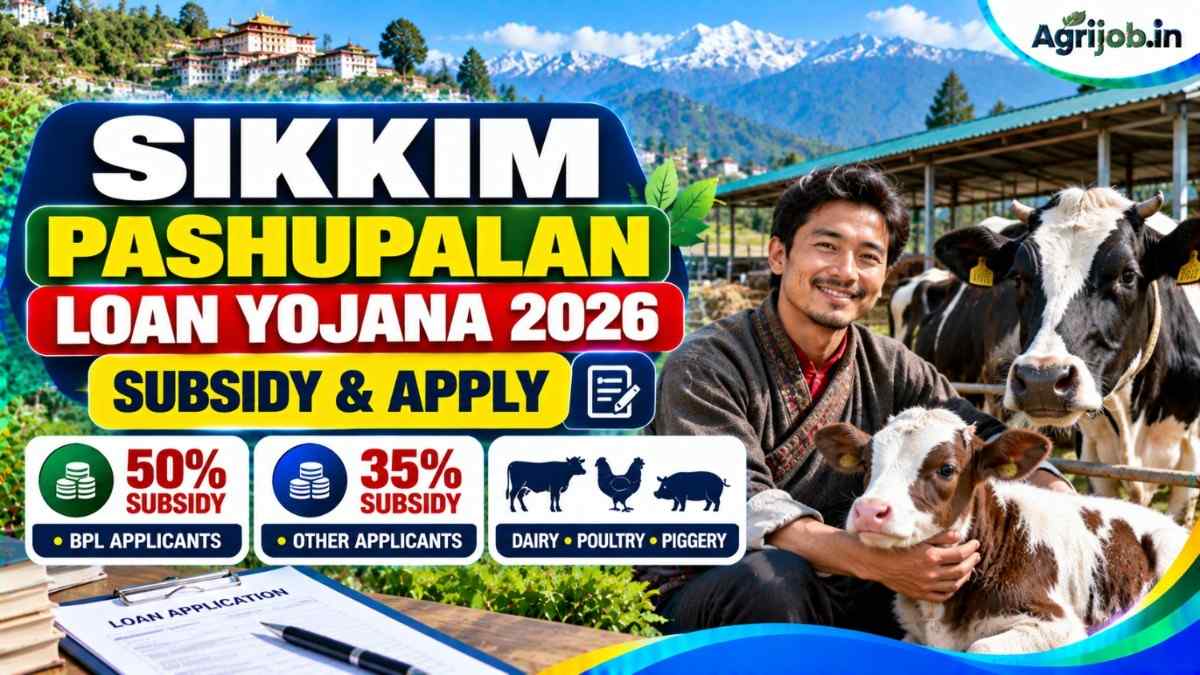
Sikkim Pashupalan Loan Yojana 2026 is an umbrella framework of state, central, bank, and cooperative-sector loan schemes that enable livestock farmers in Sikkim to purchase animals, build sheds, buy feed equipment, and expand dairy and animal husbandry units — with government subsidy reducing the effective loan burden by up to 50%.
The Department of Animal Husbandry & Veterinary Services (AHVS), Sikkim, headquartered at Krishi Bhawan, Tadong, Gangtok, serves as the nodal state body. It implements schemes both independently and in coordination with NABARD, the National Dairy Development Board (NDDB), and the Ministry of Fisheries, Animal Husbandry & Dairying, Government of India.

Sikkim’s livestock sector covers cattle, buffalo, yak, pig, goat, sheep, and poultry. The state’s 100% organic agriculture status gives Sikkim farmers an additional advantage: animals raised on certified organic fodder fetch premium prices and qualify for extra support under centrally funded missions running through 2026.
| Livestock Type | Typical Loan Range | Best Scheme |
|---|---|---|
| Dairy Cattle (2–10 cows) | ₹1 lakh – ₹8 lakh | Pashu KCC / DEDS / SDDP |
| Goat / Sheep Rearing | ₹50,000 – ₹3 lakh | NLM / Pashu KCC |
| Pig Farming | ₹75,000 – ₹5 lakh | NLM / NABARD Term Loan |
| Poultry (Broiler/Layer) | ₹1 lakh – ₹10 lakh | NLM / PMEGP |
| Yak Farming (North Sikkim) | Up to ₹5.65 lakh | NABARD / ICAR Credit Plan |
| Large Dairy / Processing Farm | ₹10 lakh – ₹2 crore | AHIDF |
Who Should Apply for Pashupalan Loan in Sikkim 2026?
This guide is for Sikkim residents who earn income from or plan to start a livestock or dairy business. All schemes listed here cover a wide range of farm scales and social categories — from a single dairy cow to a full-scale poultry processing unit.
- 🐄 Small dairy farmers with 2–5 cows or buffaloes looking to expand their herd using Pashu KCC working capital at 4% interest.
- 🐐 Goat and sheep rearers in rural Sikkim seeking National Livestock Mission (NLM) subsidy for breed improvement and fodder development.
- 🐖 Pig farmers in North and West Sikkim wanting NABARD-linked term loans for piggery shed and equipment.
- 🐔 Poultry entrepreneurs planning broiler or layer units of 500–5,000 birds who need PMEGP or NLM subsidy funding.
- 🥛 Dairy cooperative members affiliated with the Sikkim Cooperative Milk Producers’ Union (SCMPUL) who want NPDD-funded equipment and training support.
- 👩🌾 Women and SHG members eligible for higher subsidies (up to 50%) under NLM and 35% under PMEGP in Sikkim.
- 📜 SC/ST farmers who qualify for enhanced subsidy tiers and concessional interest rates across most central and state schemes.
- 🏔️ Yak farmers in higher-altitude districts (North Sikkim, Lachen, Lachung) eligible for NABARD-ICAR yak farming credit plans up to ₹5.65 lakh.
Sikkim State Government Pashupalan Schemes 2026
The Sikkim state government runs three primary livestock support programmes through the AHVS Department: the Sikkim Dairy Development Programme (SDDP), White Revolution 2.0, and the National Programme for Dairy Development (NPDD) state component. Together, these offer subsidised cattle purchase, infrastructure support, and a guaranteed milk procurement mechanism.
1. Sikkim Dairy Development Programme (SDDP)
The Sikkim Dairy Development Programme, implemented by the AHVS Department, provides direct subsidies on cattle purchase and shed construction for eligible dairy farmers. Benefits include: subsidised purchase of high-yielding exotic and crossbred cows, capital assistance for building clean-milk production sheds, and access to free veterinary health camps. Subsidy rates are determined by beneficiary category — SC/ST and BPL applicants receive higher capital assistance than general-category farmers. Applications are processed through district AHVS offices.
The programme works in direct coordination with the Sikkim Cooperative Milk Producers’ Union (SCMPUL), which provides the assured milk procurement outlet for dairy farmers registered under it. District-level Veterinary Officers assess the farm setup, certify animal purchase invoices, and recommend subsidy release to the nodal department.
2. White Revolution 2.0 — Dairy Cooperative Society Expansion
White Revolution 2.0 is Sikkim’s flagship dairy expansion initiative under Chief Minister Prem Singh Tamang’s Sikkim Krantikari Morcha government. The programme focuses on forming new Dairy Cooperative Societies (DCS) in uncovered villages and revitalising inactive DCS into input service hubs. At Gwala Diwas 2026 held at Namchi on July 1, 2026, the Chief Minister reaffirmed continued financial and institutional backing for this initiative.
Farmers who join a registered DCS under White Revolution 2.0 benefit from: ₹8 per litre milk procurement incentive from the Sikkim Milk Union; cash awards to best-performing societies; access to hand-driven chaff cutters and silage-making equipment at subsidised rates; and priority consideration for NABARD and NPDD-funded infrastructure grants. Pabyuik MPCS (Gangtok), Upper Shankhu MPCS (Gyalshing), and Upper Sribadam MPCS (Soreng) were the top three cooperative societies recognised at Gwala Diwas 2026.
3. National Programme for Dairy Development (NPDD) — Sikkim Component SK-07K
Under NPDD SK-07K (2025–26), the Sikkim Milk Union conducts clean milk production (CMP) and good hygienic practices (GHP) training for dairy farmers, distributes processing equipment to cooperative societies, and strengthens cooperative milk chilling and handling infrastructure. In February 2026, NPDD-funded awareness programmes were held at Daramdin (Saprey Nagi MPCS) and Namchi–Singithang, directly benefiting over 220 dairy farmers from seven cooperative societies.
SCMPUL has been in its 18th consecutive year of profit as of the AGM for March 2025, confirming the financial health of the cooperative system that underpins the entire state pashupalan framework. The Union’s strategic direction for 2025–26 includes promoting organic dairy practices and forming new DCS in villages not yet covered by the cooperative network.
Central Government Livestock Loan Schemes 2026
The Ministry of Fisheries, Animal Husbandry & Dairying (MFAHD), Government of India, operates five major livestock loan and subsidy schemes applicable to Sikkim in 2026. All five are channelled through NABARD or SIDBI in the Northeast region, making NABARD the most important institutional entry point for large-scale pashupalan loans in Sikkim.
1. Animal Husbandry Infrastructure Development Fund (AHIDF)
AHIDF is a Rs.15,000 crore Central Sector Scheme administered by the Ministry of Fisheries, Animal Husbandry and Dairying. Key features: up to 90% of project cost as a loan, 3% annual interest subvention for the full 8-year repayment period, 25% credit guarantee on the sanctioned loan amount, and no ceiling on the total loan for eligible entities. Eligible entities include individual entrepreneurs, FPOs, cooperatives, private companies, and Section 8 companies. Apply at ahidf.udyamimitra.in. For loans below Rs.50 lakh, the interest rate is EBLR + 200 bps; above Rs.50 lakh, it follows the bank’s standard guidelines minus the 3% subvention.
2. National Livestock Mission (NLM) — Northeast Including Sikkim
The National Livestock Mission specifically covers North Eastern States including Sikkim under a dedicated NABARD fund allocation. Confirmed by DAHD circulars, NABARD is the fund-channelising agency for NLM in the Northeast. The NLM provides 50% capital subsidy (up to Rs.2 crore for breed multiplication farms, Rs.50 lakh for smaller units) for sheep, goat, pig farming, and poultry enterprises under its Entrepreneurship Development & Employment Generation (EDEG) component. SC/ST and women entrepreneurs receive a higher subsidy tier.
Subsidy disbursement: 50% is credited to the beneficiary’s bank account via NABARD when the bank sanctions and disburses the first instalment of the loan. The remaining 50% is released on project completion certification submitted to DAHD through NABARD. The entrepreneur must upload the project on NABARD’s EDEG portal within 30 days of loan sanction.
3. Pashu Kisan Credit Card (Pashu KCC)
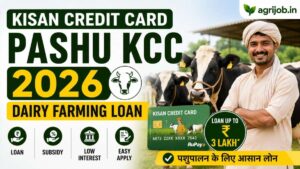
Extended to animal husbandry farmers in 2020, the Pashu KCC provides revolving working capital credit at an effective interest rate of just 4% per annum — achieved through a 3% government subvention on the standard 7% bank rate. Farmers can borrow up to ₹1.60 lakh without any collateral. By 2026, over 44.40 lakh KCCs have been issued nationwide for animal husbandry activities. Eligible livestock in Sikkim: cattle, buffalo, yak, goat, sheep, pig, poultry, and fish. The Kisan Credit Card (Pashupalan) facility covers working capital for feeding costs, veterinary aid, insurance, labour, water, and electricity for the livestock unit.
4. PM Employment Generation Programme (PMEGP) for Animal Husbandry
PMEGP supports first-generation animal husbandry entrepreneurs who want to set up goat farms, poultry units, piggeries, or dairy processing ventures. Subsidy rates: 25% for general category rural applicants and up to 35% for SC/ST, women, OBC, minorities, and ex-servicemen. Maximum project cost covered: ₹50 lakh (manufacturing) and ₹20 lakh (service sector). Apply at kviconline.gov.in. The Khadi and Village Industries Commission (KVIC) and District Industries Centres (DIC) in Gangtok process PMEGP applications for Sikkim.
5. Rashtriya Gokul Mission (RGM)
The Rashtriya Gokul Mission promotes indigenous cow breeds (Sahiwal, Gir, Rathi) through scientific breeding and genetic improvement. For Sikkim, RGM provides support for establishing bull mother farms and frozen semen production units. It operates alongside AHIDF for large-scale cattle entrepreneurs planning to invest in breed multiplication. The scheme directly benefits farmers committed to indigenous cattle rearing, which aligns with Sikkim’s organic agriculture policy.
Bank Loan Schemes for Pashupalan in Sikkim 2026
All scheduled commercial banks are mandated to finance animal husbandry activities under Priority Sector Lending (PSL) obligations. Sikkim farmers can approach SBI, Bank of Baroda, Union Bank of India, UCO Bank, Punjab National Bank, and the State Bank of Sikkim (SBS) for these specific livestock loan products:
| Bank Scheme | Loan Amount | Interest Rate | Repayment | Collateral |
|---|---|---|---|---|
| SBI Pashu KCC (Animal Husbandry) | Up to ₹3 lakh | 4% p.a. effective (after subvention) | 5 years revolving | Nil up to ₹1.60 lakh |
| SBI AHIDF Term Loan | Up to 90% of project cost | EBLR + 2% minus 3% subvention | Up to 8 years | Hypothecation + 30% collateral |
| Baroda Animal Husbandry KCC (BAHFKCC) | Up to ₹5 lakh | As per RBI direction | 5 years (annual review) | Nil up to ₹1.60 lakh |
| Union Bank AHIDF Term Loan | Up to 90% of project cost | 3% p.a. subvention (AHIDF) | Up to 8 years | As per loan size |
| NABARD Refinance via Cooperative Banks | As per NABARD unit costs | MCLR + 0.5% + 2–3% | 3–7 years | Hypothecation of animals |
| PMEGP via KVIC / SBI | Up to ₹50 lakh | Market rate (subsidy reduces principal) | 3–7 years | Project-specific |
Apply for Pashu KCC first — it gives you ₹1.60 lakh at 4% interest with zero collateral within 2–3 weeks. Build 12–18 months of animal husbandry income records, then approach NABARD or your bank for a larger NLM or AHIDF-linked loan. Starting small with KCC and graduating to a capital-subsidy scheme is the fastest, lowest-risk path to a funded pashupalan business in Sikkim.
Cooperative Society Loan Schemes for Pashupalan in Sikkim
Sikkim has one of India’s most active cooperative dairy ecosystems for its size. Joining a cooperative society unlocks both loan access and a guaranteed milk procurement channel simultaneously — making the cooperative route the most practical entry point for small and marginal farmers.
1. Sikkim Cooperative Milk Producers’ Union (SCMPUL / Sikkim Milk Union)
The Sikkim Cooperative Milk Producers’ Union Limited (SCMPUL), established in 1987 and headquartered in Gangtok, recorded its 18th consecutive year of profit as of its AGM for the year ended 31 March 2025. The Union procures milk from registered dairy cooperative societies, supplies the Indian Army and urban civilian markets across Sikkim, and distributes a range of value-added dairy products.
Benefits for SCMPUL member farmers include: ₹8 per litre milk procurement incentive, cash awards to best-performing Milk Producers’ Cooperative Societies (MPCS), access to hand-driven chaff cutters and feed equipment at no or subsidised cost, linkage to NPDD-funded clean milk production training, and priority access to state subsidy schemes under SDDP. As part of White Revolution 2.0, SCMPUL is actively forming new DCS in villages not yet covered — making the union membership more accessible than ever in 2026.
2. Primary Agricultural Credit Societies (PACS) and Dairy Cooperative Societies (DCS)
PACS across Sikkim’s six districts — Gangtok, Pakyong, Gyalshing, Soreng, Namchi, and Mangan — provide short-term working capital loans for animal husbandry. Interest rates through cooperative societies are significantly lower than commercial bank rates due to NABARD refinance support. Dairy Cooperative Societies (DCS) are the village-level milk collection entities affiliated to SCMPUL. DCS members are first in line for state subsidy schemes under SDDP, and societies like Saprey Nagi MPCS (Daramdin) — which receives approximately ₹97 lakh annually through milk sales, incentives, and related income — demonstrate the economic potential of cooperative membership.
3. Sikkim State Cooperative Bank (SISCO / SSCB)
The Sikkim State Cooperative Bank provides agricultural and animal husbandry investment loans through its affiliated PACS network. Under the IYC 2025 cooperative development activities, the bank actively supported animal husbandry investment loans to cooperative society members across all six districts of Sikkim. Interest rates are concessional compared to commercial banks due to NABARD refinancing, and loan decisions are faster for existing society members with a positive repayment track record.
Eligibility Criteria, Application Fee & Documents Required
The eligibility conditions below apply across most Sikkim Pashupalan loan schemes. Specific scheme requirements vary — always verify with the AHVS district office, your bank, or the NABARD Sikkim Regional Office before applying.
General Eligibility Criteria
- Permanent resident of Sikkim — valid domicile certificate or Sikkim Subject Certificate required
- Age: 18–65 years at the time of application (for PMEGP: up to 45 years for general, no age cap for SC/ST/women)
- Engaged in or intending to start livestock rearing, dairy farming, goat/sheep/pig farming, poultry, or yak farming
- Must have own land or a valid lease agreement for the project site
- SC/ST farmers: caste certificate mandatory for enhanced subsidy; some NLM components have no land requirement
- Self-Help Group (SHG) and Joint Liability Group (JLG) members are eligible as a group for livestock loans
- AHIDF eligible entities: individual entrepreneurs, FPOs, private companies, cooperatives, Section 8 companies
- CIBIL credit score above 650 recommended for commercial bank loans above ₹2 lakh
Application Fee — Category-Wise
| Category | Application Fee | Notes |
|---|---|---|
| General / OBC | Nil (state AHVS schemes) | Bank processing fee may apply |
| SC / ST | Nil across all schemes | Higher subsidy tier; priority processing |
| Women Applicants | Nil | 35% PMEGP subsidy; 50% NLM subsidy |
| PMEGP (KVIC online) | Nil for online registration | Margin money: 10% general, 5% SC/ST/women |
| AHIDF (udyamimitra.in) | Nil for portal registration | Bank loan processing charges applicable |
| Pashu KCC (Bank direct) | Nil | Documentation charge may apply per bank |
Documents Required (Common Across All Schemes)
- Aadhaar Card — mandatory identity and address proof for all schemes
- Voter ID / Driving Licence / Passport — additional identity proof
- Permanent Residency Certificate / Sikkim Subject Certificate / Domicile Certificate
- Bank passbook / account statement (last 6 months) — active account required
- Land ownership documents or registered lease agreement for the project site
- Detailed Project Report (DPR) — mandatory for loans above ₹2 lakh; prescribed formats available at AHVS offices
- Caste certificate (SC/ST/OBC applicants only — for enhanced subsidy)
- Passport-size photographs (2 copies)
- PAN Card — mandatory for loan amounts above ₹50,000
- Existing livestock details / Veterinary health certificate (for existing animals being pledged)
How to Apply for Sikkim Pashupalan Loan 2026 — Step by Step
- Choose your scheme: Use the comparison table in Section 9. For immediate working capital (small dairy or goat farm), choose Pashu KCC. For a new enterprise with capital subsidy, go for NLM. For large dairy/processing infrastructure, apply for AHIDF. For first-time entrepreneurs needing setup capital, PMEGP is best.
- Visit your district AHVS office: AHVS offices function in all six district headquarters of Sikkim — Gangtok (East), Pakyong (Pakyong), Gyalshing (West), Soreng (Soreng), Namchi (South), and Mangan (North). For all state schemes (SDDP, White Revolution 2.0), the district office issues the eligibility certificate and AHVS recommendation letter that your bank requires.
- Prepare your Detailed Project Report (DPR): For loans above ₹2 lakh, a DPR covering proposed unit size, number and type of animals, land details, capital cost breakdown, expected milk or product revenue, and loan repayment schedule is mandatory. NABARD provides standardised DPR templates for dairy, goat, pig, and poultry units — available at the NABARD Sikkim Regional Office, Gangtok.
- Apply at your bank: Take your AHVS recommendation letter, DPR, and full document set to your nearest SBI, Bank of Baroda, Union Bank, UCO Bank, or State Bank of Sikkim branch. For Pashu KCC, no DPR is needed — submit Form 138 with KYC documents and your livestock details.
- For AHIDF (online): Register at ahidf.udyamimitra.in, click “Apply for Loan”, complete the project detail form, and upload your DPR. The Ministry of Animal Husbandry conducts initial screening; a lender then picks the application from the portal, issues a sanction letter, and the Ministry approves the interest subvention on that portal.
- For NLM (via NABARD): Contact the NABARD Sikkim Regional Office directly or approach a NABARD-empanelled bank. The entrepreneur submits the project proposal on NABARD’s EDEG online portal within 15 days of receiving the bank’s sanction letter. NABARD’s central committee reviews and releases subsidy after the first loan disbursement.
- For PMEGP (online): Apply at kviconline.gov.in — select “Animal Husbandry” under non-farm sector activities. After online shortlisting and in-person interview at KVIC/DIC Gangtok, complete bank formalities at a KVIC-empanelled bank. The 25%–35% subsidy is locked in a Term Deposit Receipt (TDR) and released to the loan account after three years of satisfactory repayment.
- For cooperative loans: Enrol as a member of your nearest PACS or DCS. Present your Aadhaar, domicile certificate, livestock details, and membership passbook to the society secretary. The PACS submits a consolidated loan proposal to the Sikkim State Cooperative Bank, which taps NABARD refinance to fund the portfolio.
Scheme Comparison: State vs Central vs Bank vs Cooperative 2026
| Feature | State Scheme (SDDP) | Central Scheme (NLM / AHIDF) | Bank Loan (KCC / AHIDF) | Cooperative (PACS / DCS) |
|---|---|---|---|---|
| Loan Amount | ₹50,000 – ₹5 lakh | ₹1 lakh – ₹2 crore | ₹50,000 – ₹2 crore | ₹25,000 – ₹5 lakh |
| Subsidy | 25%–50% (category-based) | 33%–50% NLM; 3% AHIDF subvention | 3% interest subvention (KCC/AHIDF) | Concessional rate via NABARD |
| Effective Interest | State-determined | 4% (KCC); ~6% (AHIDF) | 4%–9% p.a. | Below commercial bank rates |
| Collateral Required | No (up to ₹2 lakh) | 30% collateral above ₹2 lakh | Nil up to ₹1.60 lakh | Animals / group guarantee |
| Repayment Period | 3–5 years | 3–8 years | 3–8 years | 1–5 years |
| Application Channel | District AHVS office | udyamimitra.in / NABARD / Bank | Bank branch / PM-KISAN portal | PACS / DCS secretary |
| Milk Procurement Support | Via SCMPUL (₹8/litre incentive) | Not directly | Not directly | Direct daily milk procurement |
| Best For | Small cattle farmers, shed construction | New goat/pig/poultry enterprise; large dairy | Immediate working capital needs | Daily dairy, women SHGs, small farms |
For most small and marginal pashupalan farmers in Sikkim, the optimal path in 2026 is: (1) Join your nearest Dairy Cooperative Society (DCS) under SCMPUL → (2) Apply for Pashu KCC (₹1.60 lakh at 4%) for immediate working capital → (3) Use NLM subsidy for your next expansion (goat/pig/poultry unit with 50% capital grant). This three-step strategy gives the lowest effective interest rate, assured milk procurement at ₹8/litre, zero collateral at entry level, and a 50% capital reduction on the expansion investment — the most capital-efficient combination available in Sikkim’s pashupalan credit ecosystem in 2026.
Pros and Cons of Sikkim Pashupalan Loan Schemes 2026
Advantages of Pashupalan Loan Schemes in Sikkim
- ✅ Layered benefit: A farmer can simultaneously access state SDDP subsidy, central NLM subsidy, and Pashu KCC working credit — creating compound financial support from multiple government sources.
- ✅ Northeast-specific NABARD fund allocation: NLM funds are ring-fenced for the Northeast including Sikkim — farmers here are not competing with large mainland states for the same subsidy pool.
- ✅ Organic premium advantage: Sikkim’s 100% organic state status means livestock products (organic milk, free-range eggs) fetch higher market prices, directly improving loan repayment capacity.
- ✅ Assured procurement from SCMPUL: The Sikkim Milk Union’s ₹8/litre incentive removes milk market risk — the biggest income uncertainty for dairy farmers — making bank repayment more predictable.
- ✅ Collateral-free entry: Pashu KCC and cooperative society loans give first-time farmers access to livestock credit without land collateral, reducing the entry barrier dramatically.
Disadvantages and Challenges
- ❌ Back-ended subsidy under NLM: The 50% capital subsidy is paid after project completion, not upfront — farmers must manage initial cash flow and construction costs before subsidy arrives.
- ❌ Higher input costs due to terrain: Sikkim’s mountainous geography increases transportation costs for cattle, feed, and construction materials compared to plains states, raising total project cost estimates.
- ❌ Limited veterinary coverage in remote areas: North Sikkim’s remote high-altitude villages have fewer veterinary dispensaries, increasing animal health risk and potentially affecting loan servicing.
- ❌ AHIDF not suitable for individual animal purchase: AHIDF is primarily designed for dairy processing and value-addition infrastructure, not individual cattle purchase — individual farmers cannot use it for buying animals.
Important Terms Related to Pashupalan Loan 2026
- Pashu KCC (Pashu Kisan Credit Card): Revolving working capital card for animal husbandry at 4% effective annual interest; up to ₹1.60 lakh without collateral. Over 44.40 lakh issued by 2026.
- AHIDF (Animal Husbandry Infrastructure Development Fund): Rs.15,000 crore central scheme for dairy/meat processing infrastructure; 90% loan, 3% p.a. interest subvention, 8-year repayment.
- NLM (National Livestock Mission): 50% capital subsidy for sheep, goat, pig, and poultry enterprises; dedicated NABARD allocation for Northeast including Sikkim.
- NABARD: National Bank for Agriculture and Rural Development — the primary refinancing and fund-channelling body for animal husbandry loans in Sikkim under both NLM and cooperative credit schemes.
- SDDP (Sikkim Dairy Development Programme): State scheme offering subsidised cattle purchase and dairy shed construction; implemented by the AHVS Department, Gangtok.
- SCMPUL (Sikkim Cooperative Milk Producers’ Union Ltd.): State dairy cooperative union; 18 consecutive years of profit; procures milk at ₹8/litre incentive; partner body for White Revolution 2.0.
- NPDD (National Programme for Dairy Development): Central scheme funding dairy cooperative infrastructure, clean milk training, and chilling equipment; Sikkim component: SK-07K 2025–26.
- DCS (Dairy Cooperative Society): Village-level milk producer cooperative affiliated to SCMPUL; entry point for cooperative credit and milk procurement support in Sikkim.
- PMEGP (PM Employment Generation Programme): Subsidy-linked loan for first-generation entrepreneurs; 25%–35% capital subsidy on projects up to ₹50 lakh; apply at kviconline.gov.in.
- Interest Subvention: Government reimbursement of 2%–3% of loan interest annually, reducing the effective rate the borrower pays. For Pashu KCC: 3% subvention brings 7% down to 4%.
Important Links for Sikkim Pashupalan Loan 2026
| Resource | URL |
|---|---|
| Sikkim AHVS Department (Official) | ahvs.sikkim.gov.in |
| Sikkim Government Portal | sikkim.gov.in/departments/sikkim-ahvs |
| AHIDF Apply Online | ahidf.udyamimitra.in |
| PMEGP Apply Online (KVIC) | kviconline.gov.in |
| DAHD Schemes — Central Government | dahd.gov.in |
| NABARD Official (Refinance & NLM) | nabard.org |
| Agrijob.in — Pashu KCC Complete Guide 2026 | Kisan Credit Card Dairy Farming 2026 Guide |
Conclusion — Sikkim Pashupalan Loan Yojana 2026
Sikkim Pashupalan Loan Yojana 2026 is not a single scheme — it is a layered ecosystem of state (SDDP, White Revolution 2.0), central (NLM, AHIDF, Pashu KCC, PMEGP), bank (SBI, Bank of Baroda, UCO Bank), and cooperative (PACS, DCS, SCMPUL) schemes that collectively reduce a farmer’s effective capital investment to as low as 10%–20% of total project cost. The Pashu KCC provides ₹1.60 lakh collateral-free at 4% for immediate working capital; NLM delivers a 50% capital grant for new goat, pig, and poultry enterprises; SCMPUL’s cooperative ecosystem guarantees ₹8/litre milk procurement; and AHIDF funds large-scale processing infrastructure at 90% loan coverage. Every income level and farm scale in Sikkim’s livestock sector has at least one well-matched scheme.
Start by visiting your nearest District Animal Husbandry & Veterinary Services (AHVS) office — present in Gangtok (East Sikkim), Namchi (South Sikkim), Mangan (North Sikkim), Gyalshing (West Sikkim), Soreng, and Pakyong. The district AHVS officer will assess your project, recommend the most suitable scheme combination, and issue the recommendation letter your bank needs to process the loan. Bookmark this page — we update it as soon as AHVS Sikkim or DAHD releases new scheme notifications for 2026–27.
- Pashu KCC gives ₹1.60 lakh at 4% effective interest with zero collateral — the fastest and cheapest entry point for livestock credit in Sikkim.
- National Livestock Mission (NLM) offers 50% capital subsidy for goat, sheep, pig, and poultry enterprises; NABARD manages these funds specifically for the Northeast including Sikkim.
- AHIDF provides up to 90% loan with 3% annual interest subvention for dairy and meat processing infrastructure — best for entrepreneurial farmers scaling up to a commercial unit.
- Joining a Dairy Cooperative Society (DCS) under SCMPUL unlocks ₹8/litre milk procurement incentive, NPDD-funded equipment support, and cooperative bank credit at concessional rates.
- SC/ST and women farmers get enhanced subsidy (up to 50% under NLM, 35% under PMEGP) — apply through your district AHVS office for the highest available benefit tier.
- Apply at ahvs.sikkim.gov.in for state schemes; ahidf.udyamimitra.in for AHIDF; kviconline.gov.in for PMEGP; and your nearest bank branch or PACS office for Pashu KCC and cooperative loans.
Frequently Asked Questions About Sikkim Pashupalan Loan Yojana 2026
What is Sikkim Pashupalan Loan Yojana 2026?
Sikkim Pashupalan Loan Yojana 2026 is a collection of livestock loan and subsidy schemes run by the Sikkim state government (through the AHVS Department), the central government (NLM, AHIDF, Pashu KCC, PMEGP, Rashtriya Gokul Mission), scheduled banks, and dairy cooperative societies. It enables Sikkim farmers to purchase animals, build sheds, and expand livestock operations with loans from ₹50,000 to ₹2 crore and capital subsidies of 33%–50%, depending on the scheme and beneficiary category.
How much loan can I get for pashupalan in Sikkim?
Loan amounts depend on the scheme chosen. Pashu KCC provides up to ₹1.60 lakh collateral-free for working capital. NABARD-linked NLM term loans cover ₹1 lakh to ₹50 lakh for goat, pig, and poultry breed multiplication. AHIDF provides up to 90% of project cost with no upper ceiling for eligible dairy processing enterprises. Cooperative society loans through PACS typically range from ₹25,000 to ₹5 lakh for small livestock activities.
What is the subsidy on pashupalan loan in Sikkim 2026?
Subsidy rates vary by scheme and applicant category. Under the National Livestock Mission, general applicants receive 33% capital subsidy (up to ₹25 lakh); SC/ST and women receive 50% capital subsidy. Under PMEGP, rural general applicants receive 25% and SC/ST/women receive 35% subsidy on total project cost. Under AHIDF there is no capital subsidy, but a 3% annual interest subvention is provided for the full 8-year repayment period.
What is the interest rate on pashupalan loan in Sikkim 2026?
The effective interest rate is 4% per annum for Pashu KCC borrowers who repay on time — achieved through a 3% government interest subvention on the standard 7% bank rate. For AHIDF term loans, the rate is approximately EBLR + 2% minus 3% subvention, equating to roughly 5.5%–6.5% depending on the lending bank’s EBLR. NLM does not reduce the loan interest rate but provides a capital grant that reduces the total principal borrowed.
How do I apply for pashupalan loan in Sikkim online?
For AHIDF, apply at ahidf.udyamimitra.in. For PMEGP, apply at kviconline.gov.in. For Pashu KCC, visit your bank’s website or the PM-KISAN portal and navigate to “Animal Husbandry KCC.” For Sikkim state schemes (SDDP, White Revolution 2.0), applications are processed through the district AHVS office — visit in person at your district headquarters with documents. The official state portal is ahvs.sikkim.gov.in and sikkim.gov.in.
Can I get pashupalan loan without land in Sikkim?
Yes. Pashu KCC provides up to ₹1.60 lakh without any land as collateral — only hypothecation of the animals purchased is required. For NLM-funded projects, leased land is accepted in place of ownership. SHG and JLG members can access cooperative group loans without individual land collateral. For AHIDF and larger bank loans above ₹2 lakh, 30% collateral is required, but this can include the animal shed or equipment being financed rather than land.
What is the role of Sikkim Milk Union (SCMPUL) in pashupalan loans?
The Sikkim Cooperative Milk Producers’ Union (SCMPUL) does not directly provide loans but plays a critical enabling role. Dairy farmers who are members of DCS affiliated to SCMPUL receive ₹8 per litre milk procurement incentive, NPDD-funded clean milk production training, access to subsidised chaff cutters and dairy equipment, and linkage to cooperative bank credit through PACS. A regular milk income from SCMPUL membership significantly improves a farmer’s creditworthiness and ability to repay livestock loans.
What is the NLM subsidy for Sikkim 2026 and how is it disbursed?
The National Livestock Mission provides a 50% capital subsidy under its EDEG component for goat, sheep, pig, and poultry enterprises. For Sikkim, the subsidy is channelled through NABARD under a dedicated Northeast allocation confirmed by DAHD. Disbursement is in two equal instalments: 50% is credited when the bank disburses the first loan instalment, and the remaining 50% is released on project completion certification submitted to DAHD via NABARD. The entrepreneur must upload the project on NABARD’s EDEG portal within 30 days of the bank’s loan sanction.
Is yak farming eligible for pashupalan loan in Sikkim?
Yes. India has approximately 58,000 yaks, with a significant population in Sikkim’s high-altitude districts — particularly North Sikkim (Lachen, Lachung, Gurudongmar). NABARD and ICAR’s Dirang centre developed a yak credit plan allowing farmers to borrow up to ₹5.65 lakh per unit for yak housing, feed, veterinary treatment, and procurement. This plan has been included in NABARD’s Potential Linked Credit Plans for applicable districts. Contact the NABARD Sikkim Regional Office in Gangtok for the current yak credit guidelines applicable in 2026.
This guide is reviewed and updated regularly as the Sikkim AHVS Department, DAHD, and NABARD release new scheme notifications. Bookmark this page for the latest updates on Sikkim Pashupalan Loan Yojana. For current subsidy amounts and application deadlines, check the official notification at ahvs.sikkim.gov.in or contact the NABARD Sikkim Regional Office, Gangtok.
This article is for informational purposes only and does not constitute financial, legal, or investment advice. Subsidy amounts, interest rates, eligibility criteria, and application processes are subject to change as per official notifications. Always verify the latest figures with your district AHVS office, your bank, NABARD Sikkim Regional Office, or the official DAHD website before applying. Agrijob.in is not responsible for decisions made based on this guide.