

Carbon farming India 2026 has emerged as one of the most exciting new income streams for Indian farmers — turning climate-positive land practices into tradeable carbon credits worth Rs.8,000 to Rs.15,000 per acre per year. With the Union Budget 2026 announcing a Rs.20,000 crore Carbon Capture, Utilisation and Storage (CCUS) programme and India’s domestic Carbon Credit Trading Scheme (CCTS) set to go live by October 2026, small and marginal farmers now have a real opportunity to earn from the global carbon market alongside their crop income. This complete guide covers everything: what carbon farming is, how much farmers can earn, which practices qualify, how to register a project, eligibility criteria, where to sell credits, comparison with traditional income, and who should start today.

- What is Carbon Farming India 2026?
- How Much Can Farmers Earn – Carbon Credit Income Table
- Eligibility for Carbon Farming in India
- 7 Carbon Farming Practices That Generate Credits
- How to Register a Carbon Farming Project – Step by Step
- India’s CCTS & Budget 2026 Carbon Programme Explained
- Who Should Start Carbon Farming in India 2026?
- Carbon Farming vs Traditional Crop Income – Full Comparison
- High-Value Carbon & Agri-Business Terms You Must Know
- Frequently Asked Questions on Carbon Farming 2026
What is Carbon Farming India 2026? A Complete Overview
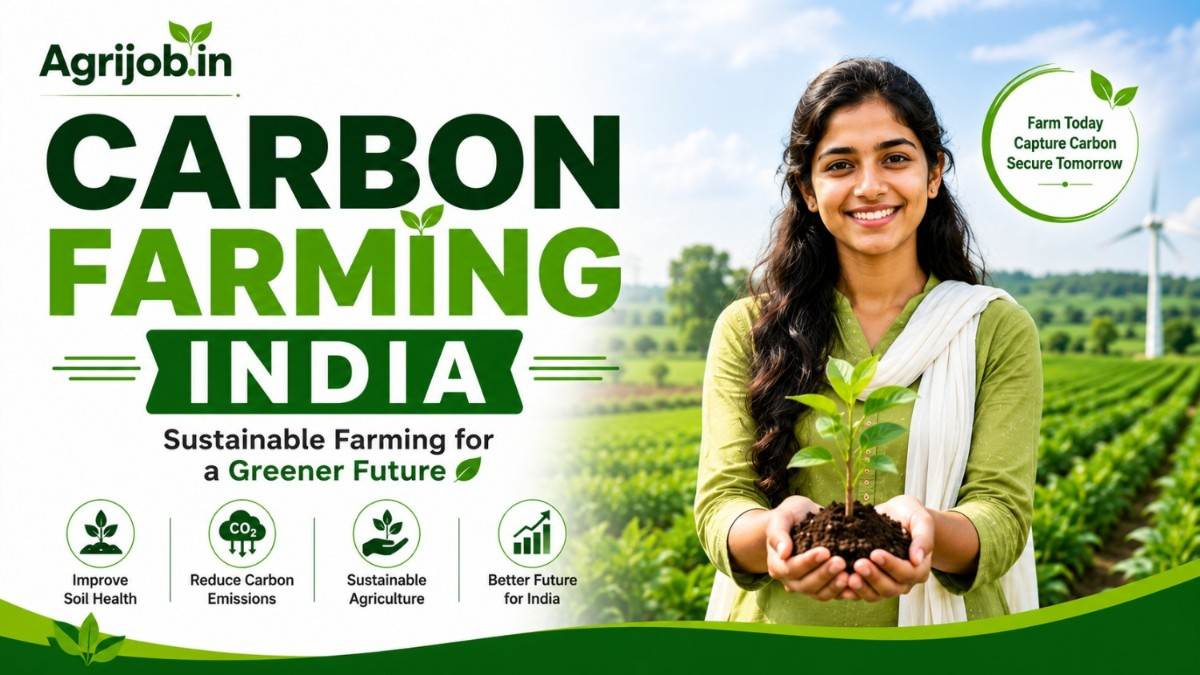
Carbon farming is the practice of adopting agricultural and land-management techniques that capture carbon dioxide (CO₂) from the atmosphere and store it in soil, plants, and trees — or that reduce greenhouse gas (GHG) emissions from farming operations. When these reductions are independently measured, reported, and verified (MRV), they are converted into Carbon Credit Certificates (CCCs) — each representing 1 tonne of CO₂ equivalent (tCO₂e) sequestered or avoided.
These carbon credits are then sold by farmers (individually or through aggregators and FPOs) to corporations, industries, and governments that need to offset their own carbon emissions in order to meet their Net Zero targets or regulatory compliance obligations. In essence, carbon farming transforms a farmer’s land into a carbon sink — a productive asset that generates two income streams simultaneously: crop revenue + carbon credit revenue.

India is now one of the world’s largest voluntary carbon credit producers, accounting for nearly 23% of all projects listed on major international registries. With the domestic CCTS framework operational from FY 2026 and the voluntary offset mechanism open to farmers and FPOs, the opportunity for rural income diversification through carbon farming has never been greater or more formally supported by Govt. of India policy.
How Much Can Farmers Earn from Carbon Credits in 2026?
Farmer earnings from carbon farming in India depend on 4 key variables: the farming practice adopted, the land area under carbon project, the verification standard used, and the market channel (voluntary vs. compliance). Here is a comprehensive income table based on 2026 market data:
| Budget 2026 CCUS Support | Rs.20,000 crore — Carbon Capture, Utilisation & Storage programme |
| Carbon Credit Price (Voluntary) | Rs.200 – Rs.1,500 per tonne CO₂e (2026) |
| Carbon Credit Price (Compliance CCTS) | Rs.800 – Rs.1,200 per tonne CO₂e (from Oct 2026) |
| Agroforestry Income | Rs.8,000 – Rs.15,000 per acre per year |
| Credits Generated (Regenerative) | 1 – 4 carbon credits per acre per year |
| No-Till Farming Credits | 0.5 – 1.5 credits per hectare per year |
| Domestic Trading Exchanges | IEX, PXIL, HPX (approved CCTS exchanges) |
| International Standards | Verra VCS, Gold Standard, BEE-CCTS Offset Mechanism |
| Minimum Land for Entry | 2 acres (via FPO/aggregator programme) |
| Income Tax on Carbon Credits | Agricultural activity income — partially exempt under IT Act |
| Carbon Farming Practice | Credits/Acre/Year | Price/Credit (Rs.) | Annual Income/Acre | Annual Income (5 Acres) |
|---|---|---|---|---|
| Agroforestry (Trees on Farm) | 2 – 4 | Rs.1,400 – Rs.1,900 | Rs.8,000 – Rs.15,000 | Rs.40,000 – Rs.75,000 |
| No-Till / Zero-Tillage | 0.5 – 1.5 (per hectare) | Rs.800 – Rs.1,200 | Rs.2,000 – Rs.6,000 | Rs.10,000 – Rs.30,000 |
| Cover Cropping (Rabi season) | 1 – 2 | Rs.600 – Rs.1,000 | Rs.3,000 – Rs.8,000 | Rs.15,000 – Rs.40,000 |
| Direct-Seeded Rice (DSR) | 1 – 3 | Rs.700 – Rs.1,200 | Rs.3,500 – Rs.9,000 | Rs.17,500 – Rs.45,000 |
| Mangrove / Reforestation | 3 – 6 | Rs.2,200 – Rs.2,800 | Rs.12,000 – Rs.25,000 | Rs.60,000 – Rs.1,25,000 |
| Biochar Incorporation | 1 – 2 | Rs.1,000 – Rs.1,500 | Rs.5,000 – Rs.10,000 | Rs.25,000 – Rs.50,000 |
Direct corporate buyers — including global companies with Net Zero commitments such as Microsoft, Shopify, Tata Group, and Cargill — actively purchase large blocks of agricultural carbon credits and often pay premium rates of Rs.2,000 or more per tonne, significantly higher than exchange-traded prices. FPOs and aggregators that bundle credits from multiple farmer groups can negotiate these better rates and pass a majority share (typically 70–80%) back to the individual farmers.
Eligibility for Carbon Farming in India 2026
Carbon farming in India 2026 is open to a broad range of participants. Below is the complete eligibility framework under both the voluntary market and India’s official CCTS Offset Mechanism:
| Eligibility Criterion | Voluntary Market (Verra/Gold Standard) | CCTS Offset Mechanism (BEE) |
|---|---|---|
| Who Can Apply | Any farmer, FPO, NGO, aggregator | Non-obligated entities incl. farmers, FPOs, startups |
| Minimum Land Size | 2 acres (via aggregator); 50+ acres (independent) | Project-based; aggregation allowed |
| Project Start Date | Any new project with documented baseline | No earlier than January 1, 2025 |
| Additionality Requirement | Yes — must be beyond business-as-usual | Yes — BEE-approved methodologies |
| Third-Party Verification | Verra-/Gold Standard-accredited auditor | BEE-accredited verifier mandatory |
| Double Registration | Cannot register same project on 2 standards | Cannot register if already on another registry |
| Women/SC/ST Priority | Premium pricing for community co-benefits | Priority block allocation under Govt. programmes |
| MRV (Monitoring) System | Satellite/GPS/soil testing; digital platforms allowed | Digital MRV system with BEE reporting |
There are no eligibility fees for farmers to join aggregator-managed carbon programmes. When registering independently under Verra VCS or Gold Standard, project registration costs typically range from Rs.50,000 to Rs.3,00,000 depending on project size — costs that aggregators absorb in exchange for a share of credit revenue (typically 20–30%). All category farmers — General, OBC, SC, ST — are equally eligible; credits sold through community-focused programmes may attract premium pricing due to UN SDG alignment.
7 Carbon Farming Practices That Generate Credits in India
Not all farming activities qualify for carbon credit generation. The practice must create measurable, additional, and verifiable reductions in GHG emissions or increases in carbon sequestration compared to the farmer’s current baseline. Here are the 7 most effective and widely adopted carbon farming practices in India 2026:
- 🌳 Agroforestry & Tree Plantation: Planting mango, timber, neem, or fruit trees on farm bunds, boundaries, or intercropped with field crops sequesters carbon in biomass and soil simultaneously. This is the highest-earning carbon farming practice in India, generating Rs.8,000–Rs.15,000 per acre per year with credits certified under Verra VCS or Gold Standard. Trees planted after January 2025 are eligible under CCTS Offset Mechanism.
- 🌾 No-Till / Zero-Tillage Farming: Traditional ploughing breaks up soil and releases stored carbon back into the atmosphere. By switching to no-till or minimum-till methods — using seed drills and direct sowing — farmers keep carbon banked in the soil. This practice generates 0.5–1.5 carbon credits per hectare annually, with income of Rs.2,000–Rs.6,000 per acre per year.
- 🌿 Cover Cropping: Planting legumes (clover, dhaincha) or grasses during the off-season (Rabi fallow period) ensures living roots are always present in the soil, building organic matter and improving carbon content. Cover crops generate 1–2 credits per acre per year and provide the additional benefit of reducing synthetic fertiliser requirements by 15–20%.
- 🌾 Direct-Seeded Rice (DSR) & Alternate Wetting-Drying (AWD): Flooded paddy fields are one of agriculture’s largest methane emission sources. Switching to Direct-Seeded Rice or the Alternate Wetting-Drying method dramatically reduces methane emissions — generating 1–3 carbon credits per acre. Sow&Reap’s programme with 35,000 paddy farmers in Telangana has already earned Gold Standard certification for over 37,000 carbon credits.
- 🌱 Organic Fertiliser & Compost Application: Replacing urea and DAP with farmyard manure, vermicompost, or biofertilisers improves soil organic carbon (SOC) levels while reducing nitrous oxide (N₂O) emissions — another potent greenhouse gas. This practice qualifies under Verra’s VM0042 soil carbon methodology widely used across Indian wheat and maize-growing regions.
- 🔥 Biochar Incorporation: Biochar — charcoal produced from crop residue pyrolysis — when mixed into soil, stores carbon for hundreds to thousands of years. Indian startups like Varaha are pioneering biochar carbon projects with international buyers. Farmers earn Rs.5,000–Rs.10,000 per acre per year in carbon income while improving soil water retention by up to 20%.
- 🌲 Miyawaki Forests & Mangrove Restoration: Dense Miyawaki forest plantations sequester carbon 10 times faster than conventional plantations, commanding premium credit prices of Rs.2,200–Rs.2,800 per tonne. Coastal and delta farmers who restore mangroves earn the highest carbon income of all nature-based solution projects — Rs.12,000–Rs.25,000 per acre per year — while also protecting their land from sea-level rise and storm surges.
How to Register a Carbon Farming Project – Step-by-Step Process
Registering a carbon farming project in India in 2026 requires a structured approach. The process involves baseline documentation, project aggregation, standard selection, third-party verification, credit issuance, and listing for sale. Here is the complete 10-step roadmap:
- 🌾 Document Your Baseline Practices: Before starting any new practice, record your current farming methods in detail — tillage frequency, fertiliser usage, crop varieties, and water management. A soil carbon test from an ICAR-accredited laboratory provides the baseline carbon level that future measurements will compare against. This documentation is essential to prove additionality.
- 🤝 Join an Aggregator Programme or FPO Carbon Project: Individual farmers with fewer than 50 acres should join an established aggregator. Key platforms active in India 2026 include Grow Indigo (a Mahyco-Indigo Ag joint venture), Boomitra (soil carbon, 12,000+ smallholder families), Varaha (biochar), Sow&Reap (paddy methane reduction, Telangana), and state FPO networks under SFAC/NABARD. Contact your district agriculture office or Ministry of Agriculture & Farmers Welfare for a list of active programmes in your region.
- 📋 Prepare a Project Design Document (PDD): The aggregator or project developer prepares a comprehensive Project Design Document covering project boundaries, farming practices to be adopted, baseline GHG calculations, and the monitoring plan. This document is submitted to the chosen verification standard (Verra, Gold Standard, or BEE).
- 💻 Register Under Your Chosen Standard: For global voluntary markets, register on the Verra Registry (verra.org) or Gold Standard Registry. For India’s domestic compliance market, register as a non-obligated entity under the CCTS Offset Mechanism through the Bureau of Energy Efficiency (BEE) portal. Projects registered under CCTS must have a start date no earlier than January 1, 2025.
- 🌱 Implement the Carbon Farming Practice: Begin adopting the registered practice — plant trees, switch to no-till, introduce cover crops, or transition to DSR methods. Use satellite imagery, GPS geotagging, and digital MRV (Measurement, Reporting & Verification) tools to track and document progress. AI-powered platforms like EOS Data Analytics now provide affordable remote monitoring for smallholder groups.
- 🔬 Third-Party Monitoring & Verification: After 1–2 growing seasons, a BEE-accredited or Verra/Gold Standard-approved independent auditor visits your project, reviews documentation, conducts soil samples, and verifies that the claimed emission reductions are real, measurable, and additional. This is the most critical quality-control step in the process.
- 📜 Receive Carbon Credit Certificates (CCCs): Upon successful verification, CCCs are issued and entered into the official registry (Grid Controller of India for CCTS; Verra Registry for VCS). Each CCC is assigned a unique serial number representing 1 tonne of CO₂ equivalent and appears in your account on the registry platform.
- 💹 List Credits for Sale on an Exchange or Marketplace: For CCTS credits, list on approved power exchanges — Indian Energy Exchange (IEX), Power Exchange India Ltd (PXIL), or Hindustan Power Exchange (HPX). For voluntary credits, list on Verra’s public registry or approach carbon brokers and direct corporate buyers. Set your price or accept the prevailing market rate.
- 💰 Receive Payment: Upon trade confirmation, the buyer transfers ownership of the CCC, which is then “retired” in the registry (ensuring it cannot be sold twice). Payment reaches the aggregator’s account within 7–15 working days and is distributed to participating farmers as per the agreed revenue-sharing ratio — typically 70–80% to farmers.
- 🔄 Repeat Annually: Carbon credits can be generated and sold each year as long as the farming practices are maintained and verified. The CCTS Offset Mechanism allows ongoing annual credit generation for project durations of up to 10 years, providing a reliable long-term supplementary income stream.
India’s CCTS & Budget 2026 Carbon Programme Explained
India’s Carbon Credit Trading Scheme (CCTS), notified under the Energy Conservation (Amendment) Act 2022, is the country’s formal domestic carbon market. As of June 2026, 7 industrial sectors — aluminium, cement, chlor-alkali, pulp and paper, petroleum refining, petrochemicals, and textiles — have been assigned legally binding GHG emission intensity targets for FY 2025–26 and FY 2026–27, covering approximately 490 industrial units. Compliance trading on approved power exchanges is expected to commence by October 2026.
For farmers and agricultural projects, the critical pathway is the CCTS Offset Mechanism — a voluntary, project-based system open to any non-industrial entity. Farmers, FPOs, cooperatives, startups, NGOs, and project developers can register eligible GHG reduction projects and earn Carbon Credit Certificates (CCCs) that are traded on the same exchanges as industrial compliance credits, ensuring real market liquidity and price discovery. The BEE opened registrations for non-obligated entities through the Offset Mechanism in June 2025, with eligible agricultural practices including agroforestry, soil carbon, and paddy methane reduction now included.
The Union Budget 2026-27 further supercharged farmer participation by announcing a Rs.20,000 crore Carbon Capture, Utilisation and Storage (CCUS) support programme — India’s largest-ever climate finance investment. This programme specifically integrates farmers through FPOs and cooperatives as carbon project participants, with official trading platforms expected to be fully active by mid-2026. Budget 2026 also underlines India’s strategic need for a domestic carbon market to avoid paying the EU’s new Carbon Border Adjustment Mechanism (CBAM) taxes on agricultural exports from 2026 onwards.
Who Should Start Carbon Farming in India 2026?
Carbon farming in India 2026 is accessible to a wide range of farmers and agri-entrepreneurs. Here are 8 profiles that stand to benefit the most from starting a carbon farming project this year:
- 🌾 Small & Marginal Farmers with 2–10 Acres: By joining FPO or aggregator programmes, even 2-acre farmers can participate and earn Rs.8,000–Rs.30,000 per year in supplementary carbon income alongside their crop sales — a meaningful addition to average annual farm income of Rs.77,000 for small farmers.
- 👩🌾 Women Farmers & SHG Members: Carbon projects that demonstrate women farmer participation command premium pricing under UN SDG co-benefit frameworks. NABARD-linked FPOs with majority women members receive priority for aggregator empanelment under Budget 2026 CCUS programme allocations.
- 🌳 Farmers with Fallow or Degraded Land: Unused, degraded, or fallow land has the highest carbon sequestration potential when converted to agroforestry or Miyawaki forests. Farmers with bunds, boundaries, or unused plot areas can start tree-based carbon projects immediately with minimal disruption to existing crop operations.
- 🌾 Paddy Farmers in Bihar, UP, West Bengal & Telangana: Rice cultivation is among the largest agricultural sources of methane globally. Farmers switching to Direct-Seeded Rice (DSR) or Alternate Wetting-Drying (AWD) methods have a ready-made carbon project eligible under Gold Standard methodology — with Sow&Reap’s Telangana pilot already proving market viability for 35,000 smallholders.
- 🏔️ Farmers in NE India, Tribal, and Forest-Fringe Areas: Forest-adjacent communities and tribal farmers in Jharkhand, Odisha, Chhattisgarh, and NE states have significant natural forest and agroforestry assets. These regions qualify for premium Miyawaki and mangrove restoration credits worth Rs.2,200–Rs.2,800 per tonne — the highest carbon credit category.
- 🎓 Agriculture Graduates & Agri-Entrepreneurs: Young graduates in BSc Agriculture, MBA Agribusiness, or environmental science can build careers as carbon project developers, MRV specialists, or CCTS compliance consultants — a rapidly growing professional segment with consultancy rates of Rs.50,000–Rs.3,00,000 per project.
- 🏢 FPO Leaders & Cooperative Managers: FPOs with 300+ member farmers can register collective carbon projects that aggregate enough land area to qualify independently under Verra VCS or CCTS — eliminating the need for a third-party aggregator and retaining a larger share of credit revenue (up to 90–100%) for member farmers.
- 🌱 Organic Farmers Already Using Regenerative Practices: Farmers who have already shifted to organic methods, reduced fertiliser use, or adopted SRI (System of Rice Intensification) may already qualify for carbon credits retroactively from January 2025 — with proper documentation and baseline establishment they can register existing practices and begin credit generation immediately.
Carbon Farming vs Traditional Crop Income – Full Comparison 2026
Carbon farming is a supplementary income layer on top of existing agriculture — not a replacement. Here is a detailed comparison to help farmers understand how the two income streams differ:
| Parameter | Carbon Farming Income | Traditional Crop Income |
|---|---|---|
| Primary Activity | Sequestering/reducing carbon emissions | Growing and selling crops |
| Income Type | Supplementary (on top of crop income) | Primary farm income |
| Income Stability | Market-dependent (credit prices fluctuate) | Seasonal, MSP-supported in some crops |
| Time to First Earnings | 12–24 months after project registration | 1 season (3–6 months) |
| Income per Acre/Year | Rs.3,000–Rs.25,000 (practice-dependent) | Rs.15,000–Rs.60,000 (crop-dependent) |
| Investment Required | Low (practice change; aggregator bears reg. costs) | High (seeds, fertilisers, water, labour) |
| Soil Health Impact | Improves long-term soil organic carbon | Degrades without proper input management |
| Market Access | Global (Verra, Gold Standard); domestic (IEX, PXIL) | Local mandi, APMC, e-NAM |
| Government Support | Rs.20,000 cr Budget 2026 CCUS; CCTS offset mechanism | MSP, PM-KISAN, crop insurance, fertiliser subsidy |
High-Value Carbon & Agri-Business Terms Every Farmer Must Know
Understanding these key terms will help farmers, agri-graduates, and entrepreneurs navigate India’s carbon farming and carbon credit market confidently in 2026:
- 🌿 Carbon Credit (CCC – Carbon Credit Certificate): A tradeable certificate representing the reduction, removal, or avoidance of 1 tonne of CO₂ equivalent from the atmosphere. In India, CCCs are the official currency of the CCTS and trade on IEX, PXIL, and HPX exchanges. Current voluntary market prices range from Rs.200 to Rs.1,500 per tonne in 2026.
- 📊 MRV (Measurement, Reporting & Verification): The system for measuring GHG reductions, reporting them transparently, and verifying them through independent third-party audits. MRV is the backbone of carbon market integrity — without it, credits have no value. AI-powered satellite MRV platforms are reducing costs for small-scale Indian agricultural projects.
- 🔬 Additionality: The requirement that a carbon project must represent new action beyond what would have happened without the carbon credit incentive. Only “additional” emission reductions are eligible for credit generation — a key eligibility test under Verra VCS, Gold Standard, and CCTS methodologies.
- 🌾 Soil Organic Carbon (SOC): The carbon stored in soil through decomposition of organic matter and root activity. Improving SOC through cover cropping, compost application, and no-till farming is the foundation of agricultural carbon projects. Each 0.1% increase in SOC across India’s 140 million hectares of farmland could sequester millions of tonnes of CO₂ annually.
- 🏢 CCTS (Carbon Credit Trading Scheme): India’s official domestic carbon market under the Energy Conservation (Amendment) Act 2022, administered by the Bureau of Energy Efficiency (BEE) and Grid Controller of India. The compliance mechanism covers 7 industrial sectors from FY 2026, while the Offset Mechanism is open to all non-industrial entities including farmers.
- 🌍 Verra VCS (Verified Carbon Standard): The world’s most widely used voluntary carbon standard, with over 1,900 certified projects globally. Indian agricultural projects verified under Verra’s VM0042 (soil carbon) or VM0047 (agroforestry) methodologies command premium prices of Rs.1,400–Rs.2,800 per tonne from multinational corporate buyers.
- 🏅 Gold Standard: A premium international carbon certification body that validates projects not just for carbon reduction but also for UN Sustainable Development Goal (SDG) co-benefits including rural livelihoods, water quality, and biodiversity. Gold Standard credits earn a 20–40% price premium over standard Verra VCS credits due to their social impact documentation.
- 💹 CBAM (Carbon Border Adjustment Mechanism): The EU’s new carbon tax on imports, taking full effect from 2026, that charges Indian exporters for the carbon footprint of their goods. FPOs and farms with verified carbon credits can offset their production emissions against CBAM charges — making carbon farming a trade competitiveness tool for Indian agri-exporters.
- 🔗 Carbon Aggregator: A company or platform that bundles carbon projects from multiple small farmers to reach the scale required for standard registration and verification. Key Indian aggregators in 2026 include Grow Indigo, Boomitra, Varaha, and Sow&Reap. Aggregators typically retain 20–30% of credit revenue as a service fee.
- 🌱 Regenerative Agriculture: A set of farming practices — agroforestry, no-till, cover cropping, organic inputs, integrated crop-livestock systems — that actively restore soil health, biodiversity, and water cycles while generating carbon credits. Studies show FPO-affiliated regenerative farmers earn 20–30% higher income than conventional farmers over a 5-year period.
Frequently Asked Questions on Carbon Farming India 2026
What is carbon farming in India and how does it work?
Carbon farming India 2026 is the practice of adopting regenerative and climate-smart farming methods — such as agroforestry, no-till farming, cover cropping, and improved paddy water management — that measurably capture or reduce carbon from the atmosphere. These reductions are independently verified and converted into Carbon Credit Certificates (CCCs), which farmers sell to industries and corporations on domestic (CCTS) or global (Verra, Gold Standard) markets, earning additional income on top of their regular crop revenue.
How much can Indian farmers earn from carbon credits in 2026?
Indian farmers practising carbon farming can earn Rs.8,000 to Rs.15,000 per acre per year through agroforestry-based carbon credits, which are the highest-earning category in 2026. Regenerative farming practices on average generate 1–4 carbon credits per acre annually. Each voluntary market credit trades at Rs.200–Rs.1,500 per tonne, while premium corporate buyers pay up to Rs.2,000 per tonne directly to FPOs. Farmers practising DSR (Direct-Seeded Rice) can earn Rs.3,500–Rs.9,000 per acre per year additionally from methane reduction credits.
What is the carbon credit price per tonne in India in 2026?
In 2026, voluntary carbon credits in India trade at Rs.200 to Rs.1,500 per tonne depending on project type and certification standard. Agricultural agroforestry credits range from Rs.1,400 to Rs.1,900 per tonne. Mangrove restoration projects command the highest prices at Rs.2,200–Rs.2,800 per tonne. When the CCTS compliance market officially launches by October 2026, domestic carbon credit prices are expected to rise to Rs.800–Rs.1,200 per tonne for offset mechanism credits, driven by mandatory industrial demand.
Can small farmers with 2 acres participate in carbon farming?
Yes. Small farmers with as little as 2 acres can participate in carbon farming in India 2026 by joining aggregator programmes or FPO-led carbon projects. Individual registration under Verra or Gold Standard requires larger land areas, but aggregators like Boomitra (which has already enrolled 12,000+ smallholder families) and Grow Indigo bundle multiple farmers’ contributions into a single registered project. The Union Budget 2026 Rs.20,000 crore CCUS programme specifically targets small and marginal farmer inclusion through FPO-led and cooperative-managed carbon aggregation.
Which carbon farming practices qualify for CCTS credits in India?
Under India’s CCTS Offset Mechanism, eligible carbon farming practices include agroforestry and tree plantation (project start date on or after January 1, 2025), Direct-Seeded Rice and improved paddy water management, soil carbon enhancement through no-till and cover cropping, and biochar incorporation. All projects must follow BEE-approved methodologies, demonstrate additionality, and be verified by an accredited third-party auditor. Projects cannot be simultaneously registered on another carbon registry.
Where can Indian farmers sell their carbon credits in 2026?
Indian farmers can sell carbon credits through 3 main channels: (1) CCTS domestic exchanges — Indian Energy Exchange (IEX), PXIL, and Hindustan Power Exchange (HPX) for compliance-grade Carbon Credit Certificates; (2) International voluntary registries — Verra and Gold Standard, accessible to global corporate buyers; (3) Direct corporate deals — companies with Net Zero commitments such as Microsoft, Cargill, and Tata Group pay premium rates of Rs.2,000+ per tonne when purchasing large blocks of verified agricultural credits directly from FPOs.
How long does it take to earn first carbon credit income?
The typical timeline from starting a carbon farming practice to receiving first credit income is 12 to 24 months. This includes 3–6 months of practice implementation and documentation, 6–12 months for monitoring one full agricultural season, and 3–6 months for third-party verification and credit issuance. Once the first credits are issued, subsequent annual cycles are faster (6–12 months). Aggregator programmes that already have established project frameworks can sometimes reduce the first-credit timeline to 12 months.
Is carbon farming income taxable in India?
Agricultural income from regenerative farming practices that generate carbon credits is generally treated as agricultural income under the Indian Income Tax Act and is largely exempt from income tax for individual farmers. Carbon credit sale proceeds received by farmers through FPO-managed projects are distributed as agricultural income. However, FPOs registered as Producer Companies are taxed as corporate entities on non-agricultural income. Farmers are advised to consult a CA with carbon market experience, as definitive tax treatment guidelines for carbon credit income are still evolving under India’s CCTS regulatory framework in 2026.
For more information on agriculture business opportunities in India, also read our guides on FPO Formation Guide 2026 – Rs.18 Lakh Grant and Agriculture Startup Funding India.
This guide is regularly reviewed and updated for accuracy. Bookmark this page for the latest carbon credit prices, CCTS policy updates, and carbon farming scheme notifications in 2026.
Last Updated: June 2026