
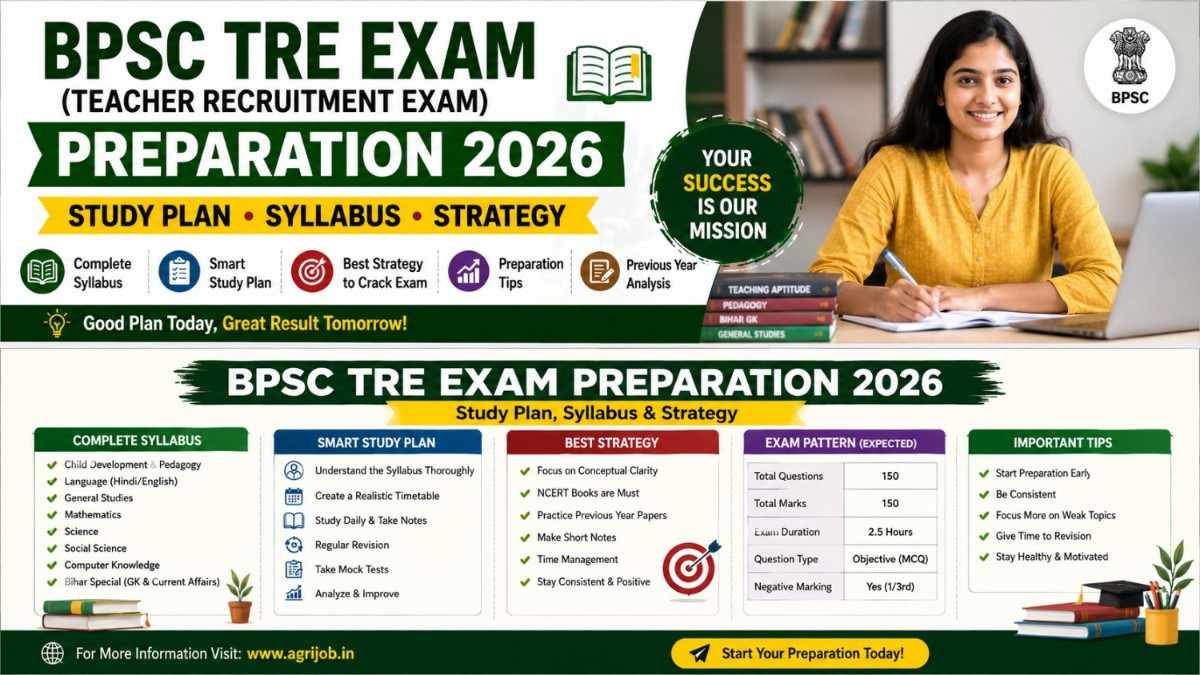
BPSC TRE Exam Preparation 2026 – Complete Study Plan, Syllabus & Strategy
BPSC TRE exam preparation 2026 demands a clear strategy, deep understanding of the SCERT and NCERT-based syllabus, and a structured study plan — because Bihar Teacher Recruitment Test is one of the most competitive government teacher exams in India with lakhs of aspirants competing for thousands of permanent teaching posts. BPSC TRE (Bihar Public Service Commission Teacher Recruitment Exam) covers 4 levels — PRT (Class 1–5), Middle (Class 6–8), Secondary/TGT (Class 9–10), and Higher Secondary/PGT (Class 11–12) — each with a dedicated syllabus aligned to Bihar’s SCERT textbooks and NCERT curriculum. With a salary of Rs.25,000–Rs.65,000/month for selected teachers, this is a life-changing opportunity. This complete guide gives you the full syllabus breakdown, a 90-day study plan, GK GS strategy, subject-wise tips, and everything you need to score 90+ and get selected in Bihar Shikshak Bharti 2026.

| Exam Name | BPSC TRE (Bihar Teacher Recruitment Exam) |
| Conducting Body | Bihar Public Service Commission (BPSC) |
| Levels | PRT (1–5), Middle (6–8), TGT (9–10), PGT (11–12) |
| Total Questions | 150 questions / 150 marks |
| Duration | 2 hours 30 minutes |
| Negative Marking | NO negative marking |
| Syllabus Source | Bihar SCERT + NCERT textbooks |
| Salary (PRT) | Rs.25,000–35,000/month (permanent govt post) |
| Salary (PGT) | Rs.47,600–65,000/month |
| Official Website | bpsc.bih.nic.in |
- BPSC TRE 2026 Exam Pattern — All Levels
- Complete Syllabus — SCERT & NCERT Based
- GK GS Preparation Strategy (Part II)
- Language Section Strategy (Part I)
- Subject-Specific Strategy (Part III)
- 90-Day Study Plan — Week by Week
- Best Books & Resources for BPSC TRE 2026
- Who Should Apply for BPSC TRE 2026?
- BPSC TRE vs STET — Which Bihar Teacher Exam is Better?
- High-Value Terms Every BPSC TRE Aspirant Must Know
- Frequently Asked Questions
BPSC TRE 2026 Exam Pattern — All Levels Explained
BPSC TRE exam preparation 2026 must begin with a thorough understanding of the exam pattern. The Bihar teacher exam is an MCQ-based test of 150 questions, 150 marks, and 2.5 hours. The pattern differs slightly by level but follows the same 3-part structure for Middle, Secondary, and Higher Secondary — and a 2-part structure for Primary level.
| Level | Part I — Language | Part II — General Studies | Part III — Subject | Total |
|---|---|---|---|---|
| PRT (Class 1–5) | 30 marks (qualifying) | 120 marks | — | 150 marks |
| Middle (Class 6–8) | 30 marks (qualifying) | 40 marks | 80 marks | 150 marks |
| Secondary TGT (Class 9–10) | 30 marks (qualifying) | 40 marks | 80 marks | 150 marks |
| Higher Secondary PGT (Class 11–12) | 30 marks (qualifying) | 40 marks | 80 marks | 150 marks |
- ✅ No negative marking — attempt all 150 questions; never leave any blank
- 🕐 2 hours 30 minutes — approximately 1 minute per question; time management is critical
- 📝 Language section is qualifying — minimum 30% (9/30) required; does NOT count in final merit
- 🏆 Merit is based on Part II + Part III (110 or 120 marks depending on level)
- 📚 GS questions are from Bihar SCERT — explicitly stated by BPSC in official notifications
Complete BPSC TRE Syllabus 2026 — SCERT & NCERT Based Breakdown
The BPSC TRE syllabus 2026 is firmly rooted in Bihar SCERT content (for General Studies) and NCERT textbooks (for subject-specific sections). Understanding exactly which chapters and topics are covered at each level is the single most important step in BPSC TRE exam preparation. Here is the complete level-wise and part-wise breakdown:

Part I — Language Syllabus (30 Marks, Qualifying)
- 🇬🇧 Part I-A — English (compulsory for all): Reading comprehension, grammar (tenses, articles, prepositions, active/passive), vocabulary, sentence correction, fill in the blanks, error detection — Class 6–10 NCERT English level
- 🗣️ Part I-B — Hindi / Urdu / Bangla (choose 1): Reading comprehension in chosen language, grammar, vocabulary, paragraph writing basics, sentence formation — Bihar SCERT language textbooks Class 6–10 level
Part II — General Studies Syllabus (40 Marks for TGT/PGT; 120 Marks for PRT)
GS questions are explicitly drawn from Bihar SCERT textbooks. This section tests 8 broad domains:
| GS Domain | Key Topics | SCERT/NCERT Source |
|---|---|---|
| Primary Mathematics | Number system, LCM/HCF, fractions, decimals, percentage, ratio & proportion, profit & loss, simple/compound interest, area, perimeter, volume | NCERT Class 6–8 Maths |
| Logical Reasoning & Mental Ability | Series, analogy, coding-decoding, direction, blood relations, syllogism, ranking, Venn diagrams, calendar & clock | Standard reasoning books |
| General Awareness & Current Affairs | Bihar GK, national current affairs, sports, awards, appointments, schemes, important days, recent government decisions | Bihar SCERT + Monthly CA |
| General Science | Physics: motion, force, light, sound, electricity; Chemistry: elements, compounds, acids/bases, metals; Biology: cell, nutrition, reproduction, disease, environment | NCERT Science Class 6–10 |
| Social Studies | Indian history (ancient, medieval, modern), Indian Constitution, government, Bihar history and culture, economics basics | NCERT + Bihar SCERT SST |
| Geography | Earth and solar system, landforms, rivers, climate zones, India’s physical geography, Bihar geography (rivers, districts, crops, industries) | NCERT + Bihar SCERT Geography |
| Environmental Studies (EVS) | Environment, biodiversity, pollution, conservation, natural resources, climate change, ecosystem | NCERT EVS Class 3–5, 6–8 |
| Indian National Movement | 1857 revolt, INC formation, Swadeshi movement, Non-Cooperation, Civil Disobedience, Quit India, Partition, role of Bihar in freedom struggle (Champaran Satyagraha) | NCERT History Class 8, 10, 12 |
Part III — Concerned Subject Syllabus (80 Marks)
The subject paper carries the highest weightage — 80 out of 150 marks and is the primary differentiator in merit. NCERT textbooks are the core source, with the level varying by teaching post:
- 📗 Middle (Class 6–8): NCERT textbooks Class 6–8 of your subject + Bihar SCERT equivalent. Subjects include Mathematics, Science, Social Science, Hindi, English, Urdu, Sanskrit, Maithili, Bangla
- 📘 Secondary/TGT (Class 9–10): NCERT textbooks Class 9–10 in your subject. Key subjects: Mathematics, Physics, Chemistry, Biology, History, Geography, Political Science, Economics, Sanskrit, Hindi, English, Computer Science
- 📙 Higher Secondary/PGT (Class 11–12): NCERT textbooks Class 11–12 + graduation-level content. Subjects: Mathematics, Physics, Chemistry, Botany, Zoology, History, Political Science, Geography, Economics, Sociology, Psychology, Philosophy, Home Science, Computer Science, Commerce/Accountancy, Music, Entrepreneurship
- 📕 Primary PRT (Class 1–5): No separate subject paper; the 120-mark GS paper covers all subjects at Class 5 and below standard using SCERT Bal Vigyan Sammelan content
BPSC TRE GK GS Preparation Strategy 2026 — Score 35+ out of 40
General Studies is where BPSC TRE exam preparation 2026 candidates either gain or lose their selection chance. Since GS questions are specifically from Bihar SCERT, your strategy must prioritize SCERT content over generic national-level GK books. Here is a proven domain-wise approach:
Bihar-Specific GK — Your Secret Weapon
Bihar GK features prominently in every BPSC TRE exam — often 8–10 questions in GS alone. Focus deeply on these areas:
- 🏛️ Bihar History: Magadha Empire, Maurya Dynasty (Chandragupta, Asoka), Gupta period, medieval Bihar (Nalanda, Vikramshila universities), 1857 revolt in Bihar (Kunwar Singh), Champaran Satyagraha 1917 (Gandhi’s first civil disobedience), Bihar as the cradle of Indian democracy
- 🗺️ Bihar Geography: Location (20°58’N–27°31’N), 38 districts, 9 divisions, major rivers (Ganga, Gandak, Koshi, Sone, Bagmati, Punpun), Northern Bihar Plain vs Southern Bihar Plateau, major crops (paddy, wheat, maize, lichi — Muzaffarpur’s lichi is GI-tagged), minerals
- 💼 Bihar Economy & Schemes: GSDP growth rate, major government schemes — Mukhyamantri Kishori Swasthya Yojana, Har Ghar Bijli Yojana, Bihar Startup Policy 2022, Jal Jeevan Hariyali, PM Kisan Samman Nidhi implementation in Bihar
- 🧑🤝🧑 Famous Personalities from Bihar: Aryabhata, Chanakya, Sher Shah Suri, Guru Gobind Singh (Patna Sahib), JP Narayan, Rajendra Prasad (1st President), Jagannath Mishra, Nitish Kumar
- 🏛️ Bihar Polity: Bihar Legislative Assembly (243 seats), Bihar Legislative Council, Chief Minister, Governor, High Court at Patna, important Articles applicable to Bihar
General Science GS Strategy — NCERT Class 6–10
- ⚛️ Physics topics: Laws of motion, force and pressure, light (reflection, refraction, human eye), sound (properties, decibel), electricity (Ohm’s law, series/parallel circuits), magnetism, work and energy
- 🧪 Chemistry topics: Atoms and molecules, structure of atom, periodic table (first 20 elements), acids/bases/salts, metals and non-metals, carbon compounds, chemical reactions and equations
- 🌿 Biology topics: Cell structure (prokaryotic vs eukaryotic), tissues, nutrition in plants and animals, reproduction (asexual, sexual), heredity, human diseases (bacterial, viral, deficiency), ecosystem, food chain
- 🌍 EVS topics: Biodiversity, air and water pollution, solid waste management, greenhouse effect, ozone depletion, conservation of wildlife and forests, sustainable development
Indian National Movement — High-Yield Topics
- 📅 1857 Revolt: Causes, leaders (Mangal Pandey, Kunwar Singh of Bihar, Rani Lakshmibai), outcome, why it failed
- 🏛️ Indian National Congress: Founded 1885 (A.O. Hume), early moderates (Dadabhai Naoroji, Gokhale) vs extremists (Bal-Pal-Lal), Surat Split 1907
- ✊ Gandhi’s movements: Champaran Satyagraha 1917 (Bihar), Non-Cooperation Movement 1920, Civil Disobedience/Dandi March 1930, Quit India Movement 1942
- 📜 Important Acts: Government of India Act 1919, 1935, Rowlatt Act 1919, Montague-Chelmsford Reforms
- 🇮🇳 Independence & Partition: Cabinet Mission Plan, Mountbatten Plan, Independence Act 1947, role of Sardar Patel, Nehru, and Ambedkar
Language Section Strategy for BPSC TRE 2026 — Score Full 30/30
The language section is qualifying (30% minimum = 9/30), but scoring high here gives you confidence and ensures you don’t fail on a technicality. Smart BPSC TRE exam preparation dedicates 20–25 minutes daily to language practice.
- 📖 English (15 marks): Focus on reading comprehension (2 passages), grammar rules (tenses, voice, narration, conjunctions), vocabulary (synonyms/antonyms), one-word substitution, idioms. Source: NCERT English Class 9–10 (Beehive, Moments) + Wren & Martin grammar
- 📝 Hindi (15 marks): Reading comprehension, sandhi-samaas, grammar (karak, ling, vachan, kaal), idioms and proverbs, tatsam-tadbhav. Source: Bihar SCERT Hindi textbooks Class 6–10 + Hardev Bahri’s Hindi grammar
- ⏱️ Time strategy: Attempt language section first in the exam — takes only 15–18 minutes. This secures the qualifying minimum and leaves maximum time for the high-scoring GS and subject sections
Subject-Specific Strategy for BPSC TRE 2026 — Win 70+ in Part III
Part III (Concerned Subject) carries 80 marks — it is the biggest lever for BPSC TRE selection. Candidates who score 65+ in Part III consistently top the merit list. The subject paper is based on NCERT textbooks of the relevant class and level. Here are strategies by major subject groups:
- 🔢 Mathematics (Middle/Secondary): Cover NCERT Class 6–10 fully — Number System, Algebra (linear equations, quadratic equations, polynomials), Geometry (triangles, circles, coordinate geometry), Statistics (mean, median, mode), Probability, Mensuration. Practice 20 numericals daily. Formula sheet revision weekly.
- 🔬 Science (Middle): NCERT Class 6–8 Science — Food, materials, the world of the living, moving things, how things work, natural phenomena, natural resources. Include diagram-based concepts (photosynthesis, human digestive system, electric circuit).
- 🌍 Social Science (Middle/Secondary): NCERT History (Our Pasts I, II, III), NCERT Geography (Earth Our Habitat, Our Environment), NCERT Civics (Social and Political Life), NCERT Economics (Understanding Economic Development). Bihar SCERT Social Science for state-specific chapters.
- ⚗️ Science — Physics/Chemistry/Biology (Secondary/PGT): NCERT Class 9–12 of your specific subject. Master numerical problems (for Physics/Chemistry) and diagram-based questions (for Biology). Previous year BPSC TRE questions from the same subject are invaluable.
- 📚 Languages (Hindi/English/Sanskrit): NCERT prose and poetry from Class 6–12 textbooks + grammar rules. Literary history (for Higher Secondary) including major authors, movements, and important works listed in Bihar SCERT syllabus.
90-Day BPSC TRE Study Plan 2026 — Week-by-Week Schedule
| Phase | Duration | Daily Focus (6–8 hours) | Goal |
|---|---|---|---|
| Phase 1 — Foundation | Day 1–30 (Month 1) | 3 hrs Subject NCERT + 2 hrs GS (SCERT) + 1 hr Language + 1 hr Bihar GK | Complete all NCERT + SCERT reading for your level |
| Phase 2 — Practice | Day 31–60 (Month 2) | 3 hrs Subject deep practice + 2 hrs GS MCQ sets + 1 hr Reasoning + 1 hr Current Affairs | Solve 100+ MCQs daily; identify weak topics |
| Phase 3 — Mock & Revision | Day 61–90 (Month 3) | 1 full mock test daily (150 Qs in 2.5 hrs) + 3 hrs revision + 1 hr PYQ analysis | Achieve 110+ score consistently in mocks |
Weekly Day-by-Day Schedule (Phase 1 — Foundation Month)
- 📅 Monday: Subject NCERT (3 chapters) + Bihar History (SCERT) — 6 hours
- 📅 Tuesday: Subject NCERT (3 chapters) + General Science (NCERT Class 6–8) — 6 hours
- 📅 Wednesday: Subject NCERT (3 chapters) + Geography (Bihar SCERT + NCERT) — 6 hours
- 📅 Thursday: Subject NCERT (3 chapters) + Indian National Movement (NCERT Class 8, 10) — 6 hours
- 📅 Friday: Subject NCERT (3 chapters) + Maths GS (primary maths + reasoning) — 6 hours
- 📅 Saturday: Subject revision + Bihar GK (economy, schemes, personalities) + Language practice — 7 hours
- 📅 Sunday: Full weekly revision + 1 chapter of PYQ analysis + Rest — 4 hours
The single biggest mistake BPSC TRE aspirants make is using generic national-level GK books for the GS section instead of Bihar SCERT textbooks. BPSC explicitly states GS questions come from SCERT — so Lucent’s GK or Arihant’s GK alone will not be enough. Get Bihar SCERT Social Science (Class 6–10), SCERT Science (Class 6–10), and SCERT Hindi textbooks and read them chapter by chapter. Combine this with NCERT for your subject paper, solve BPSC TRE 1.0, 2.0, and 3.0 previous year papers, and take 1 full mock test daily in the final month. This combination has helped thousands of candidates clear Bihar Shikshak Bharti across all rounds.
Best Books & Resources for BPSC TRE Exam Preparation 2026
| Section | Best Book/Resource | Purpose |
|---|---|---|
| General Studies (GS) | Bihar SCERT Textbooks Class 6–10 (all subjects) | Primary source — GS questions are from SCERT |
| Subject Paper | NCERT Textbooks (Class 6–12 as applicable) | Core subject content — 70–80% questions from NCERT |
| Bihar GK | Arihant’s Bihar GK / Bihar Ek Parichay | Bihar history, geography, economy, schemes |
| General GK | Lucent’s General Knowledge (latest edition) | National GK, science, history backup |
| Reasoning | R.S. Aggarwal — Verbal & Non-Verbal Reasoning | Logical reasoning, mental ability — 8–10 marks |
| English Grammar | Wren & Martin High School English Grammar | Grammar rules, sentence correction |
| Hindi Grammar | Hardev Bahri Hindi Vyakaran / SCERT Hindi textbooks | Hindi grammar, comprehension |
| Current Affairs | Pratiyogita Darpan (monthly) + newspaper (Hindustan/Dainik Jagran Bihar edition) | Current affairs, Bihar-specific events |
| Mock Tests | BPSC TRE PYQ papers (TRE 1.0, 2.0, 3.0) + online mock test platforms | Speed, accuracy, exam simulation |
| Mathematics GS | RS Aggarwal Quantitative Aptitude (Class 6–8 topics only for GS) | Primary maths for GS section |
Who Should Apply for BPSC TRE 2026?
- 🎓 B.Ed. / D.El.Ed. graduates from Bihar — the primary target group; B.Ed. or D.El.Ed. is mandatory for most levels and Bihar-based candidates get local language and Bihar GK advantage
- 👩🏫 Experienced private school teachers in Bihar — teaching experience gives a strong foundation for the subject paper and pedagogy-based questions; converting to govt service means salary upgrade from Rs.15,000 to Rs.45,000+
- 📚 CTET / BTET qualified candidates — CTET/BTET qualification is accepted in lieu of eligibility for some BPSC TRE levels; these candidates already have a GK/GS and pedagogy foundation that aligns well with BPSC TRE pattern
- 👨🎓 Fresh graduates with B.Ed. from Bihar universities — strong NCERT foundation from recent graduation is a major advantage for Part III; need to additionally focus on Bihar SCERT and Bihar GK
- 🌾 Agriculture, Science, and Maths graduates seeking government teacher jobs — BPSC TRE covers Agriculture Science, Biology, Chemistry, Physics, and Maths as dedicated subject papers for Middle, Secondary, and PGT levels
- 🏘️ SC/ST/OBC/EWS candidates from Bihar — reserved category relaxations in age, marks, and vacancies make BPSC TRE highly accessible; Bihar TRE has among the highest SC/ST vacancy reservations of any Bihar govt exam
- 👩 Women candidates from Bihar — women have significant reservation benefits in Bihar government teacher posts; teaching is a highly suitable career for women with job security, fixed hours, and proximity to home district
- 📖 Candidates who appeared in BPSC TRE 1.0, 2.0, or 3.0 — repeat applicants have a clear advantage as the syllabus and pattern are identical; use PYQs extensively to improve on your previous performance
BPSC TRE vs Bihar STET — Which Bihar Teacher Exam Should You Prepare For?
| Feature | BPSC TRE (Teacher Recruitment) | Bihar STET (Teacher Eligibility Test) |
|---|---|---|
| Purpose | Direct recruitment to govt teacher posts | Eligibility certificate only (not a job) |
| Conducted by | Bihar Public Service Commission (BPSC) | Bihar School Examination Board (BSEB) |
| Salary on selection | Rs.25,000–Rs.65,000/month (permanent) | No salary — just certificate |
| Levels covered | Class 1–5, 6–8, 9–10, 11–12 | Class 1–5, 6–8 (STET 1); 9–12 (STET 2) |
| Syllabus | SCERT + NCERT + Subject (80 marks) | Child Development + Subject (150 marks) |
| Validity | Lifetime (permanent job) | 7 years certificate validity |
| Frequency | Announced irregularly by Govt of Bihar | Conducted periodically by BSEB |
| Competition | Very high — lakhs of applicants | High — but separate from job process |
| Best for | Candidates wanting direct permanent govt job | Freshers building eligibility for future TRE |
Always prioritise BPSC TRE over STET if both are announced simultaneously — TRE is the direct route to a permanent government teaching job worth Rs.25,000–Rs.65,000/month. STET is just an eligibility certificate. That said, if you are a fresh B.Ed. graduate and BPSC TRE is not currently open, appearing in Bihar STET builds your eligibility and gives you 7 years to attempt TRE. The good news: the preparation for both exams overlaps by 70% — NCERT, SCERT, and Child Development/Pedagogy are common to both. Prepare for BPSC TRE as your primary target and use STET as a backup eligibility safeguard.
High-Value Terms Every BPSC TRE Aspirant Must Know in 2026
- 🏛️ BPSC (Bihar Public Service Commission): The state-level constitutional body that conducts BPSC TRE for permanent teacher recruitment in Bihar government schools. Official website: bpsc.bih.nic.in. Salary for selected teachers: Rs.25,000–Rs.65,000/month.
- 📚 SCERT Bihar: State Council of Educational Research and Training, Bihar — the body that prepares Bihar’s school curriculum and textbooks. GS questions in BPSC TRE are explicitly drawn from SCERT content. Reading SCERT Class 6–10 textbooks is non-negotiable for TRE preparation.
- 📗 NCERT: National Council of Educational Research and Training — the national body whose textbooks form the backbone of the subject paper (Part III) in BPSC TRE. Class 6–12 NCERT of your subject covers 70–80% of Part III questions.
- 🎓 B.Ed. (Bachelor of Education): The 2-year professional degree required for Secondary and Higher Secondary teaching posts in BPSC TRE. From 2030, 4-year integrated B.Ed. (NEP 2020) will also be valid. Monthly salary of a B.Ed. qualified Bihar govt teacher: Rs.35,000–65,000.
- 📋 D.El.Ed. (Diploma in Elementary Education): The 2-year diploma required for Primary (Class 1–5) and Middle (Class 6–8) teaching posts in BPSC TRE PRT level. Bihar has a large number of D.El.Ed. holders who are primary targets for BPSC TRE PRT.
- ✅ CTET (Central Teacher Eligibility Test): Conducted by CBSE; CTET Paper I (Class 1–5) and Paper II (Class 6–8) qualification is accepted for Bihar govt teacher eligibility alongside Bihar STET.
- 📝 Bihar STET (State Teacher Eligibility Test): Conducted by BSEB — provides eligibility certificate (7 years validity) for teaching in Bihar. Preparation overlaps 70% with BPSC TRE.
- 🏫 Bihar Shikshak Bharti: The official name for the Bihar teacher recruitment process — encompasses BPSC TRE notifications, vacancies, merit lists, and final appointment orders for all levels of Bihar government schools.
- 📊 BPSC TRE Cut-Off: The minimum score required for selection varies by category and subject. Based on TRE 1.0, 2.0, 3.0 data: General category cut-off typically 95–115/150; SC/ST cut-off 80–95/150; OBC cut-off 90–105/150.
- 🔄 NEP 2020 and BPSC TRE: The National Education Policy 2020 has introduced changes including 4-year integrated B.Ed. and emphasis on multilingualism, foundational literacy, and competency-based assessment — topics increasingly appearing in BPSC TRE pedagogy questions.
Frequently Asked Questions — BPSC TRE Exam Preparation 2026
What is the syllabus of BPSC TRE 2026?
The BPSC TRE syllabus 2026 has 3 parts: Part I — Language (30 marks, qualifying); Part II — General Studies (40 marks; from Bihar SCERT textbooks covering maths, reasoning, awareness, science, social studies, geography, EVS, Indian national movement); and Part III — Concerned Subject (80 marks; from NCERT textbooks of the relevant class level). For PRT (Class 1–5) there is no Part III; instead GS carries 120 marks.
Which books are best for BPSC TRE GK GS preparation?
For BPSC TRE GK GS preparation the best resources are: Bihar SCERT textbooks Class 6–10 (primary source — GS questions come from SCERT); NCERT Class 6–10 for science, history, geography; Arihant’s Bihar GK for state-specific content; Lucent’s General Knowledge; R.S. Aggarwal for Reasoning; and a monthly current affairs magazine. SCERT content must be prioritised above all other sources.
How many questions are in the BPSC TRE exam?
The BPSC TRE exam has 150 questions for 150 marks (1 mark each), completed in 2 hours 30 minutes. There is absolutely no negative marking, so every question should be attempted. For TGT/PGT levels: 30 marks Language (qualifying) + 40 marks GS + 80 marks Subject = 150. For PRT level: 30 marks Language (qualifying) + 120 marks GS = 150.
Is NCERT enough for BPSC TRE exam preparation?
NCERT forms 70–80% of the subject paper foundation but is not sufficient alone. You must supplement with Bihar SCERT textbooks for GS (since BPSC explicitly sources GS from SCERT), BPSC TRE previous year question papers, Bihar-specific GK resources, and reasoning practice books. Candidates who rely only on NCERT without SCERT typically score well in Part III but lose marks in Part II GS — which costs them selection.
What is the salary after BPSC TRE selection?
Teachers selected through BPSC TRE receive permanent government salary under Bihar Pay Matrix: PRT teachers Rs.25,000–Rs.35,000/month; Middle/TGT teachers Rs.35,000–Rs.44,900/month; Secondary PGT teachers Rs.44,900–Rs.60,000/month; and Higher Secondary teachers Rs.47,600–Rs.65,000/month. All posts carry DA, HRA, medical allowance, and pension under NPS — making total CTC significantly higher.
How to prepare for Bihar-specific GK in BPSC TRE?
Bihar GK preparation for BPSC TRE requires daily reading of Bihar SCERT Social Science textbooks, focused study of Bihar’s history (Magadha, Maurya, Champaran Satyagraha), geography (38 districts, rivers, crops), economy, and government schemes (Har Ghar Bijli, Mukhyamantri Kishori Swasthya Yojana, Jal Jeevan Hariyali). Read the Bihar edition of a Hindi newspaper daily (Hindustan or Dainik Jagran) for current state-level events and appointments.
What is the passing marks for BPSC TRE?
The only fixed minimum in BPSC TRE is 30% in the Language section (9/30 marks) which is qualifying in nature. There is no fixed minimum for GS or Subject paper individually. Based on previous TRE rounds, the competitive cut-off for General category is approximately 95–115 out of 150 depending on subject and district. SC/ST candidates need approximately 80–95/150 and OBC 90–105/150.
How many months of preparation is needed for BPSC TRE?
3 months (90 days) of structured daily study (6–8 hours/day) is sufficient to crack BPSC TRE for candidates with a B.Ed. or relevant graduation background. Month 1: complete NCERT + SCERT reading. Month 2: practice 100+ MCQs daily, deep GS and Bihar GK work. Month 3: full mock tests daily, previous year paper analysis, revision. Candidates who have appeared before can achieve readiness in 45–60 days using PYQ-focused revision.
Useful Links: BPSC Official — bpsc.bih.nic.in | Bihar SCERT — scert.bihar.gov.in | NCERT — ncert.nic.in | BSEB — biharboardonline.gov.in
Last Updated: May 2026 | This BPSC TRE preparation guide is regularly updated for accuracy. Bookmark this page for the latest Bihar teacher recruitment notifications, syllabus changes, and preparation tips.