

Commodity Trading for Farmers 2026 – Hedge Wheat, Rice & Cotton on MCX
Commodity trading for farmers 2026 is no longer the exclusive domain of large traders and export houses. With MCX (Multi Commodity Exchange), NCDEX, and mobile-first brokers like Zerodha making agri futures accessible on a smartphone, Indian wheat, rice, and cotton farmers can now lock in their crop selling price at sowing time — completely eliminating the market price crash risk that has historically wiped out farming profits at harvest. This complete guide explains exactly what MCX hedging is, how wheat, rice, and cotton futures work on Indian commodity exchanges, step-by-step account opening and trade execution, margin requirements, legal framework, FPO collective hedging, and a full comparison of hedging vs selling at mandi price. This guide covers all 12 sections including a FAQ with 8 real farmer questions answered in detail.

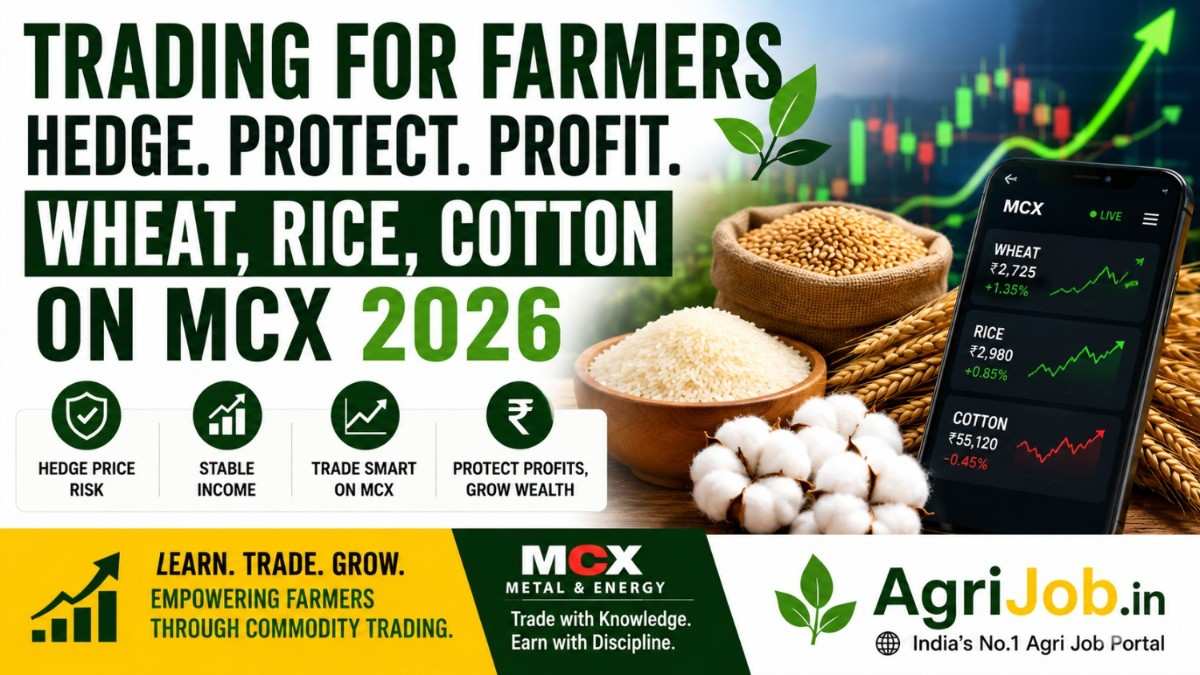
Primary Exchanges: MCX (cotton, mentha) + NCDEX (wheat, chana, soybean)
Regulator: SEBI (Securities and Exchange Board of India)
Wheat Futures Lot Size: 10 tonnes per contract (NCDEX)
Cotton Futures Lot Size: 25 bales per contract (MCX)
Minimum Margin (Wheat): Rs.15,000–Rs.25,000 per lot
Best Broker for Farmers: Zerodha (Rs.20 flat/trade), Angel One
Documents Required: Aadhaar + PAN + Bank Account
Income Protected per Acre (Wheat): Rs.20,000–Rs.45,000
Legal Status: Fully legal under SEBI / Forward Contracts Act
1. Introduction – Commodity Trading for Farmers 2026
2. What Is Hedging? How MCX Protects Your Crop Income
3. How to Hedge Wheat on NCDEX – Complete Guide 2026
4. How to Hedge Cotton on MCX – Complete Guide 2026
5. Rice Hedging in India – Options & Alternatives 2026
6. How to Open MCX/NCDEX Trading Account – Step by Step
7. Margin Requirements & Potential Income from Hedging
8. Who Should Use Commodity Hedging in 2026?
9. FPO Collective Hedging on MCX – NABARD Support
10. MCX Hedging vs Selling at Mandi – Full Comparison
11. High-Value MCX Commodity Trading Terms for Farmers
12. Frequently Asked Questions
What Is Hedging? How MCX Commodity Trading Protects Farmer Income
Every Indian farmer faces the same nightmare: you invest Rs.30,000–Rs.60,000 per acre in seeds, fertilizer, labour, and irrigation — then at harvest time the mandi price crashes 20–40% below your cost of production. Commodity trading for farmers on MCX in 2026 solves this through hedging: a strategy where you sell futures contracts on the exchange for the same quantity of crop you will harvest, locking in today’s higher price even though physical delivery happens months later.
Here is the core logic with a real example for a wheat farmer in Punjab:

- 🌾 At Sowing (October): NCDEX March wheat futures price = Rs.2,400/quintal. You sell 10 tonnes (1 lot) of March wheat futures at Rs.2,400.
- 📉 At Harvest (March): Mandi wheat price crashes to Rs.2,000/quintal due to bumper crop. You sell physical wheat at Rs.2,000 — a loss of Rs.400/quintal vs your expected price.
- ✅ Futures Gain: Your March futures sold at Rs.2,400 can now be bought back at Rs.2,000 — a gain of Rs.400/quintal × 100 quintals = Rs.40,000 profit on the futures position.
- 💰 Net Result: Physical sale loss of Rs.40,000 is exactly offset by futures gain of Rs.40,000. Your effective realisation = Rs.2,400/quintal regardless of market crash. This is perfect hedging.
In practice, the hedge may not be perfect (basis risk exists), but even a partial hedge reduces your income volatility by 60–80% compared to unprotected open-market selling.
How to Hedge Wheat on NCDEX – Complete Guide for Farmers 2026
Wheat is India’s most important Rabi crop and one of the most liquid agri futures contracts on NCDEX. Wheat commodity trading for farmers 2026 on NCDEX offers standardised contracts that allow farmers from Punjab, Haryana, UP, MP, and Rajasthan to hedge their entire season’s production in minutes from a mobile phone.
| Parameter | NCDEX Wheat Futures 2026 |
|---|---|
| Exchange | NCDEX (National Commodity & Derivatives Exchange) |
| Lot Size | 10 tonnes (100 quintals) per contract |
| Contract Months | March, April, May, June (harvest & post-harvest) |
| Current Price Range (2026) | Rs.2,200–Rs.2,600 per quintal |
| Margin Required | Rs.15,000–Rs.25,000 per lot (approx. 6–10% of contract value) |
| Delivery Centre | Hapur, Kota, Delhi, Ludhiana |
| Tick Size | Rs.1 per quintal (Rs.100 per lot) |
| Hedge Coverage per Lot | 4–6 acres of wheat crop |
Wheat Hedging Strategy for a 10-acre Punjab Farmer (2026):
- Estimate yield: 10 acres × 20 quintals/acre = 200 quintals total expected harvest.
- Sell 2 lots of NCDEX March Wheat Futures at Rs.2,450/quintal in October (at sowing).
- Deposit margin: 2 lots × Rs.20,000 = Rs.40,000 with your broker.
- At harvest in March: sell physical wheat at mandi (whatever price prevails) and simultaneously buy back (square off) your 2 futures lots.
- Net effective price = mandi price + futures gain (or minus futures loss) ≈ Rs.2,450/quintal locked in at sowing.
How to Hedge Cotton on MCX – Complete Guide for Farmers 2026
Cotton is India’s most valuable Kharif cash crop — and also the most volatile in price. Gujarat, Maharashtra, Telangana, and Punjab cotton farmers regularly see prices swing Rs.5,000–Rs.15,000 per candy (355 kg) within a single season. MCX cotton futures commodity trading for farmers 2026 is the most effective tool to neutralise this volatility.
| Parameter | MCX Cotton Futures 2026 |
|---|---|
| Exchange | MCX (Multi Commodity Exchange) |
| Lot Size | 25 bales (170 kg/bale = 4,250 kg per lot) |
| Contract Months | October, November, December, January, February, March |
| Current Price Range (2026) | Rs.55,000–Rs.75,000 per candy (355 kg) |
| Margin Required | Rs.20,000–Rs.35,000 per lot |
| Delivery Centre | Rajkot, Akola, Sirsa |
| Tick Size | Rs.10 per candy |
| Hedge Coverage per Lot | Approximately 2–3 acres of cotton |
Cotton Hedging Real Scenario for a Vidarbha Farmer (2026): A farmer in Yavatmal (Maharashtra) with 8 acres expects 80 quintals (800 kg/acre × 8) cotton ginned. At sowing in June, MCX October cotton futures are at Rs.68,000/candy. The farmer sells 4 MCX cotton lots to hedge 80% of expected production. When October arrives and prices crash to Rs.58,000/candy due to global cotton glut, the farmer’s futures gain of Rs.10,000/candy offsets the physical price loss — saving approximately Rs.80,000–Rs.1,20,000 in income that would otherwise have been lost to market volatility.
Rice Hedging in India 2026 – Options & Alternatives for Paddy Farmers
Rice (paddy) hedging on Indian exchanges is more complex than wheat or cotton because government MSP procurement by FCI and state agencies creates a price floor that reduces private market price volatility. However, non-Basmati rice sold outside the MSP procurement system and Basmati rice (for which there is no MSP) remain exposed to significant price risk.
- 🍚 Basmati Rice Futures (NCDEX): NCDEX offers Basmati rice futures contracts for farmers in Punjab, Haryana, and UP who grow export-grade Basmati. Lot size is 10 tonnes; current price range Rs.4,200–Rs.6,500/quintal depending on grade. This is the best hedging route for premium Basmati growers.
- 🌾 Non-Basmati (Common Paddy): No liquid futures market exists for common paddy in 2026 because government MSP procurement absorbs price risk for most farmers in Punjab, Haryana, and UP. Farmers in states with poor MSP procurement (Bihar, Odisha, West Bengal) are advised to explore FPO-level forward contracts with rice millers instead of exchange hedging.
- 🏭 Miller Forward Contracts: Rice millers in Bihar and Eastern UP offer pre-season forward purchase agreements at Rs.1,900–Rs.2,100/quintal for paddy — above MSP of Rs.2,183/quintal (2026-27) but without exchange-traded liquidity. These are OTC (over-the-counter) contracts, not exchange futures.
- 📦 Warehouse Receipt Financing: Paddy farmers in Bihar and Odisha can store crop in WDRA-registered warehouses and receive warehouse receipt loans at 70–80% of crop value from NABARD-linked banks — effectively monetising the crop without distress-selling, then selling when prices recover.
How to Open MCX/NCDEX Commodity Trading Account – Step-by-Step 2026
- Choose a SEBI-Registered Commodity Broker: Best options for farmers in 2026 — Zerodha (lowest cost at Rs.20/trade flat), Angel One (agri-focused tools), HDFC Securities, Motilal Oswal Commodities, or Karvy Commodities. All offer MCX + NCDEX access from a single account.
- Gather Documents: Aadhaar card (for KYC), PAN card (mandatory for commodity trading), active bank account (for fund transfer and DBT settlement), passport-size photograph, and mobile number linked to Aadhaar.
- Complete Online KYC: Visit the broker’s website or app. Upload Aadhaar and PAN. Complete video KYC (5–10 minutes) or e-Sign via Aadhaar OTP. Account is activated within 24–48 hours.
- Fund Your Account: Transfer margin money via UPI, NEFT, or IMPS to your trading account. Start with Rs.25,000–Rs.50,000 for one wheat or cotton hedging lot. Keep 20–30% extra buffer for Mark-to-Market margin calls.
- Identify Your Hedging Requirement: Calculate total expected harvest quantity. Divide by lot size to determine number of futures contracts needed. Aim to hedge 70–80% of expected production (not 100%) to allow flexibility.
- Place Sell Order (Short Hedge): In your broker’s commodity trading platform, select NCDEX Wheat or MCX Cotton. Choose the appropriate delivery month (closest to your expected harvest date). Place a Sell order for the required number of lots at current market price or a limit price.
- Monitor & Manage: Check your futures position daily. If prices move against you (rise significantly), you may receive a margin call requiring additional funds. Carry enough buffer in your account to avoid forced closure of your hedge.
- Square Off at Harvest: When you sell your physical crop at the mandi or to a trader, simultaneously buy back (square off) your futures contracts on the exchange. The net of physical sale price + futures gain/loss = your locked-in effective price.
Margin Requirements & Potential Income Protection from MCX Hedging 2026
| Crop | Farm Size | Expected Yield | Lots Needed | Margin Required | Income Protected |
|---|---|---|---|---|---|
| Wheat (NCDEX) | 5 acres | 100 quintals | 1 lot | Rs.20,000 | Rs.20,000–Rs.45,000 |
| Wheat (NCDEX) | 10 acres | 200 quintals | 2 lots | Rs.40,000 | Rs.40,000–Rs.90,000 |
| Cotton (MCX) | 5 acres | 35 quintals | 2 lots | Rs.50,000 | Rs.30,000–Rs.80,000 |
| Cotton (MCX) | 10 acres | 70 quintals | 4 lots | Rs.1,00,000 | Rs.60,000–Rs.1,60,000 |
| Basmati Rice (NCDEX) | 5 acres | 120 quintals | 1 lot | Rs.30,000 | Rs.50,000–Rs.1,20,000 |
| Soybean (NCDEX) | 5 acres | 60 quintals | 1 lot | Rs.18,000 | Rs.15,000–Rs.35,000 |
Who Should Use Commodity Hedging on MCX in 2026?
- 🌾 Large wheat farmers (5+ acres) in Punjab, Haryana, UP, MP, and Rajasthan who sell surplus wheat beyond MSP procurement and face open-market price volatility — NCDEX wheat futures hedging is tailor-made for this profile.
- 🪴 Cotton farmers in Vidarbha, Telangana, Gujarat, and Punjab who grow Bt cotton for private ginners and textile mills — MCX cotton futures hedging directly protects against the seasonal price swings that have historically driven distress in cotton belt districts.
- 🍚 Basmati rice growers in Punjab, Haryana, and western UP exporting or selling to Basmati-specific rice mills — NCDEX Basmati futures provide export-linked price discovery not available through MSP procurement.
- 🏢 Farmer Producer Organizations (FPOs) with 100+ member farmers who can aggregate production to fill multiple futures lots and hedge collectively at lower per-farmer transaction cost.
- 🌱 Soybean farmers in MP, Rajasthan, and Maharashtra — NCDEX soybean futures are among the most liquid agri contracts in India, with active hedging opportunities throughout the Kharif and post-harvest period.
- 💼 Progressive farmers with smartphones and basic financial literacy who are already using digital banking (UPI, Kisan Credit Card) and can comfortably operate a broker app for commodity trading.
- 🎓 Agriculture graduates working in extension, FPO management, or agritech who can act as commodity market facilitators for farmer clusters — creating a service income of Rs.5,000–Rs.15,000/month by helping farmers execute hedging strategies on MCX and NCDEX.
- 🏦 Agri-traders, commodity aggregators, and APMC commission agents who hold physical stock and want to lock in buy-side prices — long hedging on MCX protects their procurement costs against price rises before resale.
FPO Collective Hedging on MCX – NABARD Support for Farmer Groups 2026
One of the most powerful evolutions in commodity trading for farmers 2026 is NABARD’s active promotion of FPO-level collective hedging. Individual small farmers with 1–3 acres cannot fill a single NCDEX wheat lot (10 tonnes = approximately 5–6 acres yield). But an FPO with 200 member farmers collectively produces 400–500 tonnes — enough to hedge 40–50 lots and qualify for institutional commodity trading infrastructure.
- 🏦 NABARD e-RaKAM Platform: NABARD’s electronic Rural Agri Marketing (e-RaKAM) platform integrates with NCDEX for FPO commodity price discovery and hedging. Registered FPOs can access price information, initiate hedging, and receive margin support through NABARD’s commodity development assistance.
- 💰 NABARD Margin Support: NABARD provides margin money assistance of up to Rs.5 lakh to eligible FPOs for commodity market hedging — reducing the upfront capital barrier for farmer groups entering MCX/NCDEX for the first time.
- 📡 NCDEX mKisan: NCDEX’s mobile-first platform designed for FPO commodity trading offers simplified order placement, multi-language support (Hindi, Marathi, Gujarati, Telugu), and FPO-specific margin netting across member accounts.
- 🎓 Training Support: NABARD’s BIRD (Bankers Institute of Rural Development) and MANAGE (National Institute of Agricultural Extension Management) conduct commodity market literacy programmes for FPO CEOs and board members — covering MCX/NCDEX hedging strategy, basis risk, and margin management.
External Reference: NABARD Commodity Market Support for FPOs | MCX India Live Commodity Prices | NCDEX Agri Commodity Prices 2026
MCX Hedging vs Selling at Mandi – Complete Comparison for Farmers 2026
| Factor | MCX/NCDEX Hedging 2026 | Selling at Mandi (Unhedged) |
|---|---|---|
| Price Certainty | ✅ Locked in at sowing time | ❌ Unknown until harvest day |
| Income Stability | ✅ Protected from 60–80% of volatility | ❌ Full volatility exposure |
| Commission/Fee | Rs.20–Rs.50 per lot (broker) | 2–5% mandi cess + commission agent fee |
| Upfront Capital | ⚠️ Rs.15,000–Rs.35,000 margin per lot | ✅ None required |
| Price Discovery | ✅ National-level transparent price | ❌ Local mandi price, may be suppressed |
| Profit if Prices Rise | ⚠️ Capped at hedged price | ✅ Full upside benefit |
| Smartphone Required | ✅ Yes (for broker app access) | ❌ No |
| Legal Protection | ✅ SEBI regulated, exchange guaranteed | ❌ Only APMC Act, weaker enforcement |
| FPO Support Available | ✅ NABARD margin assistance | ❌ Limited |
| Best Suited For | Large farmers, price-risk-averse, FPOs | Small farmers, subsistence, MSP reliant |
High-Value MCX Commodity Trading Terms Every Farmer Must Know 2026
- Futures Contract: A standardised exchange-traded agreement to buy or sell a fixed quantity of a commodity at a pre-agreed price on a specified future date. MCX cotton and NCDEX wheat futures are the primary contracts for Indian farmer hedging in 2026.
- Short Hedge: A farmer’s strategy of selling futures contracts to protect against falling prices. “Going short” on MCX cotton means you profit from the futures position if cotton prices fall — offsetting your physical crop loss.
- Basis Risk: The difference between the exchange futures price and your local mandi price. Even with a perfect hedge on MCX, basis risk means your effective realisation may differ from the futures price by Rs.50–Rs.200/quintal depending on your location’s distance from the exchange delivery centre.
- Mark-to-Market (MTM): Daily profit/loss settlement on your futures position. If cotton futures price rises Rs.1,000/candy against your short hedge, Rs.1,000 per lot is debited from your margin account daily. This is why keeping a 20–30% buffer above minimum margin is essential.
- Square Off: Closing (exiting) your futures position by taking the opposite trade — buying back your sold futures contracts. Most farmers square off at harvest time rather than going to physical delivery on the exchange.
- Open Interest: Total number of outstanding futures contracts on MCX/NCDEX for a commodity. High open interest in a contract = more liquidity = easier entry and exit for hedgers. Always hedge in the most liquid contract month.
- WDRA Warehouse Receipt: A Warehouse Development and Regulatory Authority-accredited document proving your crop is stored in a certified warehouse. Used as collateral for bank loans at 70–80% of crop value — a key tool for rice and wheat farmers who cannot hedge on exchange but want to avoid distress selling.
- MSP (Minimum Support Price): Government-mandated floor price for notified crops. In 2026-27, wheat MSP = Rs.2,275/quintal, paddy MSP = Rs.2,183/quintal. MSP procurement by FCI is the default price protection for small farmers — MCX hedging is for surplus production sold above MSP quantities or for crops not covered by MSP procurement.
Frequently Asked Questions – Commodity Trading for Farmers MCX 2026
Can farmers trade on MCX to hedge their crops in India 2026?
Yes. Indian farmers can legally hedge wheat, rice, cotton, and other agri commodities on MCX and NCDEX through registered commodity brokers. SEBI permits farmers to take short futures positions to lock in prices before harvest, completely protecting income from price crashes. The minimum lot size for wheat futures on NCDEX is 10 tonnes and for cotton on MCX it is 25 bales.
What is hedging in commodity trading for farmers?
Hedging in commodity trading for farmers 2026 means selling futures contracts on MCX or NCDEX for the same quantity of crop you plan to harvest. If market prices fall at harvest time, your futures position gains exactly as much as your physical sale loses — locking in the price you saw at sowing time and eliminating market price risk from your farming income.
What is the current MCX wheat futures price in 2026?
NCDEX wheat futures in 2026 typically trade at Rs.2,200–Rs.2,600 per quintal for near-month contracts, tracking global wheat prices and domestic mandi trends. For live prices before placing any hedging trade, always check the NCDEX website at ncdex.com or your broker’s commodity trading platform — prices change daily.
How much money do I need to start hedging on MCX as a farmer?
To hedge wheat on NCDEX in 2026, you need margin money of approximately Rs.15,000–Rs.25,000 per lot (10 tonnes). For cotton futures on MCX, margin is Rs.20,000–Rs.35,000 per lot (25 bales). A 5-acre wheat farmer typically needs Rs.20,000–Rs.25,000 total margin to hedge one full season’s expected production of approximately 100 quintals.
Which broker should farmers use for MCX commodity hedging in India?
Farmers can open commodity trading accounts with SEBI-registered brokers including Zerodha (Rs.20 flat per trade — lowest cost), Angel One, HDFC Securities, and Motilal Oswal Commodities. Zerodha’s Kite platform has the most farmer-friendly mobile interface for MCX and NCDEX commodity trading. Account opening requires only Aadhaar, PAN, and a bank account — done fully online in 24–48 hours.
Is MCX hedging legal for Indian farmers in 2026?
Yes — MCX and NCDEX commodity hedging is fully legal for Indian farmers, FPOs, traders, and agricultural businesses under SEBI regulation and the Forward Contracts (Regulation) Act. Hedging positions receive regulatory preference over speculative positions, and SEBI has specifically designed farmer-friendly margin norms to encourage agri commodity hedging in 2026.
What crops can be hedged on MCX in India 2026?
Crops available for hedging in 2026 include wheat (NCDEX), cotton (MCX), castor seed, mentha oil, guar seed, guar gum, crude palm oil, turmeric, jeera, coriander, chana, soybean, and soy oil across MCX and NCDEX. Cotton and wheat are the most liquid contracts for direct farmer hedging, while Basmati rice futures on NCDEX serve premium rice growers.
How do FPOs use MCX for collective hedging in 2026?
FPOs aggregate member crop volumes to collectively fill multiple futures lots and hedge on MCX and NCDEX at lower per-farmer cost. NABARD’s e-RaKAM platform supports FPO commodity trading and provides margin money assistance up to Rs.5 lakh for eligible farmer groups. NCDEX’s mKisan platform offers Hindi-language multi-state FPO hedging tools specifically designed for rural India’s commodity trading needs.
Last Updated: May 2026 | This guide is regularly reviewed and updated for accuracy. Bookmark this page for the latest MCX commodity trading for farmers 2026 updates, contract specifications, and hedging strategy guides.