

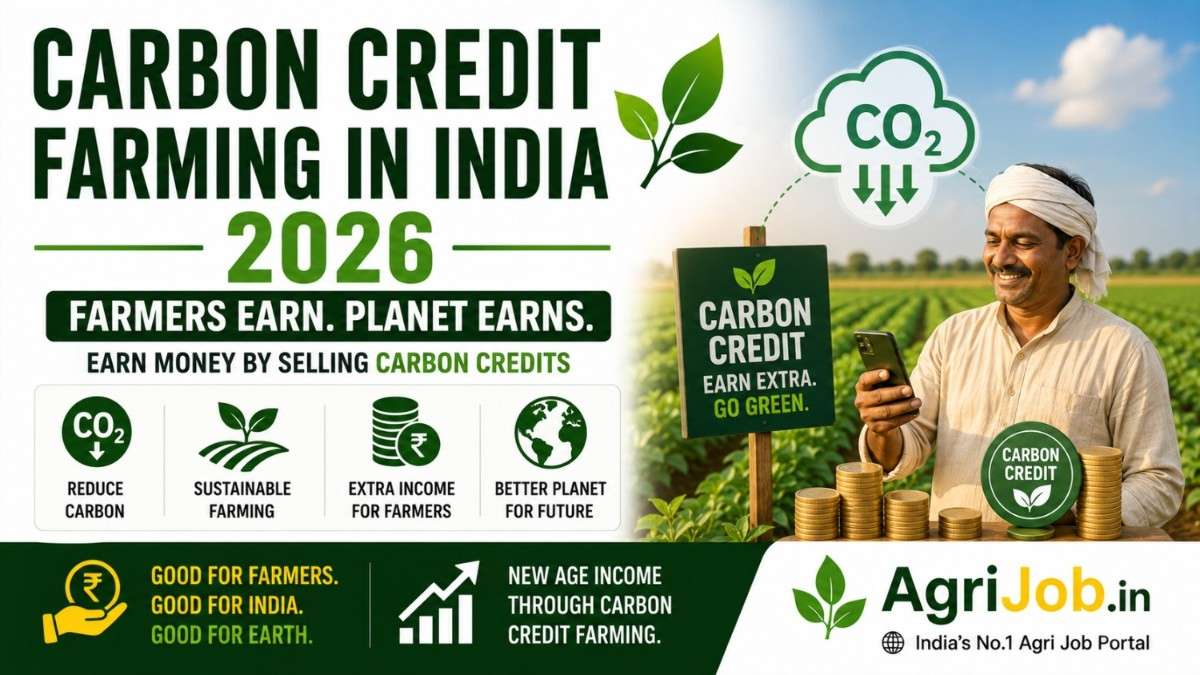
Carbon credit farming India is emerging as one of the most exciting additional income opportunities for Indian farmers in 2026 — offering an estimated Rs.30,000 to Rs.50,000 per year in extra earnings by simply changing how they farm. With India’s corporate sector under mounting pressure to achieve net-zero targets and the Government of India operationalising its domestic Carbon Credit Trading Scheme (CCTS), the demand for verified agricultural carbon credits has never been higher. This complete guide covers what carbon credit farming is, which practices qualify, exactly how much farmers can earn, step-by-step registration process, top platforms and buyers, taxation, and government schemes supporting this green income revolution for Indian agriculture.

📋 Table of Contents
- What Is Carbon Credit Farming in India?
- How Much Can Indian Farmers Earn – Earnings Table 2026
- Agricultural Practices That Qualify for Carbon Credits
- Step-by-Step Registration Process for Carbon Credits
- Top Platforms and Carbon Credit Buyers in India 2026
- Government Schemes Supporting Carbon Credit Farming
- Who Should Register for Carbon Credit Farming?
- Carbon Credit Farming vs Traditional Farming Income – Comparison
- High-Value Carbon Farming Terms Every Farmer Must Know
- Frequently Asked Questions (FAQ)
What Is Carbon Credit Farming in India?
Carbon credit farming is a system where farmers earn money by adopting agricultural practices that reduce greenhouse gas (GHG) emissions or absorb carbon dioxide (CO2) from the atmosphere into the soil or biomass. Every 1 tonne of CO2 equivalent (CO2e) that is sequestered or avoided generates 1 carbon credit, which can be sold to companies, governments, or individuals looking to offset their own emissions.
India is the world’s 3rd largest emitter of greenhouse gases, and its agriculture sector contributes approximately 14% of India’s total GHG emissions — primarily methane from paddy fields and livestock, and nitrous oxide from fertiliser use. This also means Indian agriculture has enormous potential to reduce these emissions and earn carbon credits in the process. With over 140 million farming households in India, even modest adoption of climate-smart practices could generate billions of carbon credits annually.

India’s regulatory framework for carbon trading received a major push with the Energy Conservation (Amendment) Act 2022, which established the legal basis for a domestic Carbon Credit Trading Scheme (CCTS). The Bureau of Energy Efficiency (BEE) under the Ministry of Power is the nodal agency. Agriculture-sector offset credits are expected to be a key component of the domestic market once full operationalisation occurs.
📌 Key Facts – Carbon Credit Farming India 2026
✅ Potential earnings: Rs.30,000 – Rs.50,000 per year per farm
✅ 1 carbon credit = 1 tonne CO2 equivalent absorbed or avoided
✅ Current voluntary market price: USD 5–20 per credit (Rs.415–Rs.1,660)
✅ Eligible land: any agricultural land in India, min. 1 hectare preferred
✅ India’s CCTS regulated by Bureau of Energy Efficiency (BEE), Ministry of Power
✅ Leading Indian aggregator: EKI Energy Services (NSE-listed, India’s largest carbon credit exporter)
✅ Smallholders advised to join FPO or aggregator platform for cost-effective registration
How Much Can Indian Farmers Earn from Carbon Credits – 2026 Earnings Table
Carbon credit farming income depends on 3 key variables: farm size (hectares), practice adopted (sequestration rate), and the prevailing carbon credit price. Here is a realistic earnings estimate for Indian farmers in 2026:
| Farm Size | Practice | Credits Generated/Year | Price @ Rs.800/credit | Price @ Rs.1,500/credit | Annual Earning (Approx.) |
|---|---|---|---|---|---|
| 1 hectare | Zero Tillage | 1–1.5 credits | Rs.800–Rs.1,200 | Rs.1,500–Rs.2,250 | Rs.800 – Rs.2,250 |
| 2 hectares | Agroforestry | 4–6 credits | Rs.3,200–Rs.4,800 | Rs.6,000–Rs.9,000 | Rs.3,200 – Rs.9,000 |
| 5 hectares | Zero Tillage + Organic | 10–15 credits | Rs.8,000–Rs.12,000 | Rs.15,000–Rs.22,500 | Rs.8,000 – Rs.22,500 |
| 10 hectares | Agroforestry + SRI Paddy | 20–30 credits | Rs.16,000–Rs.24,000 | Rs.30,000–Rs.45,000 | Rs.16,000 – Rs.45,000 |
| 20+ hectares | Full Climate-Smart Package | 40–60 credits | Rs.32,000–Rs.48,000 | Rs.60,000–Rs.90,000 | Rs.32,000 – Rs.90,000 |
Important note: Carbon credit income is additional income on top of regular crop revenue. A 5-hectare farmer earning Rs.15,000–Rs.22,500/year in carbon credits is earning the equivalent of 1–2 extra months of net farm income — without any additional crop investment. Farmers practising agroforestry on 10+ hectares have the highest earning potential, with credible cases of Rs.50,000+ per year from premium nature-based solution credits sold to CSR-motivated Indian corporates.
💡 Pro Tip: Small and marginal farmers (less than 2 hectares) earn the most by joining a Farmer Producer Organisation (FPO) that aggregates land and registers collectively. Individual registration costs for carbon verification can be Rs.2–5 lakh — completely unviable for 1–2 hectare holdings. But an FPO aggregating 500 farmers covering 1,000 hectares can spread costs and distribute carbon income efficiently, with each farmer netting Rs.3,000–Rs.8,000/year even after platform fees.
Agricultural Practices That Qualify for Carbon Credits in India
Not all farming changes generate verified carbon credits. Here are the 8 key practices recognised under international voluntary carbon standards (Verra VCS, Gold Standard) and expected under India’s CCTS framework:
- 🌾 Zero Tillage / Reduced Tillage: Avoiding deep ploughing keeps carbon locked in the soil rather than releasing it into the atmosphere. Widely adopted in Punjab and Haryana for wheat. Generates approximately 0.5–1.5 tonnes CO2e per hectare per year. Supported by ICAR research protocols.
- 🌳 Agroforestry (Trees on Farmland): Planting nitrogen-fixing or fruit trees on field borders or within cropland absorbs CO2 in woody biomass. One of the highest-earning carbon practices — 2–5 tonnes CO2e per hectare per year for dense agroforestry systems.
- 🌿 Organic Farming and Composting: Replacing synthetic nitrogen fertilisers with compost, FYM, or biofertilisers dramatically reduces nitrous oxide (N2O) emissions — a greenhouse gas 265 times more potent than CO2. Organic farms also build soil organic carbon over time.
- 🔥 Biochar Application: Burning crop residue in low-oxygen conditions (pyrolysis) produces biochar, a stable form of carbon that can be tilled into soil and remain sequestered for hundreds of years. 1 tonne of biochar applied sequesters approximately 2.5 tonnes CO2e permanently.
- 🌊 System of Rice Intensification (SRI): Alternate wetting and drying (AWD) technique for paddy reduces methane emissions from flooded fields by 30–50% compared to conventional flooding. Critical for India’s massive rice-growing belt.
- 🌱 Cover Cropping and Mulching: Growing legume cover crops between seasons adds nitrogen naturally and builds soil organic matter, reducing both fertiliser input emissions and erosion-related carbon loss.
- 🐄 Manure Management (Biogas / Composting): Capturing methane from livestock manure via biogas plants instead of allowing open-air decomposition generates both clean energy and measurable GHG emission reductions eligible for credits.
- 💧 Drip Irrigation with Precision Fertilisation: Reducing water use and applying fertiliser precisely via fertigation cuts nitrous oxide emissions significantly compared to flood irrigation with broadcast urea application.
Step-by-Step Registration Process for Carbon Credits – Indian Farmers 2026
- ✅ Assess Your Farm’s Eligibility: Confirm you have at least 0.5 hectares of agricultural land and are already practising (or willing to adopt) one of the 8 eligible practices. Make note of your land records (Khasra/Khatauni), Aadhaar, and bank account details.
- ✅ Choose Your Registration Route: Decide whether to register individually (viable for 5+ hectare farms) or through an FPO/aggregator (recommended for smaller farmers). Contact platforms like Boomitra, EKI Energy, or ClimateSeed, or approach your district’s FPO federation.
- ✅ Baseline Assessment: A project developer or aggregator will conduct a baseline measurement of your soil carbon, current farming practices, and emission levels. This is the starting benchmark against which future improvements are measured. For satellite-based platforms like Boomitra, this is done remotely using satellite imagery — no soil sampling required.
- ✅ Sign Project Agreement: Sign a carbon project participation agreement with your aggregator. This defines: the commitment period (typically 5–10 years), your share of carbon credit income (typically 60–80% for farmers), and the approved methodology being used (Verra VCS, Gold Standard, or BEE-CCTS).
- ✅ Implement the Approved Practice: Adopt the agreed practice on your registered plot — zero tillage, agroforestry, SRI paddy, or organic transition. Maintain a simple field diary documenting inputs used and operations performed.
- ✅ Annual Monitoring and Verification: At the end of each year (or project period), a third-party verifier (accredited under Verra or BEE) will measure actual carbon sequestration or emission reductions against the baseline. This generates the verified carbon credits.
- ✅ Credit Issuance and Sale: Once verified credits are issued in the farmer’s name (or the FPO’s name), the aggregator lists them on a carbon registry (Verra Registry, Gold Standard Registry, or domestic CCTS registry). Buyers bid or purchase at prevailing market rates.
- ✅ Payment to Farmers: After the sale is completed, payment is transferred to farmer bank accounts — directly via DBT (Direct Benefit Transfer) in India or through the FPO’s account for aggregated projects. Payment cycles are typically annual.
Top Carbon Credit Platforms and Buyers for Indian Farmers in 2026
| Platform / Organisation | Type | Focus | Farmer Payment Share | Min. Farm Size |
|---|---|---|---|---|
| Boomitra | Agri-carbon aggregator | Soil carbon (satellite-based), zero tillage | ~70–80% | 0.5 hectare (via FPO) |
| EKI Energy Services (NSE: EKINDIA) | Carbon credit developer & exporter | All agricultural methodologies | 60–75% | 5 hectares (individual) |
| ClimateSeed | International carbon marketplace | Agroforestry, reforestation | 65–75% | Via FPO |
| NABARD Green Fund | Government-linked | Agroforestry, watershed, organic transition | Varies by scheme | FPO preferred |
| Verra (VCS Registry) | International standard body | All approved methodologies | Farmer-negotiated | Any (project-based) |
| Gold Standard | International standard body | SDG co-benefit credits (premium priced) | Farmer-negotiated | Any (project-based) |
Top carbon credit buyers from Indian agriculture in 2026 include: Tata Group (net-zero by 2045 commitment), Mahindra & Mahindra (Farm Equipment Sector’s own sustainability offset programme), ITC Limited (agri-linked carbon programmes), Wipro, Infosys, and global companies like Microsoft (purchasing nature-based solution credits from India), and international airlines under CORSIA carbon offset requirements. For official guidance, farmers can contact the Bureau of Energy Efficiency (BEE) or visit ICAR’s official website for soil carbon research protocols.
Government Schemes Supporting Carbon Credit Farming in India 2026
- 🏛️ Carbon Credit Trading Scheme (CCTS) 2023: India’s domestic carbon market established under the Energy Conservation (Amendment) Act 2022. BEE is the nodal agency. Agriculture sector offset credits are expected to be formally included once sector-specific methodologies are notified. Farmers and FPOs registering now under Verra/Gold Standard will be well-positioned to transition to the domestic market.
- 🌱 PM-PRANAM (Programme for Restoration, Awareness, Nourishment and Amelioration of Mother Earth): Central Government scheme launched in 2023 to incentivise states to reduce chemical fertiliser use. States meeting reduction targets receive grants that can be passed to farmers adopting organic and low-emission practices — practices directly eligible for carbon credits.
- 🌾 National Mission for Sustainable Agriculture (NMSA): Promotes climate-resilient agriculture including zero tillage, organic farming, and soil health management — all practices eligible for carbon credit generation. Convergence with carbon credit programmes is actively being explored by Ministry of Agriculture.
- 🌳 Sub-Mission on Agroforestry (SMAF): Provides farmers a subsidy of Rs.10,000–Rs.30,000 per hectare for planting trees on agricultural land under the National Agroforestry Policy. Trees planted under SMAF can simultaneously generate carbon credits — a powerful double-income opportunity.
- 💧 Paramparagat Krishi Vikas Yojana (PKVY): Supports organic farming cluster development with Rs.50,000/hectare assistance over 3 years for groups of 50+ farmers. Organic farms registered under PKVY are strong candidates for premium Gold Standard carbon credits with SDG co-benefits.
- 🏦 NABARD Climate Change Fund: NABARD provides project finance and capacity building for climate-smart agriculture projects. FPOs seeking to develop large-scale carbon credit projects can approach NABARD for initial project development funding. Visit NABARD’s official website for current scheme details.
Who Should Register for Carbon Credit Farming in India?
- 🌾 Farmers already practising zero tillage in Punjab, Haryana, and western UP — Happy Seeder users are already generating carbon credits without realising it; registration and monetisation is the logical next step.
- 🌳 Farmers with trees or orchards on their land (agroforestry holders) — existing tree cover generates immediately quantifiable carbon sequestration eligible for backdated credits under some standards.
- 🌿 Organic farmers and natural farming practitioners — those already following Zero Budget Natural Farming (ZBNF) or certified organic methods are ideally placed for Gold Standard credits with SDG co-benefits that command premium prices.
- 🐄 Dairy farmers with 10+ animals — biogas-based manure management generates measurable methane reduction credits; many dairy FPOs have already successfully registered such projects.
- 🌊 Paddy farmers in Andhra Pradesh, Telangana, Tamil Nadu, West Bengal, and Odisha — willing to adopt alternate wetting and drying (AWD / SRI) for rice cultivation to reduce methane emissions.
- 👨👩👧👦 Farmer Producer Organisation (FPO) leaders — FPOs aggregating 200+ farmers with 500+ hectares of land are the ideal vehicle for cost-effective carbon project registration and maximum negotiating power with buyers.
- 🎓 Agriculture graduates and extension workers — who can serve as community-level carbon project facilitators and earn consulting income while helping farmers register and comply.
- 🏘️ Tribal and forest-fringe farmers — practising traditional shifting cultivation or forest-integrated farming; eligible under some community forestry and REDD+ methodologies for premium biodiversity co-benefit credits.
Carbon Credit Farming vs Traditional Farming Income – Full Comparison
| Parameter | Carbon Credit Farming (Add-On) | Traditional Farming (Status Quo) |
|---|---|---|
| Additional Income | Rs.3,000 – Rs.90,000/year (size-dependent) | Rs.0 additional income |
| Investment Required | Nil (practice adoption only; registration via FPO) | Nil |
| Crop Yield Impact | Zero tillage: same or +5% yield; Agroforestry: diversified income | No change |
| Input Cost Impact | Organic farming: saves Rs.3,000–Rs.8,000/acre on fertiliser | High input costs (fertiliser, pesticide) |
| Soil Health | Significantly improved over 3–5 years | Declining soil organic matter |
| Climate Risk | Reduced (climate-smart practices increase resilience) | Higher vulnerability to weather shocks |
| Registration Complexity | Moderate (simple via FPO/aggregator) | None |
| Payment Timeline | Annual (after verification) | Post-harvest (seasonal) |
| Best For | Progressive farmers, FPO members, agroforestry farmers | Farmers not yet aware of carbon income options |
🏆 Expert Verdict: Carbon credit farming is not a replacement for regular farming income — it is a powerful supplementary income stream that rewards farmers who are already adopting climate-smart practices or are willing to make the switch. The biggest winners in 2026 will be FPO-organised farmers in zero-tillage wheat belts, agroforestry regions, and organic farming clusters who can access premium buyers and share registration costs across hundreds of members. For individual farmers with 5+ hectares, direct platform registration via Boomitra or EKI Energy is increasingly viable with payback in the first year itself.
High-Value Carbon Farming Terms Every Indian Farmer and Agri Professional Must Know
- 🌿 Carbon Sequestration: The process by which plants, trees, and soil absorb CO2 from the atmosphere and store it as organic carbon. Agroforestry and zero-tillage are the primary sequestration methods in Indian agriculture. 1 hectare of mature agroforestry can sequester 2–5 tonnes CO2 per year.
- 📊 Verified Carbon Unit (VCU) / Carbon Credit: A standardised unit representing 1 tonne of CO2 equivalent that has been independently verified under an approved standard (Verra VCS, Gold Standard). VCUs are the tradeable commodity in carbon markets. Current India price: Rs.415–Rs.1,660 per VCU.
- 🏛️ Carbon Credit Trading Scheme (CCTS): India’s domestic carbon market established under the Energy Conservation (Amendment) Act 2022. Governed by Bureau of Energy Efficiency (BEE). Expected to become fully operational for agriculture-sector offsets by 2026–27.
- 🌾 Soil Organic Carbon (SOC): The amount of carbon stored in agricultural soil as organic matter. Higher SOC means better soil fertility, water retention, and more carbon credits. Measured in tonnes of carbon per hectare. India’s average SOC is low (0.3–0.5%) — significant improvement potential.
- 🌱 Additionality: A core carbon market principle requiring that the emission reduction or sequestration would NOT have happened without the carbon credit incentive. Farmers must prove their practice adoption is driven (at least partly) by the carbon income opportunity.
- 🔍 Third-Party Verification: Independent audit of a carbon project by an accredited verifier (e.g., Bureau Veritas, DNV, SCS Global Services) to confirm that the claimed carbon reductions are real, measurable, and permanent. Required before credits are issued.
- 🌳 Agroforestry Carbon Project: A registered project on the Verra or Gold Standard registry where a defined area of farmland with integrated trees is measured annually for carbon sequestration. India has over 200 registered agroforestry carbon projects as of 2025.
- 🐄 Methane Avoidance Credit: Carbon credits generated by preventing methane emissions — primarily from paddy AWD/SRI and livestock manure biogas management. Methane is 28 times more potent than CO2 over 100 years, so each tonne of methane avoided is worth 28 carbon credits.
- 📱 MRV (Measurement, Reporting and Verification): The technical system used to measure actual GHG reductions, report them to the registry, and get them independently verified. Modern MRV increasingly uses satellite data, drone surveys, and AI — reducing the cost burden on farmers dramatically.
- 🏢 EKI Energy Services: India’s largest carbon credit developer and exporter, listed on NSE (ticker: EKINDIA). Works with Indian farmers, industries, and municipalities to develop, verify, and sell carbon credits to global buyers. A key gateway for Indian agricultural carbon credits into international markets.
Frequently Asked Questions – Carbon Credit Farming India 2026
What is carbon credit farming in India?
Carbon credit farming is a system where Indian farmers adopt climate-friendly agricultural practices — such as zero tillage, agroforestry, organic farming, or biochar application — that reduce or absorb greenhouse gas emissions. Each tonne of CO2 equivalent absorbed or avoided generates 1 carbon credit, which farmers can sell to companies or governments seeking to offset their emissions. India’s domestic Carbon Credit Trading Scheme (CCTS), regulated by BEE, is the official framework for this market.
How much can Indian farmers earn from carbon credits in 2026?
Indian farmers can earn Rs.30,000 to Rs.50,000 per year from carbon credits depending on farm size and practices adopted. A 10-hectare farm under agroforestry and zero tillage can generate 20–30 carbon credits annually. At current prices of Rs.800–Rs.1,500 per credit, that translates to Rs.16,000–Rs.45,000 per year. Premium nature-based solution credits sold to CSR buyers can command Rs.2,000–Rs.3,000 per credit, pushing earnings for large agroforestry farms above Rs.50,000 per year.
Which government scheme supports carbon credit farming in India?
India’s Carbon Credit Trading Scheme (CCTS) 2023, notified under the Energy Conservation (Amendment) Act 2022, is the primary domestic framework. PM-PRANAM, NMSA (National Mission for Sustainable Agriculture), Sub-Mission on Agroforestry (SMAF), and Paramparagat Krishi Vikas Yojana (PKVY) all support practices that are eligible for carbon credit generation. NABARD provides financing support for FPOs developing large-scale carbon projects.
How do Indian farmers register for carbon credits?
Indian farmers register through 3 routes: (1) directly via international platforms like Boomitra or EKI Energy for farms 5+ hectares; (2) through Farmer Producer Organisations (FPOs) that aggregate small farmers and handle verification costs collectively; or (3) through the upcoming domestic CCTS registry once agriculture-sector methodologies are notified by BEE. Small farmers (under 2 hectares) should always join an FPO to make registration economically viable.
What agricultural practices qualify for carbon credits in India?
Eligible practices include: zero tillage/reduced tillage, agroforestry (trees on farmland), organic farming and composting, biochar application, System of Rice Intensification (SRI/AWD) for paddy, cover cropping, biogas-based manure management, and precision drip irrigation with fertigation. Each practice must be implemented on registered farmland and measured against an approved baseline by a third-party verifier.
Who buys carbon credits from Indian farmers?
Carbon credits from Indian farmers are purchased by Indian corporates meeting net-zero/CSR targets (Tata, Mahindra, ITC, Wipro), international companies under SBTi commitments, carbon brokers like EKI Energy Services, airlines under CORSIA offset requirements, and development finance institutions seeking rural livelihood co-benefits. Premium credits from agroforestry or ZBNF farms with biodiversity co-benefits attract the highest prices from impact-oriented buyers.
Is carbon credit income taxable for Indian farmers?
As of 2026, the tax treatment of carbon credit income for farmers is not definitively settled in Indian tax law. If credits arise purely from agricultural activity on agricultural land, a case can be made for agricultural income exemption under Section 10(1) of the Income Tax Act. However, this has not been formally notified. Farmers earning above Rs.2.5 lakh annually from carbon credits should consult a Chartered Accountant and monitor CBDT circulars on this evolving area.
What is the price of 1 carbon credit in India in 2026?
Voluntary carbon market prices for agriculture-based credits in India range from USD 5–20 per credit (Rs.415–Rs.1,660) in 2026. Nature-based solution credits with additional biodiversity or livelihood co-benefits can command USD 15–30 (Rs.1,245–Rs.2,490). The domestic CCTS market, once operational, is expected to establish a price floor of Rs.500–Rs.1,500 per credit based on industry projections.
What is Boomitra and how does it help Indian farmers earn carbon credits?
Boomitra is an agri-carbon platform using satellite data and AI to measure soil organic carbon changes on Indian farmland — eliminating expensive ground-level soil sampling. Farmers join through field partners or FPOs, register their zero-tillage or organic practices, and receive annual INR payments directly into bank accounts after satellite-based verification. Boomitra had enrolled over 500,000 hectares of Indian farmland as of 2025, making it one of the largest agricultural carbon programmes in Asia.
This guide is regularly reviewed and updated for accuracy. Bookmark this page for the latest carbon credit farming opportunities, prices, and government scheme updates for Indian farmers in 2026.
Last Updated: May 2026