
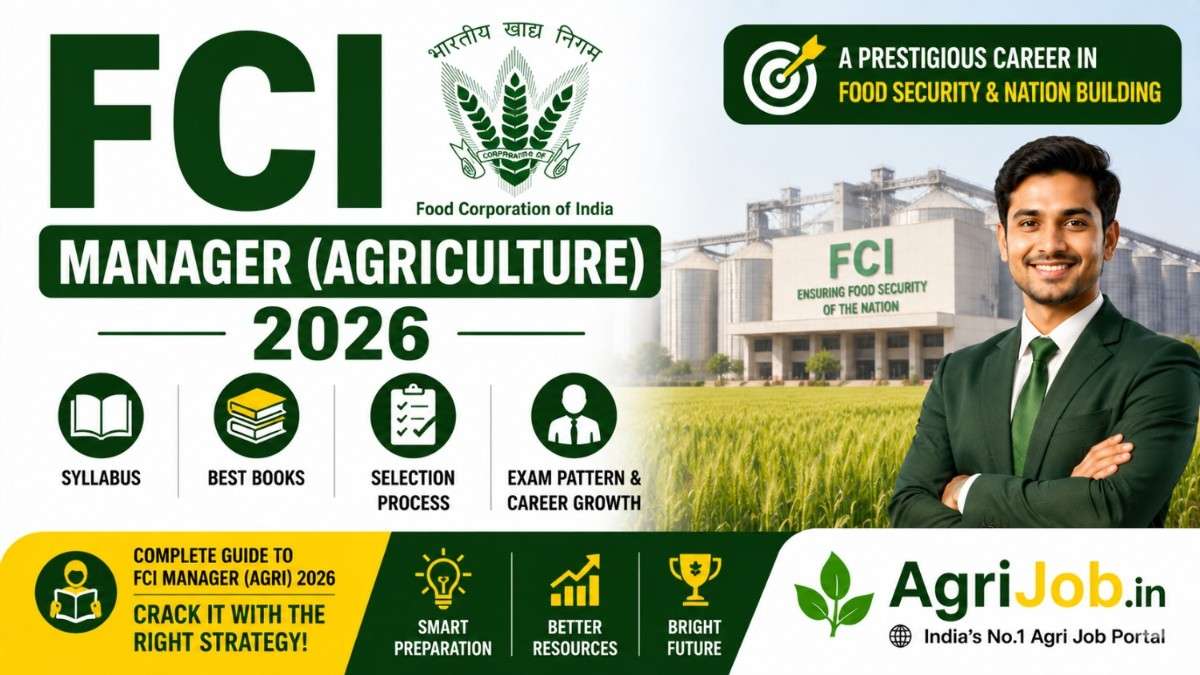
FCI Manager Agriculture 2026 – Detailed Syllabus, Books & Selection Process
The FCI Manager (Agriculture) post is one of the most coveted government job opportunities for agriculture graduates in India. Offered by the Food Corporation of India (FCI) — the country’s largest government-owned food procurement and distribution agency — the Manager (Agriculture) post places you at the heart of India’s food security system, directly involved in grain procurement, quality assessment, storage management, and agricultural extension coordination.

With a salary package exceeding ₹1 lakh per month (including all allowances), excellent job security, and career growth opportunities within FCI, this post attracts hundreds of thousands of applicants from across the country. This comprehensive guide covers everything you need to crack FCI Manager Agriculture 2026 — complete syllabus, best books, the 3-phase selection process, and smart preparation strategy.
📋 FCI Manager Agriculture 2026 – Exam Overview
| Organization | Food Corporation of India (FCI) |
| Post Name | Manager (Agriculture) – Category II |
| Recruiting Agency | Staff Selection Commission (SSC) on behalf of FCI |
| Post Level | Category II (Officer/Manager Level) |
| Pay Scale | ₹40,000 – ₹1,40,000/month (IDA Pay Scale) |
| Gross Salary | ₹1,00,000 – ₹1,20,000/month (with all allowances) |
| Eligibility | BSc Agriculture / BSc Horticulture / BSc Botany with minimum 60% marks |
| Age Limit | 28 years (General) | 31 years (OBC) | 33 years (SC/ST) |
| Selection Phases | Phase I (CBT) → Phase II (CBT) → Phase III (Interview) |
| Official Website | fci.gov.in / ssc.nic.in |
🎓 Eligibility Criteria – FCI Manager Agriculture 2026
Educational Qualification
- Mandatory: BSc Agriculture / BSc Horticulture from a recognized university with minimum 60% aggregate marks (55% for SC/ST candidates)
- Also Eligible: BSc Botany / BSc Biochemistry with Agriculture specialization (check official notification for subject-wise eligibility)
- Preferred: Candidates with MSc Agriculture or MBA Agribusiness have an advantage in the interview phase
- No Experience Required: This is a direct recruitment post open to freshers
Age Limit
| Category | Maximum Age |
|---|---|
| General / EWS | 28 years |
| OBC (Non-Creamy Layer) | 31 years (3 years relaxation) |
| SC / ST | 33 years (5 years relaxation) |
| PwBD (General) | 38 years (10 years relaxation) |
| Ex-Servicemen | As per Government norms |
📝 FCI Manager Agriculture 2026 – Complete Selection Process
FCI Manager (Agriculture) recruitment follows a 3-phase selection process. Clearing all three phases is mandatory for final appointment.

Phase I – Online Preliminary Examination (CBT)
| Section | Topics | Questions | Marks | Duration |
|---|---|---|---|---|
| English Language | Comprehension, grammar, vocabulary | 25 | 25 | 60 minutes |
| Reasoning | Logical reasoning, puzzles, series | 25 | 25 | |
| Numerical Aptitude | Arithmetic, data interpretation, percentages | 25 | 25 | |
| General Awareness | Current affairs, India GK, agriculture GK | 25 | 25 | |
| Total | 100 | 100 |
Negative Marking: 0.25 marks deducted per wrong answer | Nature: Qualifying / Screening only (marks not counted in final merit)
Phase II – Online Main Examination (CBT)
Phase II is the most critical phase — marks scored here contribute to the final merit list for interview shortlisting.
| Section | Topics | Questions | Marks | Duration |
|---|---|---|---|---|
| Part A – General English | Advanced comprehension, grammar, vocabulary, précis writing | 20 | 40 | 120 minutes |
| Part B – General Studies | Current affairs, Indian polity, economy, environment, science & tech | 20 | 40 | |
| Part C – Agriculture (Subject Paper) | All agriculture disciplines (detailed below) | 60 | 120 | |
| Total | 100 | 200 |
Negative Marking: 0.25 marks per wrong answer | Minimum Qualifying: General-45%, OBC-40%, SC/ST-30%
Phase III – Interview / Personality Test
- Marks: 100 marks
- Shortlisting: Top candidates from Phase II merit list (typically 3–5 times the vacancies) are called for interview
- Final Merit: Phase II (200 marks) + Phase III Interview (100 marks) = 300 marks total for final selection
- Interview Focus: Agriculture subject knowledge, current agriculture policy awareness, communication skills, leadership potential, FCI-specific knowledge
📚 FCI Manager Agriculture 2026 – Detailed Syllabus (Phase II – Part C)
The Agriculture subject paper (Part C, 60 questions, 120 marks) is the heart of the FCI Manager Agriculture exam. Questions are at BSc Agriculture final year level, covering all major disciplines. Here is the complete topic-wise syllabus:
1. Agronomy (Expected Weightage: 18–22%)
- Principles of crop production — soil-plant-water-atmosphere relationships
- Crop physiology — photosynthesis, respiration, transpiration, nutrient uptake
- Cropping systems — mono, mixed, inter, relay, sequential, alley, strip cropping
- Tillage types — primary, secondary, conservation tillage, zero tillage, minimum tillage
- Irrigation methods — surface, sprinkler, drip; irrigation scheduling, water use efficiency
- Weed science — classification, biology, critical period, allelopathy, herbicide mode of action, resistance
- Major Kharif crops: paddy, maize, sorghum, bajra, cotton, sugarcane, groundnut, soybean
- Major Rabi crops: wheat, barley, gram, mustard, linseed, potato
- Dryland farming, organic farming, precision agriculture, conservation agriculture
- Crop rotation principles, green manuring, mulching, intercropping advantages
2. Soil Science & Agricultural Chemistry (Expected Weightage: 14–18%)
- Soil formation and profile — pedogenesis, horizons, parent material
- Soil classification — USDA Soil Taxonomy (Orders), Indian classification
- Physical properties — texture, structure, bulk density, porosity, hydraulic conductivity
- Soil water — field capacity, wilting point, available water, matric potential
- Chemical properties — CEC, base saturation, pH buffering, soil acidity & alkalinity
- Soil organic matter — humus fractions, C:N ratio, decomposition, soil health indicators
- Essential nutrients — macro and micronutrients, deficiency symptoms, critical levels
- Fertilizers — urea, DAP, SSP, MOP, complex fertilizers — properties and use
- Integrated nutrient management — biofertilizers, vermicompost, FYM, green manure
- Saline and alkali soils — reclamation, gypsum use, leaching
- Soil conservation — wind and water erosion, contour farming, bunding, check dams
3. Plant Pathology (Expected Weightage: 10–14%)
- Principles of plant pathology — Koch’s postulates, disease triangle, infection process
- Major fungal diseases — rice blast, wheat rust (stem, leaf, yellow), powdery mildews, downy mildews, Fusarium wilt, early & late blight of potato
- Major bacterial diseases — bacterial blight of rice, citrus canker, fire blight of apple
- Major viral diseases — TMV, TYLCV, CMV, sugarcane mosaic, banana bunchy top
- Nematode diseases — root-knot nematode, cyst nematode, burrowing nematode
- Integrated disease management — cultural, biological, chemical, host resistance
- Fungicides — contact vs systemic, FRAC groups, copper, sulphur, triazoles, strobilurins
- Biocontrol agents — Trichoderma viride, Pseudomonas fluorescens, Bacillus subtilis
- Post-harvest diseases — grain molds, storage fungi, mycotoxins (aflatoxin, ochratoxin) — highly important for FCI context
4. Agricultural Entomology (Expected Weightage: 10–12%)
- Insect taxonomy — classification up to order; major pest families
- Insect life cycles — complete and incomplete metamorphosis, instars, diapause
- Economic Threshold Level (ETL) and Economic Injury Level (EIL) — concept and application
- Major crop pests — BPH, WBPH, stem borers, leaf folders (rice); aphids, Hessian fly (wheat); pink bollworm, American bollworm (cotton); pod borers (pulses)
- Stored grain pests — Khapra beetle, grain weevil, lesser grain borer, rust-red flour beetle — EXTREMELY important for FCI
- Pest management strategies — cultural, mechanical, biological, chemical, regulatory
- Insecticide classification — organochlorine, OP, carbamate, pyrethroid, neonicotinoid — mode of action
- Fumigants — Aluminium phosphide (ALP/Celphos), methyl bromide — storage grain fumigation
- IPM components — monitoring, action threshold, intervention decision-making
5. Horticulture (Expected Weightage: 10–12%)
- Pomology — mango, banana, citrus, grapes, apple, guava — varieties, production technology
- Olericulture — tomato, brinjal, potato, onion, pea, cucurbits — cultivation practices
- Floriculture — rose, chrysanthemum, marigold, gladiolus — protected cultivation
- Propagation techniques — budding, grafting, layering, micropropagation
- Post-harvest technology — maturity indices, pre-cooling, cold storage, CA storage, MAP
- Spice crops — black pepper, turmeric, ginger, cardamom, coriander, cumin
- Plantation crops — coconut, arecanut, tea, coffee — agronomy and post-harvest
- Medicinal & aromatic plants — aloe vera, tulsi, ashwagandha, lemongrass
6. Agricultural Economics & Farm Management (Expected Weightage: 8–10%)
- Basic economics — demand, supply, price determination, elasticity
- Farm management — types of farming, farm planning, budgeting, cost concepts
- Production function — law of diminishing returns, returns to scale, factor-product relationship
- Agricultural marketing — price spread, market efficiency, APMC, e-NAM, direct marketing
- Agricultural price policy — MSP, procurement policy, buffer stock, PDS
- Agricultural credit — KCC, NABARD, priority sector lending, cooperative credit
- Agricultural insurance — PMFBY, RWBCIS, crop insurance coverage norms
- FCI-specific knowledge — procurement norms, fair and average quality (FAQ) standards, procurement prices
- WTO and trade — Agreement on Agriculture (AoA), Green/Amber/Blue Box, SPS/TBT agreements
7. Food Grain Storage & Quality Management (Expected Weightage: 8–10%)
(This is the most FCI-specific section — expect 8–12 questions directly from this area)
- Grain quality parameters — moisture content, test weight, broken grain %, foreign matter, insect infestation, grain color
- FAQ (Fair and Average Quality) standards — parameters for wheat, rice, paddy, maize procurement by FCI
- Grain moisture management — safe moisture levels for storage (wheat 12%, rice 14%), moisture meters, drying methods
- Storage structures — conventional godowns, CAP storage (Cover and Plinth), silos, grain bins — capacity and management
- Scientific storage methods — hermetic storage, modified atmosphere storage, grain coding system
- Pest management in storage — prophylactic treatment, celphos fumigation (ALP), phosphine gas management, safety protocols
- Mycotoxin management — aflatoxin in groundnut/maize, ochratoxin in wheat — prevention and testing
- PDS (Public Distribution System) — NFSA 2013, TDPS, Antyodaya Anna Yojana, PMGKAY
- FCI operations — procurement, movement, storage, distribution network, depot management
- Grain quality testing — visual inspection, moisture testing, germination test, Hagberg falling number (wheat quality)
8. Agricultural Extension & Rural Development (Expected Weightage: 5–8%)
- Extension education — definition, scope, principles, methods (individual, group, mass)
- Extension approaches — T&V system, farming system approach, participatory extension
- Agricultural technology transfer — KVK, ATARs, ATMA scheme, FPO development
- Rural development programmes — MGNREGS, PMAY-G, PMGSY, SHG promotion
- Cooperative movement in India — PACS, Iffco, Kribhco, NAFED, NCCF
- Digital agriculture — e-NAM, PM-KISAN portal, mKisan, Kisan Suvidha App, AGMARKNET
9. Plant Breeding & Seed Technology (Expected Weightage: 5–8%)
- Basic genetics — Mendelian laws, chromosome theory, linkage and crossing over
- Plant breeding objectives — yield, quality, disease resistance, stress tolerance
- Breeding methods — mass selection, pure line, pedigree, bulk, SSD, backcross breeding
- Hybrid seed production — male sterility (CMS, GMS), hybrid vigour
- Important released varieties of wheat, rice, maize, cotton — ICAR/CIMMYT varieties
- Seed technology — seed certification classes (Breeder, Foundation, Certified), seed testing (germination, purity, moisture), seed treatment
- Seed legislation — Seeds Act 1966, PPV&FR Act 2001, New Seeds Bill
📖 Best Books for FCI Manager Agriculture 2026
| Subject | Best Books | Author/Publisher |
|---|---|---|
| Agronomy | Principles of Agronomy | S.R. Reddy & G.H.S. Reddy |
| Soil Science | Fundamentals of Soil Science | N.C. Brady & R.R. Weil |
| Plant Pathology | Introduction to Plant Pathology | R.S. Singh |
| Entomology | Agricultural Entomology | K.P. Srivastava |
| Horticulture | Principles of Horticulture | M.K. Sadhu |
| Agricultural Economics | Agricultural Economics | H.L. Sharma & K.C. Sharma |
| Grain Storage | Storage of Grain and Their Products | Christensen & Kaufmann |
| Grain Storage (Indian) | Post Harvest Management of Food Grains | NIPHM Publication |
| Plant Breeding | Principles of Plant Breeding | R.W. Allard |
| Extension Education | Extension Education – Principles & Methods | A.K. Sharma |
| FCI Exam (All Topics) | FCI Manager Agriculture Complete Guide | Kiran Prakashan / Arihant |
| General Awareness | Lucent’s GK + Agriculture Current Affairs | Lucent / AgriJob.in |
| Reasoning & Aptitude | A Modern Approach to Verbal & Non-Verbal Reasoning | R.S. Aggarwal |
| English Language | Objective General English | S.P. Bakshi (Arihant) |
🎯 FCI Manager Agriculture – Phase II Preparation Strategy
Part C – Agriculture Subject (Most Important — 60% of Phase II marks)
Priority 1 – Grain Storage & Quality Management: This topic is unique to FCI and directly relevant to the job. No other agriculture exam tests it as deeply. Spend 15–20% of your total preparation time on storage pest management, mycotoxins, FAQ standards, PDS, and FCI operations. This knowledge will also help massively in the Phase III interview.
Priority 2 – Agronomy: Consistently the highest-weightage topic. Master crop production technology for all major crops, irrigation management, and cropping systems. Practice 30–40 MCQs daily from agronomy.
Priority 3 – Soil Science: Soil classification, soil chemistry, and nutrient management are asked in every FCI agriculture exam. Build solid conceptual understanding of CEC, soil pH, and organic matter.
Priority 4 – Stored Grain Pests (Entomology): Read thoroughly about Khapra beetle, grain weevil, lesser grain borer, and flour beetles — their biology, damage, and management using fumigants. Phosphine (ALP) fumigation protocols are almost always in the exam.
Part A – General English (20 questions, 40 marks)
Practice reading comprehension daily. Focus on grammar (subject-verb agreement, tenses, prepositions), vocabulary (synonyms, antonyms, one-word substitutions), and sentence correction. Use “Objective General English” by S.P. Bakshi for systematic preparation.
Part B – General Studies (20 questions, 40 marks)
Read a quality newspaper daily (The Hindu or Indian Express). Focus on: Union Budget agriculture allocations, government schemes (PMKSY, PMFBY, PM-KISAN, PMGKAY), India’s agriculture trade data, FCI-related news (procurement figures, stock positions, PDS reforms), and environmental policy. Keep a monthly agriculture current affairs register.
📊 FCI Manager Agriculture – Previous Year Cutoff Analysis
| Category | Phase II Cutoff (out of 200) | Final Cutoff (Phase II + Interview, out of 300) |
|---|---|---|
| General / EWS | 105–120 | 160–185 |
| OBC (NCL) | 95–108 | 145–168 |
| SC | 80–95 | 125–148 |
| ST | 75–88 | 115–138 |
Key Insights from Cutoff Trends:
- Part C (Agriculture subject) is the main differentiator — candidates who score 90+ out of 120 in Part C generally clear Phase II comfortably
- Interview scores vary significantly — thorough FCI-specific knowledge (procurement, PDS, grain storage) can add 15–20 extra marks in the interview
- Phase I is purely qualifying — focus maximum effort on Phase II preparation
- Cutoffs have been rising by 3–5 marks per cycle as more agriculture graduates compete
⏰ 90-Day FCI Manager Agriculture Preparation Plan
| Phase | Days | Focus Area | Daily Target |
|---|---|---|---|
| Foundation | Day 1–25 | Agronomy + Soil Science + Grain Storage (Priority topics) | 4 hrs Agriculture + 1 hr English + 1 hr GS |
| Building | Day 26–50 | Plant Pathology + Entomology + Horticulture + MCQ Practice | 3 hrs Agriculture + 1 hr English + 1 hr GS + 50 MCQs |
| Consolidation | Day 51–70 | Agricultural Economics + Plant Breeding + Extension + Weak Areas | 2 hrs Agriculture + 1 hr Aptitude + 70 MCQs |
| Revision & Mocks | Day 71–90 | Full syllabus revision + Previous papers + Full mock tests | 1 full mock daily + Targeted revision |
💼 FCI Manager Agriculture – Job Profile & Career Growth
Job Role of FCI Manager (Agriculture)
- Grain Procurement: Oversee paddy and wheat procurement from farmers/mandis during Kharif and Rabi marketing seasons; ensure FAQ quality standards during purchase
- Quality Inspection: Conduct quality checking of procured grains — moisture testing, foreign matter analysis, pest infestation checking, and grain grading
- Storage Management: Supervise FCI godowns and CAP storage sites; implement pest control measures including ALP fumigation; maintain stock records
- PDS Coordination: Coordinate NFSA grain distribution to ration shops through the Public Distribution System
- Agricultural Extension: Coordinate with state agriculture departments, KVKs, and farmer groups for quality grain production and post-harvest management
- Documentation: Maintain procurement registers, stock statements, quality certificates, and government returns
Promotion Path & Career Growth
| Level | Post | Approx. Salary |
|---|---|---|
| Entry Level | Manager (Agriculture) – Category II | ₹40,000 – ₹1,40,000 (IDA) |
| After 5–8 years | Senior Manager (Agriculture) | ₹50,000 – ₹1,60,000 (IDA) |
| After 12–15 years | Assistant General Manager (Agriculture) | ₹60,000 – ₹1,80,000 (IDA) |
| Senior Level | Deputy General Manager / General Manager | ₹80,000 – ₹2,20,000 (IDA) |
Additional Benefits for FCI Managers
- DA (Dearness Allowance): Updated quarterly — currently adds 40–50% of Basic Pay
- HRA: 8–24% of Basic Pay depending on city classification (X, Y, Z cities)
- Transport Allowance: As per IDA norms
- Medical Benefits: Comprehensive medical coverage for self and family
- LTC (Leave Travel Concession): Domestic travel reimbursement
- PF & Gratuity: Full retirement benefits
- Official Accommodation: FCI quarters / HRA in lieu
- All-India Transfer: Postings across India — experience diverse agricultural ecosystems
📅 FCI Manager Agriculture 2026 – Important Dates (Expected)
| Event | Expected Timeline |
|---|---|
| Official Notification Release | June–August 2026 |
| Online Application Opens | July–September 2026 |
| Last Date to Apply | August–October 2026 |
| Phase I Exam Date | October–December 2026 |
| Phase II Exam Date | January–February 2027 |
| Phase III Interview | March–May 2027 |
| Final Result | June–July 2027 |
Always verify exact dates at fci.gov.in and ssc.nic.in once the official notification is published. Subscribe to AgriJob.in for instant alerts.
💡 Interview Tips for FCI Manager Agriculture Phase III
The Phase III interview carries 100 marks and is the final deciding factor between candidates who are closely matched in Phase II scores. Here is how to prepare:
- Know FCI Inside Out: Study FCI’s history, mandate, organizational structure, zones, annual report highlights, current procurement figures, and stock position. FCI interviewers heavily test domain knowledge of the organization you’re joining.
- Grain Storage Depth: Be ready for detailed questions on fumigation protocols, ALP application rates, safety precautions, phosphine concentration levels, hermetic storage technology, and silo operations.
- Current Agriculture Policy: Know the latest MSP for all major crops, PMGKAY status, One Nation One Ration Card scheme, agricultural export policy, and budget 2026 agriculture highlights.
- Your Agricultural Background: Be ready to discuss your BSc Agriculture project, state agriculture scenario, and how your background makes you suitable for FCI’s role in food security.
- Communication & Presentation: Practice structured English speaking. Interviewers assess your ability to communicate effectively — important for a manager-level post.
- Stay Updated: Follow FCI’s press releases and Ministry of Food & Consumer Affairs announcements in the months before your interview.
❓ Frequently Asked Questions – FCI Manager Agriculture 2026
Q1. Can BSc Horticulture candidates apply for FCI Manager Agriculture?
Yes. BSc Horticulture graduates are eligible for the FCI Manager (Agriculture) post, as it falls within the agricultural sciences domain. However, always verify the specific educational qualification clause in the official notification before applying, as requirements may vary slightly between recruitment cycles.
Q2. Is FCI Manager Agriculture a pan-India posting?
Yes. FCI Manager (Agriculture) is an All-India Service post. Selected candidates can be posted at any FCI zone, region, or depot across India — from Punjab procurement zones to Kerala distribution depots. Transfers are part of the service.
Q3. How many FCI Manager Agriculture vacancies are expected in 2026?
FCI recruitment cycles typically advertise 200–600 Manager (Agriculture) vacancies across all categories. The exact vacancy count depends on retirement figures, expansion of storage capacity, and operational requirements. Check the official notification for confirmed numbers.
Q4. What is the difference between FCI Manager Agriculture and FCI AGM Agriculture?
Manager (Agriculture) is the entry-level officer post (Category II) recruited through open competition. AGM (Assistant General Manager) Agriculture is a senior management post that is typically filled through internal promotion from the Manager cadre after years of service — it is not recruited directly from the open market in most cycles.
Q5. Is coaching necessary for FCI Manager Agriculture?
Coaching is not mandatory. Many candidates crack FCI Manager Agriculture through self-study with the right books and consistent mock test practice. However, given the specific FCI-oriented topics (grain storage, FAQ standards, PDS), it helps to access specialized study material designed for FCI Agriculture preparation. Online test series are highly recommended even for self-studying candidates.
✅ Final Advice – Your Roadmap to FCI Manager Agriculture 2026
FCI Manager Agriculture is a dream job for agriculture graduates — combining great pay, government security, social purpose, and a direct role in India’s food security. The exam rewards candidates who go beyond generic agriculture knowledge and develop FCI-specific expertise in grain storage, quality management, and procurement operations.
Three things will set you apart from other candidates:
- Deep knowledge of stored grain pest management and fumigation — this is FCI’s core operational concern and heavily tested at every stage
- Strong understanding of PDS, NFSA, and FCI’s operational mandate — crucial for Phase III interview
- Consistent MCQ practice with accuracy — negative marking in Phase II means 80% accuracy is better than 100% attempts
Start your preparation today, build systematically, and stay committed. With focused effort, FCI Manager Agriculture 2026 is absolutely within your reach.
For the latest FCI recruitment notifications, syllabus updates, and agriculture exam preparation guides, stay connected with AgriJob.in – India’s #1 Agriculture Job Portal.