

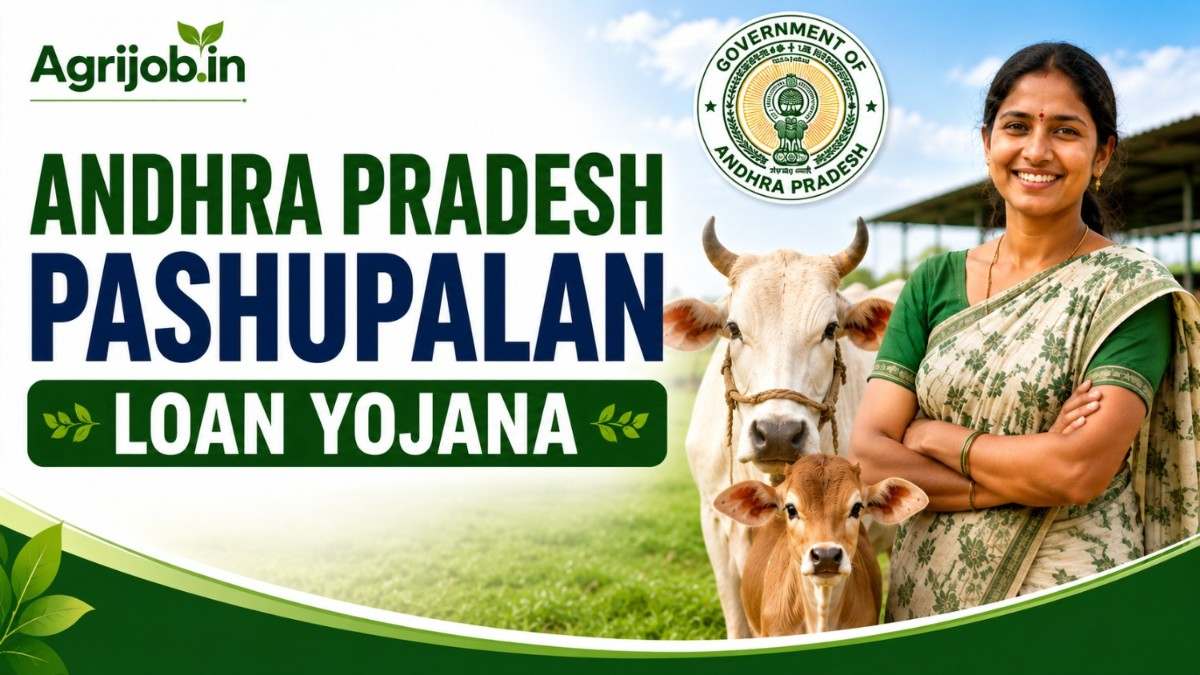
Andhra Pradesh Pashupalan Loan Yojana 2026 gives eligible farmers, women SHG members, and rural entrepreneurs access to subsidised loans of up to Rs.30 lakh per unit — with a government subsidy component of Rs.15 lakh (50% of project cost) — for dairy cattle, sheep, goat, and local breed cow farming. Under the current TDP government led by CM N. Chandrababu Naidu, AP’s Department of Animal Husbandry, Dairy Development and Fisheries (AHDD&F) implements these programmes through NABARD-backed central schemes and AP-specific dairy finance mechanisms. This guide is for AP farmers, rural women in BC/SC/ST communities, dairy entrepreneurs, and agriculture students who want a complete, verified 2026 breakdown of every scheme, subsidy slab, eligibility rule, and application step. You will find: the Local Breed Cow Farm Scheme, YSR Cheyutha animal induction programme, NABARD DEDS/AHIDF options, AP-specific subsidy tables, and a step-by-step apply process via ahd.aptonline.in.

The Andhra Pradesh Pashupalan Loan Yojana 2026 provides a 50% subsidy (Rs.15 lakh) on a Rs.30 lakh Local Breed Cow Farm unit, with a Rs.9 lakh loan component and Rs.6 lakh beneficiary contribution. For dairy cattle (2–10 animals), NABARD DEDS offers 25% subsidy (35% for SC/ST/women) up to Rs.2 lakh per AP beneficiary. Apply through the nearest District Animal Husbandry office or at ahd.aptonline.in.
- Scheme Authority: Dept. of Animal Husbandry, Dairy Development & Fisheries (AHDD&F), Govt. of Andhra Pradesh
- Current Minister: Kinjarapu Atchannaidu (TDP), since June 2024
- Local Breed Cow Farm — Total Project Cost: Rs.30.00 lakh
- Subsidy (Local Breed Cow Farm): Rs.15.00 lakh (50% of project cost)
- Loan Component (Local Breed Cow Farm): Rs.9.00 lakh
- Beneficiary Contribution: Rs.6.00 lakh (20%)
- Dairy Animal Purchase (YSR Cheyutha / general): Rs.75,000/animal unit cost
- Subsidy under NABARD DEDS (General): 25% / max Rs.1.25 lakh (10 animals)
- Subsidy under NABARD DEDS (SC/ST/Women in AP): 35% / max Rs.2 lakh
- AHIDF Interest Subvention: 3% per annum (loan up to 90% of project cost)
- Eligible Animals: Graded Murrah Buffalo, HF Crossbred, Jersey Crossbred, Gir, Sahiwal, Punganoor (Local breed)
- Official Portal: ahd.aptonline.in
- What Is AP Pashupalan Loan Yojana 2026?
- Who Should Apply for This Scheme?
- Income and Subsidy Details — How Much Can You Earn?
- Eligibility and Requirements
- How to Apply — Step-by-Step Process 2026
- AP State Scheme vs NABARD Central Schemes
- Pros and Cons of AP Pashupalan Loan Yojana
- Important Terms Related to Pashupalan Loan
- Important Dates and Timeline
- Important Links
- Conclusion
- Key Takeaways
- Frequently Asked Questions
What Is AP Pashupalan Loan Yojana 2026?
The AP Pashupalan Loan Yojana 2026 is an umbrella of government-backed animal husbandry financing schemes implemented by the Andhra Pradesh Department of Animal Husbandry, Dairy Development and Fisheries (AHDD&F) — providing subsidised loans, capital grants, and interest subvention to farmers, self-help group women, and dairy entrepreneurs for livestock-based livelihood creation across all 26 districts of Andhra Pradesh.
Andhra Pradesh is one of India’s top five milk-producing states, with a cattle population exceeding 1.24 crore and an annual milk output of over 16 million metric tonnes. The AP government channels dairy livestock financing through three distinct pathways: (1) state-operated schemes under AHDD&F such as the Local Breed Cow Farm Scheme and Jagananna Paala Velluva (now continuing under the TDP government with revised branding); (2) NABARD-backed central dairy schemes including DEDS and AHIDF; and (3) the AP State-Level Bankers’ Committee (SLBC) priority-sector agriculture credit programme.
The most significant AP-specific scheme currently operational in 2026 is the Local Breed Cow Conservation and Farm Scheme — a unique programme for promoting organic A2 milk production through indigenous cow breeds like Punganoor, Sahiwal, and Gir. Under this scheme, a Joint Liability Group (JLG) of farmers collectively establishes a desi cow farm with a total project cost of Rs.30 lakh, of which the government provides Rs.15 lakh as subsidy and Rs.9 lakh as bank loan, while the group contributes Rs.6 lakh as their share. This model has been successfully implemented in districts including Amalapuram, Kakinada, and East Godavari.
| Scheme Component | Amount (Rs. Lakh) |
|---|---|
| Total Project Cost | 30.00 |
| Animals Cost (Desi Cows) | 18.90 |
| Cattle Shed Construction | 8.50 |
| Equipment | 2.10 |
| Maintenance Cost | 0.50 |
| Government Subsidy | 15.00 (50%) |
| Bank Loan Component | 9.00 (30%) |
| Beneficiary Contribution | 6.00 (20%) |
Who Should Apply for AP Pashupalan Loan Yojana 2026?
This scheme is designed for a wide range of AP residents involved in or planning to enter livestock-based livelihoods. If any of the following profiles match yours, you should apply in 2026:
- 🧑🌾 Small and marginal farmers in rural AP who own or lease land and want to add a livestock income of Rs.20,000–50,000 per month from dairy cattle or goat farming alongside crop production
- 👩 Women from BC/SC/ST/Minority communities aged 45–60 who qualify under YSR Cheyutha / Jagananna Paala Velluva for a subsidised milch animal with Rs.75,000 unit cost (government-backed bank loan + insurance included)
- 🏡 Self-Help Group (SHG) members in DRDA-linked networks who want to form a Joint Liability Group and collectively own a Local Breed Cow Farm worth Rs.30 lakh with 50% government subsidy
- 🎓 Agriculture graduates and diploma holders under 40 who want to start a modern dairy business instead of waiting for government jobs — a 10-cow NABARD DEDS unit can generate Rs.60,000–1 lakh/month net income
- 🍏 SC/ST farmers who receive the enhanced 35% subsidy (vs 25% for general) under NABARD DEDS/AHIDF schemes available through AP-empanelled banks
- 🛒 Dairy entrepreneurs and FPO members building a commercial dairy unit (Rs.50 lakh–Rs.5 crore) who qualify for AHIDF’s 3% interest subvention and up to 90% project finance
- 🐍 Sheep and goat farmers seeking NLM (National Livestock Mission) 50% capital subsidy under DAHD’s breed development sub-mission, now channelled through AP’s AHDD&F
- 🌿 Indigenous/A2 milk producers wanting to tap the premium market for Punganoor, Gir, or Sahiwal milk — the Local Breed Cow Farm Scheme is specifically designed for this segment
Income and Subsidy Details — How Much Can You Earn in 2026?
Understanding the earnings potential before investing is the single most important step for any pashupalan loan applicant. Below are realistic income projections based on AP market rates for 2026, scheme-wise subsidy slabs, and verified data from AHDD&F district reports.
Scheme-wise Subsidy Comparison Table (AP 2026)
| Scheme | Target Beneficiary | Subsidy % | Max Subsidy (Rs.) | Loan Coverage |
|---|---|---|---|---|
| Local Breed Cow Farm (AP State) | JLG / Farmer Groups | 50% | Rs.15 lakh | Rs.9 lakh (30%) |
| YSR Cheyutha / Jagananna Paala Velluva | BC/SC/ST Women aged 45–60 | Unit-based (Rs.75,000/animal) | Full unit cost via bank | Bank-backed, insurance included |
| NABARD DEDS (General) | All AP farmers | 25% | Rs.1.25 lakh (10 animals) | Bank loan (balance) |
| NABARD DEDS (SC/ST/Women) | AP SC/ST/Women farmers | 35% | Rs.2 lakh | Bank loan (balance) |
| AHIDF (Dairy Processing) | MSMEs, FPOs, SHGs | 3% interest subvention | 90% of project cost | Up to Rs.100 crore loan |
| NLM (Goat/Sheep/Poultry) | Entrepreneurs, FPOs | 50% capital subsidy | Rs.25 lakh (breed development) | Bank loan (balance) |
Breed-wise Monthly Income Potential (AP Market Rates 2026)
| Animal / Breed | Milk Yield / Day | AP Milk Price (Rs./litre) | Monthly Gross Income (5 animals) | Annual Net (Approx) |
|---|---|---|---|---|
| Murrah Buffalo (Milch) | 8–9 litres | Rs.45–55 | Rs.54,000–74,250 | Rs.4.5–6 lakh |
| Graded Murrah Buffalo | 6–8 litres | Rs.45–55 | Rs.40,500–66,000 | Rs.3.5–5 lakh |
| HF Crossbred Cow | 10–12 litres | Rs.32–40 | Rs.48,000–72,000 | Rs.4–6 lakh |
| Jersey Crossbred Cow | 10–11 litres | Rs.32–40 | Rs.48,000–66,000 | Rs.4–5.5 lakh |
| Sahiwal / Gir (A2 Milk) | 6–10 litres | Rs.60–80 (premium) | Rs.54,000–1,20,000 | Rs.5–9 lakh |
| Punganoor (Local Breed) | 3–4 litres | Rs.80–120 (A2 premium) | Rs.36,000–72,000 | Rs.3–5 lakh |
Note: Punganoor and other local AP breeds command significantly higher A2 milk prices in urban markets, health-conscious consumer segments, and Vijaya Dairy premium channels. A 10-animal Punganoor unit under the Local Breed Cow Farm Scheme can generate Rs.3–5 lakh annually in A2 milk revenue alone — plus organic manure sales at Rs.5,000–10,000/month additional income.
Eligibility and Requirements for AP Pashupalan Loan Yojana 2026
Eligibility criteria vary by sub-scheme. The table below covers the most important conditions across AP’s major pashupalan financing programmes in 2026. Verify the specific criteria for your chosen scheme at your District Animal Husbandry office before applying.
General Eligibility Criteria (All AP Pashupalan Schemes)
- Must be a permanent resident of Andhra Pradesh
- Age: Minimum 18 years; YSR Cheyutha targets women aged 45–60 years
- Must possess or lease agricultural / homestead land for cattle shed construction
- Must have an Aadhaar-linked bank account (DBT-enabled) for subsidy transfer
- No existing default on any prior government agricultural loan
- For JLG-based Local Breed Cow Farm: minimum 3–5 farmers in a Joint Liability Group approved by District Collector
- Animals must be INAPH-tagged (mandatory for any AP animal purchase); recently tagged animals (under 1 month) are not eligible for procurement
- For YSR Cheyutha / Paala Velluva: must be a registered SHG member through SERP
Application Fee Table — AP Pashupalan Schemes
| Category | Application Fee | Notes |
|---|---|---|
| General Category | Nil | No fee for state scheme applications |
| SC / ST Category | Nil | Additional subsidy benefit (35% vs 25% under NABARD DEDS) |
| Women SHG Members | Nil | Priority processing under SERP/DRDA channels |
| Bank Processing Charges | As per bank norms | Varies by lender — AP Grameena Vikas Bank, SBI, Andhra Bank |
Documents Required
- 📄 Aadhaar Card (mandatory — used for Aadhaar-based authentication and DBT subsidy transfer)
- 📄 White Ration Card or income certificate
- 📄 Caste Certificate (for SC/ST/BC enhanced subsidy)
- 📄 Bank Account Passbook (Aadhaar-linked, zero-default)
- 📄 Land documents (Patta / lease agreement for shed construction)
- 📄 Passport-size photographs (2)
- 📄 SHG membership certificate (for Paala Velluva / Cheyutha applicants)
- 📄 JLG formation certificate signed by District Collector (for Local Breed Cow Farm Scheme)
- 📄 INAPH tag details of animals being purchased (verified by VAS/AD at RBK centre)
- 📄 Loan application form from bank (AP Grameena Vikas Bank, SBI, or cooperative bank)
How to Apply — Step-by-Step Process 2026
The AP Pashupalan Loan Yojana application process follows a district-level, offline-first model with INAPH portal verification and DBT subsidy release. Follow these steps in 2026:
- Identify Your Scheme: Determine which AP pashupalan scheme fits your profile — Local Breed Cow Farm (JLG/desi cows), Jagananna Paala Velluva (SHG women/dairy animals), NABARD DEDS (individual dairy unit 2–10 animals), or AHIDF (commercial/MSME scale). Each has different eligibility and subsidy structures.
- Visit Your District Animal Husbandry Office: Contact the Joint Director (Animal Husbandry) at your district headquarters or the Veterinary Assistant Surgeon (VAS) at the nearest Rythu Bharosa Kendra (RBK). Collect the prescribed application form and obtain a scheme-specific checklist of documents.
- Form a Joint Liability Group (if applicable): For the Local Breed Cow Farm Scheme, form a JLG of 3–5 eligible farmers. The JLG must be registered and approved by the District Collector-chaired monitoring committee before proceeding to bank sanction.
- Submit Bank Loan Application: Approach AP-empanelled banks — AP Grameena Vikas Bank, State Bank of India, Andhra Bank, or AP Cooperative Bank (APCOB) — with your completed scheme application, JLG/SHG certificate, and all documents. The bank verifies eligibility and prepares a Detailed Project Report (DPR).
- Animal Selection and INAPH Verification: Once loan is sanctioned, select your animals from approved sellers. The VAS/AD conducts INAPH tag verification at the nearest RBK gathering point. Animals must meet breed-specific specifications (age, milk yield, dentition) as mandated by AHDD&F guidelines.
- Insurance and DBT Linkage: Bank arranges 3-year group insurance coverage for purchased animals (insurance premium deducted from unit cost — approx 3.6% of animal value). Subsidy is transferred directly to your Aadhaar-linked bank account via DBT after successful animal purchase and INAPH verification.
- Post-Induction Training: Mandatory training at your local RBK covers feeding practices, milking protocols, vaccination schedules, reproductive health, and milk marketing via Vijaya Dairy cooperatives. AH Assistants conduct follow-up visits (daily in week 1, every 3 days in week 2, weekly thereafter).
AP farmers can legally combine state and central dairy schemes for maximum benefit. For example: take the NABARD DEDS 25% back-ended subsidy for infrastructure (milking machine, cooler unit), then layer it with the AP Local Breed Cow Farm 50% subsidy for animal purchase — as long as the same project component is not double-funded. Consult your District Joint Director (AH) or the NABARD District Development Manager (DDM) at your district office for multi-scheme stacking eligibility before applying.
AP State Pashupalan Scheme vs NABARD Central Schemes — 2026 Comparison
Farmers in Andhra Pradesh often ask: should I apply for the AP state scheme or the NABARD central scheme? The answer depends on your scale, beneficiary category, and livestock type. This comparison covers the key decision dimensions.
| Parameter | AP Local Breed Cow Farm (State) | NABARD DEDS (Central) | AHIDF (Central — Large Scale) |
|---|---|---|---|
| Target Scale | JLG / Group Farm (Rs.30 lakh unit) | Individual (2–10 animals) | MSME / FPO / Large units (Rs.10 crore+) |
| Subsidy % | 50% (Rs.15 lakh) | 25% general / 35% SC/ST/Women | 3% interest subvention (no capital subsidy) |
| Max Subsidy | Rs.15 lakh | Rs.2 lakh (AP SC/ST/Women) | No ceiling — 3% off loan interest |
| Animal Type Covered | Desi breeds only (Punganoor, Sahiwal, Gir) | Crossbred + indigenous (HF, Jersey, Murrah) | All — processing units, feed plants too |
| Subsidy Release Mode | Government subsidy to bank account; loan via bank | Back-ended (credited to loan after repayment) | Back-ended interest subvention |
| Application Channel | District AH Office / District Collector | Commercial bank / RRB | Scheduled bank / udyamimitra.in |
| Best For | JLG groups wanting A2/organic milk farming | Individual dairy farmers scaling up | Dairy entrepreneurs building processing units |
| Insurance | 3-year group insurance (included in unit cost) | Borrower’s responsibility | Borrower’s responsibility |
| INAPH Tag Requirement | Mandatory | Recommended | Not applicable |
For small farmers and SHG women in AP in 2026, the Local Breed Cow Farm Scheme is the clear winner for group-based desi cow farming — 50% subsidy is double what NABARD DEDS offers. However, for an individual farmer purchasing 5–10 crossbred cows (HF/Jersey), the NABARD DEDS route via AP Grameena Vikas Bank or SBI is faster and simpler. SC/ST applicants should always prefer NABARD DEDS in AP for the 35% enhanced subsidy. FPOs and dairy entrepreneurs above Rs.25 lakh project scale should explore AHIDF for maximum loan coverage (90%) with 3% interest relief.
Advantages and Disadvantages of AP Pashupalan Loan Yojana 2026
Advantages (Pros)
- ✅ 50% government subsidy on Local Breed Cow Farm units — one of the highest subsidy rates for livestock in India among state schemes in 2026
- ✅ DBT subsidy transfer directly to Aadhaar-linked bank account — no middlemen, no delay, transparent and corruption-free
- ✅ INAPH-backed animal verification ensures genuine, disease-screened cattle with traceable health records — protects farmers from fraud
- ✅ Built-in 3-year animal insurance under YSR Cheyutha / Paala Velluva schemes with livestock loss compensation up to Rs.30,000/large animal
- ✅ Rythu Bharosa Kendra (RBK) linkage provides doorstep feed supply, veterinary services, and milk marketing access through cooperative networks like Vijaya Dairy
- ✅ Women-priority design — 5.63 lakh women beneficiaries have already received dairy animals under previous iterations; new applications continue to prioritise BC/SC/ST women
Disadvantages (Cons)
- ❌ JLG formation requirement adds administrative complexity — individual small farmers cannot access the Local Breed Cow Farm Scheme alone; need a group of 3–5 farmers
- ❌ NABARD DEDS subsidy is back-ended — the 25–35% subsidy under the central scheme is credited after repayment, not upfront, creating initial cash-flow pressure on new borrowers
- ❌ INAPH tag restrictions (animals tagged less than 1 month are ineligible) can delay animal purchase if suitable tagged stock is unavailable locally — out-of-state procurement adds logistics cost
Important Terms Related to AP Pashupalan Loan Yojana 2026
Understanding these 10 key terms will help you navigate AP’s animal husbandry loan system, communicate correctly with bank officers and district AH officials, and fill applications without errors.
- 🏦 DBT (Direct Benefit Transfer): Government’s system for transferring subsidy directly to the beneficiary’s Aadhaar-linked bank account. All AP pashupalan subsidies use DBT — no cash, no middlemen. Subsidy amount appears as a credit entry in your bank passbook.
- 💳 INAPH (Information Network for Animal Productivity and Health): India’s national cattle identification database maintained by DAHD. Every animal eligible for AP government schemes must be INAPH-tagged — farmers can check their animal’s tag status at the nearest RBK or VAS office.
- 🤝 JLG (Joint Liability Group): A group of 3–5 farmers who jointly apply for a bank loan and are collectively responsible for repayment. The AP Local Breed Cow Farm Scheme mandates JLG formation and District Collector approval before bank sanction.
- 💰 NABARD DEDS (Dairy Entrepreneurship Development Scheme): Central government scheme channelled through NABARD providing 25% (general) or 33.33% (SC/ST) back-ended capital subsidy for dairy units of 2–10 animals; AP state extends this to 35% for women/SC/ST.
- 🏭 AHIDF (Animal Husbandry Infrastructure Development Fund): Rs.29,110 crore central fund offering 3% annual interest subvention on loans up to 90% of project cost for dairy processing, feed plants, breed multiplication farms — ideal for FPOs and dairy MSMEs in AP.
- 📄 Back-ended Capital Subsidy: A subsidy credited to your loan account after a defined repayment period — not paid upfront. NABARD DEDS uses this model. The subsidy reduces your outstanding principal, lowering future EMIs.
- 🏥 RBK (Rythu Bharosa Kendra): AP government’s farm service centres at the village/mandal level where Animal Husbandry Assistants are stationed. These are the primary contact points for INAPH verification, feed ordering (TMR — Total Mixed Ration), animal purchase committee meetings, and milk yield recording.
- 🐄 Punganoor Breed: AP’s indigenous cattle breed found in Chittoor district — small-bodied (height ~3 feet), hardy, drought-resistant, and produces 1,100 kg A2 milk per lactation at Rs.80–120/litre premium rates. Supported under the Local Breed Cow Conservation Scheme.
- 🧾 NLM (National Livestock Mission): DAHD scheme with 50% capital subsidy for breed development and entrepreneurship in sheep, goat, poultry, and piggery sectors — fully applicable to AP farmers through NABARD district managers.
- 📊 SLBC (State Level Bankers’ Committee): AP’s inter-bank coordination body that sets annual credit targets for priority-sector agriculture lending including animal husbandry. AP’s SLBC priority-sector credit plan mandates all banks to actively disburse pashupalan loans as part of agriculture credit targets.
Important Dates and Timeline for AP Pashupalan Schemes 2026
| Event / Milestone | Date / Period |
|---|---|
| Current Government (TDP/Chandrababu Naidu) formed | June 12, 2024 |
| Current Minister of AHDD&F (Kinjarapu Atchannaidu) took charge | June 12, 2024 |
| AP SLBC Priority Sector Credit Plan 2026–27 released | Check slbcap.nic.in for latest |
| NABARD DEDS applications (ongoing, no fixed deadline) | Year-round via empanelled banks |
| AHIDF applications (ongoing) | Year-round via scheduled banks / udyamimitra.in |
| Local Breed Cow Farm Scheme — District-level JLG approval | Rolling — apply at District Collector office |
| Livestock Insurance Scheme renewal deadline | Check with nearest RBK / VAS office |
| Annual pashu bima premium subsidy period (DAHD) | April–March (FY 2026–27) |
| NABARD DDM (District Development Manager) review meeting | Quarterly — check NABARD district office |
Important Links — AP Pashupalan Loan Yojana 2026
| Link Name | URL |
|---|---|
| AP Animal Husbandry Department (Official) | ahd.aptonline.in |
| DAHD Central Schemes Portal | dahd.gov.in/schemes-programmes |
| NABARD Dairy Loan Guide (Agrijob.in) | NABARD Dairy Farm Loan 2026 — Subsidy & Apply |
| Dairy Farm Loan Subsidy 2026 — 25%, 33%, 50% Explained | Dairy Farm Loan Subsidy 2026 Guide |
| Bihar Pashupalan Loan Yojana 2026 (Compare with AP) | Bihar Pashupalan Loan Yojana 2026 |
| NABARD Official Website | nabard.org |
| AP SLBC Official Portal | slbcap.nic.in |
| Livestock Insurance Scheme 2026 Guide (Agrijob.in) | Livestock Insurance Scheme 2026 |
Conclusion
The AP Pashupalan Loan Yojana 2026 is one of the most comprehensive state-plus-central livestock financing ecosystems available to any Indian farmer. With the Local Breed Cow Farm Scheme offering a 50% subsidy on a Rs.30 lakh unit, NABARD DEDS providing 35% enhanced subsidy to AP’s SC/ST and women farmers, and AHIDF supporting large-scale dairy entrepreneurs with 90% project finance and 3% interest subvention — there is a scheme for every scale of pashupalan in Andhra Pradesh. Apply at the nearest District Animal Husbandry office or visit ahd.aptonline.in for the latest application forms, and bookmark this page as scheme data is updated regularly alongside official AHDD&F notifications.
- AP’s Local Breed Cow Farm Scheme provides a 50% subsidy (Rs.15 lakh) on a Rs.30 lakh project — highest subsidy rate for any state pashupalan scheme in AP
- NABARD DEDS gives 35% subsidy (up to Rs.2 lakh) to SC/ST and women farmers in AP — higher than the national average of 33.33%
- All AP pashupalan subsidies are transferred via DBT to Aadhaar-linked bank accounts — no cash, no middlemen, transparent process
- Animals must be INAPH-tagged and verified by a VAS at the nearest RBK before purchase — protects farmers from fraud and ensures scheme compliance
- Farmers can legally stack AP state schemes with NABARD central schemes for different project components — consult your District Joint Director (AH) for multi-scheme guidance
- Apply at ahd.aptonline.in or the nearest District Animal Husbandry office — applications are accepted year-round with no fixed deadline for most sub-schemes
Frequently Asked Questions About AP Pashupalan Loan Yojana 2026
What is the AP Pashupalan Loan Yojana 2026?
The AP Pashupalan Loan Yojana 2026 is a cluster of state and central government dairy and livestock financing schemes implemented by Andhra Pradesh’s AHDD&F department. The flagship state component — the Local Breed Cow Farm Scheme — provides a 50% government subsidy (Rs.15 lakh) on a Rs.30 lakh unit cost for indigenous desi cow farming through Joint Liability Groups. Central schemes like NABARD DEDS and AHIDF are also available to AP farmers through empanelled banks.
How much subsidy can AP farmers get under this scheme in 2026?
AP farmers can receive subsidies ranging from Rs.25,000 to Rs.15 lakh depending on the scheme. The Local Breed Cow Farm Scheme provides Rs.15 lakh (50% of Rs.30 lakh project cost) for JLG-based desi cow farms. Under NABARD DEDS, general AP farmers get 25% subsidy (maximum Rs.1.25 lakh for 10 animals), while SC/ST and women farmers in AP receive 35% subsidy (maximum Rs.2 lakh).
Who is eligible for the AP Pashupalan Loan Yojana?
Eligibility varies by sub-scheme. For the Local Breed Cow Farm Scheme, JLG groups of 3–5 AP resident farmers with land for shed construction are eligible, subject to District Collector approval. For the YSR Cheyutha / Jagananna Paala Velluva animal programme, women from BC/SC/ST/Minority communities aged 45–60 who are registered SERP SHG members are eligible. For NABARD DEDS, any AP farmer or dairy entrepreneur with a zero-default bank record can apply through empanelled banks.
How do I apply for AP Pashupalan Loan Yojana online?
The primary application portal for AP animal husbandry schemes is ahd.aptonline.in. For NABARD DEDS and AHIDF, applications are submitted directly to empanelled commercial banks (SBI, AP Grameena Vikas Bank, Andhra Bank). AHIDF applications can also be initiated at udyamimitra.in. Most AP state scheme applications require an in-person visit to the nearest District Animal Husbandry office for JLG formation, INAPH verification, and District Collector-level approval.
What animals are covered under the AP Pashupalan Loan Yojana?
The AP Local Breed Cow Farm Scheme covers indigenous breeds — Punganoor, Sahiwal, and Gir cows. The YSR Cheyutha / Jagananna Paala Velluva programme covers Murrah/Graded Murrah buffaloes, HF crossbred cows, Jersey crossbred cows, Gir cows, and Sahiwal cows — all must be INAPH-tagged. Under NABARD DEDS, crossbred cows (HF, Jersey) and graded buffaloes (up to 10 animals) are eligible. The NLM scheme additionally covers sheep, goats, poultry, and piggery.
What is the unit cost and loan amount for AP dairy cattle schemes?
For the YSR Cheyutha / Paala Velluva scheme, the unit cost per dairy animal is Rs.75,000 (covering animal cost, insurance at 3.6%, feeding, and transport). The bank disburses this amount directly to the seller. For the Local Breed Cow Farm Scheme, the total unit cost is Rs.30 lakh — of which Rs.9 lakh is provided as bank loan. For NABARD DEDS, a standard 10-animal dairy unit costs Rs.5 lakh, with the bank providing the remaining balance after deducting the back-ended subsidy (25–35%).
What is the difference between back-ended subsidy and front-ended subsidy?
A front-ended subsidy is paid to the beneficiary upfront before or at the time of asset purchase — reducing the loan amount from day one. A back-ended subsidy (used in NABARD DEDS) is credited to the loan account after satisfactory repayment milestones — so the farmer initially repays the full loan EMI, and the subsidy reduces the outstanding principal at a later stage, lowering future EMIs. The AP Local Breed Cow Farm Scheme uses a hybrid model where the Rs.15 lakh subsidy is credited through the government’s bank account directly, reducing the loan to Rs.9 lakh.
Can I get a pashupalan loan without land in Andhra Pradesh?
Land ownership is not strictly mandatory for all AP pashupalan schemes. For YSR Cheyutha / Paala Velluva, SHG women can use homestead land or leased land for the cattle shed. For NABARD DEDS, a lease agreement for minimum 1–2 cents of land for shed construction is usually acceptable to banks. However, for the Local Breed Cow Farm Scheme requiring a full shed costing Rs.8.50 lakh, the JLG group should collectively have or lease adequate land — confirm with your District Animal Husbandry office.
Is livestock insurance mandatory for AP pashupalan loan beneficiaries?
Yes — for animals purchased under the YSR Cheyutha / Jagananna Paala Velluva scheme, 3-year group insurance is mandatory and is arranged by the financing bank (premium of approx 3.6% of animal cost is deducted from the Rs.75,000 unit cost). Under the AP government’s YSR Pasu nashta Parihara Padhakam (livestock loss compensation scheme), insured improved/indigenous cows and she-buffaloes are also eligible for compensation of Rs.30,000/animal in case of accidental death — up to 5 animals per family per year.
Last Updated: August 2026. This guide is reviewed and updated regularly as official AHDD&F notifications, NABARD scheme guidelines, and AP government orders are revised. Bookmark this page for the latest information on AP Pashupalan Loan Yojana subsidies, eligibility, and apply links.
Disclaimer: This article is for informational purposes only. Subsidy amounts, eligibility criteria, and scheme guidelines are subject to change as per official Government of Andhra Pradesh and DAHD/NABARD notifications. Verify all details at ahd.aptonline.in or your nearest District Animal Husbandry office before applying. Agrijob.in is not a financial advisor and does not guarantee loan sanction outcomes.