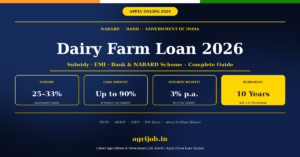

Dairy farm loan subsidy 2026 rates confuse most first-time applicants because the numbers genuinely differ by scheme, category, and state — and a lot of the information online is outdated. This guide clears up exactly who gets 25%, who gets 33.33%, and who gets 50% or more, explains the crucial difference between front-ended and back-ended subsidy, walks through how banks actually release the money after verification, and covers why claims get delayed and how to track them. We also flag an important update that many other articles miss: the original 25%/33.33% scheme is no longer active at the central level.

Old DEDS Subsidy (General/SC-ST): 25% / 33.33% — discontinued from FY 2020-21
Current NPDD Cattle Induction Subsidy: Up to 50% (BPL/SC/ST), up to 75% for women
State Schemes: Up to 75-90% in select states (e.g., Jharkhand, Bihar)
Subsidy Type: Mostly back-ended, bank-routed
Release Trigger: Loan sanction + physical verification + repayment track record
📋 Table of Contents
- 1. Important Update: The 25%/33.33% DEDS Subsidy Is No Longer Active
- 2. The Current Picture: What Replaced DEDS
- 3. Subsidy Comparison Matrix: 25% vs 33.33% vs 50%+
- 4. Front-Ended vs Back-Ended Subsidy Explained Simply
- 5. How Banks Release Subsidy After Verification
- 6. Money Table: Subsidy Ceilings by Category
- 7. Eligibility Criteria by Category
- 8. Step-by-Step: How to Claim Dairy Subsidy
- 9. Common Reasons for Subsidy Delay
- 10. How to Check Your Subsidy Claim Status
- 11. Who Should Apply for Dairy Farm Subsidy?
- 12. Important Subsidy Terms You Must Know
- 13. State-Wise Dairy Subsidy: Quick Reference
- 14. Frequently Asked Questions
Important Update: The 25%/33.33% DEDS Subsidy Is No Longer Active
If you’ve read elsewhere that dairy farmers can get a flat 25% subsidy (33.33% for SC/ST) through the NABARD Dairy Entrepreneurship Development Scheme (DEDS), that information is outdated. NABARD’s own scheme records confirm that DEDS was discontinued from financial year 2020-21 due to non-availability of budget allocation. The scheme is no longer accepting fresh applications at the central level, even though many websites continue to describe it as currently active with its old 25%/33.33% structure.

This matters because applying based on outdated DEDS information wastes time. The good news: the underlying goal of DEDS — helping farmers set up small dairy units, rear heifer calves, and buy dairy equipment — has not disappeared. It has simply moved to other active schemes, which is what this guide focuses on.
The Current Picture: What Replaced DEDS
Dairy subsidy support in 2026 now comes from a mix of central and state sources rather than one single scheme:
- 🏛️ National Programme for Dairy Development (NPDD): Primarily infrastructure-focused (milk testing, chilling, processing) for cooperatives and federations, but includes a cattle induction component for BPL/SC/ST families and women
- 🐄 National Livestock Mission (NLM): Covers poultry, sheep/goat, piggery, and fodder entrepreneurship with 50% capital subsidy (not dairy cattle specifically)
- 🏦 Animal Husbandry Infrastructure Development Fund (AHIDF): Loan up to 90% of project cost with interest subvention, for larger dairy processing infrastructure
- 🗺️ State-specific CM-level schemes: Madhya Pradesh, Bihar, Jharkhand, and others run their own state dairy/pashupalan subsidy schemes, several offering 50-90% subsidy
Subsidy Comparison Matrix: 25% vs 33.33% vs 50%+
| Subsidy Rate | Scheme/Source | Category | Current Status |
|---|---|---|---|
| 25% | DEDS (NABARD) | General category | ❌ Discontinued since FY 2020-21 |
| 33.33% | DEDS (NABARD) | SC/ST farmers | ❌ Discontinued since FY 2020-21 |
| 50% | NPDD cattle induction | BPL/SC/ST families | ✅ Active |
| 50% | NLM-EDP (poultry/goat/pig, not cattle) | All eligible entities | ✅ Active |
| 75% | NPDD cattle induction | Women milk producers | ✅ Active |
| 75% | Bihar Samagra Gavya Vikas Yojana | SC/ST/Mahadalit | ✅ Active (state scheme) |
| 90% | Jharkhand Mukhyamantri Pashudhan Vikas Yojana | Women/widows/disabled | ✅ Active (state scheme) |
Front-Ended vs Back-Ended Subsidy Explained Simply
This distinction trips up most first-time applicants, so here it is in plain terms:
- 💵 Front-ended subsidy: The subsidy amount is paid out upfront, before or right when the loan is disbursed. The borrower’s loan amount is effectively reduced from day one, lowering both the principal and the EMI immediately.
- 🏦 Back-ended subsidy: The bank first disburses the full loan amount and charges interest on it as usual. The subsidy amount is kept aside in a separate account and is only adjusted against the loan’s outstanding principal after the borrower has repaid regularly for a defined period (commonly demonstrated through timely EMI payments). This rewards disciplined repayment but means the borrower initially pays interest on the full loan amount, including the portion that will eventually be subsidised.
Most NABARD-linked dairy and livestock subsidy schemes, including the now-discontinued DEDS, use the back-ended model. This is precisely why understanding the mechanism matters: a farmer who stops repaying midway can lose eligibility for the subsidy adjustment entirely, even after years of partial repayment.
How Banks Release Subsidy After Verification
The typical bank-routed subsidy release sequence works like this:
- 🏦 Beneficiary applies for the loan with a Detailed Project Report (DPR) at the financing bank
- ✅ Bank sanctions and disburses the loan, charging interest on the full amount
- 📋 Bank applies to the nodal agency (NABARD, State Implementing Agency, or DAHD) for release of eligible subsidy
- 🔍 Nodal agency or department conducts physical verification of the dairy unit — checking that animals, shed, and equipment match the sanctioned project
- 💰 Subsidy amount is credited to the bank, not directly to the farmer’s account
- 📉 For back-ended schemes, the bank adjusts the subsidy against the loan principal after the defined repayment period; for front-ended/DBT schemes, the amount may be credited earlier
Money Table: Subsidy Ceilings by Category
| Beneficiary Category | Applicable Scheme Type | Typical Subsidy Range |
|---|---|---|
| General category individual farmer | State-specific dairy/pashupalan scheme | 25%-50% (varies by state) |
| BPL / SC / ST families | NPDD cattle induction | Up to 50% |
| Women milk producers | NPDD cattle induction | Up to 75% |
| Women/widows/disabled (Jharkhand) | Mukhyamantri Pashudhan Vikas Yojana | Up to 90% |
| SC/ST/Mahadalit (Bihar) | Samagra Gavya Vikas Yojana | Up to 75% |
| Larger commercial entrepreneurs | AHIDF (loan-based, not direct subsidy) | Loan up to 90% + 3% interest subvention |
Eligibility Criteria by Category
- 👩🌾 Women milk producers (NPDD): Must be an active or prospective milk producer; documentation through the relevant milk union/cooperative often required
- 🏘️ BPL/SC/ST families (NPDD cattle induction): Valid BPL card or caste certificate, residence proof, linkage with a recognised dairy cooperative or milk producer organisation
- 🌾 General category individual (state schemes): State domicile, willingness to take up dairying, basic shed/land arrangement, varies by state
- 🏭 Larger entrepreneurs (AHIDF): Registered entity (private company, FPO, individual entrepreneur, Section 8 company); government entities and cooperatives are generally not eligible under AHIDF
- 📄 Common documents across most schemes: Aadhaar card, bank account details, residence/domicile proof, caste certificate (where applicable), land/lease documents, and a project report or loan application
Step-by-Step: How to Claim Dairy Subsidy
- 📝 Identify the correct current scheme for your category and state (do not assume DEDS applies — confirm with your bank or department first)
- 📋 Prepare a project report covering the number of animals, shed cost, equipment, and total project cost
- 🏦 Approach an eligible bank (commercial bank, RRB, state cooperative bank) or your state’s designated department
- 📤 Submit the loan/subsidy application with all required documents
- 🔍 Cooperate fully during the physical verification visit by bank or department officials
- 💳 Once the loan is sanctioned and disbursed, ensure regular EMI payments if the subsidy is back-ended
- 📊 Track the subsidy adjustment/release status periodically with your bank branch or the relevant state portal
Common Reasons for Subsidy Delay
- 📄 Incomplete or mismatched documentation — caste certificate, Aadhaar, or bank details not matching application records
- 🔍 Pending physical verification — officials unable to schedule or complete the ground visit promptly
- 💸 Delayed fund release from the nodal agency — central or state budget release timelines affecting disbursement to banks
- 🏦 Aadhaar-bank seeding issues — particularly relevant for DBT-based state schemes where NPCI seeding must be active
- 📐 Project not matching scheme cost norms — if actual project cost or unit size deviates from what the scheme guidelines specify
- 📉 Irregular EMI repayment — for back-ended subsidy schemes, inconsistent repayment can delay or jeopardise the eventual subsidy adjustment
How to Check Your Subsidy Claim Status
- 🌐 For NLM-related claims: Use the “Track Status” tab on nlm.udyamimitra.in
- 🏛️ For state schemes: Check your state’s dedicated portal where available (e.g., dairy.bihar.gov.in for Bihar) or visit the District Animal Husbandry Office
- 🏦 For bank-routed subsidy: Contact your loan branch directly — banks can confirm whether the subsidy application has been forwarded to and processed by the nodal agency
- 📞 Helpline numbers: Most states publish a dedicated helpline for dairy/pashupalan scheme queries on their respective department websites
Who Should Apply for Dairy Farm Subsidy?
- 🧑🌾 Small and marginal farmers wanting to set up a 2-10 animal dairy unit
- 👩🌾 Women milk producers eligible for the higher 75% NPDD subsidy slab
- 🏘️ BPL/SC/ST families eligible for NPDD’s cattle induction support
- 👵 Widows and disabled beneficiaries in states like Jharkhand offering top-tier subsidy
- 🏭 Larger entrepreneurs better suited to AHIDF’s loan-based infrastructure support
- 🥛 Existing milk cooperative members who can route applications through their union/federation
Important Subsidy Terms You Must Know
- 📌 Back-ended subsidy: Subsidy adjusted against loan principal only after a defined repayment track record, used by most NABARD-linked schemes
- 📌 Front-ended subsidy: Subsidy released upfront, reducing the effective loan amount from the start
- 📌 DBT (Direct Benefit Transfer): Subsidy credited directly to the beneficiary’s Aadhaar-linked bank account, bypassing the bank-adjustment route
- 📌 Cattle induction: The NPDD component specifically supporting the purchase/induction of milch cattle for eligible BPL/SC/ST/women beneficiaries
- 📌 Margin money: The borrower’s own minimum contribution toward the project, on top of the loan and subsidy
- 📌 Nodal agency: The body responsible for sanctioning and releasing subsidy funds (NABARD, DAHD, or the State Implementing Agency depending on scheme)
- 📌 Physical verification: The mandatory ground inspection confirming the dairy unit matches the sanctioned project before subsidy release
State-Wise Dairy Subsidy: Quick Reference
| State | Scheme | Subsidy Range |
|---|---|---|
| Madhya Pradesh | Mukhyamantri Dudharu Pashu Praday Yojana | Subsidy on 2 milch animals + loan-linked support for larger units |
| Bihar | Samagra Gavya Vikas Yojana | 50%-75% |
| Jharkhand | Mukhyamantri Pashudhan Vikas Yojana | 75%-90% |
| Haryana | Hi-Tech & Mini Dairy Unit Scheme | 25%-50% + interest subvention |
| Uttar Pradesh | Pragatisheel Pashupalak Protsahan Yojana | Fixed cash incentive per indigenous cow, not %-based |
| All India (BPL/SC/ST/Women) | NPDD Cattle Induction | 50%-75% |
Since state schemes change names, budgets, and percentages periodically, always confirm the current rate directly with your state’s Animal Husbandry or Dairy Development Department before applying.
Frequently Asked Questions
Is the 25% and 33.33% dairy subsidy under DEDS still available in 2026?
No. The Dairy Entrepreneurship Development Scheme (DEDS), which offered a 25% back-ended subsidy for general category and 33.33% for SC/ST farmers, was officially discontinued by NABARD from financial year 2020-21 due to non-availability of budget allocation. Many websites still describe DEDS as active; this is outdated information. Its objectives have since been folded into broader programs like NPDD and state-specific schemes.
Which scheme currently offers 50% or higher dairy subsidy?
Under NPDD, cattle induction assistance for BPL families, Scheduled Tribes, and Scheduled Castes is capped at 50% of cost, rising up to 75% for women milk producers. Several state-run schemes, such as Jharkhand’s Mukhyamantri Pashudhan Vikas Yojana, also offer subsidy in the 75-90% range for women and disadvantaged categories.
What is the difference between front-ended and back-ended subsidy?
A front-ended subsidy is paid upfront, reducing the loan amount from day one. A back-ended subsidy, used by NABARD-linked schemes, is parked and adjusted against the loan’s principal only after the borrower has serviced the loan regularly for a set period, rewarding timely repayment rather than reducing the initial loan burden.
How does the bank release dairy subsidy after verification?
The bank first sanctions and disburses the loan. It then applies to the nodal agency for release of the eligible subsidy. The subsidy is credited to the bank, not directly to the farmer, and is generally adjusted against the loan principal after physical verification and a defined repayment track record.
What are the common reasons for delay in dairy subsidy disbursement?
Common reasons include incomplete documentation, pending physical verification, delays in fund release from the nodal agency, Aadhaar-bank seeding issues for DBT schemes, and project cost or unit-size mismatches with scheme guidelines.
How can I check my dairy farm subsidy claim status?
For NLM-related claims, use the Track Status tab on nlm.udyamimitra.in. For state schemes, check the respective state department portal or contact the District Animal Husbandry Office. For bank-routed subsidy, your loan branch can confirm processing status with the nodal agency.
Do women dairy farmers get extra subsidy in 2026?
Yes. Under NPDD’s cattle induction component, women milk producers can get up to 75% subsidy compared to 50% for other eligible categories. State schemes such as Jharkhand’s Mukhyamantri Pashudhan Vikas Yojana also reserve their highest slab (up to 90%) specifically for women, widows, and disabled beneficiaries.
Can I get dairy subsidy without taking a bank loan?
Most major dairy and livestock subsidy schemes in India require the subsidy to be routed through a bank loan or linked to project financing. Pure grant-only models without loan linkage are uncommon at the central scheme level, though some state schemes provide assistance with minimal or no loan requirement for very small units.
📚 Official Sources: Always verify current rates with original sources — NABARD official scheme page, DAHD – National Programme for Dairy Development, and NLM Application Portal.
This guide is regularly reviewed and updated for accuracy. Bookmark this page for the latest dairy subsidy notifications. Subsidy percentages, scheme names, and budget allocations are revised periodically by central and state governments — always confirm the current rate with the official department before applying.
Last Updated: June 2026