
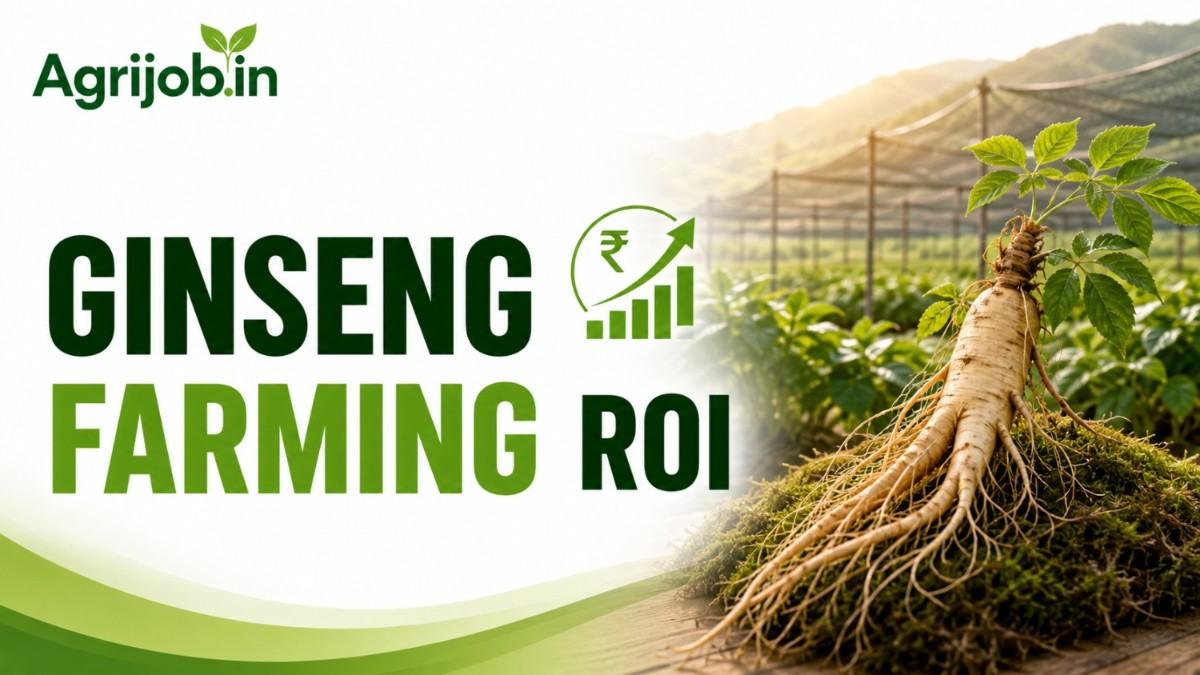
Ginseng farming ROI 2026 is one of the most misunderstood investment calculations in specialty agriculture — because the $35/lb cultivated market price tells only half the story. The real opportunity lies in wild-simulated cultivation, where 6-year-old roots command $60–$80/lb at harvest, and properly aged 8–10 year woodland roots fetch $500–$800/lb from export buyers. This guide is for farmers, woodland owners, and agri-investors aged 25–55 who want a complete, numbers-driven answer to whether ginseng’s long crop cycle delivers genuine returns in 2026. We cover startup costs, yield projections, three cultivation methods, the 6-year timeline week by week, market pricing tiers, regulatory requirements, and the honest risk factors no promoter mentions.

Ginseng farming ROI in 2026 is real but requires patience: a woodland-grown acre costs $37,000 to establish over 6 years and nets approximately $36,000 at harvest, while intensive shade-cloth cultivation costs $53,000 and nets $76,000 in 4 years. Cultivated roots sell for $35–$80/lb; wild-simulated roots fetch $500–$800/lb for 8+ year roots.
- Crop Cycle: 4–6 years (cultivated) · 6–10 years (wild-simulated)
- Market Price — Cultivated: $35–$80 per dry pound (2026)
- Market Price — Wild-Simulated (6 yr): $60–$120 per dry pound
- Market Price — Wild-Simulated (8–10 yr): $500–$800 per dry pound
- Yield Per Acre (Cultivated, 4 yr): 1,500–2,000 lbs dry root
- Yield Per Acre (Woodland, 6 yr): 100–300 lbs dry root
- Startup Cost — Woodland (per acre): $37,000 over 6 years
- Startup Cost — Intensive (per acre): $53,000 over 4 years
- Net Profit — Woodland (6 yr): ~$36,000/acre
- Net Profit — Intensive (4 yr): ~$76,000/acre
- Global Ginseng Market Size (2026): $4.92 Billion (CAGR 5.96%)
- Regulatory Body: U.S. Fish & Wildlife Service (CITES Appendix II)
📋 Table of Contents
- What Is Ginseng Farming and Why Does the 6-Year Cycle Matter?
- Who Should Grow Ginseng in 2026?
- Ginseng Market Price 2026 — The $35/lb Reality vs Premium Tiers
- 3 Cultivation Methods Compared: Woodland vs Intensive vs Wild-Simulated
- The 6-Year Ginseng Crop Cycle: Year-by-Year Investment Timeline
- Ginseng Farming ROI Calculation 2026 — Real Numbers Per Acre
- Eligibility, Land Requirements & Regulatory Compliance
- How to Start a Ginseng Farm: 9-Step Complete Process
- Woodland vs Intensive Ginseng Farming: Full Comparison
- Pros and Cons of Ginseng Farming in 2026
- Important Terms & Concepts for Ginseng Investors
- Important Links & Resources
- Conclusion
- Key Takeaways
- Frequently Asked Questions
What Is Ginseng Farming and Why Does the 6-Year Cycle Matter?
Ginseng farming is the controlled cultivation of Panax quinquefolius (American ginseng) or Panax ginseng (Asian ginseng) for their high-value medicinal roots. American ginseng is the dominant commercial variety grown in North America and commands premium prices from Asian export markets, particularly China, where it is a cornerstone ingredient in Traditional Chinese Medicine.
The 6-year crop cycle is the defining characteristic that separates ginseng from annual cash crops. A root harvested at 4 years commands $35–$60/lb. The same plant grown for 6 years earns $60–$120/lb. At 8–10 years under woodland conditions, prices rise to $500–$800/lb. Every additional year of growth exponentially increases root value — because age, root complexity, and ginsenoside concentration all improve together. That compounding value is the core of the ginseng investment thesis.

According to IMARC Group market data, the global ginseng market reached $4.92 billion in 2026 and is projected to grow to $6.99 billion by 2032 at a CAGR of 5.96%, driven by rising demand for immune-boosting supplements, energy products, and Traditional Chinese Medicine applications worldwide.
Who Should Grow Ginseng in 2026?
Ginseng is not the right crop for everyone. The 6-year crop cycle demands specific conditions, capital patience, and risk tolerance. Here are the farmer profiles best suited to ginseng cultivation in 2026:
- 🌲 Woodland owners in eastern USA or Canada — Anyone with 1+ acres of hardwood forest in Pennsylvania, Ohio, Kentucky, West Virginia, Tennessee, or Wisconsin sits on the ideal natural habitat for wild-simulated ginseng with almost zero shade infrastructure cost.
- 💰 Investors seeking a 4–6 year asset — Growers who can front $37,000–$53,000/acre and wait for a lump-sum harvest payout find ginseng outperforms most agricultural bonds and land investments on a per-acre basis.
- 🌿 Herbal supplement farmers diversifying income — Existing Ashwagandha, Safed Musli, or Stevia farmers can add a ginseng woodland plot as a long-term appreciation asset alongside their annual income crops.
- 🏡 Small-plot farmers with 0.5–2 acres available — Ginseng’s high value per pound means even a half-acre plot, managed correctly, can generate $18,000–$38,000 net at harvest without full-time labor input.
- 🌍 Export-oriented agribusiness operators — Growers with access to CITES-compliant export channels can target the premium Asian market where cultivated American ginseng commands $45–$52/kg in Japan and Germany as of Q1 2026.
- 🧪 Organic and specialty herb farmers — Certified-organic ginseng commands 20–40% price premiums over conventional and is especially sought after by North American supplement brands.
- 📚 First-time specialty crop growers starting small — Cornell Cooperative Extension and Penn State Extension recommend starting with ¼ acre test plots before scaling — making ginseng accessible even to beginners willing to learn.
- 🏦 Land-rich, cash-patient farmers near harvest age — Farmers planning a business exit in 6–10 years can plant ginseng today and harvest a high-value single payout as a retirement-style asset.
Ginseng Market Price 2026 — The $35/lb Reality vs Premium Tiers
The $35/lb market price for cultivated ginseng is real — but it applies only to smooth-rooted, intensively field-grown roots with a short (3–4 year) maturity period. As of August 2026, the U.S. wholesale price for cultivated ginseng roots is $32.96/lb, down 20.2% year-on-year according to Selina Wamucii trade data. This is the floor of the market, not the ceiling.
| Ginseng Grade | Age at Harvest | Price Per Dry Pound (2026) | Market |
|---|---|---|---|
| Field-Cultivated (Intensive) | 3–4 years | $30–$45/lb | Domestic wholesale |
| Woods-Cultivated | 5–6 years | $55–$80/lb | Domestic + export |
| Wild-Simulated (Standard) | 7–8 years | $200–$500/lb | Asian export |
| Wild-Simulated (Premium) | 9–10 years | $500–$800/lb | Asian export premium |
| Wild (Certified, Legal) | Varies | $500–$1,200/lb | Licensed dealers only |
| Wild (Exceptional Aged) | 20+ years | $10,000–$50,000/lb | Auction (specialty only) |
Indiana’s 2024 season report documented a mid-season average of $608.33/lb for certified wild ginseng. Virginia’s 2024 harvest produced approximately 882 pounds valued near $450,000 — an average of $510/lb. These figures confirm that the premium market for aged, certified American ginseng remains extremely strong even as the low-end cultivated price faces pressure from Chinese imports. The critical investment decision is choosing which tier of the market you are targeting — because cultivation method, crop cycle length, and upfront cost all differ completely between tiers.
3 Cultivation Methods Compared: Woodland vs Intensive vs Wild-Simulated
American ginseng can be cultivated using three primary methods, each with a distinct risk-reward profile, crop cycle, and target market. Choosing the wrong method for your land type is the single most common mistake new ginseng growers make.
| Factor | Wild-Simulated (Woodland) | Woods-Cultivated | Intensive (Shade Cloth) |
|---|---|---|---|
| Crop Cycle | 7–10 years | 5–7 years | 3–4 years |
| Setup Cost/Acre | $500–$2,000 | $15,000–$25,000 | $40,000–$65,000 |
| Total Investment/Acre | $10,000–$37,000 | $25,000–$45,000 | $53,000–$75,000 |
| Expected Yield/Acre | 100–300 lbs dry | 300–800 lbs dry | 1,500–2,000 lbs dry |
| Price Per Pound | $200–$800/lb | $60–$120/lb | $30–$45/lb |
| Disease Risk | Low (natural ecosystem) | Medium | High (root rot, blight) |
| Labor Intensity | Low | Medium | High |
| CITES Export Eligible | Yes (5+ years, certified) | Yes | Yes (artificially propagated) |
| Best For | Woodland owners, patient investors | Managed forest farmers | Commercial operations, fast ROI |
For most small-to-medium farmers in 2026, woods-cultivated or wild-simulated ginseng in existing hardwood forest offers the best risk-adjusted return. The ultra-low disease pressure of woodland growing eliminates the biggest cost driver in intensive cultivation, while the longer cycle pushes roots into the $60–$200+/lb price tier that makes the investment genuinely worthwhile. Intensive shade-cloth growing makes sense only for commercial operators who have secured forward contracts with established buyers.
The 6-Year Ginseng Crop Cycle: Year-by-Year Investment Timeline
Understanding the ginseng farming 6-year crop cycle is essential before committing capital. Unlike annual crops, ginseng requires front-loaded investment with zero revenue for the first 3–5 years. Here is the complete year-by-year breakdown for a woodland-cultivated acre:
- Year 1 — Site Preparation & Planting (Cost: $8,000–$12,000/acre): Select and assess hardwood forest site with 70–90% canopy cover, pH 5.5–6.0, and excellent drainage. Purchase 40–50 lbs of stratified ginseng seed at $85–$150/lb. Broadcast seeds by hand in late fall before ground freezes. Apply 1–2 inch hardwood leaf mulch. Install deer fencing if needed. Expect 40–60% germination rate in spring.
- Year 2 — Establishment & Monitoring (Cost: $1,500–$3,000/acre): Seedlings emerge 1–2 leaves (1-prong stage). Monitor for damping-off fungal disease, slug damage, and deer browsing. Weed manually if needed — do not use chemical herbicides in wild-simulated plots. Mark boundaries clearly to prevent poaching. No revenue this year.
- Year 3 — Growth & First Seed Production (Cost: $1,000–$2,000/acre): Plants reach 2-prong stage. First flowers appear in July; berries ripen in September. Harvest and replant red berries immediately to expand your plot (seeds are worth $65+/lb stratified). First potential income stream: sell stratified seeds at $85–$150/lb. Plants still too young for root harvest.
- Year 4 — 3-Prong Stage & Seed Revenue (Cost: $800–$1,500/acre maintenance): Plants reach 3-prong stage. Seed production increases significantly. A well-established plot can generate $2,000–$5,000/acre annually in seed sales. Roots are technically harvestable but not legally exportable (must have 4+ stem scars under USFWS CITES rules). Continue reinvesting seed revenue into plot maintenance.
- Year 5 — Thinning & Market Assessment (Cost: $500–$1,000/acre): Plants reach 4-prong stage — minimum legal age for certified export. Begin monitoring root weights and market conditions. Some growers start selectively harvesting their largest roots for domestic sale at $55–$80/lb. Contact licensed dealers and export brokers about forward pricing for Year 6 harvest.
- Year 6 — Final Harvest (Revenue: $60,000–$90,000/acre gross at optimal conditions): Dig roots after tops go dormant in late summer or early fall (August–October). Wash gently without scrubbing. Dry on screens at 70°F — never use heat dryers. Sort roots by size, shape, and quality. Contact your state certification program for CITES export certification. Net revenue at $60–$80/lb with 100–300 lbs dry yield = $6,000–$24,000/acre at conservative end; $36,000–$60,000 at strong prices.
Never harvest all roots at once in Year 6. Stagger your harvest over Years 5–8 to capitalize on age-based price appreciation. Roots left in the ground from Year 6 to Year 8 can triple in market value as they cross into the wild-simulated premium price tier ($200–$500/lb). This staggered approach also smooths your cash flow and reduces weather or market-timing risk dramatically.
Ginseng Farming ROI Calculation 2026 — Real Numbers Per Acre
Based on verified data from Hobby Farms, Cornell Small Farms, and Penn State Extension, here is a transparent ROI calculation for both major cultivation approaches in 2026. All figures are in USD per acre over the full crop cycle.
| Cost / Revenue Item | Woodland (6-Year) | Intensive Shade (4-Year) |
|---|---|---|
| Seed Cost (40–50 lbs/acre) | $4,000–$7,500 | $4,000–$7,500 |
| Shade Structure / Canopy | $0 (natural forest) | $14,000–$20,000 |
| Site Prep & Fencing | $2,000–$5,000 | $3,000–$6,000 |
| Annual Maintenance (×6 or ×4 yrs) | $9,000–$15,000 | $12,000–$20,000 |
| Harvest & Processing Labor | $3,000–$5,000 | $5,000–$8,000 |
| CITES Certification & Export Fees | $500–$1,000 | $500–$1,000 |
| Total Cost (Approx.) | $18,500–$33,500 | $38,500–$62,500 |
| Dry Yield Per Acre | 100–300 lbs | 1,000–1,500 lbs |
| Market Price Per Pound | $60–$200/lb | $30–$45/lb |
| Gross Revenue (Mid-Range) | $60,000–$80,000 | $45,000–$67,500 |
| Net Profit (Approx.) | $36,000–$50,000 | $30,000–$76,000 |
Key caveat: These figures assume favorable growing conditions, no major disease outbreak, and market prices at or above the 2026 mid-range. The U.S. cultivated ginseng price dropped 20.2% year-on-year through August 2026 due to increased imports from China. Growers who target the premium wild-simulated tier by extending their crop cycle to 8+ years are best insulated against cultivated price volatility.
Seed sales provide an important supplementary income stream from Year 3 onward. Stratified seeds sell for $85–$150/lb, and a productive acre can yield 20–40 lbs of seed annually — adding $1,700–$6,000/year to your income during the growing cycle. This partially offsets annual maintenance costs and improves overall ROI significantly. For more on diversified specialty crop ROI strategies, see our complete guide on Saffron Farming Business Plan 2026 and our analysis of Hemp Farming Profitability Per Acre.
Eligibility, Land Requirements & Regulatory Compliance
American ginseng is listed under CITES Appendix II, meaning all international trade is regulated to prevent overharvesting of wild populations. Before investing a single dollar in ginseng cultivation, understand these compliance requirements:
- Land Requirement: Minimum 0.5 acres; ideal is 1–5 acres of hardwood forest with 70–90% canopy shade, pH 5.5–6.0, moist well-drained soil rich in calcium. USDA PLANTS database confirms the native range covers 19 eastern and midwestern states.
- State Licensing: Most states with approved CITES ginseng programs require a licensed dealer’s permit before you can sell or transport ginseng. Contact your state Department of Natural Resources or agriculture department to confirm your state’s program status.
- Minimum Harvest Age: For CITES-certified export, the U.S. Fish and Wildlife Service requires roots to have at least 4 stem scars (rhizome scars) — indicating a minimum of 5 years of growth. Roots younger than this cannot be legally exported.
- CITES Export Permit: Required for any international shipment of ginseng roots. Apply through USFWS ePermits system. Master File permits for artificially propagated ginseng are valid for 3 years; wild-collected permits valid for 1 year.
- USDA Grade Standards: Commercially traded cultivated ginseng must meet USDA Agricultural Marketing Service grades U.S. No. 1 through No. 7, emphasizing clean, well-cured, mold-free roots with correct color and texture.
- Startup Investment Range: Quarter-acre hobby plot: $5,000–$10,000 (USDA Farm Business Management data). One-acre commercial setup: $30,000–$60,000.
| Requirement Category | Details |
|---|---|
| Minimum land area | 0.25 acre (hobby) · 1+ acre (commercial) |
| Soil pH | 5.5–6.0 (slightly acidic) |
| Canopy shade required | 70–90% natural or artificial |
| Minimum legal harvest age | 5 years (CITES export requirement) |
| State licensing needed | Yes — dealer/grower permit in most states |
| CITES export permit | Required for international shipment |
| USDA Protected Plant Permit | Required for commercial multi-shipment exports |
| States with approved programs | Approx. 20 states (check USFWS current list) |
How to Start a Ginseng Farm: 9-Step Complete Process
Follow this step-by-step ginseng farming startup process to minimize risk and maximize your chances of a profitable 6-year crop cycle:
- Assess your land and soil: Walk your woodland and identify areas where wild ginseng, trillium, bloodroot, or mayapple already grow — these are strong indicators of ideal pH, moisture, and soil biology. Take soil samples and test for pH (target 5.5–6.0) and phosphorus levels. Contact your county Extension office for a free site assessment.
- Choose your cultivation method: Based on your land type, budget, and timeline, decide between wild-simulated (woodland), woods-cultivated (managed beds in forest), or intensive (shade cloth). Start with wild-simulated if you have existing hardwood forest — the lowest cost and disease risk method.
- Set up test plots before full investment: Plant 10–15 test plots of 9 square feet each (one per 4,000 sq ft of potential growing area) using 2 oz of stratified seed per plot. Evaluate survival rates through the first summer before committing to full-scale planting. Cornell Extension’s recommended protocol for site validation.
- Source stratified seed from certified dealers: Purchase ginseng seed only from certified, reputable suppliers. Stratified seed (pre-chilled for germination) costs $85–$150/lb. Avoid uncertified sources — disease-compromised or mislabeled seed is the leading cause of first-year crop failure.
- Plant in fall before ground freeze: Broadcast seeds at 40–50 lbs/acre in late summer or early fall. Rake into the top 1–2 inches of soil. Cover with 1–2 inches of shredded hardwood leaf mulch. Do not use plastic mulch — ginseng needs natural soil biology to thrive.
- Install deer and pest protection: Deer browse on ginseng seedlings and roots. Install perimeter fencing (minimum 8 feet high for white-tailed deer country) or use deterrent systems. Slug and blight management in Years 1–3 is critical — monitor regularly and remove diseased plants immediately to prevent spread.
- Register with your state program and obtain permits: Contact your state Department of Natural Resources to register as a ginseng cultivator and obtain your dealer’s permit. This step is mandatory before you can legally sell or transport roots. Contact USFWS to understand CITES export permit requirements if you plan to access Asian markets.
- Identify buyers before harvest: Reach out to licensed ginseng dealers, export brokers, and supplement companies in Year 4 or 5 — before your roots are ready. The ginseng market has limited buyers; approaching them early allows you to negotiate better prices and ensure your harvest has a committed buyer lined up at harvest time.
- Harvest, dry, and certify properly: Dig roots after plant tops go dormant (late August through October). Wash gently with water only — no scrub brushes. Dry on wire screens at 60–70°F for 3–6 weeks. Apply for state certification and CITES permits. Grade roots by USDA standards before sale.
Woodland vs Intensive Ginseng Farming: Full Comparison
| Comparison Factor | Woodland / Wild-Simulated | Intensive (Shade Cloth) |
|---|---|---|
| Upfront cost | $10,000–$20,000/acre | $40,000–$65,000/acre |
| Crop cycle | 6–10 years | 3–4 years |
| Price per pound achieved | $60–$800/lb (age-dependent) | $30–$45/lb |
| Disease pressure | Low (natural balance) | High (root rot, blight) |
| Labor requirement | Low-Medium | High |
| Infrastructure needed | Minimal (deer fence) | Shade cloth, irrigation, beds |
| Poaching risk | Medium (remote locations) | Higher (visible field crops) |
| Market premium potential | Very high (wild-appearance premium) | Low (commodity pricing) |
| Export eligibility | High (aged roots preferred) | Yes, but at lower price tier |
| Net profit/acre estimate | $36,000–$60,000+ (6 yr) | $30,000–$76,000 (4 yr) |
Woodland cultivation wins on risk-adjusted returns for most farmers in 2026. The elimination of shade infrastructure costs ($14,000–$20,000/acre) reduces financial exposure significantly, and the longer cycle pushes roots into the price tiers ($200–$800/lb) that intensive growers can never access. Intensive shade cultivation makes financial sense only when you have secured forward-purchase contracts with domestic supplement companies at guaranteed minimum prices — never enter this model speculatively.
Pros and Cons of Ginseng Farming in 2026
| ✅ Advantages | ❌ Disadvantages |
|---|---|
| Extremely high value per pound ($35–$800+) | 6–10 year wait before any harvest revenue |
| Global demand growing at 5.96% CAGR through 2032 | Cultivated price dropped 20.2% YoY (Aug 2026) |
| Low labor input for woodland method | High disease risk (root rot, blight) in intensive method |
| Seed sales provide early cash flow from Year 3 | Strict regulatory compliance (CITES, state permits) |
| Asset appreciation — roots increase in value every year | Poaching risk in rural locations |
| Uses marginal woodland that has no other high-value use | Limited buyer pool — market access is challenging for small growers |
The honest risk every prospective ginseng farmer must evaluate: the long crop cycle creates massive exposure to market price fluctuations. A 20% drop in cultivated ginseng prices (which occurred in 2025–2026) can turn a projected $76,000/acre intensive-growing profit into a much narrower margin. This is why the wild-simulated, age-maximizing approach is consistently recommended by Cornell, Penn State, and NC State Extension specialists — older roots are far less sensitive to commodity price swings. For a comparison with other high-value crops, see our guide on Ashwagandha Farming Profit Per Acre 2026.
Important Terms & Concepts for Ginseng Investors
Understanding these key terms will help you navigate ginseng cultivation, compliance, and market access successfully:
- Ginsenosides: The active bioactive compounds in ginseng roots responsible for its medicinal properties. Higher ginsenoside concentrations are found in older, slower-grown roots — one key reason wild-simulated roots command premium prices over intensively cultivated ones.
- CITES Appendix II: The international trade classification for American ginseng (Panax quinquefolius), managed by the U.S. Fish & Wildlife Service. Any international export of ginseng roots requires a CITES permit. Violating CITES regulations can result in loss of export authorization and criminal penalties.
- Stratified Seed: Ginseng seed that has undergone cold stratification (18–24 months of moist cold storage) to break natural dormancy. Stratified seed germinates in spring; unstratified seed will not germinate until the following year. Purchasing pre-stratified seed saves one growing season.
- Stem Scars (Rhizome Scars): Annual growth rings visible on the underground rhizome connecting root to stem. Each scar represents one year of growth. USFWS requires at least 4 stem scars for certified export — meaning only 5+ year-old roots are legally exportable.
- Wild-Simulated Cultivation: The practice of planting ginseng seed in natural hardwood forest conditions without artificial inputs, mimicking wild growth. Produces roots visually and chemically similar to wild ginseng, commanding significantly higher market prices. Recommended by Penn State Extension and Cornell as the lowest-risk, highest-return method for woodland owners.
- Root Grade (USDA Standards): USDA Agricultural Marketing Service grades cultivated ginseng from U.S. No. 1 (best quality, highest price) through No. 7, based on root shape, color, cleanliness, and absence of defects. Grade directly determines sale price with established buyers.
- Green Root vs Dry Root Pricing: Fresh (“green”) roots contain 3× their dry weight in water. Prices are always quoted per dry pound. If a dealer offers $25/lb for green roots and your drying ratio is 3:1, the effective dry-weight equivalent is $75/lb. Always convert to dry-weight pricing before comparing offers.
- Forward Contract: A pre-harvest purchase agreement between a grower and buyer at a set price. Experienced ginseng growers secure forward contracts before harvest to eliminate market-timing risk. Access to forward contracts is a key advantage of building long-term relationships with licensed dealers and supplement companies.
- High-Value Specialty Crop Loan: USDA Farm Service Agency provides operating loans and emergency loans for specialty crop growers including medicinal herbs. USDA SARE (Sustainable Agriculture Research & Education) grants are also available for innovative ginseng growing systems research.
- Companion Planting: Ginseng planted alongside goldenseal, bloodroot, black cohosh, and mayapple creates a synergistic woodland system where companion species also have market value, diversifying your revenue from the same acreage without additional management cost.
Important Links & Resources
| Resource | Link |
|---|---|
| USFWS Ginseng Export (CITES) | fws.gov — Ginseng CITES Permits |
| Cornell Small Farms Ginseng Production Guide | Cornell Small Farms Extension |
| USDA Forest Service — Ginseng Agroforestry Notes | USDA NAC Agroforestry Notes |
| CITES Export Application (Form 3-200-34) | USFWS ePermits System |
| Saffron Farming ROI Guide (Agrijob.in) | Saffron Farming Business Plan 2026 |
| Ashwagandha Farming Profit Guide (Agrijob.in) | Ashwagandha Farming Profit Per Acre 2026 |
| Hemp Farming Profitability Guide (Agrijob.in) | Hemp Farming Profitability 2026 |
Conclusion: Is Ginseng Farming Worth the 6-Year Wait in 2026?
Ginseng farming ROI in 2026 is genuinely compelling for the right grower — but only if you select the right cultivation method and timeline for your situation. The $35/lb cultivated market price is real, but it reflects the commodity floor, not the investment opportunity. Woodland owners willing to plant today and wait 6–10 years are targeting the $200–$800/lb price tier where the real returns exist. A woodland-grown acre costs $18,500–$37,000 over 6 years and can generate $36,000–$60,000+ net at harvest — with seed sales providing partial income from Year 3 onward. Bookmark this page — we update it every time official market price data changes, and the ginseng market shifts meaningfully each season.
- Ginseng farming ROI 2026 ranges from $36,000 to $76,000 net per acre depending on cultivation method and crop cycle length.
- The $35/lb cultivated market price is the commodity floor; wild-simulated roots aged 8–10 years command $500–$800/lb.
- The 6-year woodland crop cycle costs $18,500–$37,000/acre total — far less than intensive shade-cloth cultivation at $53,000–$65,000/acre.
- U.S. Fish & Wildlife Service CITES rules require roots to have 4+ stem scars (5+ years old) before they can be legally exported internationally.
- Seed sales from Year 3 onward at $85–$150/lb provide early cash flow to offset annual maintenance costs during the growing cycle.
- Start with ¼-acre test plots, secure state permits, identify buyers before harvest, and target the wild-simulated premium tier for the best long-term return.
Frequently Asked Questions About Ginseng Farming ROI 2026
How much profit can you make per acre growing ginseng?
Net profit from ginseng farming ranges from $36,000 per acre for woodland-grown roots harvested at 6 years to $76,000 per acre for intensively cultivated roots harvested at 4 years, based on North Carolina Cooperative Extension data. Wild-simulated plots aged to 8–10 years can exceed $100,000/acre at premium prices of $500–$800/lb, though this requires a longer capital commitment and suitable woodland land.
Is the $35/lb ginseng market price still accurate in 2026?
Yes — but $35/lb ($72.66/kg) represents the 2026 average wholesale price for cultivated ginseng roots in the U.S., which actually dropped 20.2% year-on-year through August 2026 according to Selina Wamucii export data. This price applies to smooth-rooted, intensively grown commercial-grade roots. Woods-grown and wild-simulated roots command $60–$800/lb depending on age, shape, and certification status. The $35/lb price is not the ceiling — it is the floor for the lowest-quality commercial grade.
How long does ginseng take to grow before you can sell it?
Ginseng roots can be sold domestically after 4 years of growth, when they reach the 3-prong stage. However, for CITES-certified international export — which accesses the premium Asian market — roots must have at least 4 stem scars, meaning a minimum of 5 years of growth. Most commercial growers target 6 years for woodland cultivation to maximize both root weight and price-per-pound. Seed sales can begin generating income from Year 3 onward.
What land do I need to grow ginseng profitably?
The ideal land for ginseng farming is 1+ acres of hardwood forest in eastern or midwestern USA with 70–90% natural canopy cover, soil pH of 5.5–6.0, good drainage, and moist but not waterlogged conditions. Natural indicators of suitable land include existing wild ginseng, trillium, bloodroot, or mayapple plants. States with the strongest growing conditions include Pennsylvania, Ohio, West Virginia, Kentucky, Tennessee, Wisconsin, and North Carolina. A minimum of 0.5 acres is needed for commercially meaningful yields.
Do I need a license to grow and sell ginseng?
Yes. Most U.S. states with approved CITES ginseng programs require a dealer’s license or grower’s permit before you can legally sell or transport ginseng roots across state lines or internationally. Additionally, any international export requires a CITES permit from the U.S. Fish & Wildlife Service (Form 3-200-34 for multiple commercial shipments). Regulations vary by state, so contact your state Department of Natural Resources or agriculture department to confirm current requirements before planting.
Why is wild ginseng worth so much more than cultivated ginseng?
Wild and wild-simulated ginseng roots command dramatically higher prices ($500–$1,200/lb vs $35–$80/lb for cultivated) because of three factors: age, root morphology, and ginsenoside concentration. Older roots grown slowly in natural forest soil develop complex, twisted shapes prized in Asian markets as signs of authenticity and potency. They also accumulate higher concentrations of active ginsenoside compounds over time. In Traditional Chinese Medicine, root age and appearance are directly correlated with perceived medicinal efficacy — which drives the price premium.
What is the biggest risk in ginseng farming?
The three biggest risks in ginseng farming are: (1) Disease — root rot (Pythium), blight (Alternaria), and damping-off fungus can devastate intensive plots; woodland growing dramatically reduces this risk; (2) Market price volatility — the cultivated ginseng wholesale price dropped 20.2% in 2025–2026 due to Chinese import competition; (3) Poaching — high-value ginseng roots attract thieves, especially in accessible woodland plots. Mitigating these risks requires choosing woodland cultivation over intensive, targeting the age-premium wild-simulated price tier, and installing adequate security measures.
Can I grow ginseng on a small plot and still make money?
Yes. A quarter-acre woodland plot requires only $5,000–$10,000 in startup investment (USDA Farm Business Management data) and can yield 25–75 lbs of dry root at 6 years. At $60–$80/lb for woods-cultivated roots, that generates $1,500–$6,000 gross on a small plot — plus annual seed revenue of $500–$2,000 from Year 3 onward. Many successful ginseng growers begin with a quarter-acre test plot and scale up as they gain experience and market connections. Starting small is strongly recommended by Penn State Extension and Cornell Small Farms specialists.
What is the global ginseng market outlook for 2026 and beyond?
The global ginseng market reached $4.92 billion in 2026 and is projected to grow to $6.99 billion by 2032 at a CAGR of 5.96%, according to Research and Markets. The American ginseng segment specifically is valued at $220.91 million in 2026 growing at 4.5% annually, with Asia-Pacific holding the largest share (China alone accounts for 33.86% of global consumption). Rising demand for immune-boosting supplements, energy products, and traditional medicine applications across aging populations in China, Japan, and South Korea is the primary demand driver for the next decade.
Last Updated: August 2026. This guide is reviewed and updated regularly for accuracy. Bookmark this page for the latest ginseng market price data and cultivation guidance.
Disclaimer: This article is for informational and educational purposes only. Ginseng cultivation involves significant financial risk and a multi-year capital commitment. All figures are estimates based on publicly available data from Extension services, USDA, and market reports. Actual results will vary based on land quality, weather, disease pressure, management skill, and market conditions at time of harvest. Consult your state Extension service and a licensed ginseng dealer before making any investment decisions.