

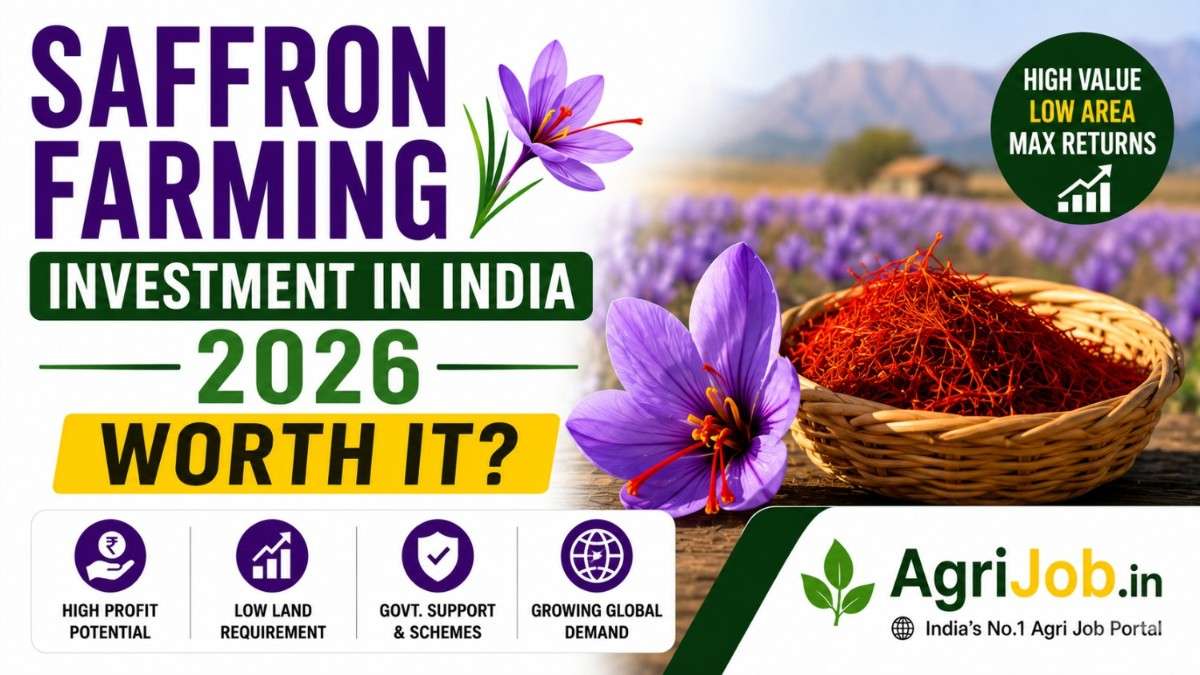
Saffron farming investment India 2026 is attracting farmers, entrepreneurs, and investors like never before — and for good reason. At Rs.3 lakh to Rs.6 lakh per kilogram, saffron (kesar) is India’s most expensive agricultural crop, often called “red gold.” But is the investment truly worth it in 2026? This complete guide covers everything: cost per acre, profit margins, step-by-step cultivation, government subsidies, aeroponic saffron farming, selling channels, and a brutally honest risk assessment — so you can make an informed decision.

- Saffron Farming Investment India 2026 – Why It Matters Now
- Saffron Price Per Kg India 2026 – Grade-Wise Breakdown
- Saffron Farming Cost Per Acre – Complete Investment Breakdown
- Saffron Farming Profit Per Acre – Realistic Income Table
- How to Grow Saffron in India – Step-by-Step Guide 2026
- Aeroponic Saffron Farming India 2026 – The Future of Kesar
- Government Schemes for Saffron Farming Investment India
- Who Should Invest in Saffron Farming in India 2026?
- Saffron Farming vs Other High-Value Crops – Comparison
- High-Value Saffron & Agri Investment Terms You Must Know
- Frequently Asked Questions
Saffron Farming Investment India 2026 – Why It Matters Now
Saffron farming investment India 2026 is at a historic inflection point. India’s Kashmir saffron holds a coveted Geographical Indication (GI) tag, making it legally distinct from Iranian saffron and commanding a 40–60% price premium globally. With global saffron demand growing at 8% annually and domestic Ayurvedic, food processing, and cosmetics industries expanding rapidly, the market fundamentals for Indian saffron farmers have never been stronger.

- 🌸 Current saffron price (Mongra grade): Rs.4 lakh – Rs.6 lakh per kg
- 🌾 India’s annual saffron production: 6–8 metric tonnes (Kashmir)
- 📈 Global saffron market size 2026: USD 1.1 billion, growing at 8% CAGR
- 🏅 Kashmir saffron GI tag awarded: 2020 (Protected Geographical Indication)
- 🧪 Aeroponic saffron pilot locations: Himachal Pradesh, UP, Maharashtra
- 💰 Net profit potential per acre: Rs.4.5 lakh – Rs.21 lakh annually
- 🏦 Government subsidy available: Up to 50% under National Saffron Mission
The National Saffron Mission (NSM), launched by the Government of India, has injected over Rs.400 crore into saffron farming revival in Kashmir and is now being extended to encourage cultivation in new geographies using technology-aided growing methods. For 2026, both traditional and aeroponic saffron cultivation pathways offer excellent investment potential for the right farmer profile.
Saffron Price Per Kg India 2026 – Grade-Wise Breakdown
Understanding saffron price grades is critical before making any saffron farming investment India 2026. The price varies enormously by grade, moisture content, and certification:
| Saffron Grade | Description | Price Per Kg (2026) | Best Market |
|---|---|---|---|
| Mongra (Lacha) | Only red stigma, highest colouring power | Rs.4 lakh – Rs.6 lakh | Export, premium retail |
| Lacha | Red + yellow parts, good aroma | Rs.2.5 lakh – Rs.3.5 lakh | Domestic wholesale |
| Zarda | Yellow style + red stigma, mild grade | Rs.1.5 lakh – Rs.2.5 lakh | Food processing, FMCG |
| Bulk / Powder | Processed, blended grades | Rs.80,000 – Rs.1.5 lakh | Cosmetics, pharma |
Farmers who achieve GI-certified Kashmir Mongra saffron consistently command the highest prices. Selling through NAFED, direct export, or premium e-commerce (Amazon Global, specialty spice brands) maximises returns compared to local mandi prices.
Saffron Farming Cost Per Acre – Complete Investment Breakdown
Before estimating returns, every saffron farming investment India 2026 decision must start with an honest cost assessment. Here is the full breakdown for 1 acre (0.4 hectare) of traditional open-field saffron farming:
| Cost Head | Year 1 Cost | Year 2+ Cost | Notes |
|---|---|---|---|
| Saffron Corms (bulbs) | Rs.80,000 – Rs.1.5 lakh | Rs.0 (self-multiplying) | 100–150 kg corms per acre needed |
| Land Preparation | Rs.20,000 – Rs.35,000 | Rs.10,000 – Rs.20,000 | Ploughing, drainage, bed formation |
| Fertiliser & Manure | Rs.15,000 – Rs.25,000 | Rs.15,000 – Rs.25,000 | FYM 20–25 tonnes/acre preferred |
| Labour (planting + harvest) | Rs.30,000 – Rs.60,000 | Rs.25,000 – Rs.50,000 | Harvest is 100% manual, labour-intensive |
| Irrigation Setup | Rs.10,000 – Rs.20,000 | Rs.5,000 – Rs.10,000 | Drip irrigation strongly recommended |
| Post-Harvest Drying | Rs.5,000 – Rs.10,000 | Rs.5,000 – Rs.10,000 | Sun drying or food dehydrator |
| Miscellaneous / Contingency | Rs.10,000 – Rs.20,000 | Rs.10,000 – Rs.15,000 | Pest control, storage, transport |
| Total Cost Per Acre | Rs.1.7 lakh – Rs.3.2 lakh | Rs.70,000 – Rs.1.3 lakh | Year 2+ costs drop sharply |
The biggest cost advantage of saffron farming is that corms self-multiply. By Year 3, a 1-acre farm generates enough corms to expand to 3–4 acres without additional corm purchase cost — dramatically improving return on investment.
Saffron Farming Profit Per Acre – Realistic Income Table 2026
Here is a realistic income and profit projection for saffron farming investment India 2026, based on open-field Kashmir-style cultivation:
| Scenario | Yield/Acre | Price/Kg | Gross Revenue | Net Profit (Y1) | Net Profit (Y2+) |
|---|---|---|---|---|---|
| Conservative | 1.5 kg | Rs.3 lakh | Rs.4.5 lakh | Rs.1.3 lakh | Rs.3.2 lakh |
| Moderate | 2.5 kg | Rs.4 lakh | Rs.10 lakh | Rs.7 lakh | Rs.9 lakh |
| Optimistic | 4 kg | Rs.5.5 lakh | Rs.22 lakh | Rs.19 lakh | Rs.21 lakh |
Even the conservative scenario delivers a solid return. From Year 2 onwards — when corm costs disappear — profit margins exceed 70%, making saffron farming one of the highest-ROI crops in India’s agriculture sector.
How to Grow Saffron in India – Step-by-Step Guide 2026
A successful saffron farming investment India 2026 begins with mastering the cultivation process. Follow these 8 steps for optimal yield:
- 🌍 Select the Right Location: Choose land at 1,500–2,500 m altitude (traditional) or use controlled environment indoors. Soil must be well-drained sandy-loam with pH 6–8. Avoid low-lying waterlogged plots.
- 🌱 Procure Quality Corms: Buy certified saffron corms (Crocus sativus) weighing 8–10 grams each from SKUAST Kashmir, ICAR-CITH, or NAFED-verified suppliers. Larger corms give higher first-year yield.
- 🚜 Prepare the Land (June–July): Deep plough the field 2–3 times. Mix 20–25 tonnes of well-decomposed FYM (farmyard manure) per acre. Form raised beds 15–20 cm high for drainage.
- 🌾 Plant Corms (July–August): Plant corms 6–8 cm deep at 10×10 cm spacing. Place pointed end upward. Cover with loose soil. Do not irrigate immediately — natural moisture is sufficient at planting.
- 💧 Irrigation Management: First irrigation 30–40 days after planting. Give 3–4 light irrigations. Avoid excess water — corm rot is the #1 cause of crop failure in saffron farming.
- 🌸 Flowering & Harvest (October–November): Flowers bloom for only 15–20 days per year. Harvest flowers daily at sunrise before they open fully. This is the most labour-intensive phase — 150–200 labour hours per kg of dried saffron.
- 🧺 Stigma Separation & Drying: Separate the 3 red stigmas from each flower immediately after harvest. Dry stigmas at 40–45°C for 12–15 minutes using a food dehydrator, or sun-dry for 2–3 days. Proper drying is critical for Grade 1 pricing.
- 📦 Storage & Grading: Store dried saffron in airtight glass containers away from light. Grade as Mongra, Lacha, or Zarda for pricing. Apply for GI certification if farming in Kashmir for maximum market value.
Aeroponic Saffron Farming India 2026 – The Future of Kesar
One of the most exciting developments in saffron farming investment India 2026 is the rise of aeroponic cultivation — growing saffron in a controlled indoor environment without soil, where corm roots are suspended in air and misted with nutrients.
Aeroponic saffron farming allows 3–4 harvests per year instead of just 1 in open-field farming. While setup cost is higher (Rs.15–25 lakh per 1,000 sq ft), annual income per unit can reach Rs.8–15 lakh — making it ideal for urban farmers, agritech entrepreneurs, and investors in non-Himalayan states.
| Parameter | Open Field (Traditional) | Aeroponic (Indoor) |
|---|---|---|
| Setup Cost (per 1,000 sq ft) | Rs.1.5–3 lakh | Rs.15–25 lakh |
| Harvests Per Year | 1 (October–November only) | 3–4 (year-round) |
| Yield Per 1,000 sq ft/year | 0.08–0.12 kg | 0.3–0.5 kg |
| Geographic Limitation | Himalayan belt only | Anywhere in India |
| Water Requirement | High | 90% less water |
| Break-Even Period | 1–2 years | 2–3 years |
| Best For | Kashmir, HP, Uttarakhand farmers | Agritech entrepreneurs, urban farming |
Government Schemes for Saffron Farming Investment India 2026
The Indian government actively supports saffron farming investment India 2026 through several targeted schemes. Here are the most important ones for farmers and entrepreneurs:
- 🏛️ National Saffron Mission (NSM) — Provides up to 50% subsidy on corms, inputs, and irrigation for saffron farmers in J&K and Ladakh. Apply via NHB (National Horticulture Board).
- 🌾 MIDH Scheme (Mission for Integrated Development of Horticulture) — Up to 40% capital subsidy for high-value horticulture including saffron. Accessible via state horticulture departments. Visit midh.gov.in for details.
- 💳 Kisan Credit Card (KCC) for Saffron — Saffron farmers are eligible for KCC loans at 4% effective interest rate (post subvention). NABARD-backed scheme through all scheduled banks. Loan up to Rs.3 lakh without collateral.
- 🚜 PM-KISAN Income Support — Rs.6,000 per year baseline support for all eligible farmers including saffron growers. Register at pmkisan.gov.in.
- 🧪 RKVY-RAFTAAR Agritech Grants — For aeroponic and tech-based saffron cultivation entrepreneurs, RKVY provides seed grants of Rs.5–25 lakh through agri-business incubation centres.
- 📦 APEDA Export Support — Saffron exporters receive packaging, certification, and market development assistance from APEDA under the Agricultural and Processed Food Products Export Development Authority.
Who Should Invest in Saffron Farming India 2026?
Not every farmer or investor is the right fit for saffron farming investment India 2026. Here is who stands to benefit most:
- 🏔️ Farmers in J&K, Ladakh & Himachal Pradesh — Natural climate advantage, existing GI brand recognition, and government scheme access make these the ideal primary candidates.
- 🌿 Small & Marginal Farmers (0.5–2 acres) — Saffron’s extremely high value per kg means even 0.5 acres can generate Rs.3–8 lakh annual income — transformative for smallholders.
- 💻 Agritech Entrepreneurs — Aeroponic saffron farming is a capital-efficient agritech business with predictable returns, ideal for first-generation entrepreneurs backed by RKVY or angel funding.
- 👩🌾 Women Farmers & SHGs — Saffron harvesting and processing is predominantly female labour. Women-led FPOs in Kashmir earn direct premium income from saffron processing and packaging enterprises.
- 🏦 Agri Investors Seeking High-ROI Crops — With 70%+ profit margins from Year 2 and a premium export market, saffron rivals vanilla and cardamom as the best ROI crop in India’s high-value agri basket.
- 🎓 Agriculture Graduates & BSc Agri Freshers — Starting a saffron enterprise post-graduation, backed by NABARD incubation or state agri university support, is a viable alternative to government jobs with far higher earning potential.
- 🏙️ Urban Investors in Contract Farming — Urban professionals can invest in contract saffron farming with established Kashmiri farmer groups via FPO agreements — earning Rs.1–3 lakh annually per lakh invested.
- 🌍 Exporters & Spice Entrepreneurs — India’s saffron export to UAE, UK, USA, and Europe is growing 12% annually. Building a GI-certified saffron export brand from Kashmir is a Rs.10–50 crore business opportunity.
Saffron Farming vs Other High-Value Crops India – Comparison Table
| Parameter | Saffron | Vanilla | Cardamom | Stevia |
|---|---|---|---|---|
| Price/Kg | Rs.3–6 lakh | Rs.40,000–80,000 | Rs.1,500–3,500 | Rs.150–300 |
| Setup Cost/Acre | Rs.1.7–3.2 lakh | Rs.2–4 lakh | Rs.1–2 lakh | Rs.50,000–1 lakh |
| First Yield (Years) | Same year (Year 1) | 2–3 years | 2–3 years | Same year |
| Net Profit/Acre | Rs.4–21 lakh | Rs.3–10 lakh | Rs.1–4 lakh | Rs.50,000–1.5 lakh |
| Geographic Limit | High (or indoor tech) | High (tropical only) | Medium | Low (grows anywhere) |
| Govt Subsidy | Up to 50% (NSM) | Up to 30% (MIDH) | Up to 30% | Minimal |
| Export Market | Excellent (GI protected) | Good | Good | Moderate |
| Best For | High-value, low-volume | Coastal/tropical farmers | Western Ghats farmers | Any small farmer |
Saffron is India’s undisputed #1 high-value crop by price per kg. For farmers in the Himalayan belt, it offers the best income per acre of any crop in India. For entrepreneurs using aeroponic technology, it opens a geography-independent premium business. The key risks — climate dependence and manual harvest labour — are manageable with proper planning. If you have the right land, water discipline, and market access, saffron farming investment India 2026 is absolutely worth it.
High-Value Saffron & Agri Investment Terms You Must Know
Understanding these terms will help you navigate saffron farming investment India 2026 discussions with lenders, buyers, and government scheme officers:
- 📌 GI Tag (Geographical Indication) — Legal protection for Kashmir saffron ensuring only saffron grown in designated Kashmir zones can carry the “Kashmir Saffron” label. Commands 40–60% price premium over untagged saffron.
- 📌 Crocus sativus — The scientific name for the saffron plant. Each flower produces exactly 3 stigmas — the part harvested as saffron. One kg of dried saffron requires 150,000–200,000 flowers.
- 📌 Corm — The bulb-like underground storage organ of the saffron plant. Self-multiplies each year (1 corm → 5–8 corms in 3 years), eliminating replanting costs from Year 2 onwards.
- 📌 ISO 3632 Standard — International quality standard for saffron. Grade I (highest) requires crocin content above 250. Achieving ISO 3632 Grade I certification enables premium export pricing of Rs.5–6 lakh per kg.
- 📌 NAFED Saffron Procurement — National Agricultural Cooperative Marketing Federation of India procures Kashmir saffron at MSP-linked prices, providing a guaranteed floor price for J&K farmers.
- 📌 Aeroponic Farming — Soilless farming technique where roots are suspended in air and misted with nutrient solution. Enables year-round saffron production anywhere in India, 90% more water-efficient than field farming.
- 📌 FPO (Farmer Producer Organisation) — Collective of farmers legally structured as a company. Saffron FPOs in Kashmir achieve better prices by bulk grading, packaging, and direct B2B/export sales bypassing middlemen.
- 📌 KCC (Kisan Credit Card) — Short-term crop loan product at 4% effective interest rate post subvention. Available up to Rs.3 lakh without collateral for all registered farmers including saffron growers.
- 📌 Crocin — The primary pigment compound in saffron responsible for its golden-yellow colour. Higher crocin = higher quality grade = higher price. Tested under ISO 3632 standards for export certification.
- 📌 APEDA Export Certification — Agricultural and Processed Food Products Export Development Authority certification required for saffron export. Enables access to UAE, European, and North American premium spice markets.
Frequently Asked Questions – Saffron Farming Investment India 2026
What is the price of saffron per kg in India 2026?
Saffron price in India 2026 ranges from Rs.3 lakh to Rs.6 lakh per kg depending on grade and quality. Mongra grade — the finest Kashmir saffron — commands up to Rs.6 lakh per kg in domestic and export markets. Lacha and Zarda grades sell at Rs.1.5 lakh to Rs.3.5 lakh per kg depending on buyer and channel.
How much does saffron farming cost per acre in India?
Saffron farming cost in India ranges from Rs.1.7 lakh to Rs.3.2 lakh per acre in the first year, including corm purchase, land preparation, fertiliser, and labour. From Year 2 onwards, costs drop to Rs.70,000–Rs.1.3 lakh per acre because corms self-multiply and do not need to be repurchased.
How much profit can I earn from saffron farming per acre?
A well-managed saffron farm in India can yield 2–4 kg of dried saffron per acre. At Rs.3–6 lakh per kg, gross revenue per acre ranges from Rs.6 lakh to Rs.24 lakh. After deducting costs, net profit ranges from Rs.4.5 lakh to Rs.21 lakh per acre annually from Year 2 onwards.
Can saffron be grown outside Kashmir in India?
Yes, saffron can be successfully grown outside Kashmir using aeroponic and controlled environment techniques. States like Himachal Pradesh, Uttarakhand, and Ladakh support traditional cultivation. In non-Himalayan states, aeroponic indoor farming with climate control allows year-round saffron production with 3–4 harvests annually.
What government schemes support saffron farming in India 2026?
Key government schemes include the National Saffron Mission (NSM) offering up to 50% subsidy on inputs, the MIDH scheme under NHB for high-value horticulture, NABARD KCC loans at 4% interest, PM-KISAN income support, and RKVY-RAFTAAR grants for tech-based saffron entrepreneurs up to Rs.25 lakh.
How long does it take for saffron to yield after planting?
Saffron corms planted in July–August typically flower in October–November of the same year. First-year yields are lower at 1–2 kg per acre. Full productive yield of 3–4 kg per acre is achieved from the 2nd or 3rd year onwards as corms multiply naturally in the soil.
Is aeroponic saffron farming profitable in India?
Aeroponic saffron farming is highly profitable for technology-oriented entrepreneurs. Setup cost is Rs.15–25 lakh per 1,000 sq ft unit. Annual yield can achieve 3–5 harvests versus just 1 in open fields, generating Rs.5–15 lakh annual revenue per unit. Break-even is typically achieved in 2–3 years.
Where can I sell saffron produced in India?
Saffron can be sold through Kashmir’s Saffron Park in Pampore, NAFED procurement centres, online via Amazon and specialty portals, export to UAE, UK, and USA markets, and directly to Ayurvedic and food companies like Dabur, Patanjali, and certified spice exporters under APEDA registration.
What are the main risks in saffron farming investment India 2026?
Key risks include corm rot due to excess soil moisture, climate irregularity disrupting flowering, high initial corm procurement cost, price competition from cheaper Iranian saffron, and adulteration risk at the processing stage. Proper drainage, GI certification, and direct-to-consumer marketing significantly reduce these risks.
Is saffron farming worth it in 2026 for a small farmer?
Yes, saffron farming is one of the best investment decisions for small farmers with 0.5–2 acres in the Himalayan belt. Even a conservative yield of 1.5 kg per acre at Rs.3 lakh per kg generates Rs.4.5 lakh gross income — transforming the financial position of small and marginal farmers who typically earn Rs.50,000–1.5 lakh from conventional crops on the same land.
📅 Last Updated: May 2026 | This guide is regularly reviewed and updated for accuracy. Bookmark this page for the latest saffron farming investment India updates, government scheme notifications, and price trends.