

A saffron farming business plan 2026 making the rounds online promises $150,000 in revenue per acre — a number that would put saffron ahead of nearly every other legal crop on the planet, dollar for dollar. This guide is for Indian farmers, agri-entrepreneurs, and NRI investors deciding whether saffron deserves a place in their portfolio, not another marketing pitch dressed up as a business plan. We trace the $150,000-per-acre figure to its source, cross-check it against official National Saffron Mission yield data and current 2026 Kashmir saffron prices, and build a realistic saffron farming business plan with real costs, timelines, and government scheme support.

In a realistic saffron farming business plan 2026, the viral $150,000-per-acre claim does not hold up against verified data. Official National Saffron Mission figures put actual Indian farm-gate revenue at roughly $4,800–$6,500 per acre (Rs 4.5–6.2 lakh) in a strong, rejuvenated field — a fraction of the viral number. $150,000+ per acre becomes mathematically possible only if a grower also owns the retail brand and sells 100% of output at premium consumer prices, which almost no raw producer does.
- Viral claim: $150,000 revenue per acre (unverified US business-plan template)
- Realistic Indian farm-gate revenue: $4,800–$6,500 per acre in a rejuvenated field
- Best-case retail-brand-capture revenue: $117,000–$176,000 per acre (rare)
- National Saffron Mission best recorded yield: 6.96 kg/hectare (2023-24), target 7.5 kg/hectare
- 2026 Kashmir wholesale price: Rs 1.65–1.88 lakh per kg (~$1,720–$1,960)
- 2026 branded retail Mongra price: Rs 4–6 lakh per kg (~$4,170–$6,250)
- Year-1 setup cost: Rs 1.7–3.2 lakh per acre (~$1,770–$3,330)
- Typical break-even: 1–2 years for open-field cultivation
- Government subsidy: up to 50% under the National Saffron Mission
- What Is a Realistic Saffron Farming Business Plan?
- Who Should Build a Saffron Farming Business Plan?
- How Much Does Saffron Farming Really Earn Per Acre?
- Land, Climate & Eligibility: What You Need First
- How to Build Your Saffron Business Plan: 8 Steps
- Open-Field vs Aeroponic Saffron Farming
- Pros and Cons of a Saffron Farming Business
- Key Terms Every Saffron Business Plan Should Get Right
- Saffron Farming Timeline: Planting to Payout
- Important Links
- Conclusion
- Frequently Asked Questions
What Is a Realistic Saffron Farming Business Plan?
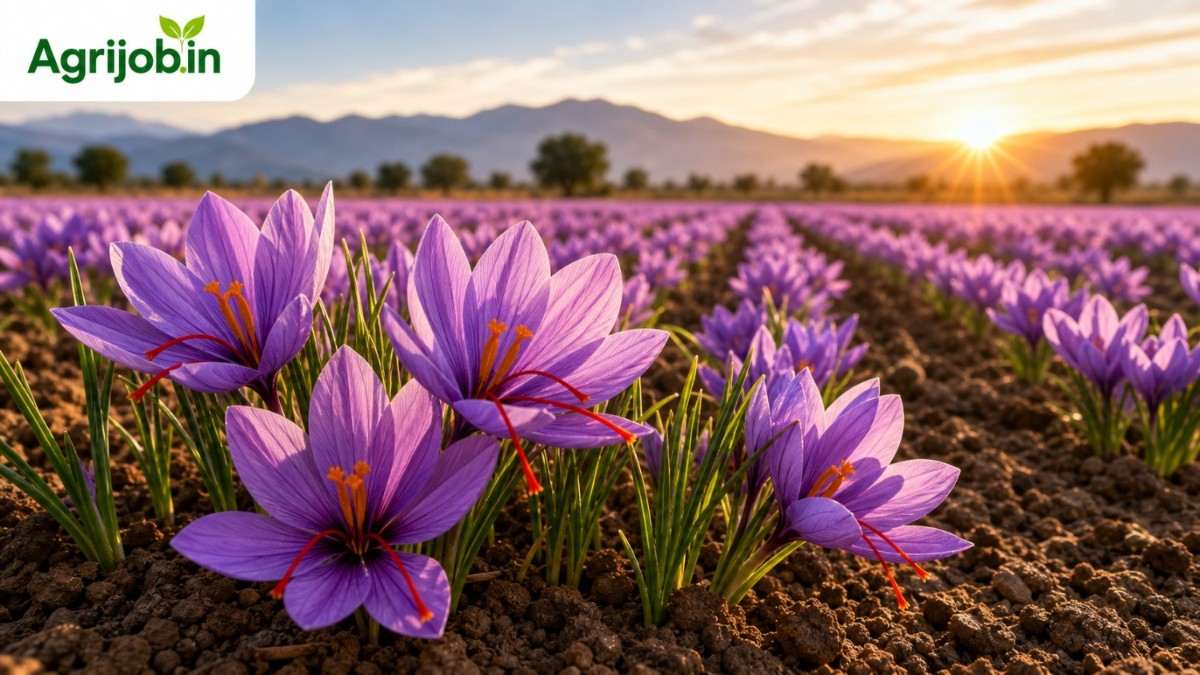
A realistic saffron farming business plan is a per-acre revenue and cost model built from verified yield and price data — not a template figure copied across dozens of AI-generated business-plan websites. Genuine saffron economics depend on three variables: kilograms of dried saffron produced per acre, the price a grower actually receives, and the years needed to reach full yield.
The $150,000-per-acre figure traces back to US business-plan-generator blogs that cite a single unverifiable example farm, with no audited financials or government data behind it. That is very different from India’s official National Saffron Mission productivity records, which are published, cross-verified, and tracked over 15 years.

Two mistakes commonly inflate saffron revenue claims. First, hectare and acre figures get swapped — a hectare is 2.47 times larger than an acre, so quoting a per-hectare yield as a per-acre yield can overstate revenue by nearly 150%. Second, farm-gate wholesale prices get replaced with branded retail prices, which include packaging, marketing, and distribution margins the raw grower never actually receives.
- Global benchmark yield in Iran and Spain: 4–6 kg saffron per hectare, per peer-reviewed saffron production research
- India’s National Saffron Mission best-ever recorded yield: 6.96 kg per hectare (2023-24, rejuvenated fields only)
- 2026 Kashmir farm-gate/wholesale price: Rs 1.1–2.2 lakh per kg
- 2026 branded retail Mongra price: Rs 4–6 lakh per kg
Who Should Build a Saffron Farming Business Plan in 2026?
Saffron is not a crop for every farmer or investor. A realistic saffron business plan fits these profiles best:
- 🏔️ Farmers in J&K, Ladakh & Himachal Pradesh — natural high-altitude climate and direct access to National Saffron Mission subsidies.
- 🌿 Small and marginal farmers (0.25–2 acres) — saffron’s high value per kilogram means even a small plot can outperform wheat or paddy on the same land.
- 💻 Agritech entrepreneurs exploring aeroponic or controlled-environment cultivation outside the Himalayan belt.
- 🏦 Investors seeking an honest cost-benefit model, not a marketing projection — this guide gives you the verified range.
- 👩🌾 Women farmer groups and FPOs — saffron harvesting and grading is a major source of organised rural employment in Kashmir.
- 🎓 Agriculture graduates evaluating saffron as a post-degree enterprise alongside a government job search.
- 🌍 Exporters and spice entrepreneurs who plan to control processing and branding, not just raw sale — this is the only path close to the higher revenue figures.
How Much Does Saffron Farming Really Earn Per Acre?
Saffron farming income depends entirely on which price point a grower actually captures. Using current 2026 wholesale price data and official National Saffron Mission yield records, here is the same acre of Kashmir saffron valued at four different, verifiable price points.
| Scenario | Yield/Acre | Price Captured | Revenue/Acre (Rs) | Revenue/Acre (USD) |
|---|---|---|---|---|
| National average (non-rejuvenated field) | 1.6–2.6 kg | Farm-gate Rs 1.1–1.6 lakh/kg | Rs 1.8–4.2 lakh | $1,850–$4,350 |
| NSM-rejuvenated best case (2023-24 record) | ~2.8 kg | Wholesale Rs 1.65–2.2 lakh/kg | Rs 4.6–6.2 lakh | $4,800–$6,500 |
| Full retail-brand capture (rare, direct export/DTC) | ~2.8 kg | Branded retail Rs 4–6 lakh/kg | Rs 11.3–16.9 lakh | $117,000–$176,000 |
| Viral $150,000/acre claim | Unverified | Unverified | Unverified | $150,000 (unaudited) |
Only the third row — a grower who processes, brands, and sells saffron directly at full consumer retail price with zero crop failure — lands anywhere near $150,000 per acre. For everyone selling raw or wholesale saffron, which is the overwhelming majority of Indian saffron farmers, real revenue sits between $1,850 and $6,500 per acre.
Even in the United States, where saffron sells at premium direct-to-consumer prices, a University of Vermont saffron researcher puts realistic one-acre revenue at around $100,000 by the third year of production — smaller than the viral claim, and achieved only through hand-selling to chefs and consumers, not wholesale trade.
For readers comparing detailed cost breakdowns and year-by-year profit tables, our complete saffron farming investment guide walks through per-acre setup costs and a conservative-to-optimistic profit table for open-field cultivation.
Land, Climate & Eligibility: What You Need Before You Start
Before writing a single revenue projection, a saffron farming business plan must confirm land, climate, and capital fit. India currently has about 2,825 hectares under saffron cultivation, almost entirely in Jammu & Kashmir, because open-field corms need a genuine winter chill cycle and well-drained soil that most Indian regions cannot offer.
- Altitude of 1,500–2,500 metres for open-field cultivation, or a temperature-controlled indoor unit for aeroponic farming
- Well-drained sandy-loam soil, pH 6–8; waterlogging causes corm rot, the single biggest cause of crop failure
- Certified corms (8–10 grams each) from SKUAST-Kashmir, ICAR-CITH, or NAFED-verified suppliers
- Capital of Rs 1.7–3.2 lakh per acre for Year 1 (corms, land prep, irrigation, labour)
- Access to manual harvest labour during the 15–20 day flowering window in October–November
- A marketing plan — Saffron Park (Pampore), NAFED, APEDA export registration, or direct-to-consumer channels
Farmers financing this through a bank loan can use a Kisan Credit Card or NABARD-backed loan, which carries a subsidised effective interest rate for registered farmers.
| Support Scheme | Benefit | Category |
|---|---|---|
| National Saffron Mission (NSM) | Up to 50% subsidy on corms, inputs, irrigation | J&K, Ladakh farmers |
| MIDH (Mission for Integrated Development of Horticulture) | Up to 40% capital subsidy | All states, high-value horticulture |
| Kisan Credit Card (KCC) | Loan up to Rs 3 lakh, ~4% effective interest post subvention | All registered farmers |
| RKVY-RAFTAAR | Seed grants of Rs 5–25 lakh | Agritech / aeroponic entrepreneurs |
| APEDA Export Support | Packaging, certification, market development assistance | Saffron exporters |
How to Build Your Saffron Farming Business Plan: 8 Steps
Follow this process to turn saffron farming from a viral revenue claim into an actual, financeable business plan.
- Verify your land or setup against climate data. Confirm altitude, drainage, and winter chill hours, or budget for a controlled indoor environment.
- Get an official yield estimate for your zone. Ask SKUAST-Kashmir or your state horticulture department for a realistic kg/acre figure — never accept a blog’s number.
- Price your saffron at farm-gate, not retail. Use current wholesale rates (Rs 1.1–2.2 lakh/kg in 2026) unless you already have a direct retail or export channel.
- Cost Year 1 and Year 2+ separately. Corm cost disappears after Year 1 because corms self-multiply, sharply improving margins from Year 2 onward.
- Apply for National Saffron Mission or MIDH subsidy before purchasing corms — subsidy approval can affect your input costs by up to 50%.
- Build a marketing channel before harvest. Decide between Saffron Park sale, NAFED procurement, APEDA export, or direct consumer sale — each changes your real price per kg.
- Insure the crop where possible. Corm rot and erratic snowfall are the leading causes of saffron crop failure in Kashmir.
- Re-run your numbers against this article’s revenue table before presenting the plan to any lender or investor.
Ask any saffron business plan, pitch deck, or investment scheme for its price-per-kg source and yield-per-acre source separately. If either number cannot be traced to a government portal, a university extension programme, or an audited export record, treat it as marketing, not data.
Open-Field Kashmir Saffron vs Aeroponic Indoor Saffron
Aeroponic saffron farming is often used to justify inflated per-acre projections because it promises 3–4 harvests a year instead of one. The comparison looks very different once setup cost is scaled to a full acre.
| Parameter | Open-Field (Traditional) | Aeroponic (Indoor) |
|---|---|---|
| Setup cost per 1,000 sq ft | Rs 1.5–3 lakh | Rs 15–25 lakh |
| Setup cost scaled to 1 acre (43,560 sq ft) | Rs 65–130 lakh | Rs 6.5–10.9 crore |
| Harvests per year | 1 (October–November) | 3–4 (year-round) |
| Geographic limitation | Himalayan belt only | Anywhere in India |
| Water requirement | High | ~90% lower |
| Break-even period | 1–2 years | 2–3 years |
| Yield data source | Government-audited (NSM) | Mostly vendor/pilot projections |
| Best for | Kashmir, HP, Uttarakhand farmers | Well-capitalised agritech entrepreneurs |
Open-field Kashmir saffron has the most reliable, government-audited yield and price data available, which makes it the safer basis for a business plan. Aeroponic saffron can genuinely raise output per square foot, but scaling it to acre-sized capital requirements — crores, not lakhs — is rarely disclosed alongside the revenue projections that quote it.
Pros and Cons of a Saffron Farming Business in 2026
A saffron farming business plan looks attractive on paper, but honest planning means weighing both sides.
Advantages
- Highest value per kilogram of any legal Indian crop, even at realistic farm-gate prices
- Corms self-multiply, cutting Year 2+ input costs sharply
- GI tag on Kashmir saffron commands a genuine 40–60% price premium over untagged saffron
- Multiple government subsidy routes (NSM, MIDH, RKVY-RAFTAAR) reduce upfront risk
Disadvantages
- Geographically restricted for open-field cultivation — only Himalayan-belt land qualifies
- Corm rot and erratic snowfall can wipe out an entire season’s flowering
- Harvest is 100% manual and labour-intensive during a narrow 15–20 day window
- Real farm-gate prices are far below the branded retail prices used in most viral projections
Key Terms Every Saffron Business Plan Should Get Right
Understanding these terms prevents the unit and pricing confusion that inflates most viral saffron revenue claims.
- 📌 Farm-gate price — what a grower is actually paid at first sale, before processing, branding, or retail markup. This is the correct number for any per-acre revenue calculation.
- 📌 Hectare vs acre — 1 hectare = 2.47 acres. Confusing the two can overstate a per-acre figure by nearly 150%.
- 📌 Crocus sativus — the scientific name of the saffron plant; each flower yields exactly 3 stigmas, the part harvested as saffron.
- 📌 Corm — the underground bulb that self-multiplies each year, eliminating replanting cost from Year 2 onward.
- 📌 GI Tag (Geographical Indication) — legal certification that protects “Kashmir Saffron” as a distinct, traceable origin, commanding a real price premium.
- 📌 ISO 3632 — the international saffron grading standard; Grade I (Mongra) requires crocin content above 250 and commands the highest export price.
- 📌 NAFED procurement — the National Agricultural Cooperative Marketing Federation channel that offers J&K farmers an MSP-linked floor price.
- 📌 Aeroponic farming — soilless cultivation with roots suspended in air and misted with nutrients, enabling multiple harvests per year at a much higher capital cost per acre-equivalent.
Saffron Farming Timeline: Planting to Payout
| Month / Stage | Activity |
|---|---|
| June–July | Land preparation, deep ploughing, FYM application |
| July–August | Corm planting, 6–8 cm deep |
| September–October | First light irrigation, growth monitoring |
| October–November | Flowering and harvest window (15–20 days, manual only) |
| Post-harvest | Stigma separation and drying within hours of picking |
| Year 1 | Lower yield, ~1–2 kg/acre as corms establish |
| Year 2–3 | Full productive yield as corms multiply naturally |
Important Links for Your Saffron Farming Business Plan
| Resource | Link |
|---|---|
| National Saffron Mission — official update (PIB) | pib.gov.in |
| Saffron Mission expansion to North East (PIB) | pib.gov.in |
| NHB — National Horticulture Board (subsidy portal) | nhb.gov.in |
| Complete saffron cost & profit breakdown (Agrijob.in) | Saffron Farming Investment Guide 2026 |
| Kisan Credit Card & NABARD subsidy guide (Agrijob.in) | KCC & NABARD Guide |
| Farmland investment returns in India (Agrijob.in) | Farmland Investment India 2026 |
| NRI agricultural land investment rules & risks (Agrijob.in) | NRI Agricultural Land Investment |
Conclusion: Is the $150,000 Per Acre Claim Worth Believing?
A credible saffron farming business plan 2026 should be built on National Saffron Mission data and current wholesale prices, not a number copied from an AI-generated business template. On that honest basis, most Indian saffron growers can realistically expect $1,850–$6,500 per acre in gross revenue, rising into six figures only for the small number of growers who control processing, branding, and direct retail sale of every gram produced.
That does not make saffron a bad crop — it remains India’s highest-value legal crop per kilogram, with genuine government subsidy support and a self-multiplying corm that improves margins every year. It does mean treating any pitch, scheme, or “business plan” that guarantees a fixed, extreme per-acre return with real scepticism; India’s agriculture sector has seen repeated high-return investment schemes collapse once real production could not match the promised numbers. Verify yield claims against your state horticulture department or SKUAST before committing capital.
If your land and climate genuinely qualify, apply for National Saffron Mission or MIDH subsidy support before purchasing corms, and model your first two years on the conservative end of this article’s revenue table. Bookmark this page — we update it whenever official saffron price and yield data changes.
- The $150,000-per-acre saffron claim traces to unverified US business-plan templates, not audited farm data.
- Real Indian farm-gate revenue runs $1,850–$6,500 per acre; NSM’s best-ever recorded yield is 6.96 kg/hectare.
- $150,000+/acre is only reachable through full retail-brand capture at Rs 4–6 lakh/kg — rare for raw growers.
- Hectare-to-acre unit confusion alone can inflate a claimed yield figure by nearly 150%.
- National Saffron Mission and MIDH subsidies cover up to 50% of Year-1 setup cost for eligible farmers.
- Apply through NHB or your state horticulture department before buying corms, and verify every yield number independently.
Frequently Asked Questions About Saffron Farming Business Plan 2026
Is the $150,000 per acre saffron farming claim real?
No independent, audited evidence supports a $150,000-per-acre saffron farming claim. It originates from AI-generated business-plan-template websites that cite an unverifiable example farm. Official National Saffron Mission data puts realistic Indian farm-gate revenue at $4,800–$6,500 per acre in a strong year, far below the viral figure.
How much does saffron farming really earn per acre in India?
Realistic gross revenue for open-field Kashmir saffron ranges from Rs 1.8–4.2 lakh per acre ($1,850–$4,350) for a national-average field to Rs 4.6–6.2 lakh per acre ($4,800–$6,500) for a National Saffron Mission-rejuvenated field, based on 2026 wholesale prices of Rs 1.1–2.2 lakh per kg.
What is the average saffron yield per acre in Kashmir?
India’s National Saffron Mission recorded a best-ever productivity of 6.96 kg per hectare in 2023-24, equal to roughly 2.8 kg per acre. The national average across Kashmir saffron land typically runs between 1.6 kg and 2.6 kg per acre, below Iran and Spain’s benchmark of 4–6 kg per hectare.
How much does it cost to start a saffron farming business plan in India?
Year 1 setup cost for one acre of open-field saffron typically runs Rs 1.7–3.2 lakh ($1,770–$3,330), covering corms, land preparation, fertiliser, irrigation, and labour. Because corms self-multiply, Year 2 onward costs drop to Rs 70,000–1.3 lakh per acre.
Is saffron farming profitable for a small farmer in 2026?
Yes, for farmers in the Himalayan belt with genuine climate and altitude fit. Even a conservative yield sold at wholesale price can outperform traditional crops like wheat or paddy on the same land, and National Saffron Mission subsidies of up to 50% reduce the upfront capital risk.
What government schemes support a saffron farming business plan?
Key support includes the National Saffron Mission (up to 50% subsidy on corms and irrigation), the MIDH scheme (up to 40% capital subsidy), Kisan Credit Card loans at a subsidised effective interest rate, and RKVY-RAFTAAR grants of Rs 5–25 lakh for agritech and aeroponic saffron entrepreneurs.
Is aeroponic saffron farming actually more profitable than open-field?
Aeroponic saffron can produce 3–4 harvests a year instead of one, but setup cost scales to roughly Rs 6.5–10.9 crore per acre-equivalent, compared to Rs 65–130 lakh for open-field cultivation at the same scale. Most aeroponic yield figures are vendor or pilot-scale projections rather than government-audited data, so verify them independently before using them in a business plan.
How long before a saffron farm becomes profitable?
Open-field saffron typically reaches break-even within 1–2 years, with full productive yield arriving in Year 2 or 3 as corms multiply naturally in the soil. First-year yield is usually lower, around 1–2 kg per acre, because the corm bed is still establishing.
What is the price of saffron per kg in India in 2026?
In 2026, Kashmir saffron sells at Rs 1.1–2.2 lakh per kg at farm-gate and wholesale level, while branded retail Mongra grade sells for Rs 4–6 lakh per kg to end consumers. The gap between these two prices is the main reason viral per-acre revenue claims differ so widely from real farmer income.
What are the biggest risks in a saffron farming business plan?
The leading risks are corm rot from excess soil moisture, erratic snowfall disrupting flowering, high dependence on manual harvest labour during a narrow 15–20 day window, and price competition from cheaper Iranian saffron. Verifying yield and price claims against government sources before investing significantly reduces these risks.
Last Updated: August 2026. This saffron farming business plan guide is reviewed and updated regularly against National Saffron Mission data and current market prices. Bookmark this page for the latest saffron farming business plan 2026 updates.
Disclaimer: This article is for general informational purposes only and does not constitute financial, investment, or agronomic advice. Saffron yield and price figures vary by season, region, and grade; verify current numbers with your state horticulture department, SKUAST-Kashmir, or ICAR-CITH before making any investment decision. Agrijob.in is not liable for losses arising from decisions based on this content.