

Kisan Rail Scheme 2026 – Send Perishable Crops by Train at 50% Discount
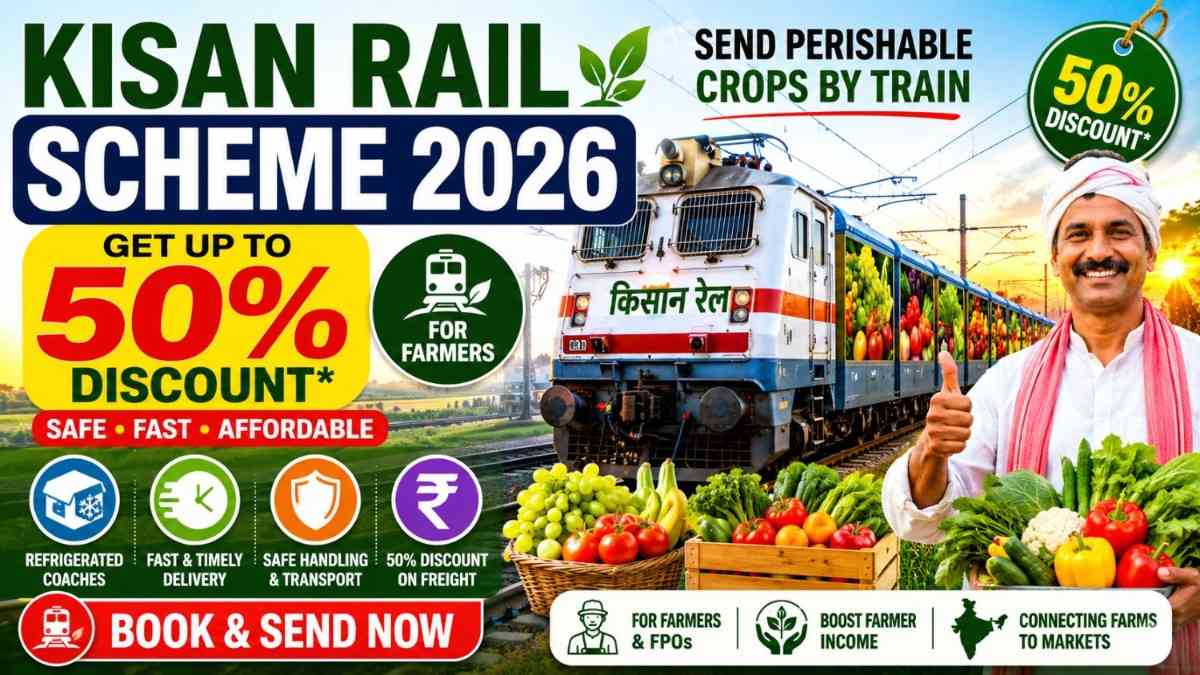
Kisan Rail scheme 2026 is the Government of India’s most impactful agricultural logistics initiative — a dedicated Indian Railways service that allows farmers to transport perishable crops including fruits, vegetables, milk, meat, fish, and dairy products from production surplus regions to consumption markets across India at a 50% discount on freight charges. Launched on 7 August 2020, Kisan Rail has so far operated 2,364 services, transporting 7.9 lakh tonnes of perishables and saving farmers crores of rupees in logistics costs. With no minimum quantity limit, refrigerated coaches maintaining produce freshness, savings of Rs.1,000 per tonne and 15 hours in transit time over road transport, and the 50% subsidy paid upfront at booking, Kisan Rail is a direct income multiplier for every perishable crop farmer in India. This complete 2026 guide covers what Kisan Rail is, the full list of 42 eligible fruits and vegetables, how to book step by step, active routes, Operation Greens linkage, Perishable Cargo Centres, and who should use Kisan Rail immediately this season.

| Scheme Name | Kisan Rail (Dedicated Agricultural Produce Train Service) |
| Launched By | Indian Railways / Ministry of Railways, Govt. of India |
| Launch Date | 7 August 2020 (Devlali, Maharashtra → Danapur, Bihar) |
| Freight Subsidy | 50% on notified fruits & vegetables (paid upfront at booking) |
| Subsidy Borne By | Ministry of Food Processing Industries (MoFPI) — Operation Greens |
| Total Services Operated | ~2,364 Kisan Rail services (since 2020) |
| Total Perishables Transported | ~7.9 lakh tonnes |
| Eligible Crops | 42 notified fruits & vegetables + milk, meat, fish, poultry, eggs |
| Minimum Quantity | None — even small farmers with a few bags can book |
| Coach Type | Refrigerated / Controlled Atmosphere parcel vans |
| Time Saving vs Road | ~15 hours per trip |
| Cost Saving vs Road | ~Rs.1,000 per tonne (before 50% subsidy) |
| Booking Mode | Station Parcel Office / parcel.indianrail.gov.in |
| Advance Booking Window | Up to 120 days in advance |
| Freight Tariff | P-scale of parcel tariff |
| Announced In | Union Budget 2020-21 |
- What is Kisan Rail Scheme 2026?
- 50% Freight Subsidy – How It Works & Who Pays
- 42 Eligible Fruits & Vegetables + Other Perishables
- Key Features of Kisan Rail 2026
- Benefits of Using Kisan Rail vs Road Transport
- Who Should Use Kisan Rail in 2026?
- Kisan Rail Routes – Production to Market Connectivity
- Perishable Cargo Centres (PCCs) – Cold Chain on Rail
- Documents Required to Book Kisan Rail
- How to Book Kisan Rail 2026 – Step-by-Step Process
- Operation Greens – TOP to Total: The Subsidy Scheme Behind Kisan Rail
- Kisan Rail vs Road Transport vs Krishi Udan – Comparison
- High-Value Agriculture Logistics & Scheme Terms to Know
- Frequently Asked Questions – Kisan Rail 2026
What is Kisan Rail Scheme 2026?
Kisan Rail is a dedicated Indian Railways train service designed to move perishable agricultural produce rapidly from production surplus regions to high-demand consumption centres across India. Announced in the Union Budget 2020-21 by Finance Minister Nirmala Sitharaman and launched on 7 August 2020 between Devlali (Maharashtra) and Danapur (Bihar), Kisan Rail solves one of Indian agriculture’s most persistent and costly problems — the inability of small and marginal farmers to affordably transport perishable produce beyond local markets.
The fundamental challenge Kisan Rail addresses is this: a vegetable or fruit farmer in Maharashtra, Andhra Pradesh, or Gujarat grows quality produce for which buyers in Delhi, Kolkata, or Guwahati would pay significantly more — but road transport is expensive, slow, and causes heavy spoilage in non-refrigerated trucks. Without a cold logistics chain connecting farm to distant market, the farmer is trapped selling locally at low prices or watching produce rot. Kisan Rail breaks this trap by providing refrigerated rail transport at 50% subsidised rates, with no minimum quantity requirement, using Indian Railways’ vast network that reaches into villages across every state.

Kisan Rail is operated as a multi-commodity, multi-consignor, multi-consignee, multi-loading/unloading transportation product — meaning a single train can carry produce from multiple farmers, destined for multiple buyers, stopping at multiple stations along its route. This makes Kisan Rail genuinely accessible to the smallest farmer with just a few bags of tomatoes or a single crate of mangoes — unlike dedicated cold chain trucks which require full truckload bookings that most small farmers cannot afford.
Since its launch to the latest available data, Indian Railways have operated around 2,364 Kisan Rail services, transporting approximately 7.9 lakh tonnes of perishables. The first Kisan Rail transported 100 tonnes of onions, significantly reducing spoilage and ensuring farmers fetched better prices. The 100th Kisan Rail service was flagged off by Prime Minister Modi himself on 28 December 2020 (Sangola to Shalimar) — a testament to the political importance and farmer impact of this scheme.
50% Freight Subsidy Under Kisan Rail – How It Works & Who Pays
The 50% freight subsidy is the single most powerful feature of Kisan Rail for farmers. Here is exactly how this subsidy mechanism works in 2026:
- 💰 Subsidy is Upfront — Farmer Pays Only Half at Booking: The 50% subsidy is applied at the time of booking itself — the farmer is charged only half the actual freight for the consignment at the Parcel Office counter. There is no reimbursement process, no portal application, and no waiting for DBT credit. The discount is immediate and automatic for eligible crops.
- 🏛️ Ministry of Food Processing Industries (MoFPI) Bears the Cost: The 50% subsidy is borne entirely by the Ministry of Food Processing Industries (MoFPI) under their Operation Greens – TOP to Total scheme. Indian Railways is reimbursed for the foregone freight revenue by MoFPI — making this a seamless inter-ministry subsidy mechanism that requires zero paperwork from the farmer.
- 📋 Applicable Only to Notified Crops: The 50% subsidy applies specifically to the 42 notified fruits and vegetables listed under Operation Greens. Other perishables transported via Kisan Rail (meat, fish, dairy, eggs, flowers) are charged at the standard P-scale parcel tariff without the 50% subsidy — though they still benefit from refrigerated transport and faster transit compared to road.
- 🧮 Tariff Scale – P-Scale: All commodities booked via Kisan Rail trains are charged at the P-scale of parcel tariff — the most favourable parcel pricing tier in Indian Railways’ tariff structure. The 50% subsidy is then applied on top of the P-scale rate for the 42 eligible fruits and vegetables.
- 📅 Advance Booking Up to 120 Days: Advance indenting of Parcel Vans to be attached to passenger carrying trains and timetabled Parcel Special trains is permitted 120 days in advance. This allows farmers and FPOs to plan seasonal logistics well ahead of harvest — booking refrigerated van space before the peak season rush.
Without Kisan Rail: Road freight for 10 tonnes of onions from Nashik to Delhi costs approximately Rs.25,000–Rs.30,000. Transit time: 30–40 hours with spoilage risk in unrefrigerated trucks. Net realisation at Delhi mandi: lower due to quality loss.
With Kisan Rail: Rail freight at P-scale for 10 tonnes ≈ Rs.16,000–Rs.20,000. After 50% Operation Greens subsidy: farmer pays Rs.8,000–Rs.10,000. Transit time: 18–22 hours in refrigerated van. Net realisation: significantly higher due to fresh quality produce arriving at Delhi market. Saving: Rs.17,000–Rs.22,000 per 10-tonne trip, plus better price per quintal.
42 Eligible Fruits & Vegetables for 50% Kisan Rail Subsidy 2026
The complete list of notified crops eligible for the 50% freight subsidy when transported via Kisan Rail is provided by the Indian Railways Parcel portal under Operation Greens. Here is the full official list:
| Category | Eligible Crops (50% Subsidy) | Key Production States |
|---|---|---|
| Fruits (21 Crops) | Mango, Banana, Guava, Kiwi, Litchi, Papaya, Mousambi (Sweet Lime), Orange, Kinnow, Lime, Lemon, Pineapple, Pomegranate, Jackfruit, Apple, Almond, Aonla (Amla), Passion Fruit, Pear, Sweet Potato, Chikoo (Sapota) | Maharashtra, UP, AP, Bihar, HP, J&K, Karnataka, TN, Gujarat, WB |
| Vegetables (21 Crops) | French Beans, Bitter Gourd, Brinjal, Capsicum, Carrot, Cauliflower, Green Chillies, Okra (Bhindi), Cucumber, Peas, Garlic, Onion, Potato, Tomato, Large Cardamom, Pumpkin, Ginger, Cabbage, Squash, Turmeric (Dry), and one seasonal addition | Maharashtra, MP, UP, Rajasthan, Punjab, Haryana, Bihar, Odisha, WB |
| Other Perishables (No 50% subsidy but eligible for Kisan Rail transport) | Milk & Dairy Products, Meat & Poultry, Fish & Fishery Products, Eggs, Cut Flowers, Processed Food Items | All states — especially NE, coastal states, dairy belts |
Primary commodities most frequently transported via Kisan Rail include onion, tomato, oranges, potato, pomegranate, banana, custard apple, carrots, and capsicum — the high-volume perishables where price realisation at distant urban markets is significantly higher than local mandi prices.
Key Features of Kisan Rail 2026
- 🚂 Multi-Commodity Transport: A single Kisan Rail can carry multiple types of fruits, vegetables, and other perishables simultaneously — not restricted to a single crop. A Maharashtra farmer shipping oranges can share the same train as a potato grower and a tomato seller, making every service relevant to multiple farming communities along the route.
- 👥 Multi-Consignor, Multi-Consignee: Multiple farmers (consignors) can book space in the same parcel van for different buyers (consignees) at different destination stations. This is what makes Kisan Rail genuinely usable for small and marginal farmers — they do not need to fill an entire wagon to benefit from subsidised rail transport.
- 🌡️ Refrigerated Coaches — Cold Chain on Wheels: The initiative incorporates refrigerated coaches to maintain the freshness of perishable commodities during transit. This eliminates the 15–25% post-harvest loss typical of road transport in unrefrigerated trucks — directly adding to the value of produce received at the destination market.
- 📊 Timetabled Services + Demand-Based Operations: Trains operate as per demand, ensuring the availability of logistics when required. Core routes run on timetabled schedules with predictable arrival times — critical for market buyers who need to plan inventory. Additional services are added on demand when farmers or FPOs indicate high availability of produce.
- ⚖️ No Minimum Quantity: No minimum limit on quantity that can be booked, enabling even small and marginal farmers to reach bigger and distant markets. This is the most inclusivity-defining feature — a farmer with 200 kg of chillies can book Kisan Rail just as easily as an FPO with 20 tonnes of onions.
- 🛤️ Uses Existing Railway Network: Kisan Rail uses the existing network of Indian Railways. This network reaches remote and small villages all over the country. Therefore, even the small farmer in a remote village gets access to markets in other parts of the country — without any new infrastructure cost.
- 🏭 Multiple Loading/Unloading Stops: Kisan Rail supports multiple loading and unloading stops along a route — allowing produce from farmers at intermediate stations to be added, and buyers at different cities to receive their consignments from the same train.
- 📱 Punctuality Monitoring: These Kisan Rail trains are run on timetabled paths, and their punctuality is strictly monitored to avoid any en-route detentions and delays — a critical assurance for perishable cargo where every hour of delay means quality loss and potential rejection at the destination market.
Benefits of Using Kisan Rail vs Road Transport in 2026
| Parameter | Kisan Rail | Traditional Road Transport | Advantage for Farmer |
|---|---|---|---|
| Freight Cost (10 MT, long distance) | ~Rs.8,000–10,000 (after 50% subsidy) | Rs.25,000–35,000 | Rs.15,000–25,000 saved per trip |
| Cost per Tonne | ~Rs.800–1,000 (subsidised) | Rs.2,500–3,500 | ~Rs.1,000–2,500/tonne saved |
| Transit Time (e.g. Nashik to Delhi) | 18–22 hours | 30–42 hours | ~15 hours saved |
| Temperature Control | ✅ Refrigerated coaches | ❌ Mostly unrefrigerated trucks | 15–25% less spoilage |
| Minimum Quantity | ✅ None — any quantity | Full truck needed (5–15 MT min.) | Small farmers can ship too |
| Post-Harvest Loss | Low (cold chain + speed) | High (heat, vibration, delays) | Better quality at destination = better price |
| Multi-City Delivery | ✅ Multiple stops per route | Single destination typically | One consignment → multiple buyers |
| Booking Advance | ✅ Up to 120 days ahead | 2–3 days typically | Better harvest + logistics planning |
| Safety of Produce | High — monitored, scheduled | Variable — driver and road conditions | More consistent quality at delivery |
Who Should Use Kisan Rail in 2026?
- 🍅 Onion, Tomato & Potato Farmers in Maharashtra, MP, UP, Rajasthan: The original TOP (Tomato, Onion, Potato) crops under Operation Greens are still the highest-volume Kisan Rail commodities. Farmers in Nashik (onion), Satara (tomato), Agra (potato), and Indore (onion, garlic) growing these crops and targeting Delhi, Kolkata, Hyderabad, or Guwahati markets should book Kisan Rail every season without fail — the 50% subsidy alone can save Rs.15,000–Rs.25,000 per trip compared to road freight.
- 🍊 Citrus & Tropical Fruit Growers: Orange farmers in Nagpur/Vidarbha (Maharashtra), banana growers in Jalgaon, litchi farmers in Bihar (Muzaffarpur), mango producers in UP and AP, and pomegranate growers in Karnataka and Maharashtra are among the highest-benefit users of Kisan Rail. Delicate fruits that lose quality rapidly in unrefrigerated road transport gain maximum value from Kisan Rail’s refrigerated coaches and faster transit.
- 🏔️ Farmers in Remote / NE / Hilly Areas: Farmers from remote regions, often lacking access to markets, benefit significantly from this service. The Kisan Rail’s use of existing Indian Railways network — which already reaches remote areas road transport struggles to serve economically — makes it particularly valuable for Northeastern states, hilly districts, and tribal farming communities growing high-value crops like large cardamom, kiwi, passion fruit, and ginger.
- 👩🌾 Small & Marginal Farmers with Low Volume: The no-minimum-quantity rule makes Kisan Rail uniquely accessible to small farmers. A woman farmer in Bihar with 300 kg of litchi, or a marginal Rajasthan farmer with 5 bags of garlic, can ship via Kisan Rail at the same subsidised rate as large commercial traders — accessing markets that were previously closed to them due to minimum consignment requirements of road freight companies.
- 🏢 FPOs & Farmer Cooperatives with Aggregated Produce: Farmer Producer Organisations that aggregate produce from member farmers — achieving 5–20 tonne lots — are ideal Kisan Rail users. FPOs can pre-book refrigerated parcel vans up to 120 days in advance, ensuring reliable cold chain logistics for their members’ entire harvest. This forward planning advantage over individual road freight bookings is a significant operational benefit.
- 🌸 Floriculture Farmers: Cut flower farmers in Karnataka, Tamil Nadu, Maharashtra, and Himachal Pradesh benefit significantly from Kisan Rail’s speed advantage. Flowers are perhaps the most time-sensitive perishable of all — every additional hour in transit destroys value. Kisan Rail’s 15-hour transit time saving over road is worth thousands of rupees per consignment for flower growers reaching metro markets.
- 🐟 Fish & Seafood Producers in Coastal States: Coastal fishing communities in Kerala, Tamil Nadu, Andhra Pradesh, Maharashtra, Odisha, and West Bengal can ship fresh fish, prawns, and seafood to inland markets rapidly via Kisan Rail refrigerated vans — accessing premium prices in North Indian markets that were previously unviable due to transit time and cost.
- 🥛 Dairy Farmers in Milk Surplus Districts: Milk and dairy produce (paneer, chhena, ghee) from surplus production areas can be transported via Kisan Rail to deficit consumption areas. Dairy cooperatives in Gujarat, UP, Rajasthan, and Punjab regularly use Kisan Rail for inter-state dairy logistics at subsidised freight rates.
Kisan Rail Routes – Production to Market Connectivity
Potential circuits for movement of vegetables, fruits and other perishables are identified in consultation with Ministry of Agriculture & Farmers Welfare and Agriculture/Animal Husbandry/Fisheries Departments of State Governments as well as local bodies and agencies, Mandis, and services are planned on the basis of demands placed taking into consideration operational feasibility. Here are the key established Kisan Rail route corridors:
| Origin (Production Hub) | Destination (Consumption Market) | Key Crops | State Connection |
|---|---|---|---|
| Devlali / Nashik | Danapur (Bihar) | Onion, Tomato, Grapes | Maharashtra → Bihar |
| Sangola (Maharashtra) | Shalimar (West Bengal) | Pomegranate, Onion, Banana | Maharashtra → WB |
| Laxmibai Nagar (near Indore) | New Guwahati (Assam) | Onion, Garlic, Vegetables | MP → Assam |
| Dahanu Road (Maharashtra) | Adarsh Nagar (Delhi) | Chikoo (Sapota) | Maharashtra → Delhi |
| Anand / Nadiad (Gujarat) | Various North India destinations | Banana, Potato, Vegetables | Gujarat → Northern India |
| Muzaffarpur (Bihar) | Delhi / Kolkata | Litchi, Mango, Vegetables | Bihar → Delhi / WB |
| Nagpur (Maharashtra) | Delhi / Kolkata / Guwahati | Oranges (Nagpuri), Vegetables | Maharashtra → NI / NE |
| Bellary / Kalaburagi (Karnataka) | Delhi / Mumbai | Onion, Pomegranate, Tomato | Karnataka → Delhi / MH |
| Guntur (Andhra Pradesh) | Delhi / Kolkata | Chilli, Tomato, Banana | AP → North India |
| Shimla / Solan (Himachal Pradesh) | Delhi / Chandigarh | Apple, Pear, Kiwi, Ginger | HP → Delhi-NCR |
For the current, updated list of all timetabled Kisan Rail trains and routes, visit the Indian Railway Parcel portal at parcel.indianrail.gov.in — which lists all active Kisan Rail schedules with station names, arrival/departure times, and parcel booking availability status.
Perishable Cargo Centres (PCCs) – Cold Chain on Rail
To strengthen Kisan Rail’s cold chain infrastructure, the Government of India has established Temperature-Controlled Perishable Cargo Centres (PCCs) at key stations along major Kisan Rail routes. These are dedicated cold storage facilities at railway stations that maintain produce freshness during any waiting time between loading, transit, and pickup at the destination. Established Perishable Cargo Centres are located at:
- 🏭 Nashik / Devlali — Maharashtra (major onion, tomato, grape origin point)
- 🏭 New Azadpur — Delhi (India’s largest fruit and vegetable wholesale market)
- 🏭 Singur — West Bengal (key distribution point for eastern India)
- 🏭 Raja Ka Talab / Varanasi — Uttar Pradesh (central India distribution hub)
- 🏭 Ghazipur — Uttar Pradesh (vegetable market hub near Delhi)
- 🏭 Fatuha — Bihar (distribution centre for eastern Bihar)
PCCs allow produce to be temporarily stored in temperature-controlled conditions at intermediate stations — critical for multi-stop Kisan Rail services where produce may wait a few hours before onward delivery. This end-to-end cold chain is what separates Kisan Rail’s quality outcomes from traditional unrefrigerated road transport, enabling premium-quality fresh produce to arrive at destination markets in significantly better condition.
Documents Required to Book Kisan Rail 2026
- 🪪 Aadhaar Card — identity proof for the farmer/consignor at the Parcel Office; used for recording the booking in the railway system
- 📦 Packed Produce — produce must be securely packed in boxes, strong baskets, crates, or gunny bags as per Indian Railway Coaching Tariff packing norms; perishables must be packed to withstand handling and transit without leakage or damage
- 📋 Consignment Declaration — details of the crop type, variety, approximate quantity (in kg/tonnes), and destination; the Parcel Office staff fill this in the booking form which the farmer signs
- 🏦 Bank Account Details — for any refund or dispute resolution (not required upfront for standard booking, but recommended to carry passbook)
- 📄 Land Record / Farm Produce Certificate — may be required at some stations to confirm the consignor is a genuine farmer (particularly for large-volume bookings); a copy of Khasra-Khatauni or a village-level certificate is sufficient
- 📱 Mobile Number — for SMS notification of Railway Receipt (RR) number, tracking, and delivery confirmation at destination
How to Book Kisan Rail 2026 – Complete Step-by-Step Process
- Check Kisan Rail Schedule for Your Route: Before harvest, visit parcel.indianrail.gov.in and check the timetabled Kisan Rail trains available for your origin station and destination. Note the train number, departure date/time, and available parcel van space. You can book parcel van space up to 120 days in advance — use this window to plan seasonal logistics before the harvest rush.
- Prepare and Pack Your Produce: Harvest and pack your produce according to Indian Railways packing norms — in strong wooden crates, plastic crates, or gunny bags that can withstand handling. Label each package with crop name, variety, weight, and your name/contact number. Proper packing reduces damage during loading/unloading and ensures your produce arrives in the best condition.
- Visit the Railway Station Parcel Office: Carry your packed produce to the Parcel Booking Office at your nearest railway station on a Kisan Rail route. The Parcel Office is typically near the goods handling area of the station. Carry your Aadhaar card, and the produce with packing complete.
- Inform the Chief Parcel Supervisor: Approach the Chief Parcel Supervisor (CPS) and specify that you want to book produce under the Kisan Rail scheme. Mention your destination station, crop type, and quantity. The CPS will check if a scheduled Kisan Rail service is available for your route on the required date.
- Produce Weighment & Tariff Calculation: Your consignment is weighed on the station’s certified weighbridge. The CPS calculates the freight charge at the P-scale parcel tariff for the distance. If your crop is among the 42 notified fruits and vegetables under Operation Greens, the 50% subsidy is automatically applied — you pay half the calculated freight.
- Pay Subsidised Freight & Receive Railway Receipt (RR): Pay the discounted freight amount (50% of P-scale tariff for eligible crops) at the Parcel Office counter. You receive a Railway Receipt (RR) — the official booking document with a Progressive Reference Record (PRR) number. Keep this document safely — it is required for claiming the consignment at the destination.
- Loading onto Kisan Rail: Railway staff loads your consignment into the designated refrigerated parcel van of the Kisan Rail service. Multi-consignor loading means your produce shares the van with other farmers’ produce destined for the same or nearby stations.
- Share RR Details with Buyer: Send your Railway Receipt number and the expected arrival date/time to your buyer at the destination market. The buyer will use the RR to claim the consignment at the destination station’s Parcel Office.
- Track Consignment: Track your consignment status online at parcel.indianrail.gov.in using your PRR/RR number, or via the NTES (National Train Enquiry System) for train movement tracking. SMS updates are sent to your registered mobile at key transit points.
- Buyer Collects at Destination Parcel Office: Upon arrival, the Kisan Rail service reaches the destination station. Your buyer collects the consignment from the station’s inward godown (warehouse) by presenting the original Railway Receipt. Payment from the buyer to you is typically settled via bank transfer or UPI — many farmers now integrate eNAM or WhatsApp-based buyer networks for advance payment before the train arrives.
The most effective 2026 strategy for perishable crop farmers is to use eNAM to find the best-priced buyer (check live prices across 1,656 mandis on enam.gov.in the day before harvest), then use Kisan Rail to ship at 50% subsidised freight to that buyer’s city. This two-step combination — best price discovery via eNAM + lowest logistics cost via Kisan Rail — maximises net income per quintal. Some FPOs now simultaneously list produce on eNAM, receive bids from multiple cities, and pre-book Kisan Rail to the highest-bidding mandi city — all before harvest day.
Operation Greens – TOP to Total: The Subsidy Scheme Behind Kisan Rail
Operation Greens is the Ministry of Food Processing Industries (MoFPI) scheme that funds the 50% freight subsidy on Kisan Rail. Originally launched in 2018–19 with a focus only on Tomatoes, Onions, and Potatoes (TOP), the scheme was expanded during COVID-19 to cover all notified fruits and vegetables (Total) — hence the full name “Operation Greens – TOP to Total.”
Operation Greens has 2 components of relevance to Kisan Rail: (1) short-term price stabilisation — providing 50% transport subsidy for moving produce from surplus to deficit areas via Kisan Rail or cold storage; and (2) integrated agri-logistics support — funding cold storage infrastructure, processing capacity, and supply chain development for fruits and vegetables.
The key implication for farmers is that the Operation Greens subsidy makes Kisan Rail’s 50% freight discount not just a Railways scheme benefit — it is a food processing ministry investment in reducing post-harvest losses and price volatility for India’s most important perishable crops. As long as Operation Greens – TOP to Total remains funded in the Union Budget, the 50% Kisan Rail freight subsidy continues to be available to all eligible farmers with no end date announced.
Kisan Rail vs Road Transport vs Krishi Udan – Comparison 2026
| Parameter | Kisan Rail | Road Transport (Truck) | Krishi Udan (Air) |
|---|---|---|---|
| Mode | Dedicated train + refrigerated vans | Trucks (refrigerated/non-refrigerated) | Cargo aircraft |
| Freight Subsidy | 50% on 42 notified F&V | None | Subsidised for NE/tribal/hilly regions |
| Cost (per tonne, long distance) | Rs.800–1,000 (subsidised) | Rs.2,500–3,500 | Rs.10,000–25,000 (air freight) |
| Speed | Fast — 18–36 hrs (long distance) | Moderate — 30–48 hrs (traffic dependent) | Fastest — 2–6 hrs |
| Temperature Control | ✅ Refrigerated coaches | Partial (most trucks unrefrigerated) | ✅ Climate-controlled cargo holds |
| Minimum Quantity | None | 5–15 MT typically | 100 kg+ typically |
| Best For | Bulk perishables, medium-long distance within India | Short-medium distance, urgent/flexible timing | Export-quality or ultra-premium perishables; NE region outreach |
| Network Reach | Pan-India — all railway-connected areas | Pan-India — road network | Airport-connected cities only |
| Who Benefits Most | Small & marginal farmers, FPOs, vegetable/fruit growers | All farmers needing flexibility | NE farmers, export horticulture growers |
| Booking | Railway Parcel Office / parcel.indianrail.gov.in | Truck booking via agent or direct | State Krishi Udan nodal agency |
For any Indian perishable crop farmer shipping fruits, vegetables, fish, dairy, or meat to markets 500 km or more away, Kisan Rail is unambiguously the best-value logistics option in 2026. The 50% freight subsidy, refrigerated coaches, no minimum quantity, 15-hour transit time advantage, and Indian Railways’ pan-India reach combine into a logistics tool no road freight company can match on cost. Combined with eNAM for price discovery and Operation Greens for subsidy, Kisan Rail is the third leg of a complete digital-physical farm income maximisation system available free to every eligible Indian farmer.
High-Value Agriculture Logistics & Scheme Terms You Must Know
- 🚂 Kisan Rail — Dedicated Indian Railways train service transporting perishable agricultural produce from production surplus to consumption markets with 50% freight subsidy, refrigerated coaches, no minimum quantity, and up to 120-day advance booking. Launched 7 August 2020; 2,364+ services operated; 7.9 lakh tonnes transported.
- 🌿 Operation Greens – TOP to Total — Ministry of Food Processing Industries (MoFPI) scheme funding the 50% Kisan Rail freight subsidy. Originally covered Tomatoes, Onions, Potatoes (TOP); expanded to cover all 42 notified fruits and vegetables (Total). Also funds cold chain and processing infrastructure development.
- ✈️ Krishi Udan — Complementary Civil Aviation Ministry scheme facilitating air cargo transport of perishables from Northeastern states, tribal districts, and hilly areas — and for export-quality produce. Announced alongside Kisan Rail in Union Budget 2020-21. Best for high-value, low-volume, export-focused produce.
- 🏭 Perishable Cargo Centre (PCC) — Temperature-controlled cold storage facilities at key railway stations along Kisan Rail routes (Nashik, New Azadpur, Singur, Varanasi, Ghazipur, Fatuha) providing intermediate cold storage to maintain freshness during multi-stop transit.
- 📄 Railway Receipt (RR) — Official booking document issued by the Railway Parcel Office after Kisan Rail consignment is accepted and freight is paid. The RR number allows tracking of the consignment and is required by the buyer to claim goods at the destination station.
- 💰 P-Scale Parcel Tariff — The most favourable parcel freight pricing tier in Indian Railways’ tariff structure, applied to all Kisan Rail consignments. The 50% Operation Greens subsidy is applied on top of P-scale rates for the 42 eligible fruits and vegetables.
- 🧊 Cold Chain — An unbroken temperature-controlled supply chain from farm harvest to final consumer. Kisan Rail’s refrigerated coaches + Perishable Cargo Centres + fast transit collectively form a cold chain that reduces post-harvest losses for perishable produce by 15–25% compared to conventional road transport.
- 🌾 SFAC (Small Farmers Agribusiness Consortium) — The Govt. of India body under MoA&FW managing eNAM — Kisan Rail’s natural digital complement. FPOs registered on eNAM for price discovery can combine eNAM bids with Kisan Rail logistics for a fully integrated digital-physical crop marketing strategy.
- 📦 Multi-Consignor / Multi-Consignee Model — Kisan Rail’s operational model allowing multiple farmers (consignors) to book space in the same parcel van for different buyers (consignees) at different destination stations — making subsidised rail perishable transport economically accessible to small and marginal farmers who cannot fill entire wagons.
- 🔗 eNAM + Kisan Rail Integration — The ideal 2026 strategy for perishable crop farmers: use eNAM (enam.gov.in) to identify the best-price buyer city via transparent competitive bidding, then use Kisan Rail to ship at 50% subsidised freight to that city — combining the country’s best digital price discovery platform with its best physical agricultural logistics subsidy.
Frequently Asked Questions – Kisan Rail Scheme 2026
What is Kisan Rail scheme 2026?
Kisan Rail is a dedicated Indian Railways train service launched on 7 August 2020 for transporting perishable agricultural produce — fruits, vegetables, milk, meat, fish, poultry, and dairy — from surplus production regions to consumption markets across India. The scheme provides a 50% subsidy on freight for 42 notified fruits and vegetables under Operation Greens – TOP to Total, has no minimum quantity limit, uses refrigerated coaches, and operates with strict punctuality monitoring to protect produce quality in transit.
How much freight subsidy is available under Kisan Rail?
Under Kisan Rail, farmers receive a 50% subsidy on freight charges for transportation of the 42 notified fruits and vegetables, paid upfront at booking — the farmer pays only half the actual P-scale freight at the Parcel Office. This subsidy is borne by the Ministry of Food Processing Industries under Operation Greens – TOP to Total. Beyond the subsidy, Kisan Rail transport saves approximately Rs.1,000 per tonne and 15 hours in transit time compared to road transport.
Which fruits and vegetables are eligible for 50% Kisan Rail subsidy?
Fruits eligible include: Mango, Banana, Guava, Kiwi, Litchi, Papaya, Mousambi, Orange, Kinnow, Lime, Lemon, Pineapple, Pomegranate, Jackfruit, Apple, Almond, Aonla, Passion Fruit, Pear, Sweet Potato, and Chikoo. Vegetables eligible include: French Beans, Bitter Gourd, Brinjal, Capsicum, Carrot, Cauliflower, Green Chillies, Okra, Cucumber, Peas, Garlic, Onion, Potato, Tomato, Large Cardamom, Pumpkin, Ginger, Cabbage, Squash, and Turmeric (Dry) — totalling 42 notified commodities under Operation Greens.
How to book Kisan Rail for sending crops?
To book Kisan Rail, check the schedule at parcel.indianrail.gov.in for available services on your route, pack produce as per railway norms, and visit the Parcel Office at your nearest station on a Kisan Rail route with Aadhaar card and packed produce. The Chief Parcel Supervisor weighs the consignment, calculates subsidised freight (50% for eligible crops), collects payment, and issues a Railway Receipt (RR). Advance booking is permitted up to 120 days ahead.
Is there a minimum quantity to book Kisan Rail?
No. There is no minimum quantity limit for booking Kisan Rail — enabling even small and marginal farmers to reach bigger and distant markets. Kisan Rail’s multi-consignor model means multiple small farmers can share a single refrigerated parcel van on the same route. A farmer with even a few bags of produce can book Kisan Rail at the same subsidised rate as a large commercial trader.
What is the Operation Greens TOP to Total scheme linked to Kisan Rail?
Operation Greens – TOP to Total is the Ministry of Food Processing Industries (MoFPI) scheme that funds the 50% freight subsidy on Kisan Rail. It originally covered Tomatoes, Onions, and Potatoes (TOP) and was expanded to cover all 42 notified fruits and vegetables (Total). Under this scheme, MoFPI reimburses Indian Railways for the foregone freight revenue — making the 50% discount automatic and upfront for farmers at the point of booking with zero paperwork.
How many Kisan Rail services have been operated so far?
Since the launch of Kisan Rail service on 7 August 2020, Indian Railways have operated around 2,364 Kisan Rail services, transporting approximately 7.9 lakh tonnes of perishables. Of these, 65 services have operated from Gujarat alone, transporting approximately 18,250 tonnes. The Economic Survey has recommended expanding Kisan Rail services further, recognising its critical role in improving farmer income and reducing post-harvest losses nationally.
What is the difference between Kisan Rail and Krishi Udan?
Kisan Rail is an Indian Railways service transporting bulk perishables by train with refrigerated coaches and 50% freight subsidy — best suited for large volumes over medium and long distances within India. Krishi Udan is a Civil Aviation Ministry air freight scheme targeting farmers in Northeastern states, tribal and hilly areas, and export-quality produce requiring faster delivery. Both were announced in Union Budget 2020-21 and complement each other — Kisan Rail for bulk domestic ground transport, Krishi Udan for premium or export produce requiring air speed.
For the current Kisan Rail timetable, route list, and parcel booking, visit the official Indian Railways Parcel portal at parcel.indianrail.gov.in. For Operation Greens – TOP to Total scheme details and eligible commodity updates, refer to the Ministry of Food Processing Industries website (mofpi.gov.in) and the Press Information Bureau (pib.gov.in). Bookmark Agrijob.in for the latest Kisan Rail route additions, Operation Greens updates, and complete government scheme guides for Indian farmers.