
Holstein Friesian HF cow 2026 is the world’s highest milk-yielding cattle breed — a single well-managed HF cow can produce 25–40 litres of milk per day, outperforming three to four average desi Indian cows combined. At the Rangeelo Dairy and Animal Husbandry Festival in Rajasthan (February 2026), an HF cow owned by a Hisar farmer produced a remarkable 64.44 kg of milk in just 24 hours, drawing national attention from dairy professionals. This guide is for Indian dairy farmers, agri-entrepreneurs, and rural youth aged 20–50 who want to start or expand an HF cow dairy farm with the right breed knowledge, real cost data, and government loan access. We cover everything: HF cow milk production, current price, NABARD and AHIDF loan eligibility, ideal farming conditions, feeding requirements, and a full HF vs Jersey comparison.

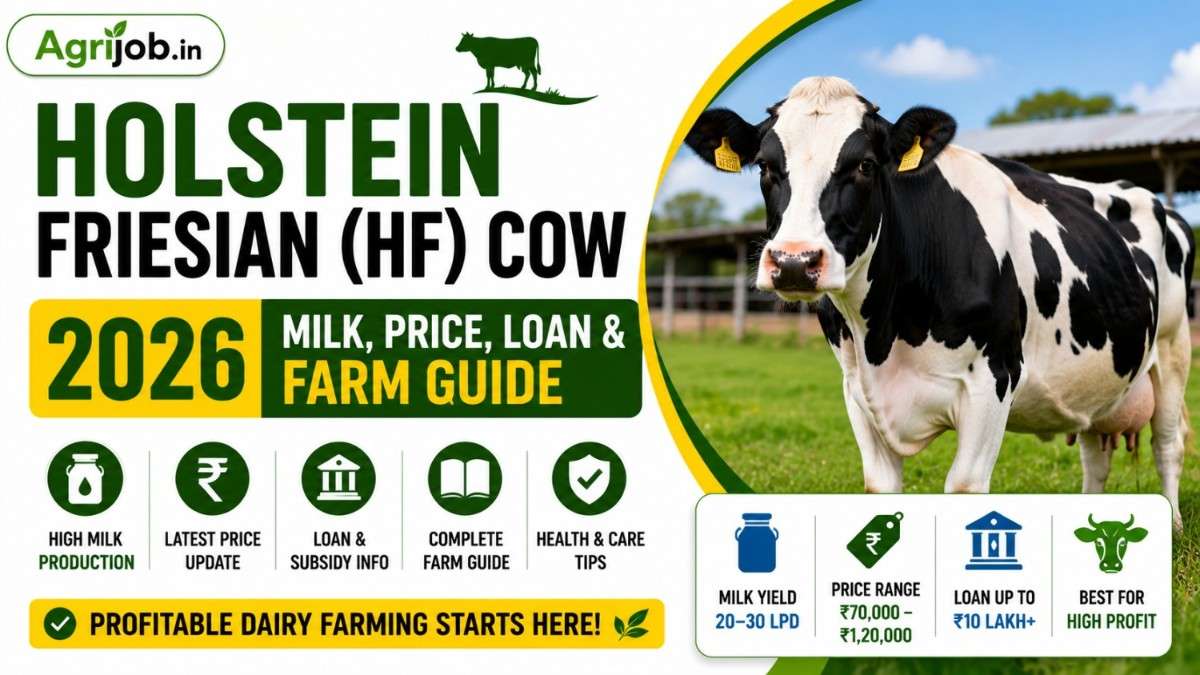
The Holstein Friesian (HF) cow produces 25–40 litres of milk per day under proper management in India, with a record 64.44 kg set in 2026. A milking HF cow costs Rs.40,000–Rs.1,50,000. NABARD’s DEDS scheme offers 25% subsidy (33% for SC/ST) and the AHIDF provides 3% interest subvention on dairy loans up to 90% of project cost.
- Breed Origin: Netherlands & northern Germany (Friesland region)
- Average Milk Yield: 25–30 litres/day (top cows: 35–40 litres/day)
- Annual Milk Output: 6,000–9,000 kg per lactation (305-day period)
- Milk Fat Content: 3.5–4.0% (lower than Jersey; best for liquid consumption)
- HF Cow Price India 2026: Rs.40,000–Rs.1,50,000 (pure HF); Rs.35,000–Rs.70,000 (crossbred)
- Body Weight: 580–700 kg (adult cow); 145–165 cm height
- Lactation Period: 305 days; calving interval 13–14 months
- Ideal Temperature: 4°C–24°C; prone to heat stress above 30°C
- Feed Cost/Day: Approx. Rs.240–Rs.300 per cow (20–25 litres yield)
- NABARD DEDS Subsidy: 25% general / 33% SC-ST (max Rs.1.25 lakh for 10-animal unit)
- AHIDF Loan: Up to 90% of project cost with 3% interest subvention
- Best States for HF Farming: Punjab, Haryana, Maharashtra, Karnataka, Tamil Nadu
- What Is a Holstein Friesian HF Cow and Why Is It So Popular?
- Who Should Start HF Cow Dairy Farming in India?
- HF Cow Milk Production Per Day – Yield, Fat & Earning Potential
- Eligibility & Requirements to Start HF Cow Dairy Farming
- How to Start HF Cow Dairy Farming – Step-by-Step Process 2026
- HF Cow vs Jersey Cow – Which Is More Profitable for Indian Farmers?
- Pros and Cons of Holstein Friesian HF Cow Farming
- Important Terms Related to HF Cow Dairy Farming
- Important Dates & Government Scheme Timelines
- Important Links – Official Portals & Resources
- Conclusion
- Key Takeaways
- Frequently Asked Questions About Holstein Friesian HF Cow 2026
What Is a Holstein Friesian HF Cow and Why Is It So Popular in India?
The Holstein Friesian (HF) cow is a high-yielding dairy cattle breed originating from the Friesland province of the Netherlands and northern Germany. It is globally recognized as the most productive dairy breed in the world, producing more milk per animal than any other cattle breed. In India, HF cows and their crossbreds have become the backbone of commercial dairy operations, particularly in states like Punjab, Haryana, Gujarat, Maharashtra, Karnataka, and Tamil Nadu.
HF cows are identifiable by their distinctive black-and-white patched coat (occasionally red-and-white), large frame, long legs, and well-developed udder. An adult HF cow weighs between 580–700 kg and stands 145–165 cm tall at the shoulder — significantly larger than most Indian native breeds. The breed arrived in India through government cattle-breeding programmes in the 20th century and has since expanded across organized dairy farms, cooperatives, and smallholder units through both purebred HF stock and HF crossbreds (HF x Sahiwal, HF x Tharparkar).

The breed dominates global and Indian dairy industry because of one simple metric: milk output per animal per day is unmatched. Where a native desi cow averages 6–8 litres per day, a well-managed HF cow delivers 25–40 litres, sometimes more. India is the world’s largest milk producer — over 230 million tonnes annually — and HF cattle play a central role in achieving that output, according to the Department of Animal Husbandry and Dairying (DAHD), Government of India.
Key Physical Characteristics of HF Cow Breed
| Characteristic | HF Cow Details |
|---|---|
| Coat Colour | Black and white patches (occasionally red-white) |
| Adult Body Weight | 580–700 kg |
| Height at Shoulder | 145–165 cm |
| Horns | Absent or very small (polled) |
| Udder | Large, well-developed, 4 functional teats |
| Temperament | Calm, easy to handle, stall-fed friendly |
| Lifespan | 12–15 years (productive life: 8–10 years) |
| Calving Interval | 13–14 months |
| First Calving Age | 24–30 months |
Who Should Start HF Cow Dairy Farming in India?
HF cow dairy farming is not a one-size-fits-all venture. It works best when the farmer has the management capacity and infrastructure to support a high-input, high-output animal. Here are the ideal profiles for whom this guide is directly relevant:
- 🐄 Commercial dairy entrepreneurs planning to set up a 5–50 cow dairy unit for daily milk supply to cooperatives or private dairies, seeking maximum litres per animal.
- 🌾 Small farmers in Punjab, Haryana, or Maharashtra with access to green fodder (maize, bajra, berseem) and stable water supply who want to replace 3–4 desi cows with 1–2 HF cows for the same or better milk output.
- 👨🎓 Agriculture graduates and rural youth aged 20–35 looking to start a dairy farm business with NABARD or AHIDF loans, seeking practical breed knowledge before investing.
- 🏦 NABARD loan and DEDS subsidy applicants who need to prepare a Detailed Project Report (DPR) and want verified data on HF cow productivity and cost.
- 👩🌾 Women SHG members and SC/ST farmers eligible for 33% capital subsidy under NABARD DEDS for crossbred milch cow units of 2–10 animals.
- 🔬 Existing dairy farmers with desi cattle wanting to upgrade herd productivity by introducing HF crossbred animals through the Rashtriya Gokul Mission’s artificial insemination programme.
- 📊 Agri-entrepreneurs evaluating breed options — HF vs Jersey vs Gir vs Sahiwal — before finalizing the breed mix for a new commercial dairy farm.
- 🏘️ Peri-urban dairy farmers near cities in Maharashtra, Karnataka, or Tamil Nadu who sell milk directly to customers at Rs.55–Rs.70/litre and need maximum daily volume to stay profitable.
HF Cow Milk Production Per Day – Yield, Fat Content & Monthly Income
HF cow milk production per day is the defining reason this breed commands premium prices and dominates commercial dairy farms. A well-fed and well-managed HF cow produces 25–30 litres of milk per day on average, with top-performing animals under excellent nutrition and veterinary care reaching 35–40 litres. In February 2026, a pure HF cow at the Rangeelo Festival in Rajasthan produced 64.44 kg of milk in 24 hours — a record that underlines the ceiling potential of this breed’s genetics when managed scientifically.
The lactation period is 305 days, after which the cow undergoes a dry period of approximately 60 days before the next calving. First-lactation HF cows typically yield 35–40 litres/day for the first two months, which then gradually declines to around 25–30 litres/day through the middle lactation, and further reduces toward the end. The cumulative annual output ranges from 6,000–9,000 kg per cow depending on genetics, feeding, and health management.
| Production Parameter | Value (India 2026) |
|---|---|
| Average daily milk yield | 25–30 litres/day |
| Top-performer daily yield | 35–40 litres/day |
| Lactation period | 305 days |
| Annual milk output | 6,000–9,000 kg |
| Milk fat content | 3.5–4.0% |
| Milk protein content | 3.2–3.4% |
| Milk price (cooperative) | Rs.34–Rs.45/litre |
| Milk price (private/direct) | Rs.50–Rs.70/litre |
| Monthly income (25L/day @ Rs.40/L) | Rs.30,000/month per cow |
| Monthly income (30L/day @ Rs.45/L) | Rs.40,500/month per cow |
| Feed cost per day | Rs.240–Rs.300/cow |
| Net monthly income (5 cows, 25L each) | Approx. Rs.60,000–Rs.80,000 |
Milk fat content of HF cow milk (3.5–4%): This is lower than Jersey milk (4.5–5%) and native Gir cow milk (4.5–5%), which matters under cooperative pricing that pays on fat percentage. However, the sheer volume advantage compensates significantly in total fat solids delivered per day. For liquid milk sales directly to consumers or processing plants, HF milk volume advantage is decisive.
Eligibility & Requirements to Start HF Cow Dairy Farming in India
Before purchasing HF cows, every aspiring dairy farmer must verify their eligibility for government loans and subsidies, and assess whether their land, water, and infrastructure resources can support this breed’s demanding requirements.
Basic Farm Requirements for HF Cow Dairy Farming
- Land: Minimum 0.25 acres for a 2-cow unit; 1–2 acres for a 10-cow unit (shed + fodder cultivation)
- Shed: Covered, ventilated, with proper drainage; minimum 40 sq ft per animal
- Water supply: Continuous clean water access; HF cows drink 80–100 litres/day
- Green fodder: Berseem, maize, sorghum, or napier grass; minimum 20–25 kg/day per cow
- Dry fodder: Wheat straw, paddy straw; 4–5 kg/day per cow
- Concentrate feed: Dairy cattle feed pellets; 4–6 kg/day per cow
- Cooling arrangement: Fans, foggers, or coolers for summer months (critical — HF cows stress above 30°C)
- Veterinary access: Regular deworming, vaccination, and artificial insemination access
NABARD DEDS Loan & Subsidy Eligibility
- Farmers, individual entrepreneurs, NGOs, SHGs, JLGs, and cooperatives are eligible
- No loan default history with any scheduled bank
- Minimum unit size: 2 milch animals; maximum: 10 animals under DEDS
- For larger units (above 10 cows): apply under AHIDF via udyamimitra.in portal
- Submit a Detailed Project Report (DPR) to your nearest empanelled bank
| Category | NABARD DEDS Subsidy % | Max Subsidy (10 Animals) |
|---|---|---|
| General Category | 25% of project cost | Rs.1,25,000 |
| SC/ST Category | 33.33% of project cost | Rs.1,67,000 |
| 2-Animal Unit (General) | 25% | Rs.25,000 |
| 2-Animal Unit (SC/ST) | 33.33% | Rs.33,300 |
| AHIDF Interest Subvention | 3% per annum | No upper limit on loan |
| AHIDF Loan Coverage | Up to 90% of project cost | Apply via Udyami Mitra portal |
Source: NABARD Dairy Entrepreneurship Development Scheme (DEDS) and DAHD AHIDF guidelines (updated 2025–26).
How to Start HF Cow Dairy Farming in India – Step-by-Step Process 2026
Starting an HF cow dairy farm requires methodical planning across breed selection, infrastructure, financing, and marketing. Follow this proven 10-step process used by successful dairy entrepreneurs across Punjab, Haryana, and Maharashtra in 2026.
- Assess your land, water, and fodder resources — Confirm you have at least 0.25 acres for a starter 2-cow unit, access to clean water year-round, and a source of green fodder (own cultivation or nearby market).
- Choose your breed type — Decide between pure HF (higher yield, more heat-sensitive) and HF crossbred (slightly lower yield, better adapted to Indian heat). For beginners in hot regions (Rajasthan, MP, UP), HF crossbred with Sahiwal or Tharparkar is safer.
- Prepare a Detailed Project Report (DPR) — Include animal cost, shed construction, equipment, feed, veterinary costs, and projected milk income. DPR templates are available at ahidf.udyamimitra.in.
- Approach your District Animal Husbandry Officer (DAHO) — Register your intent, get guidance on applicable state subsidies, and obtain a recommendation letter for bank loan applications.
- Apply for NABARD DEDS or AHIDF loan at your nearest bank — Visit any public sector bank (SBI, PNB, Bank of Baroda) or a cooperative bank. Submit KYC (Aadhaar, PAN), land documents, bank statement (6 months), DPR, and passport photos.
- Register on the AHIDF Udyami Mitra portal — For larger units above 10 cows, apply at ahidf.udyamimitra.in to claim the 3% interest subvention. Bank loan and AHIDF registration must run in parallel.
- Construct the shed before purchasing cows — Build a pucca, well-ventilated shed with proper drainage slope, concrete flooring, and fan/fogger cooling for summer. Plan for 40–50 sq ft per cow.
- Purchase HF cows from certified government farms or reputable breeders — Prefer DAHD-registered Government Cattle Breeding Farms (Hessarghatta, Suratgarh, Anand) or state livestock development board auctions for disease-free, pedigree-certified animals.
- Establish milk marketing linkage before the first milking — Register with your nearest cooperative society (Amul, Mother Dairy, state cooperative) or fix a contract buyer. Having a confirmed buyer eliminates the most common failure point in new dairy ventures.
- Maintain vaccination and health records from Day 1 — Schedule FMD, BQ, HS, and Brucellosis vaccinations through the government veterinary department. Most state animal husbandry departments provide these free or at subsidized cost.
Never purchase HF cows in summer (April–June) — heat stress during transit and the initial adaptation phase can cause severe milk drop and health issues. Buy animals in October–February when temperatures are mild and the cow adapts comfortably before the next summer season. Always insist on a 7-day observation period at the seller’s farm before finalizing the purchase.
HF Cow vs Jersey Cow – Which Is More Profitable for Indian Farmers?
The HF cow vs Jersey cow debate is one of the most searched comparisons among Indian dairy farmers. Both are exotic breeds that significantly outperform desi cattle in volume, but they differ sharply in milk composition, heat tolerance, feeding cost, and profitability under different management conditions.
| Parameter | HF Cow (Holstein Friesian) | Jersey Cow |
|---|---|---|
| Origin | Netherlands / Germany | Jersey Island, UK |
| Milk Yield Per Day | 25–40 litres | 15–20 litres |
| Milk Fat Content | 3.5–4.0% | 4.5–5.5% |
| Body Weight | 580–700 kg | 350–450 kg |
| Cow Price (India 2026) | Rs.40,000–Rs.1,50,000 | Rs.30,000–Rs.80,000 |
| Heat Tolerance | Low (needs cooling above 30°C) | Moderate (better than HF) |
| Feed Requirement/Day | Rs.280–Rs.350 (high) | Rs.180–Rs.250 (moderate) |
| Disease Resistance | Moderate (needs strong vet care) | Better than HF in tropical heat |
| Cooperative Milk Pricing | Moderate (lower fat %) | Higher (premium fat %) |
| Best Suited For | Maximum volume, liquid milk market | Cooperative fat-based pricing, hot regions |
| ROI Timeline | Faster (volume advantage) | Slower but steadier in heat zones |
| Ideal Regions India | Punjab, Haryana, Gujarat, MH coast | TN, Andhra, Kerala, Rajasthan, MP |
If you have access to year-round green fodder, stable cooling infrastructure, and a buyer who pays on volume (private dairy, direct consumer), choose the HF cow — the ROI per animal is faster. If you are in a hot, semi-arid region (Rajasthan, Madhya Pradesh, South India) with cooperative milk sales based on fat percentage, Jersey or an HF crossbred with a heat-tolerant native breed is the smarter investment. Never choose purely on milk litres — choose based on your local climate, feed access, and milk buyer pricing model.
Pros and Cons of Holstein Friesian HF Cow Farming in India
Advantages of HF Cow Farming
- ✅ World’s highest milk yield — 25–40 litres/day means maximum revenue per animal compared to any other breed.
- ✅ Faster return on investment — High volume leads to faster break-even, typically 18–24 months for a 5-cow unit under good management.
- ✅ Government subsidy support — NABARD DEDS, AHIDF, and state schemes like UP Nandi Baba Milk Mission specifically support HF and crossbred cattle purchases.
- ✅ Strong cooperative market acceptance — Amul, Mother Dairy, and most state cooperatives have well-established collection networks for HF cow milk volumes.
- ✅ Calm temperament — Easy to handle, stall-fed friendly, and adaptable to machine milking, reducing labour requirements over time.
- ✅ Calf value — Female HF calves command Rs.15,000–Rs.30,000 as potential milking cows; male calves used for crossbreeding programmes also generate income.
Disadvantages of HF Cow Farming
- ❌ Heat stress vulnerability — Pure HF cows struggle above 30°C without fans, foggers, or coolers; summer milk drops of 20–30% are common without proper cooling.
- ❌ High management cost — Feed cost alone runs Rs.240–Rs.350/day per cow; total cost including veterinary and labour is Rs.400–Rs.550/day, requiring consistently high milk output to stay profitable.
- ❌ Disease sensitivity — More susceptible to mastitis, foot-and-mouth disease, and metabolic disorders than hardy native breeds; regular veterinary support is non-negotiable.
- ❌ Infrastructure dependency — Requires pucca shed, cooling systems, quality feed, and reliable water; cannot be managed with minimal infrastructure like desi cows.
Important Terms Related to Holstein Friesian HF Cow Dairy Farming
Understanding these high-CPC industry terms helps you navigate government scheme documents, bank loan applications, and dairy cooperative registration processes effectively.
- Lactation Period: The duration a cow produces milk after calving — typically 300–305 days for HF cows. Milk yield calculations for project reports are based on this period.
- Dry Period: The 45–60 day rest period before the next calving when the cow is not milked. Critical for udder recovery and next-lactation milk output.
- HF Crossbred Cow: An animal with 50–75% HF genetics crossed with a native breed (Sahiwal, Tharparkar). Yields 12–20 litres/day with better heat tolerance than pure HF.
- NABARD DEDS (Dairy Entrepreneurship Development Scheme): Government scheme offering 25–33% back-ended capital subsidy for setting up small dairy units of 2–10 milch animals.
- AHIDF (Animal Husbandry Infrastructure Development Fund): Central government fund with Rs.29,110 crore outlay offering 3% interest subvention and up to 90% loan coverage for dairy infrastructure projects. Apply at ahidf.udyamimitra.in.
- Rashtriya Gokul Mission (RGM): Government scheme with Rs.3,400 crore outlay (revised March 2025) focusing on genetic upgradation of bovines via artificial insemination; 50% capex subsidy available for breed multiplication farms.
- THI (Temperature-Humidity Index): A combined measure of temperature and humidity used to assess heat stress in cattle. HF cows begin showing milk yield drops when THI exceeds 68–72.
- Calving Interval: The time between two consecutive calvings — ideally 12–14 months for HF cows. Longer intervals mean fewer lactations and lower lifetime milk output.
- DPR (Detailed Project Report): A business plan document required for bank loan and government subsidy applications. Covers animal cost, infrastructure, feed, projected income, and repayment schedule.
- KCC (Kisan Credit Card): Short-term working capital credit available to dairy farmers at 7% interest (4% with prompt repayment incentive) for animal purchase and feed costs up to Rs.3 lakh.
Important Dates & Government Scheme Timelines for Dairy Farmers 2026
| Event / Scheme | Date / Timeline |
|---|---|
| AHIDF Scheme Outlay Validity | Up to 31 March 2026 (Rs.29,110.25 crore) |
| Rashtriya Gokul Mission (Revised) Approval | March 2025 (Rs.3,400 crore, 15th Finance Commission cycle) |
| NABARD DEDS — Ongoing Applications | Rolling basis via empanelled banks throughout 2026 |
| KCC Dairy Interest Subvention 2024-25 | 4% effective rate for prompt repayment (RBI circular) |
| Best Season to Purchase HF Cows | October to February (avoid April–June heat) |
| Vaccination Schedule: FMD | Twice a year (typically May and November) |
| Vaccination Schedule: HS & BQ | Annually before monsoon (May–June) |
| AI (Artificial Insemination) Best Window | 12–18 hours after heat detection in HF cows |
Important Links – Official Portals & Resources for HF Cow Dairy Farming
| Resource | Link |
|---|---|
| DAHD — Official Animal Husbandry Department | dahd.gov.in |
| NABARD — Dairy Entrepreneurship Development Scheme | nabard.org |
| AHIDF — Apply for Dairy Infrastructure Loan | ahidf.udyamimitra.in |
| Rashtriya Gokul Mission Guidelines | dahd.gov.in/rashtriya-gokul-mission |
| Dairy Farm Business Plan 2026 – Agrijob.in | Dairy Farm Business Plan India 2026 |
| UP Nandi Baba Milk Mission – Agrijob.in | UP Nandi Baba Milk Mission Guide |
| National Dairy Development Board (NDDB) | nddb.coop |
Conclusion – Is HF Cow Dairy Farming Right for You in 2026?
The Holstein Friesian HF cow remains India’s most productive dairy breed in 2026, delivering 25–40 litres per day and enabling serious dairy farmers to generate Rs.30,000–Rs.80,000 per month from a 5-cow unit under proper management. With NABARD DEDS offering 25–33% subsidy, AHIDF providing 3% interest subvention on loans up to 90% of project cost, and the Rashtriya Gokul Mission supporting genetic upgradation across the country, the financial infrastructure for HF cow dairy farming has never been more accessible. Bookmark this guide — data is updated regularly to reflect scheme changes and current market prices.
- HF cows produce 25–40 litres of milk per day — the highest of any cattle breed in India in 2026.
- A milking HF cow costs Rs.40,000–Rs.1,50,000; crossbred HF cows are available at Rs.35,000–Rs.70,000.
- NABARD DEDS provides 25% subsidy (33% for SC/ST) with a maximum of Rs.1.25 lakh for a 10-animal unit.
- AHIDF offers up to 90% project cost as loan with 3% interest subvention — apply at ahidf.udyamimitra.in.
- HF cows need cooling above 30°C, high-quality feed (Rs.240–Rs.300/day), and consistent veterinary care to perform.
- For hot regions, opt for HF crossbred over pure HF; compare with Jersey breed based on local milk buyer pricing.
Frequently Asked Questions About Holstein Friesian HF Cow 2026
How much milk does an HF cow give per day in India?
A well-managed Holstein Friesian HF cow produces 25–30 litres of milk per day on average in India in 2026. Top-performing cows under excellent feeding and health management can yield 35–40 litres per day. The first two months of lactation typically see the highest daily output, which then gradually declines over the 305-day lactation period. Record production of 64.44 kg (litres) was achieved by an HF cow at the Rangeelo Festival in Rajasthan in February 2026.
What is the price of an HF cow in India in 2026?
The Holstein Friesian HF cow price in India in 2026 ranges from Rs.40,000 to Rs.1,50,000 for pure milking cows, depending on age, milk yield, purity, and location. High-yielding cows with certified pedigree from government breeding farms may command Rs.1.5 lakh or more. HF crossbred cows are available at Rs.35,000–Rs.70,000. Prices are generally higher in Punjab and Haryana, where demand from commercial dairy farmers is strong.
What is the NABARD subsidy for HF cow dairy farming?
Under NABARD’s Dairy Entrepreneurship Development Scheme (DEDS), general category farmers get a 25% back-ended capital subsidy on the project cost, capped at Rs.1,25,000 for a 10-animal unit. SC/ST farmers receive 33.33% subsidy capped at Rs.1,67,000. For a 2-animal unit, the maximum subsidy is Rs.25,000 (general) and Rs.33,300 (SC/ST). Additionally, the AHIDF scheme provides 3% annual interest subvention with loans up to 90% of project cost for larger dairy infrastructure projects. All applications are processed through scheduled commercial banks.
Is HF cow suitable for Indian climate conditions?
Pure Holstein Friesian HF cows are adapted to cool, temperate climates (4°C–24°C) and face heat stress in Indian summers when temperatures exceed 30°C. With proper shed construction, cooling fans, foggers, and adequate water supply (80–100 litres/day), HF cows can be successfully managed across India’s dairy belts including Punjab, Haryana, Maharashtra, and coastal Karnataka. For very hot and semi-arid regions like Rajasthan, Madhya Pradesh, and interior Andhra Pradesh, HF crossbreds with Sahiwal or Tharparkar are recommended as they combine reasonable milk yield with better heat tolerance.
What is the ideal feed for an HF cow per day?
An HF cow producing 25 litres per day requires approximately 20–25 kg of green fodder (berseem, napier, maize silage), 4–5 kg of dry fodder (wheat straw or paddy straw), and 4–6 kg of concentrate dairy feed per day. Mineral mixture (50–75 g/day) and clean water (80–100 litres/day) are non-negotiable. Total daily feed cost runs between Rs.240–Rs.300 per cow at 2026 market rates. Cutting feed quality or quantity in HF cows directly reduces milk output within days — unlike desi breeds, HF cows have very little buffer capacity.
HF cow vs Jersey cow — which gives more milk?
The Holstein Friesian HF cow gives significantly more milk by volume — 25–40 litres/day versus 15–20 litres/day for Jersey cows. However, Jersey milk has higher fat content (4.5–5.5%) compared to HF milk (3.5–4%), which matters for cooperative fat-based pricing and ghee/paneer production. In absolute volume terms, HF wins clearly. In terms of profitability under hot Indian conditions with cooperative pricing, Jersey often performs more reliably due to lower feed cost and better heat tolerance. The right choice depends on your region, infrastructure, and milk buyer.
How to get a dairy farm loan for HF cows in India?
To get a dairy farm loan for HF cows in India, visit your nearest public sector bank (SBI, PNB, Bank of Baroda, or any cooperative bank) with a Detailed Project Report (DPR), KYC documents (Aadhaar, PAN), land ownership or lease documents, a 6-month bank statement, and a recommendation from your District Animal Husbandry Officer (DAHO). For the AHIDF interest subvention benefit, register your project at ahidf.udyamimitra.in simultaneously. For the NABARD DEDS subsidy, ensure your bank is on NABARD’s empanelled list and that your unit size is between 2–10 milch animals.
What vaccinations does an HF cow need in India?
HF cows require vaccination against Foot and Mouth Disease (FMD) twice a year (May and November), Hemorrhagic Septicemia (HS) and Black Quarter (BQ) annually before the monsoon, and Brucellosis once (heifers aged 4–8 months). Deworming every 3–6 months and regular tick-control treatment are also essential. Most state animal husbandry departments provide FMD and HS vaccines free or at nominal cost through mobile veterinary units. Keep a vaccination card for each cow and update it at every veterinary visit.
What is the lactation period of an HF cow?
The standard lactation period of a Holstein Friesian HF cow is 305 days (approximately 10 months), followed by a dry period of 45–60 days before the next calving. A productive HF cow can complete 5–7 lactations in her commercial lifetime, typically from age 2.5 years to 9–10 years. The calving interval (time between two calvings) is ideally 12–14 months. Regular pregnancy checks after insemination and proper dry cow management are critical for maintaining this cycle consistently.
Where can I buy a genuine HF cow in India?
Reliable sources for purchasing genuine HF cows in India include Government Cattle Breeding Farms under DAHD (Hessarghatta, Karnataka; Suratgarh, Rajasthan; Anand, Gujarat), State Livestock Development Board auctions, and NABARD-empanelled dairy farms. Avoid purchasing without veterinary health certificates, milk yield records for at least 2 milkings, and vaccination cards. For crossbred HF animals, contact your block-level Animal Husbandry Department office for details of registered breeders in your district.
Last Updated: July 2026. This guide is reviewed and updated regularly for accuracy. Data sourced from DAHD, NABARD, and official government portals. Bookmark this page for the latest Holstein Friesian HF cow farming information.
Disclaimer: The information in this article is for educational and informational purposes only. Milk yield figures, cow prices, and subsidy amounts are indicative and may vary by region, animal quality, and government scheme revisions. Always verify current subsidy rates and loan terms with your nearest NABARD office, District Animal Husbandry Officer, or empanelled bank before making financial commitments. Agrijob.in does not sell cattle or provide financial advisory services.