

eNAM Portal 2026 – How Farmers Can Sell Crops Online at Best Price
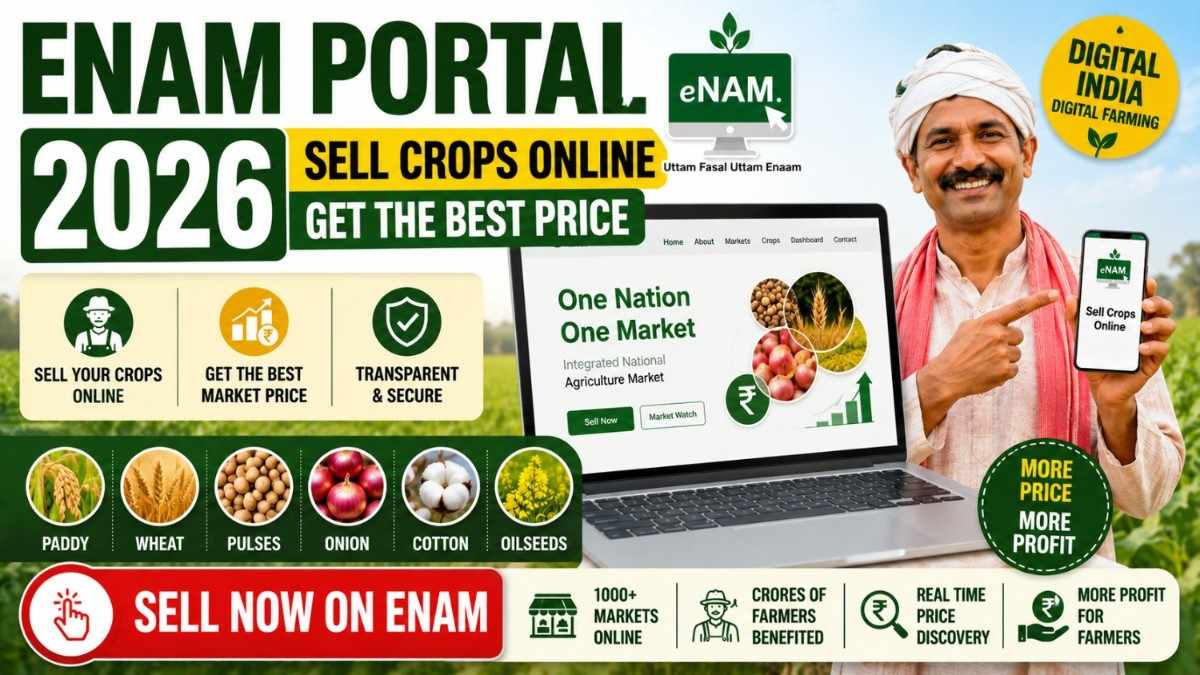
eNAM portal 2026 — India’s National Agriculture Market at enam.gov.in — has grown into the world’s largest digital agricultural trading platform, with 1,656 mandis integrated across 23 states and 4 Union Territories, 1.80 crore farmers registered, and a cumulative trade value of Rs.4.84 lakh crore since launch. In 2026, eNAM is not just a mandi upgrade — it is a complete digital income maximisation tool for every Indian farmer. With 15–20% better prices via competitive online bidding, DBT payment within 48 hours, AI-powered quality assaying, an FPO trading module enabling farm-gate sales without mandi visits, and an app available in 8 Indian languages, eNAM gives every farmer — big or small — direct access to buyers across the country. This complete 2026 guide covers what eNAM is, how it works, how to register, how to list and sell crops step by step, which crops are eligible, state-wise mandi coverage, FPO module benefits, and who should register immediately.

| Full Name | National Agriculture Market (eNAM) |
| Launch Date | 14 April 2016 (by PM Narendra Modi) |
| Official Portal | enam.gov.in |
| Managed By | Small Farmers Agribusiness Consortium (SFAC), MoA&FW |
| Mandis Integrated (Mar 2026) | 1,656 mandis — 23 States & 4 UTs |
| Farmers Registered (Mar 2026) | 1.80 crore farmers |
| Traders Registered | 2.73 lakh traders |
| FPOs Registered | 4,724 Farmer Producer Organisations |
| Commission Agents Registered | 1,16,042 |
| Total Trade Value (till June 2026) | Rs.4.84 lakh crore (13.25 crore MT) |
| Commodities Supported | 247 agricultural commodities |
| App Languages | 8 Indian languages |
| Payment Mode | DBT within 48 hours to Aadhaar-linked bank account |
| Govt. Infrastructure Support | Up to Rs.75 lakh per mandi for eNAM integration |
| Price Advantage vs Local Mandi | 15–20% higher prices via competitive online bidding |
| Awards Won | Platinum Award (1st) — Digital Empowerment of Citizens Category |
- What is eNAM Portal 2026?
- How eNAM Works – The Digital Mandi Trading Process
- Benefits of Selling on eNAM vs Traditional Mandi
- 247 Commodities Available on eNAM 2026
- Who is Eligible to Register on eNAM?
- Who Should Register on eNAM Immediately?
- Documents Required for eNAM Registration
- How to Register on eNAM Portal 2026 – Step by Step
- How to List & Sell Crops on eNAM 2026 – Step by Step
- eNAM FPO Trading Module – Sell Without Going to Mandi
- eNAM Mobile App 2026 – Features & Download
- State-Wise eNAM Mandi Coverage 2026
- eNAM vs Traditional Mandi vs Jaivik Kheti Portal – Comparison
- High-Value Agriculture Marketing & Digital Trading Terms to Know
- Frequently Asked Questions – eNAM Portal 2026
What is eNAM Portal 2026?
The National Agriculture Market (eNAM) is a pan-India electronic trading portal launched on 14 April 2016 by Prime Minister Narendra Modi. Built and operated by the Small Farmers Agribusiness Consortium (SFAC) under the Ministry of Agriculture and Farmers Welfare, eNAM networks existing APMC (Agriculture Produce Market Committee) mandis across India into a single, unified national agricultural market — accessible from any smartphone or computer, anytime.
The fundamental problem eNAM solves is information asymmetry and market fragmentation. Before eNAM, a farmer in Patna could only sell wheat to local traders who had complete knowledge of market prices — leaving the farmer at a severe disadvantage. Traders would form local cartels, suppress bids, and charge commission of 10–15% on top. The farmer had no visibility into what buyers in Delhi, Mumbai, or Hyderabad were willing to pay for the same crop.

eNAM changes this entirely. Since its launch to March 2026, the platform has enabled the trading of 13.25 crore metric tonnes of commodities, generating a total trade value of Rs.4.84 lakh crore. The number of connected mandis has risen from 1,389 in 2024 to 1,656 as of March 2026, spanning 23 states and 4 Union Territories. As of March 2026, the platform has registered over 1.80 crore farmers, 2.73 lakh traders, and 4,724 Farmer Producer Organisations (FPOs).
The 2026 version of eNAM goes well beyond simple online bidding. The platform now supports trading in 247 agricultural commodities after the government added newer items like green tea, ashwagandha dry roots, mustard oil, lavender oil, mentha oil, and broken rice. The platform has also integrated AI-powered quality assaying tools, multilingual mobile app support, SMS-based transaction alerts, and electronic display boards at mandis showing real-time market rates. eNAM in 2026 is India’s most powerful digital agricultural income maximisation platform — and it is completely free for farmers to use.
How eNAM Works – The Digital Mandi Trading Process
Understanding eNAM’s workflow helps farmers prepare for their first sale and extract maximum value from the platform. The trading process on eNAM follows a step-by-step workflow that digitises the traditional mandi auction system. Here is the complete end-to-end process:
- Farmer Registration: The farmer (or FPO) registers once on enam.gov.in with Aadhaar, bank account, and land records. A permanent eNAM login ID and password is issued. This is a one-time process.
- Produce Arrival at Mandi (Gate Entry): The farmer brings produce to any integrated eNAM mandi. The mandi staff completes a digital gate entry using the eNAM app — recording the crop type, quantity, farmer ID, and vehicle details in real time.
- AI-Powered Quality Assaying: The produce undergoes quality testing at the mandi’s assaying lab using standardised AGMARK parameters. The platform provides single-window services like commodity arrivals, quality assaying through AI, e-bidding, and direct e-payment to farmers. The quality grade is digitally entered and linked to the lot.
- Online Listing & Bidding: The graded lot is listed on the eNAM platform. Buyers — registered traders from across India — can view the lot details, quality report, and quantity online, then place competitive bids electronically. The platform allows for open and competitive bidding on listed commodities, enhancing transparency and enabling buyers to bid fairly for the produce.
- Price Discovery & Bid Acceptance: The bidding window closes and the highest bid is displayed. The farmer (or mandi commission agent acting on behalf) reviews the highest bid and accepts it. If the price is below the farmer’s acceptable threshold, they can reject and re-list.
- Weighing & Lot Handover: After bid acceptance, produce is officially weighed on digital weighbridges. The buyer (or their representative) takes possession of the lot from the mandi.
- Digital Payment via DBT: Payment is processed electronically via BHIM-UPI, RTGS/NEFT, or internet banking. The amount — net of applicable mandi charges — is credited directly to the farmer’s Aadhaar-linked bank account within 48 hours, with an SMS confirmation sent to the farmer’s registered mobile number.
Benefits of Selling on eNAM vs Traditional Mandi in 2026
- 💰 15–20% Higher Prices: Competitive online bidding from buyers across India eliminates local trader cartel price manipulation. A rice farmer in Patna who received Rs.1,800/quintal at the local mandi received Rs.2,200/quintal on eNAM — a Rs.400/quintal gain on the same crop, same quality.
- 🏦 DBT Payment Within 48 Hours: Traditional mandi payments can take 7–30 days and involve multiple intermediaries. eNAM settles directly to the farmer’s bank account within 48 hours of sale — improving cash flow and eliminating payment risk.
- 🧹 Reduced Middlemen & Commission Costs: eNAM cuts commission agent fees of 10–15% by enabling direct farmer-to-buyer transactions. Lower transaction costs mean higher net realisations for the same selling price.
- 🤖 AI Quality Assaying — Objective Grading: Traditional mandis allow commission agents to subjectively assess quality — often to suppress prices. eNAM’s AI-powered quality assaying provides objective, standardised grading linked to AGMARK parameters, ensuring farmers get prices reflecting actual produce quality.
- 🌍 National Market Access from Any Mandi: A farmer in Madhya Pradesh can sell mustard to a buyer in Gujarat, or a Maharashtra onion grower can access buyers in West Bengal — all through a single platform. eNAM’s inter-state trading module (launched 2019) enables genuine pan-India price discovery.
- 📊 Real-Time Price Transparency: Farmers can check live commodity prices across all 1,656 mandis before deciding when and where to sell — ending the information asymmetry that cost farmers crores annually in underpriced sales.
- 📱 Mobile App in 8 Languages: The eNAM mobile app available in Hindi, Marathi, Tamil, Telugu, Kannada, Bengali, Gujarati, and Punjabi means farmers across India can manage their entire trading process from a smartphone — including gate entry, bid tracking, and payment confirmation.
- 🏆 Award-Winning Platform: The Ministry of Agriculture’s initiative of Electronic National Agriculture Market (e-NAM) program received the Platinum Award (1st) in the Digital Empowerment of Citizens Category — reflecting its status as India’s most impactful digital governance achievement in agriculture.
- 🆓 Zero Cost for Farmers: Registration, listing, bidding, and platform use are completely free for farmers and FPOs. The Government provides financial assistance of up to Rs.75 lakh per mandi to support infrastructure development, keeping the platform fully subsidised for farmer use.
247 Commodities Available on eNAM 2026
The platform now supports trading in 247 agricultural commodities after the government added newer items like green tea, ashwagandha dry roots, mustard oil, lavender oil, mentha oil, and broken rice. Here is the full category-wise commodity overview for eNAM 2026:
| Category | Key Commodities | No. of Commodities (Approx.) |
|---|---|---|
| Cereals & Millets | Wheat, Paddy, Maize, Jowar, Bajra, Ragi, Barley, Oat | 15+ |
| Pulses | Arhar (Tur), Moong, Urad, Chana, Masoor, Rajma, Moth | 20+ |
| Oilseeds | Mustard, Groundnut, Soybean, Sunflower, Sesame, Linseed, Castor | 18+ |
| Vegetables | Potato, Onion, Tomato, Garlic, Ginger, Cabbage, Cauliflower, Brinjal | 35+ |
| Fruits | Mango, Banana, Apple, Orange, Grapes, Pomegranate, Guava, Papaya | 25+ |
| Spices & Condiments | Chilli, Turmeric, Coriander, Cumin, Pepper, Cardamom, Ginger (dry) | 22+ |
| Fibres | Cotton (raw & lint), Jute | 5+ |
| Medicinal & Aromatic Crops | Ashwagandha Dry Roots, Mentha Oil, Lavender Oil, Lavender Dried Flower | 12+ |
| Processed Agri Products | Mustard Oil, Virgin Olive Oil, Green Tea, Broken Rice | 15+ |
| Other Crops | Sugarcane, Tobacco, Areca Nut, Coconut, Bamboo, Flowers | 30+ |
The addition of medicinal and aromatic crops (ashwagandha, mentha, lavender) and processed agri-products (mustard oil, green tea) to eNAM in 2024–25 is particularly significant — these are high-value commodities where price discovery was earlier entirely opaque and controlled by large processors. eNAM gives farmers of these crops their first-ever access to transparent national price benchmarks and direct buyers.
Who is Eligible to Register on eNAM Portal 2026?
| Stakeholder Type | Eligible | Key Requirement | Registration Fee |
|---|---|---|---|
| Individual Farmer | ✅ Yes | Aadhaar, land records, bank account, agricultural produce | Free |
| Small & Marginal Farmer | ✅ Yes (Priority) | Same as above; no minimum land or produce quantity | Free |
| Women Farmer | ✅ Yes (Priority) | Aadhaar, land records or tenancy proof, bank account | Free |
| SC/ST Farmer | ✅ Yes (Priority) | Aadhaar, caste certificate, land records, bank account | Free |
| Tenant Farmer / Sharecropper | ✅ Yes | Aadhaar, tenancy agreement or village-level verification | Free |
| FPO / Farmer Cooperative | ✅ Yes | FPO registration certificate, bank account, authorised signatory | Free |
| Licensed Trader | ✅ Yes | Trading license, bank details, identity proof | As per state APMC rules |
| Commission Agent | ✅ Yes | APMC-registered commission agent licence | As per state APMC rules |
| Non-farmer / Consumer | ❌ No | eNAM is a B2B/farmer-to-trader platform, not consumer marketplace | — |
Who Should Register on eNAM Portal Immediately in 2026?
- 🌾 All Farmers Near eNAM-Integrated Mandis: If your nearest mandi is among the 1,656 integrated mandis, you should register on eNAM before your next harvest — there is zero cost and potentially Rs.400–Rs.1,000/quintal more income from the same produce simply through competitive bidding access.
- 🌱 Pulse & Oilseed Farmers: These crops have the highest price volatility and the most opaque local pricing — precisely the conditions where eNAM’s transparent bidding adds maximum value. Arhar, mustard, groundnut, and soybean farmers in MP, Rajasthan, Maharashtra, and Gujarat should prioritise eNAM registration for the upcoming season.
- 🧅 Vegetable & Onion Farmers: Perishable vegetable farmers are most vulnerable to local trader cartel pricing — with no time to wait for better buyers. eNAM’s real-time bidding and fast payment (within 48 hours) is particularly valuable for farmers of perishable produce like onion, tomato, potato, and garlic.
- 👩🌾 Women Farmers & SHG Members: Women farmers trading individually through local mandis face significant informational and social disadvantages. eNAM’s digital platform levels the playing field — a woman farmer receives the same competitive bid prices as any other seller, with transparent, tamper-proof payment to her bank account.
- 🏘️ FPOs & Farmer Cooperatives: A significant enhancement came during the COVID-19 pandemic, when the government added a Farmer Producer Organisation (FPO) trading module to eNAM. This allowed FPOs to sell produce directly on the platform without physically bringing it to the mandi. FPOs can aggregate member produce, negotiate at scale, and access premium buyers nationwide — this module is still active and fully operational in 2026.
- 🌿 Medicinal & Aromatic Crop Farmers: Farmers growing ashwagandha, mentha, lavender, and other high-value medicinal crops have historically been completely dependent on a few large processors for price discovery. eNAM’s listing of these commodities in 2024–25 creates, for the first time, a transparent national market where multiple buyers compete for these crops.
- 📦 Farmers with Large Volumes: Farmers selling significant quantities (above 10 quintals per transaction) benefit most from eNAM’s inter-state trading module — where buyers from distant states bid competitively, often offering significantly higher prices than local traders who know a large supply is available locally.
- 💳 KCC Holders Repaying Crop Loans: Kisan Credit Card holders repaying loans at harvest time can use eNAM’s fast 48-hour DBT payment to settle loan instalments immediately after sale — avoiding interest accrual from delayed payments common in traditional mandi transactions.
Documents Required for eNAM Registration 2026
- 🪪 Aadhaar Card — mandatory for farmer identity verification and DBT payment linkage; both Aadhaar number and OTP/biometric verification required during registration
- 🏦 Bank Account Details — savings account number and IFSC code (Aadhaar-linked) for receiving DBT payment within 48 hours of sale; cancel cheque or bank passbook copy acceptable
- 🗺️ Land Records (Khasra-Khatauni) — for produce authentication and confirming farmer status; tenant farmers can use tenancy agreements or village-level produce verification as alternative
- 📸 Passport-Size Photograph — for farmer profile on eNAM portal
- 📱 Active Mobile Number linked to Aadhaar — for OTP login, bid alerts, and payment confirmation SMS
- 📧 Email ID — for receiving eNAM login credentials and transaction reports (optional but recommended)
- 📜 PM Kisan ID — optional but speeds up registration significantly for already-registered PM-Kisan beneficiaries as personal and land details are pre-populated
For FPO Registration, additional documents required: FPO registration certificate from state Registrar, authorised signatory identity proof, FPO bank account details, and list of member farmers with land records.
How to Register on eNAM Portal 2026 – Step by Step
- Visit the Official eNAM Portal: Go to enam.gov.in on any browser or smartphone. The homepage displays live commodity price data across mandis and a clear navigation menu.
- Click “Farmer Registration” in the Farmer’s Corner: On the homepage, locate the Farmer’s Corner section and click on “Registration”. Select “Farmer” as the registration type (other options: Trader, FPO/FPC).
- Enter Aadhaar & Mobile Details: Enter your Aadhaar number and registered mobile number. Complete OTP verification. The system auto-populates your name and address from the Aadhaar database.
- Enter Bank Account Details: Provide your savings account number and IFSC code for DBT payment. The system validates the account details with NPCI’s Aadhaar payment bridge.
- Select Your Home Mandi: From the dropdown list of 1,656 integrated mandis, select the mandi nearest to your farm or village where you will primarily bring produce. You can transact at any integrated mandi but one is set as home mandi for KYC purposes.
- Upload Documents: Upload clear scanned/photographed copies of your Aadhaar card, land records (Khasra-Khatauni), and a passport-size photo. Files must be in JPG or PDF format under 2MB each.
- Submit for KYC Verification: Submit the registration form. The mandi office or APMC authority completes KYC verification — typically within 2–5 working days. You can also complete in-person KYC verification at the mandi office directly if you prefer.
- Receive Login Credentials: After KYC approval, your permanent eNAM Farmer Login ID and Password is sent via SMS and email. Log in to the eNAM portal or app to access your farmer dashboard — price charts, bid history, and payment tracker are all visible from day one.
Farmers uncomfortable with online registration can visit their nearest Common Service Centre (CSC) or the mandi office of any integrated eNAM mandi. The VLE (Village Level Entrepreneur) at the CSC or the mandi’s data entry operator will complete the registration form on the farmer’s behalf using Aadhaar biometric authentication. Registration at CSC is completely free. UP and Bihar farmers can also use their Farmer Registry state portal which syncs directly with eNAM — a single registration covers both platforms simultaneously.
How to List & Sell Crops on eNAM 2026 – Complete Step-by-Step Process
- Check Live Prices Before Harvest: After logging into enam.gov.in or the eNAM app, go to “Market Rates” and select your crop and the mandis nearest to you. Compare real-time prices across multiple mandis — this intelligence alone is worth thousands of rupees, as you can choose the best-performing mandi for your crop on that day.
- Bring Produce to the eNAM Mandi: Transport your clean, sorted produce to the nearest eNAM-integrated mandi. The produce should be properly bagged/packed with crop type, variety, and approximate quantity marked.
- Complete Digital Gate Entry: At the mandi gate, provide your eNAM Farmer ID. The mandi staff scans your ID and digitally records the crop type, quantity, vehicle number, and lot number. You receive a digital gate pass with a unique lot ID — this is your reference number for tracking the entire transaction.
- Quality Assaying: Your lot is taken to the mandi’s assaying lab. Trained assayers test the produce for moisture content, foreign matter, damage percentage, and other crop-specific quality parameters using both manual assessment and AI-assisted tools. The quality grade (e.g., FAQ — Fair Average Quality, or Grade A/B) is digitally assigned to your lot.
- Online Listing & Bidding Opens: Your graded lot is automatically listed on the eNAM platform with full details (quality grade, quantity, lot ID, mandi, farmer details). A bidding window opens — typically 15–30 minutes — during which registered traders from across India view the listing and place competitive electronic bids.
- Monitor Bids in Real Time: On your eNAM app, you can watch bids arrive in real time. The highest bid is displayed live. If a trusted local trader is a registered eNAM buyer, they can also bid through the platform.
- Accept or Reject the Highest Bid: When the bidding window closes, review the highest bid. If it meets your minimum acceptable price, accept it. If it falls below your threshold, you can reject and request re-listing — giving the market another opportunity to discover the right price for your produce.
- Weighment & Lot Handover: After bid acceptance, the produce is officially weighed on certified digital weighbridges at the mandi. The actual weight determines the final transaction amount. The buyer’s representative takes physical custody of the lot.
- Online Payment Processing: The buyer initiates payment through the eNAM payment gateway (BHIM-UPI / RTGS / NEFT / Internet Banking). The mandi deducts applicable charges (mandi fee, development cess) as per state APMC regulations and transfers the net amount.
- Receive DBT in Bank Account Within 48 Hours: The net sale proceeds are credited directly to your Aadhaar-linked bank account within 48 hours. You receive an SMS confirmation on your registered mobile with the transaction details. Log in to the eNAM app to view the full transaction report and digital payment receipt.
eNAM FPO Trading Module 2026 – Sell Without Going to the Mandi
A significant enhancement came during the COVID-19 pandemic, when the government added a Farmer Producer Organisation (FPO) trading module to eNAM. This allowed FPOs to sell produce directly on the platform without physically bringing it to the mandi — a feature that proved especially useful during lockdowns and movement restrictions. In 2026, this module continues to operate and is one of the most powerful features of the platform for organised farmer groups.
The FPO module works as follows: an FPO aggregates produce from its member farmers at a central collection point (farm gate or FPO warehouse). The FPO uploads the lot details, quality certificate, and quantity on the eNAM portal. Buyers registered on eNAM bid for the lot remotely — without the produce ever entering a physical mandi. The winning buyer arranges direct pickup from the FPO collection centre. Payment is transferred to the FPO’s bank account and distributed to member farmers.
This eliminates transportation costs to the mandi, mandi loading/unloading charges, physical wait times, and enables FPOs to sell to high-value buyers including institutional purchasers, food processors, and exporters who prefer the consistency of large, graded FPO lots over individual farmer produce. As of March 2026, 4,724 Farmer Producer Organisations (FPOs) are registered on eNAM — making FPO-based selling one of the fastest-growing eNAM use cases.
eNAM Mobile App 2026 – Features & How to Download
- 📱 Available on: Google Play Store (Android) and Apple App Store (iOS) — search “eNAM” and download the official Government of India app (published by SFAC / NIC)
- 🗣️ Languages: 8 Indian languages — Hindi, Marathi, Tamil, Telugu, Kannada, Bengali, Gujarati, Punjabi
- 📊 Live Price Tracker: Real-time commodity prices across all 1,656 integrated mandis — filter by crop, state, or mandi for instant price comparison
- 🚪 Gate Entry: Mandi staff can complete digital lot arrival entry directly from the app — reducing paperwork and wait time at the mandi gate
- 🔔 Bid Alerts: Push notifications and SMS alerts when new bids are placed on your listed lot — so you never miss the bidding window
- 💳 Payment Tracker: Track payment status from bid acceptance to DBT credit — with full transaction history and digital receipts
- 🤖 AI Quality Guidance: Pre-harvest quality advisory tools help farmers prepare produce to meet standard assaying parameters — improving the quality grade they receive and therefore the price
- 🌾 MSP Information: Minimum Support Price (MSP) data for all notified crops is available in the app — allowing farmers to cross-check if eNAM bids are above or below the government floor price
- 📞 Helpline & Support: Dedicated eNAM customer support number accessible from within the app for transaction disputes, payment issues, and registration support
State-Wise eNAM Mandi Coverage 2026
| State / UT | eNAM Mandis Integrated | Key Crops Traded | State Agricultural Portal |
|---|---|---|---|
| Uttar Pradesh | High (100+ mandis) | Wheat, Paddy, Sugarcane, Potato, Onion, Mustard | Agri UP Portal |
| Madhya Pradesh | High (130+ mandis) | Soybean, Wheat, Maize, Chana, Garlic, Onion | MP Agriculture Portal |
| Rajasthan | High (120+ mandis) | Mustard, Wheat, Bajra, Cumin, Coriander, Jowar | SSO Rajasthan Portal |
| Maharashtra | High (80+ mandis) | Cotton, Soybean, Onion, Grapes, Orange, Tur | MahaAgri / NHM Maharashtra |
| Haryana | Medium (70+ mandis) | Wheat, Paddy, Mustard, Sunflower, Bajra | Hortnet Haryana |
| Punjab | Medium (30+ mandis) | Wheat, Paddy, Maize, Potato, Sunflower | Punjab Agriculture Dept |
| Gujarat | Medium (50+ mandis) | Cotton, Groundnut, Castor, Cumin, Wheat | iKhedut Gujarat |
| Karnataka | Medium (50+ mandis) | Maize, Arhar, Sunflower, Coffee, Pepper, Onion | RD Praja Vahini |
| Andhra Pradesh | Medium (40+ mandis) | Paddy, Chilli, Tobacco, Cotton, Groundnut | AP Rythu Bharosa Portal |
| Telangana | Medium (45+ mandis) | Paddy, Cotton, Maize, Turmeric, Soybean | TS Agri Portal |
| Tamil Nadu | Medium (45+ mandis) | Paddy, Banana, Tamarind, Turmeric, Coconut | HORTNET TN |
| Bihar | Growing (25+ mandis) | Maize, Wheat, Paddy, Lichi, Mango, Vegetables | Bihar Agriculture Portal |
| Odisha | Growing (20+ mandis) | Paddy, Maize, Groundnut, Vegetables | KALIA Portal |
| West Bengal | Growing (15+ mandis) | Paddy, Potato, Jute, Vegetables | WB Agriculture Dept |
| Jammu & Kashmir | Present (12+ mandis incl. Narwal, Parimpora) | Apple, Walnut, Paddy, Maize, Cherry | J&K Agriculture Dept |
eNAM vs Traditional Mandi vs Jaivik Kheti Portal – Comparison 2026
| Parameter | eNAM Portal | Traditional APMC Mandi | Jaivik Kheti Portal |
|---|---|---|---|
| Type of Market | Digital pan-India agri commodity exchange | Physical local wholesale market | Certified organic produce marketplace |
| Crops Covered | 247 commodities — all crops | Varies by state APMC rules | PGS-India certified organic produce only |
| Buyer Pool | National — traders from all 23 states | Local — only physically present traders | National — direct B2C and B2B organic buyers |
| Price Premium | 15–20% over local mandi | Baseline (local market rate) | 20–40% premium (organic certification) |
| Commission/Middlemen | Reduced (10–15% saved) | 10–15% commission to agents | Low — direct farmer to buyer |
| Payment Speed | DBT within 48 hours | 7–30 days (payment risk) | Online payment after order confirmation |
| Quality Assaying | ✅ AI-powered at mandi | Subjective by commission agent | PGS-India certification standard |
| Physical Mandi Visit | Required (except FPO module) | Mandatory | ❌ Not required — fully online |
| Who Benefits Most | All farmers, especially high-volume sellers | Farmers near local mandis | PKVY organic cluster farmers |
| Registration | Free — enam.gov.in | No registration needed | Free — jaivikkheti.in |
| Can be Used Together | ✅ YES — eNAM for conventional crops + Jaivik Kheti for organic produce = maximum income diversification | ||
For a 2026 Indian farmer maximising crop income, the optimal strategy is: use eNAM for all conventional crop sales (15–20% price uplift, 48-hour DBT payment), register the farm under PKVY for organic transition and use the Jaivik Kheti portal for certified organic produce (20–40% premium), and combine with a Kisan Credit Card (KCC) to finance inputs at 4%. This triple-platform approach can boost net farm income by 35–60% per season compared to traditional local mandi dependence — using only free government digital platforms.
High-Value Agriculture Marketing & Digital Trading Terms You Must Know
- 🖥️ eNAM (National Agriculture Market) — India’s official pan-India electronic agricultural trading portal at enam.gov.in, integrating 1,656 APMC mandis enabling transparent competitive bidding, AI quality assaying, and DBT payment to 1.80 crore registered farmers. Traded Rs.4.84 lakh crore since 2016.
- 🏛️ APMC (Agriculture Produce Market Committee) — State government bodies managing regulated wholesale markets (mandis) for agricultural produce. eNAM integrates with APMC mandis to digitise their operations while retaining APMC’s legal oversight role.
- 🔍 Price Discovery — The process by which the true market price of a commodity is determined through supply-demand interaction. eNAM’s competitive bidding replaces manipulated local price discovery with genuine pan-India demand-supply based pricing.
- 📊 MSP (Minimum Support Price) — Government-declared floor price for notified agricultural crops below which the government commits to procure from farmers. eNAM’s app displays MSP for all notified crops so farmers can verify if market bids are above or below the government price floor.
- 🤖 AI-Powered Quality Assaying — eNAM’s use of artificial intelligence and digital sensors for objective, standardised quality grading of agricultural produce at mandis — replacing subjective commission agent assessments that historically suppressed prices for quality produce.
- 👥 FPO (Farmer Producer Organisation) — A collective business entity formed by farmers, enabling them to aggregate produce, negotiate at scale, access eNAM’s farm-gate selling module, and approach institutional buyers and exporters with consistent, large, graded lots.
- 🌿 Jaivik Kheti Portal — India’s official organic produce marketplace at jaivikkheti.in — complementary to eNAM for PGS-India certified organic farmers wanting to access premium organic buyers at 20–40% above conventional market prices.
- 💳 DBT (Direct Benefit Transfer) — Government mechanism transferring eNAM sale proceeds directly to the farmer’s Aadhaar-linked bank account within 48 hours — eliminating payment delays and financial risks of traditional mandi cash transactions.
- 🔗 Inter-State Trading on eNAM — eNAM’s inter-state trading module (launched 2019) enables buyers registered in one state to bid for produce listed by farmers in another state — creating genuine national price competition for the first time in India’s agricultural history.
- 📱 SFAC (Small Farmers Agribusiness Consortium) — The Govt. of India body under the Ministry of Agriculture that owns, operates, and upgrades the eNAM platform. SFAC also manages the FPO promotion scheme and provides technical and financial support for eNAM infrastructure development at APMC mandis.
Frequently Asked Questions – eNAM Portal 2026
What is eNAM portal and how does it work in 2026?
eNAM (National Agriculture Market) is a pan-India electronic trading portal at enam.gov.in that facilitates end-to-end digital agricultural marketing by seamlessly linking mandis to a unified national market platform for the electronic trading of agricultural commodities. Farmers bring produce to any of 1,656 integrated mandis, get it AI-assayed for quality, list it for online competitive bidding by buyers across India, and receive DBT payment to their bank account within 48 hours — earning 15–20% more than traditional local mandi prices.
How do I register on eNAM portal in 2026?
Visit enam.gov.in, click “Farmer Registration” in the Farmer’s Corner, enter your Aadhaar number and mobile OTP, provide bank account details, select your home mandi from the 1,656 integrated mandis, upload land records and Aadhaar card, and submit for KYC verification. Registration is approved within 2–5 working days and a permanent login ID is issued. Farmers preferring offline registration can visit the nearest CSC or mandi office for free assisted registration.
How many mandis are connected to eNAM in 2026?
The number of connected mandis has risen from 1,389 in 2024 to 1,656 as of March 2026, spanning 23 states and 4 Union Territories. Cumulatively, from 2016 to March 2026, the platform has enabled the trading of 13.25 crore metric tonnes of commodities, generating a total trade value of Rs.4.84 lakh crore.
What crops can be sold on eNAM portal?
The platform now supports trading in 247 agricultural commodities after the government added newer items like green tea, ashwagandha dry roots, mustard oil, lavender oil, mentha oil, and broken rice. This covers all major cereals, pulses, oilseeds, vegetables, fruits, spices, fibres, and medicinal crops — making eNAM relevant for virtually every Indian farming household.
How much better price do farmers get on eNAM vs local mandi?
Farmers selling on eNAM typically receive 15–20% higher prices than at traditional local mandis through competitive online bidding that attracts buyers from across India. Additionally, eNAM reduces commission agent fees of 10–15%, and DBT payment within 48 hours eliminates the financial risk and delay typical of traditional APMC cash transactions — significantly improving net farm income per transaction.
Can FPOs sell on eNAM without going to the mandi?
Yes. eNAM’s FPO trading module allows FPOs to sell produce directly on the platform without physically bringing it to the mandi. FPOs aggregate member farmer produce at a central collection point, list it on eNAM with quality certificates, receive bids from buyers across India, and arrange direct farm-gate pickup — eliminating transportation costs, mandi fees, and wait times. As of March 2026, 4,724 FPOs are registered on eNAM.
What is the eNAM mobile app and how to download it?
The eNAM mobile app is available for free on the Google Play Store and Apple App Store — search “eNAM” and download the official SFAC/NIC-published app. The platform supports multilingual mobile app support in 8 Indian languages including Hindi, Marathi, Tamil, Telugu, Kannada, Bengali, Gujarati, and Punjabi — with features for live price tracking, gate entry, bid monitoring, payment status, and AI quality advisory.
Is eNAM registration free for farmers?
Yes. eNAM registration is completely free for all farmers, FPOs, and farmer cooperatives — no registration fee, annual fee, or platform usage charge applies. The Government provides financial assistance of up to Rs.75 lakh per mandi to support infrastructure development for eNAM integration, keeping the platform fully subsidised and zero-cost for farmer participants at all times.
For official registration, live price data, and mandi list, visit the official eNAM portal at enam.gov.in. For eNAM policy updates and government announcements, refer to the Press Information Bureau (pib.gov.in) and the Ministry of Agriculture website (agricoop.nic.in). Bookmark Agrijob.in for the latest eNAM updates, new mandi integrations, and complete guides to all government schemes for Indian farmers.