

Blockchain farm-to-table traceability 2026 is no longer an experiment reserved for tech giants — it is a Rs.10,000-crore global market growing at 48% CAGR that is forcing every food producer, exporter, and agribusiness to answer one question: which system is actually worth deploying? This guide is for Indian agri-food exporters, FPOs, food processing companies, and agritech entrepreneurs who need a clear, data-driven answer before committing capital. We cover the top 7 systems, their costs, realistic ROI timelines, and which one fits your operation size — from smallholder cooperatives to large export-oriented processors.

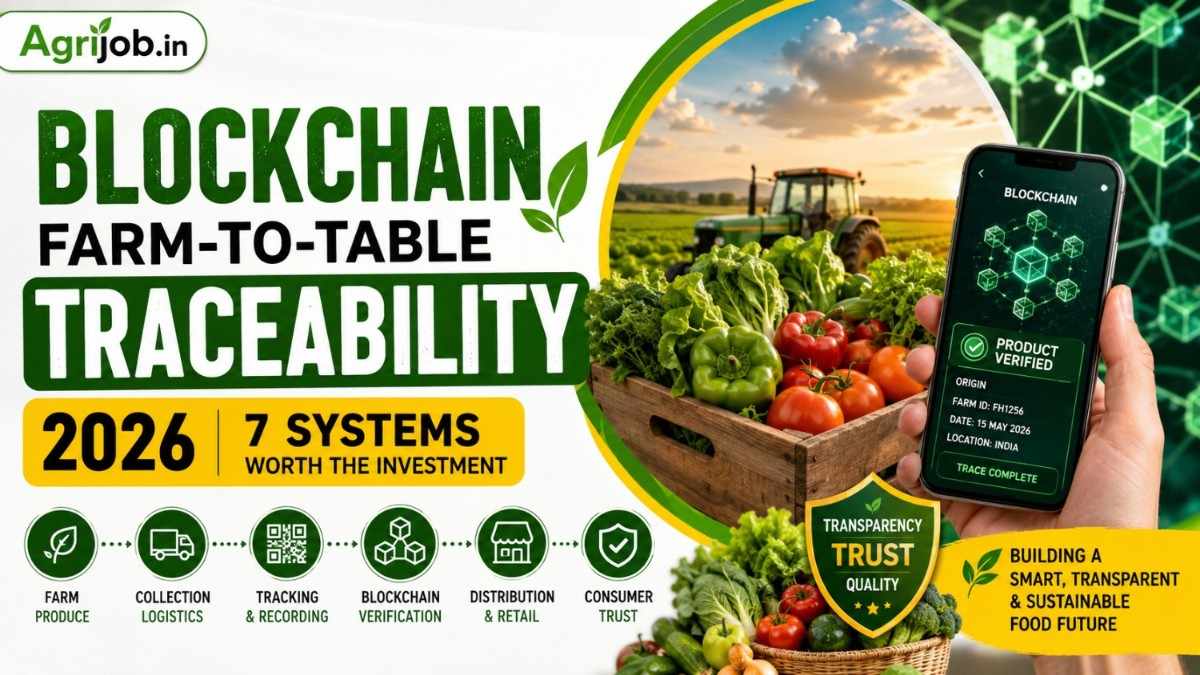
Blockchain farm-to-table traceability systems in 2026 deliver measurable ROI for mid-to-large agri-food operations: deployment costs range from $25,000 to $1,500,000+ depending on scale, and most enterprises recover investment within 12–18 months through a 50–65% reduction in recall costs and 90% savings in regulatory compliance labour. For Indian exporters targeting EU and US markets, platforms like TraceX Technologies, IBM Food Trust, and VeChain are the leading contenders — with APEDA’s BHARATI initiative actively subsidising blockchain traceability adoption for export-oriented agri-startups.
- Global Market Size (2026): USD 4.03 billion (Blockchain Food Traceability Market)
- Market CAGR: 32.9% through 2036 (projected to reach USD 69.22 billion)
- Agriculture & Food Supply Chain Segment: USD 1.23 billion in 2026 (48.1% CAGR)
- Deployment Cost Range: $25,000–$75,000 (BaaS/SaaS) to $400,000–$1,500,000+ (custom enterprise)
- Typical ROI Period: 12–18 months for mid-size FMCG operations
- Recall Cost Reduction: 50–65% reduction in recall scope and costs
- Regulatory Compliance Savings: Up to 90% reduction in FSMA/GFSI reporting labour
- India Initiative: APEDA BHARATI programme supports 100 agri-food startups with blockchain traceability tools targeting $50 billion exports by 2030
- Top Platforms (2026): IBM Food Trust, TraceX Technologies, VeChain, TE-FOOD, Wholechain, Farmonaut, Provenance
- Key Regulation: FDA FSMA Rule 204 (USA), EU Farm to Fork Strategy, India Digital Agriculture Mission
📋 Table of Contents
- What Is Blockchain Farm-to-Table Traceability?
- Who Should Invest in These Systems in 2026?
- Cost, Pricing Models and ROI Breakdown
- Eligibility and Technical Requirements for Deployment
- How Blockchain Traceability Works: 7-Step Process
- Top 7 Platforms Compared: Which System Wins?
- Pros and Cons of Blockchain Farm-to-Table Traceability
- Important Terms Every Agri-Food Business Must Know
- Important Dates and Regulatory Deadlines 2026
- Important Links and Official Resources
- Conclusion
- Key Takeaways
- Frequently Asked Questions
What Is Blockchain Farm-to-Table Traceability and Why Does It Matter in 2026?
Blockchain farm-to-table traceability is a digital system that records every event in a food product’s journey — from the soil where it was grown to the consumer’s plate — on an immutable, distributed ledger that no single party can alter retroactively. Every actor in the chain, whether farmer, processor, transporter, cold storage operator, or retailer, adds timestamped records that become permanently verifiable by all participants and regulators.
What makes 2026 a turning point is regulatory pressure converging with commercial reality. The FDA’s FSMA Rule 204 mandates electronic traceability records for high-risk foods. The EU’s Farm to Fork Strategy demands supply chain transparency for imported products. India’s own Digital Agriculture Mission and APEDA’s blockchain initiatives are aligning the country’s Rs.40,000-crore agri-export sector with these global standards. Businesses that cannot produce verified provenance data risk losing export licences — and major retail contracts.

The technology works by assigning a unique digital identifier to each product lot. IoT sensors, RFID tags, QR codes, and GPS units collect real-world data at every Critical Tracking Event (CTE). That data is written to the blockchain ledger: tamper-proof, time-stamped, and accessible by authorised participants within seconds. When contamination occurs, recall identification that previously took 7–14 days now happens in minutes — a difference that has been quantified at a 50–65% reduction in total recall costs.
Who Should Invest in Blockchain Farm-to-Table Traceability Systems in 2026?
- 🌾 Agri-food exporters targeting EU, US, Japan, and UAE markets where blockchain provenance is increasingly a buyer requirement or regulatory mandate
- 🏭 Food processing companies handling leafy greens, seafood, eggs, nut butters, or ready-to-eat products covered under FDA FSMA Rule 204
- 🧑🌾 Farmer Producer Organisations (FPOs) with 500+ member farmers seeking to command premium prices by offering verified organic or GI-tagged provenance
- 📦 Cold chain logistics operators managing temperature-sensitive products where storage condition records must be tamper-proof for regulatory audits
- 🧪 Organic certification bodies and AYUSH product manufacturers needing continuous, verifiable compliance documentation for international markets
- 🏦 Agritech startups applying to APEDA’s BHARATI initiative, where blockchain traceability is a core technology focus for the export acceleration programme
- 🛒 Retail chains and food service companies managing private-label sourcing across multiple suppliers who need end-to-end supplier accountability
- 🌿 Specialty and premium food brands — single-origin coffee, Basmati rice exporters, honey producers — where authentic origin proof directly supports a higher price premium
Cost, Pricing Models, and Realistic ROI for Blockchain Traceability in 2026
The single most important factor deterring businesses from blockchain traceability is misunderstanding the cost structure. Enterprise custom deployments are expensive — but blockchain-as-a-service (BaaS) platforms have dramatically lowered the entry point. Here is an honest breakdown across deployment tiers for 2026.
| Deployment Tier | Who It Suits | Setup Cost | Monthly Cost | ROI Timeline |
|---|---|---|---|---|
| SaaS / BaaS Platform | SMEs, FPOs, startups | $25,000–$75,000 | $500–$2,000 | 12–18 months |
| Mid-Enterprise Integration | Food processors, exporters | $75,000–$400,000 | $2,000–$8,000 | 18–24 months |
| Full Enterprise (Private Network) | Large FMCG, retail chains | $400,000–$1,500,000+ | $10,000–$30,000 | 24–36 months |
| Consortium / Shared Network | Industry groups, cooperatives | Cost-shared across members | Per-node fee | 12–20 months |
Where ROI actually comes from: The primary ROI driver is not marketing — it is operational cost reduction. A mid-size FMCG company with $500M–$2B in annual revenue typically achieves payback within 12–18 months through four channels: a 50–65% reduction in recall scope and costs; a 90% reduction in FSMA and GFSI compliance reporting labour; prevention of supplier documentation fraud; and a consumer trust premium that supports premium pricing and retailer preference. Foodborne illnesses cost the US alone an estimated $75 billion annually in healthcare costs and lost productivity — blockchain’s role in narrowing recall scope to affected lots rather than entire product lines directly captures a portion of this saving.
Eligibility and Technical Requirements for Blockchain Traceability Deployment
Not every farm or food business is ready for blockchain traceability on day one. These are the baseline requirements across operational, technical, and regulatory dimensions:
- Digital readiness: At minimum, the ability to capture batch or lot numbers digitally at key points — harvest, processing, packaging, and dispatch
- Partner network alignment: At least 2–3 supply chain partners (e.g., a processor and a retailer) willing to participate and contribute data to the shared ledger
- IoT or physical identification infrastructure: RFID tags, QR codes, or smart sensors at collection and handoff points — paper-only operations need to digitise first
- ERP or farm management system: Most enterprise blockchain platforms require API integration with existing ERP (SAP, Microsoft Dynamics, Odoo) or farm management software
- Regulatory compliance baseline: For FSMA 204-covered foods, records must capture Critical Tracking Events (CTEs) including growing, cooling, packing, first land-based receiver, shipping, and receiving
- Internet connectivity at farm level: A persistent challenge in rural India — offline data capture with batch sync is supported by platforms like TraceX and TE-FOOD for low-connectivity zones
- India-specific: APEDA RCMC registration for exporters; compliance with Digital Agriculture Mission data protocols for government-supported deployments
| Requirement Category | Minimum for SaaS Entry | Required for Enterprise |
|---|---|---|
| Annual Revenue / Scale | Any; even FPOs eligible | $500M+ for full private network |
| Supply Chain Partners | 2–3 participating entities | Full ecosystem (5–20+ nodes) |
| Data Capture Infrastructure | QR codes / manual digital entry | IoT sensors, RFID, GPS |
| ERP Integration | Optional (API available) | Mandatory (SAP, Oracle, MS) |
| IT Team Required | No (vendor-managed) | Yes (dedicated blockchain admin) |
How Blockchain Farm-to-Table Traceability Works: 7-Step Process
- Farm registration and geo-mapping: Each farm plot is registered on the platform with GPS coordinates, farmer ID, crop type, and certification status (organic, GI-tagged, etc.). This creates the anchor record from which all downstream data flows.
- Input and practice logging: Planting dates, seed batch numbers, fertiliser applications, pesticide use (with MRL compliance flags), and irrigation records are logged — either through IoT sensors or a mobile app. Every entry is timestamped and immutable.
- Harvest event capture: At harvest, a Critical Tracking Event record is created with lot number, harvest date, weight, quality grade, and the farm-plot anchor ID. This lot number travels with the produce through every subsequent stage.
- Processing and packing record: At the processing facility, the lot is assigned a batch code linked to the harvest CTE. Processing conditions, temperature logs, allergen handling records, and packaging date are added to the ledger.
- Cold chain and logistics tracking: GPS-enabled fleet data and smart temperature sensors write continuous records to the blockchain during transit. Any temperature excursion is flagged automatically and cannot be erased.
- Retail or export handoff: At the point of retail receipt or export customs clearance, the receiving party verifies the chain of custody through the shared ledger. Regulatory bodies can access the full provenance trail on demand.
- Consumer-facing verification: A QR code on the final product gives the end consumer (or auditor) a web-based provenance report: farm of origin, travel history, certifications, and batch-level safety records — all pulled from the immutable blockchain ledger.
Start your blockchain traceability pilot with one high-value crop and one verified supply chain route — not your entire operation. Prove ROI on a narrow scope first. The most successful Indian exporters using platforms like TraceX began with a single coffee or organic rice value chain, demonstrated buyer premium capture, and then scaled. Trying to digitise your full inventory on day one is the fastest path to an expensive shelf-ware system that no one uses.
Top 7 Blockchain Farm-to-Table Platforms Compared: Which System Is Worth the Investment?
The blockchain traceability category has seen significant consolidation since 2022 — including the failure of TradeLens (IBM/Maersk, shut down 2022) and Everledger entering administration in 2023. The survivors and new entrants in 2026 are more focused, better priced, and integration-ready. Here is an honest comparison of the seven platforms that matter most for agri-food businesses.
| Platform | Blockchain Base | Best For | Entry Cost | India Support | FSMA 204 Ready | Offline / Low-Connectivity |
|---|---|---|---|---|---|---|
| IBM Food Trust | Hyperledger Fabric | Large retailers, global FMCG | $$$$ (enterprise) | Limited | ✅ Yes | ❌ No |
| TraceX Technologies | Proprietary blockchain | Indian SMEs, FPOs, exporters | $$ (SaaS) | ✅ Strong | ✅ Yes | ✅ Yes |
| VeChain | VeChainThor | Premium products, IoT-heavy chains | $$$ (mid-enterprise) | Growing | ✅ Yes | ✅ Partial |
| TE-FOOD | Ethereum / TE-FOOD chain | Meat, poultry, livestock tracing | $$ (SaaS) | Limited | ✅ Yes | ✅ Yes |
| Wholechain | GS1 EPCIS standard | Seafood, produce, compliance-focused | $$ (SaaS) | Limited | ✅ Yes | ✅ Partial |
| Farmonaut | Custom + satellite data | Indian farmers, satellite-led traceability | $ (entry-level SaaS) | ✅ Strong | ❌ Partial | ✅ Yes |
| APEDA GrapeNet + Blockchain | Hybrid (government-backed) | Indian agri-exporters (grapes, rice, organics) | $ (subsidised for exporters) | ✅ Strongest | ✅ EU-aligned | ✅ Yes |
For Indian agri-food exporters and mid-scale food processors in 2026, TraceX Technologies offers the strongest combination of India-specific support, offline data capture for low-connectivity farm locations, FSMA 204 and EU compliance readiness, and an accessible SaaS pricing model. For businesses already within the APEDA export ecosystem — particularly grape, rice, organic, and meat exporters — the APEDA GrapeNet/Blockchain hybrid remains the most cost-effective entry point given its government backing and integration with existing RCMC workflows. IBM Food Trust is the gold standard for global enterprise consortia, but its complexity and cost make it unsuitable for most Indian SMEs without large IT infrastructure. VeChain is the best pick for IoT-heavy, premium product chains where per-item tracking at scale is required.
Pros and Cons of Blockchain Farm-to-Table Traceability for Agri-Food Businesses
✅ Advantages
- Tamper-proof provenance records: Once written to the blockchain, data cannot be altered retroactively — eliminating supplier fraud and falsified certification documents
- Dramatic recall response improvement: Blockchain compresses recall identification timelines by up to 80% compared to paper-based systems — from days or weeks to minutes
- Regulatory compliance automation: FSMA 204 Key Data Elements at each Critical Tracking Event are captured automatically, reducing compliance reporting labour by up to 90%
- Export market access: Verified provenance is now a buyer requirement in EU, US, and Japan markets — blockchain certification directly unlocks premium contracts
- Consumer trust and price premium: QR-code-enabled product transparency allows brands to charge premium pricing for verified organic, GI-tagged, or single-origin products
- Waste reduction: Better shelf-life and handling visibility helps reduce the estimated 30–40% of food lost in the supply chain annually
❌ Disadvantages
- High enterprise setup cost: Full private blockchain networks cost $400,000–$1,500,000+, placing them out of reach for most individual small farmers without cooperative or government support
- Data quality dependency: Blockchain records data accurately — but garbage-in means garbage-out. If physical tracking at farm level is inaccurate, the ledger simply records inaccurate data with authority; blockchain does not verify physical reality, only digital inputs
- Ecosystem buy-in challenge: A single participant cannot create a useful traceability chain — all supply chain partners must adopt the platform, creating significant coordination overhead
- Connectivity barriers in rural India: Reliable internet at the farm gate remains a challenge, though offline sync solutions are addressing this
- Platform consolidation risk: The category has seen multiple failures (TradeLens 2022, Everledger 2023) — vendor due diligence and lock-in assessment are critical before committing to a platform
Important Blockchain Traceability Terms Every Agri-Food Business Must Know
- Critical Tracking Event (CTE): A point in the food supply chain where a covered food changes hands or undergoes a significant change — growing, packing, shipping, and receiving are all CTEs under FSMA Rule 204
- Key Data Element (KDE): The specific data field that must be captured at each CTE under FSMA 204 — includes lot number, quantity, date, and location identifiers
- Permissioned Blockchain: A private or consortium blockchain where participants are known and access is controlled — the standard for food traceability (e.g., Hyperledger Fabric) as opposed to public chains like Bitcoin
- Smart Contract: Self-executing code on the blockchain that triggers automatic actions when pre-set conditions are met — for example, automatically releasing payment to a farmer when a quality inspection is recorded
- Blockchain-as-a-Service (BaaS): A cloud-hosted blockchain deployment model where the vendor manages the infrastructure — reducing setup cost to $25,000–$75,000 versus building a private network
- EPCIS Standard: Electronic Product Code Information Services — the GS1 global standard for sharing supply chain event data, used by platforms like Wholechain and IBM Food Trust for interoperability
- Distributed Ledger Technology (DLT): The broader category of technologies of which blockchain is a type — refers to any shared, decentralised database where records are replicated across multiple nodes
- Asset Tokenisation: Converting the value of a real-world asset (farmland, a standing crop, livestock) into digital tokens on a blockchain, enabling fractional ownership and access to new financing instruments for smallholder farmers
- Interoperability: The ability of different blockchain platforms to exchange data with each other — the defining challenge of 2026, with industry consortia working on standards so no single vendor can create lock-in
- APEDA GrapeNet: India’s first government-backed agri-traceability platform, originally built for grape exports to the EU in 2005–06, now expanded to organics (Tracenet), meat (Meat.net), and peanuts — and recently integrated with a blockchain layer
Important Regulatory Dates and Milestones for Blockchain Traceability 2026
| Date / Period | Event / Milestone | Relevance |
|---|---|---|
| January 2026 | Original FSMA Rule 204 compliance deadline (USA) | Extended to ~July 2028 after industry pushback; early adoption still recommended |
| July 2028 (expected) | Revised FSMA 204 compliance deadline (USA) | Mandatory electronic traceability records for all FTL-covered foods; blockchain satisfies requirements |
| September 2025 – February 2026 | APEDA BHARATI Pilot Cohort (India) | 100 agri-food startups selected; blockchain traceability is a core technology focus for $50B export target by 2030 |
| Ongoing 2026 | EU Farm to Fork Strategy enforcement | Indian exporters to EU must demonstrate supply chain transparency; blockchain provenance increasingly required by major EU buyers |
| 2026 | EU Deforestation Regulation (EUDR) enforcement for food | Requires verified geolocation data proving products are deforestation-free — blockchain + satellite integration is the primary compliance pathway |
| By 2030 | India Digital Agriculture Mission full rollout | National digital agriculture data infrastructure expected to integrate with blockchain traceability platforms for FPO and export compliance |
Important Links — Official Resources and Platform References
| Resource | Link |
|---|---|
| APEDA Official Website (India) | apeda.gov.in |
| APEDA BHARATI Initiative | BHARATI Initiative Details |
| FDA FSMA Rule 204 Official Page | FDA.gov — FSMA 204 |
| India Digital Agriculture Mission | agricoop.nic.in |
| FAO — Blockchain for Agriculture Report | fao.org/e-agriculture/blockchain |
| ICAR — Agri Technology Resources | icar.org.in |
| TraceX Technologies (India Platform) | tracextech.com |
| Agrijob.in — Agri Technology Guides | agrijob.in |
Conclusion: Is Blockchain Farm-to-Table Traceability Worth the Investment in 2026?
Blockchain farm-to-table traceability in 2026 is not a question of whether — it is a question of which platform, at what scale, and through which deployment model best fits your operation’s size, export ambitions, and budget. For mid-to-large Indian agri-food exporters targeting EU and US markets, the business case is clear: 12–18 month ROI through recall cost reduction alone justifies the SaaS-level investment, and regulatory compliance requirements are tightening every year. For FPOs and agri-startups, APEDA’s BHARATI initiative and platforms like TraceX and Farmonaut provide accessible entry points with government-backed support. The window to deploy, learn, and build verified provenance credentials before your competitors do — and before regulatory deadlines make it mandatory rather than competitive — is open right now in 2026. Bookmark this page as official regulatory timelines are updated and new platform comparisons are added.
- The blockchain food traceability market reached USD 4.03 billion in 2026 and is growing at 32.9% CAGR, driven by regulatory mandates and consumer demand for verified provenance
- BaaS/SaaS deployment costs start at $25,000–$75,000 with $500–$2,000/month ongoing, making blockchain traceability accessible to mid-scale agri-food businesses — not just FMCG giants
- Most mid-size enterprises achieve ROI within 12–18 months through a 50–65% reduction in recall costs and 90% savings in FSMA/GFSI compliance reporting labour
- India’s APEDA BHARATI initiative actively supports 100 agri-food startups with blockchain traceability tools as part of the $50 billion agri-export target by 2030 — check apeda.gov.in for eligibility
- TraceX Technologies is the strongest India-specific option for FPOs and exporters; APEDA GrapeNet/Blockchain is the most cost-effective entry for RCMC-registered exporters
- The biggest risk is not blockchain failure — it is data quality at the farm gate; invest in IoT capture and partner alignment before committing to platform deployment
Frequently Asked Questions About Blockchain Farm-to-Table Traceability 2026
What is blockchain farm-to-table traceability in simple terms?
Blockchain farm-to-table traceability is a digital system that records every step of a food product’s journey — from the farm where it was grown to the consumer’s plate — on a tamper-proof, shared digital ledger. Every event, such as harvest, processing, transport, and retail receipt, is time-stamped and permanently recorded. No single party can change or delete records, which makes the system trusted by regulators, retailers, and consumers for verifying product origin, safety, and certification claims.
How much does it cost to implement blockchain traceability for a farm or food business?
Costs vary significantly by deployment model. Blockchain-as-a-service (BaaS) platforms like TraceX cost $25,000–$75,000 for initial integration, with $500–$2,000 per month for ongoing network participation — suitable for mid-scale Indian exporters and food processors. Full custom enterprise implementations with private networks cost $400,000–$1,500,000+, designed for large FMCG companies. Indian agri-food startups should first explore APEDA’s BHARATI initiative, which provides subsidised access to blockchain traceability tools for eligible exporters.
Which blockchain traceability platform is best for Indian agri-food exporters?
TraceX Technologies is currently the strongest platform for Indian mid-scale exporters and FPOs, given its India-specific support, offline data capture capability for low-connectivity rural areas, FSMA 204 and EU compliance readiness, and accessible SaaS pricing. For exporters already registered with APEDA, the GrapeNet blockchain integration offers a subsidised, government-backed entry point that covers grapes, rice, organic products, and meat. IBM Food Trust is the global enterprise standard but requires significant IT infrastructure that most Indian SMEs do not have in place.
What is FSMA Rule 204 and how does blockchain help with compliance?
The FDA’s FSMA Rule 204 is a US regulation requiring electronic, sortable traceability records for high-risk foods — including leafy greens, shell eggs, nut butters, tomatoes, and certain seafood. These records must be producible to the FDA within 24 hours of a request. Blockchain-based traceability platforms automatically capture the required Critical Tracking Events and Key Data Elements at each stage of the supply chain, storing them in a time-stamped, immutable format. This transforms compliance from a manual, labour-intensive process into an automated, always-audit-ready system, with operators reporting up to 90% reduction in compliance reporting time.
How long does it take to see ROI from blockchain traceability investment?
For mid-size FMCG organisations with annual revenues of $500M–$2B and multi-site supply chains, the typical payback period is 12–18 months. ROI is driven primarily by four factors: a 50–65% reduction in recall scope and costs; 90% savings in FSMA and GFSI regulatory compliance labour; prevention of supplier documentation fraud; and a consumer trust premium enabling better pricing and retail contract access. Smaller operations with narrower supply chains may see longer payback periods of 18–24 months but still benefit from regulatory compliance automation and export market access.
Can small farmers and FPOs in India afford blockchain traceability?
Yes — through the right entry pathway. Individual smallholders cannot typically afford standalone deployments, but Farmer Producer Organisations (FPOs) can pool costs across members and qualify for government support. APEDA’s BHARATI initiative specifically targets agri-food startups and technology providers working with smallholder farmers. Platforms like TraceX and Farmonaut offer per-farmer subscription models and offline mobile apps that work with basic smartphones, removing the need for expensive IoT infrastructure at the farm level. The recommended approach is to start with a cooperative or consortium model and prove ROI on one crop and one export route before scaling.
What are the biggest risks of blockchain traceability systems?
The two most significant risks are data quality and vendor lock-in. Blockchain records data accurately — but if the physical data capture at the farm gate is incorrect or manipulated before entry, the blockchain simply records that inaccuracy with permanence and apparent authority. This is why investment in reliable IoT sensors, RFID tagging, and trained farm-level data entry is as important as the platform itself. Vendor lock-in is the second risk: the category has seen platform failures (TradeLens, Everledger) and consolidation. Before committing to a platform, evaluate API openness, data portability standards (EPCIS/GS1 compliance), and the vendor’s financial stability.
Does blockchain traceability prevent food fraud and adulteration?
Blockchain significantly reduces food fraud risk, but does not eliminate it entirely. Once a batch is correctly identified and entered into the system, all subsequent records are tamper-proof and verifiable. This makes it extremely difficult to substitute products mid-chain, mislabel origin, or falsify certification documents without detection. However, if fraudulent data is entered at the very first step — for example, labelling a non-organic product as organic at harvest — the blockchain will record and protect that fraudulent claim. The solution is combining blockchain with physical verification mechanisms: IoT sensors, third-party audits, and AI-powered anomaly detection. The most robust 2026 systems layer all four technologies together.
What is the APEDA BHARATI initiative and how do I apply?
APEDA’s BHARATI initiative — Bharat’s Hub for Agritech, Resilience, Advancement and Incubation for Export Enablement — was launched in September 2025 to support 100 agri-food and agri-tech startups with the goal of reaching $50 billion in agri-food exports by 2030. The programme provides a three-month acceleration covering export readiness, regulatory compliance, market access, and technology adoption — with blockchain traceability, IoT cold chains, and AI quality control as core technology focuses. Selection is managed through the APEDA website (apeda.gov.in), and eligible startups gain access to packhouses, cold storage, testing laboratories, IIT/NIT partnerships, and investor roadshows. Check the official portal for current cohort application windows.
How does blockchain traceability reduce food waste in the supply chain?
Blockchain traceability directly addresses the estimated 30–40% of food lost annually in the supply chain through two mechanisms. First, real-time visibility into temperature excursions and handling conditions during cold chain transit allows proactive intervention — stopping deterioration before it becomes total loss. Second, when contamination does occur, blockchain enables surgical recalls targeting only the affected lot, rather than the broad precautionary recalls that current paper-based systems require. The 2018 US romaine lettuce outbreak, which resulted in industry-wide destruction of safe product because traceability was inadequate, is the canonical example of why lot-level traceability is not just a regulatory requirement but a direct food waste reduction strategy worth billions annually.
Last Updated: July 2026. This guide is reviewed and updated regularly as official regulatory timelines, platform pricing, and government scheme details change. Bookmark this page for the latest information on blockchain farm-to-table traceability systems.
Disclaimer: This article is for informational purposes only. Costs, regulatory deadlines, and platform availability are subject to change. Verify current pricing directly with platform vendors and consult official regulatory portals (FDA, APEDA, EU Commission) for the latest compliance requirements before making investment decisions. Agrijob.in is not affiliated with any blockchain platform mentioned in this guide.