

ISO 22000 and FSSC 22000 certification are the two most important food safety credentials a food business can hold in 2026 — but they are not interchangeable. If your goal is to stock shelves at Reliance Retail, DMart, Walmart India, or export to the EU and Middle East, the difference between these two certifications is the difference between getting a purchase order and being turned away at the gate. This guide is for food manufacturers, processors, packaging units, and MSME food entrepreneurs across India who want to understand exactly which certification opens the most retail doors in 2026 — and why. We cover the GFSI recognition gap, cost comparison (Rs.75,000 to Rs.12 lakh), the step-by-step process, and the newly released FSSC 22000 Version 7 (May 2026).

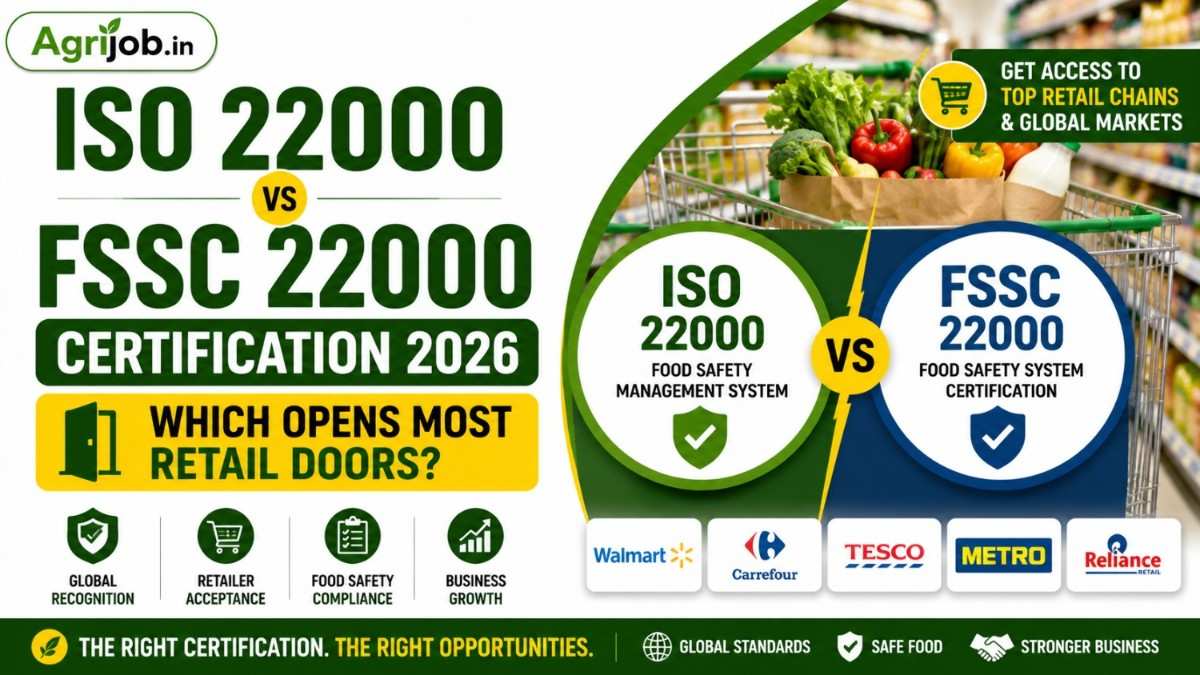
FSSC 22000 certification opens more retail doors than ISO 22000 in 2026. FSSC 22000 is GFSI-benchmarked and accepted by Walmart, Tesco, Reliance, DMart, and international export buyers — while ISO 22000 alone is not GFSI-recognised and may not meet major retailer vendor requirements. For domestic-only SMEs, ISO 22000 (starting Rs.75,000) is a solid first step; for any organized retail or export ambition, FSSC 22000 (Rs.1.5–12 lakh) is the required standard.
- ISO 22000 Governing Body: International Organization for Standardization (ISO)
- FSSC 22000 Governing Body: Foundation FSSC (non-profit)
- GFSI Recognition: ISO 22000 — No | FSSC 22000 — Yes (V6 recognised August 2024; V7 published May 1, 2026)
- ISO 22000 Cost India: Rs.75,000 – Rs.3.5 lakh (micro to medium)
- FSSC 22000 Cost India: Rs.1.5 lakh – Rs.12 lakh (small to large unit)
- Certification Validity: 3 years (annual surveillance audits required)
- Timeline to Certify: ISO 22000: 2–4 months | FSSC 22000: 3–6 months
- Retail Access: ISO 22000 — local/regional | FSSC 22000 — Walmart, DMart, Reliance, EU, Middle East
- Current Valid Version: FSSC 22000 V7 (May 2026); ISO 22000:2018
- India Accreditation Body: NABCB (National Accreditation Board for Certification Bodies) under QCI
- Regulator Alignment: Both complement FSSAI — not a replacement for FSSAI license
- What Is Food Safety Certification and Why It Matters in 2026
- Who Should Read This Guide
- Cost Comparison: ISO 22000 vs FSSC 22000 in India
- Eligibility and Requirements for Each Certification
- How to Get Food Safety Certified: Step-by-Step Process
- ISO 22000 vs FSSC 22000: Full Comparison Table
- Pros and Cons of Each Certification
- Important Terms Related to Food Safety Certification
- Important Dates and Timeline for 2026
- Important Links
- Conclusion
- Key Takeaways
- Frequently Asked Questions
What Is Food Safety Certification and Why It Matters in 2026
Food safety certification is a third-party verified credential that proves your food business operates a structured Food Safety Management System (FSMS) capable of identifying, controlling, and eliminating hazards from farm to fork. In 2026, food safety certification is no longer optional for any food manufacturer or processor with organized retail ambitions — it is the commercial entry ticket that major retailers, international buyers, airlines, and quick-service restaurant chains require before signing a supply agreement.
ISO 22000 is the international standard developed by the International Organization for Standardization. It combines HACCP principles with interactive communication and system management into a single Food Safety Management System framework applicable to every organization in the food chain — producers, manufacturers, distributors, retailers, and even pest control or packaging companies that serve the food industry. ISO 22000:2018 is the current active version.

FSSC 22000 (Food Safety System Certification 22000) is a complete certification scheme built on top of ISO 22000. It was created by Foundation FSSC, a non-profit organization, and adds sector-specific Prerequisite Programs (PRPs) — for example, ISO/TS 22002-1 for food manufacturing — plus additional FSSC-specific requirements covering food fraud, food defense, allergen management, and food safety culture. The critical commercial differentiator: FSSC 22000 is GFSI-benchmarked, meaning it is recognized by the Global Food Safety Initiative and accepted by virtually every major retailer worldwide. Foundation FSSC officially published Version 7 on May 1, 2026, with a 12-month transition window running until April 30, 2027.
The Food Safety and Standards Authority of India (FSSAI) governs domestic food safety compliance and every food business in India must hold a valid FSSAI license. ISO 22000 and FSSC 22000 are voluntary international standards that sit above FSSAI compliance — they demonstrate a higher level of food safety rigor and open doors to organized retail, exports, and premium institutional buyers. As of April 1, 2026, FSSAI licenses now carry perpetual validity under updated regulations, but international buyers still require GFSI-recognized certification regardless of FSSAI status.
Who Should Read This Certification Guide?
- 🏭 Food manufacturers and processors supplying organized retail chains like Reliance Fresh, DMart, or Big Bazaar who need GFSI-recognized certification to qualify as a vendor
- 🌍 Exporters targeting EU, UK, USA, Middle East, or Southeast Asian markets where international buyers mandate FSSC 22000 or equivalent GFSI certification
- 🥗 MSME food entrepreneurs and FPOs (Farmer Producer Organizations) considering their first food safety certification and unsure whether ISO 22000 or FSSC 22000 is the right starting point
- 📦 Food packaging, transport, and cold storage operators who need to demonstrate food safety compliance to their food manufacturer clients
- 🍽️ Institutional food suppliers (airlines, hospitals, hotel chains, school midday meal programs) where tendering bodies specify FSSC 22000 certification
- 🎓 Food safety officers and QA managers preparing their organization for a first certification or managing a V6-to-V7 transition audit before the April 2027 deadline
- 💼 Investors and business owners evaluating whether food safety certification ROI justifies the Rs.1.5–12 lakh investment against new retail or export revenue potential
- 🏪 Retail and wholesale operators seeking FSSC 22000 scope coverage that now explicitly includes retail and wholesale food businesses under Version 7
Cost Comparison: ISO 22000 vs FSSC 22000 Certification in India 2026
Certification cost in India depends on your unit size, the complexity of your food processes, and whether you engage a consultant. Both certifications follow a 3-year cycle with annual surveillance audits. Below is the verified 2026 cost breakdown for Indian food businesses across all size categories.
| Business Size | ISO 22000 Cost (India 2026) | FSSC 22000 Cost (India 2026) |
|---|---|---|
| Micro / Home-Based Unit | Rs.75,000 – Rs.1.5 lakh | Rs.1.5 lakh – Rs.2.5 lakh |
| Small Food Unit (10–50 employees) | Rs.1.5 lakh – Rs.2.5 lakh | Rs.2.5 lakh – Rs.4 lakh |
| Medium Enterprise (50–200 employees) | Rs.2.5 lakh – Rs.3.5 lakh | Rs.4 lakh – Rs.7 lakh |
| Large-Scale Food Plant (200+ employees) | Rs.3.5 lakh – Rs.5 lakh+ | Rs.7 lakh – Rs.12 lakh |
| Annual Surveillance Audit | 50–70% of initial cost | 50–70% of initial cost |
| Recertification (Every 3 Years) | 70–80% of initial cost | 70–80% of initial cost |
These figures include gap analysis, documentation preparation, internal audits, consultant fees, and the certification body’s audit man-days. FSSC 22000 costs more because audits cover three layers — ISO 22000:2018, sector-specific PRPs, and FSSC additional requirements — and typically take longer. NABCB-accredited certification bodies in India offering both standards include Bureau Veritas, TÜV SÜD, SGS, and DNV. Note: MSME food businesses may qualify for partial certification cost reimbursement under state food processing department schemes — check with your state’s MSME or food processing ministry.
Eligibility and Requirements for Each Certification
Both ISO 22000 and FSSC 22000 are open to any organization in the food chain — but FSSC 22000 has additional sector-specific and documentation requirements that make it more demanding. Here is what you need to qualify and prepare for each certification.
Minimum requirements applicable to both ISO 22000 and FSSC 22000:
- Valid FSSAI license (mandatory for all food businesses in India)
- Documented Food Safety Policy approved by top management
- Functioning HACCP system (Hazard Analysis and Critical Control Points)
- Trained Food Safety Team with a designated Food Safety Team Leader
- Documented Prerequisite Programs (PRPs) covering hygiene, pest control, cleaning, and traceability
- Internal audit system with at least 3 months of operational records before certification audit
- Management Review Minutes demonstrating senior management’s active role in food safety decisions
- Corrective action and continual improvement procedures
Additional requirements exclusive to FSSC 22000 (V6 and V7):
- Sector-specific PRP documentation: ISO/TS 22002-1 for food manufacturing (or applicable sector PRP)
- Food Fraud Vulnerability Assessment (FFVA) with annual review
- Food Defense Plan addressing intentional adulteration threats
- Allergen Management Program with documented cross-contact controls
- Food Safety Culture Plan demonstrating organization-wide food safety awareness
- Unannounced audit readiness (at least one unannounced surveillance audit per certification cycle)
- Food Loss and Waste reduction program (strengthened in V7)
- Quality control and equipment management procedures (new in V7)
- Sustainability and UN SDG-aligned objectives (V7 requirement with audit weight)
| Document / System | ISO 22000 | FSSC 22000 |
|---|---|---|
| FSSAI License | Required | Required |
| HACCP Plan | Required | Required |
| Sector-Specific PRPs (ISO/TS 22002-x) | Not mandatory | Mandatory |
| Food Fraud Vulnerability Assessment | Not required | Mandatory |
| Food Defense Plan | Not required | Mandatory |
| Allergen Management Program | Basic | Enhanced (V7) |
| Unannounced Audits | No | Yes (mandatory) |
| Food Safety Culture Plan | Not required | Mandatory |
| UN SDG Sustainability Objectives | No | Mandatory from V7 |
How to Get Food Safety Certified: Step-by-Step Process
The certification process for both ISO 22000 and FSSC 22000 follows a similar multi-stage journey. FSSC 22000 takes slightly longer due to additional requirement layers. Here is the complete step-by-step process for Indian food businesses in 2026.
- Gap Analysis (Week 1–2): Assess your current food safety system against ISO 22000:2018 and, for FSSC 22000, the sector-specific PRPs and additional FSSC requirements. Identify non-conformities and document the corrective action roadmap. Many businesses engage a NABCB-recognized consultant at this stage.
- Documentation Preparation (Week 3–8): Develop or upgrade your Food Safety Policy, HACCP Plan, Operational PRPs, Hazard Analysis records, and management system procedures to Level 1 (policy), Level 2 (procedures), Level 3 (work instructions), and Level 4 (records). For FSSC 22000, also prepare Food Fraud, Food Defense, and Food Safety Culture documents.
- Implementation and Training (Week 6–14): Deploy the documented systems across your facility. Train all staff — from production workers to senior management — on their roles in the food safety management system. Run your FSMS for a minimum of 3 months before applying for the certification audit.
- Internal Audit (Week 12–16): Conduct a comprehensive internal audit against all applicable requirements. Document findings, raise corrective actions, verify closure, and prepare your internal audit report as evidence for the certification body.
- Management Review (Week 14–18): Senior management reviews internal audit results, food safety performance data, customer complaints, and continual improvement targets. Document minutes as required evidence for the certification audit.
- Select an Accredited Certification Body (Any Time): Choose a NABCB-accredited certification body authorized for your specific FSSC 22000 food chain category. Confirm they hold accreditation under ISO/IEC 17021-1 and relevant ISO/TS 22003 requirements. For FSSC 22000, verify the CB holds FSSC-specific accreditation — not all ISO 22000 certifiers can issue FSSC certificates.
- Stage 1 Audit — Document Review (2–4 days): The certification body conducts an off-site or on-site review of your documentation. They assess whether your documented FSMS meets all requirements before the Stage 2 on-site audit. Stage 1 findings must be addressed before proceeding.
- Stage 2 Audit — On-Site Implementation Assessment (2–4 days): Auditors visit your facility to verify that what is documented is actually being implemented. They interview staff, observe processes, review records, and check CCP monitoring data. Any major non-conformities must be closed before certification is granted.
- Certificate Issuance (2–4 weeks post-audit): After non-conformity closure and certification body review, your certificate is issued for a 3-year cycle. For FSSC 22000, you can verify your certificate online at www.fssc.com.
- Surveillance Audits (Years 1 and 2): Annual surveillance audits verify continued compliance. For FSSC 22000, at least one surveillance audit per 3-year cycle will be unannounced — scheduled only within a pre-agreed window, not on a fixed date.
Many food businesses make the costly mistake of getting ISO 22000 first and then upgrading to FSSC 22000 when a retail buyer demands it. This means paying for two full certification cycles. If organized retail supply or export is your business target within 2–3 years, start directly with FSSC 22000 — the additional cost is marginal compared to lost contracts. For new applicants in 2026, pursue FSSC 22000 V7 directly rather than V6, as V7 becomes the only valid version from May 2027 onward.
ISO 22000 vs FSSC 22000: Full Comparison Table 2026
The table below covers every dimension that matters for Indian food businesses deciding between ISO 22000 and FSSC 22000 in 2026, from retail access to audit structure to cost implications.
| Comparison Factor | ISO 22000:2018 | FSSC 22000 V7 (May 2026) |
|---|---|---|
| Governing Body | ISO (International Organization for Standardization) | Foundation FSSC (non-profit) |
| GFSI Recognition | No | Yes (since August 2024 for V6; V7 carries forward) |
| Retail Access (India) | Regional / local buyers only | Reliance, DMart, Walmart India, Carrefour, Tesco |
| Export Market Access | Some buyers accept; EU/UK often require GFSI | EU, UK, USA, Middle East, Southeast Asia — widely accepted |
| Sector PRPs Required | No (uses generic PRPs) | Yes — ISO/TS 22002-1 for food manufacturing (sector-specific) |
| Food Fraud Requirements | Not mandatory | Mandatory FFVA with annual update |
| Unannounced Audits | No | Mandatory (at least 1 per 3-year cycle) |
| Certification Cost (Small Unit) | Rs.75,000 – Rs.2.5 lakh | Rs.1.5 lakh – Rs.4 lakh |
| Certification Timeline | 2–4 months | 3–6 months |
| Audit Layers | 1 (ISO 22000 only) | 3 (ISO 22000 + PRPs + FSSC Additional Requirements) |
| Best For | SMEs, domestic market, local retail | Organized retail, exports, institutional buyers |
For any food manufacturer in India with organized retail or export ambitions in 2026, FSSC 22000 is the clear winner. GFSI recognition is the commercial gatekeeper that major retailers enforce — ISO 22000 alone does not clear this bar. However, ISO 22000 remains a solid and cost-effective entry-level certification for MSMEs focused purely on domestic, local, or regional markets where buyers have not yet mandated GFSI certification. The decision framework is simple: if your buyer list includes Reliance, DMart, Walmart, or any international buyer, start with FSSC 22000. If you are an FPO, cloud kitchen, or small processor serving local institutional or domestic buyers, ISO 22000 is an appropriate and proportionate first step.
Pros and Cons of ISO 22000 and FSSC 22000 Certification
Every food business must weigh the real benefits and genuine limitations of each certification before committing to the process.
ISO 22000 — Advantages:
- ✅ Lower cost entry point (from Rs.75,000 for micro units) — proportionate for small domestic food businesses
- ✅ Applicable to every segment of the food chain including distributors, transporters, retailers, and service providers
- ✅ Provides a structured HACCP-based foundation that makes future upgrade to FSSC 22000 significantly easier
- ✅ Harmonized with ISO 9001 and ISO 14001 for integrated management system benefits
- ✅ Strong FSSAI Schedule 4 alignment for Indian regulatory compliance context
ISO 22000 — Disadvantages:
- ❌ Not GFSI-recognized — will not satisfy major organized retail or export buyer requirements
- ❌ Does not mandate sector-specific PRPs, food fraud, or food defense — gaps that buyers increasingly expect to be addressed
- ❌ Lacks unannounced audit provision — perceived as weaker real-world assurance by sophisticated buyers
FSSC 22000 — Advantages:
- ✅ GFSI-benchmarked and recognized by 150+ countries and virtually every major global retailer including Walmart, Tesco, Carrefour, Reliance, and DMart
- ✅ Mandatory for most EU, UK, USA, and Middle East export markets — future-proofs your supply chain credentials
- ✅ Covers food fraud, food defense, allergen management, and food safety culture — the full spectrum of modern food safety risk
- ✅ Unannounced audits build genuine operational food safety culture, not just paper compliance
- ✅ V7 (May 2026) expanded retail and wholesale scope — now more relevant to Indian organized retail operators themselves
FSSC 22000 — Disadvantages:
- ❌ Significantly higher cost (Rs.1.5–12 lakh) — may be disproportionate for micro or purely domestic food businesses
- ❌ More complex documentation burden — food fraud, food defense, and SDG sustainability requirements add substantial preparation time
- ❌ V7 transition adds another compliance layer for currently V6-certified businesses before April 2027 deadline
Important Terms Related to Food Safety Certification
Understanding these 10 high-value terms will help you navigate audits, buyer conversations, and certification body discussions with confidence.
GFSI (Global Food Safety Initiative) — A benchmarking initiative by the Consumer Goods Forum that recognizes food safety certification schemes meeting a globally consistent standard. GFSI recognition is the single most important credential for selling to major retailers. FSSC 22000 V6 achieved GFSI recognition in August 2024; ISO 22000 alone is not GFSI-recognised.
HACCP (Hazard Analysis and Critical Control Points) — A science-based food safety methodology for identifying, evaluating, and controlling food safety hazards. HACCP forms the technical backbone of both ISO 22000 and FSSC 22000 — without a functioning HACCP system, neither certification can be achieved.
PRPs (Prerequisite Programs) — Basic environmental and operational conditions (hygiene, pest control, cleaning, temperature control, traceability) required before a HACCP plan can be effectively implemented. ISO 22000 allows generic PRPs; FSSC 22000 mandates sector-specific PRPs under the ISO/TS 22002-x series.
NABCB (National Accreditation Board for Certification Bodies) — India’s premier accreditation body under the Quality Council of India. A certification issued by a NABCB-accredited body is internationally accepted. Always verify your chosen certification body’s NABCB accreditation status before engaging them.
Food Fraud Vulnerability Assessment (FFVA) — A systematic assessment of which ingredients or products in your supply chain are vulnerable to intentional adulteration or substitution for economic gain. FFVA is mandatory for FSSC 22000; not required for ISO 22000 alone.
Food Defense Plan — A documented system for protecting food products from intentional contamination or tampering by employees, visitors, or external threats. Required exclusively for FSSC 22000 certification.
Food Safety Culture — The shared values, beliefs, and behaviors of an organization’s workforce regarding food safety. FSSC 22000 V6 and V7 require a documented Food Safety Culture plan with measurable targets — not just awareness training.
FSSC 22000 Version 7 (V7) — Released May 1, 2026 by Foundation FSSC. V7 incorporates the new ISO 22002-x:2025 PRP series, aligns with GFSI benchmarking requirements v2024, strengthens sustainability (SDG) requirements, expands retail and wholesale scope, and updates allergen management and food loss and waste provisions. All V6 certificates remain valid until April 30, 2027 — after that, V7 is the only valid version.
ISO/TS 22002-1 — The technical specification for Prerequisite Programs in food manufacturing — the most commonly applicable sector PRP document for FSSC 22000 certification in India’s food processing industry. The updated 2025 series (ISO 22002-1:2025) is incorporated into FSSC 22000 V7.
FSSAI (Food Safety and Standards Authority of India) — India’s national food regulatory authority under the Ministry of Health and Family Welfare. Every food business in India must hold a valid FSSAI license. From April 1, 2026, FSSAI licenses carry perpetual validity under updated regulations — but ISO 22000 and FSSC 22000 certifications remain separately required for organized retail and export compliance.
Important Dates and Timeline: Food Safety Certification 2026
| Date / Event | Significance |
|---|---|
| April 1, 2024 | FSSC 22000 V6 became mandatory (V5.1 expired) |
| August 23, 2024 | FSSC 22000 V6 achieved GFSI recognition |
| March 31, 2025 | All V5.1 FSSC certificates expired — V6 is the only recognized version |
| April 1, 2026 | FSSAI perpetual license validity takes effect for new applicants in India |
| May 1, 2026 | FSSC 22000 Version 7 officially published — 12-month transition window begins |
| April 30, 2027 | FSSC 22000 V6 transition deadline — all audits from May 2027 must use V7 |
| 3-Year Cycle | Both ISO 22000 and FSSC 22000 certificates expire after 3 years — annual surveillance audits maintain validity |
Important Links for Food Safety Certification
| Resource | Link |
|---|---|
| ISO 22000 Official Standard Page | iso.org — ISO 22000 Food Safety |
| Foundation FSSC — FSSC 22000 Official Scheme | fssc.com — FSSC 22000 |
| GFSI Recognised Programmes List | mygfsi.com — GFSI Recognised Standards |
| FSSAI Official Portal | fssai.gov.in |
| NABCB — India Accreditation Body | nabcb.qci.org.in |
Conclusion: Which Food Safety Certification Opens the Most Retail Doors in 2026?
The answer in 2026 is clear: FSSC 22000 certification opens significantly more retail doors than ISO 22000 for Indian food businesses targeting organized retail chains and export markets. GFSI recognition is the commercial differentiator — without it, ISO 22000 alone cannot satisfy vendor qualification requirements at Reliance, DMart, Walmart India, or international buyers in the EU, UK, USA, and Middle East. ISO 22000 remains the right proportionate choice for MSMEs, FPOs, and local/domestic food businesses where GFSI certification is not yet a buyer requirement. The best strategy for growth-oriented food businesses is to begin with a properly implemented ISO 22000 system and transition to FSSC 22000 V7 before the April 2027 deadline — ideally achieving FSSC 22000 certification directly if retail or export is the near-term target. Bookmark this page as we update it whenever FSSC or FSSAI release regulatory changes.
- FSSC 22000 is GFSI-benchmarked and required by Reliance, DMart, Walmart, Tesco, and international export buyers — ISO 22000 alone does not meet this bar
- FSSC 22000 costs Rs.1.5–12 lakh in India (2026) depending on unit size vs. Rs.75,000–3.5 lakh for ISO 22000
- FSSC 22000 Version 7 was published May 1, 2026 — the 12-month transition window means V6 stays valid until April 30, 2027
- New applicants in 2026 should pursue FSSC 22000 V7 directly; V6 transition audit is required for currently certified organizations before May 2027
- Both certifications complement but do not replace the mandatory FSSAI license required by Indian food law
- Begin your certification journey with a gap analysis — ISO 22000 first for local market; FSSC 22000 directly if organized retail or export is your 2–3 year target
Frequently Asked Questions About ISO 22000 FSSC 22000 Certification 2026
What is the main difference between ISO 22000 and FSSC 22000?
The most critical difference is GFSI recognition. FSSC 22000 builds on ISO 22000 and adds sector-specific PRPs, food fraud, food defense, and allergen requirements — making it GFSI-benchmarked and accepted by major retailers globally. ISO 22000 alone is not GFSI-recognized and will not satisfy vendor qualification requirements at major organized retail chains or most international export buyers.
Is FSSC 22000 mandatory to supply to Reliance or DMart in India?
While individual retailers set their own vendor requirements, FSSC 22000 (or another GFSI-recognized certification) is widely required or strongly preferred by organized retailers like Reliance Retail, DMart, Walmart India, and Carrefour for their food manufacturer suppliers. As India’s organized retail sector expanded by 25% in FY26 with over 2,182 new outlets added, vendor certification requirements are becoming stricter, not looser. Confirm specific requirements directly with the retailer’s vendor onboarding team.
How much does FSSC 22000 certification cost for a small food business in India in 2026?
For small food units in India (10–50 employees), FSSC 22000 certification costs typically range from Rs.1.5 lakh to Rs.4 lakh in 2026, including gap analysis, documentation, consultant support, and certification body audit fees. Annual surveillance audits typically cost 50–70% of the initial certification cost. MSME food businesses may qualify for partial reimbursement under state food processing ministry schemes.
Can I get ISO 22000 certification first and upgrade to FSSC 22000 later?
Yes, ISO 22000 provides a solid foundation for eventual FSSC 22000 certification since FSSC is built on ISO 22000. However, upgrading requires a separate FSSC 22000 certification cycle with additional documentation for PRPs, food fraud, food defense, and other requirements. Food businesses with retail or export targets within 2–3 years are advised to pursue FSSC 22000 directly to avoid paying for two full certification rounds.
What is FSSC 22000 Version 7 and how does it affect businesses in 2026?
FSSC 22000 Version 7 was officially published on May 1, 2026 by Foundation FSSC. It incorporates the updated ISO 22002-x:2025 PRP series, aligns with GFSI benchmarking requirements v2024, strengthens food safety culture requirements, adds food loss and waste provisions, enhances allergen management, and gives UN SDG sustainability requirements formal audit weight. A 12-month transition window applies — V6 certificates remain valid until April 30, 2027, after which all audits must be conducted against V7.
Does FSSC 22000 or ISO 22000 certification replace my FSSAI license?
No. FSSAI registration or licensing under the Food Safety and Standards Act, 2006 is mandatory for every food business in India. ISO 22000 and FSSC 22000 are voluntary international certifications that demonstrate a higher level of food safety management — they complement FSSAI compliance but never replace it. As of April 1, 2026, FSSAI licenses carry perpetual validity under updated regulations, but international buyers still require ISO/FSSC certification independently.
How long does FSSC 22000 certification take in India?
FSSC 22000 certification in India typically takes 3–6 months from gap analysis to certificate issuance, depending on your organization’s existing food safety system maturity and documentation readiness. ISO 22000 certification is typically faster at 2–4 months. Both require at least 3 months of system operation before the certification body can conduct the Stage 2 on-site audit.
Which certification bodies in India are accredited for FSSC 22000?
NABCB-accredited certification bodies authorized for FSSC 22000 in India include Bureau Veritas, TÜV SÜD (under DAkkS and NABCB accreditation), SGS India, DNV, and several other recognized bodies. Always verify accreditation status on the NABCB website or the official FSSC certificate registry at fssc.com before engaging a certification body — non-accredited certificates are not internationally recognized.
Is there any government subsidy for food safety certification in India?
MSME food businesses in India may be eligible for partial cost reimbursement for ISO 22000 and FSSC 22000 certification under state-level food processing department schemes or the Ministry of Food Processing Industries (MoFPI) programs. Eligibility criteria, subsidy amounts, and application processes vary by state. Contact your state’s MSME or food processing department, or check the Ministry of Food Processing Industries portal for the latest scheme notifications.
What happens if my FSSC 22000 certification expires?
FSSC 22000 certificates are valid for 3 years, maintained by annual surveillance audits. If your certificate expires without a recertification audit, you lose GFSI recognition immediately — retail buyers will be notified of lapsed certification status through the FSSC certificate registry. This can result in contract suspension or termination. Recertification audits typically cost 70–80% of the initial certification cost and should be initiated at least 3–4 months before certificate expiry to avoid any gap in coverage.
Last Updated: July 2026 | This guide is reviewed and updated regularly for accuracy. Bookmark this page for the latest FSSC 22000 and ISO 22000 certification information.
Disclaimer: This article is for informational purposes only. Food safety certification requirements vary by buyer, market, and regulatory jurisdiction. Consult an accredited certification body or qualified food safety consultant for advice specific to your business, product category, and target markets. Agrijob.in is not a certification body and does not provide certification services.