

Subsurface drip irrigation for row crops in 2026 sits at the intersection of the two most pressing forces in modern agriculture: escalating water scarcity and relentless pressure on input costs. With more than 300,000 acres of Great Plains row crops already operating under subsurface drip irrigation (SDI), and with aquifer depletion in the Ogallala region accelerating at rates that threaten the long-term viability of conventional centre-pivot irrigation, the question every corn, soybean, cotton, and wheat producer must now answer is not whether to consider SDI — but whether the $1,800–$4,000 per-acre installation cost can be justified by long-term water savings across a 15–27 year system life. This complete 2026 analysis goes beyond the sticker-price comparison: it covers verified per-acre installation costs by scale and region, crop-by-crop water savings and yield data from peer-reviewed research, the landmark Kansas State University finding of a 27-season SDI system still operating within 3% of original flow specs, the five-step clogging prevention protocol every SDI operator must follow, the genuine SDI versus centre-pivot economics across 10, 15, and 20-year time horizons, and the USDA EQIP cost-share programmes that can reduce your net installation outlay by 50–75% in 2026.

| SDI Installation Cost Per Acre (2026) | $1,800–$4,000 (25–40% more than surface drip) |
| SDI at 50-Acre Scale (economies of scale) | $1,600–$2,800 per acre |
| System Lifespan (well-maintained) | 15–20 years standard; 27 seasons documented (KSU) |
| Water Savings vs Centre-Pivot | 35%–50% less water used |
| Water Savings vs Furrow/Flood | 50%–70% less water used |
| Water-Use Efficiency (SDI) | 90%–95% vs 75–85% centre-pivot vs 50–60% furrow |
| Maize Yield Increase (vs furrow, PMC study) | 15.8% higher grain yield |
| Wheat Yield Increase (vs furrow, PMC study) | 5.2% higher grain yield |
| Fertiliser N Saving (maize, SDI fertigation) | ~25% nitrogen reduction vs conventional |
| Dripline Burial Depth (row crops) | 12–20 inches (below plow layer at 40–45 cm in KSU trials) |
| USDA EQIP Cost-Share (2026) | 50%–75% of installation cost for qualifying farms |
| Great Plains SDI Acreage (2023) | 300,000+ acres across corn, cotton, sorghum, soybean |
- What Is Subsurface Drip Irrigation and How Does It Work for Row Crops?
- SDI Installation Cost Per Acre 2026: Complete Breakdown
- Water Savings Data: SDI vs Centre-Pivot vs Furrow Irrigation
- Crop Yield Impact: Corn, Soybean, Cotton, and Wheat Research Data
- SDI System Lifespan: The 27-Season Kansas State University Finding
- The 5-Step Clogging Prevention Protocol Every SDI Operator Must Follow
- SDI vs Centre-Pivot: 10, 15, and 20-Year Economic Comparison
- USDA EQIP Cost-Share for SDI in 2026
- Who Should Convert to Subsurface Drip Irrigation in 2026?
- Complete SDI vs Alternative Irrigation Systems Comparison Table
- Key Subsurface Drip Irrigation Terms You Must Know
- Frequently Asked Questions
What Is Subsurface Drip Irrigation and How Does It Work for Row Crops?
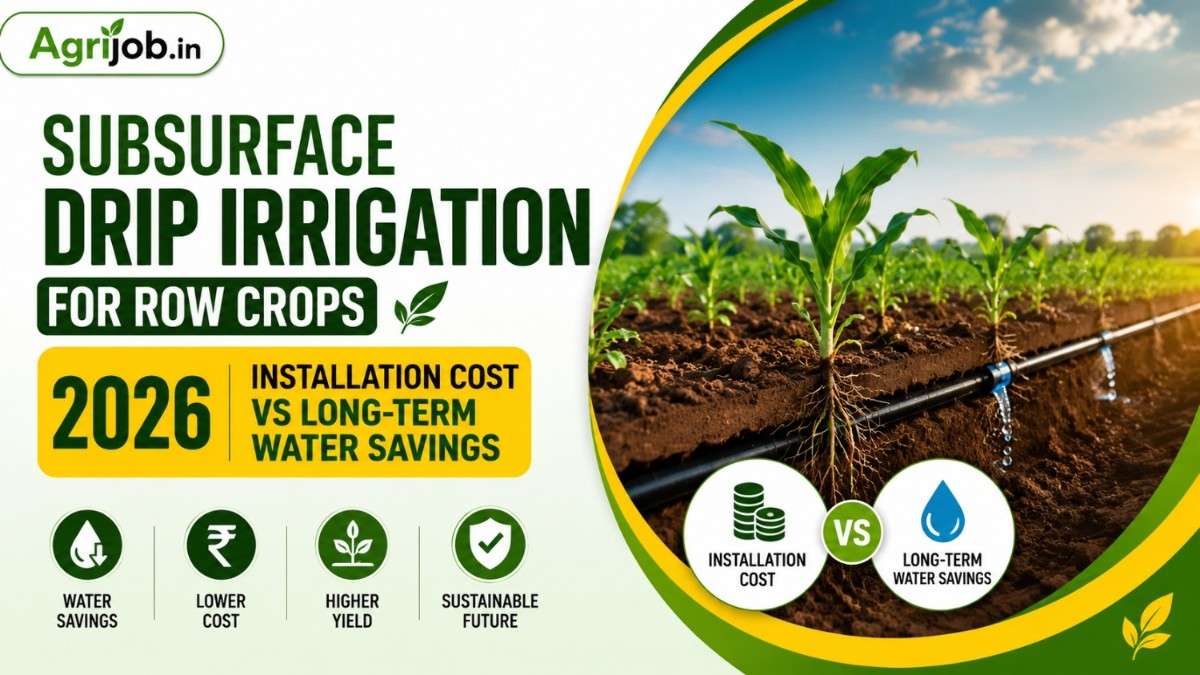
Subsurface drip irrigation (SDI) is a permanent, underground micro-irrigation system in which drip tape or dripline tubing — fitted with individual pressure-compensating emitters — is buried below the soil surface, typically at depths of 12 to 20 inches (30 to 50 cm), and delivers water slowly and directly to the crop root zone. Subsurface drip irrigation is currently the most advanced water-saving irrigation method. Compared with other irrigation methods, subsurface drip irrigation can maintain and even increase the yield of more than 30 types of crops, including corn, alfalfa, cotton, tomato, and sweet corn, by requiring less water in most cases.
SDI differs fundamentally from both surface drip irrigation and centre-pivot systems in several critical ways for row-crop producers:

- 🌱 Root-zone delivery: Water is released at precisely the depth where crop roots extract it — eliminating surface evaporation losses (which account for 15–30% of water loss in sprinkler systems) and delivering moisture exactly where it drives plant growth.
- 🌽 Field operation compatibility: Unlike surface drip irrigation, the SDI system reduces soil evaporation, permits better delivery of water and fertilisers directly to the plant root zone, and saves labour cost — critically, buried lines do not interfere with field operations during the year. Tillage, planting, and harvest equipment can operate normally across an SDI-equipped field without system removal.
- 🌊 Soil surface remains dry: A dry soil surface suppresses weed germination, reduces fungal disease pressure, and prevents the surface crust formation that impedes water infiltration in sprinkler systems — delivering multiple agronomic benefits beyond irrigation efficiency alone.
- ⚗️ Precision fertigation capability: SDI allows soluble fertilisers — nitrogen, phosphorus, micronutrients — to be injected directly into the irrigation water stream and delivered precisely to the root zone at the moment of plant uptake. Research confirms this can cut nitrogen applications by approximately 25% in maize without yield loss.
- 💧 Aquifer-extension potential: Lamm and Trooien concluded from a case study of four western Kansas counties that the useful life of the Ogallala Aquifer in that area could be extended a significant number of years through adoption of SDI over existing furrow irrigation, with conversion costs amortised over the 10–20 year life of the system.
SDI Installation Cost Per Acre 2026: Complete Breakdown by Scale and Region
Subsurface drip irrigation costs 25–40% more initially ($1,800–$4,000 per acre) due to trenching equipment and specialised tubing, but offers a longer lifespan of 15–20 years versus 5–10 years for surface drip systems and reduced maintenance. Here is the complete 2026 per-acre cost breakdown by farm scale and system component:
| Farm Scale | SDI Cost Per Acre (2026) | Total System Cost | Notes |
|---|---|---|---|
| Small farm (under 20 acres) | $2,500–$4,000 | $50,000–$80,000 | Higher per-acre cost; less bulk material discount |
| Mid-size farm (20–50 acres) | $1,800–$3,500 | $36,000–$175,000 | Economies of scale begin; efficient labour deployment |
| Large farm (50+ acres) | $1,600–$2,800 | $80,000–$140,000+ | Bulk material discounts; most competitive per-acre rate |
| High-end commercial SDI (100+ acres) | $2,000–$3,000 | $200,000+ | Includes advanced automation, fertigation, telemetry |
The per-acre SDI installation cost in 2026 breaks down across four primary components:
| Cost Component | Cost Per Acre (2026) | % of Total | Notes |
|---|---|---|---|
| Dripline/drip tape (tubing + emitters) | $600–$1,200 | 30%–35% | Pressure-compensating emitters cost more but are essential for uniformity across row-crop fields with elevation changes |
| Trenching and burial labour | $400–$900 | 20%–25% | Specialised knife-injection equipment; Midwest ($45–65/hr) vs California ($65–85/hr) |
| Filtration system (media + screen) | $200–$600 | 10%–15% | Well water needs less filtration than surface water — saves $200–$400/acre on filtration |
| Mainline, sub-mains, flush manifolds | $300–$700 | 15%–20% | Flush manifolds are critical for long system life — do not economise on these |
| Pump station and pressure regulation | $150–$350 | 8%–10% | Shared cost across total acreage — more acres = lower per-acre pump cost |
| Controller, automation, fertigation unit | $100–$300 | 5%–8% | Basic timer to full IoT automation — IoT adds $100–$200/acre but delivers additional savings |
| System design, testing, training | $50–$150 | 3%–5% | Do not skip professional design — improper installation is the primary cause of premature SDI failure |
| Total Installed Cost Per Acre | $1,800–$4,000 | 100% | Before any EQIP or state cost-share reduction |
Regional cost variations in 2026: Labour rates vary significantly — California commands $65–$85 per hour versus $45–$65 per hour in the Midwest. Water quality also affects filtration needs: well water may need less filtration than surface water, saving $200–$400 per acre in filtration costs. Sloped land requires pressure-compensating emitters, adding 15–25% to cost and potentially requiring booster pumps. Clay and rocky soils increase trenching labour costs; sandy soils — common in the Great Plains SDI adoption zone — are generally more economical to trench.
Water Savings Data: SDI vs Centre-Pivot vs Furrow Irrigation for Row Crops
The core economic case for subsurface drip irrigation for row crops rests on water savings — and the verified 2026 data across multiple research sources consistently confirms that SDI outperforms both centre-pivot and furrow irrigation in water-use efficiency by a significant margin. Here is the complete comparative picture:
| Irrigation System | Water-Use Efficiency | Water Saving vs Furrow | Water Saving vs Centre-Pivot | Evaporation Loss |
|---|---|---|---|---|
| Furrow / Flood irrigation | 50%–60% | Baseline | — | 30%–50% of applied water |
| Centre-pivot sprinkler | 75%–85% | 25%–30% less water | Baseline | 15%–25% of applied water |
| Surface drip (above-ground) | 80%–90% | 30%–50% less water | 5%–15% less water | 5%–10% of applied water |
| Subsurface drip (SDI) | 90%–95% | 50%–70% less water | 35%–50% less water | <5% of applied water |
Real-world farmer and research data reinforces these efficiency figures. Nebraska farmer Don Anthony maintained big corn and soybean yields while improving his watering efficiency by 35% or more after switching to subsurface drip irrigation. Like many western Corn Belt and southern High Plains growers with limited annual rainfall, Anthony counted on irrigation as a staple for his corn, soybeans, and other crops — but with dwindling aquifers and government restrictions, SDI replaced centre-pivot systems on some of his acres.
At the research level, a peer-reviewed maize-wheat systems study published in PMC documented that system irrigation water savings of approximately 55% were achieved under SDI versus conventional furrow irrigation — and water productivity was measurably higher in maize, wheat, and the full maize-wheat system under SDI. On the Great Plains, where each acre-inch of Ogallala water withdrawn represents a permanent reduction in the aquifer that took centuries to accumulate, a 35%–55% reduction in irrigation volume is not merely a cost saving — it is the difference between farm operations that remain viable for 20 years and those that exhaust their water allocation within a decade.
Crop Yield Impact: Verified Research Data for Corn, Soybean, Cotton, and Wheat Under SDI
Beyond water savings, the crop yield impact of subsurface drip irrigation for row crops is a critical component of the ROI calculation — because every additional bushel of yield generated from the same land and input base directly improves the system’s economics. Here is the verified crop-by-crop yield data from peer-reviewed and extension research:
| Crop | Yield Change Under SDI vs Conventional | Water Saving | Additional Benefit | Research Source |
|---|---|---|---|---|
| Maize (corn) | +15.8% grain yield vs furrow | ~55% | 25% N fertiliser saving via fertigation | PMC — maize-wheat conservation agriculture study |
| Wheat (winter) | +5.2% grain yield vs furrow | ~55% | Stabilised yield under deficit conditions | PMC — maize-wheat systems; Frontiers in Plant Science |
| Cotton (High Plains) | Maintained or increased lint yield | 35%–50% | Wider lateral spacing viable — reduces install cost | ASAE 5th International Microirrigation Congress |
| Soybean (oxygation SDI) | Water-use efficiency +54%–70% | 30%–50% | Dramatic gains on heavy clay soils | Bhattarai et al. — Annals of Applied Biology (SDI oxygation) |
| Corn (30+ crop types reviewed) | Maintained or increased vs all other methods | Crop-dependent | SDI confirmed viable for 30+ crop types | Adamsen et al. — ScienceDirect SDI review |
| Sorghum | No significant negative effect | 35%–45% | Suitable for alternate-row SDI spacing | Lamm et al. — KSU SDI research |
| Alfalfa | Maintained or improved | 40%–55% | Year-round permanent system ideal for perennial | Multiple USDA ARS studies |
| Maize-wheat system (net returns) | USD 265 higher net returns per acre vs furrow | ~55% | +47% net return increase with 80% subsidy | PMC conservation agriculture study |
The nitrogen fertigation benefit deserves particular emphasis for row-crop economics. There was saving of 25% of fertiliser nitrogen in maize and the maize-wheat system under SDI with 100% recommended nitrogen, with no saving in wheat. At current urea prices of approximately $550–$650 per tonne in 2026 US markets, a 25% nitrogen saving on a 200-lb/acre maize application represents approximately $27–$35 per acre per season in direct fertiliser cost reduction — a saving that compounds annually across the full SDI system life and meaningfully accelerates payback.
SDI System Lifespan: The 27-Season Kansas State University Finding
System longevity is the single most important economic variable in the SDI investment decision for row-crop producers — and the Kansas State University research provides the most authoritative evidence available on this question. Kansas State University established a research site in 1989 at a research centre to study SDI. One research study area was used for continuous production of SDI corn for 27 seasons without dripline replacement. Normalised plot flow rates for 23 separate plots after 27 seasons were within plus or minus 5% of their first annually measured value.
This is a remarkable finding. An SDI system installed in 1989 was still operating within design flow specifications after 27 continuous seasons — equivalent to more than 26 years of commercial farm use. The performance results of the excavated driplines were as good as or better than the performance of some unused driplines that had been in storage since 1990. The long system life of 27 seasons and 26.5 years improves the economic competitiveness of SDI with alternative irrigation systems such as centre-pivot sprinkler systems, which are currently the predominant irrigation system in the region.
The practical implications for row-crop SDI economics are profound. Here is how system lifespan changes the amortised annual cost per acre:
| System Lifespan | Install Cost at $2,500/acre | Amortised Annual Cost/Acre | Economic Competitiveness vs Centre-Pivot |
|---|---|---|---|
| 10 years | $2,500 | $250/acre/year | Marginal — requires strong water savings to break even |
| 15 years | $2,500 | $167/acre/year | Competitive when water costs are significant |
| 20 years | $2,500 | $125/acre/year | Strongly competitive with centre-pivot in most markets |
| 27 years (KSU documented) | $2,500 | $93/acre/year | Economically superior to centre-pivot in water-limited regions |
South Dakota State University ag engineer Todd Trooien emphasises: “SDI systems are very expensive to install. They have significant investment upfront — but one of the best ways to get a good return on your investment is to get that system to last many years with proper management. With proper maintenance and management, SDI systems can last 20 years.” One system on a research plot in western Kansas even lasted 27 years. The critical implication: the economic case for SDI on commodity row crops is only valid when the operator commits to the five-step maintenance protocol that protects against clogging — the primary threat to system longevity.
The 5-Step Clogging Prevention Protocol Every SDI Row-Crop Operator Must Follow
Emitter clogging is the primary technical risk in subsurface drip irrigation — and the primary reason SDI systems fail to reach their potential lifespan. As SDI systems are generally installed underground for a minimum of 10 years, preventative measures must be taken to avoid clogging. Key among these is testing your water source to ensure it is low in dissolved metals (iron, manganese), hardness minerals (calcium, magnesium), and biological contaminants (algae, bacteria). Hardness minerals and biological contaminants are somewhat solvable through chemical softening and filtering, but dissolved metals are much harder to address and can lead to biofouling and the formation of insoluble deposits, which clog emitters over time.
Todd Trooien uses a five-step programme for emitter clogging prevention that every SDI operator must implement from day one:
- 🔩 Choose the right emitter flow rate: Decide between low-flow emitters, which offer economic advantages through reduced pump energy requirements, and high-flow emitters, which are inherently easier to keep clean because water velocity through the emitter path is higher. For row crops with moderate-quality water sources, high-flow emitters reduce clogging risk at a modest energy cost premium.
- 🔲 Install and maintain mechanical filtration: Remove any solids in the water using appropriately sized screen and media filters before water enters the dripline system. Filter size must be matched to emitter path dimensions — typically 150 to 200 mesh (75–100 micron) for most agricultural SDI emitters. Filter maintenance — backwashing or cleaning at specified pressure-differential triggers — is mandatory, not optional.
- 💧 Flush the system regularly: Flush driplines periodically to clear particles smaller than the filter size that have accumulated inside the tubing. Monitoring flow rates and pressure is crucial — if a zone starts at 100 gallons per minute but drops 10–20% by mid- to late season, with a corresponding pressure increase, an acid flush is recommended. A 20% reduction from the system’s designed flow rate is the standard trigger point for flushing.
- ⚗️ Inject chemicals to prevent biological growth: Inject chlorine (sodium hypochlorite) at the system head to prevent algae, bacteria, and biofilm from colonising the interior tubing and emitter paths. Chlorination schedules vary by water quality — quarterly to monthly in high-biological-load conditions. Acid injection (sulfuric or phosphoric acid) addresses calcium carbonate and bicarbonate scale buildup separately.
- 📊 Implement a formal monitoring programme: Measure flow rate and pressure at zone level at the start, middle, and end of each growing season. Compare readings against baseline values recorded at system commissioning. Any deviation beyond plus or minus 10% from original design flow warrants investigation and preventive treatment. Annual dye tests can confirm emitter distribution uniformity without excavation.
Higher initial investment for SDI is offset over time by water savings, reduced labour, and increased yields — but only when the clogging prevention programme is consistently executed. The Kansas State 27-year system succeeded because it was decommissioned due to plastic material degradation — not clogging. The driplines’ hydraulic performance after 27 seasons remained excellent, with uniformity coefficients of approximately 98% and distribution uniformities of 96–97%. This performance is achievable only through systematic maintenance adherence, not passive neglect.
SDI vs Centre-Pivot: 10, 15, and 20-Year Economic Comparison for Row Crops
The SDI vs centre-pivot economic comparison is the core investment decision for Great Plains and High Plains row-crop producers considering system conversion in 2026. Centre-pivot systems dominate primarily because of their lower initial cost ($600–$1,200 per acre installed) and established management familiarity. Here is the complete long-term economic analysis across realistic time horizons:
| Economic Factor | Centre-Pivot (per acre) | SDI (per acre) | SDI Advantage / Disadvantage |
|---|---|---|---|
| Installation cost | $600–$1,200 | $1,800–$4,000 | Centre-pivot $1,200–$2,800/acre cheaper upfront |
| System lifespan | 15–25 years | 15–27 years (KSU documented) | Comparable — SDI potentially longer with maintenance |
| Annual water cost saving vs pivot | Baseline | $40–$120/acre/year (35–50% less water pumped) | SDI saves $40–$120/acre/year in water and pumping cost |
| Annual N fertiliser saving | Baseline | $27–$35/acre/year (25% N reduction in maize) | SDI saves $27–$35/acre/year in fertiliser |
| Annual labour saving | Baseline | $10–$30/acre/year | SDI reduces irrigation labour (no pivot moves, no wheel track management) |
| Yield premium | Baseline | +5%–16% on grain yield research data | Maize: +$20–$60/acre/year at $4–5/bushel corn price |
| Annual maintenance cost | $20–$50/acre/year | $15–$40/acre/year | SDI slightly lower (no mechanical pivot components) |
| Pivot wheel track damage | $5–$15/acre/year crop loss | None | SDI eliminates wheel track yield loss — often 3–5% per acre |
| Total annual savings (SDI over pivot) | — | $100–$240/acre/year | Combined water + N + labour + yield + wheel-track gains |
| Amortised SDI cost premium ($2,000 extra over 20 yr) | — | $100/acre/year extra | Fully offset by annual savings at mid-range water and yield assumptions |
The breakeven analysis makes clear that SDI becomes economically competitive with centre-pivot for row crops when system life exceeds 15–20 years AND when water has meaningful cost — either through water-use fees, pumping electricity cost from deep aquifer lift, or regulatory water allocation restrictions. In areas where the useful life of the Ogallala Aquifer is being shortened by conventional irrigation, conversion to SDI can extend aquifer viability for a significant number of years, with conversion costs amortised over the 10–20 year system life. For producers paying $0.50–$1.50 per acre-inch of water (common in water-metered districts), the 35–50% reduction in water use from SDI versus centre-pivot delivers $40–$90 per acre per year in direct water cost savings alone.
USDA EQIP Cost-Share for Subsurface Drip Irrigation in 2026
The upfront capital cost of SDI installation is the primary barrier for most row-crop producers considering conversion — and USDA NRCS programmes significantly reduce this barrier for eligible farms in 2026. Here is the complete funding picture:
- 💰 EQIP cost-share rate (2026): USDA NRCS EQIP programmes can cover 50%–75% of installation costs for qualifying farms in 2026. The Inflation Reduction Act extended conservation programme funding through 2026, maintaining EQIP support for water-efficient irrigation infrastructure. At $2,500 per acre installation cost, 65% EQIP coverage reduces your net outlay to $875 per acre — dramatically changing the payback calculation.
- 🌊 Water priority watershed bonus: Farms located in NRCS-designated water-priority watersheds, groundwater conservation areas, or aquifer critical management zones often qualify for the highest EQIP cost-share rates — up to 75% or higher in some states for SDI conversion from furrow or flood irrigation.
- 📋 Practice Standard 441 (Irrigation System, Micro-Irrigation): SDI installation qualifies under NRCS Conservation Practice Standard 441, which covers design, installation, and management of micro-irrigation systems including subsurface drip. All EQIP-funded installations must meet NRCS design standards for emitter spacing, burial depth, filtration, and pressure regulation.
- 🌾 EQIP application competitiveness: EQIP applications are ranked competitively within each state — applications addressing the highest-priority resource concerns (water quality, water quantity, air quality) receive the strongest funding consideration. SDI conversion from flood or furrow irrigation typically scores highly in water quantity rankings in the Great Plains, High Plains, and intermountain West.
- 🏛️ State-level additional cost-share: Several states — Kansas, Nebraska, Texas, California, Arizona — have state-level irrigation efficiency cost-share or rebate programmes that stack with federal EQIP funding. In Kansas, the State Water Plan Fund provides additional support for SDI adoption in designated groundwater management areas. Contact your local USDA NRCS service centre at nrcs.usda.gov and your state’s department of agriculture for current combined cost-share availability in your county.
- 📅 Application timing: EQIP applications open and close on state-specific cycles — typically one to three ranking periods per year. Apply early and engage your local NRCS office before any contracts are signed for materials or installation. EQIP requires pre-approval before installation begins — retroactive cost-share for already-installed systems is not available.
Who Should Convert to Subsurface Drip Irrigation for Row Crops in 2026?
SDI is not the right irrigation investment for every row-crop operation. Here is the definitive 2026 match guide for producers evaluating conversion:
- 💧 High Plains and Ogallala aquifer-dependent producers: SDI conversion is the highest-priority irrigation decision for any producer whose groundwater source is declining. More than 300,000 acres are in drip irrigation across the Great Plains, with much success seen with cotton. If your well’s static water level has declined measurably over the past decade, SDI is the most effective single action to extend your irrigated farming viability.
- 💸 Producers in water-cost or water-metered districts: If you pay for irrigation water by the acre-inch — whether from a water district, canal company, or metered groundwater allocation — SDI’s 35–50% reduction in water volume directly reduces your water bill by the same percentage. At $1.00 per acre-inch, 10 acre-inches saved per season equals $10 per acre per year in direct water cost reduction.
- 🌽 Cotton and high-value grain producers on the Southern High Plains: Cotton under SDI has demonstrated maintained to improved lint yields across multiple research sites, and the wide lateral spacing possible for cotton (alternate-furrow spacing of 1.5–2.0 m) reduces installation cost to the lower end of the $1,800–$2,500 per acre range — improving ROI significantly.
- 🔬 Producers pursuing precision nitrogen management: If nitrogen fertiliser is a major input cost — and for maize producers, it typically is — SDI’s fertigation capability delivering 25% nitrogen savings is a compelling secondary ROI driver that accelerates payback beyond the water savings calculation alone.
- ⛽ Deep-well producers with high pumping lift: Every dollar reduction in water pumped saves energy proportional to the lift distance. A producer pumping from 200 feet depth saves significantly more per acre-inch not pumped than one pumping from 50 feet. High pumping-lift operations see the strongest energy-cost component of SDI ROI.
- ⚠️ Producers who should NOT yet convert to SDI: Those with shallow, high-quality aquifers and low-cost water access; operations in high-rainfall environments where irrigation is supplemental and infrequent; farms with known dissolved iron or manganese issues that cannot be economically treated through filtration; and producers who cannot commit to the five-step clogging prevention maintenance protocol — SDI without consistent maintenance will not reach the lifespan needed for positive ROI on commodity row crops.
Complete SDI vs Alternative Row Crop Irrigation Systems Comparison Table 2026
Here is the definitive reference comparison of all major irrigation systems for row-crop producers in 2026:
| Factor | Furrow / Flood | Centre-Pivot Sprinkler | Surface Drip | Subsurface Drip (SDI) |
|---|---|---|---|---|
| Install cost per acre | $300–$600 | $600–$1,200 | $500–$1,500 | $1,800–$4,000 |
| Water-use efficiency | 50%–60% | 75%–85% | 80%–90% | 90%–95% |
| Water saving vs furrow | Baseline | 25%–30% | 30%–50% | 50%–70% |
| Crop yield impact | Baseline | Slight improvement | Moderate improvement | +5.2%–15.8% documented (wheat/maize) |
| Fertigation capability | Limited | Limited (chemigation) | Moderate | Best — direct root-zone delivery |
| N fertiliser saving | None | 5%–10% | 10%–15% | ~25% (maize, documented) |
| Field operations impact | None | Wheel track damage 3–5% | Must remove lines at harvest | None — permanent buried system |
| Weed suppression | Poor — wet surface | Moderate | Good | Best — completely dry soil surface |
| System lifespan | Minimal (earthworks) | 15–25 years | 5–10 years | 15–27 years (KSU documented) |
| Annual maintenance cost | $10–$20/acre | $20–$50/acre | $15–$35/acre | $15–$40/acre |
| Management complexity | Low | Low to moderate | Moderate | High — clogging prevention critical |
| EQIP cost-share eligible? | Limited | Yes | Yes | Yes — 50%–75% for qualifying farms |
| Best for | Abundant water, flat land | Large acreage, low water cost | High-value crops, short-term | Water-limited, long-term row crops |
| Overall ROI (20-year horizon) | Low | Moderate | Moderate | High (with proper maintenance) |
Key Subsurface Drip Irrigation Terms Row-Crop Producers Must Know in 2026
Understanding these technical and financial terms will help you evaluate any SDI system proposal, compare contractor bids intelligently, and maintain your system to achieve maximum lifespan and ROI:
- 💧 SDI (Subsurface Drip Irrigation): A permanent underground micro-irrigation system in which drip tape or dripline tubing with individual emitters is buried 12–20 inches below the soil surface and delivers water directly to the crop root zone. The most water-efficient irrigation method available for row crops — 90–95% water-use efficiency versus 50–60% for furrow irrigation.
- 🔩 Pressure-Compensating Emitter: An emitter designed to deliver a consistent flow rate across a range of inlet pressures — critical for maintaining uniform water distribution across row-crop fields with elevation changes or long dripline runs. Required for SDI on any field with more than 2–3 feet of elevation change across the irrigated area.
- 📏 Dripline Burial Depth: The depth at which SDI emitter tubing is installed below the soil surface. Research recommends burial below the plow layer — typically 40–45 cm (16–18 inches) in KSU corn research — to prevent tillage damage and allow normal field operations including deep ripping.
- 🔬 Distribution Uniformity (DU): A measure of how evenly water is distributed across an irrigated area by an SDI system. Expressed as a percentage — the KSU 27-year system maintained distribution uniformity (DU-lq) of 96–97% after 27 seasons, demonstrating that a well-maintained SDI system’s performance does not degrade significantly over time.
- ⚗️ Fertigation: The injection of soluble fertilisers into the irrigation water stream for delivery to the crop root zone through SDI emitters. SDI fertigation for maize has delivered approximately 25% nitrogen savings without yield loss in peer-reviewed research — a major ROI accelerator for high-input row-crop operations.
- 🧪 Chemigation / Chlorination: The injection of chemicals — primarily chlorine (sodium hypochlorite) for biological fouling control, and acids (sulfuric or phosphoric) for calcium carbonate scale prevention — into the SDI system to prevent emitter clogging. A mandatory component of the five-step SDI maintenance protocol, not an optional enhancement.
- 🚰 Flush Manifold: End-of-line valves that allow accumulated sediment and particles inside dripline tubing to be periodically flushed out of the system. Properly engineered flush manifolds — one per zone — are essential for achieving 15–27 year system lifespan and should not be value-engineered out of SDI installations to reduce upfront cost.
- ⚡ Oxygation: The delivery of aerated (oxygen-enriched) water through SDI systems to enhance soil oxygen levels in the root zone. Research by Bhattarai et al. documented water-use efficiency increases of 54–70% for soybean under SDI oxygation in heavy clay soils — a technique increasingly relevant for producers in clay-dominated Great Plains soils.
- 🏦 EQIP (Environmental Quality Incentives Programme): USDA NRCS cost-share programme covering 50–75% of SDI installation costs for qualifying farms in 2026. Applications are ranked competitively within each state on a resource concern priority basis. SDI conversion from furrow or flood irrigation typically ranks highly in water quantity resource concern categories across the water-stressed western US.
- 📊 Amortised Annual Cost: The system installation cost divided by expected system lifespan — the annual capital cost per acre that must be recovered through water, yield, labour, and fertiliser savings for SDI to be economically viable. At $2,500/acre over 20 years, amortised annual cost is $125/acre/year. Over 27 years (KSU documented), it drops to $93/acre/year — significantly improving economic competitiveness with centre-pivot systems.
The honest answer is yes — with important conditions.
SDI delivers water savings of 35–55% versus centre-pivot and 50–70% versus furrow irrigation, yield improvements of 5–16% for maize and wheat, approximately 25% nitrogen fertiliser savings in maize, elimination of wheel-track crop loss, and documented system lifespans of 20–27 years under proper management. The combined annual savings of $100–$240 per acre per year can fully offset the amortised SDI cost premium over centre-pivot ($100–$150/acre/year) within a 7–12 year window without EQIP, and within 3–6 years with 65% EQIP cost-share coverage.
The conditions that make SDI the right choice: You are in a water-limited or water-cost-significant region; your aquifer is declining; you can commit to the five-step clogging prevention protocol every season; and you work with a certified irrigation designer for proper installation. The Kansas State University 27-season SDI system is proof that when these conditions are met, SDI is not just an irrigation upgrade — it is the most economically and environmentally sustainable irrigation investment available to row-crop producers in 2026.
The conditions where SDI is not yet the right choice: Abundant, low-cost water; high dissolved iron or manganese that cannot be economically treated; insufficient capital without EQIP support; or an operator unwilling to invest in consistent maintenance. For these situations, centre-pivot with soil moisture sensors and weather-based scheduling delivers 30–40% water savings at much lower capital cost — a meaningful stepping stone toward full SDI adoption.
Frequently Asked Questions
What does subsurface drip irrigation cost per acre for row crops in 2026?
Subsurface drip irrigation costs 25–40% more initially than surface drip, at $1,800–$4,000 per acre, due to trenching equipment and specialised tubing. For 50-acre installations, economies of scale reduce the per-acre cost to $1,600–$2,800 per acre, with larger projects benefiting from bulk material discounts and more efficient labour deployment. The cost varies by region — California labour rates of $65–$85 per hour versus Midwest rates of $45–$65 per hour create meaningful regional differences. Well-water sources with low mineral content can save $200–$400 per acre on filtration costs versus surface water sources. USDA NRCS EQIP programmes can cover 50–75% of installation costs for qualifying farms in 2026, reducing net farmer outlay to $450–$2,000 per acre depending on cost-share rate received.
How long does a subsurface drip irrigation system last for row crops?
With proper design, installation, and maintenance, SDI systems last 15–20 years as a standard expectation — and the Kansas State University corn research documented a system that ran for 27 continuous seasons without dripline replacement. The long system life of 27 seasons and 26.5 years improves the economic competitiveness of SDI with alternative irrigation systems such as centre-pivot sprinkler systems. Normalised plot flow rates for 23 separate plots after 27 seasons were within plus or minus 5% of their first annually measured value — demonstrating that a properly maintained SDI system maintains its hydraulic performance across its full operational life. The system was decommissioned due to plastic material degradation, not clogging — confirming that the five-step clogging prevention protocol is sufficient to protect emitter performance for the full system life.
How much water does subsurface drip irrigation save compared to centre-pivot systems?
SDI saves 35%–50% of water compared to centre-pivot sprinkler systems, and 50%–70% compared to furrow or flood irrigation. Nebraska farmer Don Anthony maintained big corn and soybean yields while improving watering efficiency by 35% or more after converting from centre-pivot to SDI. At the research level, system irrigation water savings of approximately 55% were achieved under SDI versus conventional furrow irrigation in maize-wheat systems. SDI achieves 90–95% water-use efficiency versus 75–85% for centre-pivot, eliminating the evaporation and drift losses that represent the primary source of sprinkler inefficiency. In water-metered districts charging $0.50–$1.50 per acre-inch, this 35–50% water reduction directly translates to $40–$90 per acre per year in water cost savings.
Does subsurface drip irrigation increase crop yield for corn, soybeans and cotton?
Yes — and the yield impact is consistent across research. Grain yields of maize and the maize-wheat system under SDI with 100% recommended nitrogen were significantly higher by 15.8% for maize and 5.2% for wheat respectively, compared to conventional furrow irrigation. Subsurface drip irrigation can maintain and even increase the yield of more than 30 types of crops, including corn, alfalfa, cotton, tomato, and sweet corn, by requiring less water in most cases. Cotton on the Southern High Plains has demonstrated maintained lint yield under SDI at wider lateral spacings. Soybean under SDI oxygation showed water-use efficiency improvements of 54–70%. The yield improvement mechanism is consistent elimination of both under-watering stress and over-watering stress through precise root-zone moisture delivery.
What is the ROI payback period for subsurface drip irrigation on row crops?
The ROI payback period for SDI on row crops ranges from 4–8 years without government cost-share and 2–4 years with 50–75% USDA EQIP coverage. Annual savings from combined water cost reduction, fertiliser N savings in maize, eliminated wheel-track yield loss, and labour reduction typically total $100–$240 per acre per year for corn and soybean operations. Against an amortised SDI cost of $93–$167 per acre per year over 20–27 year system lives, the annual savings fully cover or exceed the amortised capital cost at mid-range water cost and yield assumptions. Net returns from the maize-wheat system were significantly higher by USD 265 under SDI versus conventional furrow irrigation — and increased by 47% when considering an 80% subsidy on SDI installation.
What are the main risks and challenges of subsurface drip irrigation for row crops?
The primary risk in SDI is emitter clogging, which shortens system life and reduces distribution uniformity if not actively managed. As SDI systems are installed underground for a minimum of 10 years, preventative measures must be taken to avoid clogging — including testing water for dissolved metals, hardness minerals, and biological contaminants. Dissolved metals are much harder to address than biological or hardness fouling and can lead to biofouling and insoluble deposits that clog emitters over time. Germination management is a secondary challenge — SDI buried at 12–20 inches cannot wet the soil surface for seed germination, requiring supplemental surface moisture at establishment. High upfront capital cost and the difficulty of diagnosing underground leaks or blockages without pressure-and-flow analysis (visual inspection is not possible) complete the key challenge profile for row-crop SDI operators.
Is SDI better than centre-pivot irrigation for row crops in 2026?
SDI outperforms centre-pivot in water-scarce regions, aquifer-depleting districts, and operations with significant water costs — delivering 35–50% less water use, 5–16% higher yields, 25% N savings in maize, and no wheel-track crop loss, all from a system that can last 20–27 years. Centre-pivot remains the stronger choice for large-acreage operations with low-cost abundant water, where the $600–$1,200 per acre installation cost and simpler management overcome SDI’s efficiency advantages. More than 300,000 acres are in drip irrigation across the Great Plains, with much success seen with cotton — and adoption is accelerating as Ogallala aquifer depletion intensifies and the economic case for water-use reduction strengthens with every passing season.
Does USDA EQIP cover subsurface drip irrigation installation costs in 2026?
Yes — USDA NRCS EQIP programmes can cover 50–75% of SDI installation costs for qualifying farms in 2026. The Inflation Reduction Act extended conservation programme funding through 2026, maintaining EQIP support for water-efficient irrigation infrastructure. SDI conversion from furrow or flood irrigation typically ranks highly in water quantity resource concern categories across the water-stressed western US. Applications are competitive within each state — contact your local USDA NRCS service centre before purchasing any materials, as EQIP requires pre-approval before installation begins. State-level cost-share programmes in Kansas, Nebraska, Texas, California, and Arizona can stack with EQIP funding for total cost-share coverage that can exceed 75% in designated groundwater conservation or priority watershed areas.
Last Updated: July 2026. SDI installation costs, EQIP cost-share rates, and crop yield research continue to evolve. Bookmark this guide for updated ROI analysis as 2026 crop season data becomes available. For USDA EQIP cost-share application details, visit nrcs.usda.gov/programs-initiatives/eqip. For SDI technical design guidance, consult the Irrigation Association for Certified Irrigation Designer directories.