

Truffle farming investment in 2026 demands Rs.8-15 lakh per acre and a wait of 7 years before the first commercial harvest — making it one of the slowest-return crops in Indian agriculture, but also one of the highest-value per kilogram. This guide is for landowners, agri-investors, and Himalayan foothill farmers in Uttarakhand, Himachal Pradesh, and Jammu & Kashmir who have oak or hazelnut-suitable land and can commit capital for a decade without needing annual cash flow. Below, we break down the real 7-year cultivation timeline, region-by-region investment costs, realistic revenue projections based on current global truffle prices, and the honest risks nobody tells you about before you plant your first inoculated sapling. Every figure here is cross-checked against 2026 international market data and Himalayan Tuber species research.

Truffle farming investment in India requires Rs.8-15 lakh per acre for land prep, inoculated saplings, fencing, and irrigation, with the first viable harvest arriving in year 7 and peak yields only after year 10-12. Realistic annual revenue at maturity ranges from Rs.15 lakh to Rs.40 lakh per acre, depending on species (Himalayan Tuber indicum vs. imported Tuber melanosporum) and market access.
- Initial investment per acre: Rs.8,00,000 – Rs.15,00,000
- Time to first harvest: 7 years (viable), 10-12 years (peak yield)
- Best host trees: Oak (Quercus spp.) and hazelnut (Corylus spp.)
- Best regions in India: Nainital, Almora, Himachal Pradesh, parts of J&K
- Global black truffle price (2026): $300-$800/lb (~Rs.25,000-Rs.66,000/kg)
- Native Indian species: Tuber indicum (Himalayan/Chinese black truffle)
- Investment horizon: 10-15 years for full ROI realization
- Risk level: High — no guaranteed inoculation success rate
📋 Table of Contents
- What Is Truffle Farming and Why Does It Take 7 Years?
- Who Should Invest in Truffle Farming?
- Truffle Farming Investment Breakdown (Cost Per Acre)
- Land, Climate & Eligibility Requirements
- 7-Year Truffle Cultivation Timeline (Step-by-Step)
- Realistic Revenue Projections at Maturity
- Truffle Farming vs Saffron Farming vs Traditional Crops
- Pros and Cons of Truffle Farming Investment
- Important Terms Related to Truffle Cultivation
- Important Timeline & Milestones
- Important Links
- Conclusion
- Frequently Asked Questions
What Is Truffle Farming and Why Does It Take 7 Years?
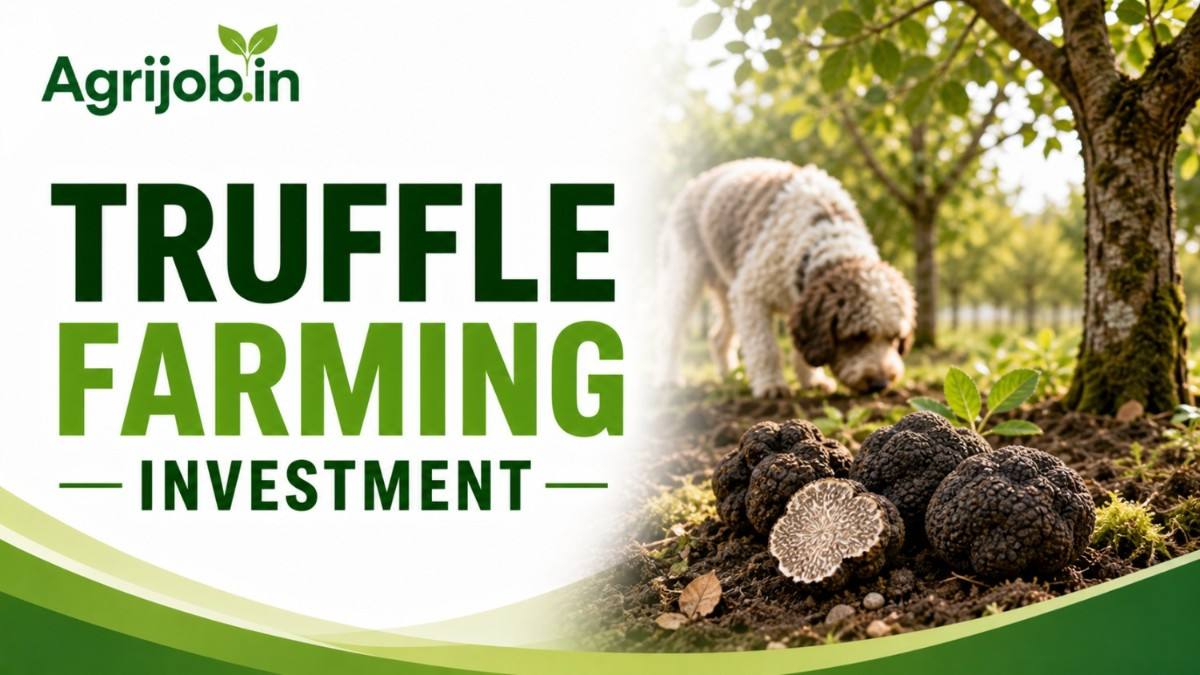
Truffle farming is the cultivation of underground fungi (genus Tuber) that form a symbiotic mycorrhizal relationship with the roots of host trees like oak and hazelnut. Unlike a normal crop, the truffle fungus must colonize the tree’s root system first, then take 5-7 years to mature enough to produce harvestable fruiting bodies underground.
Truffles aren’t planted like seeds — you plant inoculated saplings, young oak or hazelnut trees whose roots have already been infected with truffle spores in a lab. The fungus then needs years to establish a dominant mycorrhizal network before it produces truffles at a commercially viable scale.

| Truffle Species | Native Region | Commercial Status in India |
|---|---|---|
| Tuber indicum (Himalayan black truffle) | Nainital, Almora, NW Himalaya | Wild-harvested, limited cultivation trials |
| Tuber melanosporum (Périgord black truffle) | France, Spain, Italy | Experimental imported inoculation only |
| Tuber himalayense | North-west Himalaya (Quercus incana) | Research-stage, not yet commercialized |
Who Should Invest in Truffle Farming?
- 🏔️ Landowners in Himalayan foothill districts (Nainital, Almora, Shimla, Kullu) with existing oak or hazelnut cover
- 💰 High-net-worth agri-investors who can lock capital for 10+ years without needing annual returns
- 🌳 Orchard owners already growing hazelnut or oak who want to add a high-value intercrop
- 🔬 Agri-entrepreneurs interested in partnering with mycology research institutions for inoculation trials
- 🏡 NRI investors looking for a long-horizon Himalayan land asset with a luxury-food upside
- 🌍 Export-focused farmers targeting European and Gulf luxury restaurant supply chains
- 🧑🌾 Diversified farming families who can intercrop truffle orchards with short-cycle crops for interim income
- 🏦 Investors comfortable with high risk — truffle inoculation success is not guaranteed even under ideal conditions
Truffle Farming Investment Breakdown (Cost Per Acre) in 2026
Total truffle farming investment for one acre in India runs Rs.8,00,000 to Rs.15,00,000, covering land preparation, wild-boar-proof fencing, inoculated saplings, drip irrigation, and 7 years of maintenance before any revenue arrives. European irrigated, fenced plantations cost up to €10,000 per hectare, which converts to a comparable per-acre range once adjusted for Indian land and labor costs.
| Cost Component | Estimated Cost (Per Acre, Rs.) |
|---|---|
| Land preparation & soil pH correction (liming) | Rs.80,000 – Rs.1,50,000 |
| Inoculated oak/hazelnut saplings (400-500/acre) | Rs.3,00,000 – Rs.5,00,000 |
| Wild boar-proof fencing | Rs.1,50,000 – Rs.3,00,000 |
| Drip irrigation system | Rs.1,00,000 – Rs.2,00,000 |
| Annual maintenance (Years 1-7, cumulative) | Rs.1,50,000 – Rs.2,50,000 |
| Soil testing & mycorrhizal monitoring | Rs.50,000 – Rs.1,00,000 |
| Total (Year 1-7) | Rs.8,30,000 – Rs.15,00,000 |
Compare this to saffron farming investment in India, another high-value niche crop, which needs far less upfront capital but also carries a shorter payback window.
Land, Climate & Eligibility Requirements for Truffle Cultivation
Truffle cultivation requires alkaline, well-drained soil (pH 7.5-8.3), cool temperate climate, and altitude above 1,200 meters — conditions naturally found in the Nainital and Almora districts of Uttarakhand, according to regional forestry assessments, where excellent oak tree cover makes the area highly suitable for cultivation.
- Soil pH: 7.5-8.3 (alkaline) — most Indian farm soil is acidic and needs correction
- Altitude: 1,200-2,200 meters above sea level for optimal Tuber indicum growth
- Rainfall: Moderate, well-distributed — waterlogging kills mycorrhizal networks
- Host trees: Oak (Quercus spp.) or hazelnut (Corylus spp.) saplings, pre-inoculated in a certified lab
- Land size: Minimum 0.5-1 acre recommended for commercial viability
- Fencing: Mandatory — wild boars actively dig up and destroy truffle-producing root zones
| Category | Approx. Setup Cost Share |
|---|---|
| Small landholder (0.5 acre pilot) | Rs.4,50,000 – Rs.7,50,000 |
| Standard commercial (1 acre) | Rs.8,00,000 – Rs.15,00,000 |
| Large estate (5+ acres) | Rs.35,00,000 – Rs.65,00,000 (bulk discounts apply) |
How Truffle Cultivation Works — The 7-Year Timeline
The truffle cultivation timeline runs in three phases: establishment (Years 1-3), maturation (Years 4-6), and first harvest (Year 7 onward), with peak productivity only reached after year 10, based on global truffle plantation data.
- Year 0-1 — Site prep and inoculation: Soil pH corrected with lime; inoculated saplings sourced from a certified mycology lab and planted in rows.
- Year 1-2 — Establishment: Trees establish root systems; competing fungi are monitored and controlled; irrigation is calibrated carefully to avoid overwatering.
- Year 2-3 — Mycorrhizal dominance check: Soil sampling confirms whether the inoculated Tuber species has out-competed native wild fungi in the root zone.
- Year 3-5 — Canopy development: Trees mature; a trained dog or pig may be used for early scouting, though truffles are not yet commercially harvestable.
- Year 5-6 — Pre-production monitoring: “Burn” patches (bare soil rings around productive trees) begin appearing — the first visible sign truffles are forming underground.
- Year 7 — First viable harvest: Inoculated trees start to produce viable truffles, typically in small, inconsistent quantities.
- Year 10-12 — Peak production: Trees realize maximum crop potential, based on globally observed truffle orchard maturity curves.
Intercrop your truffle orchard with short-cycle medicinal plants or vegetables in the first 3-4 years to generate interim cash flow while trees establish. Never intercrop with crops requiring heavy fertilizer or fungicide — both disrupt the mycorrhizal network truffles depend on.
Truffle Farming Revenue Projections — What Can You Realistically Earn?
At full maturity (year 10+), one well-managed truffle acre can generate Rs.15-40 lakh in annual revenue, based on current global black truffle prices, which ranged between $300 and $800 per pound in 2026 market data.
Global black truffle (Tuber melanosporum) prices in 2026 commonly fall between $300 and $800 per pound, while premium European transaction data recorded fresh truffle unit prices as high as $1,021 per kg in the Netherlands and $758 per kg in France in January 2026. India’s own mushroom and truffle export unit value remains far lower at $1,337 per ton in 2024, a 33% jump from the previous year — reflecting that India’s current truffle trade is dominated by low-value wild-harvested volume rather than premium cultivated black truffles.
| Production Stage | Estimated Yield (kg/acre/year) | Est. Revenue (Rs., at Rs.30,000-60,000/kg) |
|---|---|---|
| Year 7-9 (early harvest) | 2-8 kg | Rs.60,000 – Rs.4,80,000 |
| Year 10-12 (approaching peak) | 15-35 kg | Rs.4,50,000 – Rs.21,00,000 |
| Year 12+ (peak maturity) | 40-70 kg | Rs.12,00,000 – Rs.42,00,000 |
These figures assume access to premium buyers — hotels, exporters, or European luxury food distributors. Farmers selling only into local Indian markets will realize far lower per-kilogram prices, closer to India’s blended export unit value.
Truffle Farming vs Saffron Farming vs Traditional Crops
| Factor | Truffle Farming | Saffron Farming | Traditional Crop (Wheat) |
|---|---|---|---|
| Initial investment/acre | Rs.8-15 lakh | Rs.3-6 lakh | Rs.15,000-25,000 |
| Time to first revenue | 7 years | 1-2 years | 4-6 months |
| Peak annual revenue/acre | Rs.15-40 lakh | Rs.4-8 lakh | Rs.30,000-50,000 |
| Risk of total crop failure | High (inoculation may fail) | Moderate | Low |
| Market demand certainty | Growing but export-dependent | Established (domestic + export) | Stable, low-margin |
| Land suitability in India | Very limited (Himalayan belt only) | Limited (Kashmir mainly) | Widespread |
| Liquidity of investment | Very low (10+ year lock-in) | Low-moderate | High (annual cycle) |
| Best for | Long-horizon HNI investors, Himalayan landowners | Kashmir farmers with irrigation access | Risk-averse, cash-flow-dependent farmers |
We recommend truffle farming only for investors who already own suitable Himalayan foothill land, have surplus capital they don’t need for 10+ years, and can access export or luxury-hospitality buyers. For most Indian farmers seeking quicker high-value returns, saffron farming or contract farming with buyback agreements offer a far shorter path to income.
Pros and Cons of Truffle Farming Investment
Pros:
- Extremely high per-kilogram value compared to any conventional Indian crop
- Low input cost after establishment — no annual fertilizer or heavy pesticide cycle needed
- Long productive life once mature — mycorrhizal networks can produce for 30-50 years
- Growing global demand, especially from luxury hospitality and export markets
Cons:
- 7-year wait with zero guaranteed revenue — capital is fully locked in
- Inoculation success is not guaranteed even with certified saplings and correct soil prep
- Land suitability is extremely limited — only specific Himalayan altitude zones qualify
- India has no established commercial buyer network yet — most trade is still wild-harvest based
Important Terms Related to Truffle Cultivation
- Mycorrhizal symbiosis: The mutual relationship between truffle fungus and host tree roots — the foundation of all truffle cultivation.
- Tuber indicum: The Himalayan/Chinese black truffle species native to Nainital, Almora, and parts of China — India’s only commercially relevant native truffle.
- Inoculated sapling: A young oak or hazelnut tree pre-infected with truffle spores in a lab before field planting.
- Burn/brûlé: The bare-soil ring that forms around a productive truffle tree — a key visual indicator used by harvesters.
- Ascospore: The reproductive spore of the Tuber fungus, used for lab inoculation of host tree roots.
- Trufficulture: The broader agricultural science and practice of cultivating truffles commercially.
- Ectomycorrhizal host: Any tree species (oak, hazelnut, pine) capable of forming the external root fungal relationship truffles require.
- Wild-boar fencing: Reinforced perimeter fencing essential to prevent wild animals from destroying underground truffle-producing root zones.
Important Timeline & Milestones for Truffle Investors
| Milestone | Typical Timing |
|---|---|
| Soil testing & site selection | Before Year 1 |
| Sapling inoculation & planting | Year 1 |
| Mycorrhizal dominance confirmation | Year 2-3 |
| First “burn” patches visible | Year 5-6 |
| First commercial harvest | Year 7 |
| Peak production window | Year 10-12 |
| Recommended reinvestment review | Year 15 |
Important Links
| Resource | Link |
|---|---|
| ICAR — Indian Council of Agricultural Research | icar.org.in |
| National Biodiversity Authority — Tuber Crops Bulletin | nbaindia.org |
| Global truffle price & trade data (Tridge) | tridge.com truffle market overview |
| NABARD — agricultural project financing | nabard.org |
| Kisan Loan & Agriculture Subsidy Guide 2026 | Read our KCC & NABARD financing guide |
| Saffron Farming Investment India 2026 | Compare with saffron farming investment |
| Contract Farming Investment 2026 | See faster-return contract farming options |
Conclusion: Is Truffle Farming Investment Worth It in 2026?
Truffle farming investment in 2026 is a genuine high-value opportunity, but only for landowners in the right Himalayan altitude zones who can lock away Rs.8-15 lakh per acre for a full 7-year wait before any income arrives. The potential payoff — Rs.15-40 lakh per acre annually at peak maturity — is real, but it depends entirely on successful mycorrhizal inoculation, correct soil conditions, and access to premium export or hospitality buyers rather than low-value local wild-harvest markets. If your land, capital horizon, and risk tolerance align, start with a 0.5-1 acre pilot plot before scaling. Bookmark this page — we update it every time new Himalayan truffle cultivation data becomes available from ICAR and global trade sources.
- Truffle farming needs Rs.8-15 lakh per acre and a 7-year wait for first commercial harvest.
- Peak revenue at maturity can reach Rs.15-40 lakh per acre annually, based on 2026 global prices.
- Only Himalayan foothill zones (Nainital, Almora, HP, parts of J&K) suit Tuber indicum cultivation.
- Inoculation success is not guaranteed — this is a high-risk, high-reward long-term investment.
- Start with a 0.5-1 acre pilot and secure export or hospitality buyers before scaling further.
Frequently Asked Questions About Truffle Farming Investment
What is truffle farming investment in India?
Truffle farming investment in India involves planting Tuber-inoculated oak or hazelnut saplings on Himalayan foothill land, then waiting 7 years for the mycorrhizal fungus to mature enough to produce commercially harvestable truffles underground.
How much does truffle farming cost per acre in 2026?
Truffle farming costs Rs.8,00,000 to Rs.15,00,000 per acre in 2026, covering inoculated saplings, wild-boar fencing, drip irrigation, soil correction, and seven years of maintenance before the first harvest.
How long does it take for truffles to grow after planting?
It takes 7 years for inoculated trees to produce a viable first harvest, with peak production only reached after 10-12 years once the mycorrhizal network fully matures.
Is truffle farming profitable in India?
Truffle farming can be highly profitable, with mature acres generating Rs.15-40 lakh annually, but profitability depends on successful inoculation, correct Himalayan altitude and soil conditions, and access to premium export or hospitality buyers rather than local markets.
Which regions in India are suitable for truffle cultivation?
Nainital and Almora districts of Uttarakhand are considered the most suitable due to abundant oak tree cover, alongside parts of Himachal Pradesh and Jammu & Kashmir at altitudes above 1,200 meters.
What is the difference between Himalayan truffles and French black truffles?
Himalayan truffles (Tuber indicum) are native to Nainital and Almora and are often called the Asian or Chinese black truffle, while French black truffles (Tuber melanosporum, the Périgord truffle) are a distinct, more internationally premium species not naturally native to India.
What are the biggest risks in truffle farming investment?
The biggest risks are failed mycorrhizal inoculation, incorrect soil pH or altitude, wild boar damage to root zones, and the absence of an established commercial buyer network in India for cultivated (not wild-harvested) truffles.
Can truffle farming be combined with other crops for interim income?
Yes, intercropping with short-cycle medicinal plants or low-fertilizer vegetables during the first 3-4 establishment years can generate interim cash flow, as long as heavy fertilizers and fungicides that disrupt the mycorrhizal network are avoided.
Where can truffle growers sell their harvest in India?
Current buyers are mainly luxury hotels, specialty importers, and export intermediaries targeting European and Gulf markets, since India’s domestic truffle trade remains small and largely based on low-value wild-harvested volume rather than premium cultivated truffles.
How does truffle farming compare to saffron farming as an investment?
Truffle farming needs a much larger upfront investment and a 7-year wait versus saffron’s 1-2 year payback, but truffles offer a higher peak per-acre revenue ceiling for investors who can tolerate the longer, riskier horizon — see our full saffron farming investment comparison.
Last Updated: August 2026. This guide is reviewed and updated regularly for accuracy as new Himalayan truffle cultivation and global market data becomes available. Bookmark this page for the latest information.
Disclaimer: Truffle farming involves significant financial risk and no guaranteed return. Investment figures are estimates based on available 2026 market data and regional cost surveys; actual costs, yields, and prices will vary by location, land quality, and buyer access. Consult a certified mycology or horticulture expert and a financial advisor before committing capital to truffle cultivation.