
Dairy Farm Loan Project Report 2026 – Bank-Ready Format
A dairy farm loan project report 2026 (DPR) is the single most important document that decides whether your bank loan gets approved or rejected — and most farmers never get it right. Whether you are planning a 10-cow unit costing Rs.10–15 lakh, a 20-buffalo farm at Rs.22–28 lakh, or a large 50-animal commercial dairy requiring Rs.35–45 lakh in funding, every bank — SBI, PNB, Bank of Baroda, or any RRB — will demand a detailed, bank-ready project report before sanctioning even a single rupee. This complete 2026 guide covers the exact DPR format, section-wise cost breakdown, 5-year revenue projections, NABARD subsidy rules, break-even analysis, the financial ratios banks scrutinise most, and the top rejection reasons with actionable fixes — so your dairy project report sails through credit appraisal the first time.

- What Is a Dairy Farm Loan Project Report?
- Project Cost Breakdown 2026 – 10, 20 & 50 Animal Units
- NABARD Dairy Subsidy Format & Eligibility 2026
- 7 DPR Sections Banks Check Most Carefully
- Revenue Projections & Break-Even Analysis
- Who Should Apply for a Dairy Farm Loan Project Report?
- Dairy Farm DPR vs Business Plan – Key Differences
- Top 7 Rejection Reasons & How to Fix Them
- Step-by-Step: How to Apply for Dairy Farm Loan 2026
- High-Value Dairy Finance Terms You Must Know
- Frequently Asked Questions (FAQ)
| Document Name | Dairy Farm Detailed Project Report (DPR) |
| 10-Animal Unit Cost | Rs.5–15 lakh (NABARD standard: Rs.5 lakh) |
| 20-Animal Unit Cost | Rs.18–28 lakh |
| 50-Animal Unit Cost | Rs.35–50 lakh |
| NABARD Subsidy (General) | 25% back-ended capital subsidy |
| NABARD Subsidy (SC/ST) | 33.33% back-ended capital subsidy |
| AHIDF Interest Subvention | 3% per annum for up to 8 years |
| Minimum DSCR Required | ≥ 1.25 (bank standard) |
| Loan Repayment Period | 5–7 years (AHIDF: up to 10 years) |
| Scheme Authority | NABARD / DAHD / Ministry of Fisheries, Animal Husbandry & Dairying |
What Is a Dairy Farm Loan Project Report 2026?
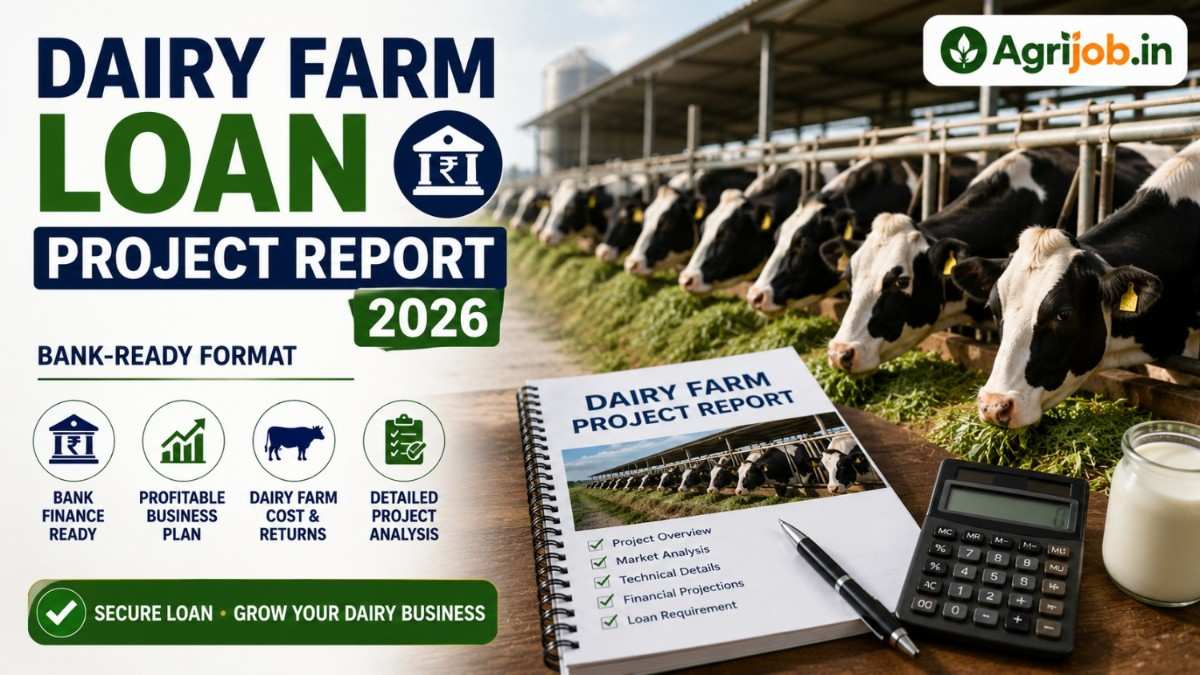
A dairy farm loan project report — also called a Detailed Project Report (DPR) or dairy farm DPR — is a formal technical and financial document submitted to a bank or financial institution alongside your loan application. Unlike a general business plan, a DPR is specifically structured to meet the credit appraisal standards of Indian scheduled commercial banks, RRBs, and cooperative banks.
The core purpose of a dairy farm loan project report is to mathematically prove to the bank’s credit officer that your dairy unit will generate enough monthly surplus to cover feed costs, veterinary expenses, labour, and loan EMIs — and still have a positive cash balance. Banks do not fund passion or intent; they fund bankable viability demonstrated through hard numbers.

India is the world’s largest milk producer, contributing over 23% of global milk output, with 8 crore+ dairy farmers. With milk demand rising steadily in Tier 2 and Tier 3 cities, the market opportunity is strong — but banks still reject a large proportion of dairy farm loan applications due to poorly prepared DPRs. A well-structured 2026 dairy farm project report eliminates this risk entirely.
Project Cost Breakdown 2026 – 10, 20 & 50 Animal Units
The project cost in your dairy farm loan project report must reflect current 2026 market rates. Using outdated figures is one of the fastest ways to get your DPR flagged during bank appraisal. Below are accurate, research-backed cost tables for all three unit sizes.
10-Animal Dairy Unit – Cost Breakdown 2026
| Cost Head | Cow Unit (Crossbred/HF) | Buffalo Unit (Murrah) |
|---|---|---|
| Animal Purchase (10 animals) | Rs.6,00,000 – Rs.8,00,000 | Rs.8,00,000 – Rs.13,00,000 |
| Shed Construction | Rs.2,00,000 – Rs.3,00,000 | Rs.2,00,000 – Rs.3,00,000 |
| Milking Machine (2-unit) | Rs.60,000 – Rs.80,000 | Rs.60,000 – Rs.80,000 |
| Chaff Cutter | Rs.20,000 – Rs.30,000 | Rs.20,000 – Rs.30,000 |
| Milk Storage / Chiller | Rs.30,000 – Rs.50,000 | Rs.30,000 – Rs.50,000 |
| Working Capital (2 months) | Rs.1,00,000 | Rs.1,00,000 |
| Animal Insurance (1st Year) | Rs.36,000 – Rs.48,000 | Rs.48,000 – Rs.78,000 |
| Total Project Cost | Rs.10–12 lakh | Rs.12–18 lakh |
| Margin (Promoter Contribution @20%) | Rs.2–2.4 lakh | Rs.2.4–3.6 lakh |
| Bank Loan (80%) | Rs.8–9.6 lakh | Rs.9.6–14.4 lakh |
20-Animal Dairy Unit – Cost Breakdown 2026
| Cost Head | 20-Cow Farm | 20-Buffalo Farm |
|---|---|---|
| Animal Purchase | Rs.12,00,000 – Rs.16,00,000 | Rs.16,00,000 – Rs.26,00,000 |
| Shed Construction | Rs.3,50,000 – Rs.5,00,000 | Rs.3,50,000 – Rs.5,00,000 |
| Equipment & Machinery | Rs.1,50,000 – Rs.2,00,000 | Rs.1,50,000 – Rs.2,00,000 |
| Working Capital (3 months) | Rs.2,00,000 | Rs.2,50,000 |
| Miscellaneous & Insurance | Rs.1,00,000 | Rs.1,50,000 |
| Total Project Cost | Rs.20–26 lakh | Rs.25–37 lakh |
| Bank Loan @75% | Rs.15–19.5 lakh | Rs.18.75–27.75 lakh |
50-Animal Dairy Unit – Cost Breakdown 2026
| Cost Head | Approximate Cost (2026) |
|---|---|
| Animal Purchase (50 HF/Murrah) | Rs.30,00,000 – Rs.40,00,000 |
| Shed & Infrastructure | Rs.6,00,000 – Rs.10,00,000 |
| Milking Parlour / BMC Equipment | Rs.3,00,000 – Rs.5,00,000 |
| Feed Storage & Chaff Cutter | Rs.1,00,000 – Rs.2,00,000 |
| Biogas Unit (optional) | Rs.1,50,000 |
| Working Capital (3 months) | Rs.4,00,000 – Rs.5,00,000 |
| Animal Insurance + Misc. | Rs.2,00,000 – Rs.3,00,000 |
| Total Project Cost | Rs.47–65 lakh |
| Bank Loan @75% | Rs.35–49 lakh |
| Promoter Contribution @25% | Rs.12–16 lakh |
NABARD Dairy Subsidy Format & Eligibility 2026
Understanding NABARD’s dairy subsidy structure is critical before you prepare your dairy farm loan project report, because the subsidy amount directly affects your means-of-finance calculation. An important point: NABARD does not give loans directly to farmers. It is a refinancing institution. You approach your nearest commercial bank, RRB, or cooperative bank; the bank sanctions and disburses your loan; and then the bank claims the subsidy from NABARD on your behalf.
| Scheme | Unit Size | Subsidy – General | Subsidy – SC/ST | Max. Subsidy Amount |
|---|---|---|---|---|
| DEDS – Small Dairy Unit | Up to 10 animals | 25% of outlay | 33.33% of outlay | Rs.1.25 lakh (Rs.1.67 lakh SC/ST) |
| DEDS – Heifer Calf Rearing | Up to 20 calves | 25% of outlay | 33.33% of outlay | Rs.1.20 lakh (Rs.1.60 lakh SC/ST) |
| DEDS – Milking Machines/BMC | Up to 2000 lit capacity | 25% of Rs.18 lakh outlay | 33.33% | Rs.4.50 lakh (Rs.6.00 lakh SC/ST) |
| AHIDF – Dairy Processing Unit | Individual/MSME/FPO | 3% interest subvention | 3% interest subvention | For 8 years; 90% loan guarantee |
| MUDRA (Kishore/Tarun) | Up to Rs.10 lakh | No collateral loan | Priority category | Rs.10 lakh limit |
The NABARD subsidy is back-ended, meaning it is not paid upfront — it is credited to your loan account after 12 months of satisfactory unit operation. This amount is then adjusted against the last few EMI repayments, effectively reducing your outstanding principal. For your DPR’s means-of-finance table, include this subsidy separately so the bank can accurately map the total funding sources. Visit the official NABARD DEDS Scheme page for the latest notifications, and the Department of Animal Husbandry and Dairying (DAHD) for AHIDF guidelines.
7 DPR Sections Banks Check Most Carefully
Not all sections of your dairy farm loan project report get equal attention from the bank’s credit officer. Here are the 7 sections that determine approval or rejection — in the order that credit managers typically review them:
- 🏦 Executive Summary (Pages 1–4): The credit officer reads this first. It must clearly state promoter qualifications, total project cost, bank loan requirement, margin contribution, IRR, and the repayment period — all in one place. If this section is vague or missing key numbers, the officer rarely reads the rest carefully.
- 💰 DSCR Calculation (Debt Service Coverage Ratio): This is the single most scrutinised figure. Formula: DSCR = Net Operating Income ÷ Annual Debt Service (EMI). Banks require DSCR ≥ 1.25. Below 1.0 is automatic rejection — no exceptions, no discussions. For a 10-cow unit, a well-structured DPR typically achieves DSCR of 1.30–1.50 in Years 2–5.
- 📈 5-Year Financial Projections (P&L + Cash Flow): Banks require projected Profit & Loss, Balance Sheet, and Cash Flow statements for 5 years. Year 1 should show 50–60% capacity utilisation — not 80–100%. Projecting full capacity in Year 1 is the second most common rejection trigger because it signals inexperience.
- 🐄 Revenue Projection (Milk + By-Products): Your revenue model must detail milk yield per animal, lactation cycle, dry period, milk price per litre (based on actual local cooperative/market rates), manure revenue, and calf sale income. Banks cross-verify milk yield claims against NABARD standard norms.
- 📋 CMA Data (Credit Monitoring Arrangement): For loans above Rs.25 lakh, all 5 IBA-prescribed CMA forms are mandatory — Operating Statement, Balance Sheet Analysis, Fund Flow Statement, MPBF Calculation, and Key Financial Ratios. Incomplete CMA is the No. 1 technical rejection cause.
- 🔍 Means of Finance Table: Total project cost must exactly equal total sources (promoter margin + bank loan + NABARD subsidy). Any funding gap is a structural defect banks cannot overlook. Ensure your numbers reconcile perfectly.
- ⚠️ Risk Analysis Section: Most applicants skip this section. It is actually critical — a well-written risk section covering milk price risk, feed cost fluctuation, disease outbreak risk, and drought/fodder scarcity (with mitigation plans) demonstrates that you have stress-tested your plan. Banks approve projects that anticipate risks, not ones that pretend risks don’t exist.
Revenue Projections & Break-Even Analysis for Dairy Farm 2026
Your dairy farm loan project report’s revenue section must be built on realistic, district-verified milk price data — not aspirational figures. Below are conservative 2026 projection benchmarks based on NABARD model project data and current market rates.
10-Cow Unit – Annual Revenue & Profit Projection (Year 2 onwards)
| Income Head | Calculation Basis | Annual Income (Rs.) |
|---|---|---|
| Milk Sales | 10 cows × 8 lit/day × 300 lactation days × Rs.35/lit | Rs.8,40,000 |
| Manure Sale | 10 animals × 10 kg/day × 300 days × Rs.1/kg | Rs.30,000 |
| Calf/Animal Sale | Estimated annual turnover | Rs.30,000 |
| Total Annual Revenue | Rs.9,00,000 | |
| Feed & Fodder Cost | 10 animals × Rs.200/day × 365 days | Rs.7,30,000 |
| Labour (1 worker) | Rs.8,000/month × 12 | Rs.96,000 |
| Veterinary & Medicine | Rs.500/animal/month × 12 | Rs.60,000 |
| Electricity & Water | Lump sum | Rs.24,000 |
| Total Annual Expense | Rs.9,10,000 | |
| Net Profit (Year 2) | Rs.2,15,000 (after repayment) |
Break-Even Point: A 10-cow dairy unit typically reaches operational break-even during Year 2, once the herd stabilises and milk production reaches 70–75% of projected capacity. The IRR for a well-managed 10-cow unit is approximately 25–30%, making it one of the more bankable agri-enterprises in India.
Revenue Summary – All 3 Unit Sizes (2026 Projections)
| Unit Size | Annual Milk Revenue (Year 2) | Net Monthly Profit | Break-Even Year | IRR (Approx.) |
|---|---|---|---|---|
| 10-Cow Unit | Rs.8–9 lakh | Rs.40,000–45,000 | Year 2 | 25–30% |
| 20-Buffalo Unit | Rs.19–24 lakh | Rs.80,000–90,000 | Year 2 | 28–32% |
| 50-Animal Mixed Unit | Rs.48–60 lakh | Rs.1,80,000–2,20,000 | Year 2–3 | 22–28% |
Who Should Apply for a Dairy Farm Loan Project Report 2026?
- 🧑🌾 Small and marginal farmers with 1–5 acres of land who want a stable daily income source beyond seasonal crop revenue, using the NABARD DEDS subsidy for 10-animal units.
- 👩 Women farmers and SHG members who can access higher SC/ST-equivalent subsidies and priority lending under MUDRA (Kishore/Tarun) for mini dairy units up to Rs.10 lakh without collateral.
- 🎓 Agriculture graduates and BSc/MSc students from SAUs (State Agricultural Universities) or ICAR institutions who want to set up a commercial dairy farm and leverage AHIDF’s 3% interest subvention.
- 🏘️ Rural youth (18–40 years) in states like UP, Bihar, Rajasthan, Haryana, and Punjab where milk cooperative networks (Amul, NDDB-affiliated) provide guaranteed milk procurement, removing market risk.
- 👨👩👧 Farmer families with existing milch animals looking to formalise and expand from 2–3 cows to a registered 10–20 animal unit to access institutional credit and subsidy benefits.
- 🏢 FPOs (Farmer Producer Organisations), Dairy Cooperative Societies, and SHGs eligible for AHIDF funding for setting up bulk milk chilling, processing, and value-addition units.
- 📊 Agripreneurs and MSME entrepreneurs planning a 50-animal commercial dairy with milking parlour, bulk milk cooler (BMC), and integrated processing to access DIDF and AHIDF funding.
- 🏦 Existing dairy farmers wanting to modernise their operations — installing milking machines, bulk milk cooling units (up to 2,000 lit capacity), or biogas units — using DEDS equipment subsidy of 25% (up to Rs.4.5 lakh).
Dairy Farm DPR vs Business Plan – Key Differences
| Parameter | Dairy Farm DPR (Bank Loan) | General Business Plan |
|---|---|---|
| Primary Purpose | Bank credit appraisal & subsidy claim | Internal planning & investor pitch |
| DSCR Required? | Yes — minimum 1.25 mandatory | No |
| CMA Data | Mandatory for loans above Rs.25 lakh | Not required |
| Page Length | 15–100 pages depending on loan size | 5–20 pages typical |
| Financial Projections | 5-year P&L, Balance Sheet, Cash Flow | 1–3 year summary |
| Capacity Utilisation (Year 1) | Must be 50–60% (bank norm) | Often aspirational |
| Risk Analysis | Mandatory with mitigation plans | Optional |
| Animal Quotations | Mandatory from certified breeders | Not required |
| NABARD Subsidy Component | Must appear in means of finance | Not applicable |
Top 7 Dairy Farm Project Report Rejection Reasons & Fixes
Banks in India reject a significant proportion of dairy farm loan applications — not because the project is unviable, but because the dairy farm loan project report has structural errors. Here are the 7 most common rejection reasons, based on bank credit officer feedback, with actionable fixes for each:
- ❌ DSCR Below 1.25: This is a hard automatic rejection. Fix: Extend the loan repayment tenure from 5 to 7 years, increase your own contribution (margin), or add verifiable by-product income (manure, biogas, calf sales) to improve net operating income.
- ❌ 80–100% Capacity Utilisation in Year 1: Banks know new dairy farms take 6–12 months to stabilise. Projecting full capacity in Year 1 signals that you have not thought through the ramp-up period. Fix: Use 50–60% capacity in Year 1, 70–75% in Year 2, and 85–90% from Year 3 onwards.
- ❌ CMA Data Inconsistencies: The most common technical rejection — your Balance Sheet does not balance, or your Cash Flow does not reconcile with P&L figures. Fix: Use a CA to prepare CMA data, or use a platform like NABCONS or Finline that auto-reconciles all CMA statements.
- ❌ Inflated Animal Cost Estimates: Banks apply NABARD-approved standard unit costs during valuation. If your DPR shows Rs.1.5 lakh per cow but the NABARD unit cost norm is Rs.70,000–Rs.80,000, the bank will not increase the subsidy or loan — it will instead question your entire cost structure. Fix: Attach actual quotations from certified breeders and keep costs aligned with NABARD norms.
- ❌ Missing Animal Insurance Provision: Animal insurance at ~6% of animal cost per year is a mandatory clause in most bank livestock loan guidelines. Omitting it makes your DPR look incomplete. Fix: Add insurance cost in your recurring expense projections and mention the type of policy (annual or long-term master policy).
- ❌ Funding Gap in Means of Finance: If Promoter Contribution + Bank Loan + NABARD Subsidy does not exactly equal Total Project Cost, the application has a structural defect. Fix: Build your means-of-finance table last, after finalising all cost heads, to ensure perfect reconciliation.
- ❌ No Risk Analysis Section: Banks approve projects that acknowledge risks and address them — not ones that present a risk-free picture. Fix: Add a 1-page risk section covering feed price risk, milk price fluctuation, disease outbreak, and drought/fodder scarcity — each with a brief mitigation plan.
Step-by-Step: How to Apply for Dairy Farm Loan 2026
- 🔢 Decide Your Unit Size: Choose between 10, 20, or 50 animals based on your land availability (minimum 0.5 acre for 10 animals), fodder cultivation area, and own capital contribution ability.
- 📋 Prepare Your DPR: Structure your dairy farm loan project report to include all mandatory sections: executive summary, business profile, market analysis, technical plan (shed design, breed, feeding), financial projections (5-year P&L + Cash Flow + Balance Sheet), DSCR, CMA data, and risk analysis.
- 🏦 Identify the Right Bank Branch: Not every branch participates in AHIDF or DEDS subsidy schemes. Confirm with your SBI Agri branch, PNB, Bank of Baroda, Indian Bank, or nearest RRB that they are actively empanelled for NABARD refinance. Submitting to an unempanelled branch restarts the entire process.
- 📁 Gather All Documents: KYC (Aadhaar + PAN), land documents or lease deed, 3-year ITR, animal purchase quotations from certified breeders, shed construction quotations, Udyam (MSME) registration, caste certificate (for SC/ST subsidy), and 6-month bank statements.
- 📝 Submit the Loan Application: Visit the bank branch or use the bank’s online agriculture loan portal. Submit your DPR + all supporting documents. The bank’s Technical Officer or Agriculture Officer will verify the DPR and conduct a field inspection.
- ✅ Bank Sanctions Loan: After appraisal (typically 15–45 days), the bank sanctions the loan and disburses in 2–3 stages against asset creation — shed construction first, then animal purchase, then equipment.
- 🏗️ Implement the Project: Use the sanctioned loan + your own contribution to implement the project as per the DPR timeline. Keep all bills, receipts, and asset creation proofs — the bank will verify end-use of funds.
- 💸 NABARD Subsidy Credited (Month 12+): After 12 months of satisfactory operation, the bank claims the NABARD subsidy on your behalf. The subsidy is credited to your Subsidy Reserve Fund Account and adjusted against your last EMIs.
For further guidance, visit the official NABARD official website for model bankable project formats, or contact your nearest DAHD State Animal Husbandry Department office for breed-specific unit cost norms.
High-Value Dairy Finance Terms You Must Know
Knowing these 10 key terms will help you prepare a more credible dairy farm loan project report 2026 and communicate confidently with bank officers and NABARD officials during appraisal:
- 📊 DSCR (Debt Service Coverage Ratio): The primary financial metric banks use to measure your dairy unit’s ability to service its loan. DSCR = Net Operating Income ÷ Annual Debt Service. A DSCR ≥ 1.25 is mandatory for loan sanction.
- 📉 IRR (Internal Rate of Return): The annualised return rate on your dairy investment. For a 10-cow unit, IRR is typically 25–30%. Banks use IRR to verify long-term viability, especially for large-scale dairy loans above Rs.25 lakh.
- 💹 BCR (Benefit-Cost Ratio): BCR = Present Worth of Benefits ÷ Present Worth of Costs. A BCR above 1.0 means the project generates more value than it costs. A typical 10-cow NABARD model project has BCR of 1.08.
- 📃 CMA Data: Credit Monitoring Arrangement data — the 5 IBA-format financial statements (Operating Statement, Balance Sheet, Fund Flow, MPBF Calculation, Key Ratios) mandatory for loans above Rs.25 lakh.
- 🔁 Back-Ended Subsidy: The NABARD capital subsidy under DEDS is not given upfront. It is released to the bank 12 months after satisfactory project operation and adjusted against your final EMI repayments.
- 🏦 AHIDF (Animal Husbandry Infrastructure Development Fund): A Government of India scheme with a Rs.29,000+ crore corpus offering 3% interest subvention for up to 8 years and 90% credit guarantee for dairy processing, milking equipment, and animal feed units.
- 🐄 BMC (Bulk Milk Cooler): A refrigerated storage unit at the farm level that chills milk rapidly after milking to preserve quality. BMC purchase (up to 2,000 litre capacity) is eligible for 25% DEDS subsidy up to Rs.4.50 lakh.
- 📐 TEV (Techno-Economic Viability) Study: For large dairy loans above Rs.5–10 crore, banks commission an independent TEV report from agencies like NABCONS to verify your DPR’s technical soundness and financial projections.
- 🧮 DER (Debt-Equity Ratio): Total bank loan divided by promoter contribution. Banks require DER ≤ 3:1 for most dairy schemes. A DER above 3:1 signals excessive leverage and is typically rejected.
- 📅 Moratorium Period: The initial period (6–24 months) after loan disbursement during which you are not required to repay principal — only interest. AHIDF allows a maximum 2-year moratorium, which is crucial for large dairy units that need time to stabilise before generating full milk revenue.
Frequently Asked Questions – Dairy Farm Loan Project Report 2026
What is a dairy farm loan project report?
A dairy farm loan project report (DPR) is a formal technical and financial document submitted to banks for credit appraisal. It includes the total project cost, revenue projections, DSCR, CMA data, means of finance, NABARD subsidy details, and a 5-year repayment plan. Banks use this document to assess the repayment capacity of your dairy unit before sanctioning the loan.
What is the project cost for a 10-cow dairy farm in India in 2026?
In 2026, the total project cost for a 10-cow dairy farm ranges from Rs.10 lakh to Rs.15 lakh, including animal purchase (Rs.6–8 lakh for HF/crossbred cows), shed construction (Rs.2–3 lakh), milking equipment (Rs.1 lakh), and working capital (Rs.1 lakh). Under NABARD’s DEDS scheme, the back-ended subsidy for a 10-animal unit is Rs.1.25 lakh (general) or Rs.1.67 lakh (SC/ST).
What is the NABARD dairy farm subsidy in 2026?
Under NABARD DEDS in 2026, the subsidy for a 10-animal dairy unit is 25% of project cost (up to Rs.1.25 lakh) for general category and 33.33% (up to Rs.1.67 lakh) for SC/ST farmers. Under AHIDF, dairy entrepreneurs get 3% interest subvention for up to 8 years of loan repayment. These subsidies are back-ended and managed entirely by the bank — you do not approach NABARD directly.
What is DSCR and what minimum DSCR do banks require?
DSCR (Debt Service Coverage Ratio) = Net Operating Income ÷ Annual Debt Service. It measures whether your dairy farm generates enough cash to cover its loan EMIs. Banks require a minimum DSCR of 1.25 for dairy farm loans. A DSCR below 1.0 is an automatic rejection regardless of all other factors in your dairy farm loan project report.
What is the project cost for a 20-buffalo dairy farm?
A 20-buffalo dairy farm in India requires a total investment of Rs.22–37 lakh in 2026. Murrah or Nili-Ravi buffaloes cost Rs.80,000–Rs.1,30,000 each. Shed construction for 20 animals runs Rs.3.5–5 lakh, milking equipment Rs.1.5–2 lakh, and 3-month working capital Rs.2.5 lakh. Monthly milk revenue (20 buffaloes × 8 lit/day × Rs.45/lit) can reach Rs.2.16 lakh, supporting a DSCR of 1.30–1.40.
What are the most common rejection reasons for dairy farm project reports?
The most common reasons banks reject a dairy farm loan project report are: DSCR below 1.25 (automatic rejection), projecting 80–100% capacity in Year 1 instead of 50–60%, CMA data inconsistencies, inflated animal cost estimates not aligned with NABARD norms, missing animal insurance provision, funding gap in the means-of-finance table, and no risk analysis section. Each issue is fixable with proper DPR preparation.
Can I apply for a dairy farm loan without collateral?
Yes. Dairy farm loans up to Rs.2 lakh from several banks require no collateral. Under MUDRA Loan (Kishore/Tarun), small dairy unit loans up to Rs.10 lakh can be accessed without collateral. Under AHIDF, NABARD provides a credit guarantee of up to 25% of the loan for MSME-defined dairy units. Your dairy farm loan project report still needs to be complete and bankable regardless of collateral waiver.
How many pages should a dairy farm DPR be?
For loans up to Rs.25 lakh, a 15–25 page DPR (including CMA annexures) is standard. For loans of Rs.25 lakh to Rs.2 crore, prepare a 25–45 page DPR with full CMA data (all 5 forms) and 5-year projections. For loans above Rs.2 crore, prepare a 45–100 page technical DPR with IRR, NPV, TOL/TNW ratio, and sensitivity analysis. Quality and internal consistency matter more than page length — a 20-page DPR with correct DSCR outperforms a 60-page report with calculation errors.
For the official NABARD model bankable dairy project formats and standard unit cost norms, visit the NABARD Model Bankable Projects portal. For scheme-wise subsidy eligibility and AHIDF guidelines, refer to the DAHD official website.
This guide is regularly reviewed and updated for accuracy. Bookmark this page for the latest 2026 notifications on dairy farm loan schemes, NABARD subsidy updates, and DPR format changes.
Last Updated: June 2026