
Dairy farm project report for PNB and SBI approval is the single most important document you will prepare before your loan is sanctioned. Without a bank-format Detailed Project Report (DPR), your application will not even be processed — regardless of your land, cattle, or credit score. In 2026, both Punjab National Bank (PNB) and State Bank of India (SBI) require a minimum 14-section DPR with DSCR of 1.25 or above, five-year financial projections, and CMA data before approving any dairy farm loan above Rs.2 lakh. This guide is for Indian farmers, agri-entrepreneurs, SC/ST applicants, and first-generation dairy operators who want a Rs.5 lakh to Rs.50 lakh bank-approved dairy loan in 2026.

This complete guide covers every mandatory section of a dairy farm project report, what PNB and SBI loan officers actually check, how to calculate DSCR correctly, which government subsidy schemes to link, and how to avoid the documentation errors that cause 60% of dairy loan rejections. By the end, you will have a ready framework to build a DPR your banker cannot reject.
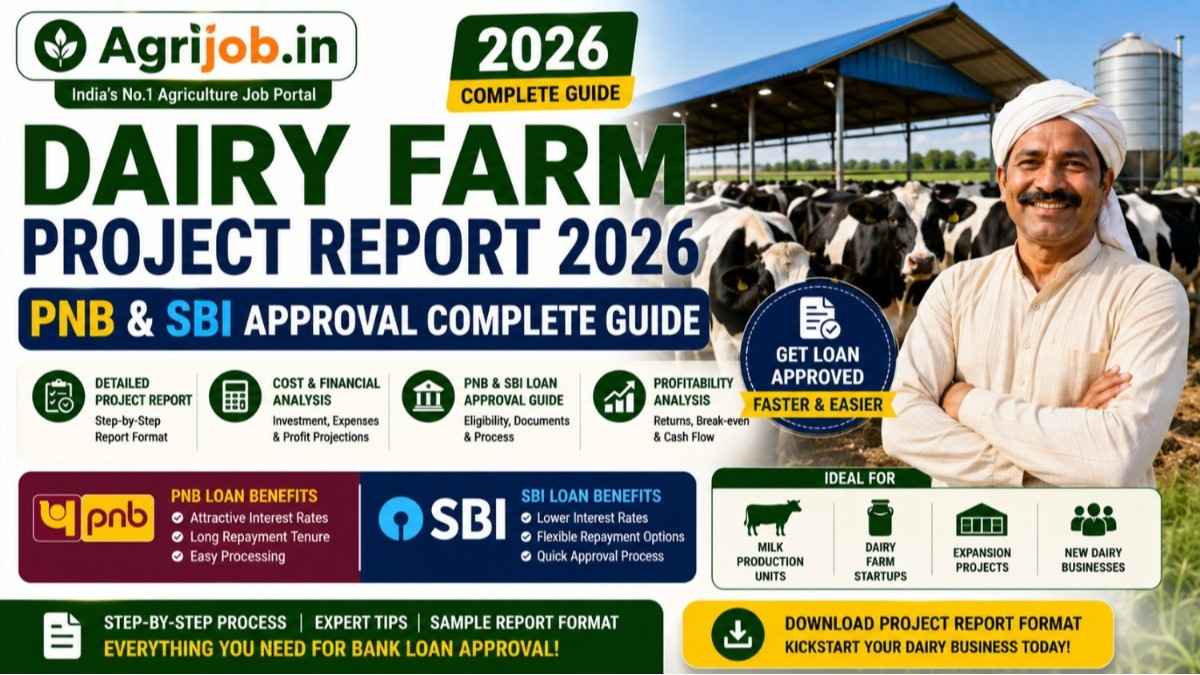
A dairy farm project report for PNB and SBI approval is a formal Detailed Project Report (DPR) containing 14 mandatory sections — from promoter profile and project cost to CMA data and DSCR — proving your Rs.5L–50L dairy unit can repay the loan from milk sales income. Banks require DSCR of at least 1.25 and five-year financial projections prepared in IBA format.
- Minimum Loan Amount Requiring DPR: Rs.2 lakh (SBI), Rs.1 lakh (PNB)
- Typical Project Cost Range: Rs.5 lakh (5-cow unit) to Rs.50 lakh (commercial dairy)
- Minimum DSCR Required: 1.25 (SBI, PNB — all PSU banks)
- Mandatory Financial Projection Period: 5 years (IBA CMA format)
- SBI Dairy Loan Interest Rate: 7.50% p.a. onwards (MCLR-linked, 2026)
- PNB Agri Term Loan Rate: Comparable to SBI; branch-specific (check official portal)
- AHIDF Interest Subvention: 3% for eligible MSMEs, FPOs, cooperatives
- NLM-EDEG Capital Subsidy: Up to 50% (SC/ST); up to Rs.10 lakh (general)
- Maximum Repayment Tenure: 7 years (SBI); 5–7 years (PNB)
- Moratorium Period: 6–12 months for new dairy setups
- What Is a Dairy Farm Project Report?
- Who Needs a Dairy Farm DPR?
- 14 Mandatory Sections for PNB and SBI Approval
- Project Cost Breakdown — 5-Cow to 20-Cow Units
- How to Draft a Dairy Farm Project Report Step by Step
- DSCR Formula and How Banks Calculate It
- Government Subsidy Schemes to Link With Your DPR
- PNB vs SBI for Dairy Farm Loan — Comparison
- Pros and Cons of Self-Preparing vs Professional DPR
- Important Terms Related to Dairy Farm Project Report
- Important Links
- Conclusion
- Key Takeaways
- Frequently Asked Questions
What Is a Dairy Farm Project Report for a Bank Loan?
A dairy farm project report is a formal Detailed Project Report (DPR) that presents the complete technical, financial, and operational blueprint of your proposed dairy unit to a bank or financial institution. It is the primary document that PNB, SBI, and all nationalized banks use to assess loan viability before sanction. Without it, your application is incomplete by default.

The DPR format for dairy farm loans follows the IBA (Indian Banks’ Association) standard structure, which all public sector banks including SBI and PNB are required to use for agriculture term loan appraisal. It contains a minimum of 14 distinct sections — from the cover page and executive summary through to the loan repayment schedule and legal declarations. Banks do not evaluate your passion for dairy farming; they evaluate the mathematical debt serviceability your DPR demonstrates.
According to SIDBI data, over 60% of MSME and agriculture loan rejections are caused by problems in the project report — not the underlying business. A poorly structured DPR without DSCR calculations, unrealistic financial projections, or missing CMA data will be returned within days of submission. Getting the DPR right the first time saves 2–6 weeks of processing delay.
Who Needs a Dairy Farm DPR for PNB or SBI?
Any individual or entity applying for a dairy farm loan above Rs.1–2 lakh from PNB or SBI requires a formal DPR. Here are the specific profiles for whom this guide is directly relevant:
- 🐄 Small dairy farmers setting up a 2–10 cow unit with a Rs.1.5–5 lakh loan under SBI’s mini dairy or PNB’s Agri Term Loan product
- 🏗️ Medium dairy entrepreneurs building a 10–20 cow shed + milking infrastructure requiring Rs.10–25 lakh from SBI Allied Activities Term Loan
- 🏭 Commercial dairy operators scaling to 50+ animals with milk chilling units, biogas, and automated milking parlors seeking Rs.25–50 lakh loans
- 🌾 SC/ST farmers wanting to combine SBI/PNB lending with NLM-EDEG’s 50% capital subsidy (up to Rs.25 lakh subsidy for eligible SC/ST beneficiaries)
- 🤝 FPO members and SHG groups seeking AHIDF interest subvention of 3% for dairy processing or cooperative milk chilling infrastructure
- 👩🌾 Women entrepreneurs in rural areas applying under state-specific dairy schemes that require a DPR as a pre-condition for subsidy release
- 🎓 Agriculture graduates and rural youth applying for PMEGP-linked dairy units where a project report is mandatory for all loan amounts
- 🏘️ Existing dairy farmers expanding capacity and requiring a top-up or enhancement loan with updated financial projections
14 Mandatory Sections for PNB and SBI Dairy Farm Loan Approval
The standard IBA-format DPR accepted by SBI, PNB, Bank of Baroda, Canara Bank, and all nationalized banks requires the following 14 sections. Omitting any section is a common reason for return or rejection at the branch level.
| # | Section Name | What the Bank Checks |
|---|---|---|
| 1 | Cover Page & Executive Summary | Business name, owner, loan amount, project cost, unit type, location |
| 2 | Promoter Profile | Age, education, farming experience, credit history, CIBIL score |
| 3 | Business Description | Type of dairy (cow/buffalo), scale, breeds, milk yield per animal, market linkage |
| 4 | Market Analysis | Local milk demand, nearest cooperative/dairy processor, price per litre, competition |
| 5 | Technical Plan | Shed design, animal capacity, fodder arrangement, water source, veterinary access |
| 6 | Project Cost Statement | Itemised capital cost — land preparation, civil construction, animal purchase, equipment |
| 7 | Means of Finance | Own contribution (min 10–25%), bank loan, subsidy component |
| 8 | Machinery & Equipment List | Milking machine, bulk milk cooler, chaff cutter, biogas unit — with quoted prices |
| 9 | Raw Material & Manpower Plan | Monthly feed cost, veterinary expenses, labour, electricity, water |
| 10 | 5-Year Financial Projections | P&L statement, balance sheet, cash flow — Year 1 to Year 5 |
| 11 | CMA Data (IBA Format) | Current assets, current liabilities, net working capital — bank’s internal appraisal format |
| 12 | Working Capital Assessment | Monthly operating cost vs monthly milk income — cash cycle analysis |
| 13 | Loan Repayment Schedule + DSCR | EMI table, interest cost, DSCR ≥ 1.25 for each projection year |
| 14 | SWOT Analysis & Declarations | Risk factors, mitigation strategies, promoter signature, CA certification where required |
Important: For loan amounts above Rs.10 lakh, SBI and PNB typically require the CMA data to be prepared or certified by a Chartered Accountant. For smaller loans, a well-structured self-prepared DPR with the above 14 sections is usually accepted at the discretion of the branch credit officer.
Project Cost Breakdown — 5-Cow to 20-Cow Dairy Units (2026)
The project cost in your DPR must reflect actual 2026 market prices for your state, not national averages. Below is a reference breakdown for three common dairy unit sizes. Use these figures as a starting framework and adjust them based on your district’s Animal Husbandry Department unit cost norms and your bank’s NABARD-prescribed scale of finance.
| Cost Component | 5-Cow Unit (Rs.) | 10-Cow Unit (Rs.) | 20-Cow Unit (Rs.) |
|---|---|---|---|
| Animal Purchase (HF/Crossbreed) | 1,75,000 | 3,50,000 | 7,00,000 |
| Shed / Civil Construction | 80,000 | 1,50,000 | 2,75,000 |
| Milking Machine | 45,000 | 65,000 | 1,20,000 |
| Bulk Milk Cooler (BMC) | — | 75,000 | 1,40,000 |
| Chaff Cutter + Feed Storage | 25,000 | 40,000 | 70,000 |
| Biogas Unit (optional) | 35,000 | 50,000 | 80,000 |
| Working Capital (3 months) | 40,000 | 70,000 | 1,35,000 |
| Contingency (5%) | 20,000 | 35,000 | 76,000 |
| Total Project Cost | ~Rs.4.20 lakh | ~Rs.8.35 lakh | ~Rs.15.96 lakh |
| Bank Loan (75–90%) | ~Rs.3.15–3.78 lakh | ~Rs.6.26–7.52 lakh | ~Rs.11.97–14.36 lakh |
| Own Contribution (10–25%) | ~Rs.42,000–1.05 lakh | ~Rs.83,500–2.09 lakh | ~Rs.1.60–3.99 lakh |
Note: Animal purchase costs vary by breed and state. HF crossbreeds in Bihar/UP range from Rs.30,000–40,000 per animal; in Maharashtra and Karnataka, costs may be higher. Always obtain 2–3 actual market quotations and attach them to your DPR.
How to Draft a Dairy Farm Project Report Step by Step
Follow this step-by-step process to build a bank-ready dairy farm project report from scratch. This process is exactly what professional DPR consultants follow for SBI and PNB submissions in 2026.
- Collect all identity and land documents first. Gather your Aadhaar card, PAN card, land ownership certificate or registered lease deed (minimum 3-year lease for rented land), last 6 months’ bank statement, and passport-size photos. Banks will reject the DPR at intake if basic KYC is missing.
- Decide the project scale and breed before writing anything. Choose the number of animals (5, 10, 20, or 50), the breed (HF crossbreed, Gir, Sahiwal, Murrah buffalo), and the daily milk yield per animal. Your financial projections flow entirely from these decisions — changing them later requires redoing all calculations.
- Get market price quotations for all capital items. Visit your nearest livestock market and equipment dealer. Collect written quotations for animals, milking machines, BMCs, and civil construction. Attach original quotations to your DPR as annexures — both SBI and PNB credit officers verify these figures during site inspection.
- Write the Technical Plan section next. Describe your shed dimension (200 sq ft per animal as a standard), flooring type (concrete), drainage system, water source (borewell or tanker), fodder arrangement (green fodder cultivation plan or local supplier), and veterinary access (nearest government veterinary hospital or private vet).
- Prepare the 5-Year Financial Projections. Start with Year 1 monthly milk income: (number of animals) × (daily litres per animal) × (Rs. per litre) × (300 lactation days ÷ 12). Deduct monthly feed cost (Rs.200–300 per animal per day), labour, veterinary, electricity, and loan EMI. Year 2 onwards, build in a 5–10% annual improvement in milk yield and a conservative 3% price increase.
- Calculate the DSCR for each of the 5 years. DSCR = Net Operating Income ÷ Annual Debt Service (principal + interest). Your DPR must show DSCR ≥ 1.25 for every projection year. If Year 1 DSCR falls below 1.25, use the moratorium period (6–12 months) to exclude it from the repayment schedule and adjust loan tenure to 7 years.
- Prepare the CMA Data in IBA format. This is a structured table of current assets (milk receivables, fodder stock, cash), current liabilities (working capital loan, creditors), and net working capital. For loans above Rs.10 lakh, have a CA review and certify this section before submission.
- Write the SWOT Analysis and Risk Mitigation section. Banks want to see that you have thought about risks — milk price fluctuation, animal disease, drought affecting fodder, CIBIL risk. For each risk, state a concrete mitigation: cattle insurance under Rashtriya Pashu Bima Yojana, membership with local cooperative for price stability, and a fodder reserve for 30 days.
- Prepare the Cover Page and Executive Summary last. Summarise the entire project in one page: project name, promoter name, location, project cost, loan amount, own contribution, repayment period, expected annual milk revenue, and DSCR. This is the first page your loan officer reads — make it clean, professional, and specific.
- Get the DPR printed, spiral-bound, and signed. Submit 2 copies — one for the bank file and one with the officer’s acknowledgement stamp for your records. Attach all quotations, land documents, bank statements, CIBIL printout, and scheme registration details as tabbed annexures.
Before submitting your DPR to the bank, visit your District Animal Husbandry Officer (DAHO) and ask them to review the project — not to certify it, but just to confirm your animal unit cost and yield assumptions are aligned with state government norms. A DAHO remark or a letter of support increases your DPR’s credibility significantly with branch credit officers and speeds up the site inspection step.
DSCR Formula and How PNB and SBI Calculate It for Dairy Loans
The Debt Service Coverage Ratio (DSCR) is the single most important financial metric in your dairy farm project report. It tells the bank whether your dairy business generates enough income to repay the loan. A DSCR below 1.0 means your business cannot cover loan repayments from operations — virtually guaranteed rejection at both PNB and SBI.
DSCR Formula: DSCR = Net Operating Income (NOI) ÷ Total Annual Debt Service
Where: NOI = Annual Milk Revenue + By-product Revenue (calves, dung, biogas) − All Operating Expenses (feed, labour, veterinary, insurance, electricity) − Depreciation. Annual Debt Service = Total annual loan repayment (principal + interest).
| Example — 10-Cow Unit, Rs.6 Lakh Loan @ 7.5%, 5-Year Tenure | Amount (Rs.) |
|---|---|
| Annual milk revenue (10 cows × 12 litres/day × 300 days × Rs.38/litre) | 13,68,000 |
| By-product revenue (calf sales + manure) | 60,000 |
| Total Annual Revenue | 14,28,000 |
| Feed cost (10 × Rs.280/day × 365) | 10,22,000 |
| Labour + veterinary + insurance + electricity | 1,20,000 |
| Total Operating Expenses | 11,42,000 |
| Net Operating Income (NOI) | 2,86,000 |
| Annual EMI (Rs.6L @ 7.5%, 5 years) | ~1,44,000 |
| DSCR | 1.99 ✅ |
Most public sector banks including SBI and PNB require DSCR of at least 1.25 for agricultural and animal husbandry term loans. A DSCR above 1.50 is considered strong. The example above at 1.99 is excellent and would result in fast approval. If your calculated DSCR falls below 1.25, increase the loan tenure (7 years instead of 5), reduce the loan quantum slightly, or add a by-product income stream like biogas or vermicompost.
Government Subsidy Schemes to Link With Your Dairy Farm DPR
In 2026, two active central government subsidy routes can be linked to your dairy farm project report — AHIDF and NLM-EDEG. The earlier NABARD Dairy Entrepreneurship Development Scheme (DEDS) was discontinued after FY 2020–21. Linking the correct active scheme to your DPR dramatically improves approval prospects and reduces your effective interest cost.
| Scheme | Benefit | Who Qualifies | Nodal Agency |
|---|---|---|---|
| AHIDF (Animal Husbandry Infrastructure Development Fund) | 3% interest subvention for up to 8 years; 25% credit guarantee | MSMEs, FPOs, cooperatives, private companies for dairy processing/infrastructure | NABARD via ahidf.udyamimitra.in |
| NLM-EDEG (National Livestock Mission – Entrepreneurship Development) | 50% capital subsidy for SC/ST (up to Rs.25 lakh); Rs.10 lakh for general category | Individual farmers, SHGs, NGOs for small dairy/livestock units | NABARD and State Animal Husbandry Dept |
| PM Mudra Yojana (Tarun) | Up to Rs.10 lakh collateral-free; no processing fee | Small dairy farms with 2–5 animals; first-generation entrepreneurs | SBI, PNB, all scheduled banks |
| PMEGP (PM Employment Generation Programme) | 15–35% back-ended capital subsidy on project cost | Rural self-employment dairy units; first-time entrepreneurs only | KVIC, DIC offices |
| State Dairy Schemes | 25–50% additional subsidy (Bihar, UP, Haryana, Maharashtra vary) | State-resident farmers — check your State Animal Husbandry Dept | Respective State AHD |
To claim AHIDF interest subvention, register your dairy project on ahidf.udyamimitra.in before or simultaneously with your bank loan application. For NLM-EDEG subsidy, apply through your nearest NABARD district development manager or state nodal agency. Always mention the applicable scheme name and scheme reference number in Section 7 (Means of Finance) of your DPR.
PNB vs SBI for Dairy Farm Loan — Which Bank for Your DPR?
Both PNB and SBI are excellent choices for dairy farm loans in 2026. The choice depends on your location, existing banking relationship, and the scale of your project. Here is a detailed side-by-side comparison to help you decide before you prepare your DPR:
| Parameter | SBI (State Bank of India) | PNB (Punjab National Bank) |
|---|---|---|
| Interest Rate | 7.50% p.a. onwards (MCLR-linked) | Comparable; check current branch rate |
| Loan Product Name | Allied Activities Term Loan / SBI Dairy Loan | PNB Agriculture Term Loan (Animal Husbandry) |
| Maximum Loan Amount | Rs.50 lakh+ (AHIDF route: higher) | Rs.25 lakh (standard); higher case-by-case |
| Repayment Tenure | Up to 7 years + 12-month moratorium | Up to 5–7 years + 6-month moratorium |
| Collateral Requirement | Nil up to Rs.1.60 lakh; land mortgage above Rs.3 lakh | Nil up to CGTMSE limit; land mortgage typical above Rs.3 lakh |
| NABARD Refinance Linkage | Full refinance linkage available | Full refinance linkage available |
| AHIDF Scheme Access | Yes — SBI is a primary AHIDF lender | Yes — PNB is an AHIDF eligible bank |
| Rural Branch Network | 22,000+ branches (stronger rural reach) | Strong in North India — UP, Bihar, Punjab, Haryana |
| Processing Time | 30–40 days (existing SBI account faster) | 30–45 days typically |
| Best For | Medium-to-large dairy units; AHIDF-linked projects; all states | Small-to-medium units in North India; farmers with existing PNB accounts |
For dairy entrepreneurs across India, SBI is the better first choice in 2026 — primarily because of its unmatched rural branch penetration, full AHIDF linkage, and 30–40% faster processing for existing SBI account holders. If you are in North India — specifically UP, Bihar, Punjab, or Haryana — and already have a PNB account, PNB’s agri term loan is equally viable and may result in faster approvals at the local branch level. Prepare your DPR in IBA format and it will be accepted at both banks.
Pros and Cons of Self-Preparing vs Professional Dairy Farm DPR
One of the most common questions dairy loan applicants ask is whether to prepare the project report themselves or hire a professional consultant or CA. Both approaches have genuine trade-offs in 2026:
Advantages of Preparing the DPR Yourself
- ✅ Zero cost — saves Rs.3,000–15,000 in consultant fees
- ✅ You understand your own project better than any outsider
- ✅ Banks trust DPRs that show the promoter understands their financials
- ✅ Easily updatable if the bank suggests revisions
Disadvantages of Self-Prepared DPR
- ❌ CMA data errors are the single most common rejection reason — difficult to get right without accounting background
- ❌ DSCR calculation mistakes lead to incorrect projections that credit officers catch immediately
- ❌ Missing sections or wrong IBA format causes the DPR to be returned without processing
Advantages of a Professional CA/Consultant DPR
- ✅ CA-certified CMA data is preferred by SBI and PNB for loans above Rs.10 lakh
- ✅ Professional consultants know state-specific NABARD unit cost norms
- ✅ Faster first-time approval; fewer revision rounds
- ✅ Can prepare subsidy linkage paperwork simultaneously
Disadvantages of Professional DPR
- ❌ Costs Rs.3,000–15,000 depending on project size
- ❌ Some consultants use generic templates that do not reflect actual project specifics — banks detect this
- ❌ You may not understand your own DPR when the bank asks questions during the interview
Important Terms Related to Dairy Farm Project Report
Knowing these terms will help you prepare your DPR correctly and answer questions confidently during the bank loan interview:
- DPR (Detailed Project Report): The formal document submitted to the bank covering all technical, financial, and operational aspects of your dairy project. Mandatory for all loans above Rs.2 lakh.
- CMA Data (Credit Monitoring Arrangement): An IBA-standard financial statement format that banks use for appraisal. Includes current assets, liabilities, net working capital, and projected P&L for 5 years.
- DSCR (Debt Service Coverage Ratio): Net Operating Income ÷ Annual Debt Service. Minimum 1.25 required by SBI and PNB for dairy farm loans.
- Moratorium Period: A grace period of 6–12 months at the start of a new dairy loan during which only interest is payable — principal repayment begins after this period. Critical for new setups needing time to achieve full milk production.
- Scale of Finance: The maximum loan amount per animal or per unit prescribed by NABARD and state-level banks for a given type of dairy unit. Your loan amount cannot exceed this without special sanctions.
- AHIDF (Animal Husbandry Infrastructure Development Fund): A Rs.15,000 crore Government of India fund offering 3% interest subvention for dairy processing and infrastructure projects. Managed by NABARD; implemented by SBI and other scheduled banks.
- NLM-EDEG (National Livestock Mission – Entrepreneurship Development and Employment Generation): Active central scheme providing 50% capital subsidy (max Rs.25 lakh for SC/ST; Rs.10 lakh for general) for small dairy and livestock units in 2026.
- IRR (Internal Rate of Return): The annualised return on your dairy investment. Lenders want to see IRR above 15% for commercial dairy proposals. Strong IRR demonstrates long-term project viability.
- BCR (Benefit-Cost Ratio): Total discounted project benefits ÷ Total discounted project costs. A BCR above 1.0 indicates the project is worth undertaking; BCR above 1.50 is considered strong by agricultural banks.
- Hypothecation: The primary security arrangement for dairy loans — you pledge the dairy animals and farm assets (milking machine, BMC) as collateral while retaining possession and use of them.
Important Links
| Link Name | URL |
|---|---|
| NABARD Official Portal (Dairy Schemes) | nabard.org |
| AHIDF Scheme Registration (Udyami Mitra) | ahidf.udyamimitra.in |
| DAHD Official Guidelines (AHIDF) | dahd.gov.in |
| SBI Agriculture Loans Portal | sbi.co.in — Agriculture Banking |
| NLM Official Portal | nlm.udyamimitra.in |
| Agrijob.in — SBI Dairy Farm Loan 2026 Guide | SBI Dairy Farm Loan 2026 — Rate, EMI & Eligibility |
| Agrijob.in — Dairy Farm Business Plan 2026 | Dairy Farm Business Plan India 2026 — Cost, Loan & Profit |
| Agrijob.in — Dairy Farm Loan Without Collateral 2026 | Dairy Farm Loan Without Collateral 2026 — Full Guide |
Conclusion
A well-structured dairy farm project report is not just paperwork — it is the financial and operational proof that converts your dairy vision into a bank-sanctioned loan. For PNB and SBI approval in 2026, your DPR must include all 14 IBA-standard sections, show a DSCR of 1.25 or above across five projection years, and be supported by genuine market quotations and CMA data. Link your application to the right government scheme — AHIDF for processing projects or NLM-EDEG for small units — and your approval timeline can be as short as 30–45 days.
Start with the step-by-step drafting process in this guide, use the project cost breakdown table as your financial framework, and get your DPR reviewed by your District Animal Husbandry Officer before submission. Bookmark this page — it is updated every time NABARD or DAHD releases revised scheme guidelines or interest rate changes.
- A dairy farm project report for PNB and SBI requires a minimum of 14 sections in IBA format — omitting any section causes return or rejection.
- DSCR must be at least 1.25 for every projection year; a DSCR of 1.50+ ensures fast-track approval at most branches.
- Project costs range from Rs.4.20 lakh (5-cow unit) to Rs.15.96 lakh (20-cow unit) at 2026 reference prices — always adjust to your district’s actual market rates.
- AHIDF offers 3% interest subvention for MSMEs and FPOs; NLM-EDEG provides up to 50% capital subsidy for SC/ST beneficiaries in 2026.
- For loans above Rs.10 lakh, get CMA data certified by a CA before submission — it is the most common rejection trigger at SBI and PNB for larger dairy loans.
- Start your DPR by visiting your District Animal Husbandry Officer and getting local unit cost norms — this single step dramatically increases your approval success rate.
Frequently Asked Questions About Dairy Farm Project Report PNB SBI
What is a dairy farm project report and why do banks need it?
A dairy farm project report is a formal Detailed Project Report (DPR) that proves the financial viability and technical soundness of your proposed dairy unit to a lending bank. SBI and PNB require it because the DPR contains DSCR calculations, 5-year financial projections, and CMA data that allow credit officers to assess whether your milk sales income will be sufficient to service the loan without default. Without a DPR, dairy loan applications above Rs.1–2 lakh are not processed at any public sector bank in India in 2026.
How many sections does a dairy farm project report for SBI need?
The standard IBA-format DPR accepted by SBI contains 14 mandatory sections: Cover Page and Executive Summary, Promoter Profile, Business Description, Market Analysis, Technical Plan, Project Cost Statement, Means of Finance, Machinery and Equipment List, Raw Material and Manpower Plan, 5-Year Financial Projections, CMA Data, Working Capital Assessment, Loan Repayment Schedule with DSCR, and SWOT Analysis with declarations. Missing even one section can result in the DPR being returned before it reaches the credit appraisal stage.
What is the minimum DSCR needed for dairy farm loan approval at PNB and SBI?
Both Punjab National Bank (PNB) and State Bank of India (SBI) require a minimum Debt Service Coverage Ratio (DSCR) of 1.25 for agriculture and animal husbandry term loans, including dairy farm loans. This means your dairy unit’s Net Operating Income must be at least 1.25 times the annual loan repayment amount (principal + interest). A DSCR above 1.50 is considered strong and typically results in faster approval. A DSCR below 1.0 means automatic rejection as it signals the business cannot cover its debt obligations from milk revenue.
How much does a 10-cow dairy farm project cost in 2026?
A 10-cow dairy farm project in India costs approximately Rs.7.50 lakh to Rs.10 lakh in 2026, depending on your state, breed choice, and infrastructure requirements. The major cost components are animal purchase (Rs.3–3.5 lakh for HF crossbreed cows), shed construction (Rs.1.25–1.75 lakh), milking machine (Rs.60,000–80,000), bulk milk cooler (Rs.65,000–80,000), and 3 months of working capital (Rs.70,000–80,000). Always use actual market quotations from your district — not national averages — in your project report, as bank officers verify these figures during site inspection.
Can I get a dairy farm loan without collateral from SBI or PNB?
Yes, dairy farm loans up to Rs.1.60 lakh (SBI’s limit for nil-collateral agri loans) do not require physical collateral. For amounts between Rs.1.60 lakh and Rs.3 lakh, hypothecation of cattle and farm assets serves as primary security. Above Rs.3 lakh, most SBI and PNB branches require land mortgage or a third-party guarantee as collateral. For collateral-free loans up to Rs.10 lakh, the MUDRA Tarun route or CGTMSE (Credit Guarantee Fund Trust for Micro and Small Enterprises) guarantee can eliminate the need for physical collateral — this must be explicitly mentioned in Section 7 of your DPR.
What government subsidy is available for dairy farm loans in 2026?
In 2026, two active central government dairy subsidy routes are available. The AHIDF (Animal Husbandry Infrastructure Development Fund) provides a 3% interest subvention for up to 8 years for eligible MSMEs, FPOs, and cooperatives investing in dairy processing and infrastructure — apply via ahidf.udyamimitra.in. The NLM-EDEG (National Livestock Mission – EDEG) provides up to 50% capital subsidy for SC/ST beneficiaries (maximum Rs.25 lakh) and Rs.10 lakh for general category applicants for small dairy and livestock units. The earlier NABARD-DEDS subsidy was discontinued after FY 2020–21. Always verify the latest scheme status at nabard.org or your district NABARD office before submitting your DPR.
Do I need a Chartered Accountant to prepare my dairy farm DPR?
A Chartered Accountant is not mandatory for dairy farm DPRs for all loan amounts, but it is strongly recommended for loans above Rs.10 lakh. For smaller loans (Rs.2–10 lakh), a well-structured self-prepared DPR with all 14 sections, accurate DSCR calculations, and genuine market quotations is typically accepted by SBI and PNB. However, for loans above Rs.10 lakh — particularly those involving AHIDF or PMEGP subsidies — a CA-certified CMA data section is preferred by credit officers and significantly reduces the risk of rejection or revision requests.
What is CMA data and why does the bank need it in my dairy DPR?
CMA (Credit Monitoring Arrangement) data is a standardised financial statement format specified by the Indian Banks’ Association (IBA) that banks use for credit appraisal. In a dairy farm DPR, the CMA data section presents your projected balance sheet, profit and loss account, and cash flow statement for 5 years in a structured format that allows the bank’s credit committee to assess working capital requirements, liquidity, and financial health year by year. It is the most technically demanding section of the DPR and the most common source of errors that trigger loan rejections at SBI and PNB branches.
How long does SBI or PNB take to approve a dairy farm loan after DPR submission?
After a complete and correctly formatted DPR is submitted, SBI typically takes 30–45 days and PNB typically takes 30–50 days to sanction a dairy farm loan. This includes document verification (3–5 days), credit officer review of the DPR (5–7 days), site inspection of the proposed dairy location (7–10 days), credit committee review and sanction (7–14 days), and documentation and first disbursement (5–10 days). Existing SBI account holders with pre-verified KYC can see processing time reduced by 30–40%. Incomplete DPRs or DPRs returned for revision add 2–6 weeks to this timeline.
Disclaimer: This guide is for informational purposes only. Loan interest rates, eligibility criteria, and government scheme benefits are subject to change by the respective banks and government agencies. Always verify the latest terms at your nearest SBI/PNB branch, official bank website, or NABARD district office before submitting your application. This is not financial or legal advice.
Last Updated: July 2026. This guide is reviewed and updated regularly for accuracy. Bookmark this page for the latest dairy farm loan and DPR information.