
The Red Sindhi Tharparkar cow pairing represents India’s two toughest indigenous milch breeds, bred for exactly the heat, drought, and fodder scarcity that stops crossbred cattle cold. Both are ICAR-NBAGR registered Bos indicus breeds giving 6–10 litres of A2 milk a day on feed a Holstein Friesian would starve on. This guide is for small and marginal farmers, dairy entrepreneurs, and Gaushala operators in drought-prone parts of Bihar, Rajasthan, and Gujarat who want low-input, high-resilience cattle. Below you’ll find 2026 milk yield data, purchase prices, a side-by-side breed comparison, and every Central and state subsidy scheme that funds these two breeds.

A Red Sindhi Tharparkar cow suits hot, drought-prone regions best: Red Sindhi gives 6–10 litres of milk daily (1,100–2,600 kg per lactation), while Tharparkar gives 6–8 litres daily (913–2,147 kg per lactation). Both breeds qualify for up to 75% capital subsidy under Bihar’s Desi Gaupalan Protsahan Yojana and the central Rashtriya Gokul Mission in 2026.
- Red Sindhi milk yield: 6–10 litres/day, 1,100–2,600 kg/lactation
- Tharparkar milk yield: 6–8 litres/day, 913–2,147 kg/lactation
- Average milk fat: ~5% in both breeds (A2 beta-casein)
- Native tract: Sindh/Karachi region (Red Sindhi); Thar Desert Rajasthan & Kutch Gujarat (Tharparkar)
- Found across India: Odisha, Tamil Nadu, Bihar, Kerala, Assam (Red Sindhi); Rajasthan, Gujarat (Tharparkar)
- 2026 price range: ₹40,000–₹2.5 lakh (Red Sindhi); ₹30,000–₹80,000+ (Tharparkar)
- Productive lifespan: 15–20 years, 8–12 lactations
- Government subsidy: Up to 75% (SC/ST/EBC) or 50% (general) under multiple Central and state schemes
- What Are Red Sindhi and Tharparkar Cows?
- Who Should Raise These Breeds?
- Milk Yield, Price & Value Details
- Eligibility & Subsidy Schemes
- How to Buy & Start Rearing — Step-by-Step
- Red Sindhi vs Tharparkar — Which Is Better?
- Pros and Cons of These Desi Breeds
- Important Terms Related to Desi Cow Farming
- Important Dates & Scheme Timeline
- Important Links
- Conclusion
- Frequently Asked Questions
What Are Red Sindhi and Tharparkar Cows?
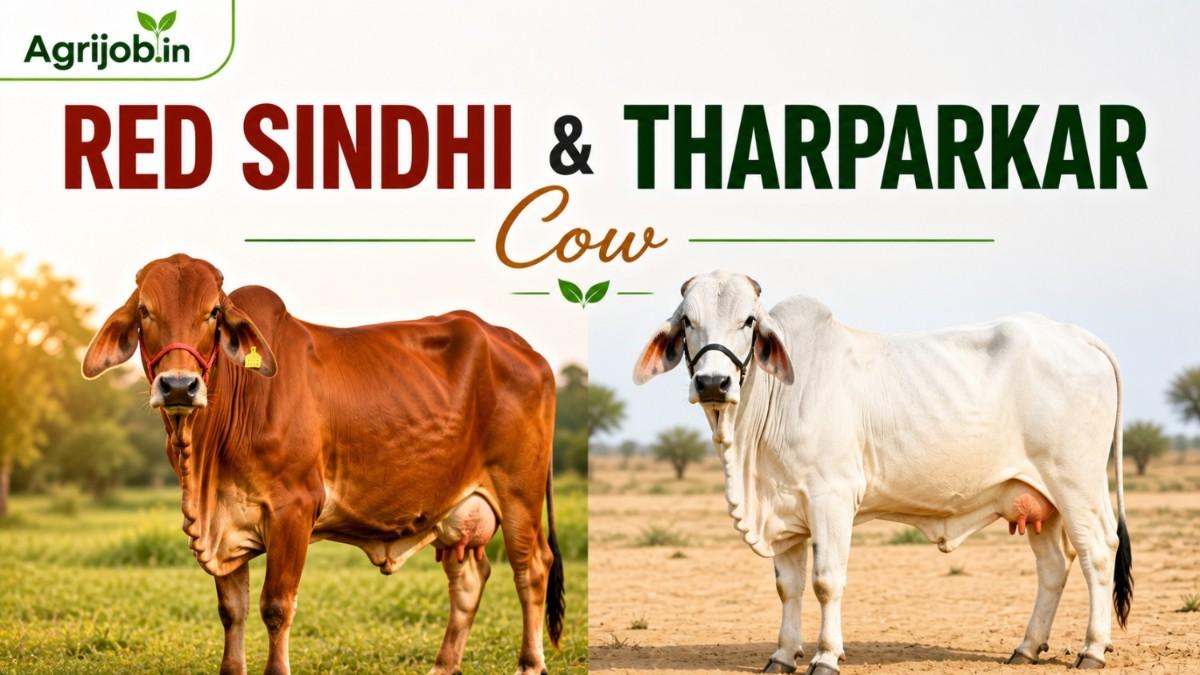
Red Sindhi and Tharparkar are ICAR-NBAGR registered Bos indicus (zebu) cattle breeds from India’s arid northwest. Red Sindhi, native to the Karachi region of Sindh, is a milk-specialist breed producing 1,100–2,600 kg per lactation. Tharparkar, native to Rajasthan’s Thar Desert and Gujarat’s Kutch district, is a dual-purpose breed used for both milk and light draught work.
Both breeds trace their ancestry to the same arid belt straddling modern Sindh, Rajasthan, and Gujarat. Red Sindhi is also known as Malir, Red Karachi, or simply Sindhi, and carries a deep red to reddish-brown coat with occasional white patches on the dewlap and forehead. Tharparkar goes by White Sindhi, Grey Sindhi, Thari, or Cutchi, and is easy to spot by its white-to-light-grey coat that darkens on the face and legs.

| Attribute | Red Sindhi | Tharparkar |
|---|---|---|
| Native Tract | Karachi/Hyderabad region, Sindh | Tharparkar district (Sindh) & Thar Desert, Rajasthan/Kutch |
| Other Names | Malir, Red Karachi, Sindhi | White Sindhi, Grey Sindhi, Thari, Cutchi |
| Recognised By | ICAR-NBAGR | ICAR-NBAGR |
| Coat Colour | Deep red to reddish-brown | White to light grey, darker face/legs |
| Adult Male Weight | 350–530 kg | 400–500 kg |
| Adult Female Weight | 325–400 kg | 300–400 kg |
| Primary Purpose | Milk (dairy specialist) | Dual purpose — milk & draught |
Who Should Raise These Breeds?
A Red Sindhi Tharparkar cow is not the right fit for every dairy operation. Here’s who gets the most value from these two breeds:
- 🌾 Small and marginal farmers in drought-prone or low-rainfall districts of Bihar, Rajasthan, and Gujarat
- 🐄 Existing dairy farmers looking to shift from high-input crossbreds to low-maintenance desi cattle
- 👩🌾 Women and Jeevika SHG members applying under Bihar’s Desi Gaupalan Protsahan Yojana
- 🎓 Educated unemployed rural youth exploring self-employment through dairy entrepreneurship
- 🏜️ Farmers in arid or semi-arid zones with scarce fodder, irrigation, and veterinary access
- 🥛 A2 milk and desi ghee entrepreneurs targeting premium urban or export-quality markets
- 🐮 Gaushala operators and FPOs working to conserve indigenous cattle genetics
- 📋 Anyone comparing Rashtriya Gokul Mission or NLM subsidy routes before investing in cattle
Milk Yield, Price & Value Details
Milk output and purchase cost decide whether a Red Sindhi Tharparkar cow pays for itself. Both breeds trail exotic crossbreds in raw litres but win on lower feed cost, longer productive life, and A2 milk price premiums.
| Milk Metric | Red Sindhi | Tharparkar |
|---|---|---|
| Average daily yield | 6–8 litres | 6–8 litres |
| Peak/well-managed yield | 10–15 litres | 10–15 litres |
| Lactation yield (range) | 1,100–2,600 kg | 913–2,147 kg (up to 2,500 kg on farms) |
| Average lactation yield | ~1,840 kg | ~1,749 kg |
| Fat content | ~5.0% | ~4.9–5.0% |
| Age at first calving | ~41 months | ~40–47 months |
| 2026 Purchase Price | Red Sindhi | Tharparkar |
|---|---|---|
| Heifer / young unbred | ₹30,000–₹50,000 | ₹30,000–₹55,000 |
| Average milch cow | ₹50,000–₹70,000 | ₹55,000–₹75,000 |
| High-yield / pedigree-verified | ₹70,000–₹2.5 lakh+ | ₹80,000–₹1.5 lakh+ |
Illustrative income estimate: a 2-cow unit giving a combined 14–16 litres/day, sold through a Sudha COMFED-linked cooperative at roughly ₹50–₹60/litre for desi A2 milk, generates gross revenue of about ₹21,000–₹28,800 per month. After feed costs of roughly ₹8,000–₹10,000 for two animals, net income lands near ₹12,000–₹19,000 per month — before accounting for the capital subsidy that cuts your upfront investment. These figures are indicative; actual returns depend on local milk price, feed cost, and animal health.
Eligibility & Subsidy Schemes
A Red Sindhi Tharparkar cow purchase can be subsidised through Central and state schemes, but breed eligibility and subsidy percentage vary by program. Check the table below before you buy.
| Scheme | Breeds Covered | Subsidy | Beneficiary |
|---|---|---|---|
| Rashtriya Gokul Mission (Central) | All ICAR-registered indigenous breeds | Up to 50% capital cost (max ₹2 crore for breed multiplication farms) | Entrepreneurs, Gaushalas, SIAs |
| National Livestock Mission — EDP (Central) | Indigenous dairy cow/buffalo units | Up to 50% capital subsidy (component-dependent cap) | Individuals, FPOs, SHGs, JLGs |
| Bihar Desi Gaupalan Protsahan Yojana (State) | Sahiwal, Gir, Tharparkar | 75% (SC/ST/EBC), 50% (general) | Small/marginal farmers, women, Jeevika SHGs |
| Bihar Pashupalan Loan Yojana (State) | Not breed-restricted | 75% (SC/ST), 50% (general) | Any Bihar resident farmer |
| UP Nand Baba Dugdh Mission (State) | Gir, Sahiwal, Haryana, Tharparkar, Gangatiri | Up to 40% (₹80,000 for 2-cow unit) | UP-domiciled farmers |
General eligibility documents: Aadhaar card, land ownership or lease record, DBT-linked bank passbook, caste certificate (for the higher SC/ST/EBC subsidy slab), a basic project report or self-declaration, and — for 10-cow-plus units — a rearing experience certificate from the block veterinary officer. Bihar’s Desi Gaupalan Protsahan Yojana specifically lists Sahiwal, Gir, and Tharparkar as approved breeds; Red Sindhi buyers in Bihar should confirm current breed eligibility with their district Gavya Vikas office before applying, since it is not named in the published breed list.
How to Buy & Start Rearing — Step-by-Step
- Select a verified source. Buy from an ICAR-recognised breeding farm, the NDDB e-Pashuhaat portal, or your State Livestock Development Board rather than an unverified roadside seller.
- Verify pedigree and health records. Ask for the vaccination card, at least one prior lactation’s milk record, and a veterinary health certificate before paying.
- Apply for subsidy before purchase. Most schemes, including Bihar’s Desi Gaupalan Protsahan Yojana, pay a back-ended subsidy released only after verified expenditure — apply through your Block Animal Husbandry Officer first.
- Build a suitable shed. Allow at least 40–50 sq ft of covered, cross-ventilated space per animal; heat-tolerant breeds still need shade and clean water during peak summer.
- Register for Pashu Aadhaar. Get the animal tagged with its 12-digit identification number under Pashu Sanjivani — most subsidy and insurance schemes require this.
- Feed a balanced daily ration. Provide 20–25 kg green fodder, 4–5 kg dry fodder, 2–2.5 kg concentrate feed, and 50 g mineral mixture for peak lactation yield.
- Join a dairy cooperative. Register with Sudha COMFED or your local milk union for assured procurement and the desi-milk price premium.
- Insure the animal. Enrol under Pradhan Mantri Pashudhan Bima Yojana for up to 50% premium subsidy against death or theft.
Never buy a Red Sindhi or Tharparkar cow within two months of calving without seeing at least one prior lactation record. First-lactation yield typically runs 15–20% below mature yield, and some sellers quote a first-calver’s number as if it were the animal’s peak capacity.
Red Sindhi vs Tharparkar — Which Is Better?
Choosing between Red Sindhi and Tharparkar comes down to your region’s climate and whether you need a milk specialist or a dual-purpose animal.
| Factor | Red Sindhi | Tharparkar |
|---|---|---|
| Native climate | Arid, humid-coastal Sindh | Extreme dry desert, Thar/Kutch |
| Primary use | Milk specialist | Dual purpose (milk + draught) |
| Daily milk | 6–10 litres | 6–8 litres (up to 10–15 well-managed) |
| Lactation yield | 1,100–2,600 kg | 913–2,147 kg |
| Heat tolerance | Excellent | Excellent |
| Extreme drought/fodder scarcity | Very good | Best-in-class — thrives on Sewan grass |
| Bihar Desi Gaupalan Yojana listed | Not listed — verify locally | Yes, listed with Sahiwal and Gir |
| Best for | Farmers prioritising milk volume | Farmers in extreme drought/arid zones needing a dual-purpose animal |
For Bihar farmers applying under the Desi Gaupalan Protsahan Yojana, Tharparkar is the safer choice today because it is explicitly listed alongside Sahiwal and Gir in the scheme’s approved breed list, while Red Sindhi eligibility needs confirmation from your district Gavya Vikas office. For pure milk volume outside a state scheme, Red Sindhi’s higher upper-range yield gives it a slight edge.
Pros and Cons of These Desi Breeds
Pros
- Survive on Sewan grass and scarce fodder where crossbreds fail, especially Tharparkar
- High resistance to ticks, heat stress, and endemic diseases cuts veterinary cost
- A2 beta-casein milk earns a price premium over regular A1 crossbred milk
- Productive for 15–20 years across 8–12 lactations — longer working life than most crossbreds
Cons
- Lower absolute milk yield than Holstein Friesian or Jersey crossbreds (15–25+ litres/day)
- Later age at first calving (around 41 months) delays return on investment
- Pedigree-verified pure animals can be hard to source outside the native breeding tract
- Red Sindhi is not currently listed under Bihar’s Desi Gaupalan Protsahan Yojana breed list
Important Terms Related to Desi Cow Farming
- A2 Milk: milk containing only the A2 beta-casein protein, found in Red Sindhi, Tharparkar, Gir, and Sahiwal, and sold at a 20–40% price premium over regular A1 milk.
- Zebu Cattle (Bos indicus): the humped cattle subspecies native to South Asia; both breeds in this guide belong here, unlike taurine breeds such as Holstein Friesian.
- Lactation Yield: total milk produced in one complete milking cycle of roughly 270–310 days — the standard figure for comparing breed productivity.
- ICAR-NBAGR: the National Bureau of Animal Genetic Resources, Karnal — the government body that officially registers India’s 55+ indigenous cattle breeds.
- Rashtriya Gokul Mission: the Central government’s flagship indigenous-breed conservation scheme, offering up to 50% capital subsidy for breed multiplication farms.
- Gokul Gram: an integrated cattle development centre set up under RGM to breed and multiply high-genetic-merit indigenous cattle in their native tract.
- Back-Ended Subsidy: government subsidy released only after the beneficiary completes and verifies a defined share of project expenditure — the model used by Bihar’s Desi Gaupalan Protsahan Yojana.
- Pashu Aadhaar: the 12-digit unique identification number issued to each registered bovine, required for most subsidy and insurance schemes.
- Sex-Sorted Semen: artificial-insemination semen processed to raise the odds of a female calf, subsidised up to 50% under Rashtriya Gokul Mission.
- Dairy Entrepreneurship: any self-employed dairy business with two or more animals, eligible for capital subsidy under NLM or state schemes like Bihar’s Pashupalan Loan Yojana.
Important Dates & Scheme Timeline
| Scheme | Validity / Cycle | Application Window |
|---|---|---|
| Rashtriya Gokul Mission (revised) | 2021-22 to 2025-26, revised outlay approved March 2025 | Ongoing, via State Implementing Agency |
| National Livestock Mission — EDP | Realigned from 2021-22, continuing | Ongoing at nlm.udyamimitra.in |
| Bihar Desi Gaupalan Protsahan Yojana | Under Saat Nishchay-2, phased district rollout | Check dairy.bihar.gov.in or district Gavya Vikas office |
| Bihar Pashupalan Loan Yojana | Active across all 38 districts | Rolling — apply via Block/District office |
As per the official notification, exact district-wise application dates and quotas can change — always confirm the current window on the official portal before applying.
Important Links
| Link Name | URL |
|---|---|
| Rashtriya Gokul Mission (Official — DAHD) | dahd.gov.in/rashtriya-gokul-mission |
| National Livestock Mission (Official — DAHD) | dahd.gov.in/national-livestock-mission |
| NLM Application Portal | nlm.udyamimitra.in |
| ICAR-NBAGR Red Sindhi Breed Profile | nbagr.icar.gov.in — Red Sindhi |
| Bihar Dairy & Gavya Vikas Department | dairy.bihar.gov.in |
| Bihar Pashupalan Loan Yojana 2026 (agrijob.in) | Read full guide |
| Pradhan Mantri Pashudhan Bima Yojana 2026 (agrijob.in) | Insure your cattle |
| Best Dairy Cow Breeds in India 2026 (agrijob.in) | Compare all breeds |
Conclusion
A Red Sindhi Tharparkar cow is the practical choice for any farmer whose land sees more drought than rainfall — both breeds keep producing milk on scarce fodder where high-input crossbreds struggle. Tharparkar currently has the clearer subsidy path in Bihar through the Desi Gaupalan Protsahan Yojana, while Red Sindhi remains the stronger pick for farmers chasing higher peak milk volume. Confirm your district’s current breed eligibility and apply for the subsidy before you purchase — the back-ended payment structure rewards farmers who follow the process in order.
- Red Sindhi gives 6–10 litres/day; Tharparkar gives 6–8 litres/day, both on low-input feed.
- 2026 prices range from ₹30,000 for a heifer to ₹2.5 lakh for a pedigree-verified animal.
- Bihar’s Desi Gaupalan Protsahan Yojana lists Tharparkar (with Sahiwal and Gir) for 50–75% subsidy.
- Rashtriya Gokul Mission and NLM add Central subsidy routes up to 50% of project cost.
- Both breeds stay productive for 15–20 years across 8–12 lactations.
- Apply for subsidy first, then purchase — most schemes use back-ended disbursement.
Frequently Asked Questions About Red Sindhi Tharparkar Cow
What is the daily milk yield of a Tharparkar cow?
A Tharparkar cow gives 6–8 litres of milk daily under normal smallholder conditions, rising to 10–15 litres for well-managed animals with good nutrition. Total lactation yield ranges from 913 to 2,147 kg, averaging around 1,749 kg per lactation cycle.
How much milk does a Red Sindhi cow give daily?
A Red Sindhi cow produces 6–10 litres of milk per day on average, with high-genetic-merit animals reaching 10–15 litres. Its lactation yield ranges from 1,100 to 2,600 kg, with roughly 5% average fat content.
What is the price of a Red Sindhi cow in India in 2026?
Red Sindhi cow prices in 2026 range from about ₹30,000–₹50,000 for a young heifer to ₹50,000–₹70,000 for an average milch cow, and up to ₹2.5 lakh or more for a high-yield, pedigree-verified animal purchased from a certified government farm.
What is the price of a Tharparkar cow in 2026?
Tharparkar cow prices in 2026 typically range from ₹30,000–₹55,000 for a heifer to ₹55,000–₹75,000 for an ordinary milch cow, with good milch animals giving 10–15 litres/day priced at ₹80,000 and above.
Which is better for a small farmer, Red Sindhi or Tharparkar?
Tharparkar suits farmers in extreme drought or fodder-scarce zones and those applying for Bihar’s Desi Gaupalan Protsahan Yojana, since it is on the approved breed list. Red Sindhi suits farmers prioritising higher peak milk volume in hot, humid climates outside that specific scheme.
Is there a government subsidy for buying a Tharparkar cow in Bihar?
Yes. Bihar’s Desi Gaupalan Protsahan Yojana funds Tharparkar, Sahiwal, and Gir cow units at 75% subsidy for SC/ST/EBC applicants and 50% for the general category, on an approved project cost of ₹2.42 lakh (2-cow unit) or ₹5.20 lakh (4-cow unit).
Can Red Sindhi and Tharparkar cows survive drought conditions?
Yes, both breeds are bred for drought endurance. Tharparkar can sustain itself on sparse bushy vegetation like Sewan grass with minimal water, while Red Sindhi shows strong heat and tick resistance and continues cycling and producing calves even under harsh feed conditions.
What is A2 milk and why does it matter for these breeds?
A2 milk contains only the A2 beta-casein protein instead of the A1 protein found in most crossbred and exotic cattle milk. Both Red Sindhi and Tharparkar naturally produce A2 milk, which commands a 20–40% price premium in urban and health-conscious markets.
How do I apply for the Rashtriya Gokul Mission subsidy?
Rashtriya Gokul Mission subsidy is routed through your State Implementing Agency, typically the state Livestock Development Board. Entrepreneurs submit a bankable project proposal, obtain bank loan sanction, and the subsidy is released in installments after the State Implementing Agency verifies project progress.
What is the lifespan and number of lactations of these cows?
Both Red Sindhi and Tharparkar cows live productively for 15–20 years and sustain 8–12 lactation cycles with proper nutrition and veterinary care, making them a longer-term investment than most high-yield exotic crossbreds.
Last Updated: August 2026. This guide is reviewed and updated regularly for accuracy — bookmark this page for the latest Red Sindhi Tharparkar cow price, milk yield, and subsidy information.
Disclaimer: Subsidy percentages, project costs, and scheme eligibility mentioned in this guide are based on publicly available government notifications and may change without notice. Always verify current details with your district Animal Husbandry / Gavya Vikas office or the official scheme portal before applying or purchasing an animal. This article is for general informational purposes and does not constitute financial or veterinary advice.