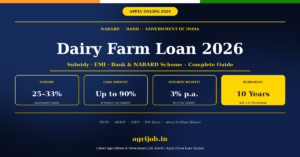

Punjab Dairy Development Board scheme loans 2026 give Punjab farmers institutional finance of up to Rs.33 lakh per component — backed by a 25% subsidy for general category and 33% for SC/ST beneficiaries under NABARD’s Dairy Entrepreneurship Development Scheme (DEDS). Punjab produces 13 million tonnes of milk annually and leads India in per-animal milk yield, yet thousands of dairy farmers still lack structured financing to scale their units. This guide is for Punjab farmers, rural youth aged 18–50, dairy entrepreneurs, and SC/ST beneficiaries who want to set up or expand a dairy farm using PDDB-facilitated bank loans. We cover every scheme, every loan amount, all eligibility rules, required documents, and the exact step-by-step application process for 2026.

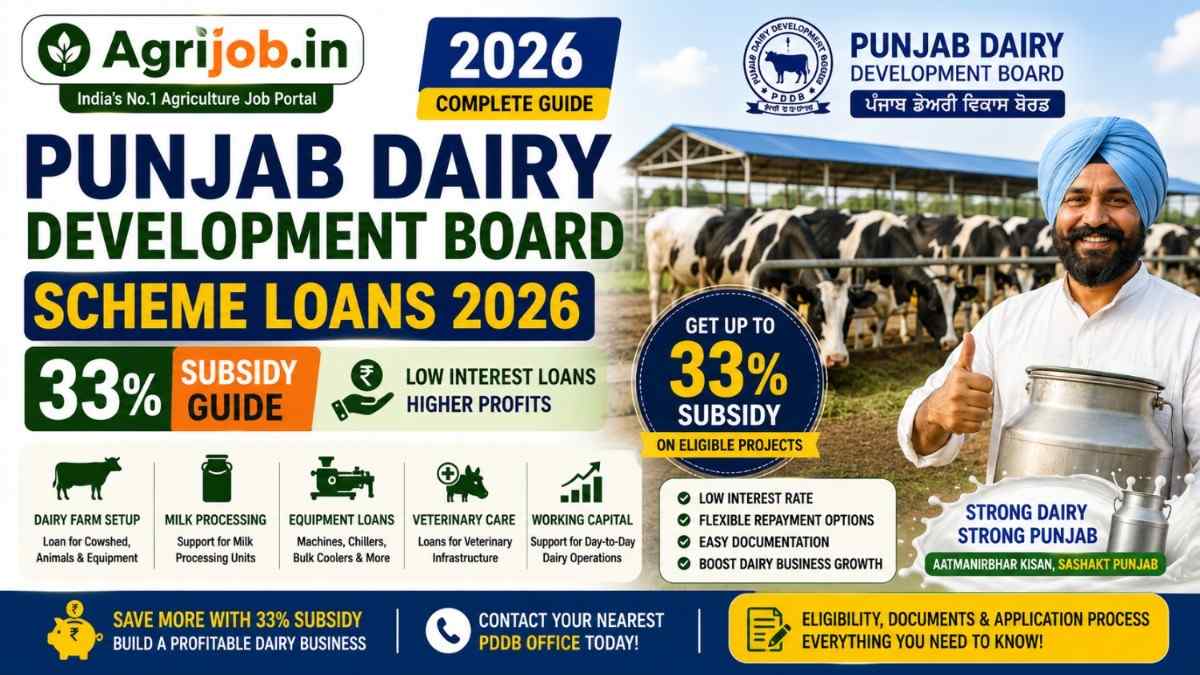
Punjab Dairy Development Board (PDDB) scheme loans in 2026 cover dairy units of 2–20 milch animals with project costs of Rs.1.20 lakh to Rs.6 lakh for small units, and up to Rs.33 lakh for cold storage — with 25% NABARD subsidy (33% for SC/ST) and repayment terms of 3–7 years through any commercial or cooperative bank. Apply via your nearest bank branch after completing the mandatory 2-week PDDB training.
- Nodal Agency: Punjab Dairy Development Board (PDDB), Livestock Complex, Sector-68, SAS Nagar
- Central Scheme: NABARD Dairy Entrepreneurship Development Scheme (DEDS)
- Loan Range: Rs.1.20 lakh (2-animal unit) to Rs.33 lakh (cold storage facility)
- Subsidy — General Category: 25% back-ended capital subsidy
- Subsidy — SC/ST Category: 33.33% back-ended capital subsidy
- Repayment Tenure: 3 to 7 years (depending on project type)
- Grace Period: 3–6 months (up to 3 years for calf-rearing units)
- Minimum Qualification: 5th class pass (2-week PDDB training mandatory)
- New Dairy Units Established Per Year: ~200 (via PDDB facilitation)
- Fodder Harvester Subsidy: Rs.50,000 (General) | Rs.63,000 (SC/ST)
- PDDB Contact: 0172-5027285 | dairydevpunjab.org
- Milk Price Hike (2026): Rs.20 per kg fat increase by Milkfed (effective May 1, 2026)
- What Is the Punjab Dairy Development Board and Its Loan Scheme?
- Who Should Apply for PDDB Scheme Loans?
- Loan Amounts and Subsidy Details Under Each Scheme Component
- Eligibility Criteria and Requirements for PDDB Loans
- How to Apply for Punjab Dairy Development Board Scheme Loans
- PDDB NABARD Loan vs MUDRA Dairy Loan — Which Is Better?
- Pros and Cons of Punjab Dairy Development Board Scheme Loans
- Important Terms Related to PDDB Dairy Scheme Loans
- Important Dates and Milestones
- Important Links
- Conclusion
- Frequently Asked Questions About Punjab Dairy Development Board Scheme Loans 2026
What Is the Punjab Dairy Development Board and Its Loan Scheme?
The Punjab Dairy Development Board (PDDB) is the apex body established under the Punjab Dairy Development Board Act, 2000 to develop Punjab into a national leader in dairy farming. It operates under the Department of Animal Husbandry, Dairy Development and Fisheries, Government of Punjab, and sits at Livestock Complex, 4th Floor, Sector-68, SAS Nagar (Mohali).
The PDDB does not directly disburse loans to farmers. Instead, it functions as a facilitating and training body: it trains farmers, guides them through the mandatory PDDB certification, and assists them in approaching banks and financial institutions for dairy farm loans. The actual credit is channeled via commercial banks, cooperative banks, and regional rural banks (RRBs), with NABARD providing refinance and back-ended capital subsidies.

Punjab’s dairy sector produces approximately 13 million tonnes of milk annually, contributing 7% of India’s total milk output, according to the Ministry of Food Processing Industries (MOFPI). India’s milk production reached 247 million tonnes in 2025, with Punjab leading in per-animal yield — driven by superior fodder availability, high-yield Murrah buffalo and crossbred cow breeds, and strong institutional support from bodies like PDDB and Milkfed (Verka). The PDDB facilitates establishment of approximately 200 new dairy units every year, securing institutional finance of around Rs.200 crores annually to support these farms.
What Are the Core Functions of PDDB?
- Policy Formulation: Develops strategies for genetic improvement of milch animals and quality enhancement of milk products
- Loan Facilitation: Assists prospective dairy farmers in raising institutional loans from banks under NABARD DEDS and other schemes
- Training and Extension: Runs 2-week and 4-week dairy training programs at Dairy Training and Extension Centres (Chatamli, Sangrur and Bija)
- Mechanization Subsidies: Provides incentives on Self-Propelled Forage Cutters, Fodder Harvesters, Automatic Mixing and Feeding Units, and Automatic Milk Dispensing Units
- Research and Development: Undertakes projects to increase dairy productivity and quality
Who Should Apply for PDDB Scheme Loans in 2026?
PDDB dairy scheme loans are designed for a broad range of beneficiaries across Punjab. Check whether your profile fits one of the eight categories below before beginning the application process.
- 🐄 Small and Marginal Farmers: Punjab domicile holders who own or lease agricultural land and want to set up a 2–10 animal dairy unit as a supplementary income source
- 👨🎓 Educated Unemployed Rural Youth (18–45 years): Those who have completed at least 10th class and want to start a dairy parlor or mini-processing unit with a PDDB loan and Rs.1 lakh dairy parlor financing
- 👩🌾 Women Dairy Entrepreneurs: Women in Punjab’s rural areas aiming to establish village-level milk collection units or self-help group (SHG) dairy ventures — eligible for all DEDS components
- 🏗️ SC/ST Beneficiaries: Scheduled Caste and Scheduled Tribe applicants who receive a higher 33% subsidy under NABARD DEDS and Rs.63,000 on fodder harvester vs Rs.50,000 for general category
- 🐃 Existing Dairy Farmers Looking to Expand: Those who already own 2–5 milch animals and want to scale to 10–20 animals using the heifer calf rearing or bulk milk cooling unit components
- 🧊 Entrepreneurs in Milk Processing: Those interested in setting up indigenous milk product manufacturing units (project cost: Rs.26.50 lakh) or cold storage facilities (up to Rs.33 lakh) with NABARD financing
- 🚜 Farmers Seeking Mechanization Support: Those wanting to buy Milking Machines, Milkotesters, or Bulk Milk Cooling Units (up to 5,000 litres) under the Rs.20 lakh NABARD component
- 🏘️ Rural Youth Post PDDB Training: Those who have completed the mandatory 2-week PDDB Dairy Training Certificate and are now ready to apply for the DD-8 scheme (2 to 20 milch animals)
Loan Amounts and Subsidy Details Under Each PDDB Scheme Component
The Punjab Dairy Development Board facilitates loans under the NABARD Dairy Entrepreneurship Development Scheme (DEDS) across multiple components. Each component has a defined project cost ceiling, and subsidies are applied as back-ended capital subsidies — meaning the bank gives you the full loan first, and the subsidy is adjusted once you receive it from NABARD via the bank.
| Scheme Component | Project Cost Ceiling | General Subsidy (25%) | SC/ST Subsidy (33%) |
|---|---|---|---|
| Small dairy unit — 2 milch animals | Rs.1.20 lakh | Rs.30,000 | Rs.39,600 |
| Small dairy unit — 10 milch animals (max) | Rs.6.00 lakh | Rs.1.25 lakh (ceiling) | Rs.1.67 lakh (ceiling) |
| Rearing of heifer calves — up to 20 calves | Rs.5.30 lakh | 25% of outlay | 33% of outlay |
| Milking machines / Milkotesters / Bulk Milk Cooling Units (up to 5,000 litres) | Rs.20 lakh | 25% of outlay | 33% of outlay |
| Dairy processing equipment (indigenous milk products) | Rs.26.50 lakh | 25% of outlay | 33% of outlay |
| Cold storage facilities for milk and milk products | Rs.33 lakh | 25% of outlay | 33% of outlay |
| Dairy marketing outlet / Dairy parlor | Rs.1.00 lakh | 25% of outlay | 33% of outlay |
| Fodder Harvester (mechanization incentive) | Market rate | Rs.50,000 subsidy | Rs.63,000 subsidy |
Source: Dairy Development Department, Punjab — patiala.nic.in; NABARD DEDS scheme guidelines — nabard.org
Under the DD-8 Scheme (the state-level dairy facilitation scheme), trained PDDB certificate holders can access bank loans for 2 to 20 milk cattle through participating banks. Working capital of approximately Rs.2,500 per animal per year may also be sanctioned alongside the term loan for feed, fodder, and medicine costs.
How Much Does a 10-Cow Dairy Farm Earn in Punjab in 2026?
Punjab farmers supplying milk to Milkfed (Verka) received a Rs.20 per kg fat hike effective May 1, 2026, as announced by Chief Minister Bhagwant Singh Mann. A typical high-yield Murrah buffalo produces 8–12 litres per day at 7–8% fat. At revised Verka rates, a 10-animal buffalo unit can generate Rs.40,000–Rs.55,000 per month in gross milk income — and net income of Rs.18,000–Rs.30,000 after accounting for feed and operational costs. This makes a PDDB-facilitated loan one of the most bankable agricultural investments in Punjab.
Eligibility Criteria and Requirements for PDDB Scheme Loans
To access Punjab Dairy Development Board facilitated loans in 2026, applicants must meet the following eligibility criteria as defined by the Dairy Development Department, Punjab and NABARD DEDS guidelines.
- Domicile Requirement: Applicant must be a resident of Punjab — the scheme is not available to farmers from other states
- Minimum Educational Qualification: 5th class pass (for 2-week training programme) or 10th class pass (for 4-week entrepreneurship training and DD-8 scheme)
- Age Limit: 18 to 50 years (training eligibility); 18 to 45 years for the 4-week and DD-8 schemes
- Training Certificate: Mandatory 2-week Dairy Training Certificate from a PDDB Dairy Training and Extension Service Centre (Verka, Amritsar; Chatamli, Sangrur; or Bija)
- Land Requirement: Farmer must have land or a registered lease deed for raising adequate fodder
- Rural Background: Applicant must have a rural background
- Non-Defaulter Status: Affidavit required confirming the applicant is not a defaulter of any financial institution
- NABARD DEDS Family Rule: Only once per component per individual; family members must set up separate units at least 500 metres apart
Application Fee Structure
| Training Programme | General Category Fee | SC Category Fee |
|---|---|---|
| 2-Week Dairy Training (prerequisite for loan) | Rs.1,000 | Rs.750 |
| 4-Week Dairy Entrepreneurship Training | Rs.5,000 | Rs.4,000 |
| Bank Loan Processing Fee | As per bank norms | As per bank norms |
Documents Required for PDDB Dairy Scheme Loan Application
- ✅ Aadhaar Card (mandatory — Aadhaar-linked bank account preferred)
- ✅ PDDB 2-week Dairy Training Certificate from an authorised centre
- ✅ Qualification Certificate (educational proof)
- ✅ Caste Certificate (for SC/ST applicants — mandatory for higher subsidy)
- ✅ Passport-size photograph (minimum 2 copies)
- ✅ Land ownership document or registered lease deed (for fodder cultivation proof)
- ✅ Bank account passbook (active, DBT-linked)
- ✅ Affidavit — proof of non-employment status and non-defaulter declaration
- ✅ Land documents for mortgage (required if loan exceeds Rs.1 lakh)
- ✅ Detailed Project Report (DPR) — including animal breed, shed design, cost breakdown, income projection
How to Apply for Punjab Dairy Development Board Scheme Loans — Step-by-Step
Applying for a PDDB dairy scheme loan is a multi-step process involving training, bank liaison, and NABARD subsidy registration. Follow each step carefully — missing any one step can delay disbursement by months.
- Attend the Mandatory PDDB Training: Visit the nearest Dairy Training and Extension Centre (Verka/Amritsar, Chatamli/Sangrur, or Bija) and enroll in the 2-week dairy training programme. Fee: Rs.1,000 (General) or Rs.750 (SC). This certificate is non-negotiable for loan eligibility.
- Get a Dairy Training Certificate: After successfully completing the training, collect your official PDDB Dairy Training Certificate. Keep 3 attested photocopies ready — the bank and NABARD both require this.
- Prepare Your Detailed Project Report (DPR): Take assistance from your District Deputy Director (Dairy) or the Dy. Director Dairy at district level to prepare a DPR covering: number and breed of animals, shed specifications, cost estimate, and projected monthly income. The DPR is the backbone of your bank application.
- Approach a Participating Bank: Visit any commercial bank (SBI, PNB, Bank of Baroda), state cooperative bank, or regional rural bank (RRB) branch in Punjab. Ask specifically for the NABARD DEDS dairy loan product or Allied Activities Term Loan. Submit your DPR, PDDB certificate, Aadhaar, land documents, and affidavit.
- Bank Appraisal and Loan Sanction: The bank will conduct site inspection, appraise your project, and sanction the loan based on NABARD’s unit cost norms. Loan disbursement may be in one or multiple tranches depending on the project phase.
- Project Implementation: Use the sanctioned loan strictly for the stated purpose — purchase of milch animals, shed construction, equipment purchase. Keep all bills and receipts; these are required for the subsidy claim.
- Subsidy Claim via Bank: After the project is operational, your bank submits the subsidy claim to NABARD on your behalf. NABARD releases the back-ended subsidy directly into a lien account at your bank, which is then adjusted against your outstanding principal — reducing your effective loan burden.
- Register with Milkfed/Verka (Recommended): Join a local milk cooperative society affiliated with Milkfed Punjab (Verka) for assured milk procurement. As of May 2026, Verka pays Rs.20 per kg fat more than the previous rate — making this the most financially rewarding route for milk marketing in Punjab.
Complete the 4-week Dairy Entrepreneurship Training (Rs.5,000 for General / Rs.4,000 for SC) instead of just the 2-week programme if you plan to establish a dairy unit with 5 or more animals. The 4-week course covers artificial insemination, milk processing, and business management — skills that directly improve your DPR quality and increase your chances of loan sanction at first submission.
PDDB NABARD Dairy Loan vs MUDRA Dairy Loan — Which Is Better?
Punjab dairy farmers in 2026 have two primary structured loan routes: the PDDB-facilitated NABARD DEDS loan and the Pradhan Mantri MUDRA Yojana (PMMY) for allied agricultural activities. The two schemes differ significantly in subsidy structure, documentation, and scale.
| Feature | PDDB + NABARD DEDS | MUDRA Dairy Loan (PMMY) |
|---|---|---|
| Nodal Agency | NABARD / Punjab PDDB | MUDRA Ltd via banks/MFIs/NBFCs |
| Max Loan Amount | Rs.33 lakh (per component) | Rs.20 lakh (Tarun Plus category) |
| Capital Subsidy | 25% (General) | 33% (SC/ST) | No direct subsidy |
| Training Requirement | 2-week PDDB certificate mandatory | No training prerequisite |
| Repayment Period | 3–7 years with grace period | 3–5 years typically |
| Processing Speed | Slower (subsidy claim cycle: 6–12 months) | Faster (7–15 working days in many cases) |
| Best For | Large-scale units (10+ animals), processing, cold storage | Small-scale dairy, quick working capital |
| Collateral | Required for loans above Rs.1 lakh | No collateral up to Rs.10 lakh |
| SC/ST Benefit | Extra 8% subsidy over general category | Priority sector, no extra subsidy |
| Milk Marketing Link | Encourages Milkfed/Verka tie-up | No mandated marketing linkage |
For Punjab farmers planning units of 5 animals or more, cold storage, or milk processing — the PDDB-facilitated NABARD DEDS route is clearly superior due to the 25–33% capital subsidy that permanently reduces your debt burden. For small-scale operators needing quick working capital for 2–3 animals, MUDRA’s Shishu or Kishore products (Rs.50,000–Rs.5 lakh) are faster and require less paperwork. The ideal strategy: use NABARD DEDS for the capital investment and MUDRA (or KCC for Allied Activities) for recurring feed and operational costs.
Pros and Cons of Punjab Dairy Development Board Scheme Loans
Advantages
- ✅ Substantial back-ended capital subsidy of 25–33% permanently reduces the principal you repay
- ✅ Access to Rs.200 crore institutional finance per year facilitated by PDDB — strong bank confidence in scheme-backed proposals
- ✅ Free and subsidised training at three PDDB centres builds genuine farm management skills before you take on debt
- ✅ Covers all dairy value-chain components — from milch animals to cold storage to dairy parlors — under a single financing umbrella
- ✅ Milkfed (Verka) market linkage provides assured procurement at competitive prices (Rs.20/kg fat hike in May 2026 directly benefits loan applicants)
Disadvantages
- ❌ Slow subsidy release cycle: The back-ended subsidy can take 6–12 months to reflect in your account after project completion, creating interim cash flow stress
- ❌ NABARD DEDS listed as temporarily closed on the official NABARD website as of mid-2026 — verify current operational status with your bank or NABARD District Development Manager before applying
- ❌ Mandatory training requirement (2-week programme + Rs.1,000 fee) adds a prerequisite step that delays the loan application by 2–3 weeks
- ❌ Collateral required for loans above Rs.1 lakh — smallholder farmers without land title face difficulty
Important Terms Related to Punjab Dairy Development Board Scheme Loans
Understanding these key financial and dairy sector terms will help you navigate the PDDB loan application, communicate with your bank manager confidently, and avoid common documentation errors.
- PDDB (Punjab Dairy Development Board): The apex state dairy body established under the Punjab Dairy Development Board Act, 2000, headquartered at Livestock Complex, Sector-68, SAS Nagar, responsible for loan facilitation, training, and dairy policy in Punjab
- NABARD DEDS: Dairy Entrepreneurship Development Scheme — the central government’s back-ended capital subsidy scheme launched in 2010 and implemented by NABARD (National Bank for Agriculture and Rural Development) for bankable dairy projects from Rs.1.20 lakh to Rs.33 lakh
- Back-ended Capital Subsidy: A subsidy that is not given upfront; instead, the bank provides the full loan, and the subsidy is credited to a lien account and adjusted against principal after project verification — effectively reducing your repayment burden after the fact
- DD-8 Scheme: The Punjab state-level dairy facilitation scheme under which PDDB-trained farmers can access bank loans for 2 to 20 milch cattle through partner banks
- Milch Animal: A female animal in lactation that produces milk — includes crossbred cows (HF, Jersey), indigenous cows (Sahiwal, Gir, Red Sindhi), and graded buffaloes (Murrah, Nili-Ravi) — the core asset financed under PDDB loans
- DPR (Detailed Project Report): A formal document submitted to the bank describing your dairy project — includes number of animals, breed, shed plan, equipment list, cost estimate, and 5-year income projection; the single most important document for loan sanction
- Milkfed / Verka: Punjab State Cooperative Milk Producers’ Federation Ltd, North India’s largest dairy cooperative marketing milk and dairy products under the Verka brand; the primary milk buyer for PDDB loan beneficiaries, with 2.5 lakh farmer members and a Rs.100 crore/month rural economy impact
- KCC (Kisan Credit Card) for Allied Activities: A revolving credit facility for dairy farmers for recurring costs like feed, veterinary services, and labour — complementary to the term loan under DEDS; available from SBI, PNB, Bank of Baroda, and cooperative banks
- TMR Wagon (Total Mixed Ration): An Automatic Mixing and Feeding Unit subsidized by PDDB for mechanization of dairy farming — improves feed efficiency and milk output per animal
- AHIDF (Animal Husbandry Infrastructure Development Fund): A central government fund offering 3% interest subvention for dairy processing, cold chain, and value-added product manufacturing — complementary to PDDB/NABARD loans for scale-up projects above Rs.10 lakh
Important Dates and Programme Timeline for PDDB Dairy Loans
| Event / Milestone | Date / Period |
|---|---|
| PDDB established under Punjab Act | Year 2000 |
| Dairy Development Department set up (separated from AH Dept) | 1964 |
| NABARD DEDS scheme launched by Central Government | September 2010 |
| 2-week PDDB training enrolment (rolling admissions) | Year-round — check dairydevpunjab.org for schedule |
| 4-week Entrepreneurship Training enrolment | Year-round — limited batches per quarter |
| Milkfed milk price hike (Rs.10–15/kg fat) | Effective April 1, 2026 |
| Milkfed milk price hike (Rs.20/kg fat) | Effective May 1, 2026 |
| NPDD funds sanctioned for Punjab training (Rs.445.63 lakh) | As of December 11, 2025 |
| Annual dairy units established via PDDB facilitation | ~200 units per financial year |
| DEDS status on NABARD website | Temporarily listed as closed — verify before applying (July 2026) |
Important Links — Punjab Dairy Development Board Scheme Loans
| Resource | Link |
|---|---|
| PDDB Official Website | dairydevpunjab.org |
| Punjab Govt — Dept of Animal Husbandry, Dairy Development | punjab.gov.in |
| NABARD — Official Dairy Schemes | nabard.org |
| PIB — NPDD Punjab Training Data (December 2025) | pib.gov.in |
| Milkfed Punjab (Verka) — Official Programmes Page | verka.coop |
| Dairy Farm Loan 2026 — Complete Guide (Agrijob.in) | agrijob.in — Dairy Farm Business Plan 2026 |
| SBI Dairy Farm Loan 2026 — Rate, EMI, Eligibility (Agrijob.in) | agrijob.in — SBI Dairy Loan 2026 |
| UP Nandi Baba Milk Mission 2026 (Agrijob.in) | agrijob.in — UP Dairy Scheme Guide |
Conclusion — Should You Apply for a PDDB Dairy Scheme Loan in 2026?
Punjab Dairy Development Board scheme loans in 2026 remain one of the most financially sound routes for setting up or expanding a dairy farm in Punjab — combining NABARD’s 25–33% capital subsidy with PDDB’s free training, loan facilitation support, and Milkfed’s assured Rs.20/kg fat milk procurement rate. The primary caveat is to verify NABARD DEDS operational status with your bank or NABARD District Development Manager before committing your application, as the scheme’s availability can vary by financial year. Complete your 2-week PDDB training first, prepare a solid DPR, and approach a public sector bank in Punjab — the entire process from training to loan sanction can be completed in 8–12 weeks for a well-prepared applicant. Bookmark this page — we update it every time PDDB or NABARD issues a new notification.
- PDDB facilitates — not directly disburses — dairy loans; you apply through commercial banks with a PDDB training certificate in hand
- Project costs range from Rs.1.20 lakh (2-animal unit) to Rs.33 lakh (cold storage), with 25–33% NABARD back-ended subsidy reducing your final repayment burden
- SC/ST beneficiaries receive a higher 33% capital subsidy plus Rs.63,000 on Fodder Harvesters — significantly better than the 25% general category rate
- Milkfed’s May 2026 price hike of Rs.20 per kg fat injects an estimated Rs.100 crore per month into Punjab’s rural economy, directly improving loan repayment viability for new dairy units
- Verify NABARD DEDS current operational status with your bank before applying — as of mid-2026 the scheme is listed as temporarily closed on nabard.org; your NABARD District Development Manager is the authoritative source
Frequently Asked Questions About Punjab Dairy Development Board Scheme Loans 2026
What is the Punjab Dairy Development Board scheme loan and who runs it?
The Punjab Dairy Development Board (PDDB) scheme loan refers to the institutional credit facilitated by PDDB under the NABARD Dairy Entrepreneurship Development Scheme (DEDS). PDDB itself does not lend money — it trains farmers, helps them prepare project reports, and liaises with commercial banks, cooperative banks, and RRBs that actually disburse the loans. NABARD provides back-ended capital subsidies of 25% (general category) and 33.33% (SC/ST) on eligible dairy projects in Punjab.
What is the maximum loan amount available under PDDB dairy scheme in 2026?
The maximum project cost covered under PDDB-facilitated NABARD DEDS is Rs.33 lakh for cold storage facilities for milk and milk products. For dairy processing equipment units, the ceiling is Rs.26.50 lakh. For milking machines, Milkotesters, and Bulk Milk Cooling Units, the project cost ceiling is Rs.20 lakh. Small dairy units of 2–10 milch animals range from Rs.1.20 lakh to Rs.6 lakh in project cost, making them the most accessible entry point for new farmers.
Is the 2-week PDDB training really mandatory for the dairy loan?
Yes, the 2-week Dairy Training Certificate from a PDDB-authorised Dairy Training and Extension Centre is mandatory for accessing dairy scheme loans under the PDDB facilitation route. The training fee is Rs.1,000 for general category and Rs.750 for SC applicants. Training centres are located at Verka (Amritsar), Chatamli (Sangrur), and Bija. Skipping this step will result in your bank application being returned incomplete. Many banks and NABARD district offices verify this certificate as a condition of loan processing.
How much subsidy do SC/ST beneficiaries get on PDDB dairy loans?
SC/ST beneficiaries under NABARD DEDS receive a 33.33% back-ended capital subsidy on all eligible dairy scheme components, compared to 25% for general category applicants. On a Rs.6 lakh, 10-animal dairy unit, this translates to a subsidy ceiling of Rs.1.67 lakh for SC/ST farmers versus Rs.1.25 lakh for general category. Additionally, SC/ST farmers receive a higher Fodder Harvester subsidy of Rs.63,000 compared to Rs.50,000 for the general category — a meaningful difference when budgeting mechanization costs.
What is the repayment period for PDDB dairy scheme loans?
The repayment tenure for Punjab Dairy Development Board facilitated NABARD DEDS loans typically ranges from 3 to 7 years, depending on the nature of the project and the cash-flow projections submitted in the DPR. A grace period of 3 to 6 months is standard for general dairy farm loans — this helps new farms reach full milk production before EMI repayment begins. Calf-rearing unit owners are eligible for an extended grace period of up to 3 years, aligned with the longer time to first lactation.
Which banks participate in the PDDB dairy loan scheme in Punjab?
All scheduled commercial banks (including SBI, Punjab National Bank, Bank of Baroda, and Canara Bank), state cooperative banks, regional rural banks (RRBs) operating in Punjab, and state cooperative agriculture and rural development banks are eligible to disburse NABARD DEDS-linked dairy loans. NABARD provides refinance to these institutions, enabling them to offer competitive interest rates aligned with RBI guidelines. Contact your nearest branch of any public sector bank and ask for the Agriculture Term Loan — Allied Activities product, specifying NABARD DEDS eligibility.
Is NABARD DEDS still active in 2026 for Punjab farmers?
As of mid-2026, NABARD’s official website (nabard.org) lists the Dairy Entrepreneurship Development Scheme (DEDS) as temporarily closed or suspended. However, state-level facilitation by PDDB and alternative dairy financing routes (AHIDF interest subvention, KCC for Allied Activities, MUDRA Tarun loans) remain fully operational. Punjab farmers are strongly advised to verify the current DEDS status directly with their bank’s agriculture department or the NABARD District Development Manager (DDM) for their district before building the subsidy into their financial planning.
How does the Milkfed Verka milk price hike of 2026 help dairy loan repayment?
The Milkfed Punjab (Verka) milk procurement price increase of Rs.20 per kg fat, effective May 1, 2026 (as announced by Chief Minister Bhagwant Singh Mann), directly improves the income viability of new dairy units set up with PDDB loans. For a 10-animal buffalo unit producing milk at 7% fat, this translates to approximately Rs.14 extra per litre of milk sold — a meaningful income boost that improves debt-service coverage ratio (DSCR) for bank loans. This also helps existing PDDB loan borrowers maintain timely EMI payments and avoid NPA classification.
Can I combine a PDDB dairy loan with the Kisan Credit Card scheme?
Yes, the Kisan Credit Card (KCC) for Allied Activities and the PDDB-facilitated NABARD DEDS term loan can be taken simultaneously from the same or different banks, provided the total credit does not result in over-financing of the same asset. The KCC is a revolving working capital facility (interest subvention of 2% for prompt repayers under NABARD norms) covering recurring costs like cattle feed, veterinary medicines, and labour. The NABARD DEDS term loan finances fixed assets: milch animals, shed construction, milking equipment. Use both to fully cover your dairy farm financing needs.
What is the DD-8 scheme under Punjab dairy development?
The DD-8 scheme is the Punjab state-level dairy loan facilitation scheme under which trained PDDB certificate holders can access bank loans for 2 to 20 milch animals through partner banks. Under DD-8, the PDDB’s District Deputy Director (Dairy) provides an official recommendation letter for the bank, which supports faster loan processing. The scheme targets farmers who have completed at least the 2-week PDDB training and meet the basic eligibility criteria of being Punjab domicile holders between ages 18 and 45 with rural background.
Disclaimer: This article is for informational purposes only. Loan schemes, subsidy amounts, and eligibility criteria are subject to change by NABARD, Punjab government, and participating banks. Always verify the current operational status of any scheme directly with your bank, NABARD District Development Manager, or the Punjab Dairy Development Board before making financial commitments. Agrijob.in is not a bank, NBFC, or financial advisor.
Last Updated: July 2026 | Sources: patiala.nic.in (Punjab government), pathankot.nic.in (Punjab government), pib.gov.in (PIB December 2025), nabard.org, verka.coop, tribuneindia.com (April–May 2026), investpunjabblog.com (Invest Punjab official blog). This guide is reviewed and updated regularly for accuracy. Bookmark this page for the latest PDDB and NABARD dairy scheme notifications.