
Dairy farm expansion loan 2026 options are critical for operators scaling to 500+ cows. U.S. milk production is now concentrated on fewer, larger farms — and scaling to 500 cows requires $2.5M–$6.0M in total capital depending on land, infrastructure, and cattle costs. This guide is for dairy farm owners in the USA planning a significant herd expansion and needing a clear roadmap through USDA FSA programs, Farm Credit institutions, and private lenders. We cover current June 2026 interest rates, loan limits, eligibility criteria, a step-by-step application process, and a full comparison of every major financing channel.

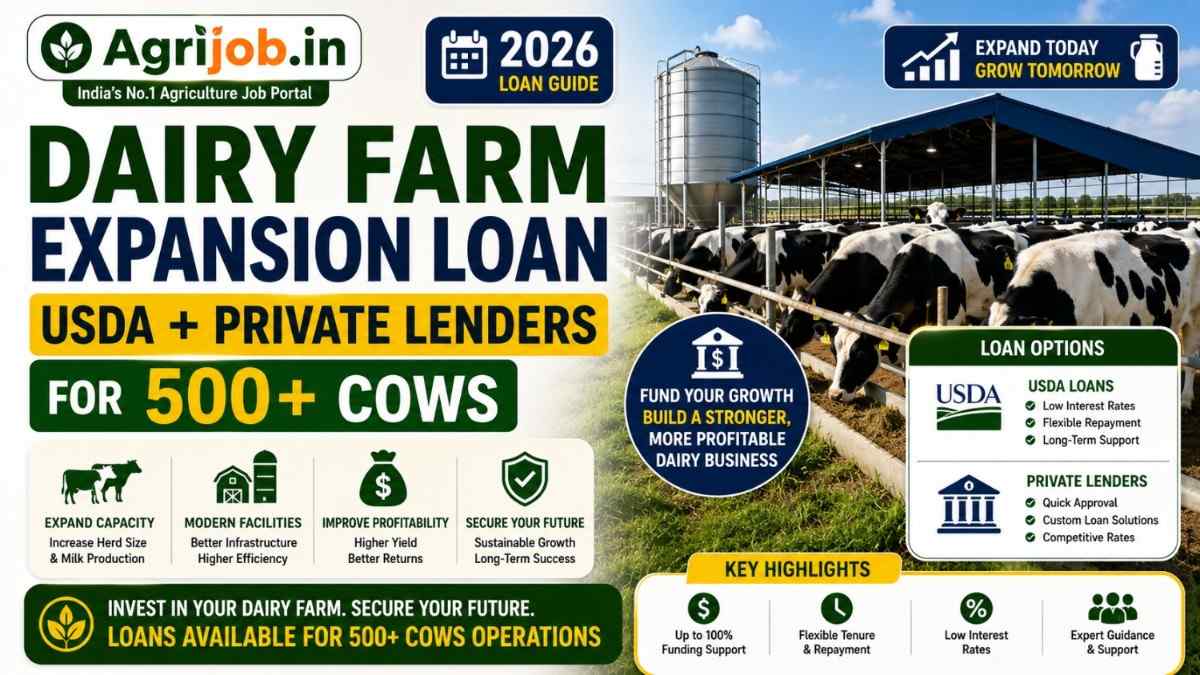
The best dairy farm expansion loan in 2026 combines a USDA FSA Guaranteed Loan (up to $2,343,000 at 95% guarantee) with a Farm Credit System term loan for amounts above that cap — giving 500-cow operations access to $3M–$5M in total financing, with FSA direct rates starting at 5.000% for operating loans as of June 2026.
- FSA Direct Operating Loan Rate (June 2026): 5.000%
- FSA Direct Ownership Loan Rate (June 2026): 5.875%
- FSA Joint Financing Rate (June 2026): 3.875%
- FSA Down Payment Loan Rate (June 2026): 1.875%
- FSA Guaranteed Loan Maximum: $2,343,000 (95% guarantee)
- FSA Direct Ownership Loan Maximum: $600,000
- FSA Direct Operating Loan Maximum: $400,000
- Farm Credit System (FCS): No hard cap; patronage dividends reduce cost ~1%/yr
- Maximum Repayment Term: Up to 40 years (Ownership Loans)
- Estimated Capital for 500-Cow Expansion: $2.5M–$6.0M total
What Is a Dairy Farm Expansion Loan and Why It Matters in 2026?
A dairy farm expansion loan is a specialized agricultural financing product that provides capital for herd growth, facility construction, equipment upgrades, and land acquisition. Unlike general business loans, these are underwritten against milk production income, livestock collateral, and farmland equity — not just credit scores.
According to USDA Economic Research Service data published in February 2026, U.S. milk production has increased over the past two decades while the number of dairy farms has declined — meaning larger farms now produce the bulk of America’s milk supply. Between 2000 and 2021, use of computerized milking systems on U.S. dairy farms grew from 20% to 45% of milk sales, and farms milking cows three or more times daily increased from 19% to 50%. Farms milking 500+ cows benefit from significantly lower per-unit production costs, creating a powerful financial incentive to scale.

Three primary loan channels exist for dairy expansion in 2026: USDA Farm Service Agency Direct and Guaranteed Loans, Farm Credit System institutions (FCSAmerica, AgriBank, Farm Credit Mid-America), and private commercial lenders (AgAmerica, regional ag banks). Combining programs — an FSA Guaranteed Loan layered with a Farm Credit System operating line — is how most 500-cow operations assemble their full capital stack at the lowest blended cost.
Who Should Apply for a Dairy Farm Expansion Loan in 2026?
Dairy expansion financing suits a specific profile of producers. Confirm you fit one or more of these categories before committing to the application process:
- 🐄 Mid-scale dairy operators (100–300 cows) looking to cross the 500-cow threshold for economies of scale and lower per-hundredweight production costs.
- 🏗️ Farmers building new freestall barns or milking parlors who need long-term construction financing over 20–40 years at fixed government rates.
- 🌾 Family farm operators who meet the FSA “family farm” definition — where family members provide both physical labor and day-to-day management decisions — and want below-market government loan rates.
- 📈 Dairy producers with 3+ years of tax returns showing positive net farm income — the minimum documentation standard for most agricultural lenders in 2026.
- 💡 Farms adding robotic milking technology — a $12,000–$13,000 per-stall investment requiring dedicated equipment financing on top of herd and facility loans.
- 🌱 Beginning or socially disadvantaged farmers — eligible for FSA set-aside funding and priority loan processing under 2026 FSA program guidelines.
- 🔄 Dairy operators refinancing existing high-interest debt to free up capital for herd expansion, using FSA Guaranteed Loans to consolidate at better rates.
- 🏦 Farm entities seeking $600K–$2.34M in financing — the sweet spot where FSA Guaranteed Loans through commercial banks offer terms unavailable through any other channel.
Capital Cost to Scale a Dairy Farm to 500+ Cows in 2026
Understanding your total capital need before choosing a loan is essential. A 500-cow dairy expansion involves four major cost categories: cattle purchase, facility construction, milking equipment, and working capital. Here is a realistic 2026 breakdown based on USDA ERS research, FSA data, and published construction benchmarks:
| Cost Category | Unit Cost (2026 Est.) | Total for 500-Cow Expansion |
|---|---|---|
| Dairy Cows (milking herd) | $2,500–$4,000/head | $1.25M–$2.0M |
| Freestall Barn Construction | $600–$1,600/stall | $300K–$800K |
| Milking Parlor / Robotic Milking Setup | $12,000–$13,000/robot stall | $300K–$650K |
| Manure Storage and Lagoon | Included in build estimate | $100K–$250K |
| Land (if purchasing) | $3,000–$12,000/acre (varies by state) | $300K–$1.2M+ |
| Feed Storage Facility (FSFL-eligible) | FSA Farm Storage Facility Loan available | $75K–$200K |
| 6-Month Operating Capital | ~$49,000–$100,000/month at scale | $300K–$600K |
| Total Estimated Capital Range | — | $2.5M–$6.0M |
Lender approval for expansion at this scale requires a term-debt coverage ratio (TDCR) above 1.25. The industry benchmark for net farm income is $800–$1,000 per cow annually — a 500-cow operation should demonstrate projected net income of $400,000–$500,000 per year to comfortably service $350,000–$450,000 in annual debt payments. Lenders also require a current ratio above 2.0, indicating $2.00 in liquid farm assets for every $1.00 of current liabilities.
USDA FSA Loan Programs for Dairy Farm Expansion 2026
The USDA Farm Service Agency is the primary federal source of below-market agricultural lending in the United States. FSA operates through more than 2,100 county service centers nationwide. For June 2026, FSA published the following direct loan interest rates effective June 1, 2026 — representing the lowest government-backed rates available to any dairy operator regardless of credit profile:
| FSA Loan Type | June 2026 Rate | Maximum Loan Amount | Maximum Term |
|---|---|---|---|
| Farm Operating Loan (Direct) | 5.000% | $400,000 | 7 years |
| Farm Ownership Loan (Direct) | 5.875% | $600,000 | 40 years |
| Farm Ownership — Joint Financing | 3.875% | 50% of project cost | 40 years |
| Down Payment Loan (Beginning Farmer) | 1.875% | $300,150 / up to 45% of purchase | 20 years |
| Emergency Loan (Actual Loss) | 3.750% | Project-specific | Varies |
| Farm Storage Facility Loan (5-yr term) | 4.125% | Project-specific | 5 years |
| Farm Storage Facility Loan (10-yr term) | 4.375% | Project-specific | 10 years |
| FSA Guaranteed Loan (via commercial bank) | Lender-set (market rate) | $2,343,000 | Up to 40 years |
Direct Loans are funded by FSA directly from Congressional appropriations — you apply through your county FSA office. Guaranteed Loans are made by a USDA-approved commercial bank, with FSA guaranteeing up to 95% of principal and interest against loss. For 500-cow expansion needs exceeding $600,000, the Guaranteed Loan pathway through a participating commercial bank is typically the right route, allowing up to $2,343,000 with the full 95% FSA backstop. Crucially, FSA does not rely on credit scores to determine eligibility — repayment history with other creditors is assessed instead, making FSA accessible to farms with limited or imperfect credit profiles.
The Farm Storage Facility Loan (FSFL) program provides a separate financing channel at rates from 4.125% to 4.625% for feed bunkers, silage storage, and grain storage construction — a frequently overlooked resource for dairy operations building on-farm feed infrastructure that runs parallel to and independent of your main ownership or operating loan.
Use an FSA Guaranteed Loan (up to $2.34M via a participating bank) for facilities and land acquisition, then add an FSA Farm Storage Facility Loan at 4.125%–4.625% separately for your feed bunker or silage storage. Both programs run simultaneously, serve distinct eligible cost categories, and have separate budgets. Most dairy operators leave the Farm Storage Facility Loan entirely unused simply by not knowing it operates as an independent program with its own funding channel and application process.
How to Apply for a Dairy Farm Expansion Loan: Step-by-Step Process
The application process differs depending on whether you pursue an FSA Direct Loan, FSA Guaranteed Loan, or Farm Credit System loan. The sequence below covers all three pathways in the order most 500-cow expansion applicants follow for the fastest, lowest-cost outcome:
- Assemble your complete financial documentation package. Gather 3 years of federal income tax returns with Schedule F, a current farm balance sheet showing all assets and liabilities, 12 months of milk marketing statements, a full herd inventory by production class and age, and all existing loan schedules. Lenders calculate your term-debt coverage ratio from this data before making any credit decision — gaps in documentation delay approval by weeks.
- Build a detailed expansion business plan with verified cost quotes. Include projected herd size post-expansion, expected milk production per cow per year (using your actual herd performance history), facility construction timeline, feed cost estimates, staffing plan, and a 5-year pro forma income statement. Obtain actual written quotes from barn contractors and equipment vendors — lenders require specifics, not ballpark estimates, for projects over $1M.
- Schedule a free pre-application meeting at your local FSA Service Center. The Farm Loan Officer reviews your eligibility for Direct or Guaranteed programs and advises which route fits your capital need, operation type, and credit profile. Find your nearest office at farmers.gov using your ZIP code. This meeting takes 1–2 hours, costs nothing, and typically saves weeks by identifying documentation gaps before you formally apply.
- Apply for an FSA Guaranteed Loan through a participating commercial bank. For projects exceeding $600,000, the bank and applicant jointly file Form FSA-2001 (Application for Guarantee) with the FSA Service Center. FSA reviews eligibility, collateral adequacy, and repayment ability, then issues a conditional commitment to the lender outlining guarantee terms and conditions.
- Contact a Farm Credit System institution for capital above FSA caps. For needs exceeding $2.34M, or for operating lines of credit to finance cattle purchase and feed working capital, contact FCSAmerica, Farm Credit Mid-America, AgAmerica, or your regional FCS association. Farm Credit lenders specialize exclusively in agriculture and can structure a coordinated package alongside your FSA loan without conflict or duplication.
- Complete the required appraisal and environmental review. All FSA loans require an independent appraisal of real estate collateral and a completed environmental review before final approval. Critical rule: site preparation or ground disturbance cannot begin until FSA issues written approval. Starting construction early violates FSA program rules and can disqualify your application entirely — contact your FSA office early in your planning process to determine what level of environmental review is required.
- Close the loan and receive disbursed funds. FSA Direct Loans process in approximately 30–60 days once a complete application is submitted. FSA Guaranteed Loans take 2–4 weeks for the guarantee approval once the commercial lender submits the FSA request. Farm Credit System loans typically close in 3–6 weeks depending on complexity. Direct Loan funds come from FSA; Guaranteed Loan funds are disbursed by the commercial lender after FSA issues the guarantee certificate.
USDA FSA vs Farm Credit vs Private Lenders — Full Comparison 2026
Choosing the right lender — or the right combination of lenders — determines your total financing cost over a 20–40 year loan life. Here is a complete side-by-side comparison of all three primary dairy farm expansion financing channels available in 2026:
| Comparison Factor | USDA FSA Direct / Guaranteed | Farm Credit System (FCS) | Commercial / Private Lender |
|---|---|---|---|
| Interest Rate (2026) | 5.000%–5.875% direct; 3.875% joint financing | Competitive market rate; patronage dividend reduces effective cost ~1%/yr | Typically 6.5%–9.0%+ depending on collateral |
| Maximum Loan Amount | $600K direct; $2.34M guaranteed | No hard cap; scales to complex large operations | No hard cap; collateral and cash-flow driven |
| Down Payment Required | 0% (100% financing available); 5% for Down Payment program | Typically 20%–30% equity required | Typically 20%–35% required |
| Approval Timeline | 30–60 days (Direct); 2–4 weeks (Guaranteed) | 3–6 weeks | 1–4 weeks |
| Credit Score Requirement | None — repayment history assessed instead | Good to excellent credit preferred | Typically 680+ FICO required |
| Eligible Uses | Land, livestock, facilities, equipment, operating costs | All ag purposes: real estate, operating, equipment, improvements | Varies by lender; generally all ag uses |
| Unique Benefits | Beginning Farmer set-asides; socially disadvantaged priority; no credit score threshold | Annual patronage dividends returned to borrower-owners; ag-only expertise and flexibility | Speed of closing; custom loan structures; amounts above FSA caps without stacking |
| Best For | Farmers who cannot obtain commercial credit at reasonable terms; beginning farmers; projects under $2.34M | Established mid-to-large dairy operations seeking long-term ag lender relationship and cost savings | Speed requirements; very large single-lender amounts; highly customized debt structures |
The best financing structure for a 500-cow dairy expansion combines: FSA Guaranteed Loan (up to $2.34M at 95% guarantee) through a USDA-approved commercial bank for land and facility construction, plus a Farm Credit System operating line of credit for cattle purchase and feed working capital. This structure delivers the lowest blended interest rate, no total capital ceiling, and annual Farm Credit patronage dividends that reduce effective borrowing cost by approximately 1% per year. On a $3M loan balance over 30 years, that 1% annual saving amounts to approximately $900,000 in cumulative interest reduction — a material financial advantage that justifies the additional setup of a second lender relationship.
Pros and Cons of Dairy Farm Expansion Loans in 2026
Key Advantages of Dairy Farm Expansion Financing
- ✅ Proven economies of scale at 500+ cows: USDA ERS research published February 2026 confirms that dairy farms with larger herds consistently achieve lower costs per hundredweight of milk produced — the fundamental financial case for scaling up with borrowed capital.
- ✅ Below-market rates via FSA programs: Direct loan rates as low as 3.875% (joint financing) and 1.875% (beginning farmer down payment) are unavailable through any commercial channel without government backing, saving tens of thousands annually on large loan balances.
- ✅ Up to 100% financing available via FSA Direct Ownership Loans: Eliminates the need to liquidate other farm assets or equity for a down payment, preserving operational liquidity during the critical construction and herd ramp-up phase.
- ✅ Repayment terms up to 40 years for ownership loans: Keeps monthly debt service manageable relative to milk revenue cycles, protecting cash flow during the low-price periods that historically occur every 4–7 years in the U.S. dairy market.
- ✅ Annual Farm Credit patronage dividends: FCS borrowers receive cash-back payments annually from cooperative net earnings — Farm Credit institutions have returned a portion of net earnings to eligible customer-owners every year since 2004, effectively reducing the real cost of borrowing by approximately 1% annually.
Risks and Disadvantages to Consider Before Expanding
- ❌ Long FSA approval timelines: Direct Loans take 30–60 days to process, making them unsuitable for time-sensitive cattle purchase opportunities where sellers require a closing within 1–2 weeks.
- ❌ Extensive documentation requirements: 3 years of tax returns, balance sheets, milk records, contractor quotes, environmental review coordination, and detailed pro forma projections create a significant pre-application workload for farm staff who are already running a full operation.
- ❌ Milk price volatility risk: Sustained low milk prices can compress margins below the term-debt coverage ratio threshold, potentially triggering lender restructuring discussions that complicate planned expansion timelines.
- ❌ FSA caps require multi-lender stacking: The $2.34M Guaranteed Loan cap means most 500-cow operations must coordinate multiple lenders and programs simultaneously, increasing administrative complexity and relationship management demands.
Important Terms Related to Dairy Farm Expansion Financing
Understanding these terms helps you negotiate better loan conditions, read documents accurately, and communicate effectively with FSA officers and Farm Credit loan officers:
- Term-Debt Coverage Ratio (TDCR): Net farm income divided by total annual debt payments. Most lenders require TDCR above 1.25; a ratio of 1.75+ qualifies you for the most favorable terms. A 500-cow operation targeting $400,000 in net income must keep total annual debt service under $320,000 to maintain a 1.25 TDCR.
- FSA Guaranteed Loan: A loan made by a USDA-approved commercial lender with FSA guaranteeing 95% of principal and interest against loss. The 2026 maximum is $2,343,000 per borrower across all guaranteed loan types combined.
- Joint Financing Loan: An FSA program where FSA lends up to 50% of the project cost at a highly subsidized rate (3.875% as of June 2026) and a commercial lender provides the remaining balance — available when the commercial lender is providing at least 50% of total project financing.
- Farm Credit System (FCS): A government-sponsored cooperative network of agricultural lenders with total assets exceeding $373 billion as of Q1 2026, providing more than 40% of all U.S. agricultural lending. Members are borrower-owners who receive annual patronage dividends.
- Current Ratio: Current farm assets divided by current farm liabilities. Lenders target above 2.0 — indicating $2.00 in liquid assets for every $1.00 of current debt. A ratio below 1.25 typically blocks new expansion loan approval.
- Farm Storage Facility Loan (FSFL): A separate FSA program for grain, feed, and silage storage construction. June 2026 rates range from 4.000% (3-year term) to 4.875% (12-year term) — a distinct program with its own funding budget running independently of farm ownership and operating loans.
- REAP Guaranteed Loan: A USDA Rural Energy for America Program loan guarantee for renewable energy systems and energy efficiency improvements. Available to dairy farms adding solar, anaerobic digesters, or energy-efficient milking equipment. The grant portion is paused as of March 31, 2026; guaranteed loans remain open year-round through USDA Rural Development state offices.
- Patronage Dividend: An annual cash payment returned to Farm Credit System borrowers from cooperative net earnings. Farm Credit institutions have distributed patronage dividends to eligible customer-owners every year since 2004 — effectively reducing the net interest cost of all outstanding FCS loans by approximately 1% per year.
Important Links — Dairy Farm Expansion Loan Resources 2026
| Resource | Link |
|---|---|
| USDA FSA Farm Loan Programs (Official) | fsa.usda.gov — Farm Loan Programs |
| USDA FSA Guaranteed Farm Loans | fsa.usda.gov — Guaranteed Loans (95% backstop) |
| FSA Loan Assistance Tool | lat.fpac.usda.gov — Loan Assistance Tool |
| USDA ERS — Dairy Farm Cost Research 2026 | ers.usda.gov — Fewer Farms, More Milk Report |
| USDA REAP Guaranteed Loan Program | rd.usda.gov — REAP Guaranteed Loans |
| Agrijob.in: SBI Dairy Farm Loan 2026 Guide | agrijob.in — SBI Dairy Loan Rate and EMI Guide |
| Agrijob.in: Dairy Farm Business Plan India 2026 | agrijob.in — Dairy Farm Business Plan and Profit Guide |
Conclusion — Dairy Farm Expansion Loan 2026
Scaling to 500+ cows in 2026 is financially achievable with the right loan structure. The USDA FSA Guaranteed Loan (up to $2,343,000 at 95% guarantee) combined with a Farm Credit System term loan gives most dairy operators the $3M–$5M capital stack they need — at rates starting from 3.875% on joint financing programs announced by USDA as of June 1, 2026. The key to a successful application is preparation: build your financial documentation package before contacting any lender, calculate your term-debt coverage ratio honestly against projected milk income, and use the FSA Loan Assistance Tool at farmers.gov to identify the correct program for your operation.
Start with your local FSA Service Center for a free pre-application meeting, layer in Farm Credit for amounts and purposes beyond FSA caps, and bookmark this page — we update our dairy farm expansion loan 2026 guide each time USDA publishes new monthly lending rates and whenever Congress adjusts program limits.
- FSA Direct Operating Loan rate is 5.000% and Ownership Loan rate is 5.875% as of June 2026 — the lowest government-backed agricultural loan rates available in the United States this year.
- FSA Guaranteed Loans allow up to $2,343,000 at a 95% government guarantee through a commercial bank — the most effective route for 500-cow expansion capital above the $600K direct loan ceiling.
- A 500-cow dairy expansion in 2026 requires $2.5M–$6.0M in total capital: cattle ($1.25M–$2.0M), freestall barn ($300K–$800K), milking equipment ($300K–$650K), and 6 months of operating capital.
- Farm Credit System annual patronage dividends reduce the effective cost of borrowing by approximately 1% per year — worth approximately $900,000 in cumulative interest savings on a $3M loan over 30 years.
- REAP guaranteed loans remain open for dairy farms investing in renewable energy and efficiency upgrades; the grant portion is paused as of March 31, 2026 pending new USDA regulations.
- Always schedule a free FSA pre-application meeting at farmers.gov before submitting any loan documents — it identifies the right programs for your operation and prevents weeks of avoidable delays.
Frequently Asked Questions About Dairy Farm Expansion Loan 2026
What is the maximum USDA loan for dairy farm expansion in 2026?
The USDA FSA Guaranteed Loan program allows up to $2,343,000 through a commercial lender, with FSA guaranteeing 95% of principal and interest against loss. For direct loans, the cap is $600,000 for farm ownership and $400,000 for farm operating loans. Dairy operations needing more than $2.34M must supplement with Farm Credit System or private agricultural lenders, which carry no hard loan caps for creditworthy borrowers with adequate collateral and repayment capacity.
What is the USDA FSA dairy farm loan interest rate as of June 2026?
As of June 1, 2026, USDA FSA published the following direct loan rates: Farm Operating Loans at 5.000%, Farm Ownership Loans at 5.875%, Joint Financing Ownership Loans at 3.875%, and Down Payment Loans for beginning farmers at 1.875%. FSA recalculates and publishes these rates on the first of every month. FSA Guaranteed Loans carry lender-set rates — typically at or near commercial market rates — but the 95% government guarantee reduces the lender’s risk and often results in better terms than unguaranteed commercial agricultural loans of comparable size.
How much does it cost to expand a dairy farm to 500 cows in 2026?
A 500-cow dairy expansion in 2026 typically requires $2.5M–$6.0M in total capital, depending on land costs, construction type, and milking system technology. Dairy cows cost $2,500–$4,000 per head; freestall barn construction runs $600–$1,600 per stall; and a robotic milking setup costs $12,000–$13,000 per robot stall including buildings, robots, gates, and 30-day manure storage. Add 6 months of operating capital at $49,000–$100,000 per month at 500-cow scale, based on published 2026 dairy operation cost modeling.
Can I get a USDA dairy farm loan if I already have existing farm debt?
Yes. Existing debt does not automatically disqualify you, but your term-debt coverage ratio must exceed 1.25 after the new loan is factored into total annual debt service. FSA calculates TDCR as net farm income divided by total annual debt payments — existing debt obligations reduce this ratio, so you need strong documented milk revenue to absorb new payments. FSA also offers a free Debt Consolidation Tool at farmers.gov that can help restructure existing high-interest farm debt to improve your TDCR before pursuing new expansion financing.
What is the Farm Credit System and how does it differ from USDA FSA?
The Farm Credit System is a government-sponsored cooperative network — including FCSAmerica, Farm Credit Mid-America, AgriBank, and Horizon Farm Credit — with total assets exceeding $373 billion as of Q1 2026, providing more than 40% of all U.S. agricultural lending. Unlike FSA, FCS is a cooperative owned by its borrowers, not a government agency. FCS has no hard loan caps, offers annual patronage dividends, and serves established operations of all sizes. FSA is specifically designed for farmers who cannot obtain reasonable commercial credit. For large dairy expansions, using both together — FSA for the guaranteed portion and FCS for operating lines — delivers the best blended rate and the broadest capital access.
Does USDA offer grants for dairy farm expansion in 2026?
Direct expansion grants are not available through FSA. However, the USDA Rural Energy for America Program (REAP) offers grants and guaranteed loans for renewable energy systems and energy efficiency improvements by agricultural producers — including dairy farms adding biodigesters, solar panels, or high-efficiency milking equipment. As of March 31, 2026, USDA announced a pause on REAP grant applications pending new regulations; REAP guaranteed loans continue to be accepted year-round through USDA Rural Development state offices. Contact your state Rural Development office for current program status and application windows.
What financial documents are needed for a dairy farm expansion loan?
Standard documentation for a dairy farm expansion loan includes: 3 years of federal income tax returns with Schedule F, a current farm balance sheet showing all assets and liabilities, 12 months of milk marketing statements, a full herd inventory by age and production class, all existing loan schedules showing current outstanding balances, contractor quotes for facility construction, equipment vendor invoices or estimates, and a 5-year pro forma income projection. FSA additionally requires Form FSA-2001 for guaranteed loans and an environmental site review completed before any ground disturbance begins.
How long does USDA FSA dairy farm loan approval take in 2026?
FSA Direct Loans take approximately 30–60 days to process after a complete application is submitted to the county Service Center. FSA Guaranteed Loans through commercial banks take 2–4 weeks for the guarantee approval once the lender formally submits the request to FSA. Farm Credit System loans typically close in 3–6 weeks depending on complexity and documentation completeness. Scheduling a free pre-application meeting with your local FSA Service Center before submitting documents significantly accelerates the process by identifying and resolving documentation gaps before the formal review clock starts.
Is dairy farm expansion to 500 cows financially viable in 2026?
Yes, for well-managed operations. USDA ERS research published in February 2026 confirms that larger dairy farms with 500+ cows consistently achieve lower costs per hundredweight of milk produced compared to smaller herds — driven by labor efficiencies, computerized feed delivery, milking parlor throughput, and bulk purchasing advantages. The industry net income benchmark is $800–$1,000 per cow annually. A 500-cow operation generating $400,000–$500,000 in net annual income can comfortably service $350,000–$450,000 in annual loan payments while maintaining a term-debt coverage ratio between 1.1 and 1.5 — sufficient for most lender requirements.
What is the USDA Farm Storage Facility Loan and can dairy farms use it?
The USDA Farm Storage Facility Loan (FSFL) is a separate FSA program that provides low-interest financing specifically for constructing or upgrading on-farm storage facilities — including feed bunkers, silage storage, grain bins, and hay storage structures essential to dairy operations. June 2026 FSFL rates range from 4.000% for 3-year terms to 4.875% for 12-year terms. Dairy farms can use the FSFL program simultaneously alongside their main FSA Ownership or Guaranteed Loan — it runs on a completely separate funding budget and application process, making it an additional financing tool rather than a competing one.
Last Updated: July 2026 | Sources: USDA FSA June 2026 Lending Rates (fsa.usda.gov, effective June 1, 2026), USDA ERS Dairy Structure and Cost Report February 2026 (ers.usda.gov), USDA FSA 2026 Budget Explanatory Notes, USDA Rural Development REAP Program Announcement March 31, 2026 (rd.usda.gov). This page is reviewed and updated regularly for accuracy. Bookmark it for the latest dairy farm expansion loan rates and program changes as USDA publishes new monthly lending rates on the 1st of each month.
Disclaimer: This guide is for informational purposes only and does not constitute financial, legal, or investment advice. Interest rates, loan limits, and program eligibility rules are subject to change by USDA and participating lenders at any time. Consult your local FSA Service Center and a qualified agricultural financial advisor before making any financing decision. USDA Farm Service Agency is an equal opportunity lender. Complaints about discrimination should be sent to: Secretary of Agriculture, Washington, DC 20250.