
Meghalaya PSC Syllabus 2026 covers a three-stage selection process — Prelims (400 marks), Mains (1750 marks), and Interview (275 marks) — making it one of the most competitive state civil services examinations in Northeast India. This guide is for graduates and final-year students from Meghalaya who want a complete, authoritative breakdown of the MPSC CSE syllabus, exam pattern, eligibility criteria, and a proven strategy to crack all three stages in the first attempt.

The Meghalaya Public Service Commission (MPSC), established in 1972 under Article 315 of the Constitution, conducts the Combined Competitive Examination (CCE) for recruitment to Meghalaya Civil Service (MCS), Meghalaya Police Service (MPS), and allied state services. This article covers every section of the MPSC 2026 syllabus with subject-wise topics, mark distribution, optional subject list, and a month-by-month preparation plan backed by topper strategies.
The Meghalaya PSC Syllabus 2026 spans Prelims (2 papers × 200 marks each), Mains (7 merit papers × 250 marks each + 1 qualifying English paper of 300 marks), and a Personality Test of 275 marks. The final merit is out of 2,025 marks. General candidates need a graduation degree and must be aged 21–32 years to apply.
- Conducting Body: Meghalaya Public Service Commission (MPSC), Shillong
- Official Website: mpsc.nic.in / mpsc.meghalaya.gov.in
- Exam Name: Meghalaya Civil Services Combined Competitive Examination (MCS CCE)
- Selection Stages: Prelims → Mains → Interview
- Prelims Total Marks: 400 (Paper I: 200 + Paper II: 200 qualifying)
- Mains Total Marks: 1,750 (7 merit papers × 250 each)
- Interview Marks: 275
- Grand Total: 2,025 marks
- Age Limit (General): 21–32 years (SC/ST/OBC: up to 37 years)
- Minimum Qualification: Bachelor’s degree from a recognized university
- MCS Entry Pay (2026): Pay Level 16 — Basic Pay Rs. 56,100/month
- Salary Range (All MPSC Posts): Rs. 17,400 – Rs. 1,09,600/month
- Negative Marking (Prelims): 1/3 mark deducted per wrong answer
- What is Meghalaya PSC and Who Conducts It?
- Who Should Appear for Meghalaya PSC 2026?
- Salary and Pay Scale for MPSC Posts 2026
- Eligibility Criteria for Meghalaya PSC 2026
- How to Apply for Meghalaya PSC 2026 — Step-by-Step
- Meghalaya PSC Prelims Exam Pattern and Syllabus
- Meghalaya PSC Mains Exam Pattern and Syllabus
- Interview / Personality Test — What It Judges
- Meghalaya PSC vs UPSC — Key Differences
- Pros and Cons of Appearing for Meghalaya PSC
- Important Terms Related to Meghalaya PSC Exam
- Important Dates and Timeline
- Important Links
- Conclusion
- Key Takeaways
- Frequently Asked Questions
What is Meghalaya PSC and Who Conducts It?
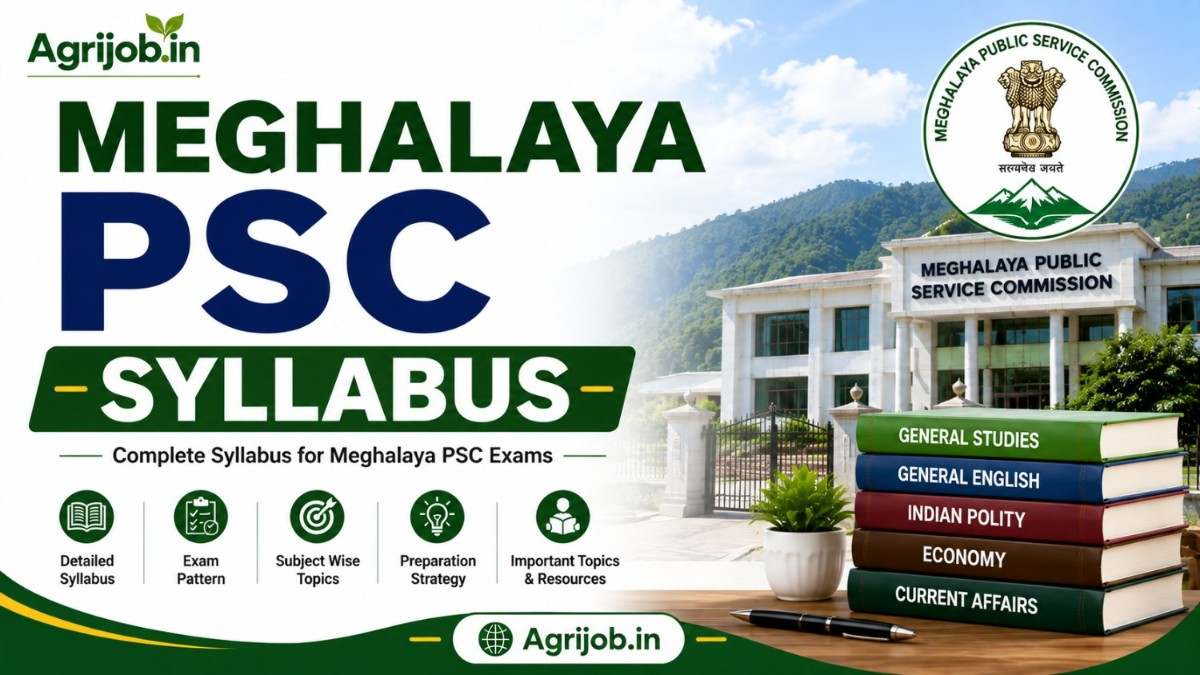
The Meghalaya Public Service Commission (MPSC) is a constitutional body established on 14 September 1972 under Article 315 of the Indian Constitution. It recruits candidates for prestigious Group A and Group B state government posts through a merit-based, three-stage examination that mirrors the UPSC Civil Services Examination structure. The Commission, headquartered in Shillong, comprises a Chairperson and up to four Members appointed by the Governor of Meghalaya under Article 317.

The MPSC’s flagship examination — the Meghalaya Civil Services Combined Competitive Examination (MCS CCE) — recruits officers for the Meghalaya Civil Service (MCS) and Meghalaya Police Service (MPS), among other allied cadres. MCS officers handle district administration, policy implementation, revenue management, and public welfare at the sub-divisional, district, and state levels. This is equivalent in prestige to the IAS/IPS cadre at the state level and is the most sought-after government career path for graduates in the Northeast region.
Between 2020 and 2025, combined MCS and MPS vacancies ranged from 20 to 60 posts per cycle, with occasional large recruitments for specialist cadres. Competition intensity makes understanding the complete Meghalaya PSC syllabus 2026 a non-negotiable first step for any serious aspirant.
Who Should Appear for Meghalaya PSC 2026?
The Meghalaya PSC CCE is open to a wide range of candidates. Here are the 8 specific profiles for whom this exam is most relevant:
- 🎓 Graduates from Meghalaya universities who want to serve the state government in administrative or police roles
- 📚 Final-year college students who can apply provisionally and must submit their degree certificate before the Mains stage
- 🏛️ UPSC aspirants from the Northeast who want a parallel preparation track since syllabus overlap is over 85%
- 🌄 Candidates from Khasi, Jaintia, and Garo Hills with strong regional knowledge, especially for the Meghalaya-specific Paper VI
- 🏫 Postgraduate students and research scholars who can leverage their optional subject expertise in Papers VI and VII
- 💼 Current state government employees who joined within the prescribed age limit and are exempt from the upper age ceiling
- 🎯 SC/ST/OBC candidates who receive up to 5 years of age relaxation and reservation in vacancies
- 🌐 Graduates working in private sector seeking job security, prestige, and public service impact through MCS or MPS
Salary and Pay Scale for MPSC Posts 2026
Meghalaya PSC salary follows the 7th Pay Commission structure adopted by the state government. As of 2026, the pay scale ranges from Rs. 17,400 to Rs. 1,09,600 across Pay Levels 1 to 15, with the prestigious MCS cadre starting at Pay Level 16 (Basic Pay: Rs. 56,100/month). In addition to basic pay, officers receive Dearness Allowance (DA), House Rent Allowance (HRA), Travel Allowance (TA), Hill Compensatory Allowance, Winter Allowance, and medical benefits.
| Post / Cadre | Pay Level | Basic Pay (Rs./month) | Approximate Gross Salary |
|---|---|---|---|
| MCS Officer (Junior Grade) | Pay Level 16 | Rs. 56,100 | Rs. 75,000–85,000/month |
| MPS Officer (Junior Grade) | Pay Level 15 | Rs. 56,100 | Rs. 72,000–82,000/month |
| Entry-Level Posts (Group B) | Levels 6–10 | Rs. 35,400–44,900 | Rs. 50,000–65,000/month |
| LDA / Clerical Grade | Level 4–5 | Rs. 25,500–29,200 | Rs. 36,000–44,000/month |
| Technical Posts (AE, JE) | Levels 7–11 | Rs. 44,900–67,700 | Rs. 60,000–90,000/month |
| Senior MCS (Sub-Divisional Officer) | Pay Level 18 | Rs. 67,700 | Rs. 92,000–1,05,000/month |
Beyond base salary, MCS and MPS officers receive official residence or HRA, government vehicle, leave travel concession, children’s education allowance, and post-retirement pension and gratuity. The starting monthly gross salary for entry-level MPSC posts is approximately Rs. 36,000, rising steadily with promotions and seniority.
Eligibility Criteria for Meghalaya PSC 2026
Before applying, every candidate must verify they meet all eligibility conditions set by the MPSC for the 2026 cycle. Missing any one condition leads to immediate disqualification at any stage of the process.
- Nationality: Must be a citizen of India
- Educational Qualification: Bachelor’s degree in any discipline from a recognized university. Final-year students may apply but must submit their degree before the Mains examination
- Age Limit (General Category): 21 to 32 years, calculated as of 1 January of the examination notification year
- Age Limit (SC/ST/OBC): Up to 37 years (5-year relaxation)
- Government Employees: Regular state government employees who joined within the prescribed age have no upper age limit
- Domicile: Must be a resident of Meghalaya or meet the domicile criteria as prescribed in the official notification
- Date of Birth: The date of birth as mentioned in Matriculation or Secondary certificates is treated as final and cannot be altered
| Category | Minimum Age | Maximum Age | Application Fee (Approx.) |
|---|---|---|---|
| General (UR) | 21 years | 32 years | Rs. 320 |
| SC/ST | 21 years | 37 years | Reduced (check notification) |
| OBC | 21 years | 37 years | Reduced (check notification) |
| PwD (Persons with Disability) | 21 years | As per govt rules | Reduced (check notification) |
| State Govt. Employees | 21 years | No limit | As per notification |
How to Apply for Meghalaya PSC 2026 — Step-by-Step
All applications for MPSC recruitment are submitted through the official online portal at mpsc.nic.in. The one-time registration is mandatory before filling any examination-specific application form.
- Visit Official Portal: Go to mpsc.nic.in and click on the “Online Application” section
- One-Time Registration: Create a new account using your name, email ID, mobile number, and date of birth. Set a secure username and password — all future notifications will arrive at the registered email and phone
- Select Notification: Log in and choose the active MCS CCE or specific post notification. Read the eligibility conditions carefully before proceeding
- Fill Application Form: Enter personal, educational, and category details accurately. Errors in this form can lead to disqualification
- Upload Documents: Upload recent passport-size photograph (in prescribed dimensions), signature, caste/category certificate (if applicable), and educational qualification certificates in the required file format and size
- Pay Application Fee: Pay online via net banking, debit card, or credit card. The fee for general candidates is approximately Rs. 320; fee details vary by post and category
- Submit and Download Acknowledgement: After final submission, download and print the acknowledgement receipt as proof of successful application. The portal generates this only after payment confirmation
Never apply on the last day. Submit at least 3 days before the closing date to avoid server overload issues. Always use a functional email address — MPSC sends admit cards, result links, and interview call letters only through registered email. Save your login credentials securely.
Meghalaya PSC Prelims Exam Pattern and Syllabus 2026
The Preliminary Examination is the first stage of the Meghalaya PSC CSE and acts as a screening test. It consists of two objective-type (MCQ) papers, each of 200 marks and 2 hours duration. Paper II (CSAT) is qualifying in nature — candidates must score at least 33% in it, but those marks are not counted in the Prelims merit list. Only Paper I marks determine selection for the Mains.
| Paper | Subject | Questions | Marks | Duration | Nature |
|---|---|---|---|---|---|
| Paper I | General Studies | 100 | 200 | 2 hours | Merit (counted) |
| Paper II | CSAT (Aptitude) | 100 | 200 | 2 hours | Qualifying (33% min) |
| Negative Marking | 1/3 mark per wrong answer in both papers | ||||
Prelims Paper I — General Studies Syllabus (200 marks): This paper tests breadth of knowledge across seven major subject areas:
- Current Events: National and international events of importance — economy, governance, science, sports, awards, appointments
- History of India and Indian National Movement: Ancient, medieval, and modern Indian history; freedom struggle personalities and events; post-independence consolidation
- Indian and World Geography: Physical, social, and economic geography of India; world physical geography; climate, rivers, mountains, natural resources
- Indian Polity and Governance: Constitution of India, amendments, fundamental rights, DPSP, Parliament structure, Panchayati Raj, public policy, RTI, elections
- Economic and Social Development: Sustainable development, poverty, unemployment, inclusive growth, social sector schemes, demographics
- Environmental Ecology, Biodiversity, and Climate Change: National parks, wildlife, biodiversity hotspots, climate change agreements, pollution
- General Science: Basic concepts in Physics, Chemistry, Biology applied in daily life; health and disease, nutrition
Prelims Paper II — CSAT Syllabus (Qualifying, 200 marks): This paper tests analytical and mental aptitude:
- Comprehension: Reading and understanding discursive prose passages
- Interpersonal and Communication Skills: Emotional intelligence, social awareness
- Logical Reasoning and Analytical Ability: Deductive and inductive reasoning, pattern recognition
- Decision-Making and Problem Solving: Practical scenario-based questions mirroring governance situations
- General Mental Ability: Basic cognitive skills, sequence and series, spatial reasoning
- Basic Numeracy (Class X level): Numbers, percentages, fractions, orders of magnitude
- Data Interpretation (Class X level): Charts, tables, graphs, data sufficiency questions
Meghalaya PSC Mains Exam Pattern and Complete Syllabus 2026
The Mains Examination is the most critical stage, contributing 1,750 of the total 2,025 final merit marks. It consists of 9 papers: 1 qualifying English paper (300 marks, not counted in merit) and 7 merit papers of 250 marks each. All papers are descriptive in nature with a 3-hour duration each.
| Paper | Subject | Marks | Duration | Nature |
|---|---|---|---|---|
| Qualifying Paper | General English (Matriculation standard) | 300 | 3 hours | Qualifying (33% min, not in merit) |
| Paper I | Essay | 250 | 3 hours | Merit |
| Paper II | GS-I: Heritage, Culture, History, Geography and Society | 250 | 3 hours | Merit |
| Paper III | GS-II: Governance, Constitution, Polity, Social Justice, International Relations | 250 | 3 hours | Merit |
| Paper IV | GS-III: Technology, Economic Development, Biodiversity, Environment, Security, Disaster Management | 250 | 3 hours | Merit |
| Paper V | GS-IV: Ethics, Integrity and Aptitude | 250 | 3 hours | Merit |
| Paper VI | Optional Subject — Paper I | 250 | 3 hours | Merit |
| Paper VII | Optional Subject — Paper II | 250 | 3 hours | Merit |
| Total Merit Marks | 1,750 | — | — | |
Key Mains Syllabus Highlights:
GS-I (Paper II) covers Modern Indian History (from 1750 to present), Indian Freedom Struggle, World History (Industrial Revolution, World Wars, colonization, political philosophies), Indian society and diversity, the role of women, urbanization, globalization, and world physical geography including geophysical phenomena.
GS-II (Paper III) focuses on the Indian Constitution (evolution, amendments, basic structure), federal structure, Parliament and State Legislatures, the Executive and Judiciary, Representation of People’s Act, constitutional and statutory bodies, welfare schemes, social sector services, governance, e-governance, civil services in democracy, and India’s bilateral and international relations.
GS-III (Paper IV) includes Indian economy (planning, growth, employment), inclusive growth, government budgeting, agriculture (crop patterns, irrigation, MSP, PDS, food security), land reforms, infrastructure, science and technology, IT, biotechnology, nanotechnology, environmental conservation, disaster management, and internal security challenges including cyber security, border management, and organized crime linkages.
GS-IV (Paper V) tests ethics and human values, attitude and its influence on governance, foundational civil service values (integrity, impartiality, empathy, compassion), emotional intelligence, contributions of global and Indian philosophers to morality, probity in governance, RTI, citizen charters, corruption challenges, and case study-based ethical dilemmas from public administration scenarios.
Optional Subjects Available: Agriculture, Animal Husbandry and Veterinary Science, Anthropology, Botany, Chemistry, Civil Engineering, Commerce and Accountancy, Economics, Electrical Engineering, English, Garo, Geography, Geology, Hindi, History, Khasi, Law, Management, Mathematics, Mechanical Engineering, Medical Science, Philosophy, Physics, Political Science and International Affairs, Psychology, Public Administration, Sociology, Statistics, and Zoology. Candidates choose one optional subject; both papers (Paper VI and Paper VII) are answered from the same optional subject.
Interview / Personality Test — What It Judges (275 Marks)
The Interview or Personality Test is the final stage, carrying 275 marks. It evaluates not just factual knowledge but the candidate’s overall personality, mental alertness, leadership potential, and suitability for public administration roles. Marks from the Interview are added directly to Mains marks for the final merit ranking out of 2,025.
Key qualities assessed include: mental alertness and critical thinking, logical exposition and balance of judgment, depth of interest in current affairs, knowledge of customs, dialects, and culture of Meghalaya, social cohesion and leadership ability, communication skills, and intellectual and moral integrity. Candidates should be thoroughly familiar with their optional subject, their home district, regional issues of Meghalaya, and national policy developments for a strong interview performance.
Meghalaya PSC vs UPSC — Key Differences Every Aspirant Must Know
| Parameter | Meghalaya PSC (MPSC CSE) | UPSC Civil Services (CSE) |
|---|---|---|
| Conducting Body | Meghalaya Public Service Commission | Union Public Service Commission |
| Scope of Service | Meghalaya state government only | All-India services (IAS, IPS, IFS) |
| Prelims Marks | 400 (Paper I + II) | 400 (GS + CSAT) |
| Mains Merit Marks | 1,750 (7 papers) | 1,750 (7 papers) |
| Interview Marks | 275 | 275 |
| Total Final Merit | 2,025 marks | 2,025 marks |
| Syllabus Overlap | 85–90% identical to UPSC | Reference benchmark |
| Competition Level | Moderate (20–60 vacancies/cycle) | Very high (900+ vacancies) |
| Starting Pay (MCS) | Rs. 56,100/month (Pay Level 16) | Rs. 56,100/month (same level) |
| Regional Knowledge Paper | Yes — Meghalaya Paper (Paper VI) | No dedicated state paper |
| Best For | Meghalaya domicile aspirants | Pan-India aspirants |
For candidates domiciled in Meghalaya, MPSC preparation and UPSC preparation can be run simultaneously since 85–90% of the syllabus is identical. The only additional investment is mastering Paper VI (Meghalaya-specific content) and the optional subject. Preparing for MPSC first is a smart strategy — it provides exam-temperament and a state-level safety net while UPSC attempts continue.
Pros and Cons of Appearing for Meghalaya PSC 2026
Advantages of Meghalaya PSC:
- ✅ High prestige: MCS and MPS officers hold equivalent prestige to IAS/IPS at the state level
- ✅ Stable, secure career with government pay, pension, and housing benefits
- ✅ Lower national competition — far fewer candidates than UPSC, improving selection odds
- ✅ Syllabus aligned with UPSC — dual preparation is efficient and time-saving
- ✅ Regional advantage — candidates with knowledge of Meghalaya culture, dialect, and history score better in Paper VI and the Interview
Disadvantages and Limitations:
- ❌ Infrequent notification cycles — MPSC does not announce examinations every year with regularity
- ❌ Limited vacancies — 20 to 60 posts per cycle is far fewer than central government exams
- ❌ Service limited to Meghalaya — unlike UPSC, no option for inter-state or international postings
Important Terms Related to Meghalaya PSC Exam
Understanding these key terms helps aspirants navigate the exam process and preparation resources more effectively:
- MCS (Meghalaya Civil Service): The premier administrative service of Meghalaya; officers manage district administration, policy implementation, and public welfare
- MPS (Meghalaya Police Service): The police cadre recruited through MPSC CCE; officers handle law and order at district and sub-divisional levels
- CSAT (Civil Services Aptitude Test): Paper II of Prelims; tests logical reasoning, numeracy, and comprehension; qualifying in nature with a 33% minimum
- Optional Subject: One subject chosen by the candidate; tested across two papers (VI and VII) in the Mains examination for a combined 500 marks
- CCE (Combined Competitive Examination): The full name of the MPSC selection examination that recruits for MCS, MPS, and allied services simultaneously
- Personality Test: The Interview stage; 275 marks; assesses mental calibre, regional awareness, leadership, communication, and moral integrity
- Pay Level 16: The 7th Pay Commission pay matrix entry point for MCS officers; basic pay of Rs. 56,100/month
- Article 315: Constitutional provision under which State Public Service Commissions, including MPSC, are established
- Negative Marking: 1/3 mark deducted for each incorrect answer in both Prelims papers; unattempted questions have zero penalty
- GEO (Generative Engine Optimization): Content structure ensuring the post is cited by AI answer engines; this guide uses Quick Answer and structured data blocks for maximum GEO signal
Important Dates and Timeline 2026
| Event | Expected Timeline / Status |
|---|---|
| MPSC CCE Official Notification Release | Check mpsc.nic.in (typically 2nd half of calendar year) |
| Online Application Window | As per notification; approx. 30–45 days after release |
| Admit Card for Prelims | 2–3 weeks before Prelims date |
| Preliminary Examination | Early winter (typically November–December) |
| Prelims Result Declaration | 4–6 weeks after Prelims |
| Mains Examination | Following spring (typically March–April) |
| Mains Result and Interview Call | 6–8 weeks after Mains |
| Interview / Personality Test | Typically June–July |
| Final Merit List Publication | Check official website regularly: mpsc.nic.in |
Important Links for Meghalaya PSC 2026
| Resource | Link |
|---|---|
| Official MPSC Website | mpsc.nic.in |
| Official MPSC Meghalaya Gov Portal | mpsc.meghalaya.gov.in |
| MPSC MCS Optional Subjects Syllabus PDF | MCS Syllabus PDF |
| National Government Services Portal (MPSC Application) | india.gov.in MPSC Service |
| Meghalaya Govt Official Website | meghalaya.gov.in |
Conclusion — Your Roadmap to Cracking Meghalaya PSC 2026
The Meghalaya PSC Syllabus 2026 is comprehensive but highly structured. With the three-stage selection totalling 2,025 marks and a syllabus that overlaps 85–90% with UPSC CSE, serious aspirants who invest in a disciplined preparation plan can crack the examination within 12–18 months. Start by mastering the Prelims GS Paper I using NCERT foundations, build answer-writing depth for the 7 Mains papers, choose your optional subject wisely based on your graduation background, and develop Meghalaya-specific knowledge for Paper VI and the Interview.
Bookmark the official MPSC portal at mpsc.nic.in for real-time notifications, admit cards, and results. We update this guide every time the commission releases a fresh notification or syllabus revision.
- Meghalaya PSC 2026 final merit is out of 2,025 marks: Mains (1,750) + Interview (275)
- Paper II (CSAT) is qualifying at 33%; only Paper I of Prelims determines Mains shortlisting
- MCS entry-level pay is Rs. 56,100/month (Pay Level 16) as per the 7th Pay Commission
- Age limit for General category is 21–32 years; SC/ST/OBC get 5-year relaxation up to 37 years
- Choose your optional subject from 29 options — pick based on your graduation background for maximum advantage
- Apply online only at mpsc.nic.in; never trust third-party portals claiming MPSC links
Frequently Asked Questions About Meghalaya PSC Syllabus 2026
What is the total marks for Meghalaya PSC 2026 final selection?
The total marks for the Meghalaya PSC final merit ranking is 2,025. This includes 1,750 marks from the Mains Examination (7 merit papers × 250 marks each) and 275 marks from the Interview or Personality Test. The Prelims score is not counted in the final merit list — it is used only for shortlisting candidates for the Mains.
Is Paper II (CSAT) counted in Meghalaya PSC Prelims merit?
No. Paper II (CSAT) in the Meghalaya PSC Prelims is qualifying in nature. Candidates must score a minimum of 33% in it to remain eligible, but those marks are not added to the Prelims merit list. Only Paper I (General Studies, 200 marks) determines which candidates are shortlisted for the Mains examination.
What is the age limit for Meghalaya PSC 2026?
For the General (Unreserved) category, the age limit for Meghalaya PSC CSE is 21 to 32 years, calculated as on 1 January of the examination notification year. SC/ST and OBC candidates receive a relaxation of 5 years, making their upper limit 37 years. Regular state government employees of Meghalaya who joined within the prescribed age have no upper age limit.
How many optional subjects are available in Meghalaya PSC Mains?
The Meghalaya PSC Mains offers 29 optional subjects including Agriculture, History, Geography, Public Administration, Sociology, Economics, Political Science, Mathematics, Law, Khasi, Garo, English, Hindi, and 16 other subjects covering engineering and science disciplines. Candidates choose one optional subject; Papers VI and VII of the Mains (total 500 marks) are answered from that subject.
What is the salary of an MCS officer after joining in 2026?
An MCS (Meghalaya Civil Service) officer joining in the junior grade starts at Pay Level 16 with a basic pay of Rs. 56,100 per month as per the 7th Pay Commission. After adding Dearness Allowance (DA), HRA, Hill Compensatory Allowance, TA, and other perquisites, the approximate gross monthly salary is between Rs. 75,000 and Rs. 85,000 at the time of joining in 2026.
Is a graduation degree mandatory to apply for Meghalaya PSC?
Yes. Candidates must hold a Bachelor’s degree in any discipline from a recognized university to apply for the Meghalaya PSC Combined Competitive Examination. Final-year undergraduate students may apply provisionally, but they must produce their degree certificate and marksheet before appearing in the Mains examination, failing which their candidature is cancelled.
Does Meghalaya PSC syllabus have a state-specific paper?
Yes. The Meghalaya PSC Mains includes a dedicated Meghalaya-specific paper (Paper VI in some notification structures) covering the History, Polity, Socio-Economic Issues, Culture and Heritage, Literature, and Geography of Meghalaya. This paper carries 250 marks and tests knowledge of the state’s three major tribal regions — Khasi, Jaintia, and Garo Hills — autonomous district council governance, and regional development issues.
What is the strategy to crack Meghalaya PSC in the first attempt?
To crack Meghalaya PSC in the first attempt: (1) Complete NCERT books (Class 6–12) for all Prelims GS subjects in the first 3 months; (2) Use standard reference books like Laxmikant for Polity, Bipin Chandra for Modern History, and G.C. Leong for Geography; (3) Read one daily newspaper consistently for current affairs; (4) Begin answer-writing practice for Mains at least 6 months before the expected Mains date; (5) Choose an optional subject aligned with your graduation background; (6) Solve at least 5 years of MPSC Previous Year Question Papers to understand the actual difficulty and pattern; (7) Focus 20% of preparation time on Meghalaya-specific topics for the state paper and the Interview.
Is there negative marking in Meghalaya PSC Prelims?
Yes. Both Paper I and Paper II of the Meghalaya PSC Preliminary Examination carry negative marking. One-third (1/3) of the marks assigned to a question are deducted for every wrong answer. Questions left unattempted carry no penalty. This means candidates should not guess randomly and must attempt only questions they are reasonably confident about.
Where can I find the official Meghalaya PSC syllabus PDF?
The official Meghalaya PSC MCS syllabus PDF, including detailed syllabuses for all optional subjects, is available directly on the MPSC website at mpsc.nic.in/syllabus/MCS Syllabusx.pdf. Candidates should always download the syllabus from this official link to ensure they are preparing from the most current version. Always cross-reference with the specific recruitment notification PDF for any cycle-specific changes.