

APEDA Basmati Organic Training Centre Pilibhit 2026 is India’s first dedicated facility for premium basmati and organic farming, backed by a Rs.15 crore investment and a 70-year government lease. Farmers in Uttar Pradesh and Uttarakhand now have direct access to world-class training, a demonstration farm, and cutting-edge AI-powered crop surveying — all under one roof in Tanda Bijaisi village, Pilibhit district. This guide is for farmers, agricultural graduates, FPOs, and anyone connected to the basmati and organic farming ecosystem in north India. We cover the project details, facilities, who benefits, how to leverage this opportunity, the concurrent AI Basmati Paddy Survey, and what it means for India’s USD 5.67 billion basmati export sector in 2026.

APEDA has signed a 70-year lease to establish India’s first Basmati & Organic Training Centre-cum-Demo Farm in Pilibhit, Uttar Pradesh on 7 acres at Tanda Bijaisi, at an estimated cost of Rs.15 crore. The centre will train farmers in premium basmati cultivation and certified organic farming to support India’s USD 5.67 billion basmati export industry.
- Project Name: Basmati & Organic Training Centre-cum-Demo Farm, Pilibhit
- Implementing Agency: APEDA (Ministry of Commerce & Industry)
- Location: Tanda Bijaisi Village, Pilibhit District, Uttar Pradesh
- Land Area: Approximately 7 acres (Government Agriculture Farm)
- Estimated Investment: Rs.15 crore
- Lease Duration: 70 years (APEDA + Govt. of UP + Dept. of Agriculture)
- Status: 70-year lease signed; April 30, 2026 — development phase
- Beneficiaries: Farmers, students, agri-experts — UP and Uttarakhand
- Concurrent Initiative: India’s first AI-based Basmati Paddy Survey (2026–2028)
- AICRP Designation: 3rd AICRP centre in UP’s Basmati GI zone
- Official Source: PIB Press Release, May 1, 2026
- What Is the APEDA Basmati Organic Training Centre Pilibhit 2026?
- Who Should Read This Guide?
- Value & Benefits for Farmers — Income & Export Potential
- Eligibility & How to Access the Centre
- Facilities Inside the Pilibhit Training Centre
- India’s First AI Basmati Paddy Survey 2026–2028
- APEDA Organic Certification vs Conventional Basmati Farming
- Pros & Cons of APEDA’s Pilibhit Initiative
- Important Terms — Basmati Export & Organic Farming
- Important Dates & Project Timeline
- Important Links
- Conclusion
- Key Takeaways
- Frequently Asked Questions
What Is the APEDA Basmati Organic Training Centre Pilibhit 2026?
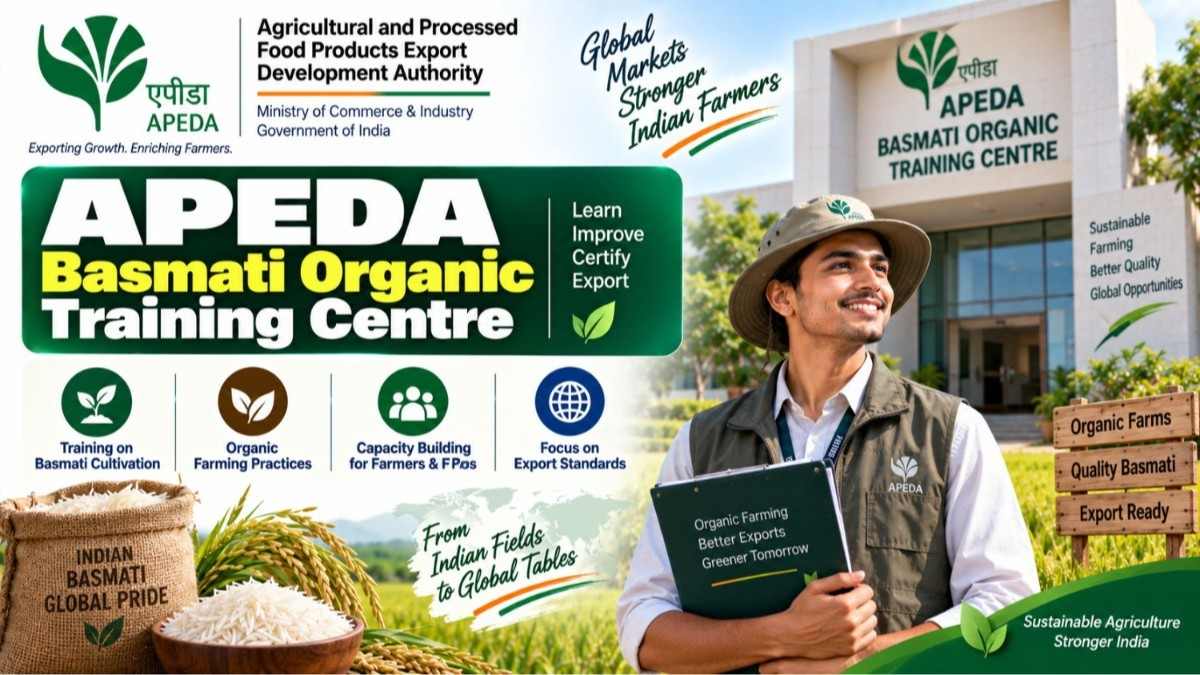
The APEDA Basmati & Organic Training Centre-cum-Demo Farm in Pilibhit is India’s first dedicated institution exclusively for premium basmati rice cultivation and certified organic farming. Established through a 70-year lease agreement signed on April 30, 2026, between the Agricultural and Processed Food Products Export Development Authority (APEDA), the Department of Agriculture, and the Government of Uttar Pradesh, the centre will be developed across approximately 7 acres of government agricultural land at Tanda Bijaisi village in Pilibhit district.
APEDA — established in 1985 under the Ministry of Commerce and Industry — is India’s apex body for agricultural and processed food product export promotion. The Pilibhit centre directly supports India’s basmati rice export sector, which recorded exports of USD 5.67 billion (Rs.50,138 crore) in 2025–26, with volumes reaching 6.52 million metric tonnes. The new facility will serve as a national-level knowledge and demonstration hub, bridging the gap between farm-level basmati cultivation and the global export market.

Union Minister of State for Commerce and Industry Shri Jitin Prasada attended the land-transfer ceremony, praising Pilibhit’s growing importance as a Basmati-producing region. He proposed adding an AI-based interactive museum and a dedicated outlet for certified basmati seeds and organic inputs within the facility. The centre has also been designated as an All India Coordinated Research Projects (AICRP) hub for national-level Basmati varietal trials — making Pilibhit the third such AICRP centre in Uttar Pradesh’s Basmati GI zone, after Nagina (Bijnor) and BEDF Modipuram.
Who Should Read This Guide?
This guide is relevant to a wide range of stakeholders in the basmati and organic farming ecosystem across north India:
- 🌾 Basmati farmers in UP and Uttarakhand — who want to access free training, certified seeds, and organic farming support to increase yield and fetch export-grade prices.
- 🎓 Agriculture graduates and students — looking for hands-on research experience at an AICRP-designated national research centre.
- 📦 Farmer Producer Organisations (FPOs) — seeking APEDA certification, premium pricing, and export market linkages for their basmati produce.
- 🌿 Organic farming aspirants — who want to access NPOP certification pathways, government subsidies, and training to command 20–40% price premiums.
- 💼 Agri-exporters and rice traders — who need updated information on India’s Basmati GI zone expansion and AI-driven crop forecasting data.
- 🏛️ Government job aspirants in agriculture — tracking APEDA recruitment, AICRP research positions, and agri-sector career opportunities.
- 📊 Agri-entrepreneurs and agritech startups — interested in the AI-based Basmati Paddy Survey project covering 4 million hectares and 500,000+ farmers.
- 🌏 Researchers and policy analysts — studying India’s basmati export strategy, GI tag enforcement, and sustainable agriculture initiatives.
Value & Benefits for Farmers — Income & Export Potential
The Pilibhit training centre directly addresses one of the most critical income gaps in Indian agriculture: the difference between what a conventional basmati farmer earns per acre and what a certified organic basmati farmer earns per acre when selling into export markets. The financial stakes are significant.
| Farming Type | Paddy Price (per quintal) | Export Price (FOB/MT) | Estimated Income/Acre |
|---|---|---|---|
| Conventional Basmati (e.g. 1121) | Rs.3,400–Rs.4,600 | USD 1,100–USD 1,200 | Rs.40,000–Rs.55,000 |
| Organic Basmati (NPOP Certified) | Rs.4,800–Rs.6,000+ | USD 1,500–USD 2,000+ | Rs.60,000–Rs.80,000 |
| Organic Basmati (EU/USA Export) | Rs.6,000–Rs.8,000+ | USD 2,000–USD 2,800 | Rs.80,000–Rs.1,10,000 |
Source: APEDA export data 2025–26; indicative farm-gate estimates based on mandi benchmarks and export FOB rates. Actual income depends on variety, yield, and certification status.
India’s basmati rice export earnings crossed USD 5.67 billion in 2025–26 — with Saudi Arabia (16.6%), Iran (13.9%), Iraq (11.2%), and UAE (8.2%) as top markets. The Pilibhit centre will help farmers access this export premium directly by providing: NPOP-compliant organic farming training, post-harvest processing know-how, APEDA RCMC registration guidance, and direct linkage to rice exporters through the All India Rice Exporters Association (AIREA).
Beyond direct income, the Haryana government — following APEDA’s push — announced in May 2026 a subsidy of Rs.10,000 per acre per year for 5 years to farmers adopting organic farming with APEDA certification. Similar support frameworks are being replicated across UP under the Paramparagat Krishi Vikas Yojana (PKVY), which offers up to Rs.15,000 per hectare DBT subsidy for organic cluster formation.
Eligibility & How to Access the Centre
The APEDA Pilibhit Training Centre will be open to a broad range of agricultural stakeholders once operational. Based on the official announcements and APEDA’s standard training and capacity-building framework, the following eligibility criteria apply:
- ✅ Individual farmers from Uttar Pradesh and Uttarakhand with land in the Basmati GI zone or aspirations to cultivate basmati or organic crops.
- ✅ Farmer Producer Organisations (FPOs) and self-help groups (SHGs) operating in the basmati or organic farming value chain.
- ✅ Agricultural students and researchers from recognized universities and institutions — especially those enrolled in agronomy, genetics, and plant breeding programs.
- ✅ APEDA-registered exporters and their field representatives seeking updated training on Basmati GI compliance, NPOP norms, and post-harvest quality standards.
- ✅ Agri-entrepreneurs working in seed supply, organic inputs, or value-added basmati processing.
| Requirement / Document | Detail |
|---|---|
| Land Proof (for farmers) | Khasra / Khatauni / Patta showing agricultural land |
| Identity Proof | Aadhar Card / Voter ID / Government-issued ID |
| Bank Account (for subsidy linkage) | Account linked to Aadhar for DBT subsidy receipt |
| FPO Registration (if applicable) | MCA / NABARD / State registration certificate |
| APEDA RCMC (for exporters) | Mandatory for accessing export promotion benefits |
| Application Process | Via State Agriculture Department, UP / APEDA website |
Note: The centre is currently in the development phase (post-lease signing, April 2026). Formal training schedules and enrollment procedures will be announced by APEDA at apeda.gov.in once construction and facility setup is complete. Farmers are advised to register with their block-level agriculture department now to receive timely notifications.
Facilities Inside the Pilibhit Training Centre
The Basmati & Organic Training Centre-cum-Demo Farm at Pilibhit is designed as a comprehensive agricultural knowledge hub. According to the official PIB press release (May 1, 2026), the facility will include:
- Auditorium — For large-scale training sessions, farmer awareness programs, and industry conferences on basmati export and organic farming.
- Museum & Gallery on Basmati and Organic Farming — An interactive exhibit showcasing the history, cultivation, varieties, and export journey of basmati rice, with a proposed AI-based interactive learning module suggested by Minister Jitin Prasada.
- Conference Room — For research seminars, AICRP varietal trial reviews, and coordination meetings between APEDA, exporters, and farmer representatives.
- Laboratory — For soil testing, seed quality assessment, pesticide residue analysis, and NPOP organic certification compliance checks.
- Storage Space for Organic Farming Inputs — Centralised stock of certified organic inputs — bio-fertilisers, bio-pesticides, and vermicompost — accessible to registered farmers.
- Demonstration Farm (7 Acres) — Live cultivation plots demonstrating best practices for both conventional and organic basmati cultivation, varietal comparisons, and post-harvest handling techniques.
- Dedicated Seed & Input Outlet (proposed) — A retail point for certified basmati seed varieties and organic farming inputs, ensuring farmers access quality inputs without depending on unregulated markets.
- AICRP Research Hub — As the 3rd AICRP centre in UP’s Basmati GI zone, the facility will conduct systematic varietal trials for new basmati varieties suited to Pilibhit’s agro-climatic conditions.
Even before the Pilibhit centre opens, UP farmers can access APEDA’s existing training programmes and NPOP organic certification pathways at apeda.gov.in. Getting your APEDA RCMC (Registration-cum-Membership Certificate) now — at a one-time government fee of Rs.5,900 — positions you to immediately access the centre’s export linkage programs, subsidy schemes, and premium buyer networks the moment it becomes operational.
India’s First AI Basmati Paddy Survey 2026–2028
Launched alongside the Pilibhit centre on April 30, 2026, India’s first AI-based Basmati Paddy Survey is a landmark initiative that will reshape how the country plans, monitors, and markets its basmati exports. Implemented by APEDA in collaboration with the All-India Rice Exporters Association (AIREA), the project runs from 2026 to 2028 and operates at an unprecedented scale.
| Survey Parameter | Scale / Target |
|---|---|
| Total Area Covered | Nearly 4 million hectares of basmati cultivation area |
| Ground-Truth Data Points | Over 150,000 verification points across GI zone |
| Farmer Engagement | More than 500,000 farmers directly participating |
| Project Duration | 2026–2028 (3 crop seasons) |
| Implementing Partners | APEDA + All India Rice Exporters Association (AIREA) |
| Technology Used | AI / Machine Learning + Satellite Remote Sensing |
| Key Objectives | Crop assessment accuracy, variety identification, export planning |
The AI survey will use satellite remote sensing combined with AI/ML models to map basmati cultivation areas, identify rice varieties, estimate crop yield, detect adulteration risks (non-basmati mixing), and generate data-driven export forecasts. For farmers, this means: better MSP support signals, scientific crop management advice, and traceable produce documentation that global buyers increasingly require. For exporters, it means real-time supply intelligence and reduced risk of shipment rejections.
The Pilibhit centre, as an AICRP hub, will serve as a data anchor point for this survey — providing ground-truth varietal data that trains the AI models to accurately distinguish authentic Geographical Indication (GI) basmati from non-GI varieties across the vast growing belt spanning Punjab, Haryana, Himachal Pradesh, Uttarakhand, Delhi, and western Uttar Pradesh.
APEDA Organic Certification vs Conventional Basmati Farming
The core value proposition of the Pilibhit centre is helping farmers transition from conventional basmati cultivation to certified organic basmati farming — which commands significantly higher prices in export markets. Understanding the difference is essential before making the switch.
| Factor | Conventional Basmati | APEDA Certified Organic Basmati |
|---|---|---|
| Certification Required | None (GI tag compliance only) | NPOP / APEDA Organic Certification |
| Export Price Premium | Standard market rate | 20–40% above conventional price |
| EU / USA Market Access | Limited (pesticide residue checks) | Full access — EU Organic, NOP recognized |
| Input Cost | Higher (chemical fertilizers + pesticides) | Lower after 2–3 years (bio-inputs) |
| Certification Timeline | Immediate (no conversion period) | 2–3 year conversion period (NPOP) |
| Government Subsidy | Standard farm support | Rs.10,000–Rs.15,000/acre/year (PKVY, state schemes) |
| Soil Health (Long-Term) | Degradation risk over time | Improving — higher carbon, water retention |
| Traceability Requirements | Basic APEDA documentation | Full TraceNet + NPOP audit trail |
| Consumer Demand Trend 2026 | Stable / Mature | Growing 15% annually (global organic demand) |
For UP farmers in the Basmati GI zone with access to the Pilibhit training centre, transitioning to APEDA-certified organic basmati farming is the highest-return long-term strategy available. The 2–3 year NPOP conversion period is now cushioned by PKVY subsidies of up to Rs.15,000/hectare and state-level support of Rs.10,000/acre/year (Haryana). Once certified, the 20–40% export price premium on organic basmati more than compensates for the conversion costs — and the Pilibhit centre will provide free technical support throughout this transition period.
Pros & Cons of APEDA’s Pilibhit Initiative
Like any large-scale government agricultural infrastructure project, the Pilibhit centre has genuine strengths and limitations worth evaluating honestly.
✅ Advantages of the APEDA Pilibhit Training Centre
- First-of-its-kind facility: India’s first dedicated Basmati & Organic Training Centre fills a critical institutional gap — no comparable facility existed for Pilibhit’s farmers previously.
- 70-year institutional commitment: The lease term ensures long-term continuity — unlike many government schemes that are discontinued within 5–10 years.
- AICRP research designation: National-level varietal trial status brings ICAR researchers, crop scientists, and cutting-edge seed development to Pilibhit’s doorstep.
- AI survey integration: The concurrent 2026–2028 AI Paddy Survey will generate real-time data benefiting the centre’s research and farmers’ planning capabilities.
- Export income potential: Certified organic basmati farmers can earn Rs.60,000–Rs.1,10,000 per acre — vs Rs.40,000–Rs.55,000 for conventional basmati.
⚠️ Limitations to Keep in Mind
- 2–3 year NPOP conversion period: Farmers shifting to organic farming face an income dip in the transition years — though PKVY subsidies partially offset this.
- Centre still under development: As of September 2026, the facility is in the development phase. Training programmes have not yet commenced — farmers should track APEDA’s official communications.
- Geographic limitation: Primary direct beneficiaries are in UP and Uttarakhand; farmers from other Basmati GI zone states (Punjab, Haryana) may find it less accessible.
Important Terms — Basmati Export & Organic Farming
Understanding the key terms in the basmati export and organic farming space is essential for farmers, FPOs, and agri-entrepreneurs who want to benefit from the Pilibhit centre and APEDA’s broader ecosystem:
- APEDA (Agricultural and Processed Food Products Export Development Authority): India’s apex body under the Ministry of Commerce & Industry, established in 1985, that regulates and promotes exports of agricultural and processed food products, including basmati rice and certified organic produce.
- NPOP (National Programme for Organic Production): India’s official organic certification system administered by APEDA. NPOP certification is mandatory for exporting organic produce and is recognized by the EU, USA, and Switzerland.
- GI Tag (Geographical Indication): A legal protection under which “Basmati” is a registered GI product of India, grown only in specific agro-climatic zones. India’s basmati GI zone covers 7 states/UTs including UP, Punjab, Haryana, and Uttarakhand.
- AICRP (All India Coordinated Research Projects): A national research program under ICAR coordinating multi-location field trials for crop varieties across India. Pilibhit is now the 3rd AICRP Basmati centre in UP.
- RCMC (Registration-cum-Membership Certificate): APEDA’s registration certificate required for exporters of scheduled agri-products. Valid for 5 years; government fee Rs.5,900.
- TraceNet: APEDA’s web-based platform for real-time tracking and certification of organic products from farm to export — a mandatory compliance tool for organic basmati exporters.
- PKVY (Paramparagat Krishi Vikas Yojana): A Government of India scheme providing up to Rs.15,000/hectare in DBT subsidies to farmers adopting certified organic farming in clusters of 50+ hectares.
- FOB (Free on Board): The export pricing benchmark for basmati rice — currently USD 1,100–USD 1,200/MT for premium 1121 variety and USD 1,500–USD 2,800/MT for certified organic basmati in EU/USA markets.
- AIREA (All India Rice Exporters Association): The industry body representing basmati rice exporters, partnering with APEDA on the AI Basmati Paddy Survey 2026–2028.
- Basmati 1121: The most exported premium basmati variety from India — long grain, high aroma, fetching Rs.3,400–Rs.4,600 per quintal in mandi prices as of 2026.
Important Dates & Project Timeline
| Date / Period | Event / Milestone |
|---|---|
| April 30, 2026 | 70-year lease agreement signed — APEDA, Dept. of Agriculture, Govt. of UP at Pilibhit |
| May 1, 2026 | PIB official press release — project formally announced to the public |
| 2026 (Current Phase) | Construction and infrastructure development of the 7-acre campus at Tanda Bijaisi |
| 2026–2028 | India’s first AI-based Basmati Paddy Survey — 4 million hectares, 150,000+ ground points |
| Post-Construction | AICRP designation activates — national Basmati varietal trials begin at Pilibhit centre |
| Post-Inauguration | Training programs, farmer enrollment, NPOP certification workshops commence |
| 2025–26 (Reference) | India’s Basmati exports: 6.52 million MT valued at USD 5.67 billion (APEDA data) |
Important Links
| Resource | Link |
|---|---|
| Official APEDA Website | apeda.gov.in |
| PIB Official Press Release (May 1, 2026) | pib.gov.in — APEDA Pilibhit Announcement |
| APEDA Basmati Rice Export Data | apeda.gov.in/BasmatiRice |
| NPOP Organic Certification — APEDA | apeda.gov.in — Organic Products Section |
| APEDA Registration Guide (Agrijob.in) | APEDA RCMC Registration 2026 — Complete Guide |
| Organic Farming Export India Guide (Agrijob.in) | Organic Farming Export India 2026 — APEDA & Certification |
| PKVY Organic Farming Subsidy | PKVY 2026 — Rs.50,000 Organic Farming Subsidy |
| India.gov.in Agriculture Portal | india.gov.in |
Conclusion — What the APEDA Pilibhit Centre Means for Indian Farmers
The APEDA Basmati & Organic Training Centre in Pilibhit is far more than a government infrastructure project — it is a strategic investment in India’s premium agricultural export future. With basmati rice exports touching USD 5.67 billion in 2025–26 and global demand for certified organic produce growing at 15% annually, the Rs.15 crore facility positions UP’s Pilibhit district as a national hub for high-value, export-ready basmati cultivation and sustainable organic farming. The concurrent AI-based Basmati Paddy Survey — covering 4 million hectares and 500,000+ farmers from 2026 to 2028 — will give India an unprecedented data advantage in export planning and GI zone management.
For farmers in Uttar Pradesh and Uttarakhand, the message is clear: register with your block agriculture department today, begin exploring APEDA RCMC registration, and consider the PKVY organic farming subsidy — so you are fully positioned to benefit from the Pilibhit centre’s training, seed outlets, and export linkages the moment it opens. Bookmark this page — we update it as APEDA announces facility completion timelines and training enrollment dates.
- APEDA signed a 70-year lease on April 30, 2026 to build India’s first Basmati & Organic Training Centre on 7 acres in Pilibhit, UP, at an estimated cost of Rs.15 crore.
- India’s basmati exports reached USD 5.67 billion (6.52 million MT) in 2025–26 — and the Pilibhit centre directly supports expanding this premium market.
- Certified organic basmati farmers can earn 20–40% higher export prices (Rs.60,000–Rs.1,10,000/acre) versus conventional basmati cultivation.
- India’s first AI-based Basmati Paddy Survey (2026–2028) will cover 4 million hectares, 150,000 ground-truth points and 500,000+ farmers — transforming crop assessment and export forecasting.
- The centre is designated as the 3rd AICRP Basmati research hub in UP’s GI zone — enabling national-level varietal trials at Pilibhit for the first time.
- Farmers should register with their state agriculture department now and explore APEDA RCMC registration (Rs.5,900 govt fee) to prepare for the centre’s training and export linkage programmes.
Frequently Asked Questions About APEDA Basmati Organic Training Centre Pilibhit 2026
What is the APEDA Basmati Organic Training Centre in Pilibhit?
It is India’s first dedicated Basmati & Organic Training Centre-cum-Demo Farm, established through a 70-year lease agreement between APEDA, the Uttar Pradesh government, and the state Department of Agriculture. Located on 7 acres at Tanda Bijaisi village, Pilibhit, the centre will train farmers, students, and agri-professionals in premium basmati cultivation and certified organic farming practices to enhance export readiness and farmer income.
What is the estimated cost of the Pilibhit training centre project?
The APEDA Pilibhit Basmati & Organic Training Centre is estimated to cost approximately Rs.15 crore. The investment will cover construction of the auditorium, conference room, laboratory, museum, storage facilities, demonstration farm development, and the proposed AI-interactive learning module. The land — 7 acres at the government agriculture farm in Tanda Bijaisi — has already been transferred under the 70-year lease agreement.
Who signed the lease for the Pilibhit APEDA Centre and when?
The 70-year lease agreement was signed on April 30, 2026 by three parties: the Agricultural and Processed Food Products Export Development Authority (APEDA), the Department of Agriculture, and the Government of Uttar Pradesh. Union Minister of State for Commerce and Industry Shri Jitin Prasada presided over the signing ceremony and outlined the centre’s long-term strategic vision for Pilibhit’s basmati and organic farming ecosystem.
Which farmers will benefit from the Pilibhit APEDA Training Centre?
The centre is designed to benefit farmers, agricultural students, researchers, and agri-entrepreneurs primarily from Uttar Pradesh and Uttarakhand — both of which fall within India’s Basmati GI zone. Farmer Producer Organisations (FPOs), APEDA-registered exporters, and agritech professionals working in the basmati and organic supply chain will also have access to the facility’s training, laboratory, and research infrastructure.
What is the AI-based Basmati Paddy Survey launched with the Pilibhit project?
India’s first AI-based Basmati Paddy Survey (2026–2028) was launched alongside the Pilibhit centre on April 30, 2026. Implemented by APEDA in collaboration with the All India Rice Exporters Association (AIREA), the project uses artificial intelligence and satellite remote sensing to assess nearly 4 million hectares of basmati cultivation, collecting data from over 150,000 ground-truth points while directly engaging more than 500,000 farmers. The survey aims to improve crop assessment accuracy, variety identification, scientific farming advice, and India’s export planning capabilities.
How much do basmati rice exports earn for India annually?
According to official APEDA data, India exported 6.52 million metric tonnes of basmati rice in 2025–26, valued at USD 5.67 billion (Rs.50,138 crore). Major export destinations include Saudi Arabia (16.6%), Iran (13.9%), Iraq (11.2%), UAE (8.2%), and the USA (5.0%). India is the world’s dominant basmati supplier, commanding over 30% of global rice trade volume.
What is the AICRP designation and why is it important for Pilibhit?
AICRP stands for All India Coordinated Research Projects — a national ICAR program that coordinates multi-location varietal trials across India. The Pilibhit training centre has been designated as an AICRP hub for basmati varietal research, as recognized at the 61st Annual Rice Research Group Meeting. This makes Pilibhit only the third AICRP Basmati centre in Uttar Pradesh’s GI zone — after Nagina (Bijnor) and BEDF Modipuram — enabling systematic testing of new basmati varieties suited to the region’s agro-climatic conditions.
What is the benefit of APEDA NPOP organic certification for basmati farmers?
APEDA’s National Programme for Organic Production (NPOP) certification opens access to premium global markets — particularly EU, USA, and Switzerland — where certified organic basmati commands 20–40% higher export prices than conventional varieties. Certified organic basmati can fetch USD 1,500–USD 2,800 per MT FOB versus USD 1,100–USD 1,200 for conventional 1121 basmati. The Pilibhit centre will provide free technical support for the 2–3 year NPOP conversion period, which is also cushioned by PKVY subsidies of up to Rs.15,000 per hectare.
How can a farmer register for the Pilibhit APEDA Training Centre?
The centre is currently in the development and construction phase (as of September 2026). Formal enrollment for training programs will be announced by APEDA on its official website at apeda.gov.in once the facility is operational. Farmers are advised to: (1) register with their block-level agriculture department in UP or Uttarakhand for advance notifications, (2) obtain an Aadhar-linked bank account for DBT subsidy eligibility, and (3) explore APEDA RCMC registration at a government fee of Rs.5,900 to pre-qualify for the centre’s export linkage programmes.
Last Updated: September 2026 | This article is reviewed regularly for accuracy. Bookmark this page for the latest updates on the APEDA Pilibhit Training Centre enrollment dates and training schedules.
Disclaimer: This article is for informational purposes only. Data on export prices, subsidies, and project timelines are sourced from official government portals including APEDA (apeda.gov.in) and PIB (pib.gov.in) as of the date of publication. Farmers are advised to verify current eligibility criteria and subsidy amounts directly with APEDA or their state agriculture department before making any financial decisions. Agrijob.in does not represent APEDA or the Government of India.