

Gir cow ghee vs desi cow ghee is one of the most searched comparisons in India’s booming A2 dairy market — and for good reason. Both are derived from indigenous Indian cows producing A2 beta-casein protein, yet the differences in breed specificity, nutritional density, flavour, and price are significant enough to matter. This guide is for health-conscious Indian families, Ayurveda practitioners, farmers, and anyone spending Rs.1,200–Rs.4,500 per kg on premium ghee who wants to know exactly what they are getting. We cover what makes each type unique, the traditional Bilona making process, verified A2 milk benefits, a full comparison table, and a clear buying recommendation.

Gir cow ghee is made exclusively from the A2 milk of the indigenous Gir breed (native to Gujarat), while desi cow ghee can come from any indigenous Indian breed — Sahiwal, Red Sindhi, Tharparkar, or Rathi. Both contain A2 beta-casein protein and offer comparable health benefits. Gir cow ghee typically costs Rs.1,500–Rs.4,500/kg due to single-breed sourcing and higher cattle maintenance costs; desi cow ghee ranges Rs.800–Rs.2,000/kg. For guaranteed breed-specific purity, choose Gir; for affordability with equal A2 protein benefits, desi cow ghee is an excellent alternative.
- Protein Type: Both contain A2 beta-casein protein (not A1)
- Gir Cow Milk Yield: 2,000–2,500 litres per lactation (approx. 326 days)
- Gir Cow Ghee Price (2026): Rs.1,200–Rs.4,500 per kg
- Desi Cow Ghee Price (2026): Rs.800–Rs.2,000 per kg
- Making Method: Traditional Bilona (5-step Vedic process)
- CLA Content (A2 Bilona Ghee): 1.0–2.0 g per 100 g
- Butyric Acid: 3.5–4.5 g per 100 g (vs 3.0–3.5 g in commercial ghee)
- Vitamin A: 3,500–4,500 IU per 100 g
- Milk-to-Ghee Ratio: Approximately 25–30 litres of milk = 1 kg of ghee
- Key Desi Breeds: Gir, Sahiwal, Red Sindhi, Tharparkar, Rathi
- What Is Gir Cow Ghee and What Makes It Special?
- What Is Desi Cow Ghee? Breeds and Sources Explained
- Who Should Choose Between Gir and Desi Cow Ghee?
- Price, Value, and Cost Breakdown in 2026
- A2 Milk Benefits – Science Behind the Healthier Protein
- Bilona Making Process – 6 Traditional Steps Explained
- Gir Cow Ghee vs Desi Cow Ghee – Full Comparison
- Pros and Cons of Each Type
- Important Terms Related to A2 Ghee
- Important Links and Resources
- Conclusion
- Key Takeaways
- Frequently Asked Questions
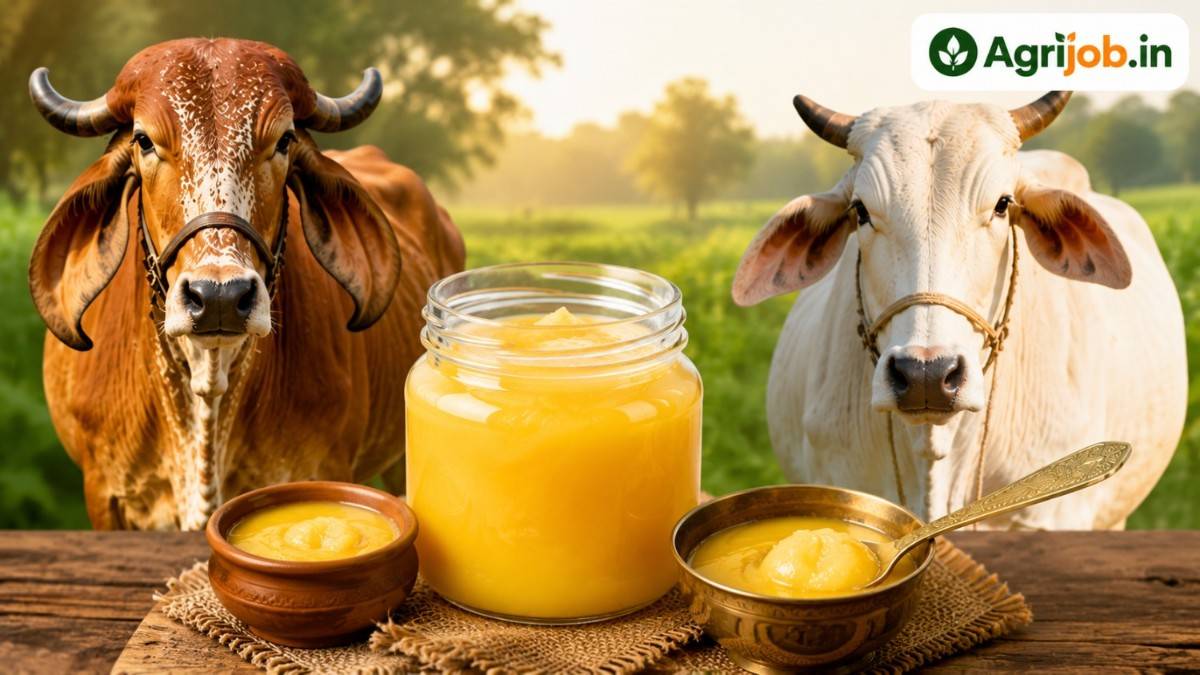
What Is Gir Cow Ghee and What Makes It Special?
Gir cow ghee is clarified butter made exclusively from the A2 milk of the Gir breed — one of India’s oldest and most revered indigenous cattle. The Gir is native to the Gir hills and forests of Kathiawar in Gujarat, with its breeding tract spanning Junagadh, Bhavnagar, Rajkot, and Amreli districts. According to research published in the Indian Journal of Animal Sciences (ICAR), the Gir cow has an average lactation yield of 2,029 litres over a 321-day lactation period — the longest lactation span among all indigenous Indian breeds at approximately 326 days.
What sets Gir cow ghee apart is its single-breed sourcing guarantee. When you purchase Gir cow ghee from a verified producer, every drop of milk comes from this specific breed. The Gir cow’s milk has an average fat percentage of 4.69–4.97%, which is higher than many commercial dairy breeds, producing ghee with a noticeably richer golden colour and distinctive nutty aroma. The National Dairy Development Board (NDDB) has been actively working on Gir breed improvement projects, documenting that select Gir cows at organised gaushala units produce 18–21 litres of milk per day under optimised conditions.

Gir cows produce A2 beta-casein protein in their milk — a structural variant of the milk protein that differs from the A1 variant found in most crossbred commercial dairy cattle. This A2 protein is widely considered easier to digest, and research from the Indian Council of Agricultural Research (ICAR) confirms that Indian indigenous breeds are genetically predisposed to produce A2 milk. The combination of A2 milk, high fat content, and Bilona processing gives Gir cow ghee its premium nutritional profile and premium price tag of Rs.1,200–Rs.4,500 per kg.
What Is Desi Cow Ghee? Breeds and Sources Explained
Desi cow ghee is made from the milk of any indigenous Indian cow breed — it is a broader category that includes Gir, but also Sahiwal, Red Sindhi, Tharparkar, Rathi, Kankrej, and dozens of other native breeds. According to ICAR, India currently has 55 registered indigenous cattle breeds, all of which are classified as Bos indicus and all of which naturally produce A2 beta-casein milk. So technically, Gir cow ghee is a subset of desi cow ghee — the key distinction is breed specificity versus multi-breed sourcing.
Desi cow ghee made from the Bilona method using any of these breeds delivers a nutritional profile nearly identical to Gir cow ghee in terms of A2 protein type, butyric acid, and fat-soluble vitamins. The Sahiwal breed, for example, is actually India’s highest milk-producing indigenous cow, and Sahiwal ghee commands respect in northern Indian markets. Red Sindhi and Tharparkar ghee are similarly prized in Rajasthan and Sindh-origin communities. The milk-to-ghee conversion ratio remains approximately the same across breeds: 25–30 litres of milk per kg of finished ghee.
The practical challenge with desi cow ghee is verification. Since it can be sourced from any indigenous breed, quality and consistency depend heavily on the producer’s sourcing practices. A reliable desi cow ghee producer will disclose the breed, feeding practices (grass-fed vs. mixed fodder), and whether the Bilona method was used. Without this transparency, desi cow ghee from mixed or unverified sources may not offer the same nutritional guarantee that single-breed Gir cow ghee does.
Who Should Choose Between Gir and Desi Cow Ghee?
- 🌿 Health-conscious urban families looking to replace refined oils with a traditional, nutrient-dense fat for daily cooking
- 👶 Parents of infants and young children seeking the most digestible, pure ghee for early nutrition — Gir cow ghee is widely recommended by Ayurvedic practitioners for children
- 🏃 Fitness enthusiasts and athletes who want a stable cooking fat rich in CLA (Conjugated Linoleic Acid) for metabolic support
- 🩺 People with lactose intolerance or IBS — A2 ghee has negligible lactose and contains A2 protein, which is significantly easier to digest than A1 protein from commercial hybrid breeds
- 🌾 Farmers and rural entrepreneurs exploring Gir cow farming or desi ghee production as an agribusiness
- 📿 Ayurveda practitioners and followers who use ghee medicinally for digestive health, skin care, and in Panchakarma therapies
- 💰 Budget-conscious health seekers who want A2 ghee benefits without paying the Gir cow premium — multi-breed desi cow ghee offers the same A2 protein at a lower price
- 🏡 Organic and natural food buyers who want ghee produced without commercial dairy farm chemicals, hormones, or industrial processing
Price, Value, and Cost Breakdown in 2026
The price difference between Gir cow ghee and other desi cow ghee comes down to three factors: breed rarity, lower milk yield per cow, and higher maintenance costs. A single Gir cow costs Rs.60,000–Rs.1,50,000 to purchase, and its monthly upkeep — natural fodder, veterinary care, and skilled labour — averages approximately Rs.9,000 per month. With an optimistic milk output of 8–10 litres per day and a milk-to-ghee conversion of 25–30 litres per kg, producing one kilogram of authentic Gir cow Bilona ghee has a raw material cost alone of Rs.750–Rs.1,200 before labour, packaging, or profit.
| Ghee Type | Price Range (per kg) | Making Method | Best For |
|---|---|---|---|
| Gir Cow A2 Bilona Ghee | Rs.1,500–Rs.4,500 | Traditional Bilona | Maximum purity, breed specificity |
| Desi Cow A2 Bilona Ghee (Sahiwal/Red Sindhi) | Rs.900–Rs.2,000 | Traditional Bilona | A2 benefits at moderate price |
| Desi Cow Ghee (Cream-Separated) | Rs.400–Rs.900 | Cream separator method | Budget cooking, not medicinal |
| Commercial Market Ghee (A1 hybrid cow) | Rs.450–Rs.750 | Industrial processing | General cooking, no A2 benefit |
Anything claiming to be “pure A2 Bilona Gir cow ghee” and priced below Rs.1,200 per kg should be approached with caution — the economics of authentic production make such pricing unsustainable without cutting corners on breed purity, feeding practices, or the traditional Bilona process.
A2 Milk Benefits – Science Behind the Healthier Protein
A2 milk contains only the A2 variant of beta-casein protein, which differs from the A1 variant at a single amino acid position — proline in A2, versus histidine in A1. This small structural difference has significant digestive consequences. When A1 beta-casein is digested, it releases a peptide called BCM-7 (beta-casomorphin-7), which some researchers associate with digestive discomfort, inflammation, and potential links to conditions like IBS. A2 milk does not produce BCM-7 during digestion, making it inherently gentler on the gut.
- Easier Digestion: A2 protein does not produce BCM-7, reducing bloating and digestive discomfort — particularly important for people who experience intolerance to regular dairy
- Gut Health Support: Butyric acid in A2 ghee (3.5–4.5 g per 100 g) nourishes the gut lining, supports healthy microbiome function, and may reduce intestinal permeability
- Fat-Soluble Vitamin Absorption: The saturated fats in A2 ghee act as carriers for Vitamins A, D, E, and K — fat-soluble vitamins the body cannot absorb efficiently without a fat medium
- Metabolic Support: Conjugated Linoleic Acid (CLA) content of 1.0–2.0 g per 100 g in A2 Bilona ghee supports healthy body composition and metabolic balance when consumed in moderation
- Anti-Inflammatory Properties: Research published in academic literature suggests A2 milk causes significantly less gut inflammation compared to A1 milk in sensitive individuals
- Brain and Memory: Omega-3 fatty acids and fat-soluble vitamins in A2 ghee support neurological function — Ayurveda specifically recommends A2 cow ghee for enhancing memory (medha)
- High Smoke Point: A2 Bilona ghee has a smoke point of approximately 250°C, making it one of the safest cooking fats for Indian high-heat cooking methods including tempering (tadka) and deep frying
At NUTRITION 2026 (the American Society for Nutrition’s Annual Meeting held in July 2026 in Maryland), The a2 Milk Company presented new clinical and preclinical research — including studies led by Purdue University researchers — confirming differences in gastric emptying, glucose metabolism, and digestive biomarkers between A1 and A2 milk consumption. This builds on over two decades of research validating A2 beta-casein’s advantages for digestive health. ICAR remains the leading institution globally in A2 beta-casein research, accounting for 40.51% of all affiliated publications in the field according to bibliometric analysis.
Bilona Making Process – 6 Traditional Steps Explained
The Bilona method is an ancient Vedic technique of ghee-making described in Ayurvedic texts for thousands of years. What distinguishes Bilona ghee from commercially processed ghee is the critical step of fermenting milk into curd before churning — rather than separating cream directly from milk and heating it. This curd-to-butter process preserves probiotics, micronutrients, and the unique aromatic compounds that give authentic Bilona ghee its golden colour and nutty fragrance.
- Milk Collection and Boiling: Fresh A2 milk from Gir or indigenous desi cows is collected and boiled. Boiling eliminates bacteria and concentrates the milk slightly, making it safe for the fermentation step that follows. Only fresh, unadulterated milk from grass-fed indigenous cows should be used at this stage.
- Fermentation into Curd (Dahi): The boiled milk is cooled to approximately 40–45°C (warm, not hot). A small spoonful of live curd culture (jamavan) is added, and the milk is kept in an earthen pot overnight. By morning, the milk ferments naturally into thick, probiotic-rich curd. No artificial starters or chemicals are used. The fermentation step is what separates Bilona ghee from cream-separator ghee — it is the soul of the process.
- Bilona Churning: The fermented curd is transferred to a large vessel. A traditional wooden churner called the “Bilona” — a hand-operated wooden implement — is used to churn the curd in alternating clockwise and anti-clockwise directions. This slow, rhythmic churning separates the fat (makkhan or butter) from the buttermilk (chaach/lassi). The churning is done by hand to preserve nutritional integrity; mechanical churning at high speeds generates heat that can degrade certain heat-sensitive compounds.
- Butter Separation: After churning, the fresh makkhan (butter) rises to the surface and is carefully scooped out. The remaining liquid — buttermilk — is a nutritious by-product rich in probiotics and is often consumed separately for digestive health. The butter is rinsed with cold water to remove residual buttermilk, which improves the ghee’s shelf life and purity.
- Slow Clarification (Heating): The collected butter is placed in a heavy-bottomed vessel (traditionally iron or brass) and heated over a low flame. The slow heating process — typically reaching 110–125°C — causes water to evaporate and milk solids to separate. Between 120–125°C, residual milk solids sink to the bottom and undergo controlled browning (Maillard reactions), releasing volatile compounds like diacetyl, furans, and lactones that create the signature nutty fragrance and golden hue of authentic Bilona ghee. Essential fatty acids, vitamins, and medicinal properties are preserved because of the low-and-slow heating method.
- Filtration and Storage: Once the ghee turns golden and clear, with a distinctive aroma and settled milk solids at the bottom, it is filtered through a fine cloth or strainer. The filtered pure ghee is stored in glass or clay pots. Authentic A2 Bilona ghee requires no preservatives and has a shelf life of 12–18 months at room temperature when stored properly.
To verify the purity of any A2 Bilona ghee before buying, apply three simple home tests: (1) Finger Rub Test — pure ghee melts almost instantly on your fingertip from body heat; adulterated ghee takes longer. (2) Water Test — add one teaspoon of ghee to a glass of water; pure ghee remains separate and does not dissolve or leave a milky residue. (3) Smell Test — authentic Bilona ghee has a mild, earthy, slightly nutty aroma — not an artificial or butter-like smell. If the price is below Rs.1,200/kg and the label claims “pure A2 Bilona Gir cow ghee,” verify the producer’s sourcing and process directly.
Gir Cow Ghee vs Desi Cow Ghee – Full Comparison
| Parameter | Gir Cow Ghee | Desi Cow Ghee (Multi-Breed) |
|---|---|---|
| Milk Source | Exclusively Gir breed (Gujarat) | Any indigenous breed (Sahiwal, Red Sindhi, Tharparkar, Rathi, etc.) |
| Protein Type | A2 beta-casein | A2 beta-casein (all Indian breeds) |
| Breed Specificity | Single breed — guaranteed | Variable — depends on producer |
| Colour and Texture | Deep golden; granular when cool | Golden to pale yellow; varies by breed |
| Aroma | Rich, nutty, distinctly desi | Mild to rich depending on breed and method |
| Price (per kg, 2026) | Rs.1,500–Rs.4,500 | Rs.800–Rs.2,000 |
| Nutritional Density | Slightly higher fat % (4.69–4.97%) | Comparable; breed-dependent variation |
| Availability | Limited — speciality producers only | Widely available across India |
| Best Making Method | Traditional Bilona (5-step Vedic) | Traditional Bilona (optimal) or cream-separated |
| Best For | Maximum purity, Ayurveda, children, medicinal use | Daily cooking, A2 benefits on a budget |
If your priority is verified single-breed purity, Gir cow ghee made via the Bilona method is the gold standard — particularly for children, elderly family members, those with digestive issues, and Ayurvedic medicinal use. If you want equal A2 protein benefits at a lower price point, desi cow ghee from verified indigenous breeds (Sahiwal, Red Sindhi) using the Bilona method is an excellent and nutritionally comparable choice. The A2 protein benefit is breed-category-level, not breed-specific — so desi cow ghee is not inferior, just less specific. Do not pay a Gir premium for cream-separator “desi ghee” — the processing method matters as much as the breed.
Pros and Cons of Gir Cow Ghee vs Desi Cow Ghee
Gir Cow Ghee — Advantages:
- ✅ Guaranteed single-breed A2 milk source with documented breed history
- ✅ Slightly higher fat percentage (4.69–4.97%) compared to many mixed-breed sources
- ✅ Deep golden colour and distinctive rich aroma — preferred in Ayurveda and ritual use
- ✅ Greater traceability — responsible producers provide farm-to-jar documentation
Gir Cow Ghee — Disadvantages:
- ❌ Significantly higher price (Rs.1,500–Rs.4,500/kg) makes daily use expensive
- ❌ Limited availability — authentic Gir cow ghee producers are concentrated in Gujarat and a few specialty online stores
- ❌ High demand and premium branding have created a market for adulterated products — verification is difficult without direct producer contact
Desi Cow Ghee — Advantages:
- ✅ Same A2 beta-casein protein as Gir cow ghee — the core health benefit is identical at protein level
- ✅ More affordable (Rs.800–Rs.2,000/kg) — better suited for regular daily consumption
- ✅ Wider availability from verified local producers across all Indian states
- ✅ Multiple high-quality breed options — Sahiwal (highest-yielding indigenous), Red Sindhi, Tharparkar each offer regionally distinctive ghee profiles
Desi Cow Ghee — Disadvantages:
- ❌ Breed sourcing is harder to verify — “desi cow” is a broad label that can be used loosely
- ❌ Nutritional consistency varies more widely — fat percentage, aroma, and CLA content depend on the specific breed and fodder quality
- ❌ Cream-separator versions labelled as “desi cow ghee” do not offer the same nutrient profile as Bilona-made ghee
Important Terms Related to A2 Ghee
- A2 Beta-Casein Protein: The specific structural form of milk protein produced by indigenous Indian cow breeds. Contains proline at position 67, which prevents BCM-7 peptide release during digestion — unlike A1 beta-casein (found in Jersey and Holstein cows) which contains histidine at the same position.
- Bilona Method: The traditional Vedic 5–6 step ghee-making process involving milk boiling, overnight curd fermentation, wooden churner-based butter separation, and slow low-flame clarification. Only ghee made via this method is authentically called Bilona ghee.
- BCM-7 (Beta-Casomorphin-7): A digestive by-product of A1 milk protein metabolism, associated with digestive discomfort and inflammatory responses in sensitive individuals. A2 milk does not produce BCM-7.
- Butyric Acid: A short-chain fatty acid present at 3.5–4.5 g per 100 g in A2 Bilona ghee. It nourishes intestinal epithelial cells, supports gut lining integrity, and serves as the preferred fuel source for colonocytes (colon cells).
- CLA (Conjugated Linoleic Acid): A naturally occurring fatty acid in grass-fed A2 ghee (1.0–2.0 g per 100 g). Associated with metabolic health support, lean body mass maintenance, and anti-inflammatory properties when consumed as part of a balanced diet.
- Smoke Point: The temperature at which a cooking fat begins to break down and produce harmful smoke. A2 Bilona ghee has a smoke point of approximately 250°C — one of the highest among Indian cooking fats — making it safe for tadka, sautéing, and moderate deep-frying.
- Panchagavya: The Ayurvedic term for the five cow-derived products (milk, curd, ghee, dung, urine) collectively considered to have medicinal and purifying properties. A2 cow ghee holds the most revered place among the five.
- Makkhan (Butter): The intermediate product extracted during the Bilona churning process — fresh raw butter before clarification into ghee. Makkhan from A2 curd is softer, more aromatic, and richer in nutrients than cream-separated butter.
- Rashtriya Gokul Mission: A Government of India programme under the Ministry of Fisheries, Animal Husbandry and Dairying specifically designed to conserve and develop indigenous cow breeds like Gir, Sahiwal, Rathi, and Ongole. It directly supports the availability and quality of source cattle for A2 ghee production.
- FSSAI Standards for Ghee: The Food Safety and Standards Authority of India (FSSAI) mandates that ghee sold in India must meet minimum fat content of 99.5% for pure ghee. Always check for FSSAI licence number on any packaged ghee label.
Important Links and Resources
| Resource | Link |
|---|---|
| NDDB – Gir Breed Development Programme | nddb.coop |
| ICAR – Indian Council of Agricultural Research | icar.org.in |
| FSSAI – Food Safety Standards for Ghee | fssai.gov.in |
| Dairy Knowledge Portal – Gir Breed Profile (NDDB) | dairyknowledge.in |
| Rashtriya Gokul Mission – Govt. of India | dahd.nic.in |
Conclusion – Which Ghee Should You Choose in 2026?
Gir cow ghee vs desi cow ghee is ultimately a choice between breed-specific certainty and practical accessibility. Both deliver A2 beta-casein protein, both support digestion, gut health, and nutrient absorption, and both made via the authentic Bilona method are far superior to any commercial ghee on Indian shelves today. If you want verified single-breed purity for medicinal use, children, or Ayurvedic applications — and are willing to invest Rs.1,500–Rs.4,500 per kg — Gir cow Bilona ghee is the premium choice. If you want all the core A2 benefits for daily cooking and family nutrition at Rs.800–Rs.2,000 per kg, a verified desi cow ghee from indigenous breeds like Sahiwal or Red Sindhi using the Bilona method delivers the same essential protein advantage. In either case, always verify the breed, the making method, and the FSSAI licence before purchasing. Bookmark this page — we update it whenever new research or significant price changes emerge.
- Gir cow ghee is a single-breed A2 ghee from Gujarat’s indigenous Gir cattle; desi cow ghee is a broader category covering all 55+ indigenous Indian breeds
- Both contain A2 beta-casein protein — the core health differentiator from commercial dairy; neither produces digestive BCM-7 peptide
- A2 Bilona ghee contains 3.5–4.5 g butyric acid and 3,500–4,500 IU Vitamin A per 100 g — significantly more than commercial cream-separated ghee
- Gir cow ghee costs Rs.1,500–Rs.4,500/kg due to single-breed rarity and Bilona process labour; authentic desi cow Bilona ghee costs Rs.800–Rs.2,000/kg
- The Bilona process — 6 steps from milk boiling to curd churning to slow clarification — is what preserves nutrients; the making method matters as much as the breed
- Always verify FSSAI licence, breed disclosure, and Bilona process confirmation before purchasing any premium A2 ghee above Rs.1,200/kg
Frequently Asked Questions About Gir Cow Ghee vs Desi Cow Ghee
Is Gir cow ghee better than desi cow ghee?
Gir cow ghee is a type of desi cow ghee, not a separate or superior category. The core A2 beta-casein protein benefit is shared by all indigenous Indian cow breeds. Gir cow ghee offers the advantage of single-breed sourcing and traceability, making it preferable for those who want guaranteed breed-specific purity. However, desi cow ghee made via the Bilona method from verified indigenous breeds like Sahiwal or Red Sindhi provides essentially the same A2 protein health benefits at a more accessible price point.
What is A2 milk and why does it matter for ghee?
A2 milk is produced by indigenous Indian cow breeds that carry two copies of the A2 variant of the beta-casein gene. Unlike A1 milk from commercial hybrid breeds (Jersey, Holstein), A2 milk does not release the BCM-7 peptide during digestion. This makes A2 milk significantly easier to digest, particularly for people with lactose sensitivity or IBS. When ghee is made from A2 milk, it retains the higher CLA content (1.0–2.0 g per 100 g) and butyric acid (3.5–4.5 g per 100 g) that make it nutritionally superior to commercial ghee.
What is the Bilona method and why is it important?
The Bilona method is a traditional Vedic ghee-making process that ferments A2 milk into curd before churning it with a wooden churner to extract butter. The butter is then slow-cooked over a low flame to produce ghee. Unlike the industrial cream-separator method — which extracts fat directly from milk using centrifugal machines and heats it rapidly — the Bilona process preserves probiotics, micronutrients, fat-soluble vitamins, and the aromatic compounds responsible for authentic ghee’s flavour. Bilona ghee contains significantly more CLA and butyric acid than cream-separated ghee from the same milk source.
How much does authentic Gir cow ghee cost in 2026?
Authentic Gir cow A2 Bilona ghee costs Rs.1,200–Rs.4,500 per kg in 2026, depending on the producer, location, and whether it is single-farm or cooperative-sourced. The high price reflects the economics of maintaining Gir cows (Rs.9,000+/month per cow), the low milk-to-ghee conversion ratio (25–30 litres of milk per kg of ghee), and the labour-intensive Bilona process. Any product claiming to be “pure A2 Gir cow Bilona ghee” priced below Rs.1,200/kg is very likely adulterated, machine-processed, or sourced from mixed breeds.
Can people with lactose intolerance eat Gir cow ghee or desi cow ghee?
Yes. Both Gir cow ghee and desi cow ghee are generally safe for people with lactose intolerance. Authentic ghee — especially Bilona ghee — contains negligible amounts of lactose and casein because the clarification process removes nearly all milk solids, including most lactose and whey proteins. What remains is almost pure butterfat. The A2 protein type further reduces the likelihood of digestive reactions. However, individuals with severe dairy allergies (not just lactose intolerance) should consult a healthcare professional before consuming any dairy-derived product including ghee.
How do I verify that ghee is genuinely A2 Bilona and not adulterated?
Apply three home tests: the Finger Rub Test (pure ghee melts instantly at body temperature), the Water Test (pure ghee stays separated in water without creating a milky residue), and the Smell Test (authentic Bilona ghee has a mild, earthy, nutty aroma — not artificial or butter-like). Additionally, check for FSSAI licence number on the label, verify the producer discloses the specific breed and farm location, and confirm the stated price is at least Rs.1,200/kg — anything below that for “pure A2 Bilona Gir cow ghee” is economically implausible. Reputable producers also share third-party lab test reports for fat content, CLA, and purity.
Which indigenous breeds produce the best desi cow ghee besides Gir?
Sahiwal (Punjab/Rajasthan) is India’s highest milk-yielding indigenous breed and produces excellent A2 ghee with a slightly milder flavour. Red Sindhi (Sindh-origin, now found across India) produces rich, deeply aromatic ghee prized in western India. Tharparkar (Rajasthan/Gujarat) produces A2 milk with consistently high fat content, ideal for ghee. Rathi (Rajasthan) is another high-quality option. All these breeds produce A2 beta-casein milk and, when processed via the Bilona method, deliver ghee that is nutritionally comparable to Gir cow ghee at a more accessible price.
Is desi cow ghee good for weight loss?
Desi cow ghee — including Gir cow ghee — contains Conjugated Linoleic Acid (CLA) at 1.0–2.0 g per 100 g, which research associates with healthy body composition support when consumed in moderation. Ghee also provides butyric acid, which supports gut health and a healthy metabolism. However, ghee is calorie-dense (approximately 900 kcal per 100 g), so it should be consumed in controlled portions — typically 1–2 teaspoons per day as part of a balanced diet. It is not a weight-loss supplement, but as a replacement for refined oils or processed fats, switching to desi cow ghee may support overall metabolic health.
What does the Rashtriya Gokul Mission do for A2 ghee production?
The Rashtriya Gokul Mission, operated by the Ministry of Fisheries, Animal Husbandry and Dairying under the Government of India, specifically aims to conserve and upgrade indigenous bovine breeds including Gir, Sahiwal, Rathi, and Ongole. The mission funds breed improvement, artificial insemination programmes, and Gokul Grams (indigenous breed conservation centres). By improving the genetic quality and availability of pure indigenous breeds, the mission directly supports the supply of high-quality A2 milk for ghee production. For official information, visit dahd.nic.in.
Last Updated: August 2026 | This guide is reviewed and updated regularly for accuracy. Bookmark this page for the latest information on A2 ghee benefits, pricing, and the traditional Bilona making process.
Disclaimer: The health-related information in this article is for educational purposes only and should not be treated as medical advice. Consult a qualified Ayurvedic practitioner or registered nutritionist for personalised dietary guidance. All pricing data is indicative and based on publicly available market sources as of August 2026. Always verify product quality and FSSAI compliance before purchase.