
Container Farming India 2026
A container farming business in India lets you grow pesticide-free leafy greens, herbs and high-value crops inside a converted shipping container using hydroponic technology — and in 2026 it has become one of the most-searched agri-startup ideas among graduates, ex-servicemen and urban entrepreneurs. But does the viral claim that one container can earn ₹40,000 a month actually hold up against real cost data? This guide breaks down the real capital cost, monthly running expenses, realistic yield and net-profit math container by container, plus eligibility, government subsidy routes, the step-by-step setup process, the best crops, and a head-to-head comparison with traditional polyhouse farming. No hype — just the numbers.

- What Is a Container Farming Business?
- Container Farming Business India 2026: The Real Money Numbers
- Container Farming Profit: Is ₹40,000/Month Realistic?
- Eligibility & Registrations for a Container Farming Business
- Step-by-Step: How to Start a Container Farming Business in India
- Best Crops for Container Farming in India
- Who Should Start a Container Farming Business in India?
- Government Subsidies & Loans for a Container Farming Business
- Container Farming vs Polyhouse: Which Is Better for India?
- High-Value Container Farming Terms You Must Know
- Frequently Asked Questions
- Business model: Hydroponic / controlled-environment farming inside a shipping container
- Container sizes: 20ft (entry-level) or 40ft (standard)
- Capital cost (CapEx): ₹6-10 lakh (20ft) / ₹10-17 lakh (40ft, India-built) / ₹40 lakh+ (fully automated, imported)
- Monthly running cost (OpEx): ₹12,000-28,000 (20ft) / ₹23,000-55,000 (40ft)
- Typical yield: 25-40 kg/week (20ft) / 50-80 kg/week (40ft) of leafy greens
- Realistic net profit: ₹0 to ₹1.5 lakh+/month — crop and market dependent
- Payback period: 18-36 months (12-18 months for experienced multi-crop operators)
- Best subsidy route: Agriculture Infrastructure Fund (3% interest subvention, no minimum area)
- Mandatory registrations: Udyam (MSME), FSSAI, GST (if applicable)
What Is a Container Farming Business?
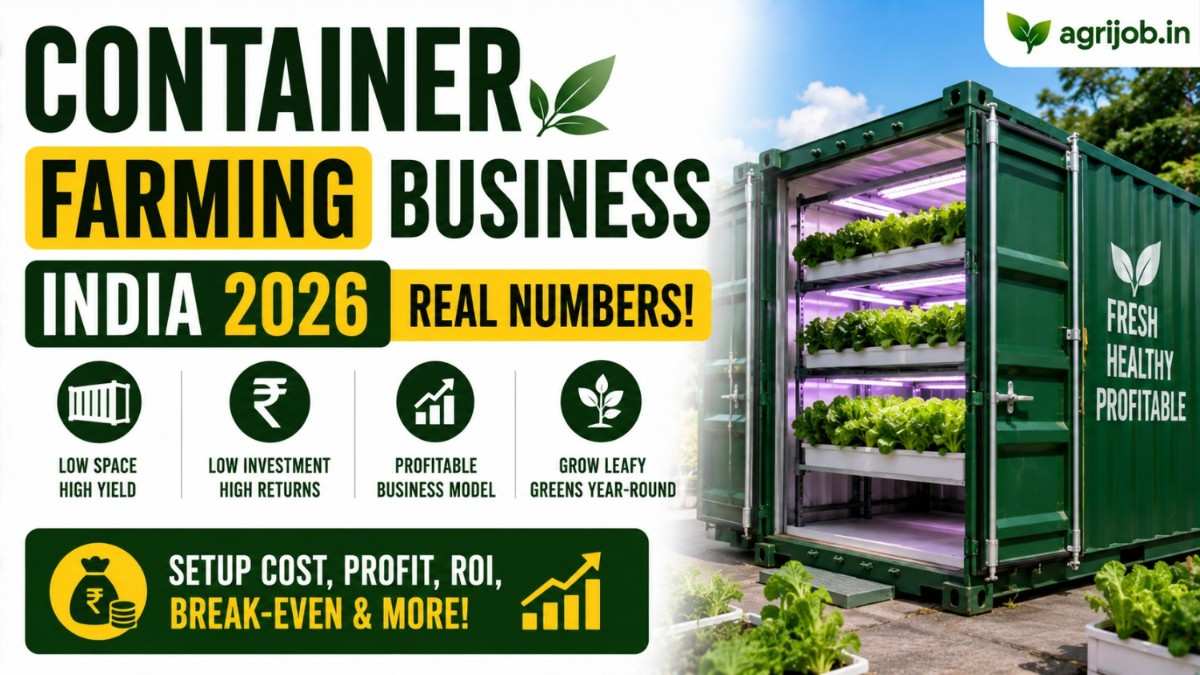
A container farming business uses a repurposed or purpose-built shipping container — usually a standard 20-foot or 40-foot steel unit — fitted with insulation, LED grow lights, a hydroponic nutrient system, and climate control to grow crops indoors, independent of weather and season. Because the container is sealed and stackable, it can sit on a rooftop, a backyard, an unused plot near a city, or even be relocated, which is why it has become popular with urban entrepreneurs who don’t own farmland. India’s version of this model is typically leaner than the fully automated systems sold in the US or Europe, since LED lights, fans, irrigation pumps and structural fittings can mostly be sourced domestically at a fraction of the import cost.
Container farming is best suited to high-value, short-cycle crops — leafy greens, herbs, microgreens, strawberries and select medicinal or aromatic plants — rather than commodity field crops like wheat, rice or sugarcane, whose market price is too low to justify the cost of artificial lighting and air conditioning. Get the crop choice wrong, and even a technically well-run container can lose money; get it right, and the same box can clear six figures a year.
Container Farming Business India 2026: The Real Money Numbers
Every container farming pitch eventually comes down to three numbers: what it costs to build, what it costs to run every month, and what it actually sells for. Here is the honest breakdown for both common sizes.
| Item | 20-Foot Container | 40-Foot Container |
|---|---|---|
| One-time setup cost (CapEx) | ₹6 lakh – ₹10 lakh | ₹10 lakh – ₹17 lakh (₹40 lakh+ if fully automated/imported) |
| Floor space needed | ~14-15 sq m | ~28-30 sq m |
| Monthly running cost (OpEx) | ₹12,000 – ₹28,000 | ₹23,000 – ₹55,000 |
| Electricity (16-18h LED + climate control) | ₹5,000 – ₹10,000 | ₹8,000 – ₹18,000 |
| Typical leafy-green yield | 25-40 kg/week | 50-80 kg/week |
| Approx. monthly yield | ~107-172 kg | ~215-345 kg |
| First harvest | 4-6 weeks after planting | 4-6 weeks after planting |
Now apply that monthly yield to three realistic selling-price tiers for a 40-foot container. This is the table that actually answers whether ₹40,000/month is achievable, and it depends entirely on which row you land in.
| Market / Price Tier | Price per kg | Monthly Revenue (215-345 kg) | Monthly OpEx | Approx. Net Profit |
|---|---|---|---|---|
| Commodity / oversupply market | ₹80 – ₹120 | ₹17,200 – ₹41,400 | ₹23,000 – ₹55,000 | Break-even to a loss |
| Mid-tier wholesale (hotels, restaurants, retailers) | ₹180 – ₹250 | ₹38,700 – ₹86,250 | ₹23,000 – ₹55,000 | ~₹0 – ₹50,000+ |
| Premium direct-to-consumer / subscription | ₹350 – ₹600 | ₹75,250 – ₹2,07,000 | ₹23,000 – ₹55,000 | ~₹40,000 – ₹1,50,000+ |
These figures are working estimates built from typical India container-farming cost and yield ranges, not a guaranteed outcome — your actual numbers will move with location, crop, electricity tariff and how well you sell. Most single-container operators report a payback period of 18-36 months; those who combine high-value crops and lock in buyers early sometimes recover their investment in 12-18 months.
Container Farming Profit: Is ₹40,000/Month Realistic?
Looking at the table above, ₹40,000/month in net profit from a single 40-foot container sits right at the boundary between mid-tier wholesale and premium pricing — it is realistic, but it is not automatic. Three conditions decide which side of that line you land on:
- 🛒 Your buyer, not your harvest, sets your income. The same kilo of lettuce sells for ₹100 in a flooded wholesale mandi and ₹400+ to a hotel chef or a subscription box — selling to commodity markets is the single biggest reason container farms fail to hit ₹40,000/month.
- ⚡ Electricity discipline matters. Lighting and HVAC make up the largest slice of OpEx; a poorly insulated container in a hot climate can push monthly costs toward ₹55,000 and erase the entire profit margin.
- 📈 Full-capacity yield takes 2-3 grow cycles to reach. Your first harvest will likely sit at the low end of the yield range — budget for thinner or even negative profit in month one and two before judging the business on its steady-state numbers.
Eligibility & Registrations for a Container Farming Business
Unlike a government job, there’s no age limit or fixed educational qualification to start a container farming business — but a few registrations are practically mandatory once you start selling commercially.
| Requirement | Why You Need It | Typical Cost / Time |
|---|---|---|
| Udyam (MSME) Registration | Needed for most loan, subsidy and AIF applications | Free, online, same-day |
| FSSAI Registration / Licence | Mandatory to sell food produce commercially in India | ₹100 – ₹7,500/year depending on turnover slab |
| GST Registration | Required once annual turnover crosses the applicable threshold | Free to register; ongoing compliance cost varies |
| Land lease/ownership document | Required by banks and subsidy schemes as project proof | Varies by location |
| Detailed Project Report (DPR) | Mandatory for AIF, NABARD and most bank agri-loans | ₹5,000 – ₹25,000 if outsourced to a consultant |
Several states also announce additional top-up subsidies for women entrepreneurs, SC/ST applicants, and registered Farmer Producer Organisations (FPOs) under their horticulture mission budgets — rates differ by state and change year to year, so confirm the current figure with your District Horticulture Officer before finalising your project cost.
Step-by-Step: How to Start a Container Farming Business in India
- Validate demand first. Talk to 5-10 local hotels, restaurants, retailers or D2C customers before spending a rupee on equipment.
- Pick your container size and crop mix based on what those buyers are actually willing to pay.
- Get a Detailed Project Report (DPR) prepared — almost every loan or subsidy route requires one.
- Register your business on Udyam, and apply for FSSAI and GST registration as applicable.
- Approach a bank for an AIF-linked or NABARD-refinanced agri-loan, submitting your DPR.
- Procure the container, hydroponic system, LED grow lights and HVAC — prefer domestically manufactured components where possible to avoid the 18-28% import duty on specialised grow-light and controller hardware.
- Install nutrient dosing and EC/pH monitoring systems before your first planting.
- Run a 4-8 week pilot grow cycle before committing to full-scale, multi-crop production.
- Lock in buyer agreements ahead of your first full commercial harvest.
- Track cost-per-kg every week and shift your crop mix toward whichever line is actually making money.
Best Crops for Container Farming in India
Crop choice is the single biggest lever on your monthly profit. Leafy greens are the easiest entry point, but they also face the most price competition. High-value crops earn more per kilo but demand more expertise and a longer learning curve.
- 🥬 Lettuce & leafy greens — fastest cycle (25-35 days), ₹80-300/kg depending on buyer
- 🌿 Herbs (basil, mint, coriander) — short cycle, strong demand from hotels and cloud kitchens, ₹200-500/kg
- 🌱 Microgreens — 7-14 day cycle, sold by the gram to premium restaurants; can add ₹1-3 lakh/month once a buyer base is built
- 🍓 Strawberries — higher CapEx and skill needed, but retail prices of ₹300-800/kg make it a strong add-on crop
- 🌸 Saffron (kesar) — extremely high value per kilo; read our detailed saffron farming investment guide before attempting it in a container
- 🍅 Cherry tomatoes — needs more vertical space and a longer cycle, but commands a steady premium price
Who Should Start a Container Farming Business in India?
- 🎓 Agriculture graduates and B.Sc(Ag) holders wanting a hands-on venture alongside or instead of job-hunting
- 👩🌾 Women entrepreneurs eligible for additional state-level subsidy top-ups
- 🏙️ Urban or peri-urban residents with limited land but access to a rooftop, yard or small plot
- 🍽️ Hotel, restaurant or cloud-kitchen owners wanting an in-house, pesticide-free supply chain
- 🎖️ Retired defence or government personnel with a lump-sum corpus looking for an active second income
- 🔬 ICAR/agricultural university students researching controlled-environment agriculture for academic or startup projects
- 💼 Career-break professionals seeking a scalable, part-time-to-full-time business
- 🌾 Existing farmers wanting to diversify income beyond seasonal, commodity-priced crops
Government Subsidies & Loans for a Container Farming Business
Most government subsidy schemes for protected cultivation were designed for larger polyhouse-scale projects, so it’s important to know which one actually fits a single shipping container.
- Agriculture Infrastructure Fund (AIF): The best general fit for a single container — a 3% per annum interest subvention on loans up to ₹2 crore, with no minimum project area, via the official AIF portal.
- National Horticulture Board (NHB): Offers up to 50% credit-linked back-ended subsidy for protected cultivation, including hydroponics — but requires a minimum project area of 1,000 sq m, so a single container alone typically won’t qualify unless clustered with other units. Details at nhb.gov.in.
- NABARD refinancing: Doesn’t lend directly to individuals but refinances participating banks, making subsidy-linked loans more accessible. See nabard.org.
- FSSAI registration: Not a subsidy, but mandatory before commercially selling your produce — apply at fssai.gov.in.
If you’re comparing container farming against other capital-intensive agri-investment options, our farmland investment returns guide and our breakdown of the drone spraying business model cover two other 2026 agribusiness ideas with very different capital and subsidy profiles.
Container Farming vs Polyhouse: Which Is Better for India?
| Factor | Container Farming | Polyhouse / Greenhouse |
|---|---|---|
| Typical capital needed | ₹6-17 lakh (₹40 lakh+ automated) | ₹30 lakh+ per acre (NHB unit-cost norms) |
| Land/space required | ~15-30 sq m; rooftop or small plot works | 1,000 sq m minimum for NHB subsidy |
| Mobility | Fully mobile / relocatable | Fixed, permanent structure |
| Climate control | Full control via LED + HVAC | Partial — natural light, passive ventilation |
| Electricity cost | High — 16-18h LED photoperiod | Low — relies mainly on sunlight |
| Subsidy eligibility | Mainly AIF; no area floor | NHB/MIDH up to 50%, area-gated |
| Time to first harvest | 4-6 weeks (leafy greens) | 8-12 weeks, crop dependent |
| Best for | Urban entrepreneurs, limited land, premium greens/herbs | Landowning farmers scaling vegetables/flowers |
High-Value Container Farming Terms You Must Know
- Hydroponics — soil-less growing in a nutrient solution; the core method used in most Indian container farms.
- NFT (Nutrient Film Technique) — a thin film of nutrient solution flowing past plant roots; common for leafy greens, costing roughly ₹1.5-3 lakh per system.
- DWC (Deep Water Culture) — roots suspended directly in oxygenated nutrient solution; simpler and cheaper to start than NFT.
- Vertical racking — stacking grow trays to multiply yield per square foot; can roughly double output for ₹2-4 lakh of extra investment.
- EC/pH meter — measures nutrient strength and acidity; a daily check costing ₹3,000-15,000 for the equipment.
- Photoperiod — hours of LED light per day (commonly 14-18h); the single biggest driver of your electricity bill.
- Farm-gate price — what a wholesale buyer pays at your container door, often half or a third of the retail/D2C price.
- Payback period — time to recover your CapEx from net profit; 18-36 months is typical in India.
- AIF (Agriculture Infrastructure Fund) — central scheme offering a 3% interest subvention on loans up to ₹2 crore for agri-infrastructure projects.
- Credit-linked back-ended subsidy — a subsidy released only after loan disbursement and project verification, the structure used under most NHB schemes.
Frequently Asked Questions
Is a container farming business profitable in India in 2026?
It can be, but profitability depends heavily on crop choice, market access and running costs. At commodity wholesale prices a single container often only breaks even; at mid-tier hotel/restaurant pricing or direct-to-consumer rates, a well-run 40-foot unit can realistically net ₹40,000 to over ₹1 lakh a month after expenses.
How much does it cost to start a container farming business in India?
A lean, domestically-built 40-foot hydroponic container farm typically costs ₹10-17 lakh in India, while a 20-foot starter unit can cost ₹6-10 lakh. Fully automated systems with imported LED and climate-control equipment can cost ₹40 lakh or more.
Can one shipping container really earn ₹40,000 a month?
Yes, under realistic conditions. A 40-foot container yielding 215-345 kg of leafy greens a month, sold at mid-tier wholesale prices of ₹180-250/kg, can generate ₹40,000 or more in net profit after typical operating costs of ₹23,000-55,000/month — but this requires securing buyers above commodity prices.
Which crops are most profitable for container farming in India?
Leafy greens, herbs and microgreens are the most common because of their short growing cycles. High-value crops like strawberries and saffron can earn significantly more per kilogram, though they need more specialised setup and expertise.
Do I need a licence to sell container-farmed produce commercially?
Yes. Most operators need Udyam (MSME) registration, an FSSAI food business registration or licence, and GST registration once turnover crosses the applicable threshold, in addition to any local municipal trade licence.
Is there a government subsidy for container or hydroponic farming in India?
The National Horticulture Board offers up to 50% subsidy for protected cultivation including hydroponics, but this requires a minimum project area of 1,000 sq m — too large for a single container alone. The Agriculture Infrastructure Fund usually fits a single-container project better, offering a 3% interest subvention on loans up to ₹2 crore with no minimum area requirement.
How long does it take to break even on a container farming business?
Most single-container farms in India report a payback period of 18-36 months. Operators who combine multiple high-value crops and lock in buyer relationships before their first harvest can sometimes break even in 12-18 months.
Is container farming better than a polyhouse or greenhouse?
Neither is universally better. Container farms cost less to start, are mobile and need very little land, but have higher electricity costs and a smaller growing area. Polyhouses and greenhouses scale more cheaply per square metre and qualify more easily for NHB-style area-based subsidies, but need significantly more land and upfront investment.
Disclaimer: This article is for educational and informational purposes only and does not constitute financial or investment advice. Capital invested in any business, including container farming, is at risk, and yields, prices and costs vary by location, crop, market access and management. Verify current figures with local equipment suppliers, your nearest Krishi Vigyan Kendra (KVK) or horticulture department, and a chartered accountant before investing. The experiences of other operators do not guarantee similar results for you.
Last Updated: June 2026. This guide is regularly reviewed and updated for accuracy — bookmark this page for the latest container farming business numbers and subsidy updates.